Tailored Access Operations 2007
Open PDFDocument date: 2007-01-08
Pages: 20
Genre: slides
Banner: TOP SECRET//COMINT//REL TO USA, AUS, CAN, GBR, NZL
Classification: TOP SECRET COMINT
Dissemination: REL TO USA, AUS, CAN, GBR, NZL
This NSA document describes the Tailored Access Operations (TAO) division, which conducts sophisticated cyber operations to penetrate and maintain persistent access to target networks globally through both remote exploits and physical interdiction methods. The presentation outlines TAO's organizational structure, mission capabilities across telecommunications and data networks, development of hardware/software implants for devices ranging from servers to SCADA systems, collaboration with HUMINT partners for physical access operations, and specialized divisions focused on exploiting telephony systems, computer networks, and developing tools for computer network attack and exploitation.
My notes
TOP SECRET//COMINT//REL TO USA, AUS, CAN, GBR, NZL
NATIONAL SECURITY AGENCY
UNITED STATES OF AMERICA
CENTRAL SECURITY SERVICES
UNITED STATES OF AMERICA
Development
Derived From: NSA/CSSM 1-52
Dated: 20070108
Declassify On: 20360401
TOP SECRET//COMINT//REL TO USA, AUS, CAN, GBR, NZL
NATIONAL SECURITY AGENCY
UNITED STATES OF AMERICA
Telecommunications Network Technologies
This Briefing is Classified TOP SECRET//COMINT//ORCON//NOFORN
Tailored Access Operations
This Briefing is Classified TOP SECRET//COMINT//ORCON//NOFORN
DERIVED FROM: NSA/CSS Manual 1-52, Dated: 20070108, Declassify On: 20320108
IOEC1000
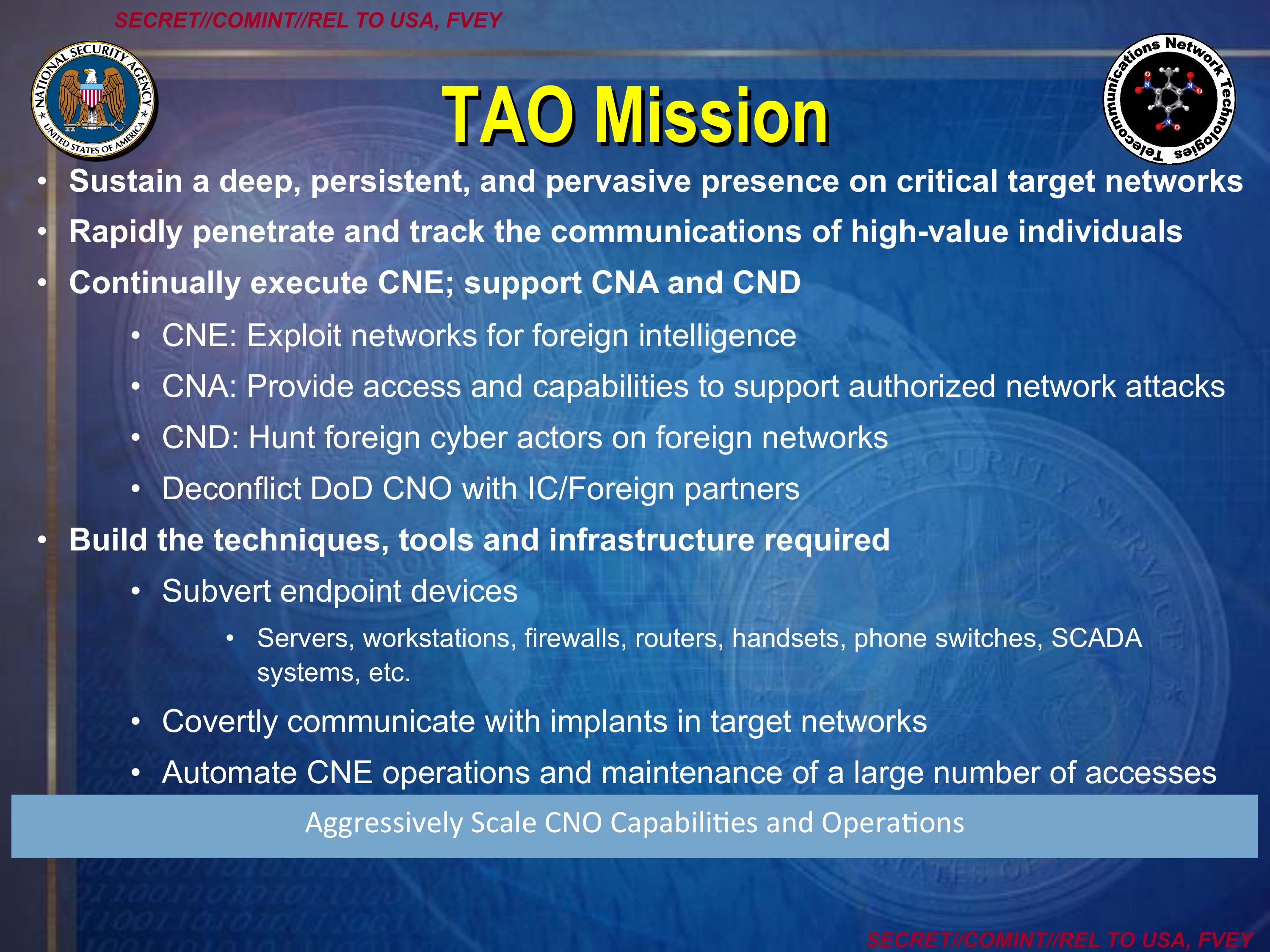
SECRET//COMINT//REL TO USA, FVEY
TAO Mission
- Sustain a deep, persistent, and pervasive presence on critical target networks
- Rapidly penetrate and track the communications of high-value individuals
- Continually execute CNE; support CNA and CND
- CNE: Exploit networks for foreign intelligence
- CNA: Provide access and capabilities to support authorized network attacks
- CND: Hunt foreign cyber actors on foreign networks
- Deconflict DoD CNO with IC/Foreign partners
- Build the techniques, tools and infrastructure required
- Subvert endpoint devices
- Servers, workstations, firewalls, routers, handsets, phone switches, SCADA systems, etc.
- Covertly communicate with implants in target networks
- Automate CNE operations and maintenance of a large number of accesses
- Subvert endpoint devices
Aggressively Scale CNO Capabilities and Operations
SECRET//COMINT//REL TO USA, FVEY
TOP SECRET//COMINT//REL TO USA, FVEY
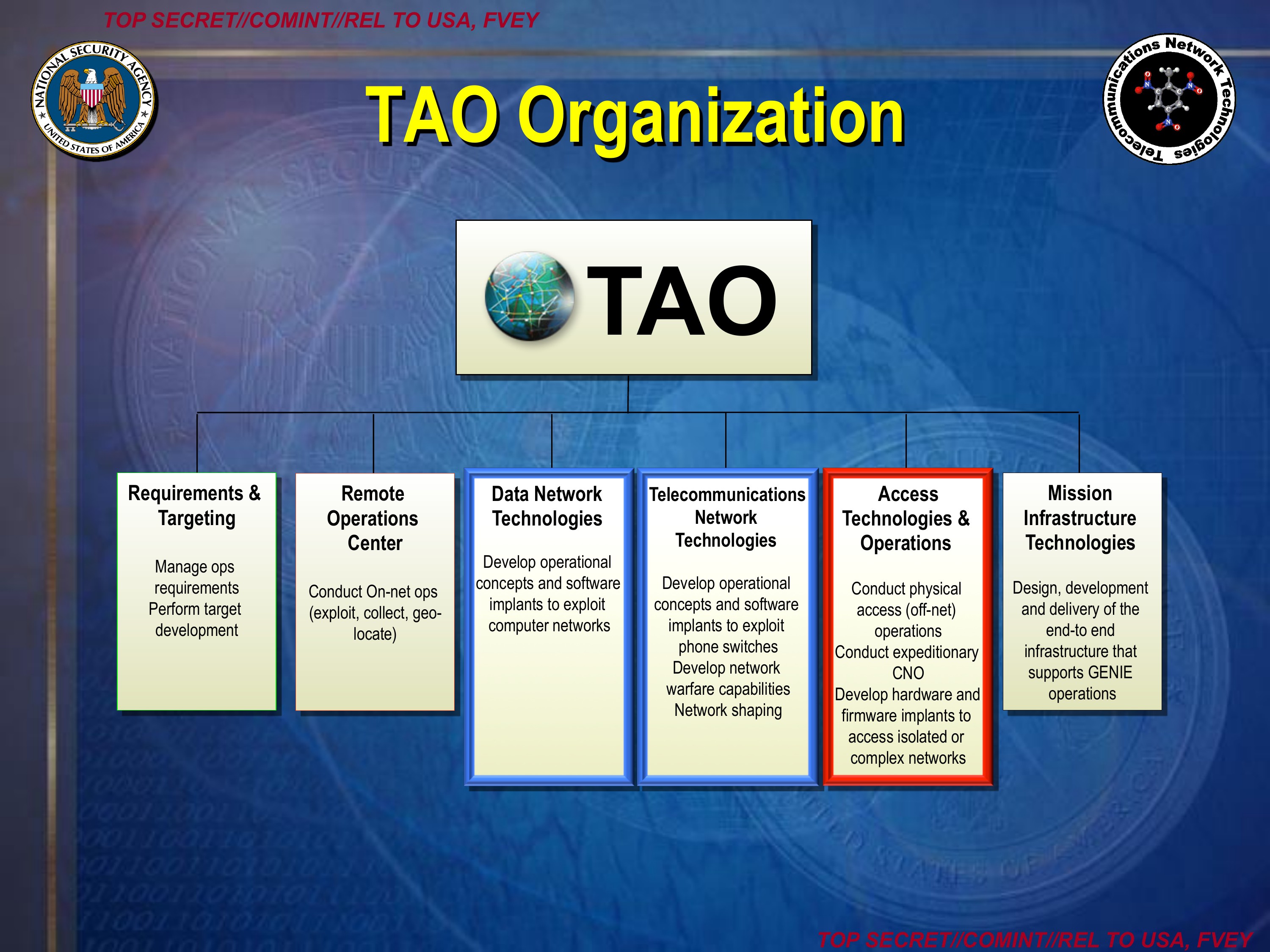
TAO Organization
TAO
- Requirements & Targeting
- Manage ops requirements
- Perform target development
- Remote Operations Center
- Conduct On-net ops (exploit, collect, geo-locate)
- Data Network Technologies
- Develop operational concepts and software implants to exploit computer networks
- Telecommunications Network Technologies
- Develop operational concepts and software implants to exploit phone switches
- Develop network warfare capabilities
- Network shaping
- Access Technologies & Operations
- Conduct physical access (off-net) operations
- Conduct expeditionary CNO
- Develop hardware and firmware implants to access isolated or complex networks
- Mission Infrastructure Technologies
- Design, development and delivery of the end-to end infrastructure that supports GENIE operations
TOP SECRET//COMINT//REL TO USA, FVEY
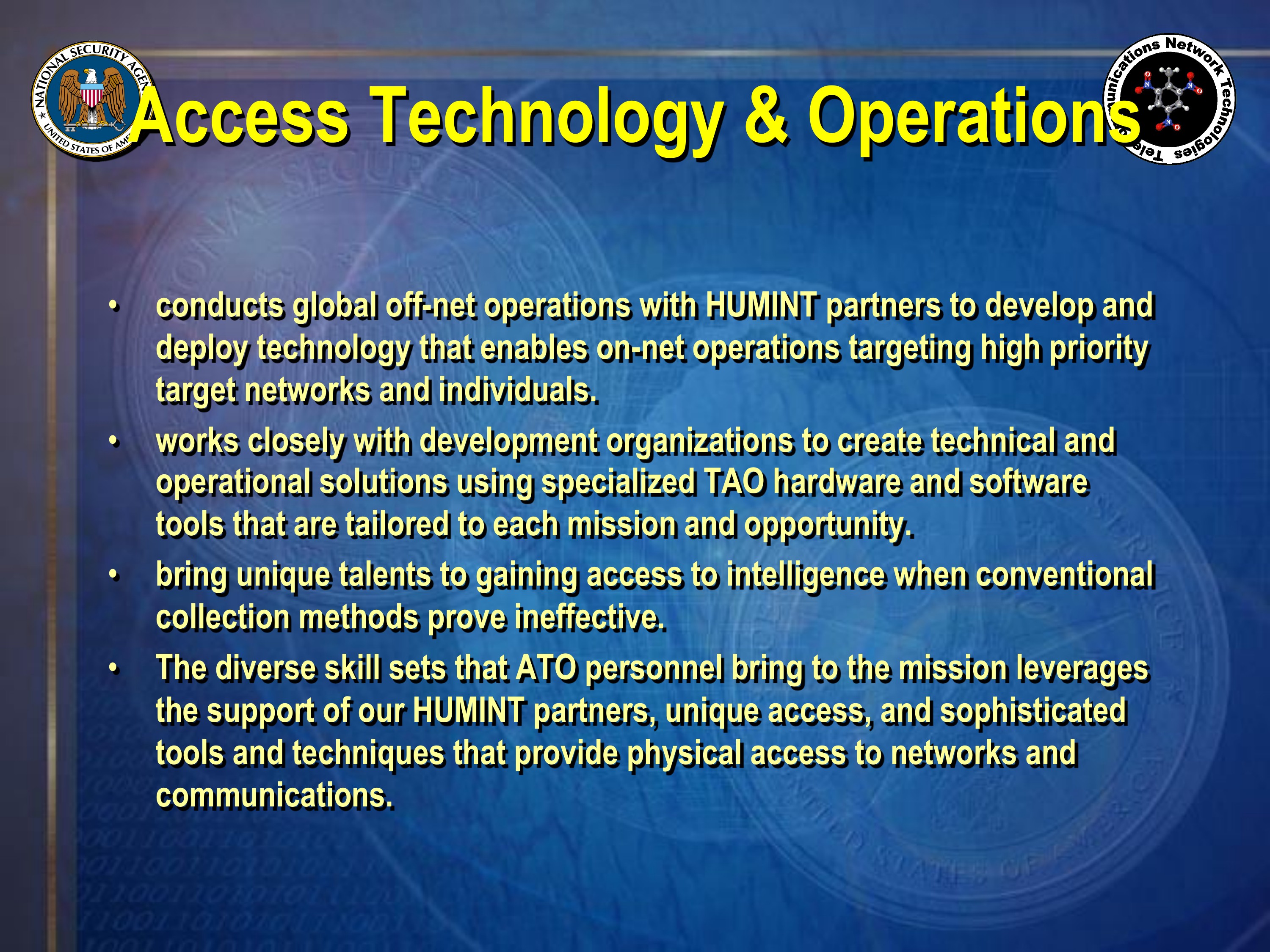
Access Technology & Operations
- conducts global off-net operations with HUMINT partners to develop and deploy technology that enables on-net operations targeting high priority target networks and individuals.
- works closely with development organizations to create technical and operational solutions using specialized TAO hardware and software tools that are tailored to each mission and opportunity.
- bring unique talents to gaining access to intelligence when conventional collection methods prove ineffective.
- The diverse skill sets that ATO personnel bring to the mission leverages the support of our HUMINT partners, unique access, and sophisticated tools and techniques that provide physical access to networks and communications.
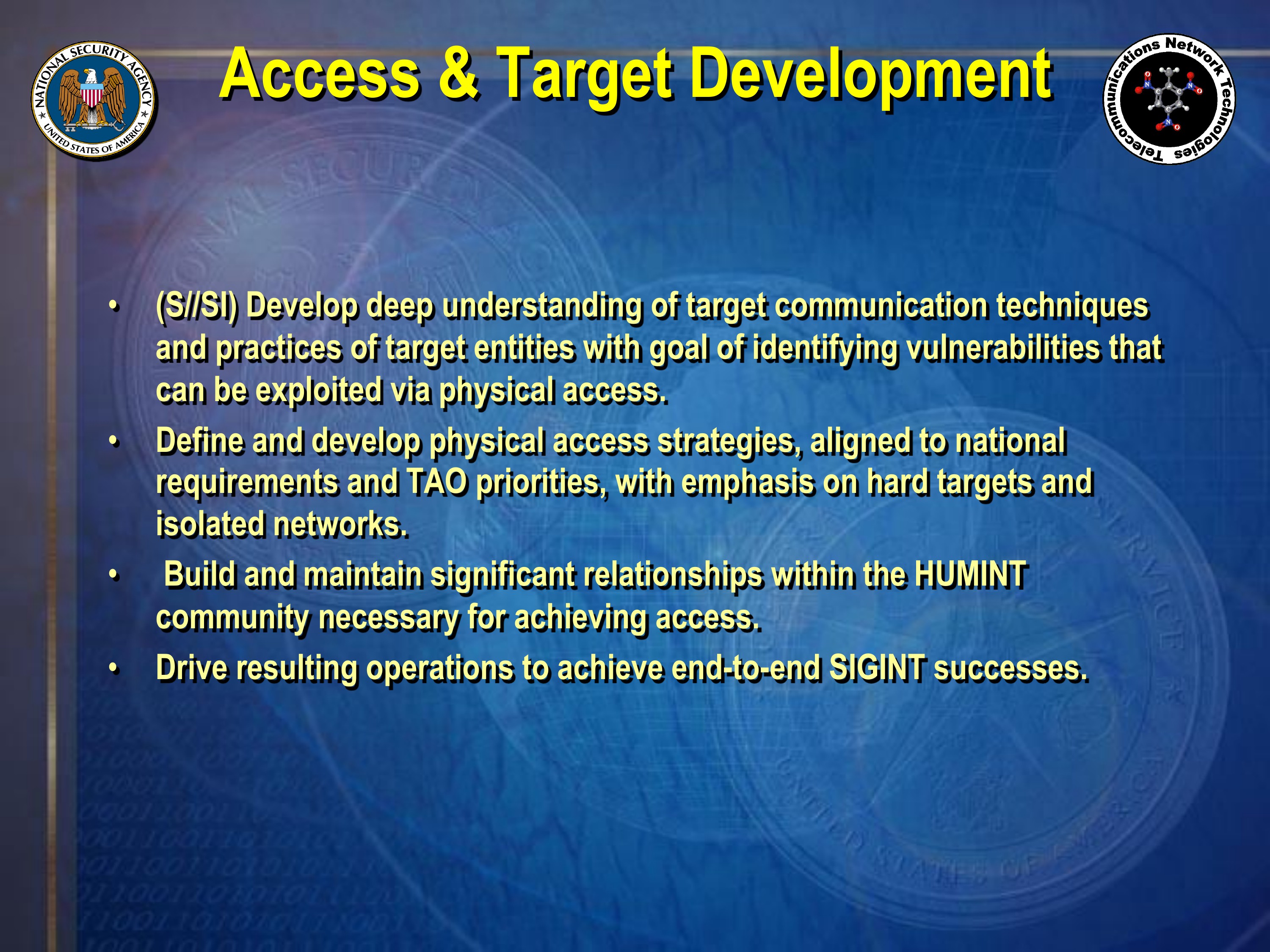
Access & Target Development
- (S//SI) Develop deep understanding of target communication techniques and practices of target entities with goal of identifying vulnerabilities that can be exploited via physical access.
- Define and develop physical access strategies, aligned to national requirements and TAO priorities, with emphasis on hard targets and isolated networks.
- Build and maintain significant relationships within the HUMINT community necessary for achieving access.
- Drive resulting operations to achieve end-to-end SIGINT successes.
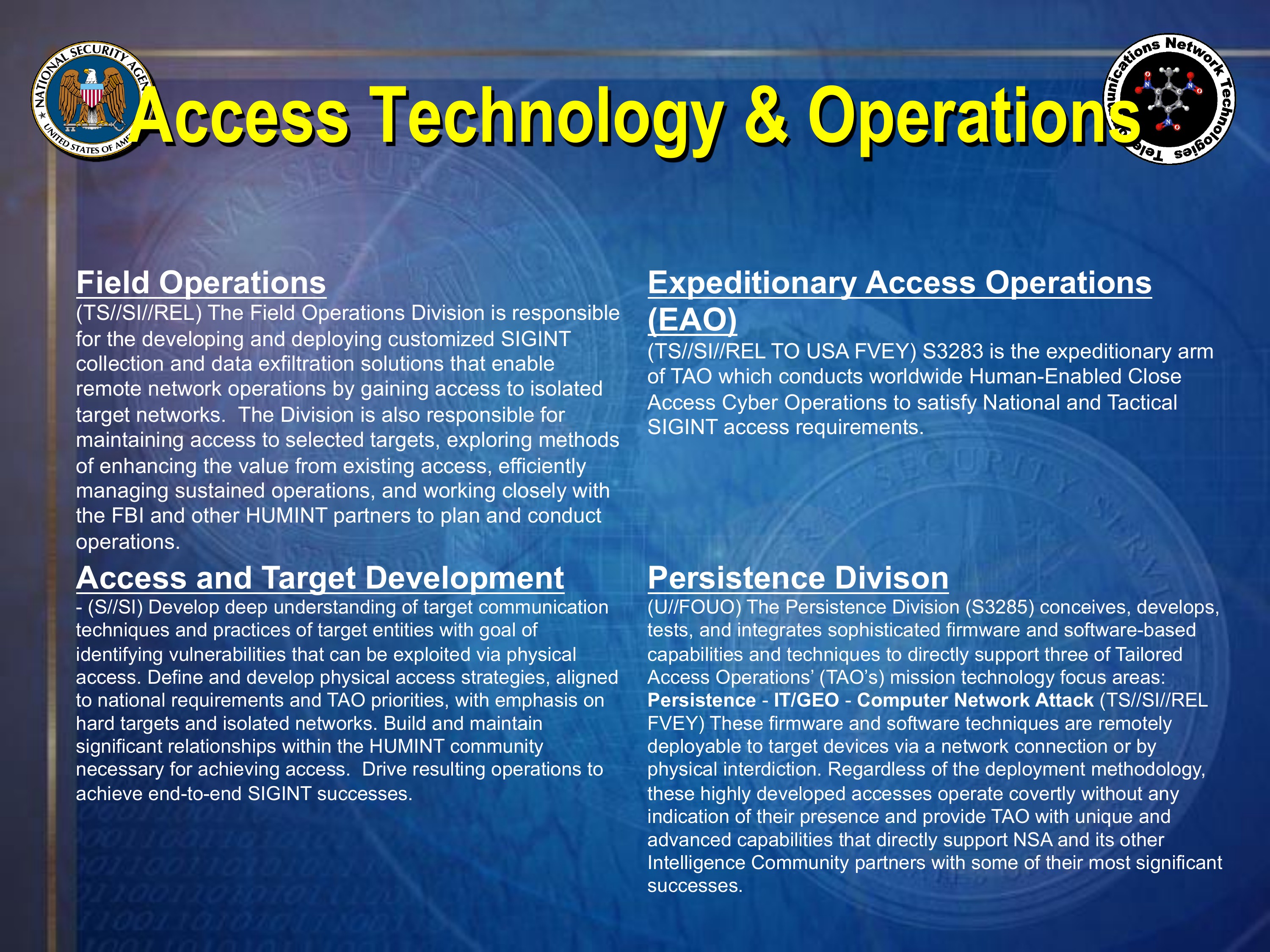
Access Technology & Operations
Field Operations
(TS//SI//REL) The Field Operations Division is responsible for the developing and deploying customized SIGINT collection and data exfiltration solutions that enable remote network operations by gaining access to isolated target networks. The Division is also responsible for maintaining access to selected targets, exploring methods of enhancing the value from existing access, efficiently managing sustained operations, and working closely with the FBI and other HUMINT partners to plan and conduct operations.
Expeditionary Access Operations (EAO)
(TS//SI//REL TO USA FVEY) S3283 is the expeditionary arm of TAO which conducts worldwide Human-Enabled Close Access Cyber Operations to satisfy National and Tactical SIGINT access requirements.
Access and Target Development
(S//SI) Develop deep understanding of target communication techniques and practices of target entities with goal of identifying vulnerabilities that can be exploited via physical access. Define and develop physical access strategies, aligned to national requirements and TAO priorities, with emphasis on hard targets and isolated networks. Build and maintain significant relationships within the HUMINT community necessary for achieving access. Drive resulting operations to achieve end-to-end SIGINT successes.
Persistence Divison
(U//FOUO) The Persistence Division (S3285) conceives, develops, tests, and integrates sophisticated firmware and software-based capabilities and techniques to directly support three of Tailored Access Operations' (TAO's) mission technology focus areas: Persistence - IT/GEO - Computer Network Attack (TS//SI//REL FVEY) These firmware and software techniques are remotely deployable to target devices via a network connection or by physical interdiction. Regardless of the deployment methodology, these highly developed accesses operate covertly without any indication of their presence and provide TAO with unique and advanced capabilities that directly support NSA and its other Intelligence Community partners with some of their most significant successes.
TOP SECRET//COMINT//REL TO USA, AUS, CAN, GBR, NZL
Telecom Network Technologies
- Providing logically intrusive methods of manipulating or extracting data from telecommunications networks.
TOP SECRET//COMINT//REL TO USA, AUS, CAN, GBR, NZL
TOP SECRET // COMINT // X1
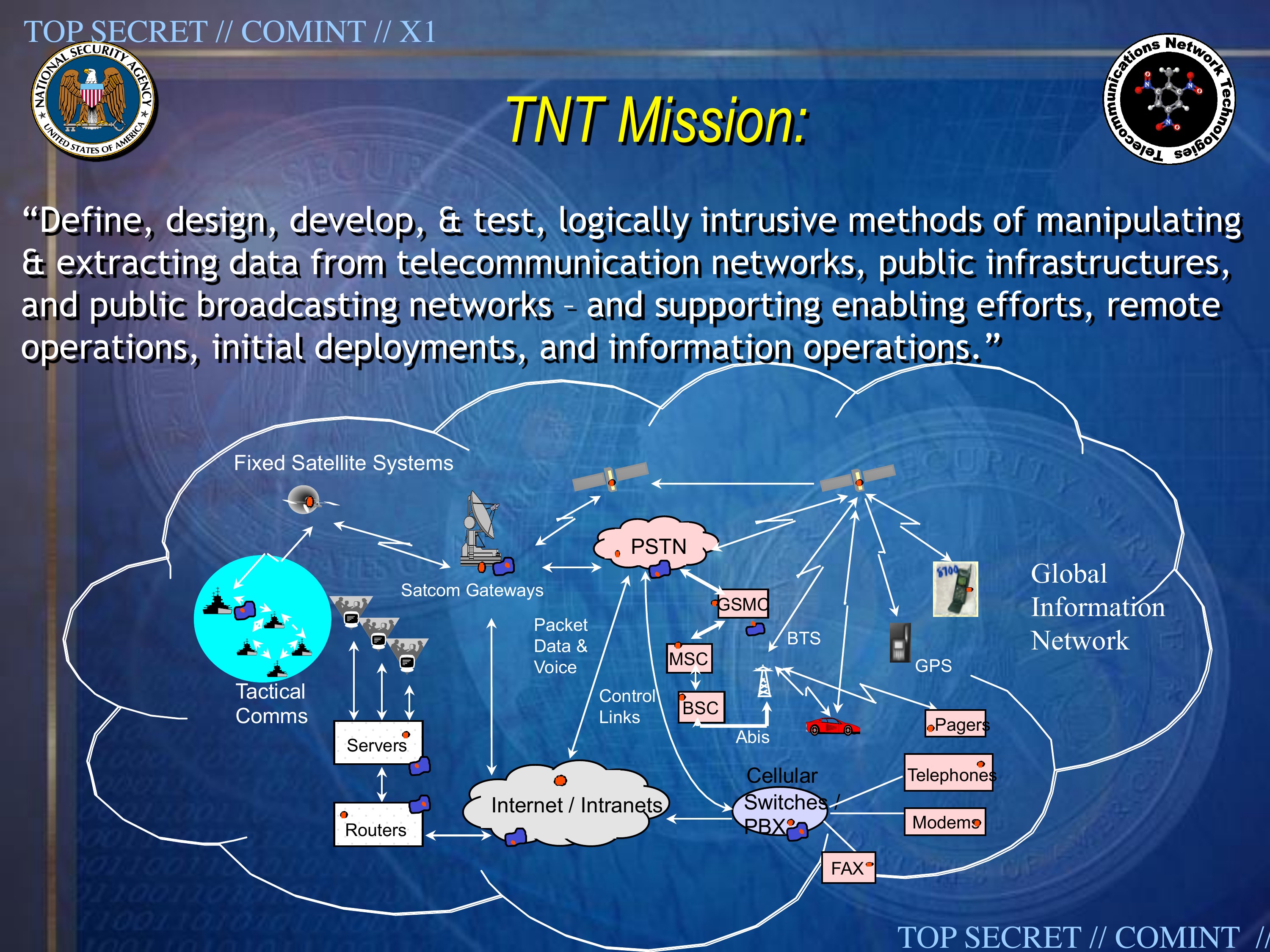
TNT Mission:
"Define, design, develop, & test, logically intrusive methods of manipulating & extracting data from telecommunication networks, public infrastructures, and public broadcasting networks - and supporting enabling efforts, remote operations, initial deployments, and information operations."
Fixed Satellite Systems
Global Information Network
PSTN
Satcom Gateways
Packet Data & Voice
Control Links
Tactical Comms
GSMC
MSC
BSC
BTS
Abis
Servers
GPS
Internet / Intranets
Cellular Switches PBX
Routers
Pagers
Telephones
Modems
FAX
TOP SECRET // COMINT //
TOP SECRET // COMINT // X1
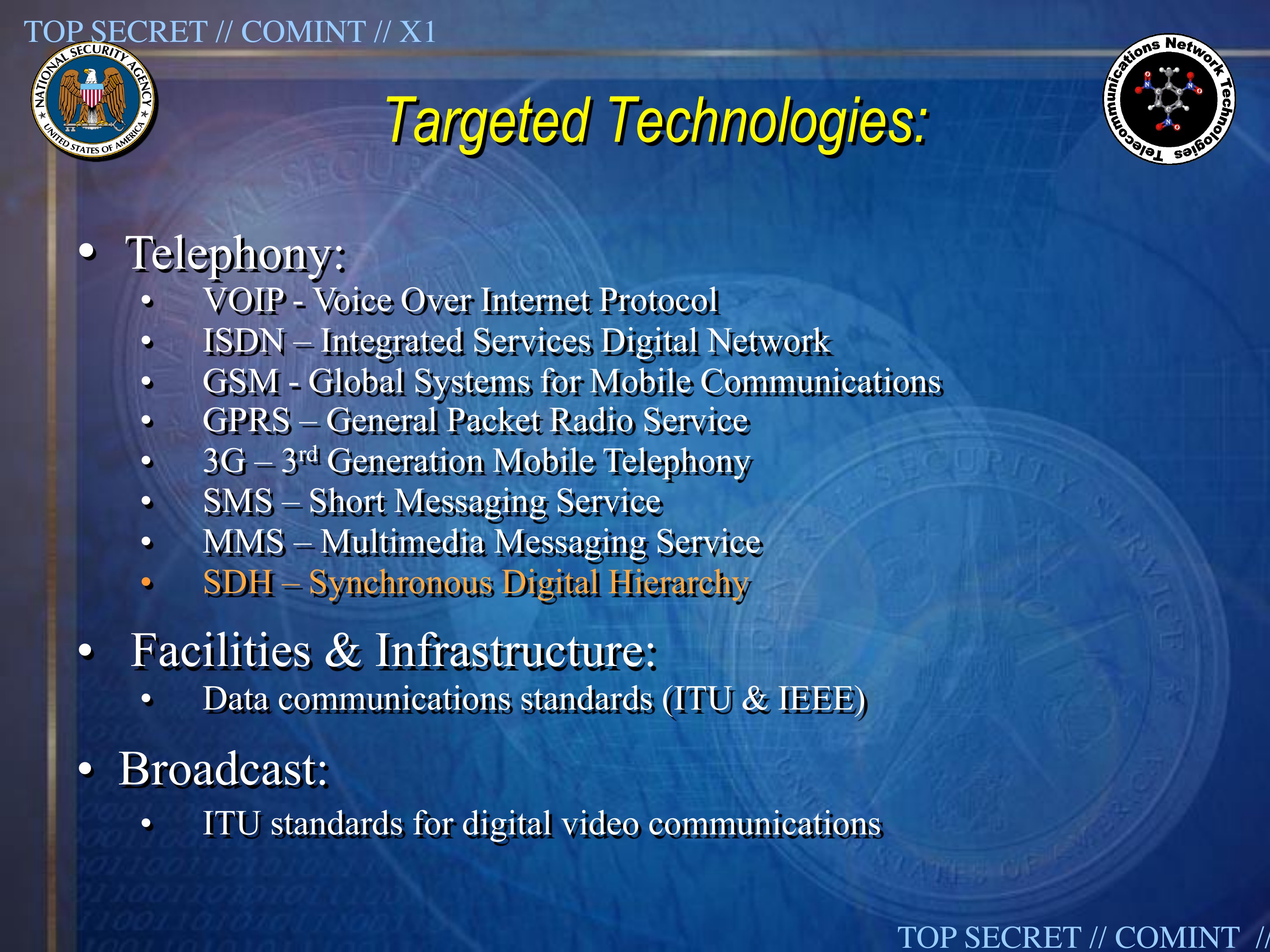
Targeted Technologies:
- Telephony:
- VOIP - Voice Over Internet Protocol
- ISDN - Integrated Services Digital Network
- GSM - Global Systems for Mobile Communications
- GPRS - General Packet Radio Service
- 3G - 3rd Generation Mobile Telephony
- SMS - Short Messaging Service
- MMS - Multimedia Messaging Service
- SDH - Synchronous Digital Hierarchy
- Facilities & Infrastructure:
- Data communications standards (ITU & IEEE)
- Broadcast:
- ITU standards for digital video communications
TOP SECRET // COMINT //
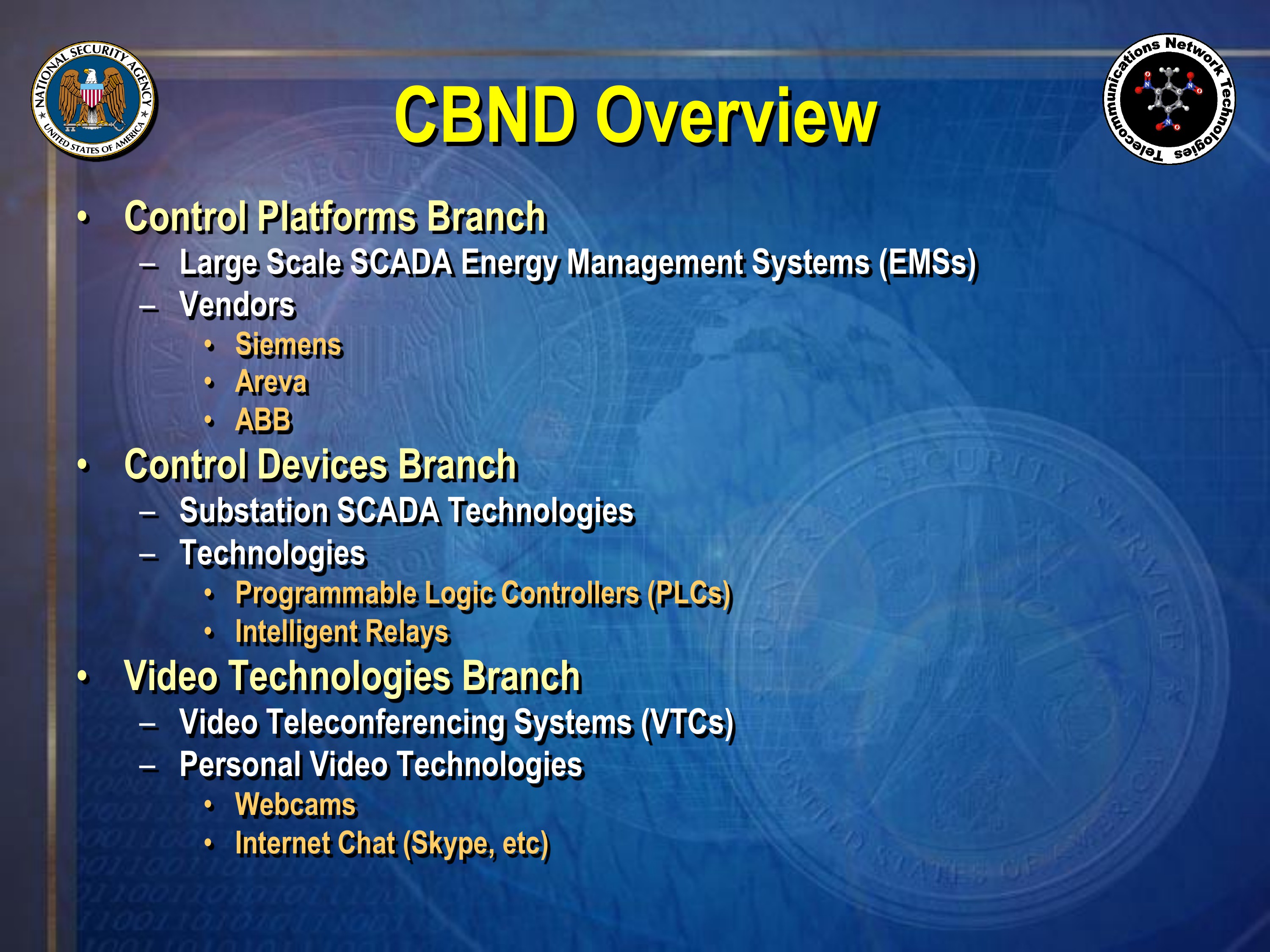
CBND Overview
- Control Platforms Branch
- Large Scale SCADA Energy Management Systems (EMSs)
- Vendors
- Siemens
- Areva
- ABB
- Control Devices Branch
- Substation SCADA Technologies
- Technologies
- Programmable Logic Controllers (PLCs)
- Intelligent Relays
- Video Technologies Branch
- Video Teleconferencing Systems (VTCs)
- Personal Video Technologies
- Webcams
- Internet Chat (Skype, etc)
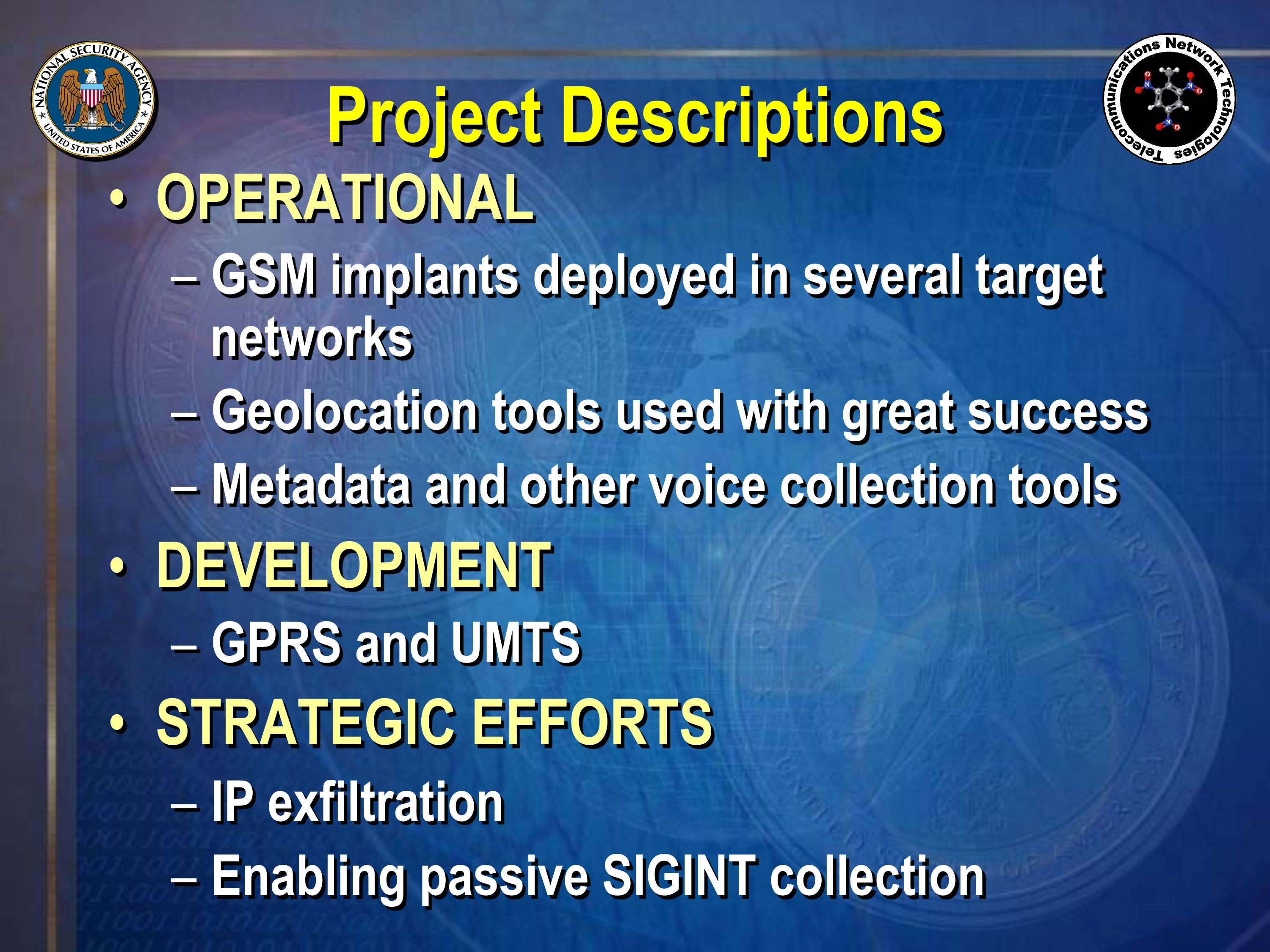
Project Descriptions
- OPERATIONAL
- GSM implants deployed in several target networks
- Geolocation tools used with great success
- Metadata and other voice collection tools
- DEVELOPMENT
- GPRS and UMTS
- STRATEGIC EFFORTS
- IP exfiltration
- Enabling passive SIGINT collection
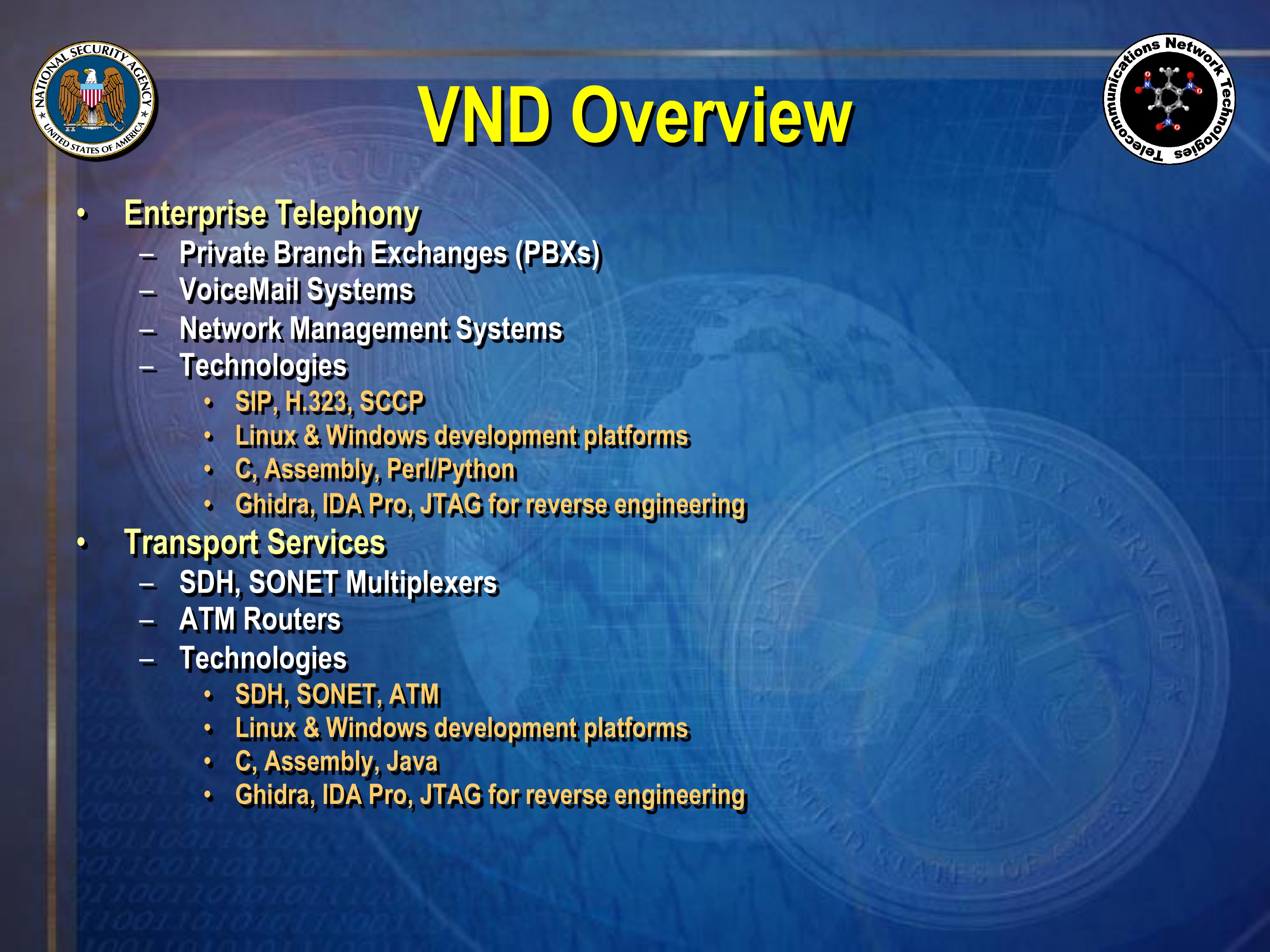
VND Overview
- Enterprise Telephony
- Private Branch Exchanges (PBXs)
- VoiceMail Systems
- Network Management Systems
- Technologies
- SIP, H.323, SCCP
- Linux & Windows development platforms
- C, Assembly, Perl/Python
- Ghidra, IDA Pro, JTAG for reverse engineering
- Transport Services
- SDH, SONET Multiplexers
- ATM Routers
- Technologies
- SDH, SONET, ATM
- Linux & Windows development platforms
- C, Assembly, Java
- Ghidra, IDA Pro, JTAG for reverse engineering
TOP SECRET//COMINT//REL TO USA, AUS, CAN, GBR, NZL
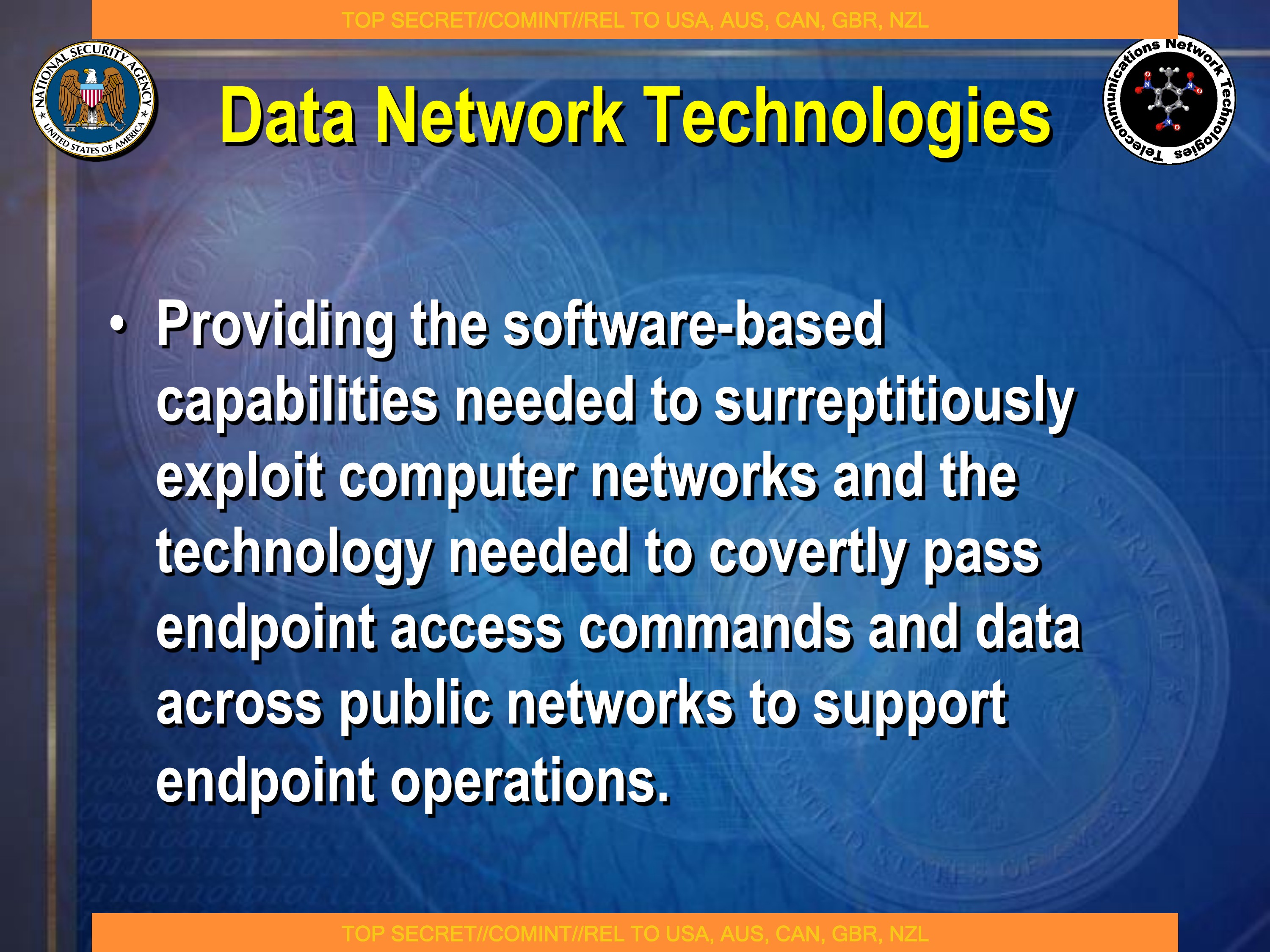
Data Network Technologies
- Providing the software-based capabilities needed to surreptitiously exploit computer networks and the technology needed to covertly pass endpoint access commands and data across public networks to support endpoint operations.
TOP SECRET//COMINT//REL TO USA, AUS, CAN, GBR, NZL
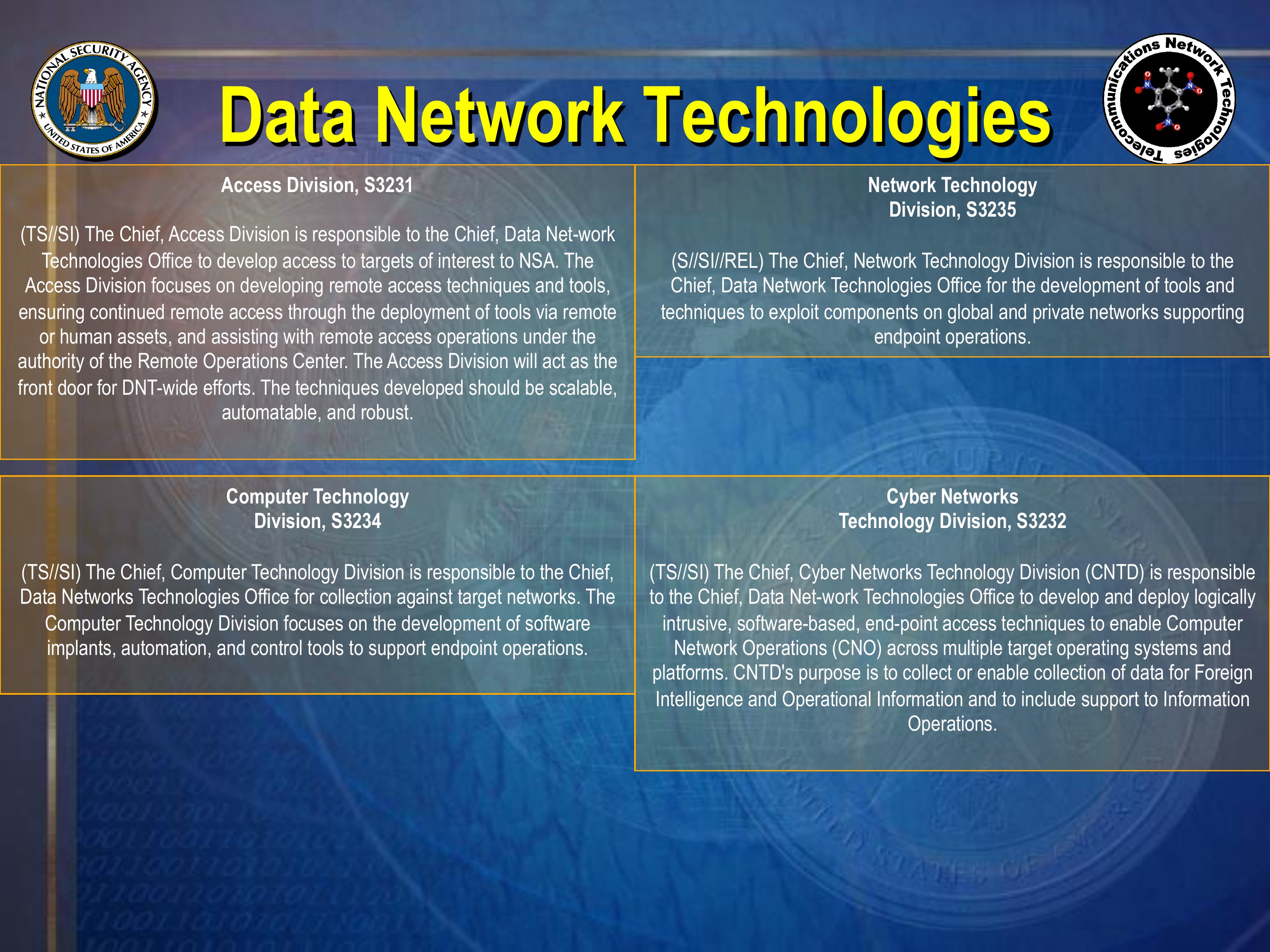
Data Network Technologies
Access Division, S3231
(TS//SI) The Chief, Access Division is responsible to the Chief, Data Net-work Technologies Office to develop access to targets of interest to NSA. The Access Division focuses on developing remote access techniques and tools, ensuring continued remote access through the deployment of tools via remote or human assets, and assisting with remote access operations under the authority of the Remote Operations Center. The Access Division will act as the front door for DNT-wide efforts. The techniques developed should be scalable, automatable, and robust.
Network Technology Division, S3235
(S//SI//REL) The Chief, Network Technology Division is responsible to the Chief, Data Network Technologies Office for the development of tools and techniques to exploit components on global and private networks supporting endpoint operations.
Computer Technology Division, S3234
(TS//SI) The Chief, Computer Technology Division is responsible to the Chief, Data Networks Technologies Office for collection against target networks. The Computer Technology Division focuses on the development of software implants, automation, and control tools to support endpoint operations.
Cyber Networks Technology Division, S3232
(TS//SI) The Chief, Cyber Networks Technology Division (CNTD) is responsible to the Chief, Data Net-work Technologies Office to develop and deploy logically intrusive, software-based, end-point access techniques to enable Computer Network Operations (CNO) across multiple target operating systems and platforms. CNTD's purpose is to collect or enable collection of data for Foreign Intelligence and Operational Information and to include support to Information Operations.
TOP SECRET//COMINT//NOFORN
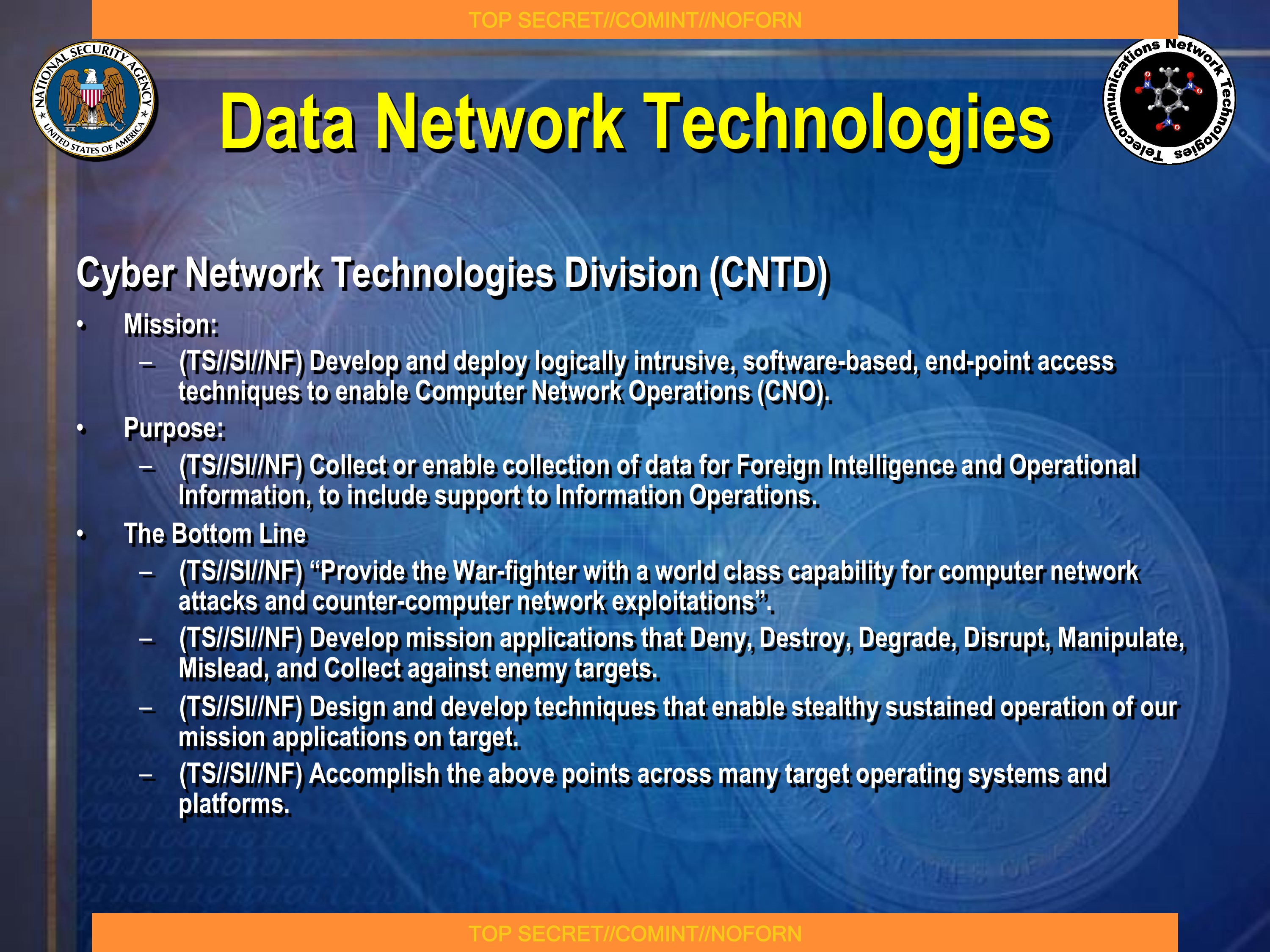
Data Network Technologies
Cyber Network Technologies Division (CNTD)
- Mission:
- (TS//SI//NF) Develop and deploy logically intrusive, software-based, end-point access techniques to enable Computer Network Operations (CNO).
- Purpose:
- (TS//SI//NF) Collect or enable collection of data for Foreign Intelligence and Operational Information, to include support to Information Operations.
- The Bottom Line
- (TS//SI//NF) "Provide the War-fighter with a world class capability for computer network attacks and counter-computer network exploitations".
- (TS//SI//NF) Develop mission applications that Deny, Destroy, Degrade, Disrupt, Manipulate, Mislead, and Collect against enemy targets.
- (TS//SI//NF) Design and develop techniques that enable stealthy sustained operation of our mission applications on target.
- (TS//SI//NF) Accomplish the above points across many target operating systems and platforms.
TOP SECRET//COMINT//NOFORN
TOP SECRET//COMINT//NOFORN
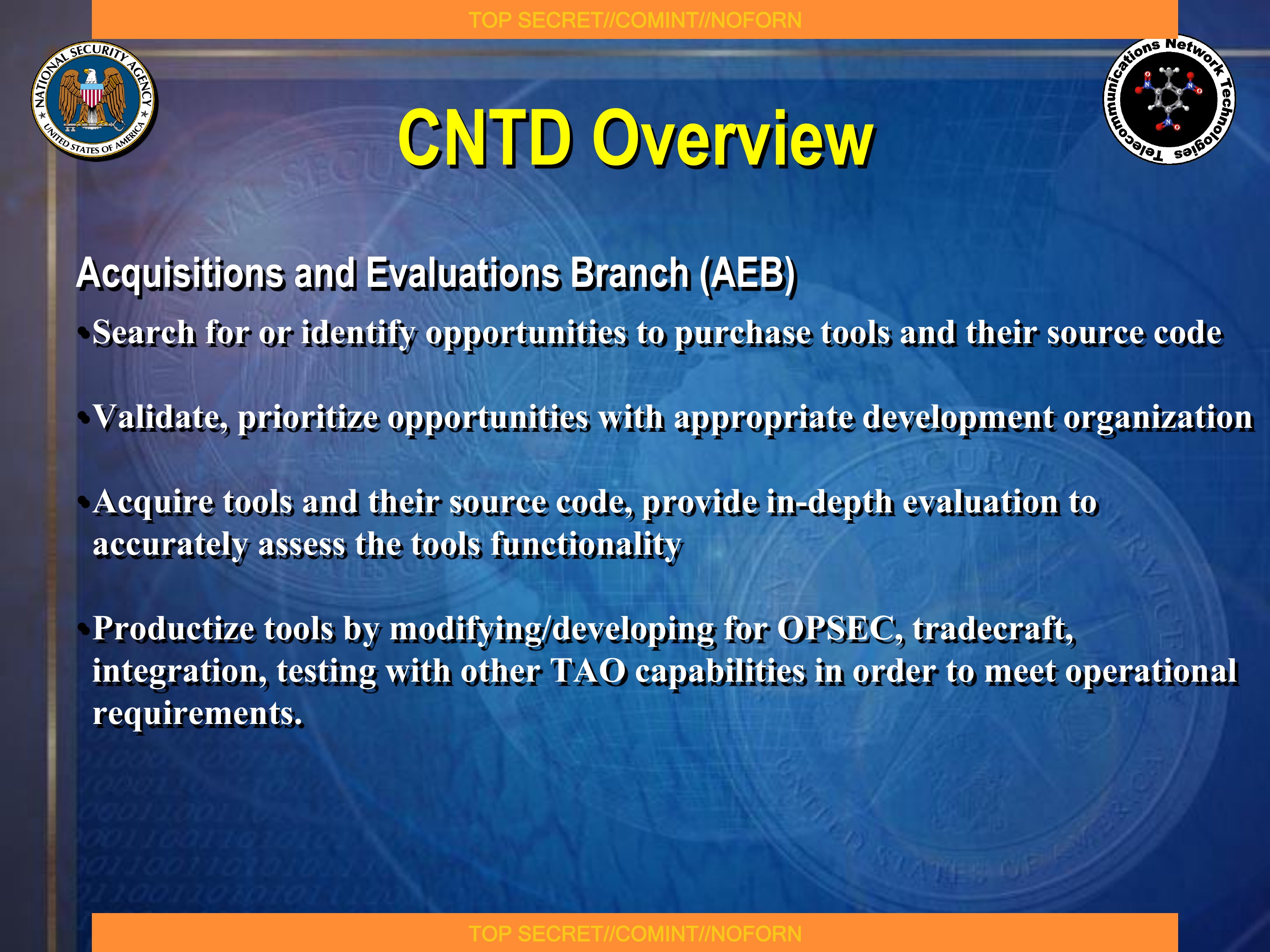
CNTD Overview
Acquisitions and Evaluations Branch (AEB)
- Search for or identify opportunities to purchase tools and their source code
- Validate, prioritize opportunities with appropriate development organization
- Acquire tools and their source code, provide in-depth evaluation to accurately assess the tools functionality
- Productize tools by modifying/developing for OPSEC, tradecraft, integration, testing with other TAO capabilities in order to meet operational requirements.
TOP SECRET//COMINT//NOFORN
TOP SECRET//COMINT//NOFORN
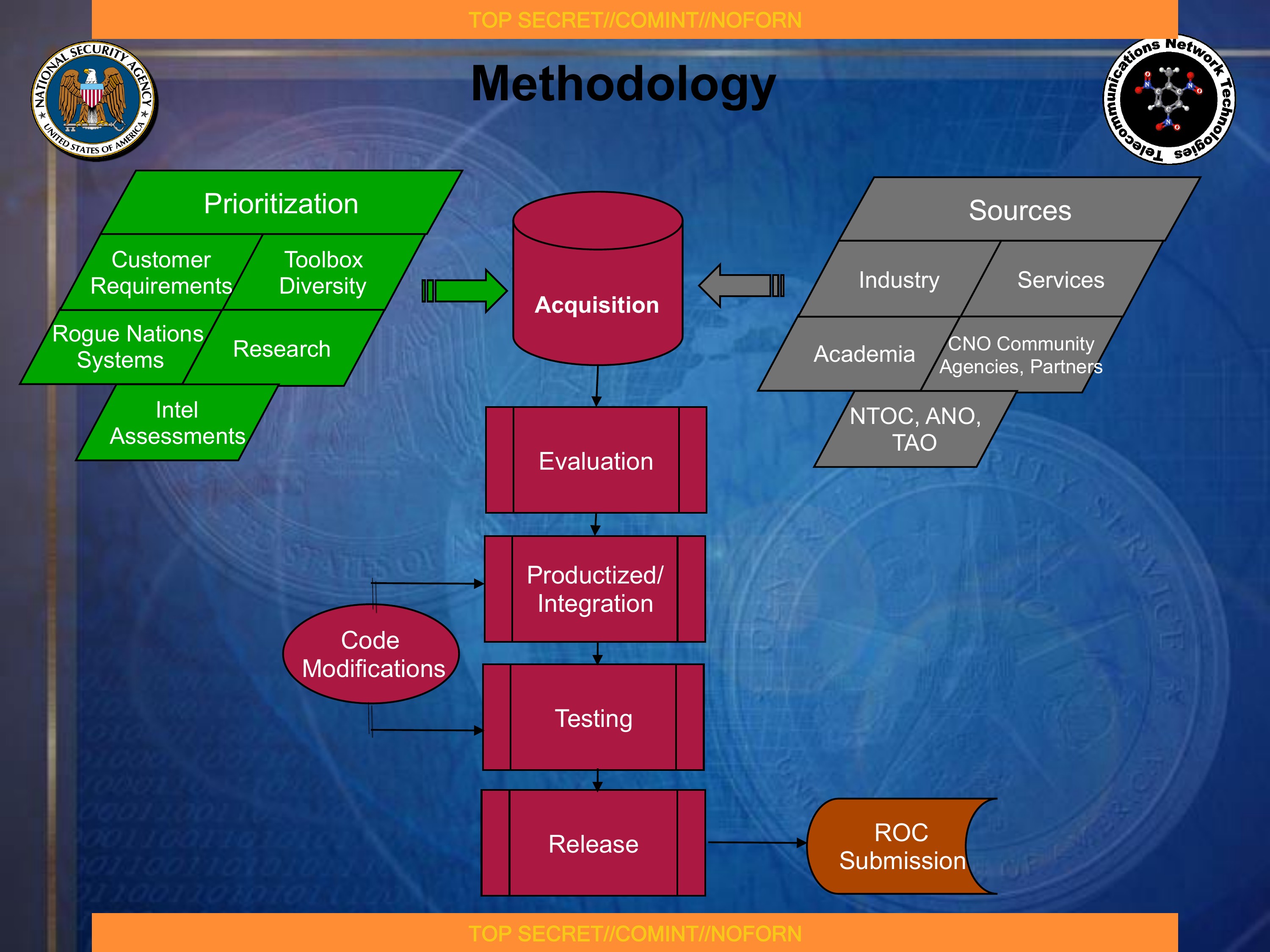
Methodology
+--------------------------+
|       Prioritization     |
+--------------------------+
| - Customer Requirements  |
| - Rogue Nations Systems  |
| - Intel Assessments      |
| - Toolbox Diversity      |
| - Research               |
+--------------------------+
             |
             |
             v
+--------------------------+         +--------------------------+
|       Acquisition        |<--------|         Sources          |
+--------------------------+         +--------------------------+
             |                       | - Industry               |
             v                       | - Academia               |
+--------------------------+         | - NTOC, ANO, TAO         |
|        Evaluation        |         | - Services               |
+--------------------------+         | - CNO Community Agencies,|
             |                       |   Partners               |
             v                       +--------------------------+
+--------------------------+
|  Productized/Integration |<-----------(Code Modifications)
+--------------------------+
             |
             v
+--------------------------+
|          Testing         |
+--------------------------+
             |
             v
+--------------------------+         +--------------------------+
|          Release         |-------->|      ROC Submission      |
+--------------------------+         +--------------------------+
TOP SECRET//COMINT//NOFORN
TOP SECRET//COMINT//NOFORN
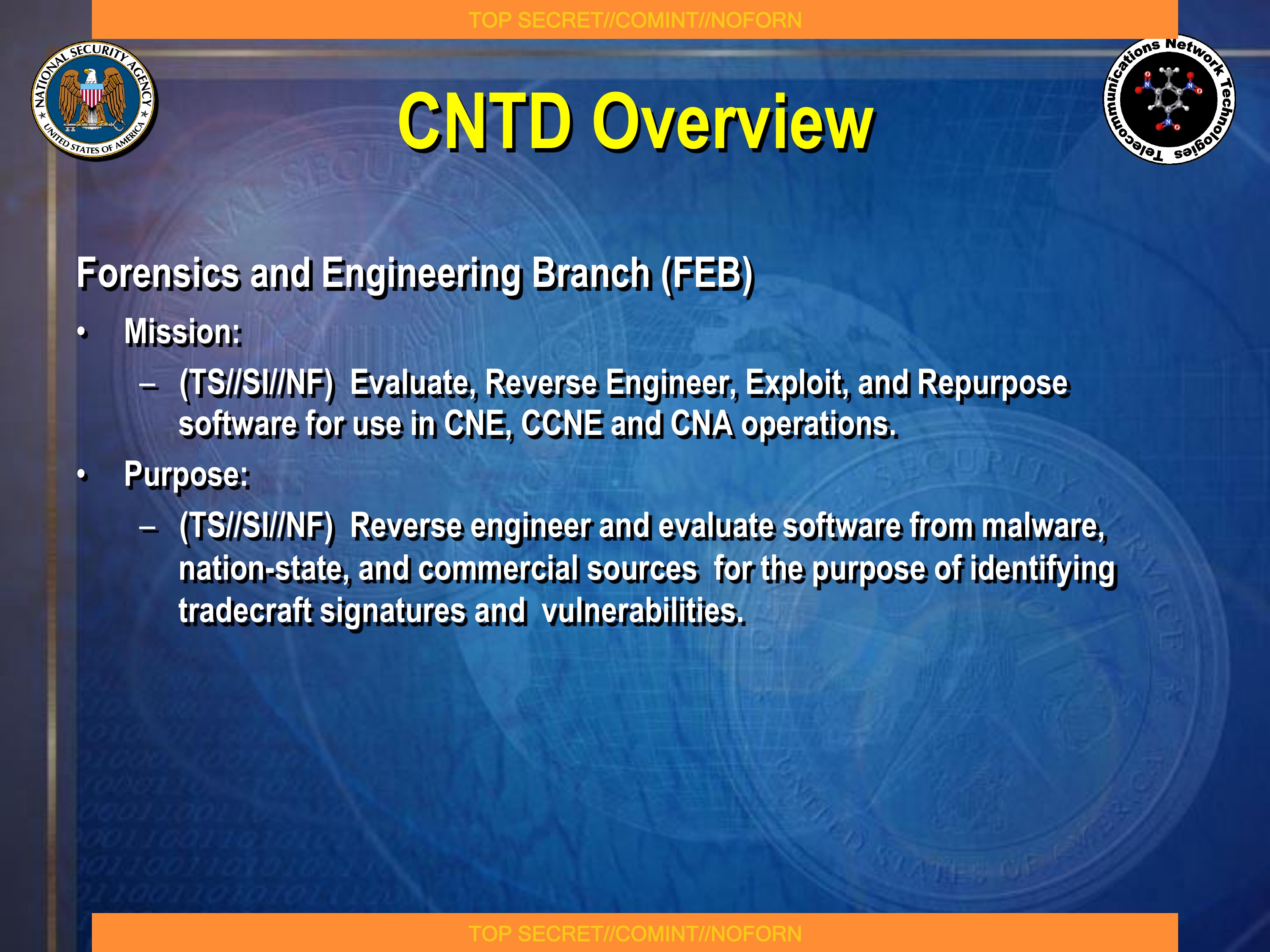
CNTD Overview
Forensics and Engineering Branch (FEB)
- Mission:
- (TS//SI//NF) Evaluate, Reverse Engineer, Exploit, and Repurpose software for use in CNE, CCNE and CNA operations.
- Purpose:
- (TS//SI//NF) Reverse engineer and evaluate software from malware, nation-state, and commercial sources for the purpose of identifying tradecraft signatures and vulnerabilities.
TOP SECRET//COMINT//NOFORN
Questions???
Published in the Same Report
(8 documents)
-
DoD 2011 Strategy for Operating in Cyberspace – Supply Chain Excerpts [pdf]
The classified 2011 Department of Defense strategy warns that U.S. reliance on foreign manufacturing—especially from countries like China—creates major cybersecurity risks, including the potential insertion of malicious hardware or software into critical systems. It outlines a government-wide plan to mitigate these supply chain vulnerabilities through coordinated policies, risk management strategies, and collaboration with industry.
-
Intellipedia – Air Gapped Network Threats [pdf]
This document from an internal wiki for the U.S. intelligence community, surveys threats to so-called air-gapped systems, arguing that supply-chain compromises, physical implants (BIOS, KVMs, peripherals), infected removable media, and enabled wireless/emanations present realistic paths for adversaries to bridge isolated networks. It assesses likelihoods and attack vectors (including insider help and CDS/guard exploitation), highlights specific historic incidents (Agent.BTZ/MAKERSMARK), and recommends strict removable-media policies, TEMPEST countermeasures, and rigorous cross-domain guard protections to mitigate the risk.
People: Witte, Griff · Warren, Peter · Streeter, Michael · Watson, Paul · Louchard, Bjørn · Crawford, George · Rudge, David · Terrazas, Michael -
Intellipedia – BIOS Threats [pdf]
This from an internal wiki for the U.S. intelligence community, titled “BIOS Threats” details the use of malicious BIOS implants as a means of achieving persistent system compromise for cyber espionage and attack purposes. It discusses the history, technical challenges, detection limitations, and global development of BIOS-based malware by both state and non-state actors, including U.S. and Chinese cyber units.
-
Intellipedia – Supply Chain Cyber Threats [pdf]
This document on Supply Chain Cyber Threats, from an internal wiki for the U.S. intelligence community, outlines vulnerabilities in hardware and firmware components such as power supplies, NICs, RAID controllers, GPUs, and peripheral devices that could be exploited by adversaries through the supply chain. It details assessments from U.S. intelligence agencies (CIA, DIA, FBI, CYBERCOM) highlighting risks from foreign companies, insider threats, and malicious modifications that could compromise critical U.S. government and military systems.
Programs: A-SPACE -
NSA Supply Chain Attack From PMR 4-24-13 [pdf]
This document is a top-secret NSA report detailing a SIGINT development operation in which a classified Voice-over-IP network shipment was intercepted and subjected to a supply-chain interdiction, allowing NSA and its intelligence community partners to gain access to the hardware and intelligence. It describes the operational process, including tracking the shipment through China, coordinating with Tailored Access Operations (TAO), and using tools like XKEYSCORE to identify targeting selectors, ultimately enabling detailed surveillance and future operational opportunities.
-
National Intelligence Estimate 2009 Global Cyber Threat – Supply Chain Excerpts [pdf]
These Supply Chain Excerpts from the 2009 National Intelligence Estimate, assesses that the U.S. faces a growing cyber threat from state actors, particularly Russia and China, who have the capability and strategic intent to exploit or disrupt U.S. and allied information systems. It emphasizes vulnerabilities from supply chains, insider threats, and technology trends that favor offensive operations, while noting the difficulty of detecting and fully defending against these sophisticated cyber threats.
-
PRC Information Warfare & Huawei [pdf]
This NSA intelligence briefing on Huawei analyzes Huawei’s global telecommunications presence and its potential links to the People’s Liberation Army (PLA) and Chinese government intelligence activities. It highlights concerns that Huawei’s international market expansion — including its subcontracted 2008 upgrade of the TAT-14 transatlantic cable carrying U.S. and defense communications — could be exploited by China for signals intelligence (SIGINT) purposes.
People: Chávez, Hugo -
Special Collection Service – Pacific SIGDEV Conference March 2011 – Supply Chain Excepts [pdf]
This top-secret 2011 NSA presentation outlines how the Special Collection Service—a joint NSA–CIA program operating from U.S. embassies—leverages its global network of “points of presence” to conduct human-enabled SIGINT and cyber operations directly inside “adversary space.” Framed as a “home field advantage,” it portrays U.S. diplomatic sites as launchpads for infiltration, surveillance, and even supply chain attacks, blurring the line between diplomacy and digital espionage.
Related Documents
-
Tailored Access Operations, FOXACID, QUANTUM [pdf]
These NSA presentation slides detail "QUANTUM," a sophisticated system that allows the agency to intercept internet traffic and inject malware onto target computers with up to 80% success rates, far exceeding traditional spam-based methods. The system works by monitoring internet traffic for specific identifiers (like Yahoo or Facebook cookies), then racing to inject malicious code before legitimate web servers can respond, thereby compromising targets' computers without their knowledge and establishing persistent backdoor access.
Programs: FOXACID · QUANTUM · QUANTUMTHEORY · QUANTUMBISCUIT · VALIDATOR · OLYMPUS · UNITEDRAKE · OLYMPUSFIRE · SSO · FORESTPLACE -
NSA ANT Catalog [pdf]
The NSA ANT catalog is a leaked confidential collection of sophisticated surveillance and hacking tools developed by the agency’s Tailored Access Operations unit (TAO), detailing hardware and software implants capable of covertly infiltrating computers, networks, and mobile devices. It revealed the NSA’s ability to conduct remote surveillance, implant malware, and maintain persistent access to targeted systems without users’ knowledge.
Programs: IRONCHEF · PROTOSS · STRONGMITE · GECKO II · STRAITBIZARRE · WAGONBED · UNITEDRAKE · DEITYBOUNCE · ARKSTREAM · TUNING FORK · GODSURGE · FLUXBABBITT · JETPLOW · BANANAGLEE · HALLUXWATER · TURBOPANDA · FEEDTROUGH · ZESTYLEAK · GOURMETTROUGH · SOUFFLETROUGH · HEADWATER · HAMMERMILL · HIT · SIERRAMONTANA · VALIDATOR · SCHOOLMONTANA · STUCCOMONTANA · CTX4000 · PHOTOANGLO · LOUDAUTO · ANGRYNEIGHBOR · NIGHTWATCHER · VIEWPLATE · LFS-2 · TAWDRYYARD · RAGEMASTER · CROSSBEAM · CHIMNEYPOOL · ROCKYKNOB · CANDYGRAM · CYCLONE Hx9 · TYPHON · EBSR · LANDSHARK · ENTOURAGE · HOLLOWPOINT · GALAXY · GENESIS · NEBULA · TYPHON HX · WATERWITCH · NIGHTSTAND · SPARROW II · BLINDDATE · DROPOUTJEEP · ARTEMIS · DROPMIRE · STRAITBIZZARE · FREEFLOW · TURBULENCE · GOPHERSET · MONKEYCALENDAR · TOTECHASER · TOTEGHOSTLY · PICASSO · TOTEGHOSTLY 2.0 · FRIEZERAMP · GENIE · VAGRANT · GOTHAM · SURLYSPAWN · GINSU · BULLDOZER · KONGUR · OMNIGAT · IRATEMONK · SERUM · SLICKERVICAR · RETURNSPRING · WISTFULTOLL · JIMSQ · SEAGULLFARO · SWAP · SNEAKERNET · TWISTEDKILT · HOWLERMONKEY · SUTURESAILOR · YELLOWPIN · CONJECTURE · SPECULATION · JUNIORMINT · MAESTRO · MAESTRO-II · SOMBERKNAVE · OLYMPUS · TRINITY · COTTONMOUTH-I · COTTONMOUTH-II · TURBINE · COTTONMOUTH-III · FIREWALK · DANDERSPRITZ -
COMPUTER NETWORK OPERATIONS - GENIE [pdf]
A TOP SECRET Congressional Budget Justification entry for the NSA/CSS GENIE project — the Tailored Access Operations programme underpinning all endpoint Computer Network Operations — requesting $651.7 million and 1,870 military and civilian positions for FY2013, with plans to maintain 85,000-96,000 implant points-of-presence worldwide and 9,000-10,000 active accesses, including $25.1 million for covert purchase of software vulnerabilities and a $3.4 million supply chain implant operation targeting al-Qaeda.
-
Sentry Eagle Brief Sheet [pdf]
A classified NSA/JFCC-NW briefing document formally inducting cleared personnel into Sentry Eagle — the agency's most sensitive umbrella program protecting core secrets about its cyber operations — and enumerating, tier by tier, what the NSA conceals about its covert industry partnerships, encryption sabotage, network hacking, computer network defense, and human intelligence relationships.
Programs: SENTRYEAGLE · SPARECHANGE · WHIPGENIE · AUNTIE · AMBULANT · OPALESCE · REVELRY · REFRACTOR · SENTRYHAWK · SENTRYFALCON · SENTRYOSPREY · SENTRYRAVEN · SENTRYCONDOR · SENTRYOWL · BLUESASH · TAREX -
FOXACID SOP for Operational Management of FOXACID Infrastructure (Draft) [pdf]
This document is an NSA standard operating procedure (SOP) manual detailing how to manage and operate the FOXACID system, which delivers malware to targets through tools like SECONDDATE and BADDECISION. It provides technical instructions for tracking, deploying, and maintaining covert web-based infections used in global cyber operations.
Programs: FOXACID · FOXSEARCH · WAITAUTO · RAISEBED · FORRESTPLACE · FOXHelp · PUZZLECUBE · YACHTSHOP · SECONDDATE · MAGIC SQUIRREL · MAGICBEAN · FINKCOAT · FRUGALSHOT · QUANTUM · FERRETCANNON · BEACHHEAD · OLYMPUS · UNITERAKE · DIRESCALLOP · DEEPFREEZE · FINKDIFFERENT · DISABLEVALOR · VALIDATOR · MISTYVEAL · UNITEDRAKE · PEDDLE CHEAP · PKTWENCH · FORESTPLACE · FOXCONTACT · EASYHOOKUP · DEMENTIAWHEEL · CASTLECREEK · ROCHELP · QUANTUMINSERT · FABULOUSFABLE · WATCHER · FROZENGAZE · FABFAB · DARKFIRE · CRYPTICSENTINEL · DARKHELMET · PSP · WILLOWVIXEN