Special Collection Service – Pacific SIGDEV Conference March 2011 – Supply Chain Excepts
Open PDFDocument date: 2011-03-01
Pages: 4
Genre: slides
Banner: TOP SECRET // COMINT // REL TO USA, AUS, CAN, GBR, NZL
Classification: TOP SECRET COMINT
Dissemination: REL TO USA, AUS, CAN, GBR, NZL
This top-secret 2011 NSA presentation outlines how the Special Collection Service—a joint NSA–CIA program operating from U.S. embassies—leverages its global network of “points of presence” to conduct human-enabled SIGINT and cyber operations directly inside “adversary space.” Framed as a “home field advantage,” it portrays U.S. diplomatic sites as launchpads for infiltration, surveillance, and even supply chain attacks, blurring the line between diplomacy and digital espionage.
My notes
TOP SECRET // COMINT // REL TO USA, AUS, CAN, GBR, NZL
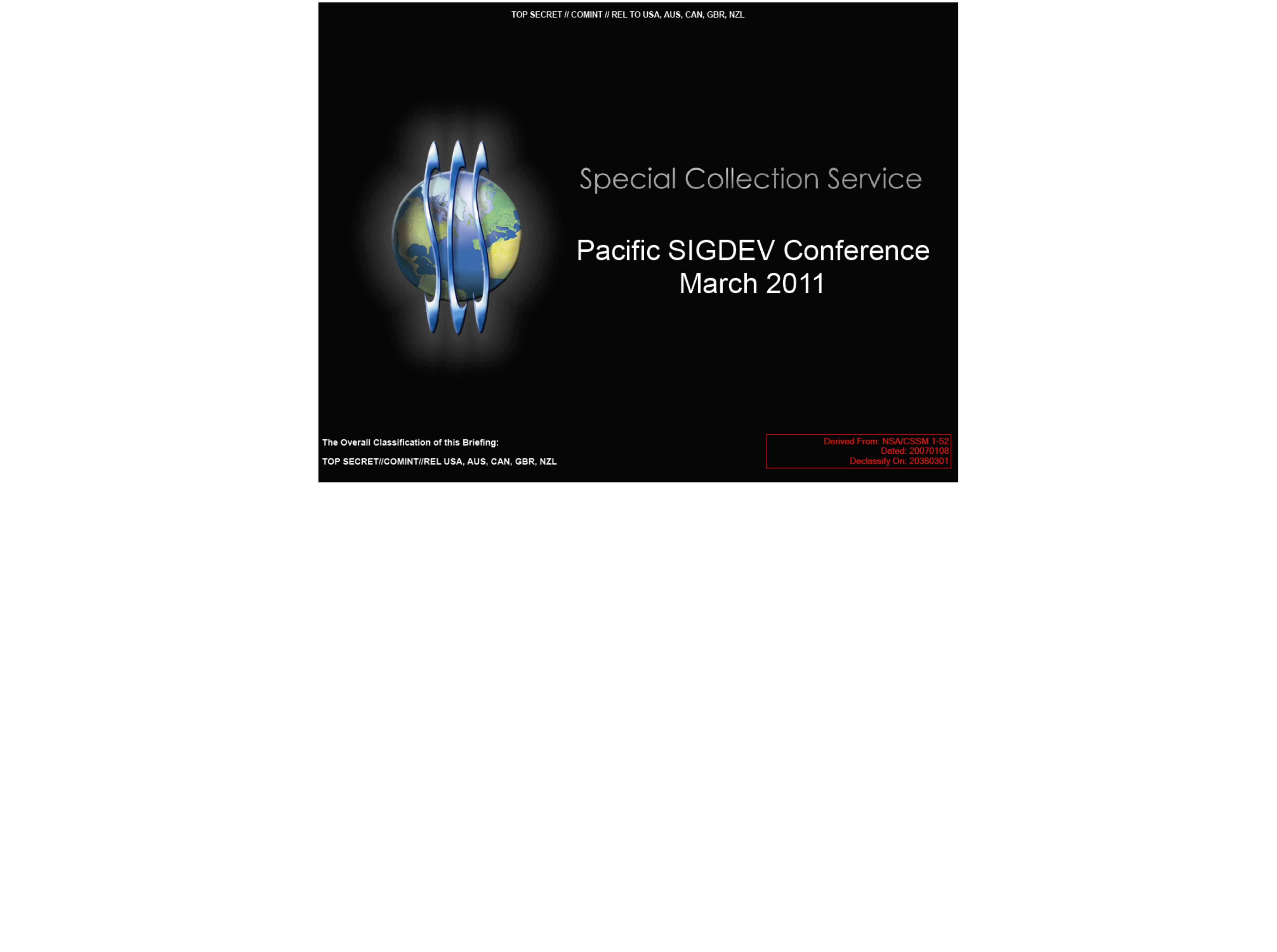
Special Collection Service
Pacific SIGDEV Conference
March 2011
The Overall Classification of this Briefing:
TOP SECRET//COMINT//REL USA, AUS, CAN, GBR, NZL
Derived From: NSA/CSSM 1-52
Dated: 20070108
Declassify On: 20360301
TOP SECRET // COMINT // REL TO USA, AUS, CAN, GBR, NZL
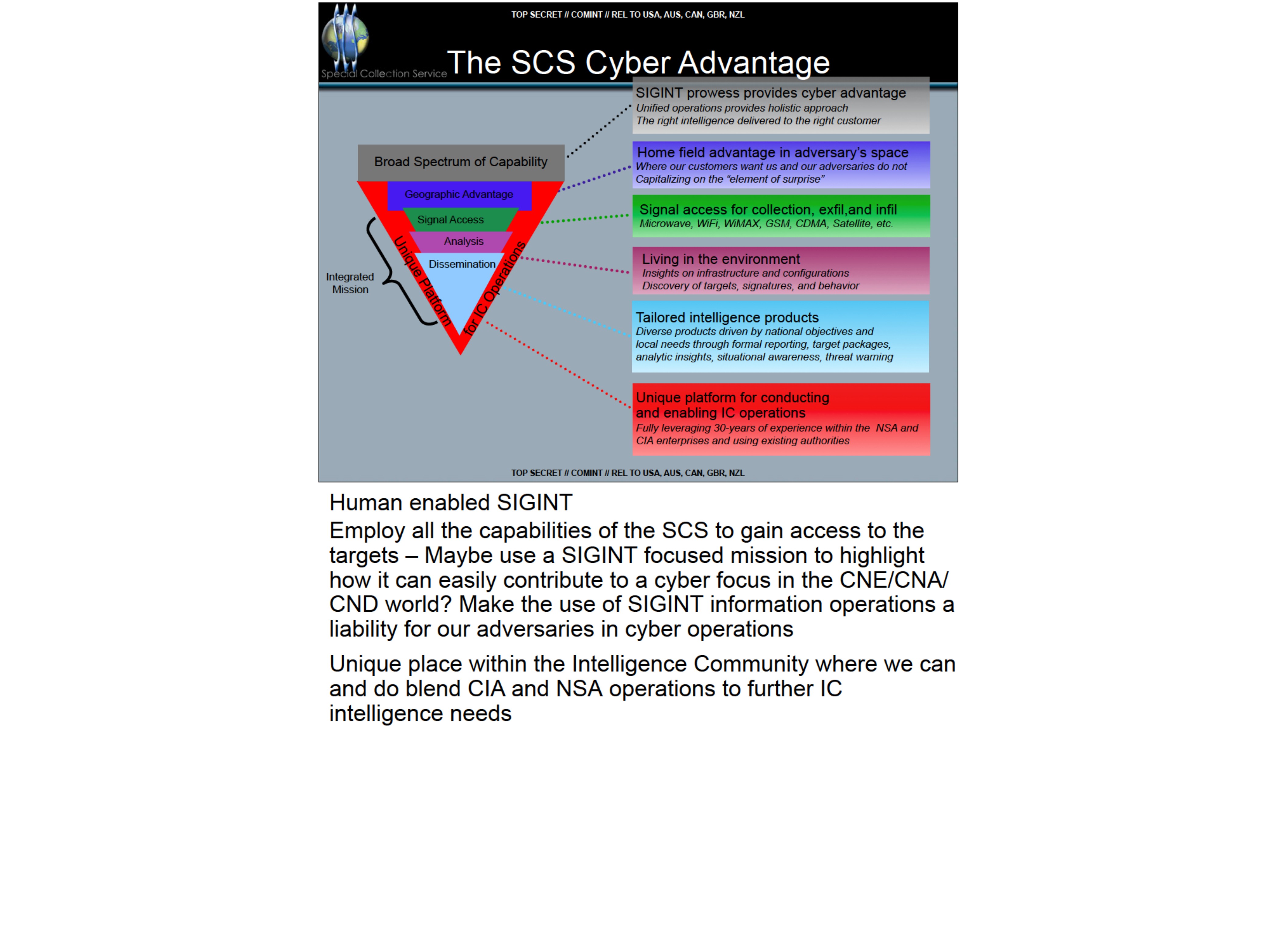
The SCS Cyber Advantage
SIGINT prowess provides cyber advantage
- Unified operations provides holistic approach
- The right intelligence delivered to the right customer
Home field advantage in adversary's space
- Where our customers want us and our adversaries do not
- Capitalizing on the "element of surprise"
Signal access for collection, exfil, and infil
- Microwave, WiFi, WiMAX, GSM, CDMA, Satellite, etc.
Living in the environment
- Insights on infrastructure and configurations
- Discovery of targets, signatures, and behavior
Tailored intelligence products
- Diverse products driven by national objectives and
local needs through formal reporting, target packages,
analytic insights, situational awareness, threat warning
Unique platform for conducting and enabling IC operations
- Fully leveraging 30-years of experience within the NSA and
CIA enterprises and using existing authorities
Broad Spectrum of Capability
- Geographic Advantage
- Signal Access
- Analysis
- Dissemination
- Analysis
- Signal Access
- Unique Platform for IC Operations
Integrated Mission
TOP SECRET // COMINT // REL TO USA, AUS, CAN, GBR, NZL
Human enabled SIGINT
Employ all the capabilities of the SCS to gain access to the targets – Maybe use a SIGINT focused mission to highlight how it can easily contribute to a cyber focus in the CNE/CNA/ CND world? Make the use of SIGINT information operations a liability for our adversaries in cyber operations
Unique place within the Intelligence Community where we can and do blend CIA and NSA operations to further IC intelligence needs
TOP SECRET // COMINT // REL TO USA, AUS, CAN, GBR, NZL
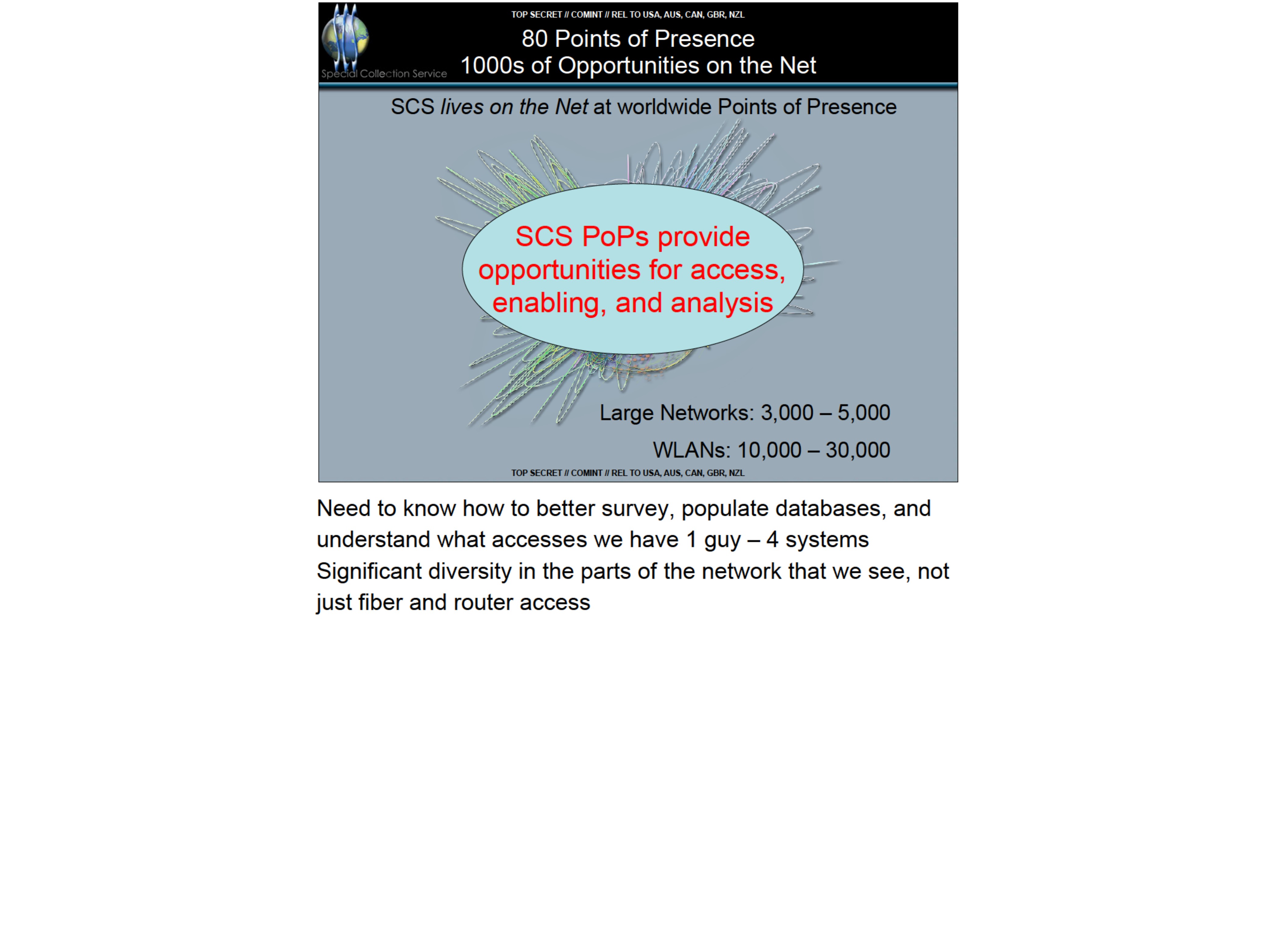
80 Points of Presence
1000s of Opportunities on the Net
SCS lives on the Net at worldwide Points of Presence
SCS PoPs provide opportunities for access, enabling, and analysis
Large Networks: 3,000 – 5,000
WLANs: 10,000 – 30,000
TOP SECRET // COMINT // REL TO USA, AUS, CAN, GBR, NZL
Need to know how to better survey, populate databases, and understand what accesses we have 1 guy – 4 systems
Significant diversity in the parts of the network that we see, not just fiber and router access
TOP SECRET // COMINT // REL TO USA, AUS, CAN, GBR, NZL
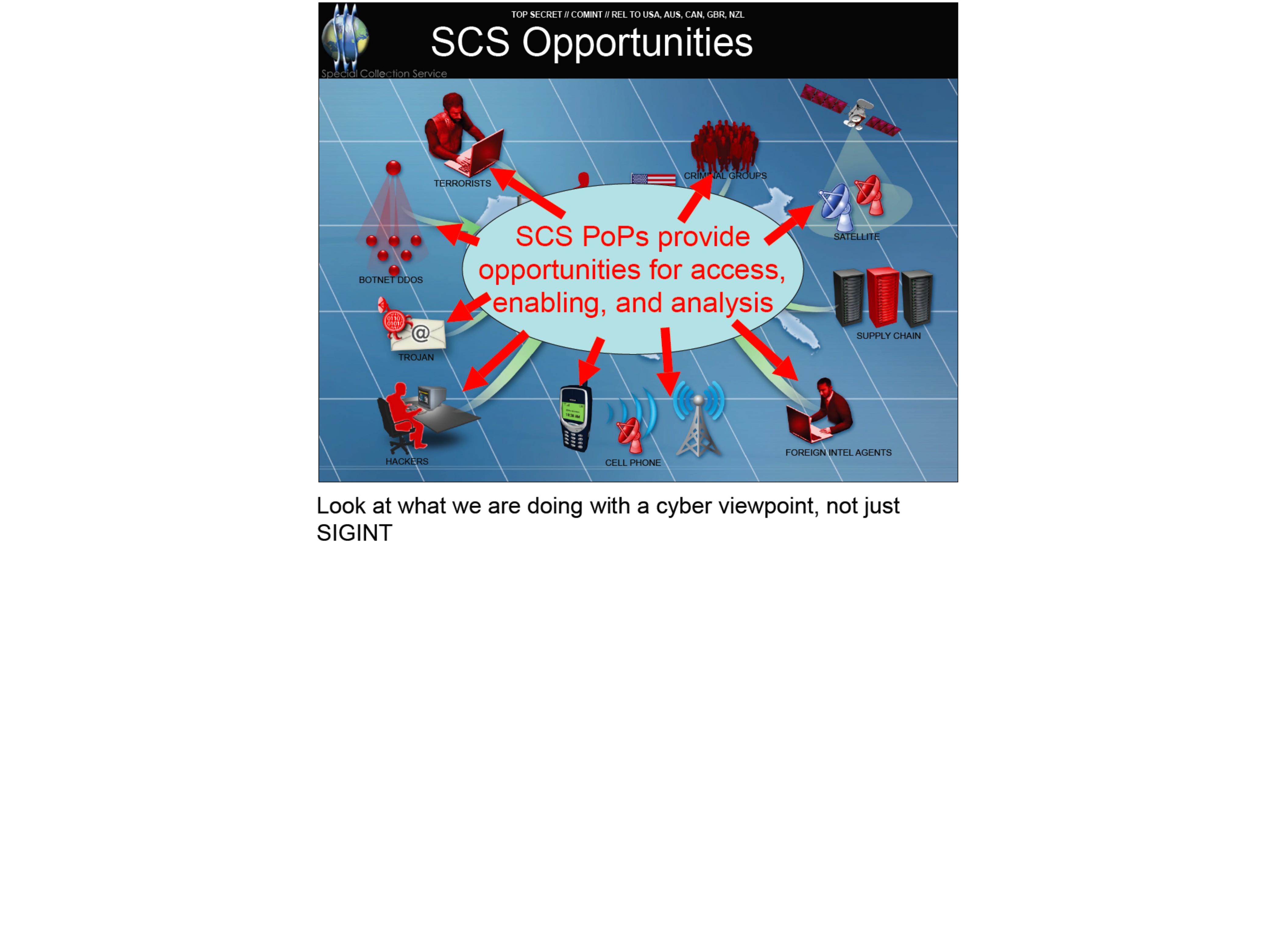
SCS Opportunities
- TERRORISTS
- CRIMINAL GROUPS
- SATELLITE
- SUPPLY CHAIN
- FOREIGN INTEL AGENTS
- CELL PHONE
- HACKERS
- TROJAN
- BOTNET DDOS
SCS PoPs provide opportunities for access, enabling, and analysis
Look at what we are doing with a cyber viewpoint, not just SIGINT
Published in the Same Report
(8 documents)
-
DoD 2011 Strategy for Operating in Cyberspace – Supply Chain Excerpts [pdf]
The classified 2011 Department of Defense strategy warns that U.S. reliance on foreign manufacturing—especially from countries like China—creates major cybersecurity risks, including the potential insertion of malicious hardware or software into critical systems. It outlines a government-wide plan to mitigate these supply chain vulnerabilities through coordinated policies, risk management strategies, and collaboration with industry.
-
Intellipedia – Air Gapped Network Threats [pdf]
This document from an internal wiki for the U.S. intelligence community, surveys threats to so-called air-gapped systems, arguing that supply-chain compromises, physical implants (BIOS, KVMs, peripherals), infected removable media, and enabled wireless/emanations present realistic paths for adversaries to bridge isolated networks. It assesses likelihoods and attack vectors (including insider help and CDS/guard exploitation), highlights specific historic incidents (Agent.BTZ/MAKERSMARK), and recommends strict removable-media policies, TEMPEST countermeasures, and rigorous cross-domain guard protections to mitigate the risk.
People: Witte, Griff · Warren, Peter · Streeter, Michael · Watson, Paul · Louchard, Bjørn · Crawford, George · Rudge, David · Terrazas, Michael -
Intellipedia – BIOS Threats [pdf]
This from an internal wiki for the U.S. intelligence community, titled “BIOS Threats” details the use of malicious BIOS implants as a means of achieving persistent system compromise for cyber espionage and attack purposes. It discusses the history, technical challenges, detection limitations, and global development of BIOS-based malware by both state and non-state actors, including U.S. and Chinese cyber units.
-
Intellipedia – Supply Chain Cyber Threats [pdf]
This document on Supply Chain Cyber Threats, from an internal wiki for the U.S. intelligence community, outlines vulnerabilities in hardware and firmware components such as power supplies, NICs, RAID controllers, GPUs, and peripheral devices that could be exploited by adversaries through the supply chain. It details assessments from U.S. intelligence agencies (CIA, DIA, FBI, CYBERCOM) highlighting risks from foreign companies, insider threats, and malicious modifications that could compromise critical U.S. government and military systems.
Programs: A-SPACE -
NSA Supply Chain Attack From PMR 4-24-13 [pdf]
This document is a top-secret NSA report detailing a SIGINT development operation in which a classified Voice-over-IP network shipment was intercepted and subjected to a supply-chain interdiction, allowing NSA and its intelligence community partners to gain access to the hardware and intelligence. It describes the operational process, including tracking the shipment through China, coordinating with Tailored Access Operations (TAO), and using tools like XKEYSCORE to identify targeting selectors, ultimately enabling detailed surveillance and future operational opportunities.
-
National Intelligence Estimate 2009 Global Cyber Threat – Supply Chain Excerpts [pdf]
These Supply Chain Excerpts from the 2009 National Intelligence Estimate, assesses that the U.S. faces a growing cyber threat from state actors, particularly Russia and China, who have the capability and strategic intent to exploit or disrupt U.S. and allied information systems. It emphasizes vulnerabilities from supply chains, insider threats, and technology trends that favor offensive operations, while noting the difficulty of detecting and fully defending against these sophisticated cyber threats.
-
PRC Information Warfare & Huawei [pdf]
This NSA intelligence briefing on Huawei analyzes Huawei’s global telecommunications presence and its potential links to the People’s Liberation Army (PLA) and Chinese government intelligence activities. It highlights concerns that Huawei’s international market expansion — including its subcontracted 2008 upgrade of the TAT-14 transatlantic cable carrying U.S. and defense communications — could be exploited by China for signals intelligence (SIGINT) purposes.
People: Chávez, Hugo -
Tailored Access Operations 2007 [pdf]
This NSA document describes the Tailored Access Operations (TAO) division, which conducts sophisticated cyber operations to penetrate and maintain persistent access to target networks globally through both remote exploits and physical interdiction methods. The presentation outlines TAO's organizational structure, mission capabilities across telecommunications and data networks, development of hardware/software implants for devices ranging from servers to SCADA systems, collaboration with HUMINT partners for physical access operations, and specialized divisions focused on exploiting telephony systems, computer networks, and developing tools for computer network attack and exploitation.
Related Documents
-
Special Collection Service - Pacific SIGDEV Conference March 2011 [pdf]
This document is a TOP SECRET briefing describing the Special Collection Service (SCS)—its organizational structure, global posture and strategic partnerships—and how SCS leverages advanced SIGINT and cyber capabilities (microwave, cellular, satellite, VPN/Internet exploitation, tools like INTERQUAKE/Einstein/Castanet/Birdwatcher) from embassy/PoP sites to collect, analyze and support intelligence and covert operations. It also outlines SCS modernization goals (unified IT core, cloud/virtualization, expanded cyber presence), operational authorities and mission advantages for enabling both SIGINT and HUMINT activities. See also Spiegel's 2013 reporting based on the same presentation (back then they only published two slides from this presentation): https://www.spiegel.de/international/germany/cover-story-how-nsa-spied-on-merkel-cell-phone-from-berlin-embassy-a-930205.html
-
SCS - Embassies and Consulates [pdf]
TOP SECRET Special Collection Service (SCS) documents about covert CIA/NSA spying sites operated from diplomatic facilities worldwide.
-
National Intelligence Estimate 2009 Global Cyber Threat – Supply Chain Excerpts [pdf]
These Supply Chain Excerpts from the 2009 National Intelligence Estimate, assesses that the U.S. faces a growing cyber threat from state actors, particularly Russia and China, who have the capability and strategic intent to exploit or disrupt U.S. and allied information systems. It emphasizes vulnerabilities from supply chains, insider threats, and technology trends that favor offensive operations, while noting the difficulty of detecting and fully defending against these sophisticated cyber threats.
-
NSA Supply Chain Attack From PMR 4-24-13 [pdf]
This document is a top-secret NSA report detailing a SIGINT development operation in which a classified Voice-over-IP network shipment was intercepted and subjected to a supply-chain interdiction, allowing NSA and its intelligence community partners to gain access to the hardware and intelligence. It describes the operational process, including tracking the shipment through China, coordinating with Tailored Access Operations (TAO), and using tools like XKEYSCORE to identify targeting selectors, ultimately enabling detailed surveillance and future operational opportunities.
-
PRC Information Warfare & Huawei [pdf]
This NSA intelligence briefing on Huawei analyzes Huawei’s global telecommunications presence and its potential links to the People’s Liberation Army (PLA) and Chinese government intelligence activities. It highlights concerns that Huawei’s international market expansion — including its subcontracted 2008 upgrade of the TAT-14 transatlantic cable carrying U.S. and defense communications — could be exploited by China for signals intelligence (SIGINT) purposes.
People: Chávez, Hugo