Tag: covert access 14 documents
Search documents matching “covert access” →Free-text subjects the curators added. Unlike the other axes these are not necessarily from the documents' own vocabulary, so they are the loosest thing to browse by (and the most forgiving).
Graphs
By Banner
By Classification
Refine (combine with another filter, via search)
Sort: Title
Documents
-
CLASSIFICATION GUIDE FOR ECI PAWLEYS (PAW) [pdf]
This 2006 NSA classification guide outlines the protocols for ECI PAWLEYS (PAW). PAWLEYS is an Exceptionally Compartmented Information (ECI) category designed to protect clandestine operations—both physical (HUMINT) and digital (CNE)—specifically aimed at acquiring foreign cryptographic information and material. The document confirms that the NSA actively seeks to circumvent encryption through clandestine HUMINT and computer network access aimed at cryptographic information and material, rather than relying solely on traditional codebreaking.
Programs: PAWLEYS -
Digint Narrative [pdf]
This Digint Programme (2010 draft) outlines MI5’s plan to strengthen its ability to collect and exploit digital intelligence, addressing the growing challenge of massive internet-based data and the risk of missing critical insights. It emphasizes collaboration with GCHQ, NTAC, and other agencies to build strategic capabilities, improve exploitation of collected data, and expand coverage for counterterrorism and national security.
Marking: UK SECRETPrograms: IMP -
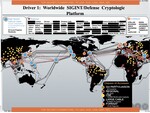
Driver 1: Worldwide SIGINT/Defense Cryptologic Platform [pdf]
A 2012 NSA management presentation slide revealing the agency's global surveillance architecture across five categories of access — covert cable taps, regional collection sites, computer network exploitation implants, foreign satellite collection, and third-party liaison relationships — including a list of cities hosting clandestine collection operations and confirmation of over 50,000 worldwide malware implants.
Programs: STELLAR · SOUNDER · SNICK · MOONPENNY · LADYLOVE · INDRA · IRONSAND · JACKKNIFE · CARBOY · TIMBERLINE“NSA infected 50,000 computer networks with malicious software” - NRC ↗ (2013-11-23) · “No Place to Hide” - Metropolitan Books ↗ (2014-05-13) · Boon, Floor · Derix, Steven · Modderkolk, Huib · Greenwald, Glenn -
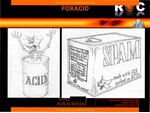
FOXACID Overall Briefing [pdf]
FOXACID is the NSA's exploit server infrastructure designed to gain "initial access" to target computers by tricking them into visiting malicious websites through spam emails, man-in-the-middle attacks, or split-second packet injection techniques that redirect legitimate web traffic. The document reveals how the agency has evolved from low-success spam operations (less than 1% success rate) to sophisticated "QUANTUM" techniques that achieve up to 80% success rates by exploiting web browsers through services like Yahoo and Facebook, allowing the NSA to compromise any target whose web traffic passes through monitored network chokepoints—with the chilling assessment that "if we can get the target to visit us in some sort of web browser, we can probably own them."
Programs: FOXACID · WILLOWVIXEN · GENUINEDRAFT · SECONDDATE · QUANTUMTHEORY · TURMOIL · TURBINE · WEBSNIPER · QUANTUMINSERT · QUANTUMBISCUIT · QUANTUMDIRK · QUANTUM · VALIDATOR · OLYMPUS · MISTYVEAL · SSO · STRAIGHTBIZARRE · ISLANDTRANSPORT -
GCHQ NAC review – April to June (2011) [pdf]
The GCHQ NAC review (Apr–Jun 2011) details the continuation of Operation Socialist, describing how NAC supported mapping Belgacom’s internal network and guided CNE operators to infiltrate key GRX routers. The aim was to establish positions within the network to enable man-in-the-middle (MitM) operations against roaming mobile handsets.
“Operation Socialist: The Inside Story of How British Spies Hacked Belgium’s Largest Telco” - The Intercept ↗ (2014-12-13) · “Lees hier hoe de Britse geheime dienst GCHQ Belgacom aanviel” - NRC ↗ (2014-12-13) · “Britse geheime dienst bespioneerde jarenlang Belgacom-klanten” - De Standaard ↗ (2014-12-13) · Gallagher, Ryan · Modderkolk, Huib · Vanhecke, Nikolas · Eeckhaut, Mark -
GCHQ NAC review – January to March (2011) [pdf]
The GCHQ NAC review (Jan–Mar 2011) highlights a successful MyNOC surge against GRX operators that significantly expanded intelligence on operator networks and traffic during Operation Socialist. This effort facilitated a major CNE operation against Belgacom (MERION ZETA), securing both deep and edge network access, with continued work to build on this infiltration.
“Operation Socialist: The Inside Story of How British Spies Hacked Belgium’s Largest Telco” - The Intercept ↗ (2014-12-13) · “Lees hier hoe de Britse geheime dienst GCHQ Belgacom aanviel” - NRC ↗ (2014-12-13) · “Britse geheime dienst bespioneerde jarenlang Belgacom-klanten” - De Standaard ↗ (2014-12-13) · Gallagher, Ryan · Modderkolk, Huib · Vanhecke, Nikolas · Eeckhaut, Mark -
GCHQ NAC review – January to March (2012) [pdf]
The GCHQ NAC review (Jan–Mar 2012) reports ongoing progress in maintaining CNE access to the Belgacom GRX operator, with the CNE EREPO team issuing new operational requirements to the NAC to further guide and support the hacking operation "OP Socialist".
“Operation Socialist: The Inside Story of How British Spies Hacked Belgium’s Largest Telco” - The Intercept ↗ (2014-12-13) · “Lees hier hoe de Britse geheime dienst GCHQ Belgacom aanviel” - NRC ↗ (2014-12-13) · “Britse geheime dienst bespioneerde jarenlang Belgacom-klanten” - De Standaard ↗ (2014-12-13) · Gallagher, Ryan · Modderkolk, Huib · Vanhecke, Nikolas · Eeckhaut, Mark -
GCHQ NAC review – July to September (2011) [pdf]
The GCHQ NAC review (Jul–Sep 2011) outlines the continued support by NAC following the successful OP SOCIALIST operation, focusing on mapping Belgacom’s internal network and identifying key internal GRX routers to establish man-in-the-middle (MitM) platforms targeting roaming mobile handsets.
“Operation Socialist: The Inside Story of How British Spies Hacked Belgium’s Largest Telco” - The Intercept ↗ (2014-12-13) · “Lees hier hoe de Britse geheime dienst GCHQ Belgacom aanviel” - NRC ↗ (2014-12-13) · “Britse geheime dienst bespioneerde jarenlang Belgacom-klanten” - De Standaard ↗ (2014-12-13) · Gallagher, Ryan · Modderkolk, Huib · Vanhecke, Nikolas · Eeckhaut, Mark -
GCHQ NAC review – October to December (2011) [pdf]
The GCHQ NAC review (Oct–Dec 2011) reports that the Belgacom GRX exploitation was highly successful, enabling both CNE and Crypt Ops by uncovering extensive VPN exploitation opportunities through OP SOCIALIST II. The surge operation focused on mapping mobile operators connecting via VPN, analyzing GTP traffic for target selector extraction, and identifying optimal access points—ultimately strengthening sustained network exploitation under the VERACIOUS Project.
“Operation Socialist: The Inside Story of How British Spies Hacked Belgium’s Largest Telco” - The Intercept ↗ (2014-12-13) · “Lees hier hoe de Britse geheime dienst GCHQ Belgacom aanviel” - NRC ↗ (2014-12-13) · “Britse geheime dienst bespioneerde jarenlang Belgacom-klanten” - De Standaard ↗ (2014-12-13) · Gallagher, Ryan · Modderkolk, Huib · Vanhecke, Nikolas · Eeckhaut, Mark -
GCHQ – Computer Network Exploitation [pdf]
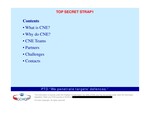
This document outlines GCHQ’s Computer Network Exploitation (CNE) capabilities, detailing how teams remotely access computers and networks without owners’ consent to gather intelligence, support operations, and conduct effects. It also covers operational tools, techniques, infrastructure, joint working with partners, deconfliction, and challenges such as avoiding detection and meeting increasing intelligence demands.
-
Reverse Engineering – GCHQ Wiki [pdf]
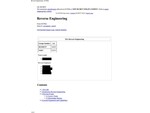
GCHQ’s internal GCWiki page sketches the TEA Reverse Engineering unit inside the TECA Product Centre: a lab team built to dissect hardware and embedded crypto devices, defeat smartcard‑class microprocessors, and turn black boxes into SIGINT‑ready emulators. It doubles as a training hub and liaison node, with kit lists, tours, and SRE exchanges—most real work pushed behind higher‑compartment CAWiki pages.
Marking: UK SECRETPrograms: RUSSETT -
Tailored Access Operations 2007 [pdf]
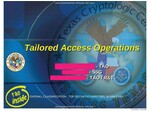
This NSA document describes the Tailored Access Operations (TAO) division, which conducts sophisticated cyber operations to penetrate and maintain persistent access to target networks globally through both remote exploits and physical interdiction methods. The presentation outlines TAO's organizational structure, mission capabilities across telecommunications and data networks, development of hardware/software implants for devices ranging from servers to SCADA systems, collaboration with HUMINT partners for physical access operations, and specialized divisions focused on exploiting telephony systems, computer networks, and developing tools for computer network attack and exploitation.
-
Tailored Access Operations, FOXACID, QUANTUM [pdf]
These NSA presentation slides detail "QUANTUM," a sophisticated system that allows the agency to intercept internet traffic and inject malware onto target computers with up to 80% success rates, far exceeding traditional spam-based methods. The system works by monitoring internet traffic for specific identifiers (like Yahoo or Facebook cookies), then racing to inject malicious code before legitimate web servers can respond, thereby compromising targets' computers without their knowledge and establishing persistent backdoor access.
Programs: FOXACID · QUANTUM · QUANTUMTHEORY · QUANTUMBISCUIT · VALIDATOR · OLYMPUS · UNITEDRAKE · OLYMPUSFIRE · SSO · FORESTPLACE -
WINDSTOP/2P System Highlights [pdf]
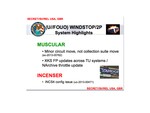
A March 2013 NSA Special Source Operations internal report describing a volume management problem at MUSCULAR — the joint NSA/GCHQ programme tapping Yahoo and Google inter-datacenter fiber links — specifically concerning Yahoo's proprietary Narchive email transfer format, which was generating 15GB/day of mostly stale email data representing 25% of the collection site's daily allocation.