Tag: Computer Network Exploitation 143 documents
Search documents matching “Computer Network Exploitation” →Free-text subjects the curators added. Unlike the other axes these are not necessarily from the documents' own vocabulary, so they are the loosest thing to browse by (and the most forgiving).
Graphs
By document date (11 years)
By Banner
By Classification
Refine (combine with another filter, via search)
Sort: Title
Documents
-
'4th Party Collection': Taking Advantage of Non-Partner Computer Network Exploitation Activity SIDtoday [pdf]
This January 2008 SIDtoday article from Menwith Hill Station describes "4th Party Collection"—an NSA technique exploiting non-Five Eyes nations' computer network operations by passively intercepting their stolen data—with the example of NSA monitoring Kurdistan Democratic Party's deployment of Perfect Keylogger commercial spyware against targets in Iran and Iraq, including people with links to the Kurdistan Regional Government and Iraqi Ministry of Foreign Affairs computers, capturing keystrokes, passwords, chat logs, and documents that traditional signals intelligence would never collect. The operation reveals KDP intelligence services systematically compromised internet cafés and Iraqi Ministry of Foreign Affairs computers, with exfiltrated data routing to email addresses in Erbil registered to terminals associated with Kurdish intelligence, which NSA then intercepts and repurposes for its own intelligence production.
-
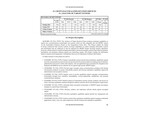
Computer Network Exploitation (CNE) Classification Guide / 2-59 [pdf]
A NSA/TAO classification guide establishing the precise classification level for 41 categories of information about computer network exploitation operations — covering remote and physical subversion methods, CNE tools and techniques, supply chain operations, hardware implants, off-net field operations, zero-day vulnerabilities, and cryptographic material acquired through CNE.
“Core Secrets: NSA Saboteurs in China and Germany” - The Intercept ↗ (2014-10-10) · “The Digital Arms Race: NSA Preps America for Future Battle” - Der Spiegel ↗ (2015-01-17) · Maass, Peter · Poitras, Laura · Appelbaum, Jacob · Gibson, Aaron · Guarnieri, Claudio · Müller-Maguhn, Andy · Rosenbach, Marcel · Ryge, Leif · Schmundt, Hilmar · Sontheimer, Michael -
Computer Network Exploitation Comes to NSA/CSS Georgia SIDtoday [pdf]
The Georgia Tailored Access Operations’s Remote Operations Center is officially opened — with a fiber-optic cable-cutting ceremony. The plan is to go from three operators doing computer network exploitation to a total of between 80 and 100 staffers, and to add computer network defense and attack capabilities.
The Intercept ↗ (2018-08-15) -
Digital Network Exploitation (DNE), Digital Network Intelligence (DNI) and Computer Network Exploitation (CNE) SIDtoday [pdf]
Explanation of the differences between Digital Network Exploitation, Digital Network Intelligence, and Computer Network Exploitation: DNE is extracting intelligence from a device on the global network; DNI is the intelligence produced by DNE; and CNE is hacking end-point devices (mentions “subtly weakening encryption”). Article acknowledges that “our targets communications are increasingly buried by millions of non-target communications.”
The Intercept ↗ (2016-08-10) -
GCHQ – Computer Network Exploitation [pdf]
This document outlines GCHQ’s Computer Network Exploitation (CNE) capabilities, detailing how teams remotely access computers and networks without owners’ consent to gather intelligence, support operations, and conduct effects. It also covers operational tools, techniques, infrastructure, joint working with partners, deconfliction, and challenges such as avoiding detection and meeting increasing intelligence demands.
-
Access: Vision 2013 [pdf]
This July 2010 GCHQ strategic document outlines the agency's vision for 2013 to create "the world's biggest SIGINT engine" with access to 800 10-gigabit connections (up from existing capacity), expanding overseas operations to 60% while reducing UK-based to 40%, and developing new capabilities including computer network exploitation (CNE), exfiltration, beaconry, geolocation, and collection of "Internet Pocket Litter" like cookies and browsing data. The strategy emphasizes "scale and pace," "balance," and "agility" while claiming to operate within legal frameworks of "necessity, proportionality and authorisation," and highlights partnerships with second and third parties to access "intractable and hard targets."
Marking: SECRET -
Advanced CNE at the Kunia RSOC SIDtoday [pdf]
The Kunia Regional Security Operations Center in Hawaii is officially sanctioned by TAO as the "first organization of the Extended Enterprise to conduct advanced Computer Network Exploitation."
The Intercept ↗ (2016-12-07) -
Analytic Challenges from Active-Passive Integration [pdf]
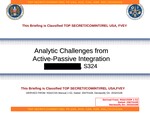
This NSA presentation examines metadata attribution challenges arising when active TAO implants exfiltrate traffic through passive TURMOIL collection infrastructure, creating conflicts where intercepted data carries dual classification markings, case notations, and legal authorities from both collection systems. The briefing highlights how existing databases and analytic tools were not designed to handle traffic with two simultaneous sets of metadata parameters, requiring enterprise-wide solutions to consistently attribute and track actively-shaped intelligence collection.
Programs: BRAVENICKEL · HAMMERMILL · APEX · MARINA · TURMOIL · PRESSUREWAVE · METROTUBE · TOYGRIPPE · HAMMERSTEIN · HAMMERSTONE · METAWAVE · TURBULENCE · SSO -
Analytic Challenges from Active-Passive Integration [pdf]
This NSA briefing addresses the technical and administrative friction caused by "shaping" operations. Shaping occurs when an active malware implant, typically situated on network infrastructure like a router, copies specific data streams and redirects them past a passive surveillance sensor such as TURMOIL. While this ensures the capture of data that might otherwise be missed, it creates a "double metadata" conflict where a single piece of intelligence carries two competing sets of identifiers: one from the active Tailored Access Operations (TAO) implant and another from the passive collection site. The document tasks analysts with finding a way to reconcile these source notations to ensure the data remains searchable and legally compliant within legacy databases.
Programs: BRAVENICKEL · HAMMERMILL · APEX · TURMOIL · HAMMERSTONE · PRESSUREWAVE · METROTUBE · TOYGRIPPE · TURBULENCE · METAWAVE · MARINA · SSO · CONVEYANCE · NUCLEON · FASCIA · HAMMERCHANT -
Another Successful Olympics Story SIDtoday [pdf]
SID spent more than a year planning for the 2004 Summer Olympics in Athens, collaborating across different areas of SID and with other intelligence agencies to gain access to communications systems and providers in Greece.
“A Death in Athens” - The Intercept ↗ (2015-09-28) · “Americans and Greeks started the 2004 wiretaps together” - Kathimerini ↗ (2015-09-29) · The Intercept ↗ (2017-04-24) · Bamford, James · Petropoulos, Aggelos -
Assessment of Intelligence Opportunity - Juniper [pdf]
This document reveals that GCHQ, with NSA cooperation, developed capabilities to exploit vulnerabilities in 13 Juniper NetScreen firewall models and was expanding efforts to target Juniper’s broader JUNOS-based products for intelligence collection. It highlights the agencies’ strategic focus on maintaining access to critical network infrastructure globally, leveraging Juniper’s widespread use in high-priority countries.
Programs: HEADRESSNU -
Automated NOC detection [pdf]
This slide deck lays out how GCHQ and Canada’s CSEC systematically identified and penetrated Network Operations Centers—most notably Belgacom—by automating NOC discovery and weaponizing that mapping for QUANTUM INSERT attacks. It reads like a blueprint for turning router configs, metadata, and bulk scans into cookie-based targeting against telecom engineers inside core networks.
Programs: SURGE · NOCTURNALSURGE · RT · NACSHACK · CHAINGUARD · TIDALSURGE · GLOBALSURGE · PENTAHO · OLYMPIA · HYPERION · TERMINALSURGE · HACIENDA · QUANTUMINSERT · MUTANTBROTH · OPSOCIALIST · SAMUEL PEPYS · GEOFUSION · FIVEALIVE · NRTA · RADIUS“Operation Socialist: The Inside Story of How British Spies Hacked Belgium’s Largest Telco” - The Intercept ↗ (2014-12-13) · “Lees hier hoe de Britse geheime dienst GCHQ Belgacom aanviel” - NRC ↗ (2014-12-13) · “Britse geheime dienst bespioneerde jarenlang Belgacom-klanten” - De Standaard ↗ (2014-12-13) · Gallagher, Ryan · Modderkolk, Huib · Vanhecke, Nikolas · Eeckhaut, Mark -
Bad guys are everywhere, good guys are somewhere! [pdf]
A classified NSA NTOC presentation describing TREASURE MAP — the agency's near real-time global internet mapping platform — which combines open source, commercial, covert, and SIGINT data to chart every device, router, and autonomous system on the internet, including through 13 covert servers secretly planted in unwitting data centers across 18 countries spanning Asia, Europe, Russia, Africa, and South America, with networks marked in red indicating active SIGINT collection access points across at least 20 major telecommunications providers on three continents including allied nations' state-owned carriers.
Programs: TREASUREMAP · PACKAGEDGOODS · SOCIALSTAMP · SEASIDEFERRY · ARK · CAIDA · RUSTICBAGGAGE · PACKAGEDGOODS-GTR · PACKAGEDGOODS-SERVER · BLACKPEARL · LEAKYFAUCET · HYDROCASTLE · MASTERSHAKE · S-TRICKLER · TOYGRIPPE · DISCOROUTE · VITALAIR2 · IPGEOTRAP · JOLLYROGER · TUTELAGE · BYZANTINEHADES · XKEYSCORE · RADIUS · TACACS -
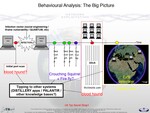
Behavioural Analysis: The Big Picture (Palantir could be used as part of a CNE) [pdf]
This diagram from GCHQ outlines the lifecycle of a CNE and identifies where Palantir fits into the intelligence workflow. The slide, titled "Behavioural Analysis: The Big Picture," illustrates a timeline of network exploitation from the initial infection of a target host to the eventual exfiltration of data. Crucially, it positions Palantir as a key "knowledge base" used for "Tipping to other systems." This indicates that Palantir’s software was used to aggregate data from successful hacks, allowing analysts to visualize connections and pivot (or "tip") that information toward further surveillance or offensive operations.
-
Black Budget: Cryptanalysis & Exploitation Services – Analysis of Target Systems [pdf]
This document is a budget justification for the NSA's Cryptanalysis & Exploitation Services project, which develops capabilities to defeat commercial encryption systems, exploit emerging communications technologies, and conduct vulnerability analysis against both foreign and domestic security products.
“The CIA Campaign to Steal Apple's Secrets” - The Intercept ↗ (2015-03-10) · Scahill, Jeremy · Begley, Josh -
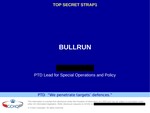
BULLRUN [pdf]
A GCHQ TOP SECRET STRAP1 briefing presentation on BULLRUN — summarising the programme's purpose, the network security technologies it targets, the sensitivities surrounding cryptanalytic capabilities, and the access control framework protecting both technical details and the "fact of" capability — notable for explicitly naming three ECIs protecting the technical underpinnings: PICARESQUE, PAWLEYS and AMBULANT.
-
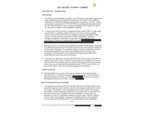
BULLRUN CoI - Briefing Sheet [pdf]
A GCHQ briefing sheet introducing the BULLRUN Community of Interest — the access control framework protecting Five Eyes capabilities to defeat encryption across TLS/SSL, HTTPS, SSH, VPNs, IPSec, encrypted chat and encrypted VoIP — covering the classification structure, handling procedures and protective marking guidance for intelligence derived from cryptanalytic exploitation.
“N.S.A. Able to Foil Basic Safeguards of Privacy on Web” - The New York Times ↗ (2013-09-05) · “Revealed: The NSA's Secret Campaign to Crack, Undermine Internet Security” - ProPublica ↗ (2013-09-05) · “Prying Eyes: Inside the NSA's War on Internet Security” - Der Spiegel ↗ (2014-12-28) · Perlroth, Nicole · Larson, Jeff · Shane, Scott · Appelbaum, Jacob · Gibson, Aaron · Grothoff, Christian · Müller-Maguhn, Andy · Poitras, Laura · Sontheimer, Michael · Stöcker, Christian -
BYZANTINE HADES: An Evolution of Collection [pdf]
A classified NSA SIGINT briefing from 2010 describes “BYZANTINE HADES,” a collection of Chinese computer network exploitation activities, with a focus on the BYZANTINE CANDOR actor set and U.S. efforts to analyze, attribute, and counter those intrusions. The document details targeting patterns, technical tradecraft, and a TAO-led counterintelligence operation that successfully penetrated the attackers’ infrastructure and personal systems.
Programs: BYZANTINEHADES · BYZANTINECANDOR · BYZANTINERAPTOR · BYZANTINEANCHOR · BISHOPKNIGHT · BYZANTINEVIKING · MAVERICKCHURCH · BISHOP · BYZANTINETRACE · DIESELRATTLE · BYZANTINEFOOTHOLD · BYZANTINEPRAIRIE · SEEDSPHERE · CARBONPEPTIDE · TITANRAIN · PINWALE · XKEYSCORE · CROSSBONES · TUNINGFORK · ARROWECLIPSE · CUTEBOY · POPROCKS · BYZANTINE -
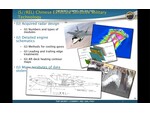
Chinese Exfiltrate Sensitive Military Technology [pdf]
This TOP SECRET NSA SIGINT development briefing describes large-scale Chinese cyber espionage that exfiltrated sensitive U.S. military technologies and inflicted extensive operational, financial, and strategic damage on Department of Defense systems. The document emphasizes both the scale of losses and the role of SIGINT in detecting, understanding, and mitigating adversary malware.
Programs: BYZANTINEHADES -
CLASSIFICATION GUIDE FOR ECI PAWLEYS (PAW) [pdf]
This 2006 NSA classification guide outlines the protocols for ECI PAWLEYS (PAW). PAWLEYS is an Exceptionally Compartmented Information (ECI) category designed to protect clandestine operations—both physical (HUMINT) and digital (CNE)—specifically aimed at acquiring foreign cryptographic information and material. The document confirms that the NSA actively seeks to circumvent encryption through clandestine HUMINT and computer network access aimed at cryptographic information and material, rather than relying solely on traditional codebreaking.
Programs: PAWLEYS