Tag: supply chain attacks 15 documents
Search documents matching “supply chain attacks” →Free-text subjects the curators added. Unlike the other axes these are not necessarily from the documents' own vocabulary, so they are the loosest thing to browse by (and the most forgiving).
Graphs
By Banner
By Classification
Refine (combine with another filter, via search)
Sort: Title
Documents
-
Assessment of Intelligence Opportunity - Juniper [pdf]
This document reveals that GCHQ, with NSA cooperation, developed capabilities to exploit vulnerabilities in 13 Juniper NetScreen firewall models and was expanding efforts to target Juniper’s broader JUNOS-based products for intelligence collection. It highlights the agencies’ strategic focus on maintaining access to critical network infrastructure globally, leveraging Juniper’s widespread use in high-priority countries.
Programs: HEADRESSNU -
AZTECTOMB32 DMW Install and ESH Package [pdf]
This document is a top-secret NSA internal project log detailing restrictions on installing new implants on machines running Kaspersky 2010+ due to the software’s cloud functionality, which prevents safe deployment of NSA malware. It records the suspension and eventual closure of a project (AZTECTOMB32/DEMENTIAWHEEL) that would have targeted such systems.
-
CLASSIFICATION GUIDE FOR THE NSA/CSS TARGET EXPLOITATION (TAREX) PROGRAM [pdf]
A 2012 NSA/CSS classification guide for the TAREX program — the agency's clandestine human intelligence and close-access signals intelligence unit — establishing what information about TAREX's operations, locations, methodologies, and interagency relationships must be protected, revealing forward-based presences in Germany, South Korea, and Beijing, and confirming that TAREX personnel operate undercover at U.S. embassies worldwide.
Programs: TAREXPeople: Shea, Teresa H. -
Intellipedia – Air Gapped Network Threats [pdf]
This document from an internal wiki for the U.S. intelligence community, surveys threats to so-called air-gapped systems, arguing that supply-chain compromises, physical implants (BIOS, KVMs, peripherals), infected removable media, and enabled wireless/emanations present realistic paths for adversaries to bridge isolated networks. It assesses likelihoods and attack vectors (including insider help and CDS/guard exploitation), highlights specific historic incidents (Agent.BTZ/MAKERSMARK), and recommends strict removable-media policies, TEMPEST countermeasures, and rigorous cross-domain guard protections to mitigate the risk.
People: Witte, Griff · Warren, Peter · Streeter, Michael · Watson, Paul · Louchard, Bjørn · Crawford, George · Rudge, David · Terrazas, Michael -
Intellipedia – BIOS Threats [pdf]
This from an internal wiki for the U.S. intelligence community, titled “BIOS Threats” details the use of malicious BIOS implants as a means of achieving persistent system compromise for cyber espionage and attack purposes. It discusses the history, technical challenges, detection limitations, and global development of BIOS-based malware by both state and non-state actors, including U.S. and Chinese cyber units.
-
IR.21 – A Technology Warning Mechanism [pdf]
This 2010 TOP SECRET NSA briefing defines the IR.21 roaming document as a critical tool for "horizon scanning" and "forecasting" global telecommunications shifts. The document outlines how the NSA uses these technical files to proactively identify emerging 3G and 4G technologies, pinpointing vulnerabilities for exploitation before new systems are even fully deployed.
-
Medical Pattern of Life - Targeting High Value Individual #1 - (SIGINT Enabling HUMINT / Targeting) [pdf]
This presentation dates from June 2010 and outlines a highly specialized intelligence strategy: using a target's medical needs as a "geospatial beacon" to bypass traditional security measures. In this context, High Value Individual #1 (HVI #1) refers to Osama bin Laden (UBL), and the document details a plan to track him via his suspected chronic kidney disease and related medical supplies.
People: bin Laden, Osama -
National Intelligence Estimate 2009 Global Cyber Threat – Supply Chain Excerpts [pdf]
These Supply Chain Excerpts from the 2009 National Intelligence Estimate, assesses that the U.S. faces a growing cyber threat from state actors, particularly Russia and China, who have the capability and strategic intent to exploit or disrupt U.S. and allied information systems. It emphasizes vulnerabilities from supply chains, insider threats, and technology trends that favor offensive operations, while noting the difficulty of detecting and fully defending against these sophisticated cyber threats.
-
NATO Civilian Intelligence Council – Cyber Panel – US Talking Points [pdf]
This 2011 US intelligence assessment for NATO identifies cyber espionage as the principal threat to Alliance networks, ranking Russia and China as the most significant nation-state actors and advocating for a shift to a consequence-based defense model that prioritizes the protection of NATO's most critical data.
-
NSA Supply Chain Attack From PMR 4-24-13 [pdf]
This document is a top-secret NSA report detailing a SIGINT development operation in which a classified Voice-over-IP network shipment was intercepted and subjected to a supply-chain interdiction, allowing NSA and its intelligence community partners to gain access to the hardware and intelligence. It describes the operational process, including tracking the shipment through China, coordinating with Tailored Access Operations (TAO), and using tools like XKEYSCORE to identify targeting selectors, ultimately enabling detailed surveillance and future operational opportunities.
-
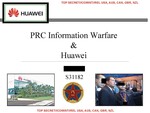
PRC Information Warfare & Huawei [pdf]
This NSA intelligence briefing on Huawei analyzes Huawei’s global telecommunications presence and its potential links to the People’s Liberation Army (PLA) and Chinese government intelligence activities. It highlights concerns that Huawei’s international market expansion — including its subcontracted 2008 upgrade of the TAT-14 transatlantic cable carrying U.S. and defense communications — could be exploited by China for signals intelligence (SIGINT) purposes.
People: Chávez, Hugo -
Slides Describe Mission Involving Huawei [pdf]
This document details an NSA-led strategic initiative to target Huawei due to its dominance in global telecommunications infrastructure. The operation (codenamed "Shotgiant") aims to exploit Huawei hardware to maintain access to target communications while investigating the company’s potential role in facilitating People’s Republic of China (PRC) signals intelligence and supply chain subversion.
-
Special Collection Service – Pacific SIGDEV Conference March 2011 – Supply Chain Excepts [pdf]
This top-secret 2011 NSA presentation outlines how the Special Collection Service—a joint NSA–CIA program operating from U.S. embassies—leverages its global network of “points of presence” to conduct human-enabled SIGINT and cyber operations directly inside “adversary space.” Framed as a “home field advantage,” it portrays U.S. diplomatic sites as launchpads for infiltration, surveillance, and even supply chain attacks, blurring the line between diplomacy and digital espionage.
-
Strawhorse: Attacking the MacOS and iOS Software Development Kit [pdf]
Abstract from the 2012 CIA Trusted Computing Base Jamboree, presented by Sandia National Laboratories, describing successful modification of Apple's Xcode 4.1 SDK to create a covert injection vector capable of embedding backdoors, exfiltrating developer private keys, forcing data transmission to intelligence listening posts, disabling ASLR in kernel extensions, and installing a keylogger via a modified OS X updater.
People: Thompson, Ken“The CIA Campaign to Steal Apple's Secrets” - The Intercept ↗ (2015-03-10) · Scahill, Jeremy · Begley, Josh -
Tailored Access Operations 2007 [pdf]
This NSA document describes the Tailored Access Operations (TAO) division, which conducts sophisticated cyber operations to penetrate and maintain persistent access to target networks globally through both remote exploits and physical interdiction methods. The presentation outlines TAO's organizational structure, mission capabilities across telecommunications and data networks, development of hardware/software implants for devices ranging from servers to SCADA systems, collaboration with HUMINT partners for physical access operations, and specialized divisions focused on exploiting telephony systems, computer networks, and developing tools for computer network attack and exploitation.