Intellipedia – BIOS Threats
Open PDFDocument date: 2012-03-13
Pages: 7
Genre: wiki
Banner: This page contains dynamic content -- Highest Possible Classification isTOP SECRET//SI/TK
Classification: TOP SECRET SI
Dissemination: NOFORN
This from an internal wiki for the U.S. intelligence community, titled “BIOS Threats” details the use of malicious BIOS implants as a means of achieving persistent system compromise for cyber espionage and attack purposes. It discusses the history, technical challenges, detection limitations, and global development of BIOS-based malware by both state and non-state actors, including U.S. and Chinese cyber units.
My notes
This page contains dynamic content -- Highest Possible Classification isTOP SECRET//SI/TKSecurity BannerTerms of Use
- Intelink
- Blogs
- Bookmarks
- eChirp
- Inteldocs
- Intellipedia
- Search
- Enterprise Search
- Enterprise Catalog
- Map
- People
- Recent Intel
- Search Support
- More
- Community
- Gallery
- IC Connect
- IC PKI
- IntelShare
- iStory
- iVideo
- Living Intelligence
- Maps
- Messenger
- Passport
- RSS Reader
- Tapioca
- URL Shortener
- Help
- Intellipedia Help
- Submit a Ticket
- ISMC Watch
- About Intelink
(U) BIOS Threats
TOP SECRET//SI//NOFORN
Jump to: navigation, search
(U) I would like feedback on this page. Please edit or leave a comment on the Talk page!
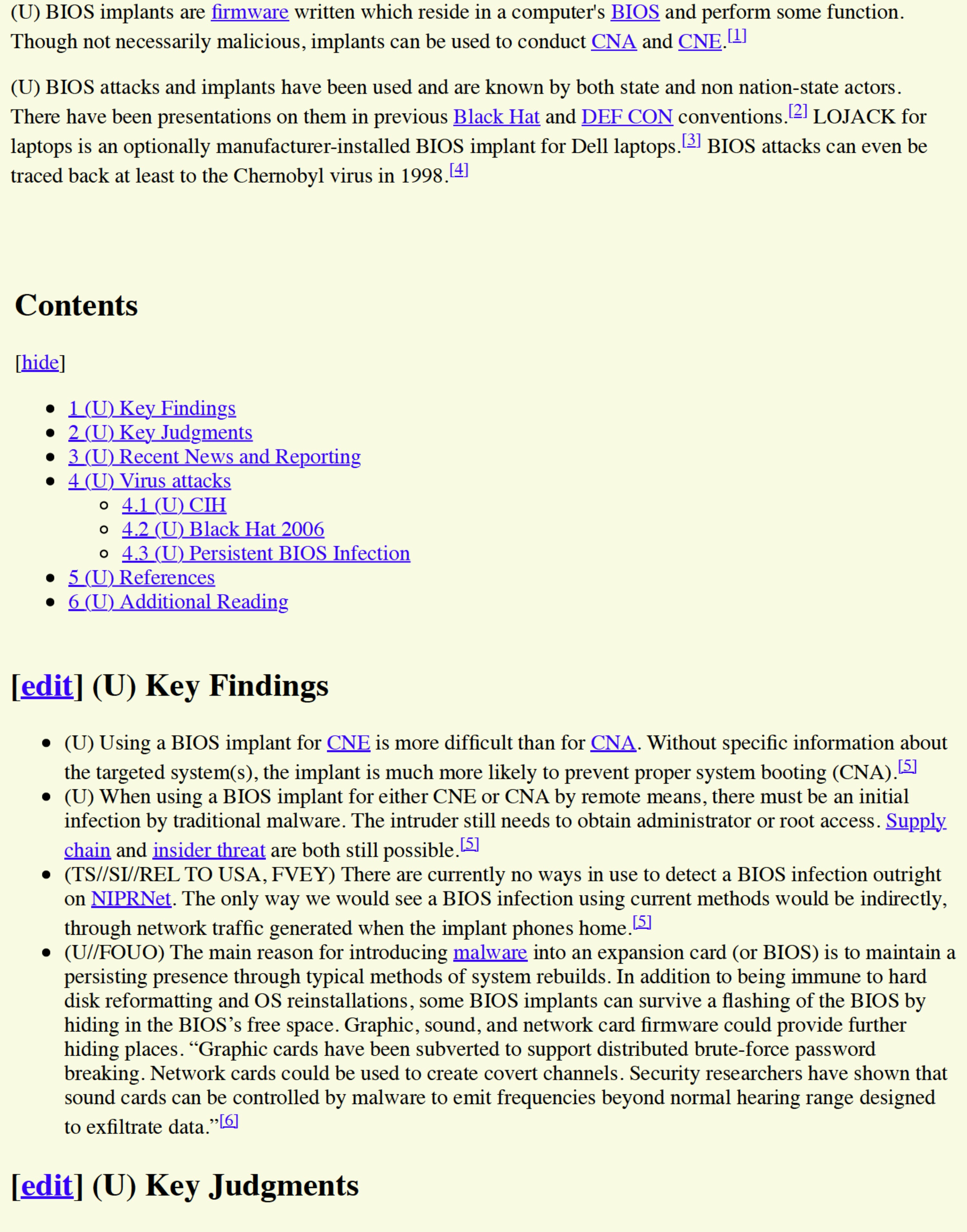
(U) BIOS implants are firmware written which reside in a computer's BIOS and perform some function. Though not necessarily malicious, implants can be used to conduct CNA and CNE.[1]
(U) BIOS attacks and implants have been used and are known by both state and non nation-state actors. There have been presentations on them in previous Black Hat and DEF CON conventions.[2] LOJACK for laptops is an optionally manufacturer-installed BIOS implant for Dell laptops. [3] BIOS attacks can even be traced back at least to the Chernobyl virus in 1998.[4]
Contents
[hide]
- 1 (U) Key Findings
- 2 (U) Key Judgments
- 3 (U) Recent News and Reporting
- 4 (U) Virus attacks
- 4.1 (U) CIH
- 4.2 (U) Black Hat 2006
- 4.3 (U) Persistent BIOS Infection
- 5 (U) References
- 6 (U) Additional Reading
[edit] (U) Key Findings
- (U) Using a BIOS implant for CNE is more difficult than for CNA. Without specific information about the targeted system(s), the implant is much more likely to prevent proper system booting (CNA).[5]
- (U) When using a BIOS implant for either CNE or CNA by remote means, there must be an initial infection by traditional malware. The intruder still needs to obtain administrator or root access. Supply chain and insider threat are both still possible.[5]
- (TS//SI//REL TO USA, FVEY) There are currently no ways in use to detect a BIOS infection outright on NIPRNet. The only way we would see a BIOS infection using current methods would be indirectly, through network traffic generated when the implant phones home.[5]
- (U//FOUO) The main reason for introducing malware into an expansion card (or BIOS) is to maintain a persisting presence through typical methods of system rebuilds. In addition to being immune to hard disk reformatting and OS reinstallations, some BIOS implants can survive a flashing of the BIOS by hiding in the BIOS's free space. Graphic, sound, and network card firmware could provide further hiding places. "Graphic cards have been subverted to support distributed brute-force password breaking. Network cards could be used to create covert channels. Security researchers have shown that sound cards can be controlled by malware to emit frequencies beyond normal hearing range designed to exfiltrate data."[6]
[edit] (U) Key Judgments
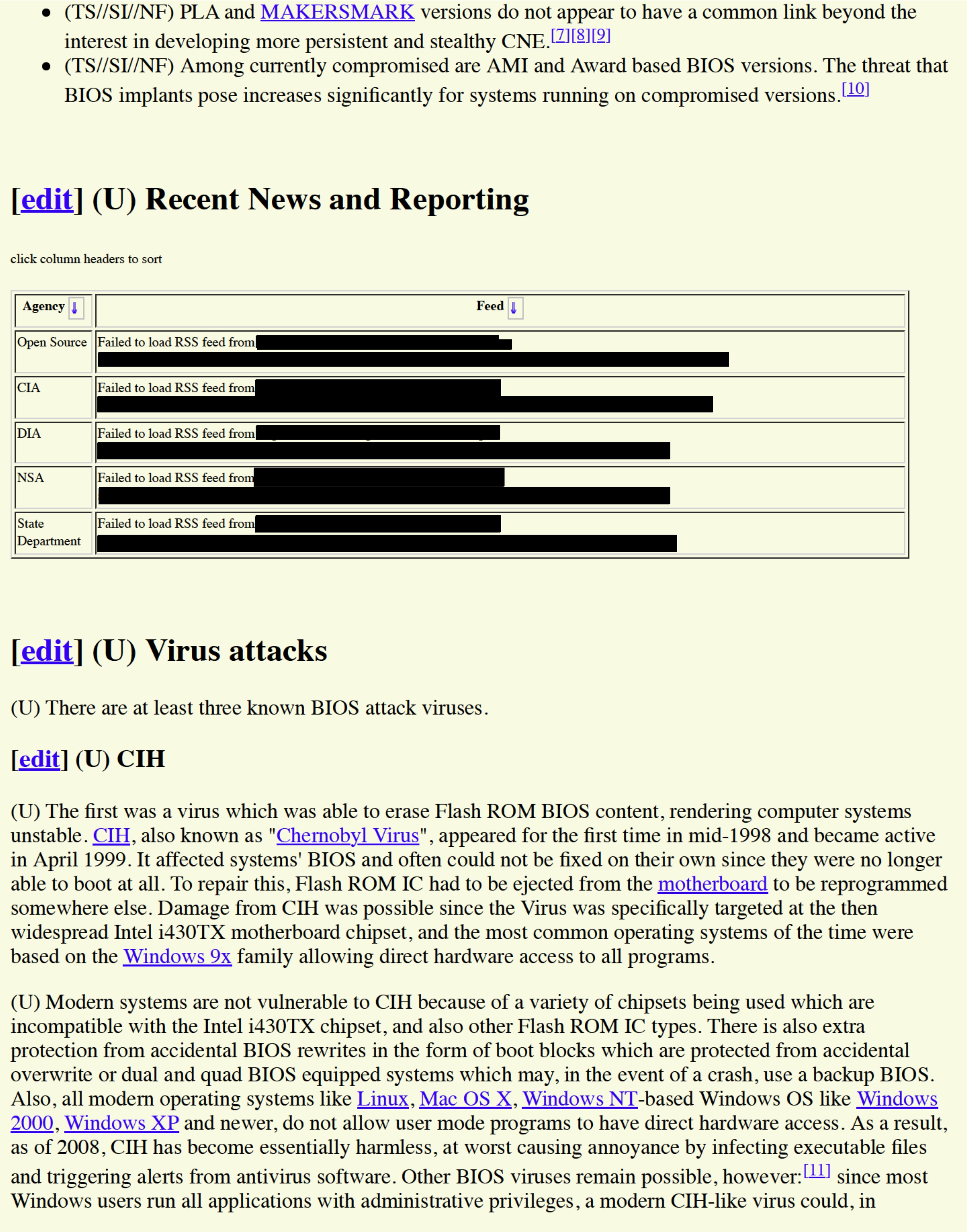
- (TS//SI//NF) PLA and MAKERSMARK versions do not appear to have a common link beyond the interest in developing more persistent and stealthy CNE.[7][8][9]
- (TS//SI//NF) Among currently compromised are AMI and Award based BIOS versions. The threat that BIOS implants pose increases significantly for systems running on compromised versions.[10]
[edit] (U) Recent News and Reporting
click column headers to sort
| Agency | Feed |
|---|---|
| Open Source | Failed to load RSS feed from [REDACTED] |
| CIA | Failed to load RSS feed from [REDACTED] |
| DIA | Failed to load RSS feed from [REDACTED] |
| NSA | Failed to load RSS feed from [REDACTED] |
| State Department | Failed to load RSS feed from [REDACTED] |
[edit] (U) Virus attacks
(U) There are at least three known BIOS attack viruses.
[edit] (U) CIH
(U) The first was a virus which was able to erase Flash ROM BIOS content, rendering computer systems unstable. CIH, also known as "Chernobyl Virus", appeared for the first time in mid-1998 and became active in April 1999. It affected systems' BIOS and often could not be fixed on their own since they were no longer able to boot at all. To repair this, Flash ROM IC had to be ejected from the motherboard to be reprogrammed somewhere else. Damage from CIH was possible since the Virus was specifically targeted at the then widespread Intel i430TX motherboard chipset, and the most common operating systems of the time were based on the Windows 9x family allowing direct hardware access to all programs.
(U) Modern systems are not vulnerable to CIH because of a variety of chipsets being used which are incompatible with the Intel i430TX chipset, and also other Flash ROM IC types. There is also extra protection from accidental BIOS rewrites in the form of boot blocks which are protected from accidental overwrite or dual and quad BIOS equipped systems which may, in the event of a crash, use a backup BIOS. Also, all modern operating systems like Linux, Mac OS X, Windows NT-based Windows OS like Windows 2000, Windows XP and newer, do not allow user mode programs to have direct hardware access. As a result, as of 2008, CIH has become essentially harmless, at worst causing annoyance by infecting executable files and triggering alerts from antivirus software. Other BIOS viruses remain possible, however:[11] since most Windows users run all applications with administrative privileges, a modern CIH-like virus could, in principle, still gain access to hardware.
[edit] (U) Black Hat 2006
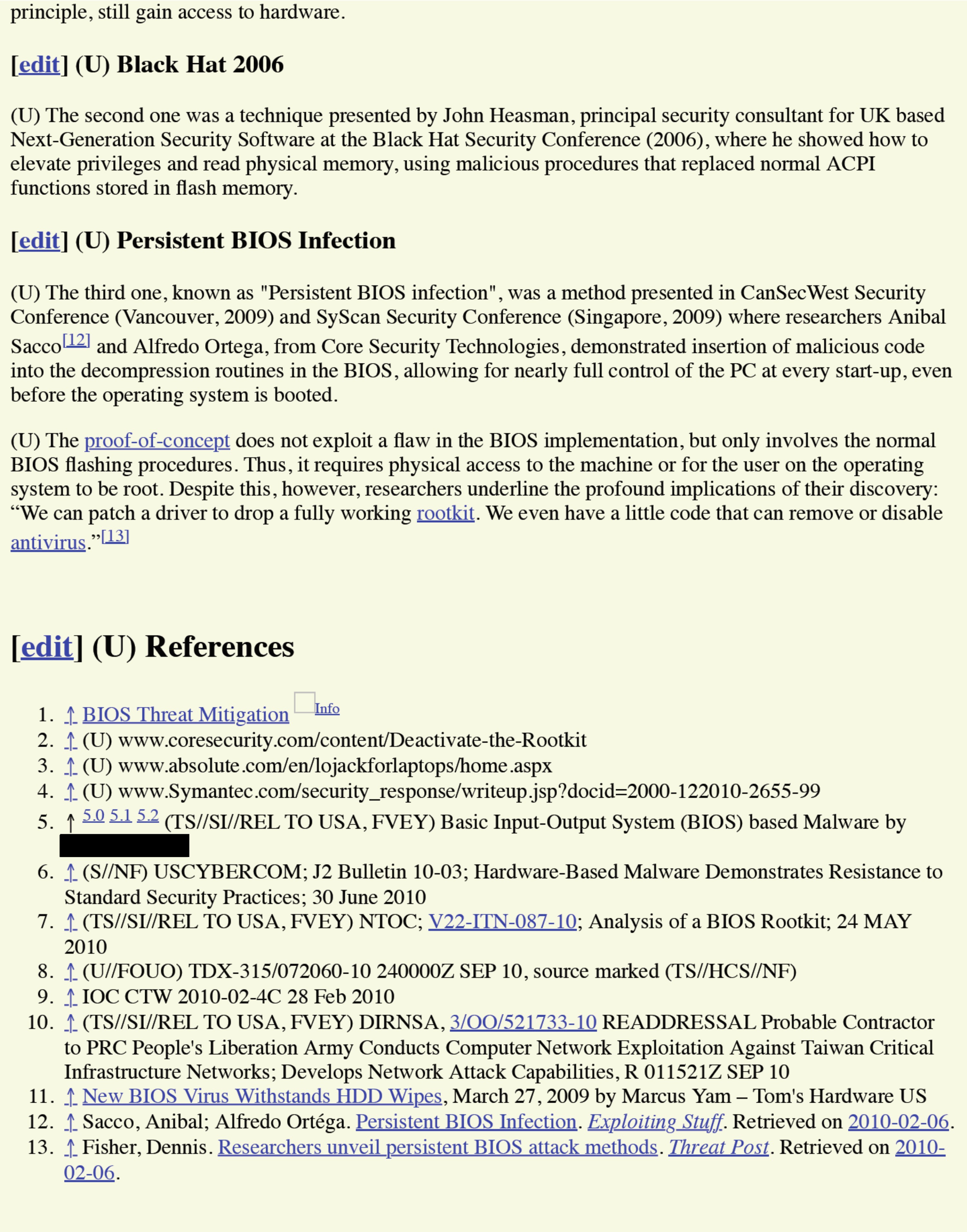
(U) The second one was a technique presented by John Heasman, principal security consultant for UK based Next-Generation Security Software at the Black Hat Security Conference (2006), where he showed how to elevate privileges and read physical memory, using malicious procedures that replaced normal ACPI functions stored in flash memory.
[edit] (U) Persistent BIOS Infection
(U) The third one, known as "Persistent BIOS infection", was a method presented in CanSecWest Security Conference (Vancouver, 2009) and SyScan Security Conference (Singapore, 2009) where researchers Anibal Sacco [12] and Alfredo Ortéga, from Core Security Technologies, demonstrated insertion of malicious code into the decompression routines in the BIOS, allowing for nearly full control of the PC at every start-up, even before the operating system is booted.
(U) The proof-of-concept does not exploit a flaw in the BIOS implementation, but only involves the normal BIOS flashing procedures. Thus, it requires physical access to the machine or for the user on the operating system to be root. Despite this, however, researchers underline the profound implications of their discovery: "We can patch a driver to drop a fully working rootkit. We even have a little code that can remove or disable antivirus."[13]
[edit] (U) References
- ↑ BIOS Threat Mitigation Info
- ↑ (U) www.coresecurity.com/content/Deactivate-the-Rootkit
- ↑ (U) www.absolute.com/en/lojackforlaptops/home.aspx
- ↑ (U) www.Symantec.com/security_response/writeup.jsp?docid=2000-122010-2655-99
- ↑ 5.0 5.1 5.2 (TS//SI//REL TO USA, FVEY) Basic Input-Output System (BIOS) based Malware by [REDACTED]
- ↑ (S//NF) USCYBERCOM; J2 Bulletin 10-03; Hardware-Based Malware Demonstrates Resistance to Standard Security Practices; 30 June 2010
- ↑ (TS//SI//REL TO USA, FVEY) NTOC; V22-ITN-087-10; Analysis of a BIOS Rootkit; 24 MAY 2010
- (U//FOUO) TDX-315/072060-10 240000Z SEP 10, source marked (TS//HCS//NF)
- IOC CTW 2010-02-4C 28 Feb 2010
- ↑ (TS//SI//REL TO USA, FVEY) DIRNSA, 3/00/521733-10 READDRESSAL Probable Contractor to PRC People's Liberation Army Conducts Computer Network Exploitation Against Taiwan Critical Infrastructure Networks; Develops Network Attack Capabilities, R 011521Z SEP 10
- ↑ New BIOS Virus Withstands HDD Wipes, March 27, 2009 by Marcus Yam – Tom's Hardware US
- ↑ Sacco, Anibal; Alfredo Ortega. Persistent BIOS Infection. Exploiting Stuff. Retrieved on 2010-02-06.
- Fisher, Dennis. Researchers unveil persistent BIOS attack methods. Threat Post. Retrieved on 2010-02-06.
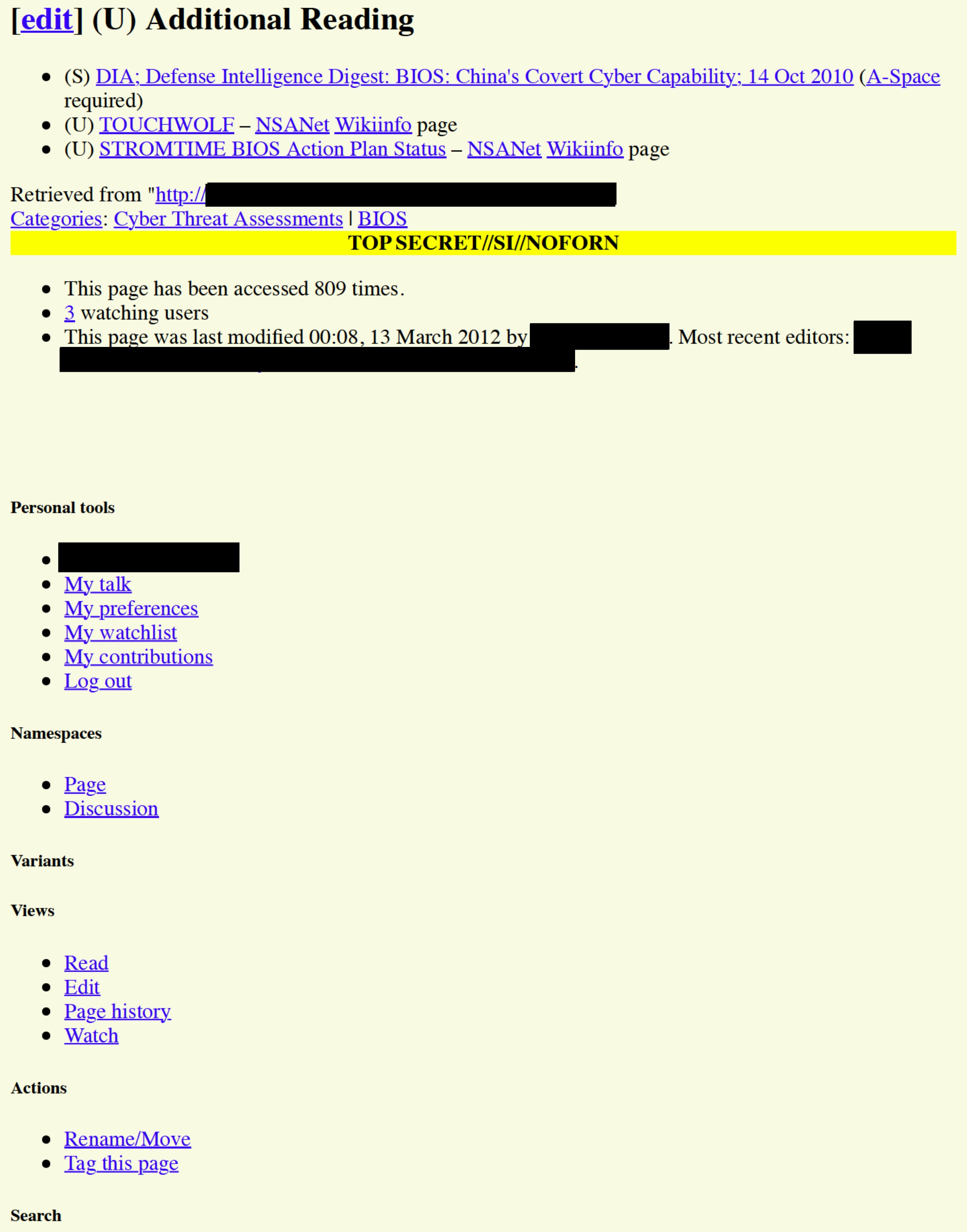
[edit] (U) Additional Reading
- (S) DIA; Defense Intelligence Digest: BIOS: China's Covert Cyber Capability; 14 Oct 2010 (A-Space required)
- (U) TOUCHWOLF - NSANet Wikiinfo page
- (U) STROMTIME BIOS Action Plan Status – NSANet Wikiinfo page
Retrieved from "http://[REDACTED]"
Categories: Cyber Threat Assessments | BIOS
TOP SECRET//SI//NOFORN
- This page has been accessed 809 times.
- 3 watching users
- This page was last modified 00:08, 13 March 2012 by [REDACTED] Most recent editors: [REDACTED]
Personal tools
- [REDACTED]
- My talk
- My preferences
- My watchlist
- My contributions
- Log out
Namespaces
- Page
- Discussion
Variants
Views
- Read
- Edit
- Page history
- Watch
Actions
- Rename/Move
- Tag this page
Search
Search
- Main Page
- Recent changes
- Help
- Random Article
- Sandbox
- Guidelines
- Recent files
- Top categories
interaction
- Featured articles
- Announcements
- Collaboration requests
- Tutorial
- Bulletin Board
- Metrics
- Acronyms
- People Finder
social software tools
Toolbox
- Privacy policy
- About Intellipedia
- Disclaimers
[REDACTED]
Use of this U.S. Government system, authorized or unauthorized, constitutes consent to monitoring of this system. Unauthorized use may subject you to criminal prosecution.
Evidence of unauthorized use collected during monitoring may be used for administrative, criminal, or other adverse actions.
This page contains dynamic content -- Highest Possible Classification isTOP SECRET//SI/TKSecurity BannerTerms of Use
Published in the Same Report
(8 documents)
-
DoD 2011 Strategy for Operating in Cyberspace – Supply Chain Excerpts [pdf]
The classified 2011 Department of Defense strategy warns that U.S. reliance on foreign manufacturing—especially from countries like China—creates major cybersecurity risks, including the potential insertion of malicious hardware or software into critical systems. It outlines a government-wide plan to mitigate these supply chain vulnerabilities through coordinated policies, risk management strategies, and collaboration with industry.
-
Intellipedia – Air Gapped Network Threats [pdf]
This document from an internal wiki for the U.S. intelligence community, surveys threats to so-called air-gapped systems, arguing that supply-chain compromises, physical implants (BIOS, KVMs, peripherals), infected removable media, and enabled wireless/emanations present realistic paths for adversaries to bridge isolated networks. It assesses likelihoods and attack vectors (including insider help and CDS/guard exploitation), highlights specific historic incidents (Agent.BTZ/MAKERSMARK), and recommends strict removable-media policies, TEMPEST countermeasures, and rigorous cross-domain guard protections to mitigate the risk.
People: Witte, Griff · Warren, Peter · Streeter, Michael · Watson, Paul · Louchard, Bjørn · Crawford, George · Rudge, David · Terrazas, Michael -
Intellipedia – Supply Chain Cyber Threats [pdf]
This document on Supply Chain Cyber Threats, from an internal wiki for the U.S. intelligence community, outlines vulnerabilities in hardware and firmware components such as power supplies, NICs, RAID controllers, GPUs, and peripheral devices that could be exploited by adversaries through the supply chain. It details assessments from U.S. intelligence agencies (CIA, DIA, FBI, CYBERCOM) highlighting risks from foreign companies, insider threats, and malicious modifications that could compromise critical U.S. government and military systems.
Programs: A-SPACE -
NSA Supply Chain Attack From PMR 4-24-13 [pdf]
This document is a top-secret NSA report detailing a SIGINT development operation in which a classified Voice-over-IP network shipment was intercepted and subjected to a supply-chain interdiction, allowing NSA and its intelligence community partners to gain access to the hardware and intelligence. It describes the operational process, including tracking the shipment through China, coordinating with Tailored Access Operations (TAO), and using tools like XKEYSCORE to identify targeting selectors, ultimately enabling detailed surveillance and future operational opportunities.
-
National Intelligence Estimate 2009 Global Cyber Threat – Supply Chain Excerpts [pdf]
These Supply Chain Excerpts from the 2009 National Intelligence Estimate, assesses that the U.S. faces a growing cyber threat from state actors, particularly Russia and China, who have the capability and strategic intent to exploit or disrupt U.S. and allied information systems. It emphasizes vulnerabilities from supply chains, insider threats, and technology trends that favor offensive operations, while noting the difficulty of detecting and fully defending against these sophisticated cyber threats.
-
PRC Information Warfare & Huawei [pdf]
This NSA intelligence briefing on Huawei analyzes Huawei’s global telecommunications presence and its potential links to the People’s Liberation Army (PLA) and Chinese government intelligence activities. It highlights concerns that Huawei’s international market expansion — including its subcontracted 2008 upgrade of the TAT-14 transatlantic cable carrying U.S. and defense communications — could be exploited by China for signals intelligence (SIGINT) purposes.
People: Chávez, Hugo -
Special Collection Service – Pacific SIGDEV Conference March 2011 – Supply Chain Excepts [pdf]
This top-secret 2011 NSA presentation outlines how the Special Collection Service—a joint NSA–CIA program operating from U.S. embassies—leverages its global network of “points of presence” to conduct human-enabled SIGINT and cyber operations directly inside “adversary space.” Framed as a “home field advantage,” it portrays U.S. diplomatic sites as launchpads for infiltration, surveillance, and even supply chain attacks, blurring the line between diplomacy and digital espionage.
-
Tailored Access Operations 2007 [pdf]
This NSA document describes the Tailored Access Operations (TAO) division, which conducts sophisticated cyber operations to penetrate and maintain persistent access to target networks globally through both remote exploits and physical interdiction methods. The presentation outlines TAO's organizational structure, mission capabilities across telecommunications and data networks, development of hardware/software implants for devices ranging from servers to SCADA systems, collaboration with HUMINT partners for physical access operations, and specialized divisions focused on exploiting telephony systems, computer networks, and developing tools for computer network attack and exploitation.
Related Documents
-
Intellipedia – Air Gapped Network Threats [pdf]
This document from an internal wiki for the U.S. intelligence community, surveys threats to so-called air-gapped systems, arguing that supply-chain compromises, physical implants (BIOS, KVMs, peripherals), infected removable media, and enabled wireless/emanations present realistic paths for adversaries to bridge isolated networks. It assesses likelihoods and attack vectors (including insider help and CDS/guard exploitation), highlights specific historic incidents (Agent.BTZ/MAKERSMARK), and recommends strict removable-media policies, TEMPEST countermeasures, and rigorous cross-domain guard protections to mitigate the risk.
People: Witte, Griff · Warren, Peter · Streeter, Michael · Watson, Paul · Louchard, Bjørn · Crawford, George · Rudge, David · Terrazas, Michael -
Tailored Access Operations 2007 [pdf]
This NSA document describes the Tailored Access Operations (TAO) division, which conducts sophisticated cyber operations to penetrate and maintain persistent access to target networks globally through both remote exploits and physical interdiction methods. The presentation outlines TAO's organizational structure, mission capabilities across telecommunications and data networks, development of hardware/software implants for devices ranging from servers to SCADA systems, collaboration with HUMINT partners for physical access operations, and specialized divisions focused on exploiting telephony systems, computer networks, and developing tools for computer network attack and exploitation.
-
Pay attention to that man behind the curtain: Discovering aliens on CNE infrastructure [pdf]
CSEC briefing from 2010 outlines Canada’s counter–computer network exploitation efforts to detect, analyze, and pursue foreign and friendly cyber actors operating on shared CNE infrastructure. It details tools, methods, and a case study showing how hidden implants and overlapping state-sponsored operations were uncovered and attributed.
Programs: SNOWGLOBE · WARRIORPRIDE · DAREDEVIL · SLIPSTREAM · CHORDFLIER · NAMEDROPPER · WORMWOOD · REPLICANTFARM · OBELIX · SHEPHERD · CARBON · ALOOFNESS · REGBACKUP · DOGHOUSE · WALKER · CHOCOPOP · BLAZINGANGEL · WINDO · QUIVERINGSQUAB · DIESELRATTLE · CYDLL · CIVETCAT · WIDOWKEY · LASEX · PULLEDPORK · MAKERSMARK · FANNER · SEEDSPHERE · BYZANTINE · VOYEUR · SUPERDRAKE · GOSSIPGIRL · WATERMARK · DOURMAGNUM -
Intellipedia – Supply Chain Cyber Threats [pdf]
This document on Supply Chain Cyber Threats, from an internal wiki for the U.S. intelligence community, outlines vulnerabilities in hardware and firmware components such as power supplies, NICs, RAID controllers, GPUs, and peripheral devices that could be exploited by adversaries through the supply chain. It details assessments from U.S. intelligence agencies (CIA, DIA, FBI, CYBERCOM) highlighting risks from foreign companies, insider threats, and malicious modifications that could compromise critical U.S. government and military systems.
Programs: A-SPACE -
NSA ANT Catalog [pdf]
The NSA ANT catalog is a leaked confidential collection of sophisticated surveillance and hacking tools developed by the agency’s Tailored Access Operations unit (TAO), detailing hardware and software implants capable of covertly infiltrating computers, networks, and mobile devices. It revealed the NSA’s ability to conduct remote surveillance, implant malware, and maintain persistent access to targeted systems without users’ knowledge.
Programs: IRONCHEF · PROTOSS · STRONGMITE · GECKO II · STRAITBIZARRE · WAGONBED · UNITEDRAKE · DEITYBOUNCE · ARKSTREAM · TUNING FORK · GODSURGE · FLUXBABBITT · JETPLOW · BANANAGLEE · HALLUXWATER · TURBOPANDA · FEEDTROUGH · ZESTYLEAK · GOURMETTROUGH · SOUFFLETROUGH · HEADWATER · HAMMERMILL · HIT · SIERRAMONTANA · VALIDATOR · SCHOOLMONTANA · STUCCOMONTANA · CTX4000 · PHOTOANGLO · LOUDAUTO · ANGRYNEIGHBOR · NIGHTWATCHER · VIEWPLATE · LFS-2 · TAWDRYYARD · RAGEMASTER · CROSSBEAM · CHIMNEYPOOL · ROCKYKNOB · CANDYGRAM · CYCLONE Hx9 · TYPHON · EBSR · LANDSHARK · ENTOURAGE · HOLLOWPOINT · GALAXY · GENESIS · NEBULA · TYPHON HX · WATERWITCH · NIGHTSTAND · SPARROW II · BLINDDATE · DROPOUTJEEP · ARTEMIS · DROPMIRE · STRAITBIZZARE · FREEFLOW · TURBULENCE · GOPHERSET · MONKEYCALENDAR · TOTECHASER · TOTEGHOSTLY · PICASSO · TOTEGHOSTLY 2.0 · FRIEZERAMP · GENIE · VAGRANT · GOTHAM · SURLYSPAWN · GINSU · BULLDOZER · KONGUR · OMNIGAT · IRATEMONK · SERUM · SLICKERVICAR · RETURNSPRING · WISTFULTOLL · JIMSQ · SEAGULLFARO · SWAP · SNEAKERNET · TWISTEDKILT · HOWLERMONKEY · SUTURESAILOR · YELLOWPIN · CONJECTURE · SPECULATION · JUNIORMINT · MAESTRO · MAESTRO-II · SOMBERKNAVE · OLYMPUS · TRINITY · COTTONMOUTH-I · COTTONMOUTH-II · TURBINE · COTTONMOUTH-III · FIREWALK · DANDERSPRITZ