Tag: intelligence sharing 91 documents
Search documents matching “intelligence sharing” →Free-text subjects the curators added. Unlike the other axes these are not necessarily from the documents' own vocabulary, so they are the loosest thing to browse by (and the most forgiving).
Graphs
By document date (12 years)
By Banner
By Classification
Refine (combine with another filter, via search)
Sort: Title
Documents
-
Ashcroft Memo on Intelligence Sharing Procedures [pdf]
In August 2002, citing a recent surveillance court ruling, then-Attorney General John Ashcroft issued new procedures that lowered safeguards on providing to foreign governments information about Americans that was deemed relevant intelligence about terrorism issues. Under procedures disclosed in a 1984 report on the Foreign Intelligence Surveillance Act, the attorney general had to approve any international dissemination; the new procedures have allowed the National Security Agency to share such information without Justice Department clearance.
People: Ashcroft, John -
A 'Glimpse of the Future' of NSA's Foreign Partnerships SIDtoday [pdf]
The NSA's foreign affairs director briefed the signals intelligence committee on foreign partnerships in the coming years. He stressed the importance of the agency's relationships with Ethiopia and Pakistan, and said his directorate is helping Iraq and Afghanistan "establish their SIGINT capabilities."
Programs: SIGINT Seniors PacificThe Intercept ↗ (2017-09-13) -
Afghanistan Coalition Dissemination Brief to Senior Leadership Forum [pdf]
This document ooutlines the structure, goals, and challenges of multinational signals intelligence (SIGINT) collaboration in Afghanistan as of 2009. It reveals how the U.S. and its intelligence-sharing allies (notably the 5 Eyes, 9 Eyes, and 14 Eyes) coordinated SIGINT collection, decryption, analysis, and dissemination across NATO and coalition forces.
“Mission Creep: How the NSA’s Game-Changing Targeting System Built for Iraq and Afghanistan Ended Up on the Mexico Border” - The Intercept ↗ (2019-05-29) · “Norges hemmelige krig i Afghanistan” - NRK ↗ (2019-05-29) · Moltke, Henrik · Skille, Øyvind Bye · Døvik, Olav · Hansen, Ståle Ellingsgard · Fjørtoft, Martin -
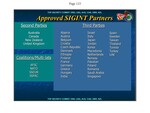
Approved SIGINT Partners [pdf]
A Foreign Affairs Directorate slide listing NSA's approved SIGINT partners: the four Second Parties, 33 Third Parties from Algeria to the United Arab Emirates, and the coalitions AFSC, NATO, SSEUR and SSPAC. This is document is from Fiscal Year 2013 "Foreign Partner Review."
-
Baltic region [pdf]
This screenshot shows a part of a document which is about the growing relationship with the Swedish FRA, as an “extremely competent” partner. In 2011, the FRA gave the NSA access to “unique” material from its cable collection regarding, among other things, Russia and the Baltic region.
-
Cartoon Crisis: NSA Support to Danish Intelligence SIDtoday [pdf]
After a Danish newspaper published caricatures of Prophet Muhammad, Danish intelligence asked the NSA to step up reporting on threats to Danish assets abroad. The NSA did “everything we could” — including working weekends and late hours — to support their Danish partner.
The Intercept ↗ (2018-08-15) -
Chef's Choice: Third Parties SIDtoday [pdf]
SID Deputy Director Meals advocates expanding third-party signals intelligence relationships, including by going “military-to-military” when “we can’t deal with civilian authorities in a certain country,” and also by dealing with countries “that aren’t necessarily our close allies.”
People: Meals, CharlieThe Intercept ↗ (2016-08-10) -
Communications Capability Development Programme [pdf]
The Communications Capability Development (CCD) Programme (formerly the Intercept Modernisation Programme, IMP) was a Home Office–led effort to maintain the U.K.’s lawful interception and communications data capabilities amid changing technologies, emphasizing that law enforcement faced a “significant decline” without new measures. GCHQ supported CCD with technical expertise and interim services like MILKWHITE Enrichment, while stressing that CCD was politically contentious, technically complex, and required legislation to mandate data retention by U.K. network operators.
-
ConSIDer This: The ABC's of Second Party Liaison SIDtoday [pdf]
Special U.S. Liaison Offices are representatives to the second-party countries (the U.K., Canada, Australia, and New Zealand) for cryptologic collaboration. The Foreign Affairs Directorate has officers overseeing second-party matters at Fort Meade, and each second party maintains a senior liaison at NSA.
The Intercept ↗ (2016-05-16) -
Cooperation between the NSA and BND [pdf]
Comprehensive internal summary of the history and current state of cooperation between the NSA and BND
Programs: RT-RGPeople: Schindler, Gerhard -
Counterterrorism Analytic Working Group Meets in Madrid SIDtoday [pdf]
This SIDtoday document details the 11th SIGINT Seniors Counterterrorism (SISECT) Analytic Working Group meeting in Madrid, which focused on enhancing counterterrorism collaboration through topics like terrorist use of the Internet, metadata sharing, and language capabilities. Key outcomes included initiatives for SIGINT exploitation of the Internet, improving language processing and translation via SIGDASYS, and fostering deeper cooperation between nations on counterterrorism efforts.
-
Croats May Hold Key to Vital Intelligence on Montenegro SIDtoday [pdf]
Ahead of Montenegro’s secession referendum, the Croatian Intelligence Agency has intercepted phone signals of high intelligence value, which may give access to the future Montenegrin government’s communications.
The Intercept ↗ (2018-08-15) -
DSD’s Risky Metadata Sharing: Australian Citizens’ Privacy Jeopardized in 5-Eyes Surveillance [pdf]
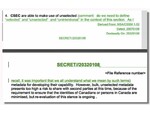
The document reveals that in 2008, Australia’s Defence Signals Directorate (DSD) was willing to share bulk, unselected, unminimised metadata about ordinary citizens with its 5-Eyes partners, including sensitive medical, legal, and religious information.
Marking: SECRET -
Event RARE weekly summaries [pdf]
This document outlines GCHQ's ongoing surveillance efforts in Libya, focusing on intercepting and analyzing communications from the Libyan regime, including military command and control via mobile satellite phones and other communication channels. It details the use of advanced SIGINT tools and close cooperation with the NSA, US, and Canadian intelligence agencies to monitor key military targets and opposition forces, supporting both tactical military operations and strategic intelligence objectives.
People: Gaddafi, Muammar -
Excerpt of May 2008 NSA Afghanistan Dataflow Analysis [pdf]
The document outlines how the NSA’s Real Time Regional Gateway (RT-RG) in Afghanistan progressively expanded from late 2007 through 2008 to ingest massive amounts of GSM, VHF, HF, and telephony metadata from dozens of locations across Afghanistan, supplemented by third-party “dirtbox” collection from allied nations such as the Netherlands, Denmark, Norway, Germany, and Spain. It details the specific collection sites, data types, and timelines (SPIN 9, 10, 11, etc.), illustrating how partner contributions and multiple signals sources fed into the RT-RG system to enable real-time intelligence.
Programs: FOURCORNERS · FORTRESS · WARRIOR · ECHIDNA · CASSIEOPIA · KARUS · SOUNDER · SNICK · TEMPOWOLFE · CALYPSO · TATTERAN · AIRBORNE · LEAVEBEHIND · UDEAUS · NELEUS · CROSSHAIR · SSO · DRT · RIVET JOINT · VOICESAIL“Mission Creep: How the NSA’s Game-Changing Targeting System Built for Iraq and Afghanistan Ended Up on the Mexico Border” - The Intercept ↗ (2019-05-29) · “Norges hemmelige krig i Afghanistan” - NRK ↗ (2019-05-29) · Moltke, Henrik · Skille, Øyvind Bye · Døvik, Olav · Hansen, Ståle Ellingsgard · Fjørtoft, Martin -
FINAL Agenda SWEDUSA [pdf]
Detailed list of points and participants in the summit meeting between the top brass of the FRA and the NSA in April 2013.
Programs: TURTLEPOWER · TURMOIL · XKEYSCORE · WINTERLIGHT · QUANTUM · PARTNERMALL · VIVIAN · NAPA-3 · GCE · SSO -
'Foreign Releases' Pay Off in War on Terrorism SIDtoday [pdf]
Foreign releases — U.S. signals intelligence reports released to governments cooperating on a “mutually beneficial activity” — have lead to arrests linked to foreign fighter networks outside Iraq, in countries such as Algeria, Saudi Arabia, and Syria.
The Intercept ↗ (2018-08-15) -
Guidelines for the classification of NSA SIGINT details (1945-1967) [pdf]
This document is an NSA classification guide that defines how and why historical SIGINT material from 1945–1967 remains classified, in many cases for 75 years. It systematically explains which intelligence activities, targets, partnerships, and technical methods must stay protected because they still reveal sensitive sources, methods, and diplomatic equities.
-
How SIGINT's Done Down Under! SIDtoday [pdf]
The Defence Signals Directorate, the Australian counterpart to NSA, had the sole “reporting responsibility” for regional targets like Indonesia, Singapore, and Malaysia. NSA and DSD have a close relationship and exchange staff.
The Intercept ↗ (2016-08-10) -
HR DIETMAR B - Director SIGINT Analysis and Production German Federal Intelligence Service, 30 April - 1 May 2013 [pdf]
This draft agenda outlines scheduled meetings and presentations for a collaboration event between the German Federal Intelligence Service (BND) and the NSA, held from April 30 to May 1, 2013. The agenda details various discussions on SIGINT analysis, data acquisition, and counterterrorism efforts, showcasing the active engagement between the two intelligence communities.
Programs: SSOPeople: Alexander, Keith B.