Classification: SECRET 154 documents
Search documents matching “SECRET” →Each document's classification level, as component values. If a document contains multiple classifications, the highest is used here.
Graphs
By Banner
Refine (combine with another filter, via search)
Sort: Title
Documents
-
Global Collaboration Environment: Director’s talking points [pdf]
This NSA document reveals discussions between the agency and GCHQ about establishing a permanent joint surveillance facility in the UK to host the "SIGINT Seniors Europe" coalition, with both agencies coordinating messaging to overcome "persistent pushback" from some member nations. The memo indicates concerns that some European partners were reluctant due to "uncertainty on what missions the center will support, and associated concerns for European human rights laws," while the NSA preferred UK hosting as "optimal in terms of having the most flexibility in tuning the operation to benefit the Five Eyes."
-
Guide to Using Contexts in XKS Fingerprints [pdf]
This technical guide explains how NSA analysts use "contexts" within XKEYSCORE fingerprints to create highly targeted surveillance queries by restricting searches to specific scopes (e.g., web searches, document bodies, geographic locations), enabling precision targeting such as finding "all people in Kabul performing web searches on Jihad" while avoiding the overwhelming noise of broader keyword searches.
-
How Is Human Language Technology (HLT) Progressing? SIDtoday [pdf]
This document provides an operational update on the deployment of "HLT Labs"—a specialized suite of voice analytics designed to automate the discovery of intelligence "nuggets" within massive volumes of audio collection. The document highlights successful field applications in Afghanistan, Georgia, Texas, and Latin America, noting that these tools are becoming "force multipliers" that allow linguists to bypass manual listening in favor of automated keyword searching and speaker recognition.
-
How to configure category throttling in XKEYSCORE [pdf]
An NSA technical guide explains how to configure "category throttling" in XKEYSCORE—a feature that automatically stops forwarding intercepted communications once analyst-defined collection targets hit predetermined data volume or session count limits, allowing the surveillance system to continue processing but prevent overflow from high-volume targets.
-
HR DIETMAR B - Director SIGINT Analysis and Production German Federal Intelligence Service, 30 April - 1 May 2013 [pdf]
This draft agenda outlines scheduled meetings and presentations for a collaboration event between the German Federal Intelligence Service (BND) and the NSA, held from April 30 to May 1, 2013. The agenda details various discussions on SIGINT analysis, data acquisition, and counterterrorism efforts, showcasing the active engagement between the two intelligence communities.
Programs: SSOPeople: Alexander, Keith B. -
ICREACH Black Budget Extracts [pdf]
This document provides fiscal and strategic justifications for the continued expansion of ICREACH, detailing its role as a primary vehicle for disseminating both telephony and Digital Network Intelligence (DNI) metadata across the Intelligence Community. It outlines the platform's transition to the NSA/CSS cloud architecture, a move intended to enhance data enrichment services and ensure the system remains responsive to the evolving requirements of the National Intelligence Priorities Framework (NIPF).
Programs: ICREACH -
ICREACH: Sharing SIGINT Comms Metadata with the Intel Community SIDtoday [pdf]
This document serves as an internal announcement marking the 2007 operational launch of ICREACH, a massive signals intelligence (SIGINT) metadata-sharing platform designed to provide real-time access to raw communication records for authorized analysts across the U.S. Intelligence Community. By consolidating telephony, cellular, and satellite data into a "one-stop shop" similar to the NSA’s internal GLOBALREACH tool, the program aimed to fulfill post-9/11 mandates for increased inter-agency collaboration and enhanced target development.
-
Internal NSA presentation on the BND's organization [pdf]
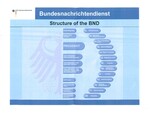
These six organizational charts and briefing slides detail the structure of Germany's BND foreign intelligence service, specifically its SIGINT Directorate (Abteilung Technische Aufklärung) and new Cyber Intelligence division (T4), along with a cooperation model showing intelligence sharing between BND, domestic intelligence service BfV, and the Federal Office for Information Security (BSI).
-
Interview with a SID "Hacker" -- Part 1: How Does TAO Do Its Work? SIDtoday [pdf]
A SIDToday interview from July 2012 with a counterterrorism subject-matter expert in TAO's Requirements and Targeting organisation, explaining how TAO plans and executes computer network exploitation operations.
“The Digital Arms Race: NSA Preps America for Future Battle” - Der Spiegel ↗ (2015-01-17) · “Arbeiten mit geheimen Snowden-Dokumenten” - Der Spiegel ↗ (2015-07-03) · Appelbaum, Jacob · Gibson, Aaron · Guarnieri, Claudio · Müller-Maguhn, Andy · Poitras, Laura · Rosenbach, Marcel · Ryge, Leif · Schmundt, Hilmar · Sontheimer, Michael · Eckert, Svea · Stark, Holger -
Interview with a SID "Hacker" -- Part 2: Hacker Culture and Worker Retention SIDtoday [pdf]
A SIDtoday internal NSA newsletter interview with a redacted TAO employee discussing hacker culture within the agency's offensive cyber unit, worker retention challenges, and the team's role in operations including the raid that killed Osama bin Laden.
Programs: SCQAWKPeople: bin Laden, Osama -
Intrusion Analysis – GCHQ [pdf]
An internal GCHQ write-up defines the Intrusion Analysis team’s remit inside the Joint Electronic Attack Cell: all‑source analysis of emerging and active electronic attacks, stewardship of electronic attack signatures, and SIGINT‑driven targeting under EITT oversight. It details sources, reporting channels, legal authorities, and auditing controls that govern how signatures are deployed and how selectors are managed.
-
Is There a Sustainable Ops Tempo in S2? How Can Analysts Deal with the Flood of Collection? SIDtoday [pdf]
The NSA's Deputy Director for Analysis and Production discusses the unsustainable operational tempo caused by overwhelming data collection volumes, advocating for "Analytic Modernization" that would shift from treating SIGINT as "radioactive" NSA-only material to sharing raw intelligence with other agencies for collaborative exploitation.
Programs: A-SPACE -
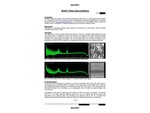
ISUAV Video Descrambling [pdf]
The document details how GCHQ analysts intercepted and descrambled scrambled analogue video from Israeli UAVs using a "cut & slide" technique similar to Sky TV’s old VideoCrypt system. By applying open-source tools like Antisky, they could reconstruct individual video frames, enabling near-perfect image recovery despite heavy processing demands.
Marking: SECRET -
Japan official NSA visit, cyber briefing [pdf]
This document outlines cooperation between the NSA and Japan’s Directorate for SIGINT (DFS) to develop Japan’s capabilities for providing signals intelligence (SIGINT) support to cyber defense operations, particularly against Chinese cyber activities. It details meetings, training, and data-sharing efforts from 2012–2013 aimed at enhancing Japan’s cyber intelligence capacity under U.S. guidance.
“Japan Made Secret Deals With the NSA That Expanded Global Surveillance” - The Intercept ↗ (2017-04-24) · “アメリカに監視される日本 ~スノーデン“未公開ファイル”の衝撃” - NHK ↗ (2017-04-24) · Gallagher, Ryan · Ikegami, Akira -
Japan official NSA visit, HF briefing [pdf]
The document describes ongoing NSA efforts to renew high-frequency direction-finding (HFDF) collaboration with Japan’s Directorate for SIGINT (DFS) after Japan withdrew from the CROSSHAIR network in 2009. By 2012–2013, both sides were manually exchanging HFDF data, and the NSA sought to advance toward automated data sharing via its BORESIGHT system while reassuring Japan that it would not replace or override its existing technology.
“Japan Made Secret Deals With the NSA That Expanded Global Surveillance” - The Intercept ↗ (2017-04-24) · “アメリカに監視される日本 ~スノーデン“未公開ファイル”の衝撃” - NHK ↗ (2017-04-24) · Gallagher, Ryan · Ikegami, Akira -
Japan provided with XKEYSCORE [pdf]
This document outlines a request for approval to provide training to the Japanese Directorate for SIGINT (DFS) on using advanced SIGINT systems, including XKEYSCORE, to enhance Japan's cyber network defense capabilities. This training, scheduled for April 2013, aligns with U.S. strategic goals to bolster the cyber defense abilities of allied nations, highlighting ongoing NSA collaboration with Japan on surveillance and cybersecurity.
“Japan Made Secret Deals With the NSA That Expanded Global Surveillance” - The Intercept ↗ (2017-04-24) · “アメリカに監視される日本 ~スノーデン“未公開ファイル”の衝撃” - NHK ↗ (2017-04-24) · Gallagher, Ryan · Ikegami, Akira -
JORDAN-BELGIUM [pdf]
2008 GCHQ report documenting the interception of a Jordan–Belgium satellite telecommunications link, through which British intelligence monitored call traffic and identified tasked surveillance targets including the Turkish foreign ministry, Palestinian Authority figures and Israeli MK Ahmad Tibi, along with other hits on Kurdish leadership, diplomats, and Jordanian government offices such as the Royal Protocol Office. The published copies redact different entries. Der Spiegel's and The Intercept's show the Turkish and Kurdish ones, Le Monde's (version 8BBAC) the Palestinian and Jordanian ones.
People: Tibi, Ahmad“Turkey Is 'Partner and Target' for the NSA” - Der Spiegel ↗ (2014-08-31) · “How the NSA Helped Turkey Kill Kurdish Rebels” - The Intercept ↗ (2014-08-31) · “L’Autorité palestinienne et la Jordanie espionnées par les services américains et britanniques” - Le Monde ↗ (2016-12-07) · Poitras, Laura · Rosenbach, Marcel · Sontheimer, Michael · Stark, Holger · Follorou, Jacques -
-
Leaky phone apps [pdf]
These GCHQ slides describe the "WARRIOR PRIDE" mobile intrusion capability being ported to iPhone and Android, with plugins for power management, remote microphone, high‑precision geolocation, kernel stealth, and self‑protection. It claims the ability to retrieve almost any content from infected phones (SMS/MMS, email, call records, photos, calendar, etc.). Part of GCHQ's project "Mobile Applications Project".
Programs: Mobile Applications Project · WARRIORPRIDE · DREAMYSMURF · NOSEYSMURF · TRACKERSMURF · PORUS · PARANOIDSMURF -
Location Cookies [pdf]
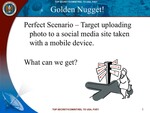
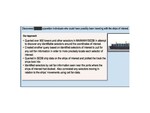
These slides contain excerpts from an April 2013 National Security Agency presentation detailing signal surveillance techniques and successes. They reveal that the NSA and its British counterpart, Government Communications Headquarters (GCHQ), use a Google-specific tracking cookie to pinpoint targets for hacking.