Article
The NSA in Germany: Snowden's Documents Available for Download
Documents published with this article 28
-
SID Around the World: The Rheinland SIDtoday [pdf]
An NSA couple worked at locations in Germany’s Rheinland and enjoyed local cuisine and European travel.
“The NSA in Germany: Snowden's Documents Available for Download” - Der Spiegel ↗ (2014-06-18) · The Intercept ↗ (2016-05-16) -
European Security Center to Begin Operations SIDtoday [pdf]
SIGINT operations in support of U.S. Army Europe and European Command will start at a facility in Darmstadt, Germany, in April 2004.
Marking: SECRET“The NSA in Germany: Snowden's Documents Available for Download” - Der Spiegel ↗ (2014-06-18) · The Intercept ↗ (2016-12-07) -
A Little Bad Aibling Nostalgia SIDtoday [pdf]
With the closing of Bad Aibling Station in Germany, some BA veterans post a list of nostalgic recollections from working there.
“The NSA in Germany: Snowden's Documents Available for Download” - Der Spiegel ↗ (2014-06-18) · The Intercept ↗ (2016-12-07) -
Forward Production at NCEUR — Inside the Customers' Decision Space SIDtoday [pdf]
Beginning in 2003, a team of NSA counterterrorism analysts based at NSA/CSS Europe began a dedicated project to support counterterrorism efforts in North Africa. The team collected signals intelligence, which they distributed to U.S. European Command and U.S. ambassadors, who then transmitted this information to governments in Mali, Algeria, and Mauritania. They believe this effort was "responsible for the capture or kill of over 40 terrorists."
“The NSA in Germany: Snowden's Documents Available for Download” - Der Spiegel ↗ (2014-06-18) · The Intercept ↗ (2017-09-13) -
On the Road Again: SID Team Visits Germany SIDtoday [pdf]
A Signals Intelligence Directorate team visits NSA sites in Germany.
Marking: CONFIDENTIAL“The NSA in Germany: Snowden's Documents Available for Download” - Der Spiegel ↗ (2014-06-18) · The Intercept ↗ (2018-08-15) -
European Technical Center Area Checked for Unexploded WWII Ordnance SIDtoday [pdf]
The European Technical Center area in Mainz, Germany, was closed for a day while investigators checked what seemed to be — but wasn’t — unexploded Word War II ordnance.
“The NSA in Germany: Snowden's Documents Available for Download” - Der Spiegel ↗ (2014-06-18) · The Intercept ↗ (2018-08-15) -
German, NSA SIGINTers Share DNI Processing Knowledge SIDtoday [pdf]
A delegation from Germany’s Federal Intelligence Service visits Fort Meade, Maryland, to learn about the NSA’s “packet level” selection and filtering of internet-based traffic, which is opposite to the approach used by the Germans.
“The NSA in Germany: Snowden's Documents Available for Download” - Der Spiegel ↗ (2014-06-18) · The Intercept ↗ (2018-08-15) -
The European Security Center to Become the 'ESOC' SIDtoday [pdf]
The European Security Center in Darmstadt, Germany will expand to become the European Security Operations Center; additional civilian NSA staff will join existing Army staff. The ESOC's primary responsibilities will be targets in Africa.
“The NSA in Germany: Snowden's Documents Available for Download” - Der Spiegel ↗ (2014-06-18) · The Intercept ↗ (2019-05-29) -
NSAers Make First-Ever Visit to FORNSAT Collection Site in Schöningen, Germany SIDtoday [pdf]
The BND (German Federal Intelligence Service) has a base at Schoningen, where they collect different types of mobile communications (satellite, fax, and GSM), many of which they share with their NSA counterparts. NSA visited to compare notes, and requested copies of some of the Germans' software tools--which had "features that surpass US SIGINT capabilities--for call chaining and metadata analysis.
“The NSA in Germany: Snowden's Documents Available for Download” - Der Spiegel ↗ (2014-06-18) · The Intercept ↗ (2019-05-29) -
BOUNDLESSINFORMANT Overview [pdf]
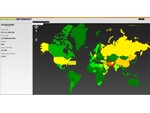
World map view from the Boundless Informant program, with "CNE" (Computer Network Exploitation) selected from the dropdown.
Programs: BOUNDLESSINFORMANT -
Internal NSA presentation on the BND's organization [pdf]
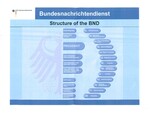
These six organizational charts and briefing slides detail the structure of Germany's BND foreign intelligence service, specifically its SIGINT Directorate (Abteilung Technische Aufklärung) and new Cyber Intelligence division (T4), along with a cooperation model showing intelligence sharing between BND, domestic intelligence service BfV, and the Federal Office for Information Security (BSI).
-
Boundless Informant statistics on Great Britain [pdf]
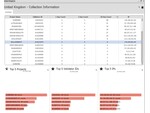
1 p.A BOUNDLESSINFORMANT country-level collection statistics page for the United Kingdom, showing 30-day collection counts across 12 named NSA collection projects (15 table rows) — with ACRIDMINI leading at 68 counts, followed by LUTEUSICARUS at 51 and CROSSEYEDSLOTH at 48 — listing validator IDs and specific IP addresses associated with each collection event.
Programs: ACRIDMINI · LUTEUSICARUS · HEADMOVIES · APERTURESCIENCE · CROSSEYEDSLOTH · KOALAPUNCH · BALLOONKNOT · MAGNUMOPUS · WAXTITAN · WILDCOUGAR · MURPHYSLAW · DARKFIRE · VALIDATOR -
Agenda for the visit of BSI Vice President Andreas Könen to the NSA [pdf]
An NSA visit schedule for Andreas Könen, Vice President of Germany's Federal Office for Information Security (BSI), covering briefings on NSA's Information Assurance Directorate, the FISHBOWL secure smartphone programme and the National Information Assurance Partnership — notable for being releasable to France but not Germany despite the visitor being a senior German government official.
Programs: FISHBOWLPeople: Könen, Andreas -
TEMPORA -- "The World's Largest XKEYSCORE" -- Is Now Available to Qualified NSA Users [pdf]
This document announces expanded NSA analyst access to TEMPORA, GCHQ’s massive XKEYSCORE‑based internet buffer, positioning it as the largest single XKEYSCORE data source in existence. It promotes TEMPORA as a high‑value discovery and development platform for large‑scale internet surveillance.
-
Guidelines for the classification of NSA SIGINT details (1945-1967) [pdf]
This document is an NSA classification guide that defines how and why historical SIGINT material from 1945–1967 remains classified, in many cases for 75 years. It systematically explains which intelligence activities, targets, partnerships, and technical methods must stay protected because they still reveal sensitive sources, methods, and diplomatic equities.
-
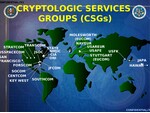
CRYPTOLOGIC SERVICES GROUPS (CSGs) [pdf]
Worldwide locations of the Cryptologic Services Groups (CSGs). The visual is a world map annotated with the locations of CSGs embedded in or supporting major U.S. combatant commands and agencies. These groups act as NSA’s cryptologic arms inside military commands. Cryptologic operations are co-located with military command authority and signals intelligence is structurally tied to every major U.S. warfighting domain.
-
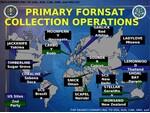
PRIMARY FORNSAT COLLECTION OPERATIONS [pdf]
This document is a TOP SECRET NSA/CSS slide mapping the global locations of primary FORNSAT (foreign satellite) collection operations, showing U.S. and second-party ground stations used to intercept satellite communications worldwide. It illustrates the geographic spread and allied integration of NSA satellite surveillance infrastructure rather than specific technical capabilities.
-
Locations of NSA personnel assigned to U.S. bases in Germany [pdf]
This document outlines locations in Germany where NSA personnel are stationed, with some information being classified due to the potential involvement in SIGINT activities or historical roles as A5 sites. It highlights various U.S. military and NSA bases and facilities, including well-known locations like Augsburg, Bad Aibling, and Berlin, while redacting sensitive information about specific activities and sites.
-
Trying to Find Potential Matches for a Garbled or Misspelled Name? Get Help from NYMROD [pdf]
Description of NYMROD, software developed by the Center for Content Extraction (CCE), intended for searching names across NSA, CIA and DoD intelligence report databases.
-
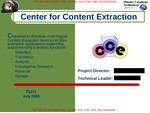
Center for Content Extraction - Nymrod Mission [pdf]
This top-secret NSA document outlines the mission and capabilities of NYMROD, a system developed by the Center for Content Extraction (CCE). It explains how NYMROD addresses analytic challenges such as linguistic variation in entity names, especially for person names, and the resolution of entity coreference problems using contextual evidence. The document discusses the multilingual content extraction services provided by NYMROD, which support various NSA enterprise applications and enhance analytic functions like selection, translation, analysis, investigative research, retrieval, and storage.
People: Ban, Ki-moon -
One-Year Anniversary for SUSLAG [pdf]
The document commemorates the one-year anniversary of the Special US Liaison Activity Germany (SUSLAG) at its new facility in Mangfall Kaserne, Bad Aibling, highlighting its transition from Bad Aibling Station. It discusses SUSLAG's ongoing role as a SIGINT liaison with the German intelligence service BND and showcases its collaborations, such as the Joint Analysis Center (JAC) and the Joint SIGINT Activity (JSA).
-
Special U.S. Liaison Activity Germany (SUSLAG)/ Joint SIGINT Activity (JSA)/ Defense Communications Interoperability Group (DCIG), CLASSIFICATION GUIDE [pdf]
The document serves as a classification guide for the Special U.S. Liaison Activity Germany (SUSLAG) and the Joint SIGINT Activity (JSA), detailing NSA's classified presence and associations with the Bundesnachrichtendienst (BND) in Mangfall Kaserne. It outlines the missions, roles, and relationships among these entities and the operational protocols for handling classified information.
Programs: FIFTYEXCLAIM -
GCHQ Report on the Technical Capabilities of the Powerful Espionage Program TEMPORA, which Allows for Full Take. [pdf]
In May 2012, GCHQ introduced the TEMPORA internet buffer capability, enabling full take collection of internet communications. This innovation provides NSA and GCHQ analysts access to extensive amounts of data, enhancing their analytical capabilities significantly.
-
-
XKeyscoreTabs XKS Development [pdf]
The document outlines the development and operational procedures for XKeyscore (XKS), detailing its types, upgrades, and the role of microplugins in enhancing data collection capabilities. It describes how different configurations manage data ingestion and the criteria used to filter and store communications for intelligence purposes.
-
HR DIETMAR B - Director SIGINT Analysis and Production German Federal Intelligence Service, 30 April - 1 May 2013 [pdf]
This draft agenda outlines scheduled meetings and presentations for a collaboration event between the German Federal Intelligence Service (BND) and the NSA, held from April 30 to May 1, 2013. The agenda details various discussions on SIGINT analysis, data acquisition, and counterterrorism efforts, showcasing the active engagement between the two intelligence communities.
Programs: SSOPeople: Alexander, Keith B. -
Final Agenda - HR DIETMAR B - Director SIGINT Analysis and Production German Federal Intelligence Service, 30 April - 1 May 2013 [pdf]
This document presents the final agenda for a visit by Hr. Dietmar B., the Director of SIGINT Analysis and Production from the German Federal Intelligence Service (BND), scheduled for April 30 to May 1, 2013. The agenda details key discussions and meetings with various officials from the NSA, focusing on strategic planning and areas of mutual interest in intelligence collaboration.
-
Talking Point Topics Proposal - HR DIETMAR B - Director SIGINT Analysis and Production German Federal Intelligence Service, 30 April - 1 May 2013 [pdf]
The memo summarizes preparatory talking points for meetings between NSA/NTOC and German intelligence (BND), BSI, and BfV leadership, highlighting Germany’s T4 cyber unit staffing progress (~130/150 positions), interest in NSA guidance on CND, and German legal prohibitions on near‑real‑time cyber defense activities. It records German interest in NSA programs (TUTELAGE, DIB partnerships), requests for follow‑on technical information, and an internal “landmine” assessment that substantial analytic/operational investment may not be justified yet; recommended next steps emphasize monitoring progress, encouraging interagency German cooperation, and offering selective lessons‑learned briefings.