Program: TAPERLAY 4 documents
Search documents matching “TAPERLAY” →Codenames and programs recorded for each document.
Graphs
By Banner
By Classification
Refine (combine with another filter, via search)
Sort: Title
Documents
-
FININT Tasking [pdf]
This document outlines GCHQ's financial intelligence (FININT) operations, detailing the use of tools like LUCKY STRIKE and LUCKY ESCAPE to search and fuse datasets from financial and travel sources. It also describes procedures for requesting financial checks on individuals and mentions the collection of bulk banking and credit card data from specific regions.
Programs: TRACFIN · LUCKY STRIKE · LUCKY ESCAPE · TAPERLAY · TMM · MOON RAKER · BROADOAK · FININTTRACKER · FINTOOLS · FOLLOWTHEMONEY · PLATINUMPLUS · RUSSETT -
How to tell if a target is 'foreign' [pdf]
The document describes a human intelligence (HUMINT) report indicating that a specific intelligence target, identified by a Foreign Source ID, is located outside the U.S., including details such as email, telephone number, and mobile network type, with checks confirming no U.S. roaming over a 60-day period. It illustrates the use of HUMINT to corroborate foreign location data for surveillance purposes.
-
ICREACH: Sharing SIGINT Comms Metadata with the Intel Community SIDtoday [pdf]
This document serves as an internal announcement marking the 2007 operational launch of ICREACH, a massive signals intelligence (SIGINT) metadata-sharing platform designed to provide real-time access to raw communication records for authorized analysts across the U.S. Intelligence Community. By consolidating telephony, cellular, and satellite data into a "one-stop shop" similar to the NSA’s internal GLOBALREACH tool, the program aimed to fulfill post-9/11 mandates for increased inter-agency collaboration and enhanced target development.
-
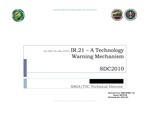
IR.21 – A Technology Warning Mechanism [pdf]
This 2010 TOP SECRET NSA briefing defines the IR.21 roaming document as a critical tool for "horizon scanning" and "forecasting" global telecommunications shifts. The document outlines how the NSA uses these technical files to proactively identify emerging 3G and 4G technologies, pinpointing vulnerabilities for exploitation before new systems are even fully deployed.