Intrusion Analysis – GCHQ
Open PDFDocument date: -
Pages: 2
Genre: report
Banner: SECRET STRAP1
Classification: SECRET STRAP 1
Dissemination: -
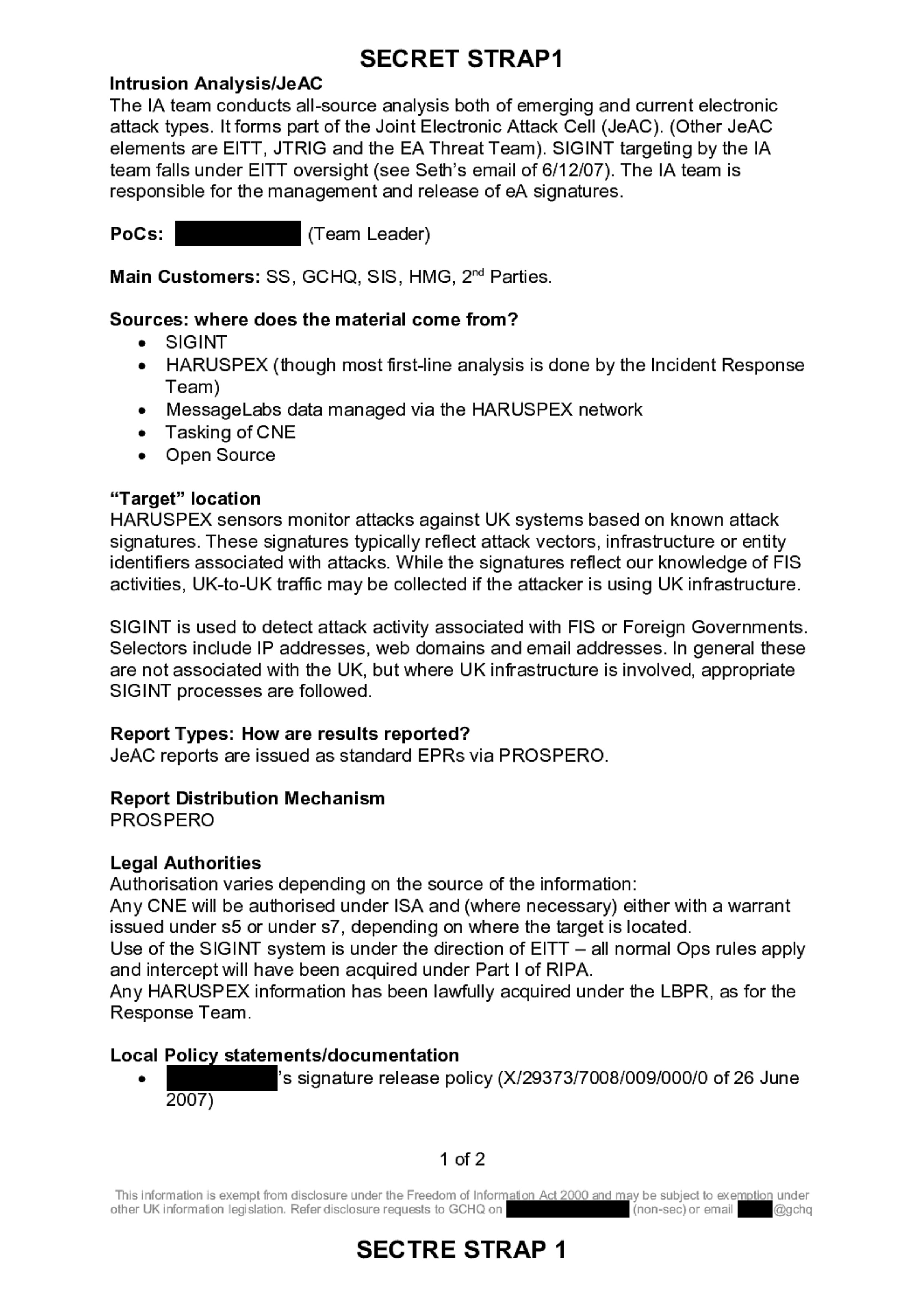
An internal GCHQ write-up defines the Intrusion Analysis team’s remit inside the Joint Electronic Attack Cell: all‑source analysis of emerging and active electronic attacks, stewardship of electronic attack signatures, and SIGINT‑driven targeting under EITT oversight. It details sources, reporting channels, legal authorities, and auditing controls that govern how signatures are deployed and how selectors are managed.
My notes
SECRET STRAP1
Intrusion Analysis/JeAC
The IA team conducts all-source analysis both of emerging and current electronic attack types. It forms part of the Joint Electronic Attack Cell (JeAC). (Other JeAC elements are EITT, JTRIG and the EA Threat Team). SIGINT targeting by the IA team falls under EITT oversight (see Seth's email of 6/12/07). The IA team is responsible for the management and release of eA signatures.
PoCs: [REDACTED] (Team Leader)
Main Customers: SS, GCHQ, SIS, HMG, 2nd Parties.
Sources: where does the material come from?
- SIGINT
- HARUSPEX (though most first-line analysis is done by the Incident Response Team)
- MessageLabs data managed via the HARUSPEX network
- Tasking of CNE
- Open Source
"Target" location
HARUSPEX sensors monitor attacks against UK systems based on known attack signatures. These signatures typically reflect attack vectors, infrastructure or entity identifiers associated with attacks. While the signatures reflect our knowledge of FIS activities, UK-to-UK traffic may be collected if the attacker is using UK infrastructure.
SIGINT is used to detect attack activity associated with FIS or Foreign Governments. Selectors include IP addresses, web domains and email addresses. In general these are not associated with the UK, but where UK infrastructure is involved, appropriate SIGINT processes are followed.
Report Types: How are results reported?
JeAC reports are issued as standard EPRs via PROSPERO.
Report Distribution Mechanism
PROSPERO
Legal Authorities
Authorisation varies depending on the source of the information:
Any CNE will be authorised under ISA and (where necessary) either with a warrant issued under s5 or under s7, depending on where the target is located.
Use of the SIGINT system is under the direction of EITT - all normal Ops rules apply and intercept will have been acquired under Part I of RIPA.
Any HARUSPEX information has been lawfully acquired under the LBPR, as for the Response Team.
Local Policy statements/documentation
- [REDACTED]'s signature release policy (X/29373/7008/009/000/0 of 26 June 2007)
1 of 2
This information is exempt from disclosure under the Freedom of Information Act 2000 and may be subject to exemption under other UK information legislation. Refer disclosure requests to GCHQ on [REDACTED] (non-sec) or email [REDACTED]@gchq
SECTRE STRAP 1
SECRET STRAP1
- [REDACTED]'s email of 6/12/07: "EITT/RCIT is accountable for eA use of the SIGINT system".
- [REDACTED] of EITT is working with OPPLEG on eA-specific authorisations for CNE (eg. to allow the targeting of UK-based victims).
- [REDACTED]'s description of the Signature Spreadsheet.
Auditing arrangements
The IA team has a fairly small number of selectors in CORINTH. Team members are prompted monthly to check the validity of their selectors. Formal audits are conducted under the auspices of EITT. HRA checking is enforced by the SIGINT system, in that selectors will age off if not re-validated. Use of SIGINT system for eA is covered by 2 MIRANDA numbers, corresponding to the separate JIC requirements for current and emerging electronic threats.
The team maintains a local spreadsheet of about 1500 eA signatures with associated information on nationality, release, likely false positive rate etc. The Signature Release Policy mentioned above controls the deployment of these signatures on HARUSPEX and their release to external agencies.
Number of reporters and their skill levels
There are 6 reporters in the IA team, of whom 2 are trained to Skill level 3 and 2 to Skill Level 2.
Other available legal/policy training
Operational Legalities Briefing.
Status:
Updated 23/7/08 with input from [REDACTED] and [REDACTED]
2 of 2
This information is exempt from disclosure under the Freedom of Information Act 2000 and may be subject to exemption under other UK information legislation. Refer disclosure requests to GCHQ on [REDACTED] (non-sec) or email [REDACTED]@gchq
SECTRE STRAP1
Published in the Same Report
(7 documents)
-
Malware Analysis & Reverse Engineering – ACNO Skill Levels [pdf]
A GCHQ competency profile defines the “Malware Analysis & Reverse Engineering” skill (ACNO Skill 12), detailing required knowledge, hands-on abilities, and a graded proficiency ladder from novice to community-recognized expert. It codifies tradecraft spanning exploitation, static/dynamic analysis, anti-analysis countermeasures, and tooling (including IDA Pro), aligning outcomes from detection through mitigation advice.
Marking: SECRET -
Operational Legalities – GCHQ Powerpoint Presentation [pdf]
GCHQ’s “Operational Legalities” deck is an internal compliance playbook that translates the UK’s surveillance laws into day‑to‑day SIGINT procedure—drilling staff on authorisation, necessity, and proportionality, and walking through warrants, targeting justifications, database queries, dissemination, and oversight. Half slides and half speaker notes, it shows how analysts are trained to document, audit, and defend operations under ISA, RIPA, HRA, and WTA while navigating edge cases like location, nationality, second‑party constraints, and “indirect targeting.”
-
GCHQ Application for Renewal of Warrant GPW/1160 [pdf]
GCHQ’s 2008 application to renew warrant GPW/1160 seeks blanket cover under ISA section 5 to reverse engineer and modify commercial software—explicitly breaching copyright and licensing—to enable CNE, vulnerability research, and even police forensics. It catalogues concrete ops against web forums, routers, and antivirus, and asserts a novel legal theory blessed by the Intelligence Services Commissioner to immunize intellectual‑property interference.
-
Reverse Engineering – GCHQ Wiki [pdf]
GCHQ’s internal GCWiki page sketches the TEA Reverse Engineering unit inside the TECA Product Centre: a lab team built to dissect hardware and embedded crypto devices, defeat smartcard‑class microprocessors, and turn black boxes into SIGINT‑ready emulators. It doubles as a training hub and liaison node, with kit lists, tours, and SRE exchanges—most real work pushed behind higher‑compartment CAWiki pages.
Marking: UK SECRETPrograms: RUSSETT -
Software Reverse Engineering – GCHQ [pdf]
GCHQ’s Network Defence unit runs software reverse engineering across both malicious and commercial code to map vulnerabilities, validate security claims, and feed CESG’s advice on electronic attack. Malicious code is fair game, but commercial RE hinges on GCHQ’s ISA s5 SRE warrant (GPW/1160), with local authorisers and audits—after a documented lapse in 2008 was retro‑authorised.
Marking: TOP SECRET -
TECA Product Centre — Wiki [pdf]
The TECA Product Centre is a GCHQ unit, within the Technical Enabling Covert Access group (TEA), whose mission is to develop and exploit specialist technologies and physical access methods to gain intelligence or SIGINT access where conventional methods fail. It works closely with SIS (MI6) on technical operations and deployment, offering bespoke managed services rather than direct products.
-
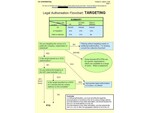
TSI — Legal Authorisation Flowcharts: Targeting & Collection [pdf]
This document contains internal GCHQ flowcharts outlining the mandatory legal authorization required for both Targeting specific entities and Collection (interception) of communications content, based primarily on the target's location, nationality, and whether the activity involves UK or "Second Party" countries, primarily referencing the Regulation of Investigatory Powers Act (RIPA).
Marking: UK CONFIDENTIAL
Related Documents
-
Cyber Defence Operations Legal Policy [pdf]
GCHQ's internal wiki laying out the legal plumbing for its Cyber Defence Operations (formerly NDIST)—detailing warrant types (RIPA, ISA, CNE), data retention schedules, targeting rules for UK/Five Eyes infrastructure, XKEYSCORE query protocols, and the bureaucratic hoops analysts must jump through to search attacker IPs, fingerprint UK networks, and share malware intelligence without tripping over location/nationality safeguards or commercial sensitivities.
Programs: JTRIG · SPAY · GORDIANKNOT · CHORDAL · DISCOVER · EVENTS · CASPORT · XKEYSCORE · CONTENT CLOUD · SQUEAL · MIRAGE · MUTANTBROTH · ANXIOUS · HALTERHITCH · BROADOAK · DONKEYKONG · ZOOL · PALANTIR · OVERLINK · RT · GATEKEEPER · IRONHAND · HARUSPEX · B3M · LOOKINGGLASS · GOLDENEYE · BLAZINGSADDLES · MOONRAKER · TRITON -
Operational Legalities – GCHQ Powerpoint Presentation [pdf]
GCHQ’s “Operational Legalities” deck is an internal compliance playbook that translates the UK’s surveillance laws into day‑to‑day SIGINT procedure—drilling staff on authorisation, necessity, and proportionality, and walking through warrants, targeting justifications, database queries, dissemination, and oversight. Half slides and half speaker notes, it shows how analysts are trained to document, audit, and defend operations under ISA, RIPA, HRA, and WTA while navigating edge cases like location, nationality, second‑party constraints, and “indirect targeting.”
-
Mobile Networks in My NOC World [pdf]
This TOP SECRET STRAP 2 GCHQ document outlines the “MyNOC” operations, a specialized Network Operations Centre used by the UK’s GCHQ to coordinate cyber exploitation of international mobile and telecom infrastructure, with a particular focus on Belgacom’s GRX network under “Operation Socialist” (OP SOCIALIST). It details operational planning, toolsets, personnel roles, network mapping, QUANTUM INSERT targeting, and successful infiltration strategies that enabled CNE (Computer Network Exploitation) access to key Belgacom systems and staff infrastructure.
Programs: HIGHNOTE · COPPERHEAD · NEXUS · CADDIS · BRENT · RUSSETT PHONE · CERBERUS · E-BEAM · PIA · JEDI · WYLEKEY · INTERACTION · EREPO · QUANTUM · WOODCUTTER · MUTANT BROTH · QUANTUM INSERT · NRTA · MERION ZETA · JTRIG · A-SPACE · GEOFUSION“Operation Socialist: The Inside Story of How British Spies Hacked Belgium’s Largest Telco” - The Intercept ↗ (2014-12-13) · “Lees hier hoe de Britse geheime dienst GCHQ Belgacom aanviel” - NRC ↗ (2014-12-13) · “Britse geheime dienst bespioneerde jarenlang Belgacom-klanten” - De Standaard ↗ (2014-12-13) · “Britain's GCHQ Hacked Belgian Telecoms Firm” - Der Spiegel ↗ (2013-09-20) · Gallagher, Ryan · Modderkolk, Huib · Vanhecke, Nikolas · Eeckhaut, Mark -
Software Reverse Engineering – GCHQ [pdf]
GCHQ’s Network Defence unit runs software reverse engineering across both malicious and commercial code to map vulnerabilities, validate security claims, and feed CESG’s advice on electronic attack. Malicious code is fair game, but commercial RE hinges on GCHQ’s ISA s5 SRE warrant (GPW/1160), with local authorisers and audits—after a documented lapse in 2008 was retro‑authorised.
Marking: TOP SECRET -
Laws on interception - Oversight - Implications for JCE (JCE UK Legalities Context) [pdf]
This GCHQ training presentation on UK surveillance laws, oversight mechanisms, and implications for Joint Collaborative Environment operations explicitly acknowledges that the UK has "a light oversight regime compared with US," detailing how RIPA, ISA, commissioners, and the Investigatory Powers Tribunal function to provide legal authorization while noting the Tribunal has "always found in our favour."
Programs: JTRIG