Document year: 2007 41 documents
Search documents matching “2007” →When each document was written, from its own dateline. Undated documents don't appear here.
Sort: Title
Documents
-
A New Day... Intellipedian Pioneers Speak at NSA SIDtoday [pdf]
NSA staff invited two of the founders of the intelligence community's wiki, Intellipedia, to give a two-day workshop that covered both the tool and an overview of the "sabbatical" training sessions given to CIA staff.
Programs: INTELLIPEDIAThe Intercept ↗ (2019-05-29) -
Alert: Voice Masking Is Discovered in SIGINT SIDtoday [pdf]
This March 2007 post from the internal NSA newsletter SIDToday draws attention to voice-masking technology used by subjects of surveillance to frustrate the agency’s voice-recognition efforts.
-
Counterterrorism Analytic Working Group Meets in Madrid SIDtoday [pdf]
This SIDtoday document details the 11th SIGINT Seniors Counterterrorism (SISECT) Analytic Working Group meeting in Madrid, which focused on enhancing counterterrorism collaboration through topics like terrorist use of the Internet, metadata sharing, and language capabilities. Key outcomes included initiatives for SIGINT exploitation of the Internet, improving language processing and translation via SIGDASYS, and fostering deeper cooperation between nations on counterterrorism efforts.
-
'Data Is Not Intelligence' SIDtoday [pdf]
A 2007 NSA SIDtoday summary of a keynote address by Deputy DNI for Analysis Thomas Fingar at the Analytic Transformation Symposium, outlining the Intelligence Community's agenda for improving analytical quality, cross-agency collaboration, and integrated operations through training, shared standards, and new tools like A-Space and the Library of National Intelligence.
Programs: A-SPACE -
DROPMIRE on the Cryptofax at the EU Embassy D.C. [pdf]
This document reveals that the NSA secretly targeted EU diplomatic communications through a program called DROPMIRE, which involved placing surveillance implants on encrypted fax machines at the EU Embassy in Washington, D.C. This operation was part of a broader effort to spy on 38 foreign embassies and missions—including allies such as France, Italy, and Greece—to gain inside knowledge of policy debates and diplomatic positions.
Programs: DROPMIRE -
ESOC: Report on the experiences of one NSA worker [pdf]
A NSA intelligence analysis intern details their 2007 temporary assignment to the European Security Operations Center (ESOC), where they successfully established a new signals intelligence (SIGINT) mission targeting Angola's energy sector. The author describes the end-to-end process from initial research and target development to successful collection and the first intelligence product.
-
ICREACH Wholesale Sharing (2007) [pdf]
This document serves as an official submission by the SID Technical Director detailing the leadership and collaborative efforts required to transition ICREACH from a conceptual framework into the Intelligence Community's first wholesale metadata-sharing platform. This document emphasizes the role of the SID team in securing critical legal and policy approvals through the NSA's Office of the General Counsel and coordinating with Five Eyes partners to ensure international participation in the system.
Programs: ICREACH -
ICREACH: Sharing SIGINT Comms Metadata with the Intel Community SIDtoday [pdf]
This document serves as an internal announcement marking the 2007 operational launch of ICREACH, a massive signals intelligence (SIGINT) metadata-sharing platform designed to provide real-time access to raw communication records for authorized analysts across the U.S. Intelligence Community. By consolidating telephony, cellular, and satellite data into a "one-stop shop" similar to the NSA’s internal GLOBALREACH tool, the program aimed to fulfill post-9/11 mandates for increased inter-agency collaboration and enhanced target development.
-
Instability creates opportunity against counter-terrorism targets SIDtoday [pdf]
This document reveals how the NSA’s collaboration with Ethiopia during and after the 2006 Ethiopian invasion of Somalia was leveraged to advance U.S. counterterrorism objectives, using SIGINT tools and shared intelligence to track and eliminate al-Qaida targets across the Horn of Africa.
-
Legalities - GCHQ Databases eg Pilbeam, Salamanca, UDAQ etc [pdf]
This October 2007 GCHQ document outlines the legal authorization requirements for querying surveillance databases, revealing that GCHQ analysts can search their own databases (like PILBEAM, SALAMANCA, UDAQ) for metadata on anyone regardless of nationality without additional authorization, while NSA databases (like MARINA, MAINWAY, DISHFIRE) prohibit searches for Americans and other Five Eyes citizens but permit searches for UK persons.
-
Linguistic Resource Sharing in Asia-Pacific Region Takes Step Forward SIDtoday [pdf]
This document highlights a significant development in linguistic resource sharing within the Asia-Pacific region, where NSA Hawaii initiated the first successful voice cut exchange among SIGINT Seniors Pacific (SSPAC) members in June 2007. The use of the CRUSHED ICE data-sharing network to facilitate this exchange marks a key step in enhancing collaborative counterterrorism efforts by expanding the linguistic resources available for terrorist communications analysis.
Programs: CRUSHEDICE -
Menwith continues successful counterterrorism survey along Af-Pak border [pdf]
Menwith Hill Station (MHS) conducted a counterterrorism surveillance operation along the Afghanistan-Pakistan border using the DARKSIDE collection system, successfully intercepting and processing microwave communications to gather actionable intelligence on terrorist activities. The operation, enhanced by Phase II hardware and coordinated with regional target offices, allowed dynamic capture and analysis of multiple signals to support ongoing counterterrorism efforts.
-
Network Shaping 101 [pdf]
An NSA top-secret training presentation that uses Yemen as a case study to explain how to "shape" a nation's Internet traffic by exploiting Autonomous Systems, upstream providers, BGP routing, and physical link topology to redirect or collect communications. The slide deck walks through practical router/IP/link details, passive SIGINT collection points and limitations, and warns that many assumptions are fabricated for the lesson and that real-world capabilities and link behavior can vary.
-
NSA Georgia Opens New Audio-Forensics Lab SIDtoday [pdf]
The document discusses the launch of a new audio-forensics lab at NSAG (National Security Agency Georgia) designed to enhance the processing and analysis of intercepted voice communications. The lab, funded through the Senior Language Technology Authority (SLTA), will focus on resolving language processing challenges for language analysts by improving the intelligibility and quality of foreign-language voice intercepts.
People: Mercer, Marti Hix -
NSA liaison in Tokyo opens new office SIDtoday [pdf]
This SIDtoday document describes how the NSA liaison to Japan (SUSLAJ) has moved its office from downtown Tokyo to the US Embassy, aiming to strengthen coordination with the US Ambassador and other intelligence representatives. This relocation follows a long-standing SIGINT partnership between NSA and Japan, dating back to the 1950s, and reflects the growing importance of US-Japan intelligence cooperation.
People: Schieffer, Thomas“Japan Made Secret Deals With the NSA That Expanded Global Surveillance” - The Intercept ↗ (2017-04-24) · “アメリカに監視される日本 ~スノーデン“未公開ファイル”の衝撃” - NHK ↗ (2017-04-24) · Gallagher, Ryan · Ikegami, Akira -
NSA Relationship With the Israeli SIGINT National Unit [pdf]
This top secret April 2007 NSA presentation provides an overview of the relationship between NSA and Israel's SIGINT National Unit (ISNU), detailing the organizational structure of Israeli signals intelligence, the history and terms of cooperation since the 1950s, and specific intelligence challenges that arose during the 2006 Israel-Hezbollah war when Israeli requests raised USG policy issues over geolocational data and NSA resources.
Programs: CHIPPEWAPeople: Shalit, Gilad -
NSA SIGINT Site Relocated in Japan: The Story Behind the Move SIDtoday [pdf]
This NSA SIDtoday newsletter article describes Project CAMELUS, a decade-long effort to relocate the agency's HANZA HF signals intelligence collection facility on Okinawa to a new site at Camp Hansen, with the Japanese government paying over $500 million for construction and new collection systems under political pressure to return occupied land. The article reveals tense negotiations where NSA leveraged Japanese funding to maintain surveillance capabilities while the Japanese government—notably not NSA's intelligence partners—pursued purely political objectives of land return, with disagreements escalating to cabinet-level discussions between the U.S. Secretary of Defense and Japanese Defense Minister.
People: Rumsfeld, Donald“Japan Made Secret Deals With the NSA That Expanded Global Surveillance” - The Intercept ↗ (2017-04-24) · “アメリカに監視される日本 ~スノーデン“未公開ファイル”の衝撃” - NHK ↗ (2017-04-24) · Gallagher, Ryan · Ikegami, Akira -
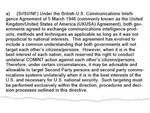
NSA's collection processing and dissemination of allied communications [pdf]
A secret 2007 deal between the US and UK allowed the NSA to collect, store, and analyze personal data of British citizens — including those not suspected of wrongdoing — marking a significant expansion of mass surveillance powers and breaking prior Five-Eyes agreements on mutual non-targeting.
-
PRESTON Architecture [pdf]
The PRESTON architecture, centered on GCHQ’s PRESTON Processing system, is detailed across multiple views showing how the agency intercepts, processes, and stores communications. It outlines a sophisticated surveillance framework that integrates lawful interception, data processing, and analyst access, emphasizing covert monitoring and management of intercepted data.
Programs: PRESTON · FAST GROK · BOXSTER · MARMION · GENTIAN · TERRAIN · BLACKNIGHT · CORINTH · FARNDALE · SAMDYCE · B3M · VSLT · SAMBOK · HAUSTORIUM · FUNFAIR · Cheltenham · SALAMANCA · IIB · LOCHNVAR · MONACO · HOTLINE · Benhall · GDR · CE · BRIGHTON · ARSENIDE · SPQR · TACHO · TRAFFIC MASTER · KEYCARD · XKEYSCORE · COURIERSKILL · MONKEYPUZZLE · PILBEAM · GREENHEART · CCDF · GTE · CADENCE · TERRAINS · GCNET · HENCE -
PRESTON Business Processes [pdf]
The PRESTON Business Processes document outlines GCHQ’s internal workflows for authorizing, enabling, managing, and terminating communications interception, as well as producing intelligence from intercepted data. It defines the roles, responsibilities, and technical processes that support lawful interception operations within the PRESTON system.