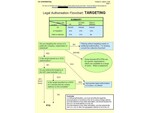
Sensitive Targeting Authorisation
Open PDFDocument date: -
Pages: 4
Genre: other
Classification: -
Dissemination: -
A GCHQ internal form template for Sensitive Targeting Authorisation (STA), used to obtain approval for surveillance targeting of individuals or organisations with sensitive nationalities or in sensitive locations, covering both real-time tasking and historical database datamining, with separate authorisation tracks for overseas targets and UK-based targets.
My notes
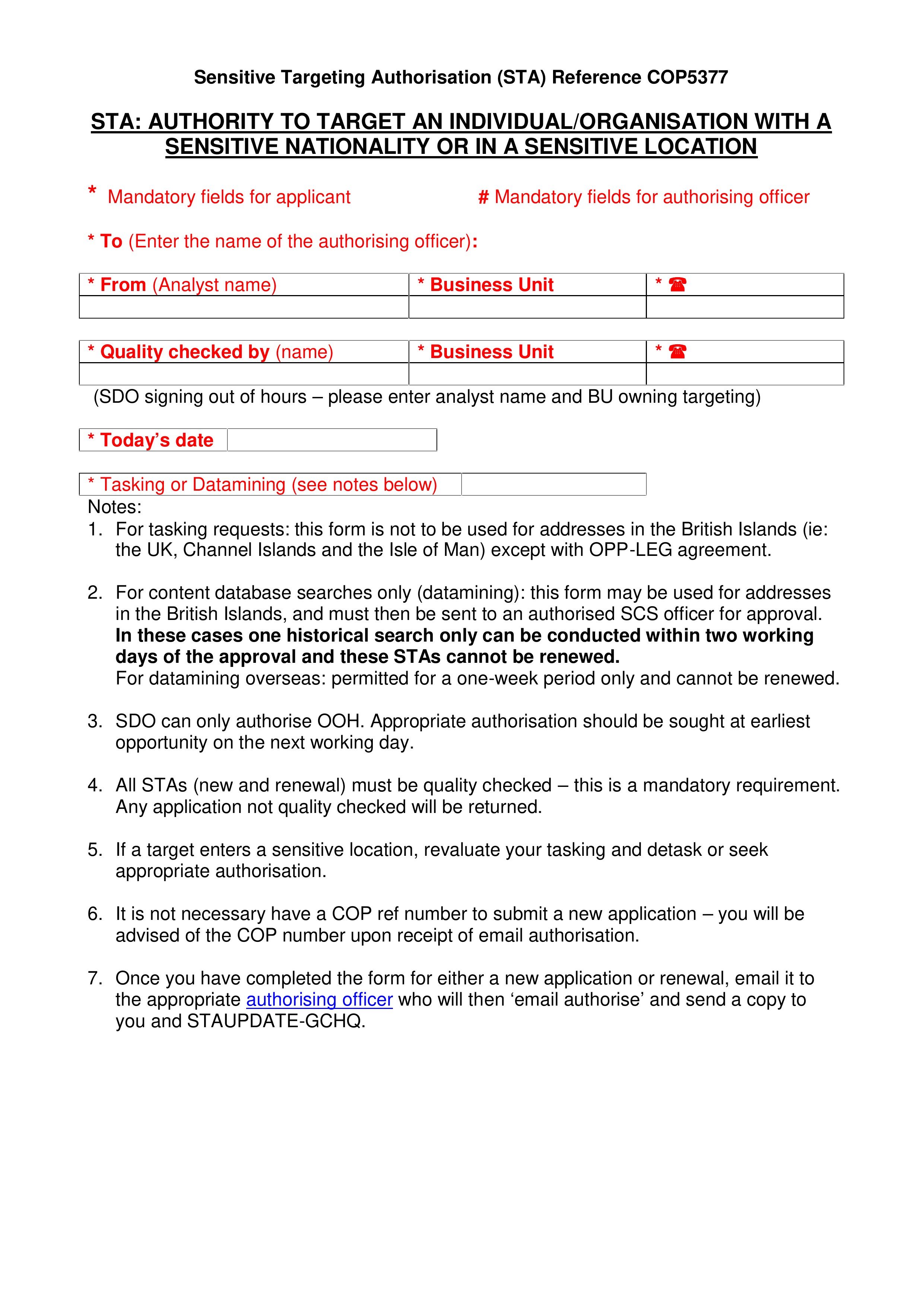
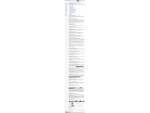
Sensitive Targeting Authorisation (STA) Reference COP5377
STA: AUTHORITY TO TARGET AN INDIVIDUAL/ORGANISATION WITH A
SENSITIVE NATIONALITY OR IN A SENSITIVE LOCATION
* Mandatory fields for applicant
# Mandatory fields for authorising officer
* To (Enter the name of the authorising officer):
* From (Analyst name)
* Business Unit
* Quality checked by (name)
* Business Unit
(SDO signing out of hours – please enter analyst name and BU owning targeting)
* Today's date
* Tasking or Datamining (see notes below)
Notes:
- For tasking requests: this form is not to be used for addresses in the British Islands (ie: the UK, Channel Islands and the Isle of Man) except with OPP-LEG agreement.
- For content database searches only (datamining): this form may be used for addresses in the British Islands, and must then be sent to an authorised SCS officer for approval. In these cases one historical search only can be conducted within two working days of the approval and these STAs cannot be renewed. For datamining overseas: permitted for a one-week period only and cannot be renewed.
- SDO can only authorise OOH. Appropriate authorisation should be sought at earliest opportunity on the next working day.
- All STAs (new and renewal) must be quality checked – this is a mandatory requirement. Any application not quality checked will be returned.
- If a target enters a sensitive location, revaluate your tasking and detask or seek appropriate authorisation.
- It is not necessary have a COP ref number to submit a new application – you will be advised of the COP number upon receipt of email authorisation.
- Once you have completed the form for either a new application or renewal, email it to the appropriate authorising officer who will then ‘email authorise' and send a copy to you and STAUPDATE-GCHQ.
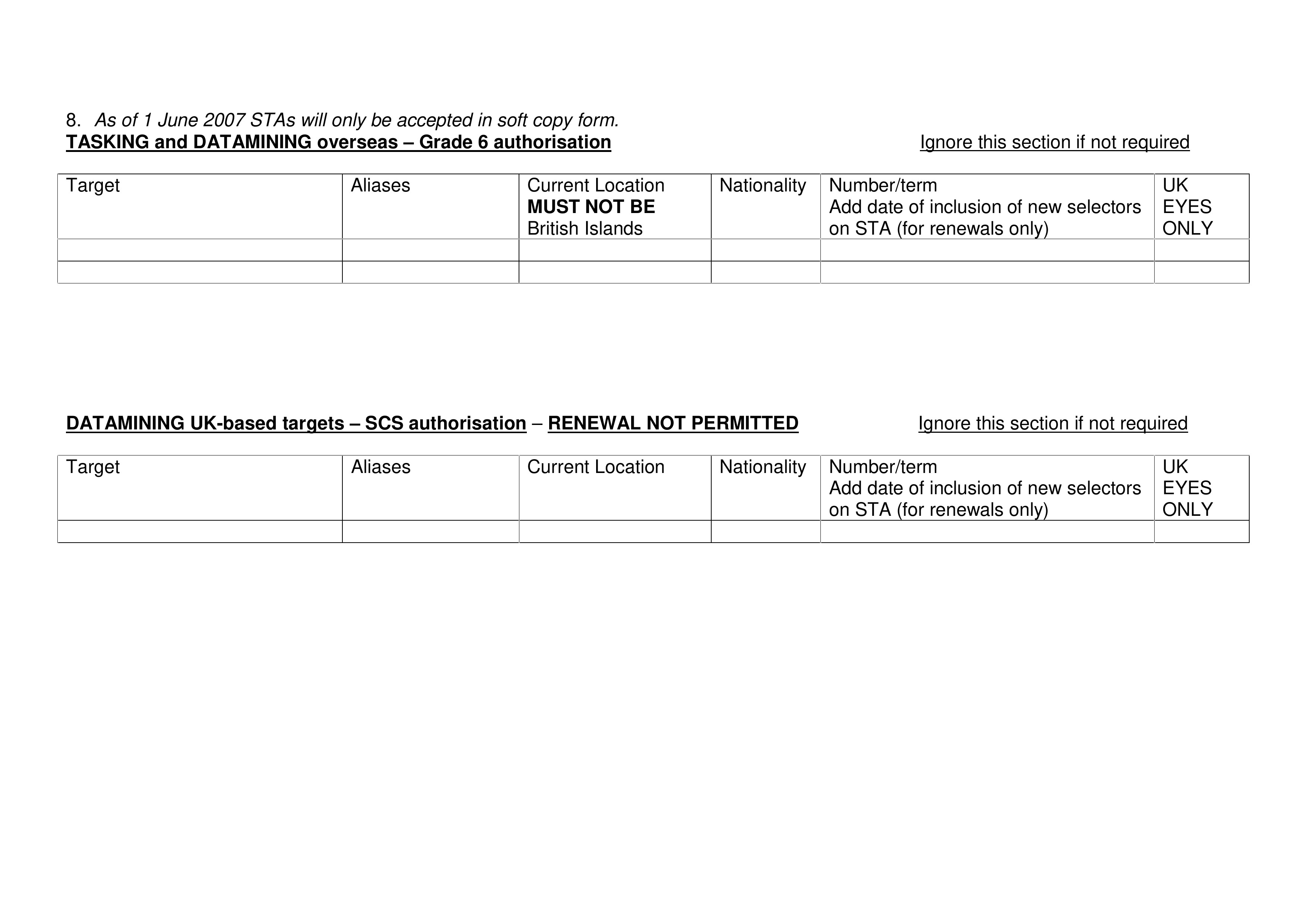
- As of 1 June 2007 STAs will only be accepted in soft copy form.
TASKING and DATAMINING overseas – Grade 6 authorisation
Ignore this section if not required
Target
Aliases
Current Location MUST NOT BE British Islands
Nationality
Number/term Add date of inclusion of new selectors on STA (for renewals only)
UK EYES ONLY
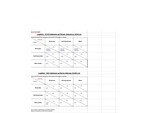
DATAMINING UK-based targets – SCS authorisation – RENEWAL NOT PERMITTED
Ignore this section if not required
Target
Aliases
Current Location
Nationality
Number/term Add date of inclusion of new selectors on STA (for renewals only)
UK EYES ONLY
<PROTECTIVE MARKING>
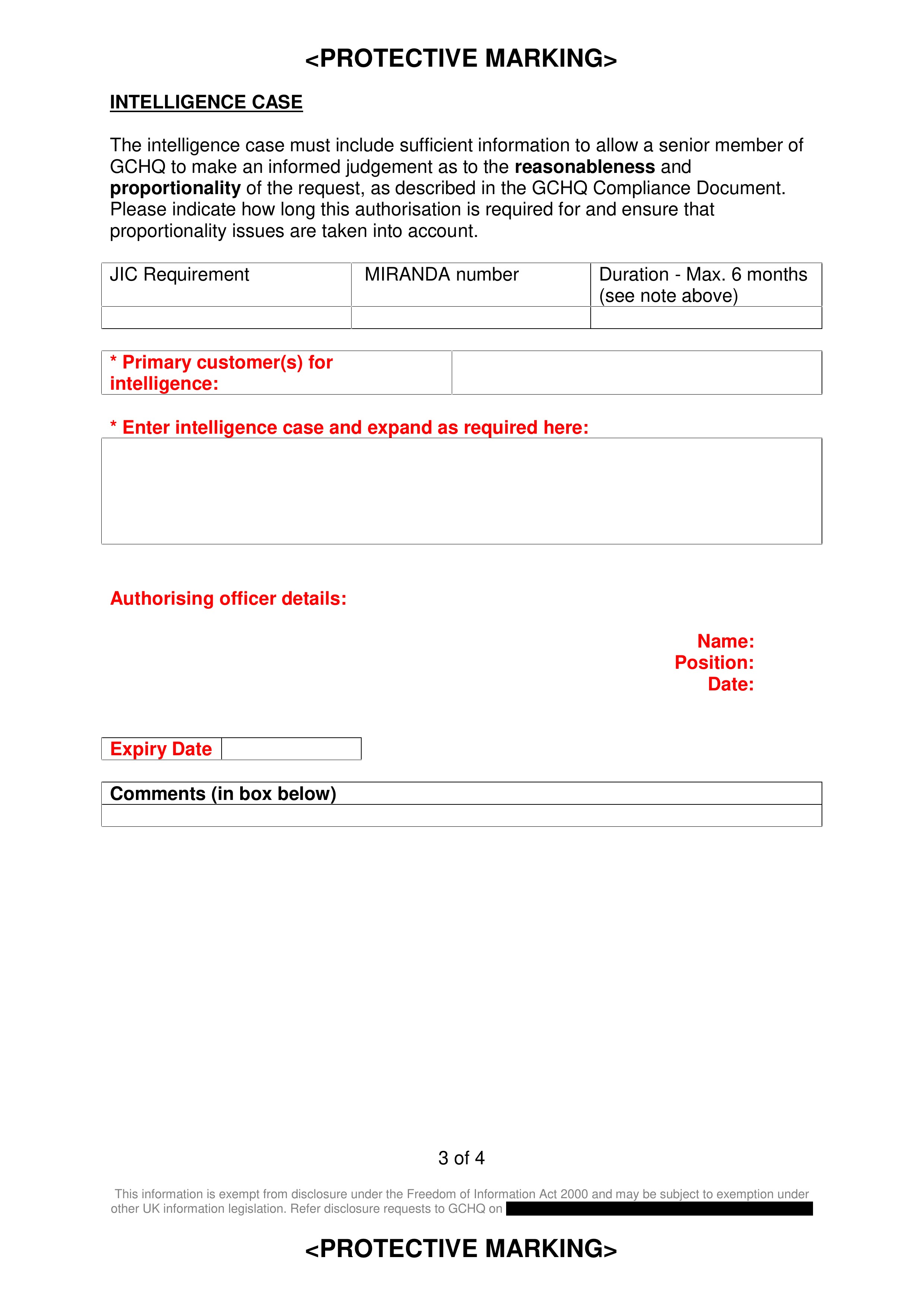
INTELLIGENCE CASE
The intelligence case must include sufficient information to allow a senior member of GCHQ to make an informed judgement as to the reasonableness and proportionality of the request, as described in the GCHQ Compliance Document.
Please indicate how long this authorisation is required for and ensure that proportionality issues are taken into account.
JIC Requirement
MIRANDA number
Duration - Max. 6 months (see note above)
* Primary customer(s) for intelligence:
\ * Enter intelligence case and expand as required here:
Authorising officer details:
Name:
Position:
Date:
Expiry Date
Comments (in box below)
3 of 4
This information is exempt from disclosure under the Freedom of Information Act 2000 and may be subject to exemption under other UK information legislation. Refer disclosure requests to GCHQ on [REDACTED]
<PROTECTIVE MARKING>
<PROTECTIVE MARKING>
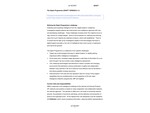
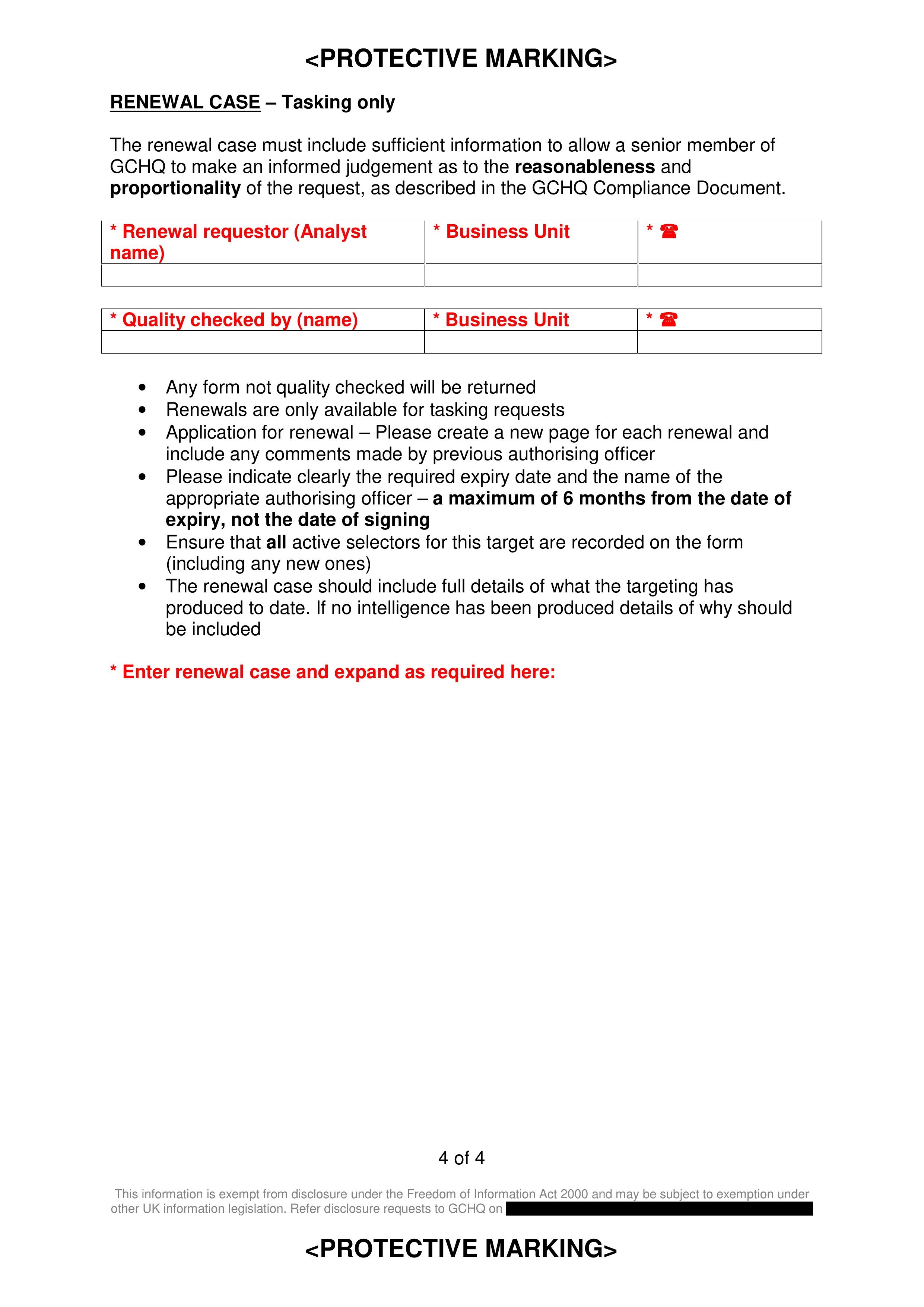
RENEWAL CASE – Tasking only
The renewal case must include sufficient information to allow a senior member of GCHQ to make an informed judgement as to the reasonableness and proportionality of the request, as described in the GCHQ Compliance Document.
* Renewal requestor (Analyst name)
* Business Unit
* Quality checked by (name)
* Business Unit
- Any form not quality checked will be returned
- Renewals are only available for tasking requests
- Application for renewal – Please create a new page for each renewal and include any comments made by previous authorising officer
- Please indicate clearly the required expiry date and the name of the appropriate authorising officer – a maximum of 6 months from the date of expiry, not the date of signing
- Ensure that all active selectors for this target are recorded on the form (including any new ones)
- The renewal case should include full details of what the targeting has produced to date. If no intelligence has been produced details of why should be included
- Enter renewal case and expand as required here:
4 of 4
This information is exempt from disclosure under the Freedom of Information Act 2000 and may be subject to exemption under other UK information legislation. Refer disclosure requests to GCHQ on [REDACTED]
<PROTECTIVE MARKING>
Published in the Same Report
(10 of 28 documents)
-
Supporting Internet Operations - Special Source Access [pdf]
In this document GCHQ outlines its plans for expanding internet operations, focusing on increasing access to 10G bearers and enhancing its intercept and egress capabilities by 2011. The agency highlighted that “25 percent of all internet traffic” transits the U.K. through approximately 1,600 different 10-gigabit cables, and it noted that it could “survey the majority of the 1,600” to “select the most valuable to switch into our processing systems.”
-
Event (SIGINT) [pdf]
5 p.This document explains that within GCHQ and NSA SIGINT operations, an “Event” refers to metadata about observable communications or user actions rather than message content, categorized into types like Communications, Presence, Social, and Geo-reference Events. These events are collected, stored in various databases, and analyzed through convergence and correlation processes, with standardized formats defined by Interface Control Documents such as INTERSTELLAR DUST (IDUST) and Actor Action (AA).
Programs: INTERSTELLAR DUST · HAUSTORIUM · SOCIAL ANTHROPOID · ACTOR-ACTION · SAMREF · GEOFUSION · HARD ASSOC · SALAMANCA · ASSOCIATION · BANYAN · MAINWAY · FASCIA · CULTWEAVE II · VOICESAIL · TEEDALE · PILBEAM · MUTANTBROTH · AUTOASSOC · MARBLEDGECKO · KARMAPOLICE · HRMAP · MEMORYHOLE · INFINITEMONKEYS · SOCIALANIMAL · AUTOTDI · SAMUELPEPYS · Mobile Applications Project · NGE · PPF · SLR -
Access: Vision 2013 [pdf]
This July 2010 GCHQ strategic document outlines the agency's vision for 2013 to create "the world's biggest SIGINT engine" with access to 800 10-gigabit connections (up from existing capacity), expanding overseas operations to 60% while reducing UK-based to 40%, and developing new capabilities including computer network exploitation (CNE), exfiltration, beaconry, geolocation, and collection of "Internet Pocket Litter" like cookies and browsing data. The strategy emphasizes "scale and pace," "balance," and "agility" while claiming to operate within legal frameworks of "necessity, proportionality and authorisation," and highlights partnerships with second and third parties to access "intractable and hard targets."
Marking: SECRET -
BLACK HOLE ANALYTICS, ADD/SD briefing, September 2009 [pdf]
This September 2009 GCHQ briefing describes the BLACK HOLE analytics infrastructure and Next Generation Events (NGE) project, which planned to scale from ~8 10-gigabit connections to ~200 10Gs by March 2011, storing intercepted data in massive flat-file repositories at Benhall and Bude before loading it into "Question Focused Dataset" (QFD) databases that power surveillance tools like MUTANT BROTH, KARMA POLICE, INFINITE MONKEYS, and others. The document outlines how "probes" extract Target Detection Identifiers (TDIs) from intercepted data feeds, store them in BLACK HOLE repositories, then enable analysts to profile targets' online activities, create social networks, investigate websites and forums, track web searches and Google Earth usage, and perform large-scale data mining across internet and telephony data.
Programs: BLACKHOLE · MUTANTBROTH · AUTOASSOC · INFINITEMONKEYS · KARMAPOLICE · SOCIALANIMAL · HRMAP · MEMORYHOLE · MARBLEDGECKO · HARDASSOC · SAMUELPEPYS · BLAZINGSADDLES · TELLURIAN · BUFFER · DISTILLERY · LOOKINGGLASS · NGEPeople: bin Laden, Osama -
Report on Architectural Risk 2012 - Summary [pdf]
This 2012 GCHQ report identifies that a historical under-investment in IT architecture has created significant risk, especially with new challenges like massive data growth, cyber defense, and increased partnering. The document recommends immediate, prioritized investment in big data strategies, integrated analytics frameworks, and security services to address the strain on the system.
Programs: BLACKHOLE -
Blazing Saddles [pdf]
This document describes BLAZING SADDLES, a GCHQ program designed to massively scale the storage and analysis of bulk internet surveillance data through multiple specialized databases that track website visits, online identities, communications patterns, and geolocation queries across the global internet population.
Programs: BLAZINGSADDLES · BLACKHOLE · SOCIALANTHROPOID · AUTOASSOC · HRMAP · INFINITEMONKEYS · KARMAPOLICE · MARBLEDGECKO · MUTANTBROTH · MEMORYHOLE · SAMUELPEPYS · SOCIALANIMAL · HAUSTORIUM · GOLDENAXE · NGE -
Broadcast/Internet Radio Exploitation and Analysis, 6th November 2009, GCHQ [pdf]
This GCHQ report analyzes 6.68 million internet radio listening events collected over three months in 2009, detailing global broadcasting patterns, user behaviors, and specifically examining Islamic radio stations and Pakistan-UK connections for potential radicalization intelligence, while recommending integration with bulk surveillance databases like KARMA POLICE for enhanced user profiling.
-
ICTR Cloud Efforts [pdf]
A GCHQ presentation details how the agency developed cloud-based big data analytics to achieve "population scale" surveillance—processing trillions of internet events to build geographic and behavioral profiles on every online identifier worldwide, enabling discovery of unknown targets through pattern analysis rather than traditional keyword searches.
Programs: EVERYASSOC · PROBABILITYCLOUD · SILVERLINING · CULTWEAVE · KARMAPOLICE · EVERYPOLICE · AWKWARDTURTLE · GORDIANKNOT · SANDIA · BLOODHOUND · FIVEALIVE · NGE · MAPREDUCE -
Content-Metadata Matrix [pdf]
GCHQ's internal taxonomy sorts intercepted data into "content" or "metadata" to determine what can be searched without individual warrants—email subject lines, full URLs, and buddy lists fall on opposite sides of the line, enabling analysts to mine massive troves of IP addresses, phone numbers, location data, and browsing history with just a few keystrokes and a brief justification.
-
Cyber Defence Operations Legal Policy [pdf]
GCHQ's internal wiki laying out the legal plumbing for its Cyber Defence Operations (formerly NDIST)—detailing warrant types (RIPA, ISA, CNE), data retention schedules, targeting rules for UK/Five Eyes infrastructure, XKEYSCORE query protocols, and the bureaucratic hoops analysts must jump through to search attacker IPs, fingerprint UK networks, and share malware intelligence without tripping over location/nationality safeguards or commercial sensitivities.
Programs: JTRIG · SPAY · GORDIANKNOT · CHORDAL · DISCOVER · EVENTS · CASPORT · XKEYSCORE · CONTENT CLOUD · SQUEAL · MIRAGE · MUTANTBROTH · ANXIOUS · HALTERHITCH · BROADOAK · DONKEYKONG · ZOOL · PALANTIR · OVERLINK · RT · GATEKEEPER · IRONHAND · HARUSPEX · B3M · LOOKINGGLASS · GOLDENEYE · BLAZINGSADDLES · MOONRAKER · TRITON


Related Documents
-
Discovery SIGINT Targeting Scenarios and Compliance [pdf]
This document is a top-secret NSA guidance manual detailing SIGINT targeting scenarios, compliance procedures, and legal guidance for querying foreign actors, malware, and potentially U.S.-linked systems, including considerations for minimizing incidental collection of U.S. persons’ communications. It outlines specific rules, approvals, and exceptions for using SIGINT tools, foreign intelligence tasks, and cases involving ambiguous or dual-use selectors like WikiLeaks, The Pirate Bay, and foreign actors operating through U.S. infrastructure.
-
Events Analysis [pdf]
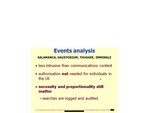
This GCHQ document explains authorization policies for querying metadata databases (SALAMANCA, HAUSTORIUM, THUGGEE, IMMINGLE), stating that metadata is "less intrusive than communications content" and that authorization is "not needed for individuals in the UK," though searches are logged and audited with necessity and proportionality considerations still applying.
-
Legalities - GCHQ Databases eg Pilbeam, Salamanca, UDAQ etc [pdf]
This October 2007 GCHQ document outlines the legal authorization requirements for querying surveillance databases, revealing that GCHQ analysts can search their own databases (like PILBEAM, SALAMANCA, UDAQ) for metadata on anyone regardless of nationality without additional authorization, while NSA databases (like MARINA, MAINWAY, DISHFIRE) prohibit searches for Americans and other Five Eyes citizens but permit searches for UK persons.
-
Digint Narrative [pdf]
This Digint Programme (2010 draft) outlines MI5’s plan to strengthen its ability to collect and exploit digital intelligence, addressing the growing challenge of massive internet-based data and the risk of missing critical insights. It emphasizes collaboration with GCHQ, NTAC, and other agencies to build strategic capabilities, improve exploitation of collected data, and expand coverage for counterterrorism and national security.
Marking: UK SECRETPrograms: IMP -
TSI — Legal Authorisation Flowcharts: Targeting & Collection [pdf]
This document contains internal GCHQ flowcharts outlining the mandatory legal authorization required for both Targeting specific entities and Collection (interception) of communications content, based primarily on the target's location, nationality, and whether the activity involves UK or "Second Party" countries, primarily referencing the Regulation of Investigatory Powers Act (RIPA).
Marking: UK CONFIDENTIAL