Tag: legal framework 10 documents
Search documents matching “legal framework” →Free-text subjects the curators added. Unlike the other axes these are not necessarily from the documents' own vocabulary, so they are the loosest thing to browse by (and the most forgiving).
Graphs
By Banner
By Classification
Refine (combine with another filter, via search)
Sort: Title
Documents
-
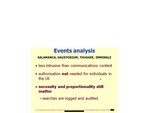
Events Analysis [pdf]
This GCHQ document explains authorization policies for querying metadata databases (SALAMANCA, HAUSTORIUM, THUGGEE, IMMINGLE), stating that metadata is "less intrusive than communications content" and that authorization is "not needed for individuals in the UK," though searches are logged and audited with necessity and proportionality considerations still applying.
-
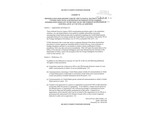
Minimization Procedures Used By The National Security Agency In Connection With Acquisitions Of Foreign Intelligence, Information Pursuant To Section 702 Of The Foreign Intelligence Court Surveillance Act Of 1978 [pdf]
The NSA’s Section 702 minimization rules expose how the agency can collect, keep, and use Americans’ communications without warrants, despite claiming to target only foreigners. While the document sets out procedures for handling U.S. data, it includes broad loopholes—like keeping “inadvertently” collected domestic messages for years, sharing unfiltered data with the FBI, CIA, and even foreign governments, and giving NSA analysts wide discretion over who gets surveilled—all under secret FISA Court approval.
People: Holder, Eric H. Jr. -
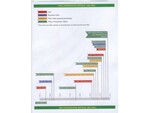
N.S.A. Timeline of Surveillance Law Developments [pdf]
This chart, apparently from an internal N.S.A. presentation, lists milestones in surveillance rules over nearly four decades. The July 2002 “Raw Take” sharing order, whose existence has not previously been disclosed, is just one of three rulings by the Foreign Intelligence Surveillance Court to make the list. The other two were 2004 and 2006 rulings allowing bulk collection of data about emails and phone calls.
-
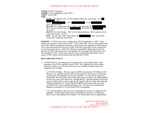
NSA El Paso Intelligence Center Trip Report 2008 [pdf]
This internal NSA memo summarizes a meeting held on February 20, 2008, regarding the deployment of the Real-Time Regional Gateway (RT-RG) system at the El Paso Intelligence Center (EPIC), a DEA-led facility. It details challenges in funding, staffing, legal policies, and coordination between DEA, DHS, and NSA, with the goal of enhancing intelligence sharing and operational capabilities for law enforcement, and using RT-RG on the U.S.-Mexico border.
People: Trent, Barbara · Trent, Barb · Foster, Larry · Poole, Douglas · Brooks, Sandy · Sutton-DeAbreu, Ila · Petrey, Harry · Allen, Charlie · Doty, Art“Mission Creep: How the NSA’s Game-Changing Targeting System Built for Iraq and Afghanistan Ended Up on the Mexico Border” - The Intercept ↗ (2019-05-29) · “Norges hemmelige krig i Afghanistan” - NRK ↗ (2019-05-29) · Moltke, Henrik · Skille, Øyvind Bye · Døvik, Olav · Hansen, Ståle Ellingsgard · Fjørtoft, Martin -
NSA inspector general report on email and internet data collection under Stellar Wind, 24 March 2009 [Working Draft] [pdf]
This 2009 NSA Inspector General draft report details the origins and legal framework of the President’s Surveillance Program (PSP), launched after 9/11 to bypass FISA limits and authorize bulk interception of internet and telephony content and metadata, including communications with one end inside the U.S. It reveals how NSA, with White House backing, expanded surveillance authority to cover “collection gaps” that existing law didn’t allow, effectively legalizing large-scale warrantless spying under a secret presidential directive.
People: Bush, George W. · Hayden, Michael · Tenet, George · Gonzales, Alberto R. · Addington, David S. · Graham, Robert · Deitz, Robert L. · Shelby, Richard · Pelosi, Nancy · Cheney, Dick · Libby, I. Lewis · Lamberth, Royce · Inouye, Daniel · Levin, Daniel · Stevens, Theodore · Kollar-Kotelly, Colleen · Rockefeller, Jay · Alexander, Keith B. · Potenza, Vito -
Procedures Used By The National Security Agency For Targeting Non-United States Persons Reasonably Believed To Be Located Outside The United States To Acquire Foreign Intelligence Court Information Pursuant To Section 702 Of The Foreign Intelligence Surveillance Act Of 1978 [pdf]
The NSA’s 2009 Section 702 targeting procedures lay out how analysts decide who can be surveilled without a warrant, supposedly limiting spying to foreigners abroad. In reality, the rules give the agency wide latitude to presume people are foreign, rely on vague “totality of the circumstances” tests, and allow broad technical methods like IP filters and metadata checks. Oversight is mostly internal and after-the-fact, creating significant potential for U.S. communications to be swept up with little accountability.
People: Holder, Eric H. Jr. -
Required Reading... SIDtoday [pdf]
All Signals Intelligence Directorate employees are required to annually review the legal and policy documents guaranteeing U.S. citizens' right to privacy.
People: Quirk, RichardThe Intercept ↗ (2017-09-13) -
Sensitive Targeting Authorisation [pdf]
A GCHQ internal form template for Sensitive Targeting Authorisation (STA), used to obtain approval for surveillance targeting of individuals or organisations with sensitive nationalities or in sensitive locations, covering both real-time tasking and historical database datamining, with separate authorisation tracks for overseas targets and UK-based targets.
-
STELLARWIND Classification Guide [pdf]
Stellarwind was the code name for the Bush administration’s surveillance and data collection programs that operated from 2001 to 2007 outside rules set by the Foreign Intelligence Surveillance Act. This guide lays out secrecy restrictions for various aspects of the program. It discusses the “Large Content” FISA order as part of the “sequence of transition events” from the warrantless wiretapping program to the Protect America Act.
-
The Real Scoop on USSID SP0018 Briefings SIDtoday [pdf]
The Signals Intelligence Directorate has trained over 5,000 staff in a minimization policy known as SP0018, which must be understood in order to look at raw signals intelligence. The directorate offers eight to 10 trainings each month, as well as shortened web versions of the training that are available in an emergency.
Marking: CONFIDENTIALThe Intercept ↗ (2018-03-01)