ICTR Cloud Efforts
Open PDFDocument date: 2011-07-01
Pages: 29
Genre: slides
Banner: UK TOP SECRET STRAP1 5EYES
Classification: TOP SECRET STRAP 1
Dissemination: 5EYES
A GCHQ presentation details how the agency developed cloud-based big data analytics to achieve "population scale" surveillance—processing trillions of internet events to build geographic and behavioral profiles on every online identifier worldwide, enabling discovery of unknown targets through pattern analysis rather than traditional keyword searches.
My notes
"ICTR Cloud Efforts”
developing "canonical” SIGINT analytics, finding hard targets and exploratory data analysis at scale
Data Mining Research – ICTR, GCHQ
Dr [REDACTED]
ICT RESEARCH
This information is exempt from disclosure under the Freedom of Information Act 2000 and may be subject to exemption under other UK information legislation. Refer disclosure requests to GCHQ on [REDACTED]
NEXT GENERATION events
UK TOP SECRET STRAP1 5EYES
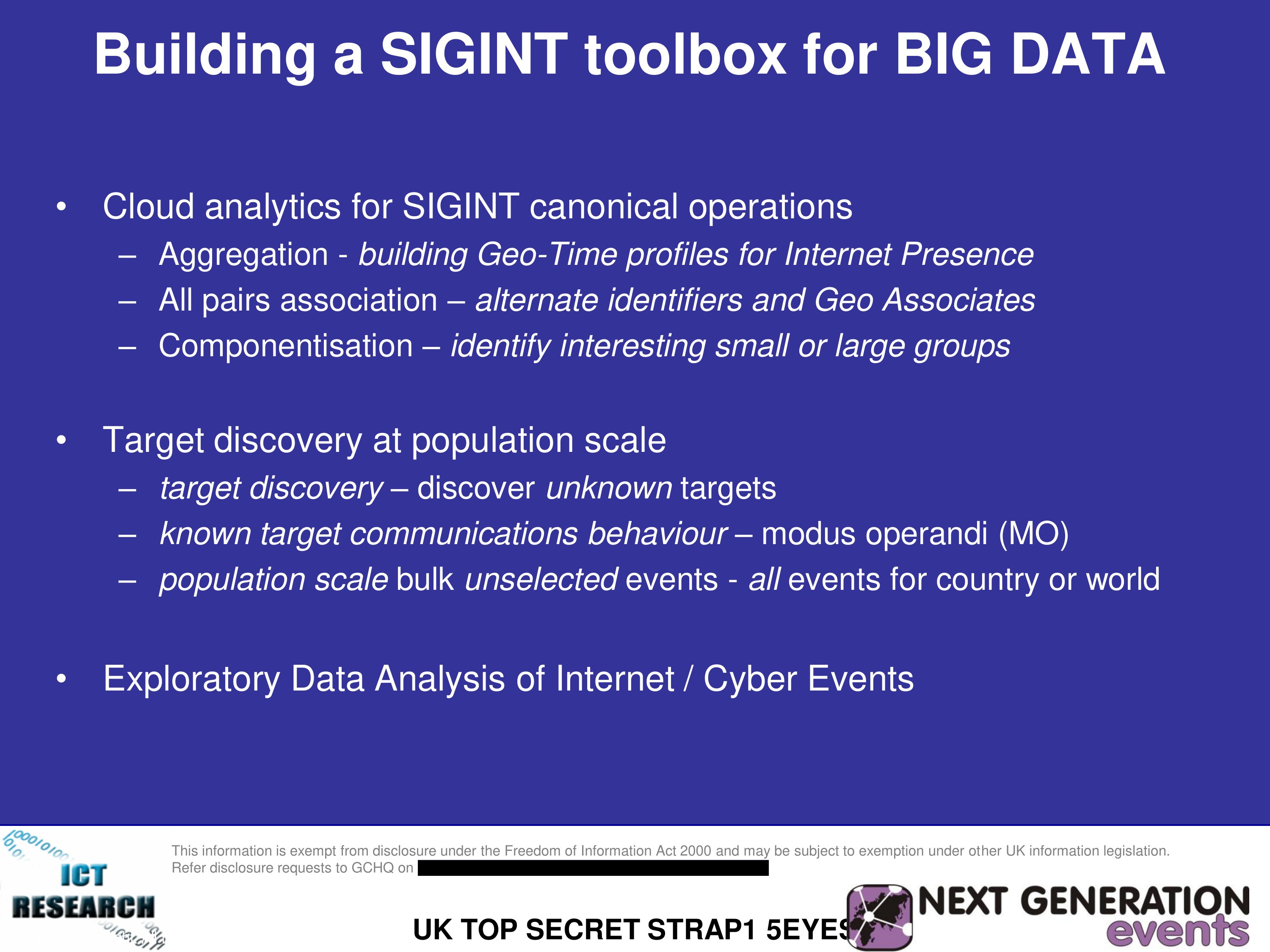
Building a SIGINT toolbox for BIG DATA
- Cloud analytics for SIGINT canonical operations
- Aggregation - building Geo-Time profiles for Internet Presence
- All pairs association – alternate identifiers and Geo Associates
- Componentisation – identify interesting small or large groups
- Target discovery at population scale
- target discovery – discover unknown targets
- known target communications behaviour – modus operandi (MO)
- population scale bulk unselected events - all events for country or world
- Exploratory Data Analysis of Internet / Cyber Events
ICT RESEARCH
This information is exempt from disclosure under the Freedom of Information Act 2000 and may be subject to exemption under other UK information legislation. Refer disclosure requests to GCHQ on [REDACTED]
NEXT GENERATION events
UK TOP SECRET STRAP1 5EYES
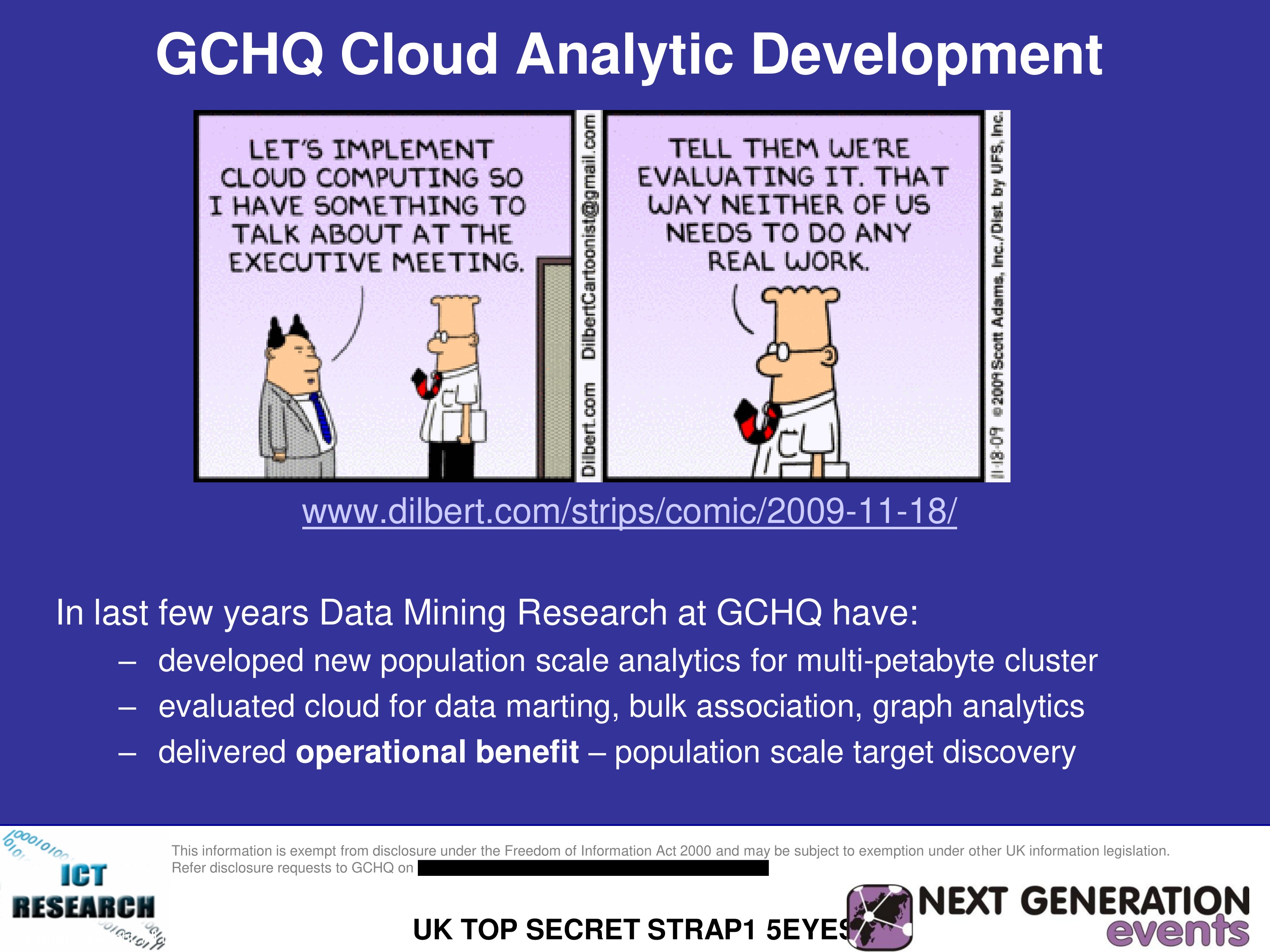
GCHQ Cloud Analytic Development
LET'S IMPLEMENT CLOUD COMPUTING SO I HAVE SOMETHING TO TALK ABOUT AT THE EXECUTIVE MEETING.
TELL THEM WE'RE EVALUATING IT. THAT WAY NEITHER OF US NEEDS TO DO ANY REAL WORK.
Dilbert.com DilbertCartoonist@gmail.com
11-18-09 2009 Scott Adams, Inc./Dist. by UFS, inc.
www.dilbert.com/strips/comic/2009-11-18/
In last few years Data Mining Research at GCHQ have:
- developed new population scale analytics for multi-petabyte cluster
- evaluated cloud for data marting, bulk association, graph analytics
- delivered operational benefit – population scale target discovery
ICT RESEARCH
This information is exempt from disclosure under the Freedom of Information Act 2000 and may be subject to exemption under other UK information legislation. Refer disclosure requests to GCHQ on [REDACTED]
NEXT GENERATION events
UK TOP SECRET STRAP1 5EYES
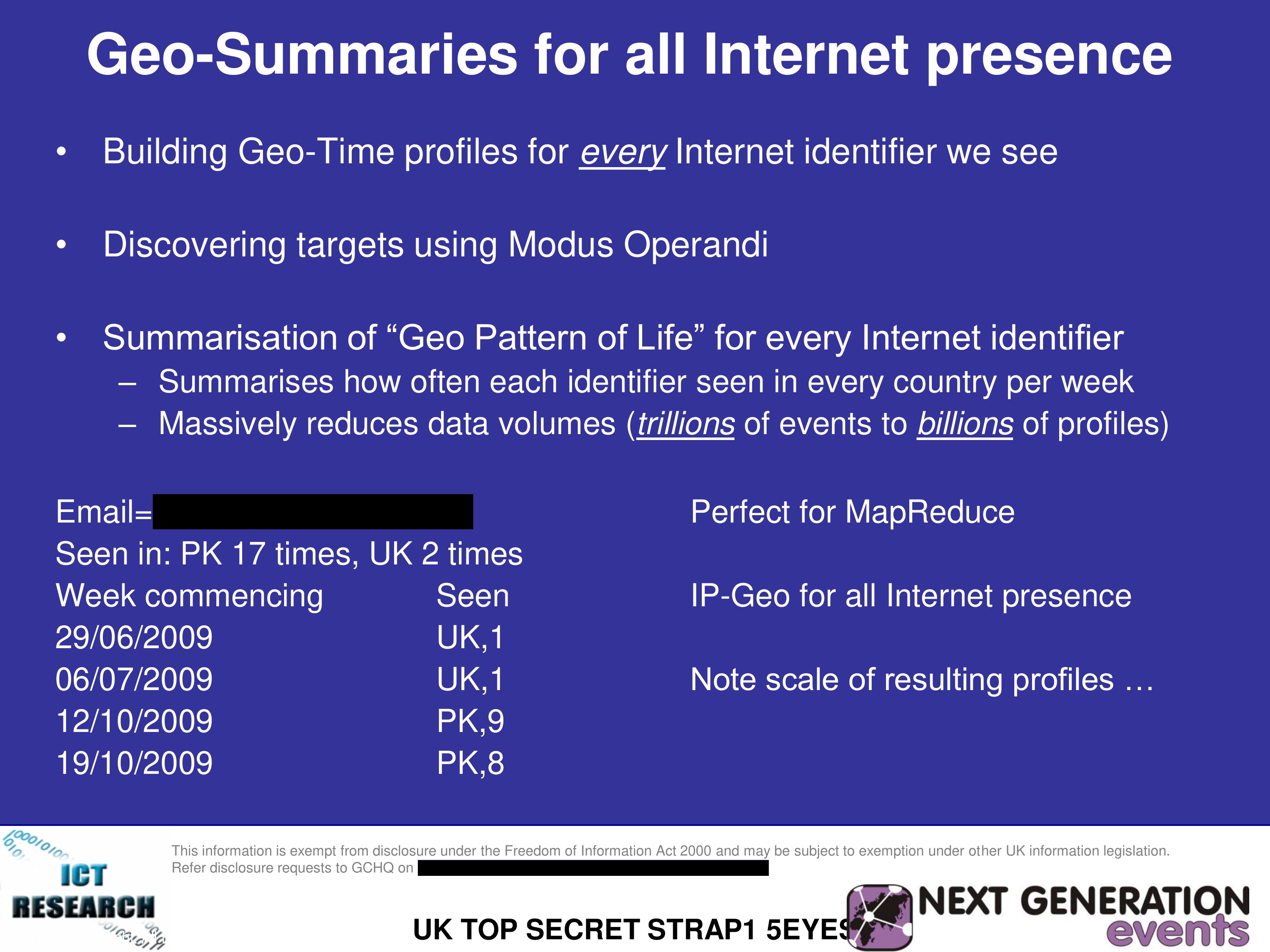
Geo-Summaries for all Internet presence
- Building Geo-Time profiles for every Internet identifier we see
- Discovering targets using Modus Operandi
- Summarisation of "Geo Pattern of Life" for every Internet identifier
- Summarises how often each identifier seen in every country per week
- Massively reduces data volumes (trillions of events to billions of profiles)
Email= [REDACTED]
Seen in: PK 17 times, UK 2 times
| Week commencing | Seen |
|---|---|
| 29/06/2009 | UK,1 |
| 06/07/2009 | UK,1 |
| 12/10/2009 | PK,9 |
| 19/10/2009 | PK,8 |
Perfect for MapReduce
IP-Geo for all Internet presence
Note scale of resulting profiles ...
ICT RESEARCH
This information is exempt from disclosure under the Freedom of Information Act 2000 and may be subject to exemption under other UK information legislation. Refer disclosure requests to GCHQ on [REDACTED]
NEXT GENERATION events
UK TOP SECRET STRAP1 5EYES
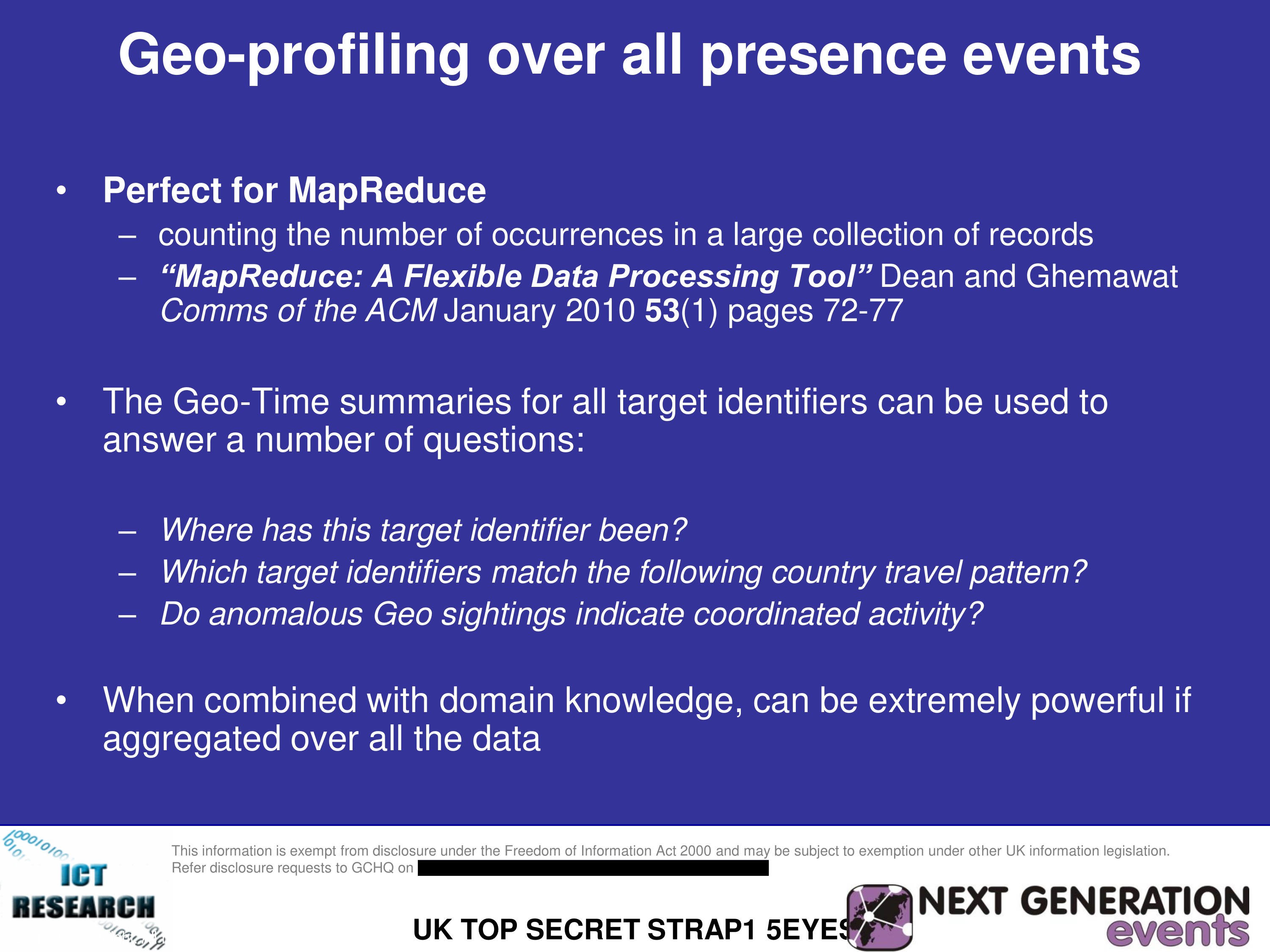
Geo-profiling over all presence events
- Perfect for MapReduce
- counting the number of occurrences in a large collection of records
- "MapReduce: A Flexible Data Processing Tool” Dean and Ghemawat Comms of the ACM January 2010 53(1) pages 72-77
- The Geo-Time summaries for all target identifiers can be used to answer a number of questions:
- Where has this target identifier been?
- Which target identifiers match the following country travel pattern?
- Do anomalous Geo sightings indicate coordinated activity?
- When combined with domain knowledge, can be extremely powerful if aggregated over all the data
ICT RESEARCH
This information is exempt from disclosure under the Freedom of Information Act 2000 and may be subject to exemption under other UK information legislation. Refer disclosure requests to GCHQ on [REDACTED]
NEXT GENERATION events
UK TOP SECRET STRAP1 5EYES
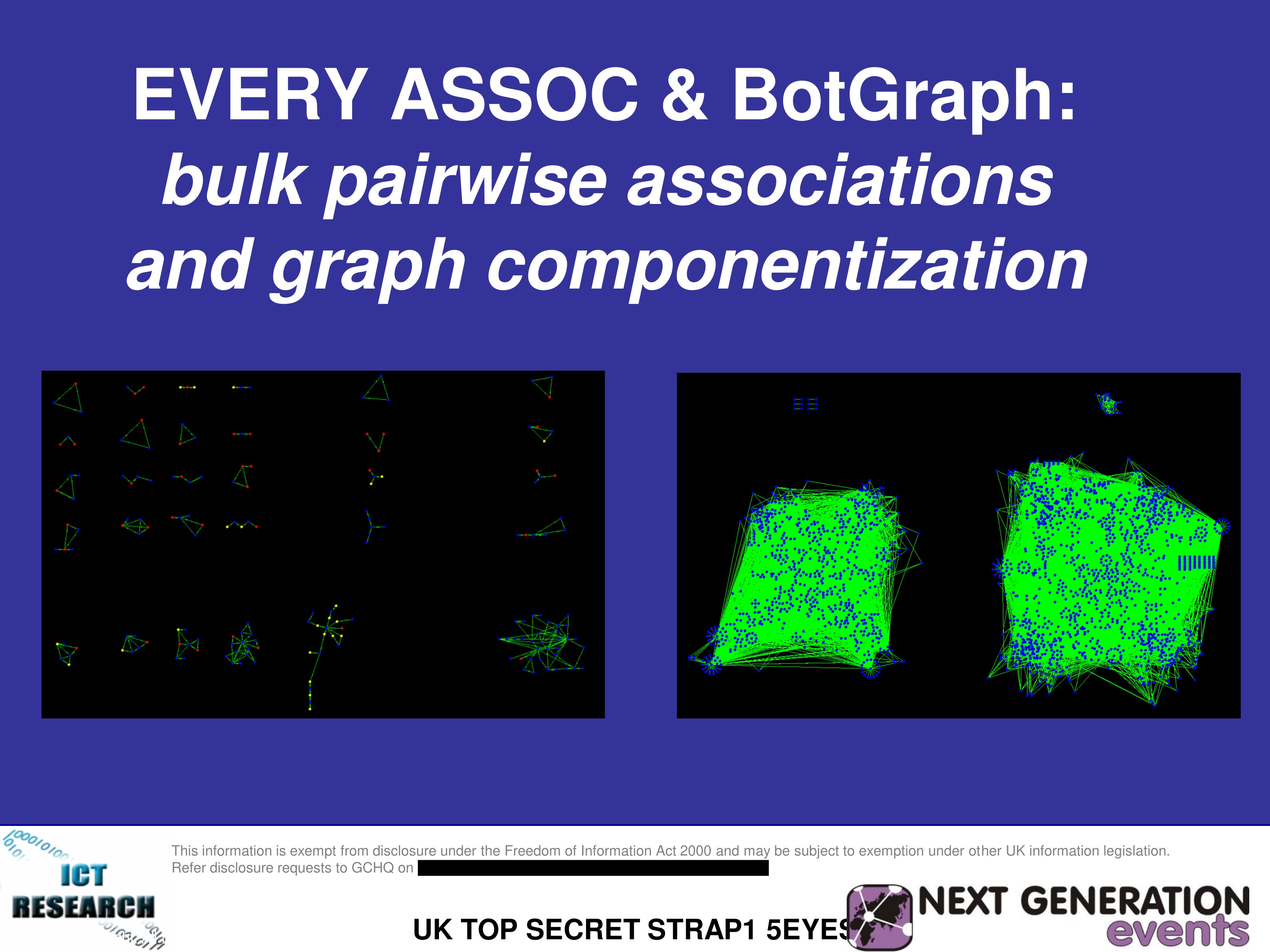
EVERY ASSOC & BotGraph:
bulk pairwise associations
and graph componentization
ICT RESEARCH
This information is exempt from disclosure under the Freedom of Information Act 2000 and may be subject to exemption under other UK information legislation. Refer disclosure requests to GCHQ on [REDACTED]
NEXT GENERATION events
UK TOP SECRET STRAP1 5EYES
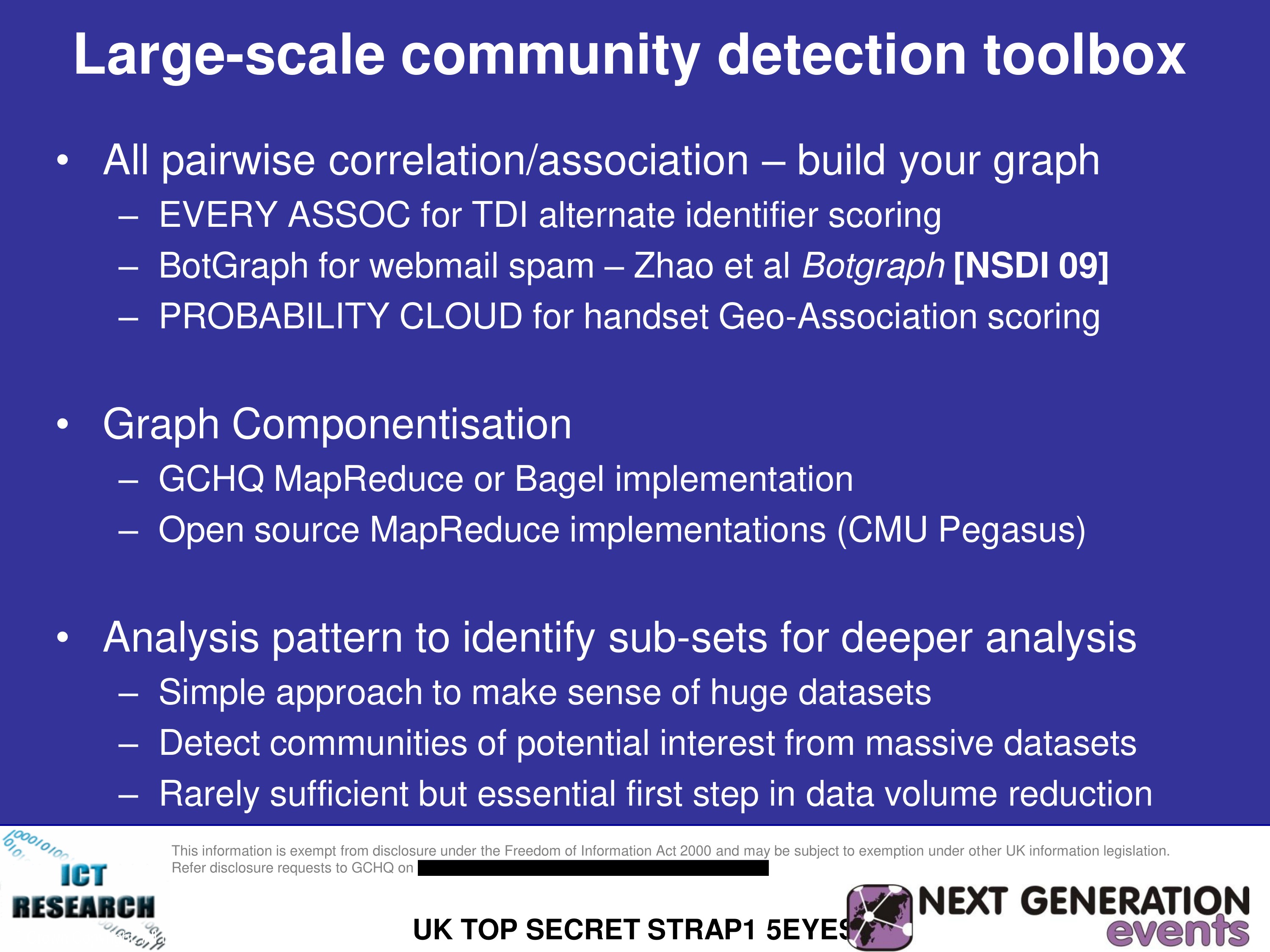
Large-scale community detection toolbox
- All pairwise correlation/association – build your graph
- EVERY ASSOC for TDI alternate identifier scoring
- BotGraph for webmail spam – Zhao et al Botgraph [NSDI 09]
- PROBABILITY CLOUD for handset Geo-Association scoring
- Graph Componentisation
- GCHQ MapReduce or Bagel implementation
- Open source MapReduce implementations (CMU Pegasus)
- Analysis pattern to identify sub-sets for deeper analysis
- Simple approach to make sense of huge datasets
- Detect communities of potential interest from massive datasets
- Rarely sufficient but essential first step in data volume reduction
ICT RESEARCH
This information is exempt from disclosure under the Freedom of Information Act 2000 and may be subject to exemption under other UK information legislation. Refer disclosure requests to GCHQ on [REDACTED]
NEXT GENERATION events
UK TOP SECRET STRAP1 5EYES
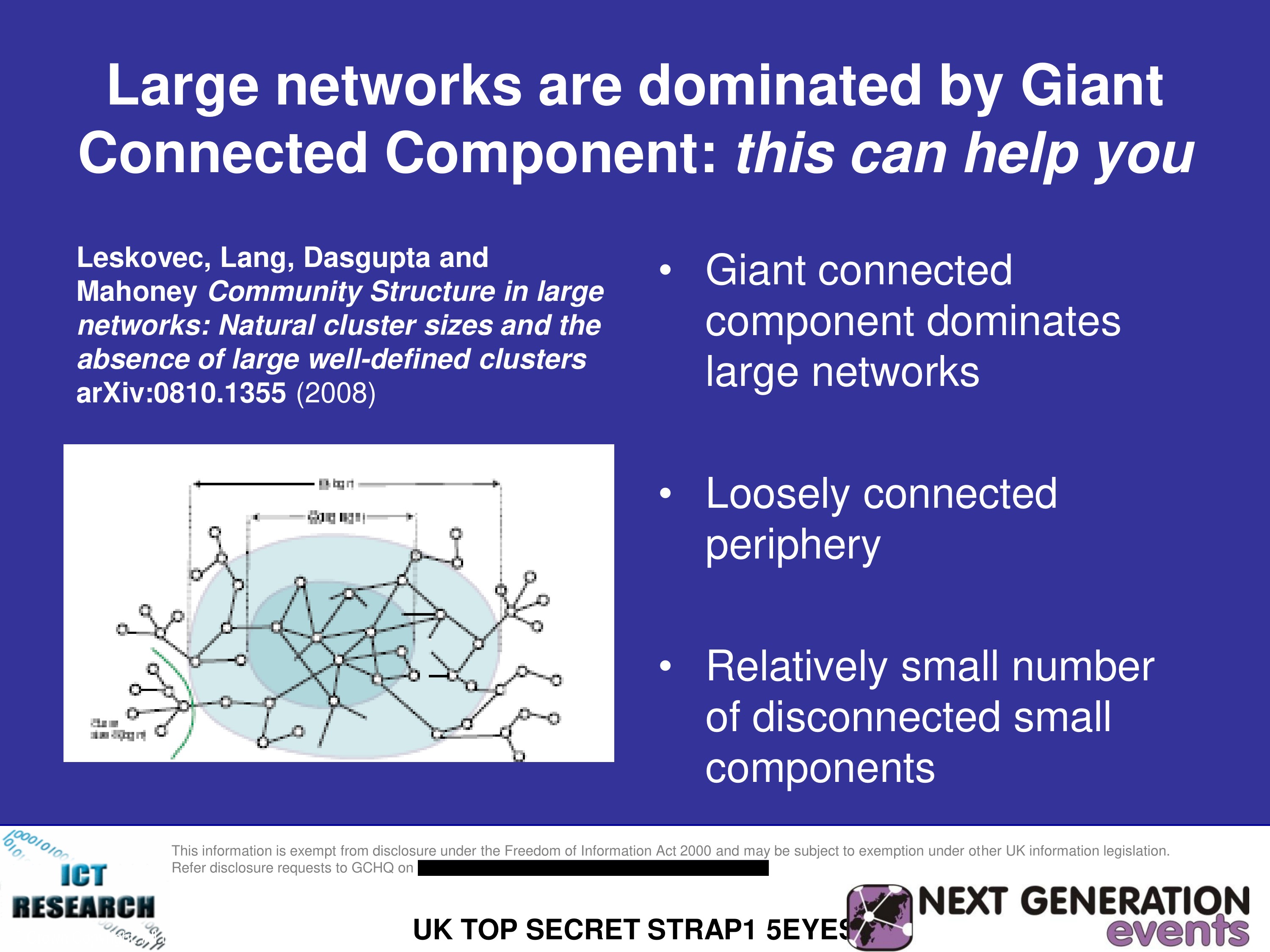
Large networks are dominated by Giant
Connected Component: this can help you
Leskovec, Lang, Dasgupta and Mahoney Community Structure in large networks: Natural cluster sizes and the absence of large well-defined clusters arXiv:0810.1355 (2008)
- Giant connected component dominates large networks
- Loosely connected periphery
- Relatively small number of disconnected small components
ICT RESEARCH
This information is exempt from disclosure under the Freedom of Information Act 2000 and may be subject to exemption under other UK information legislation. Refer disclosure requests to GCHQ on [REDACTED]
NEXT GENERATION events
UK TOP SECRET STRAP1 5EYES
Target Discovery at Population Scale
- We are describing a target discovery technique based on known target communications behaviour applied to population scale bulk unselected events
- target discovery – discover unknown targets
- known target communications behaviour – modus operandi (MO)
- population scale – all the events we have for a country
- unselected events - not seeded on targets
ICT RESEARCH
This information is exempt from disclosure under the Freedom of Information Act 2000 and may be subject to exemption under other UK information legislation. Refer disclosure requests to GCHQ on [REDACTED]
NEXT GENERATION events
UK TOP SECRET STRAP1 5EYES
Caveat Emptor
- Method has shown promise to discover phone groups of interest
undiscoverable by traditional analysis.
- “Find adversaries through their behaviour”
- Initial identification of candidates is pure target discovery
- not seeded on targets
- search for behaviour in massive events
- BUT it can only be used to effect if it is tied in with analyst knowledge of other patterns of behaviour, possibly geo-related.
ICT RESEARCH
This information is exempt from disclosure under the Freedom of Information Act 2000 and may be subject to exemption under other UK information legislation. Refer disclosure requests to GCHQ on [REDACTED]
NEXT GENERATION events
UK TOP SECRET STRAP1 5EYES
Critical Success Factors
- Technical expertise in data mining (ICTR)
- Good understanding of target MO and ability to follow up new leads which are generated (Ops CT Analysts)
- Supporting IT infrastructure (SILVER LINING)
- Bulk access to relevant data sets (SILVER LINING)
- ICTR lacks bulk access to CULT WEAVE – had snapshot in 2007
- There were promising research lines: see SD conference 2007
ICT RESEARCH
This information is exempt from disclosure under the Freedom of Information Act 2000 and may be subject to exemption under other UK information legislation. Refer disclosure requests to GCHQ on [REDACTED]
NEXT GENERATION events
UK TOP SECRET STRAP1 5EYES
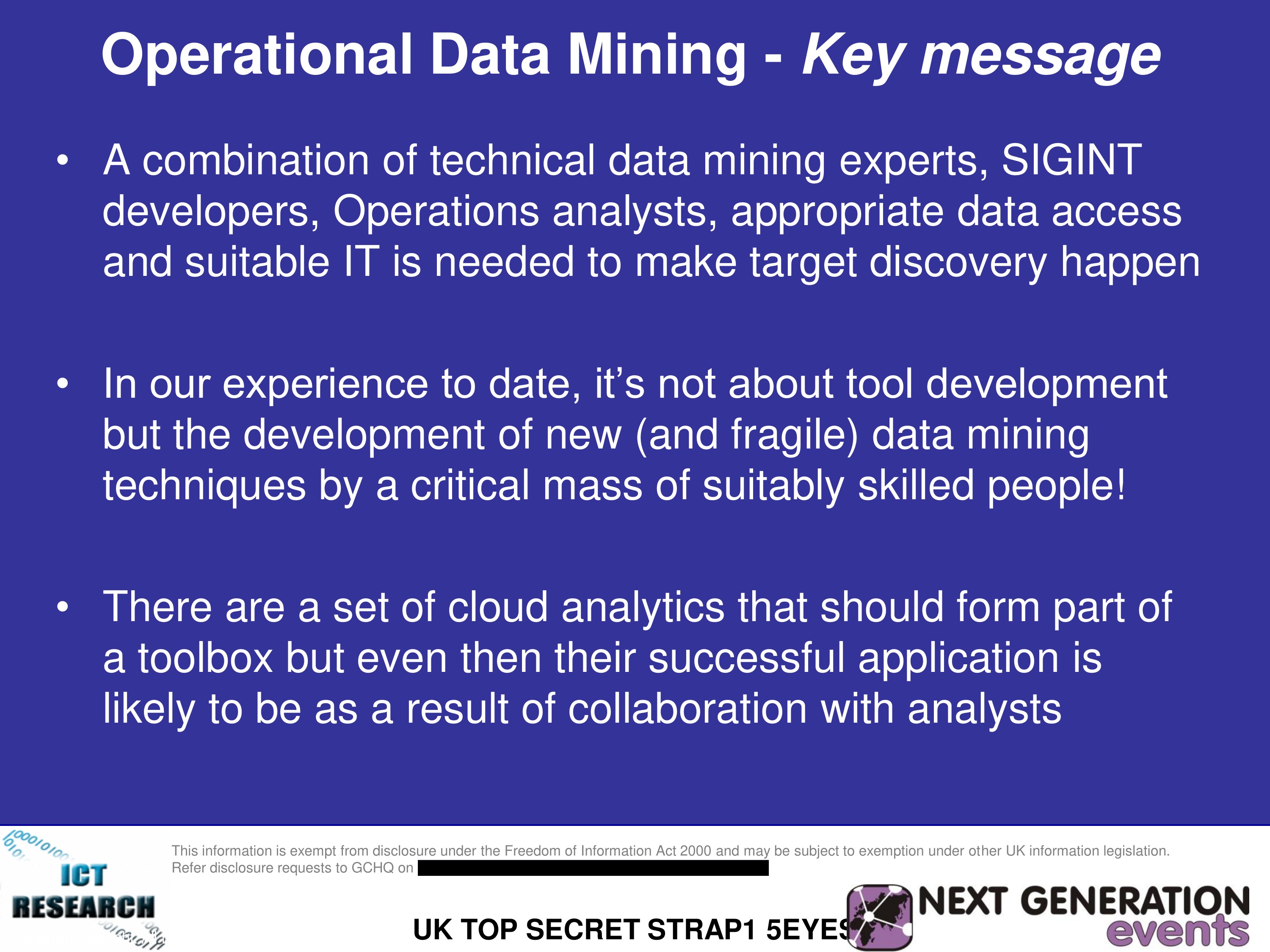
Operational Data Mining - Key message
- A combination of technical data mining experts, SIGINT developers, Operations analysts, appropriate data access and suitable IT is needed to make target discovery happen
- In our experience to date, it's not about tool development but the development of new (and fragile) data mining techniques by a critical mass of suitably skilled people!
- There are a set of cloud analytics that should form part of a toolbox but even then their successful application is likely to be as a result of collaboration with analysts
ICT RESEARCH
This information is exempt from disclosure under the Freedom of Information Act 2000 and may be subject to exemption under other UK information legislation. Refer disclosure requests to GCHQ on [REDACTED]
NEXT GENERATION events
UK TOP SECRET STRAP1 5EYES
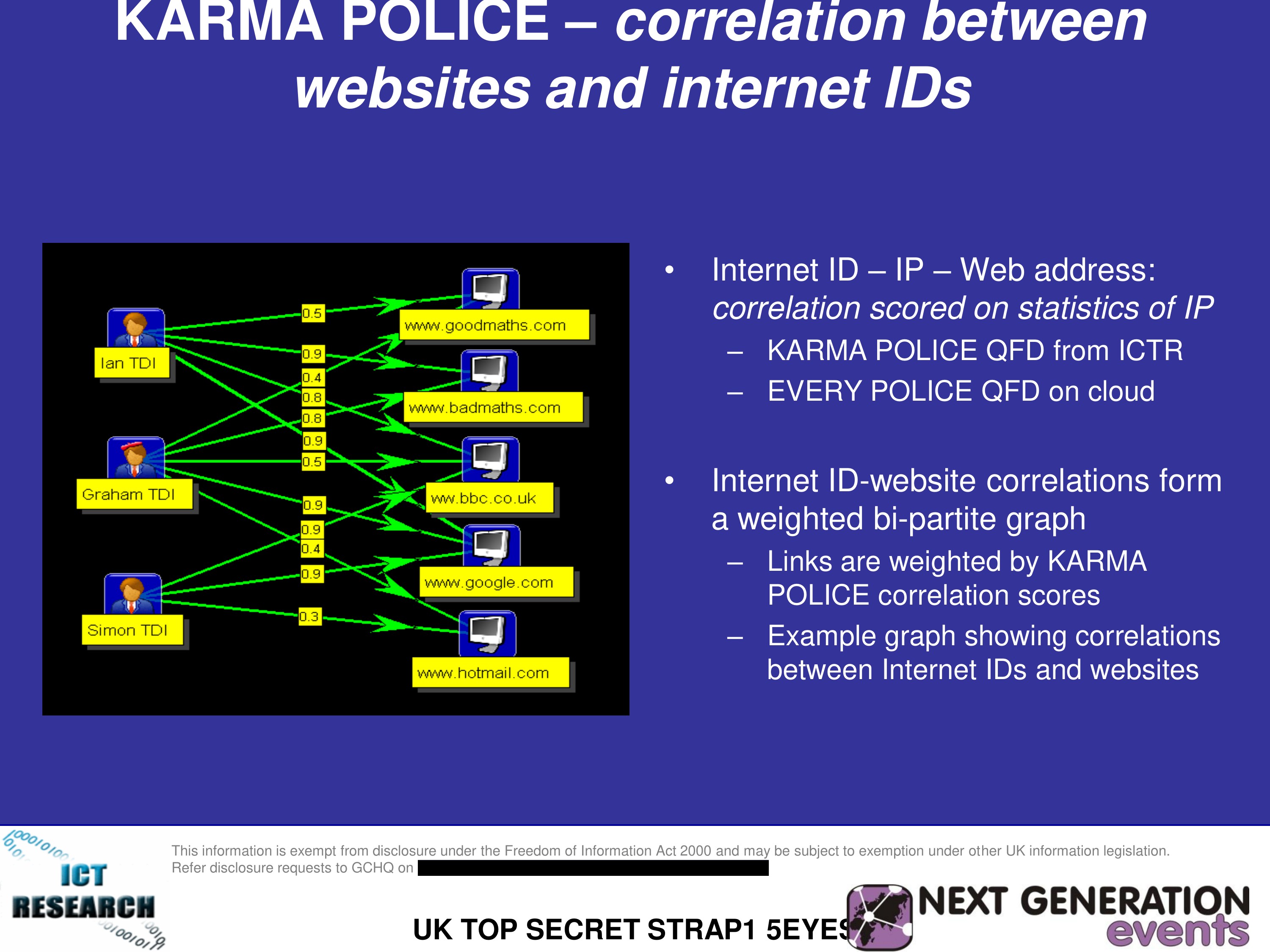
KARMA POLICE – correlation between websites and internet IDs
Ian TDI
Graham TDI
Simon TDI
www.goodmaths.com
www.badmaths.com
www.bbc.co.uk
www.google.com
www.hotmail.com
0.6 0.9 0.4 0.8 0.8 0.9 0.5 0.9 0.9 0.4 0.9 0.3
- Internet ID – IP – Web address: correlation scored on statistics of IP
- KARMA POLICE QFD from ICTR
- EVERY POLICE QFD on cloud
- Internet ID-website correlations form a weighted bi-partite graph
- Links are weighted by KARMA POLICE correlation scores
- Example graph showing correlations between Internet IDs and websites
ICT RESEARCH
This information is exempt from disclosure under the Freedom of Information Act 2000 and may be subject to exemption under other UK information legislation. Refer disclosure requests to GCHQ on [REDACTED]
NEXT GENERATION events
UK TOP SECRET STRAP1 5EYES
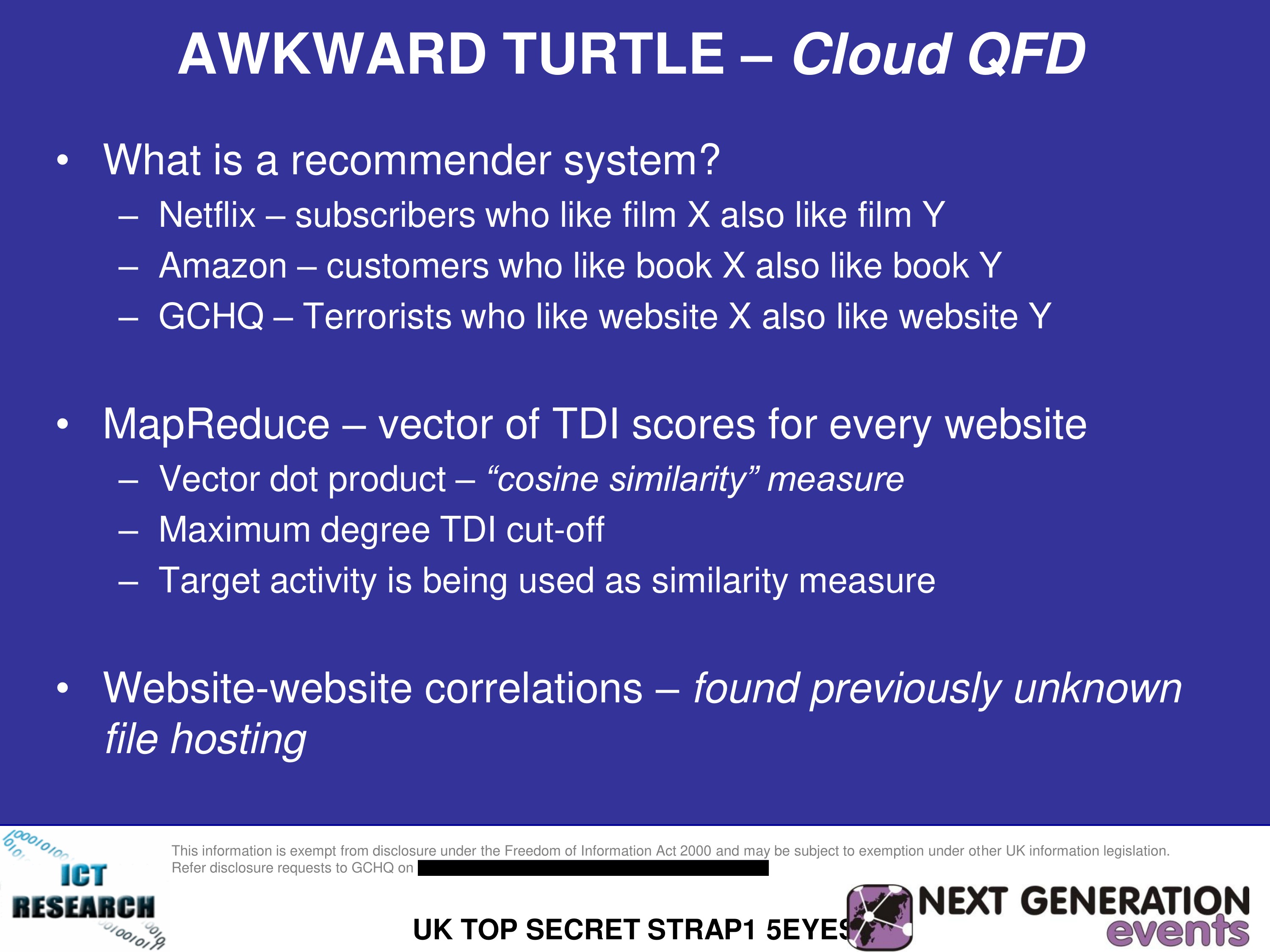
AWKWARD TURTLE – Cloud QFD
- What is a recommender system?
- Netflix – subscribers who like film X also like film Y
- Amazon – customers who like book X also like book Y
- GCHQ – Terrorists who like website X also like website Y
- MapReduce – vector of TDI scores for every website
- Vector dot product – “cosine similarity” measure
- Maximum degree TDI cut-off
- Target activity is being used as similarity measure
- Website-website correlations – found previously unknown file hosting
ICT RESEARCH
This information is exempt from disclosure under the Freedom of Information Act 2000 and may be subject to exemption under other UK information legislation. Refer disclosure requests to GCHQ on [REDACTED]
NEXT GENERATION events
UK TOP SECRET STRAP1 5EYES
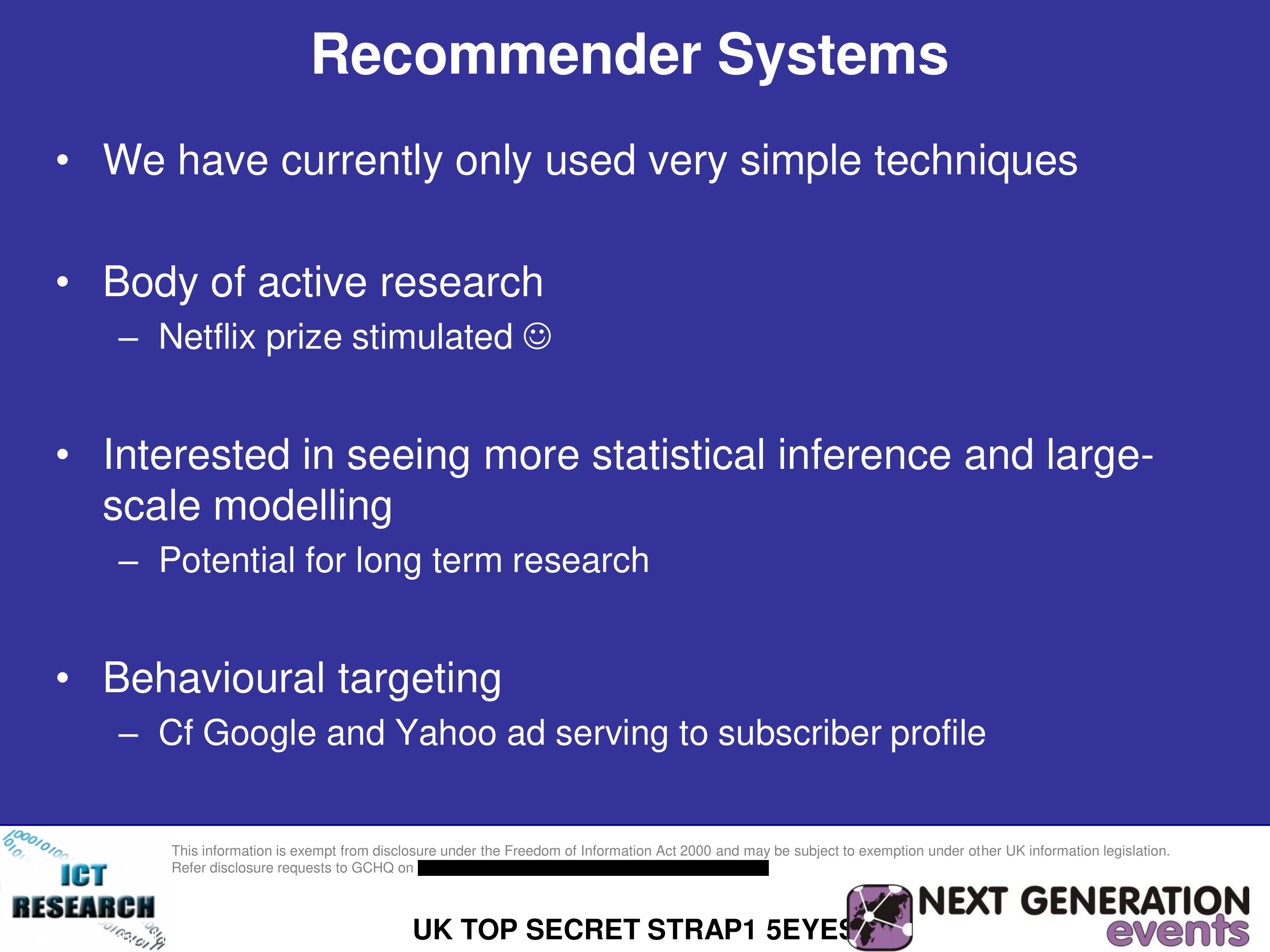
Recommender Systems
- We have currently only used very simple techniques
- Body of active research
- Netflix prize stimulated :)
- Interested in seeing more statistical inference and large-scale modelling
- Potential for long term research
- Behavioural targeting
- Cf Google and Yahoo ad serving to subscriber profile
ICT RESEARCH
This information is exempt from disclosure under the Freedom of Information Act 2000 and may be subject to exemption under other UK information legislation. Refer disclosure requests to GCHQ on [REDACTED]
NEXT GENERATION events
UK TOP SECRET STRAP1 5EYES
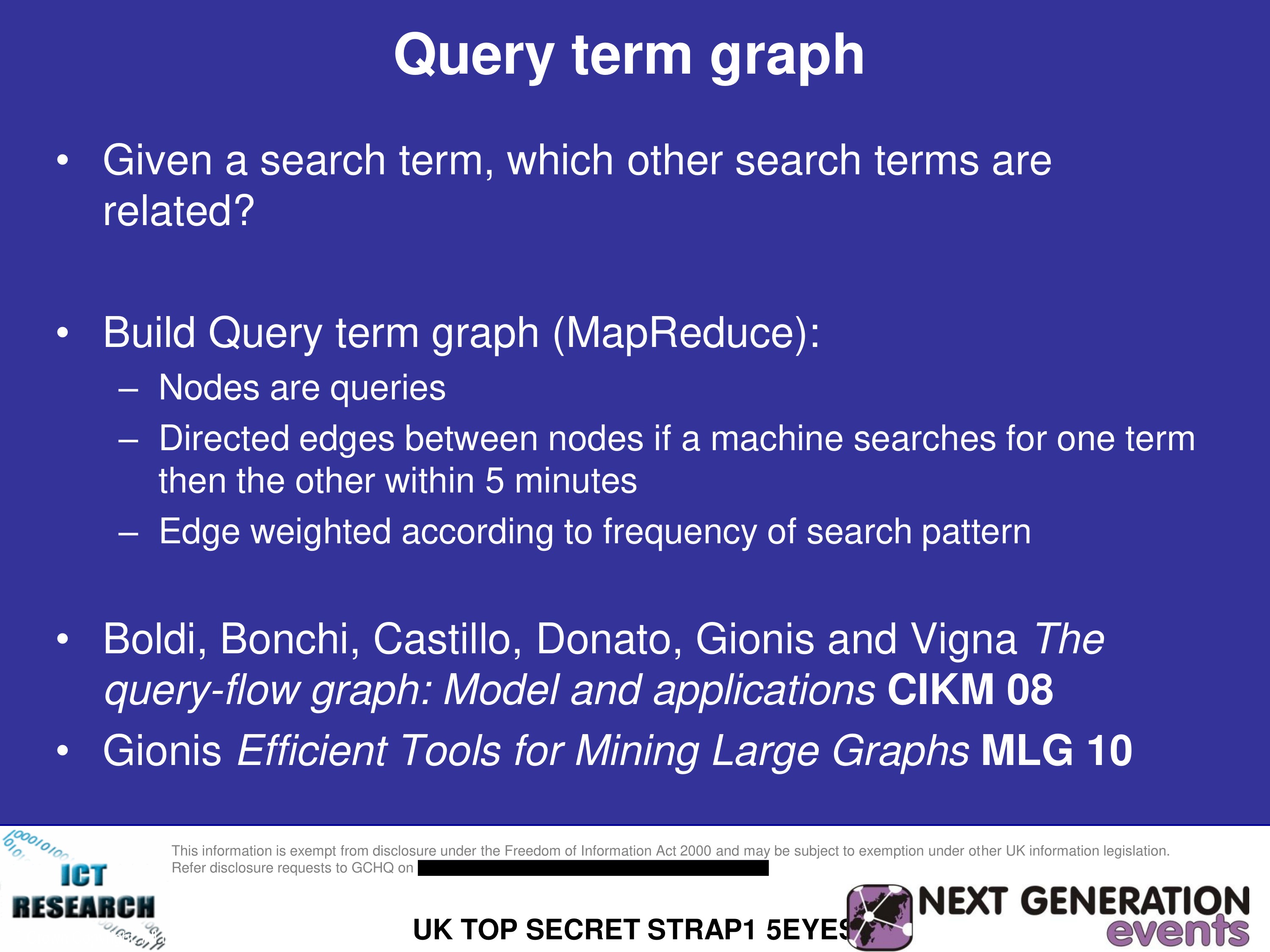
Query term graph
- Given a search term, which other search terms are related?
- Build Query term graph (MapReduce):
- Nodes are queries
- Directed edges between nodes if a machine searches for one term then the other within 5 minutes
- Edge weighted according to frequency of search pattern
- Boldi, Bonchi, Castillo, Donato, Gionis and Vigna The query-flow graph: Model and applications CIKM 08
- Gionis Efficient Tools for Mining Large Graphs MLG 10
ICT RESEARCH
This information is exempt from disclosure under the Freedom of Information Act 2000 and may be subject to exemption under other UK information legislation. Refer disclosure requests to GCHQ on [REDACTED]
NEXT GENERATION events
UK TOP SECRET STRAP1 5EYES
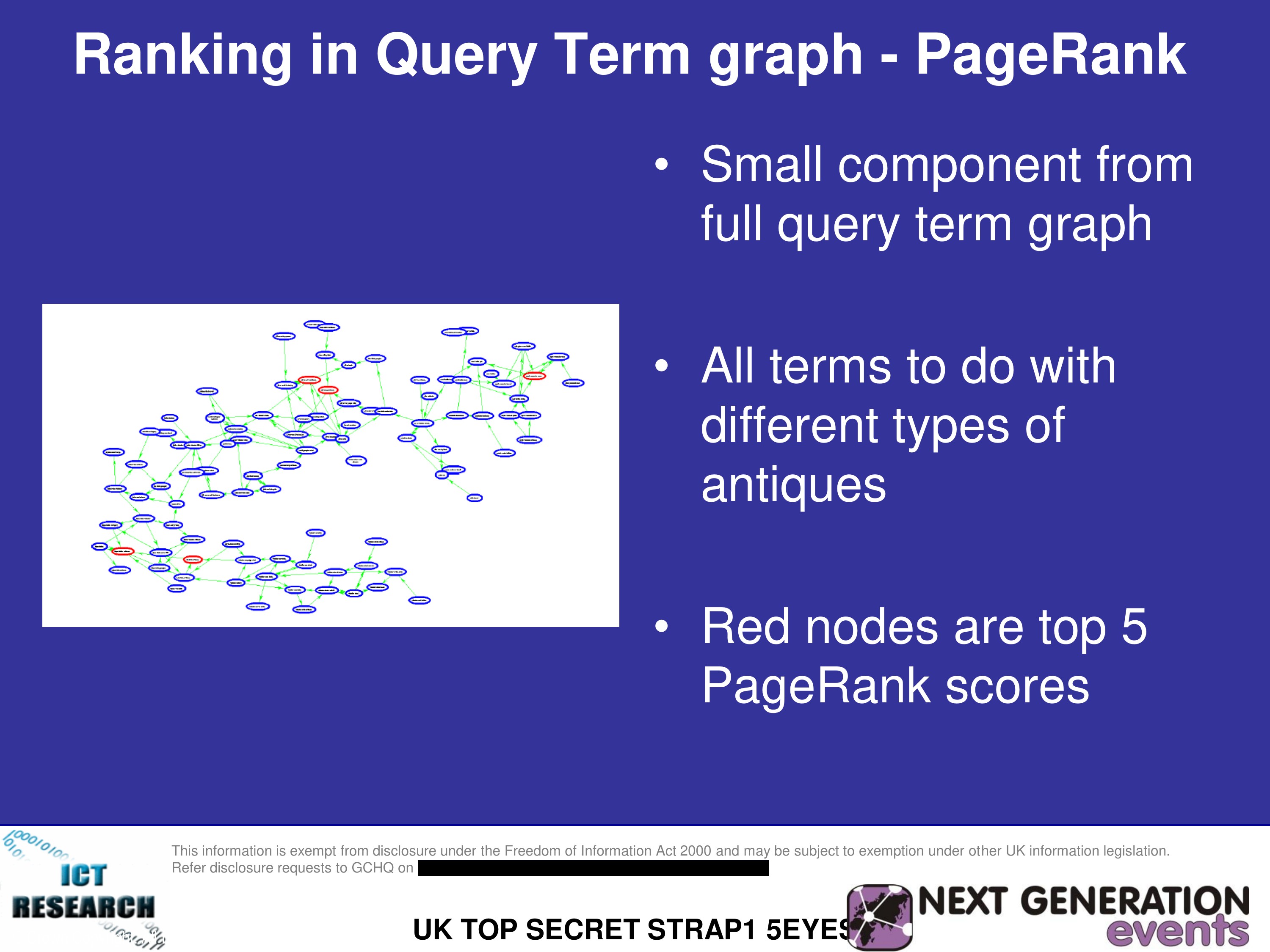
Ranking in Query Term graph - PageRank
- Small component from full query term graph
- All terms to do with different types of antiques
- Red nodes are top 5 PageRank scores
ICT RESEARCH
This information is exempt from disclosure under the Freedom of Information Act 2000 and may be subject to exemption under other UK information legislation. Refer disclosure requests to GCHQ on [REDACTED]
NEXT GENERATION events
UK TOP SECRET STRAP1 5EYES
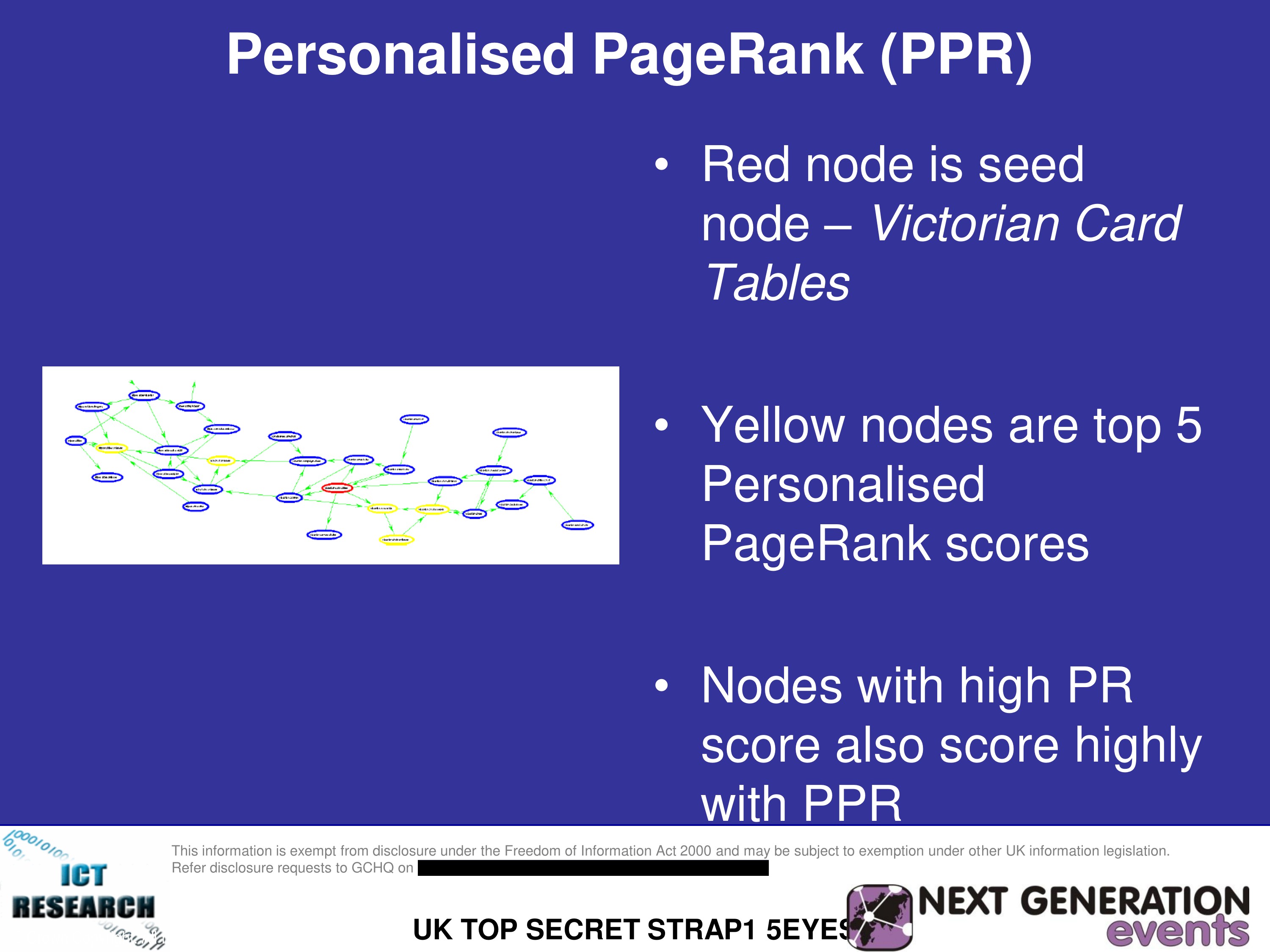
Personalised PageRank (PPR)
- Red node is seed node – Victorian Card Tables
- Yellow nodes are top 5 Personalised PageRank scores
- Nodes with high PR score also score highly with PPR
ICT RESEARCH
This information is exempt from disclosure under the Freedom of Information Act 2000 and may be subject to exemption under other UK information legislation. Refer disclosure requests to GCHQ on [REDACTED]
NEXT GENERATION events
UK TOP SECRET STRAP1 5EYES
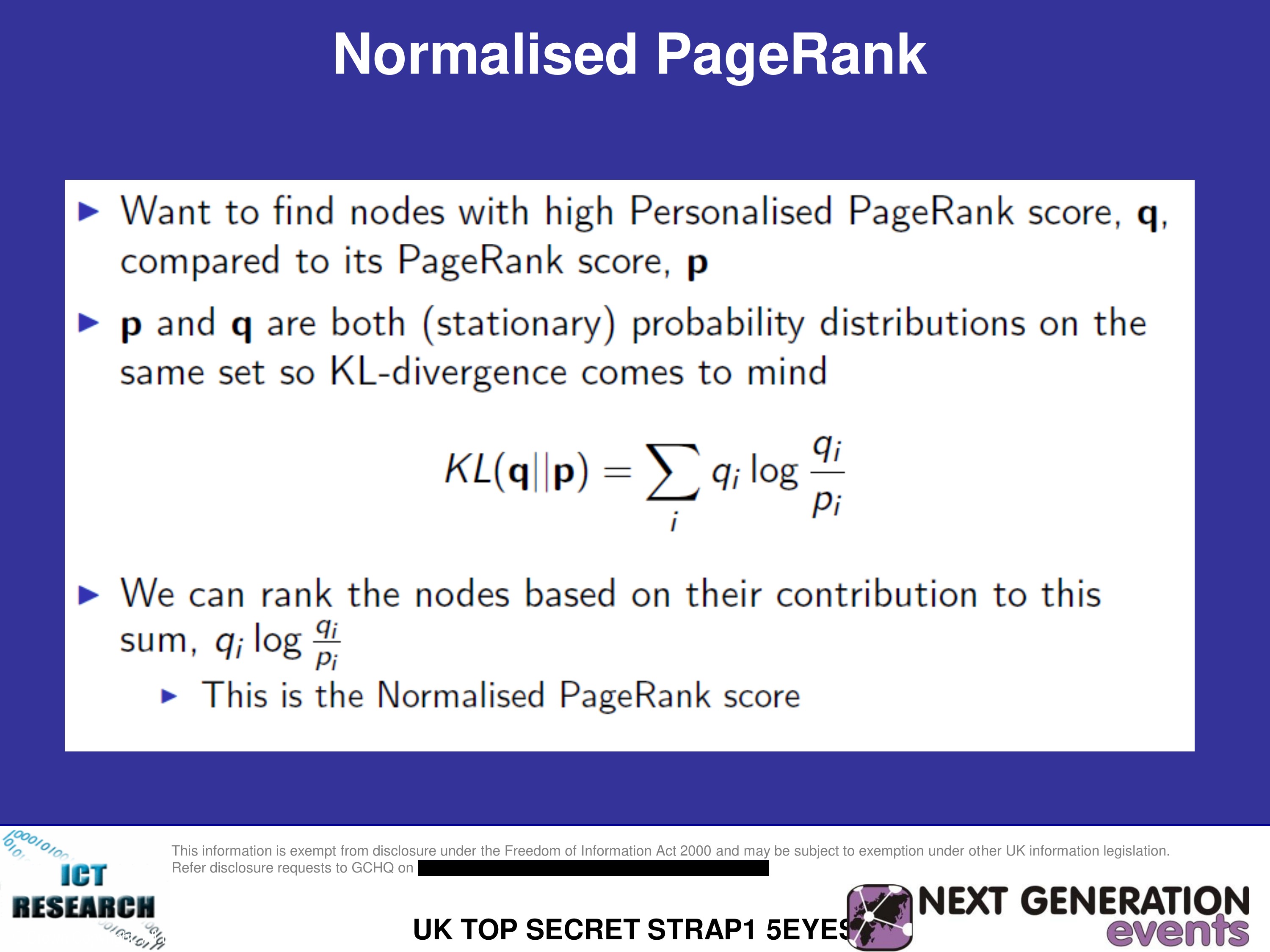
Normalised PageRank
- Want to find nodes with high Personalised PageRank score, q, compared to its PageRank score, p
- p and q are both (stationary) probability distributions on the same set so KL-divergence comes to mind
$$ KL(q||p) = \sum_i q_i \log \frac{q_i}{p_i} $$
- We can rank the nodes based on their contribution to this sum, $q_i \log \frac{q_i}{p_i}$
- This is the Normalised PageRank score
ICT RESEARCH
This information is exempt from disclosure under the Freedom of Information Act 2000 and may be subject to exemption under other UK information legislation. Refer disclosure requests to GCHQ on [REDACTED]
NEXT GENERATION events
UK TOP SECRET STRAP1 5EYES
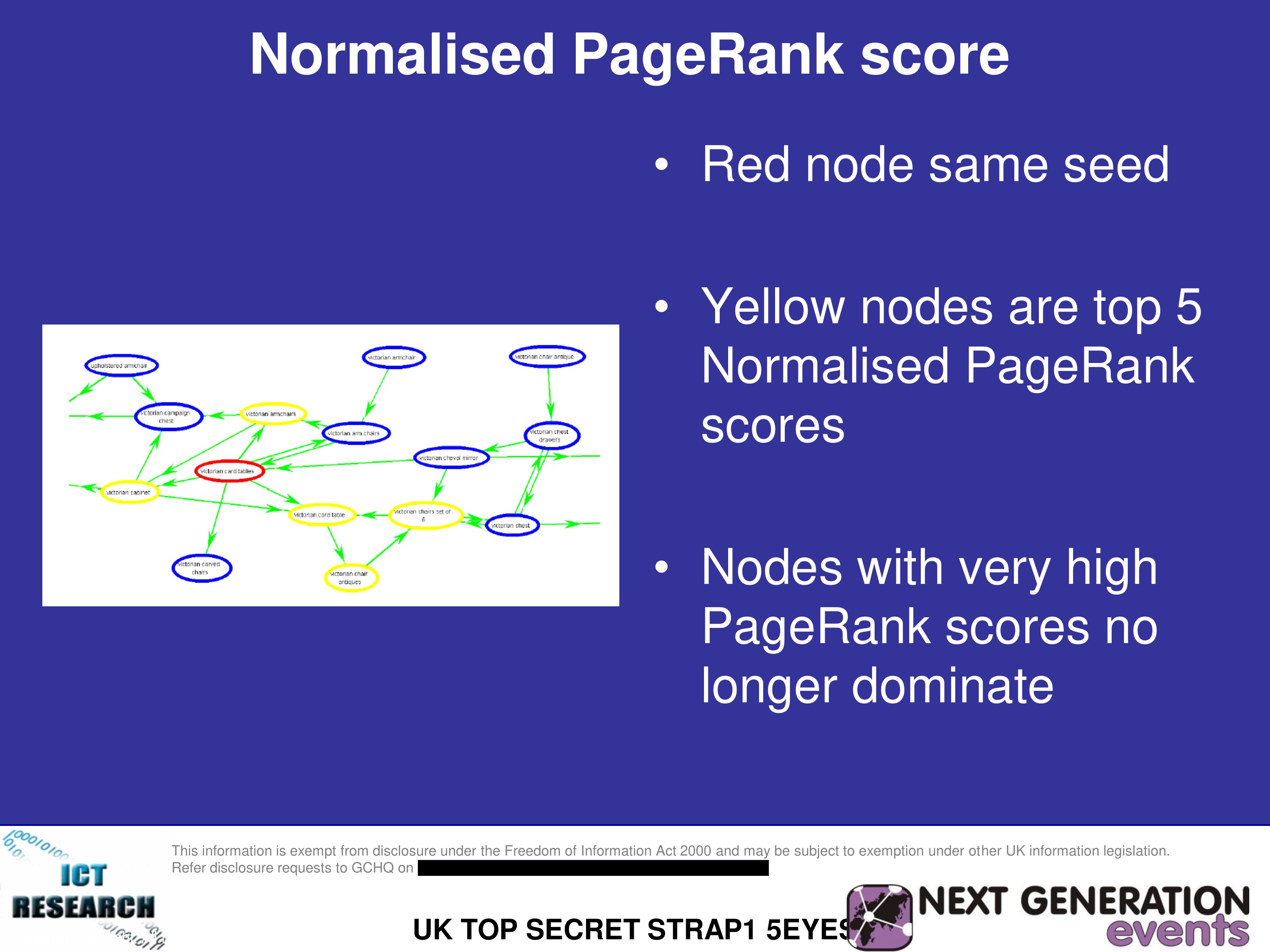
Normalised PageRank score
- Red node same seed
- Yellow nodes are top 5 Normalised PageRank scores
- Nodes with very high PageRank scores no longer dominate
ICT RESEARCH
This information is exempt from disclosure under the Freedom of Information Act 2000 and may be subject to exemption under other UK information legislation. Refer disclosure requests to GCHQ on [REDACTED]
NEXT GENERATION events
UK TOP SECRET STRAP1 5EYES
Comments on Normalised PageRank
- Could go N-hops from seed node
- Have to set pizza node degree limit
- N-hop with pizza limit is standard contact chaining method
- Normalised PageRank deals with high degree nodes
- High degree nodes tend to have high PageRank
- Must score very highly on PPR to score well in Normalised PR
- Shown results within small component
- Evaluate Normalised PR for seed term in Giant Connected Component of Query Term Graph using Bagel
ICT RESEARCH
This information is exempt from disclosure under the Freedom of Information Act 2000 and may be subject to exemption under other UK information legislation. Refer disclosure requests to GCHQ on [REDACTED]
NEXT GENERATION events
UK TOP SECRET STRAP1 5EYES
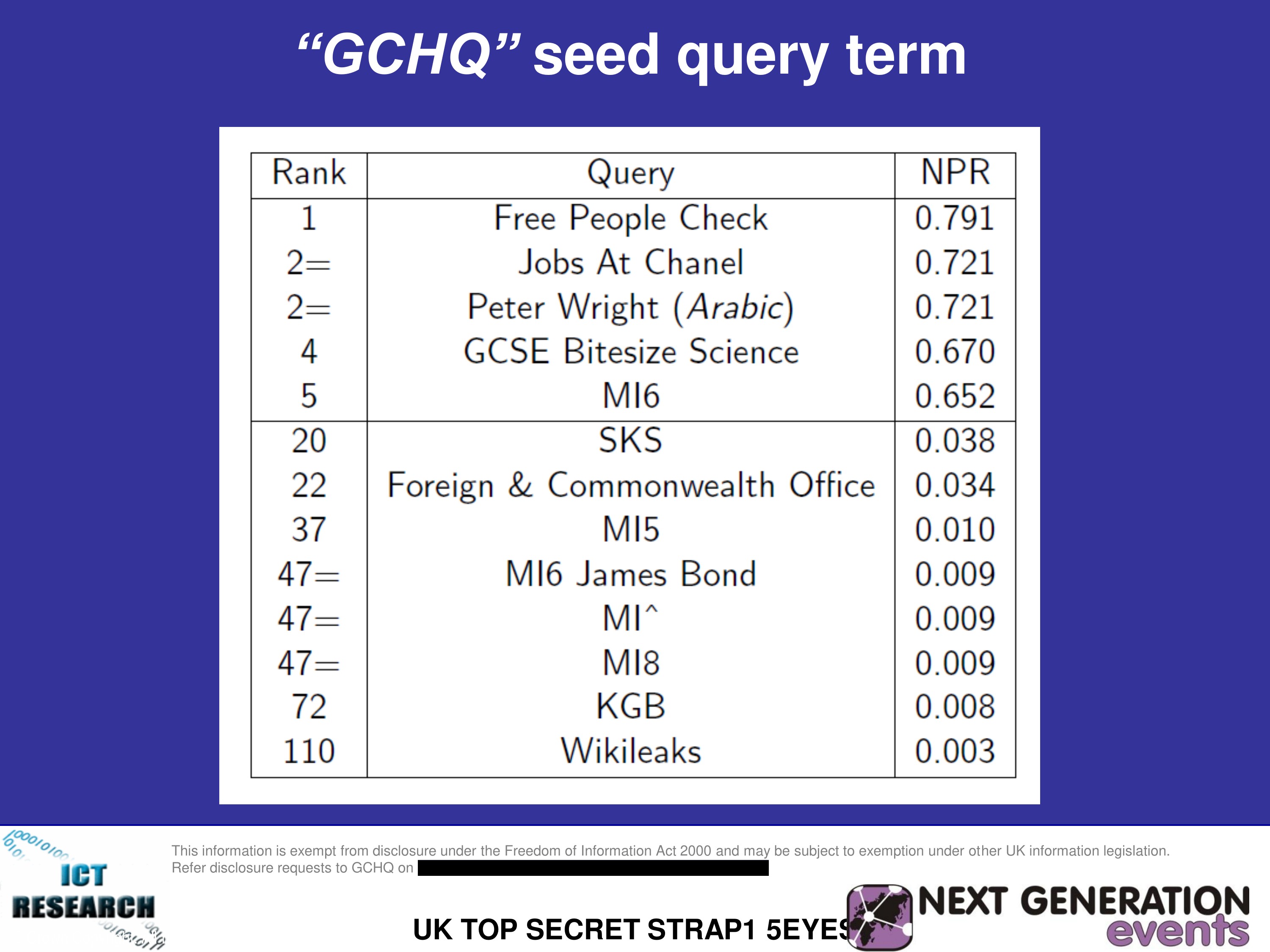
“GCHQ” seed query term
| Rank | Query | NPR |
|---|---|---|
| 1 | Free People Check | 0.791 |
| 2= | Jobs At Chanel | 0.721 |
| 2= | Peter Wright (Arabic) | 0.721 |
| 4 | GCSE Bitesize Science | 0.670 |
| 5 | MI6 | 0.652 |
| 20 | SKS | 0.038 |
| 22 | Foreign & Commonwealth Office | 0.034 |
| 37 | MI5 | 0.010 |
| 47= | MI6 James Bond | 0.009 |
| 47= | MI^ | 0.009 |
| 47= | MI8 | 0.009 |
| 72 | KGB | 0.008 |
| 110 | Wikileaks | 0.003 |
ICT RESEARCH
This information is exempt from disclosure under the Freedom of Information Act 2000 and may be subject to exemption under other UK information legislation. Refer disclosure requests to GCHQ on [REDACTED]
NEXT GENERATION events
UK TOP SECRET STRAP1 5EYES
Comments on Query Term Graph
- Query term graph is very noisy, as are all our Internet Events meta-data graphs
- Some promising results in finding similar queries but essential that results are interpreted by analysts
- Large amount of research to do
- Clustering / Sessionising / ... [lots of commercially motivated work]
- Query chains – Banana -> Apple different intent to iPod -> Apple
- Understanding the search behaviour of targets
- Normalised PageRank insights may be generally useful
ICT RESEARCH
This information is exempt from disclosure under the Freedom of Information Act 2000 and may be subject to exemption under other UK information legislation. Refer disclosure requests to GCHQ on [REDACTED]
NEXT GENERATION events
UK TOP SECRET STRAP1 5EYES
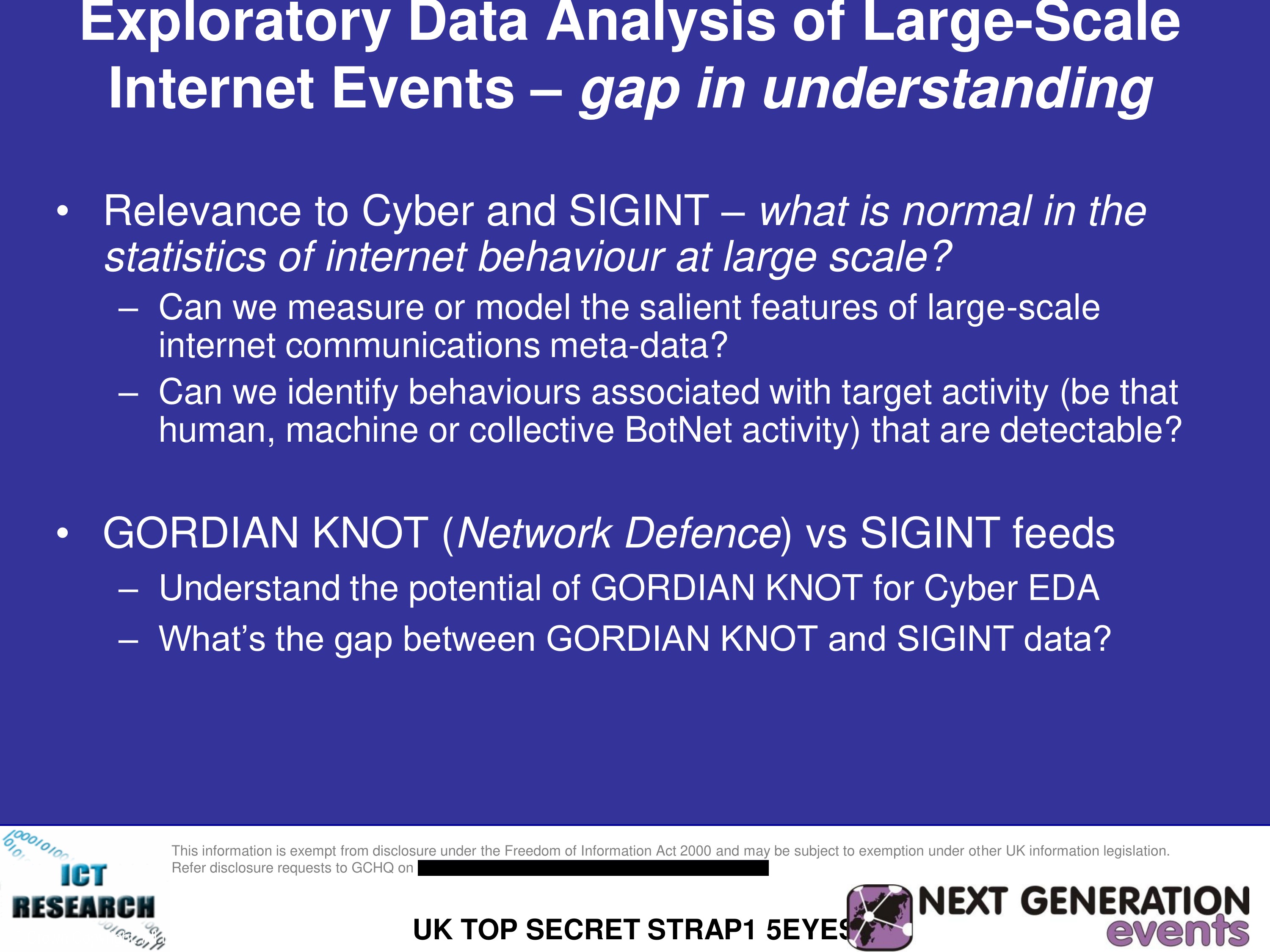
Exploratory Data Analysis of Large-Scale
Internet Events – gap in understanding
- Relevance to Cyber and SIGINT – what is normal in the statistics of internet behaviour at large scale?
- Can we measure or model the salient features of large-scale internet communications meta-data?
- Can we identify behaviours associated with target activity (be that human, machine or collective BotNet activity) that are detectable?
- GORDIAN KNOT (Network Defence) vs SIGINT feeds
- Understand the potential of GORDIAN KNOT for Cyber EDA
- What's the gap between GORDIAN KNOT and SIGINT data?
ICT RESEARCH
This information is exempt from disclosure under the Freedom of Information Act 2000 and may be subject to exemption under other UK information legislation. Refer disclosure requests to GCHQ on [REDACTED]
NEXT GENERATION events
UK TOP SECRET STRAP1 5EYES
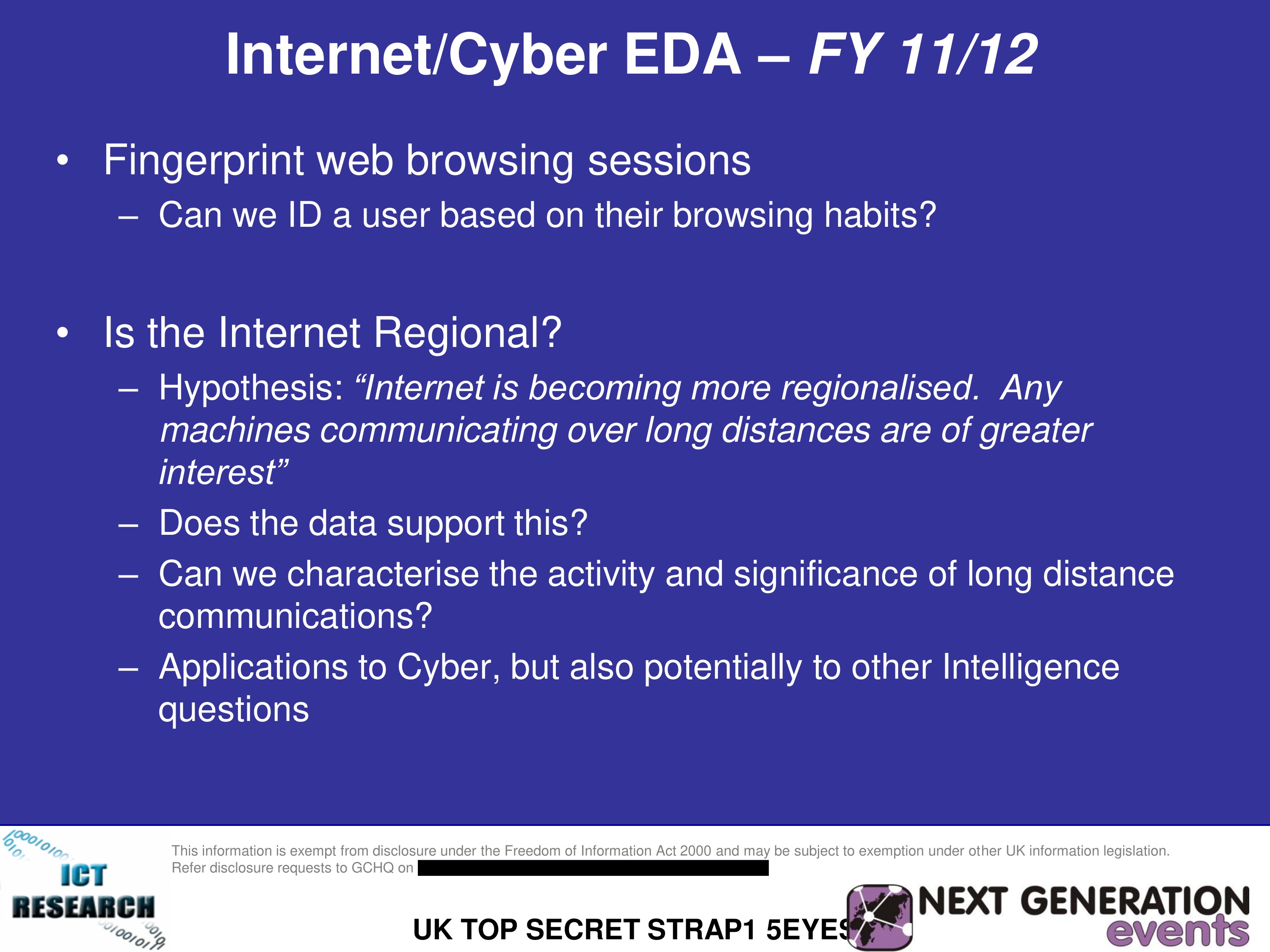
Internet/Cyber EDA – FY 11/12
- Fingerprint web browsing sessions
- Can we ID a user based on their browsing habits?
- Is the Internet Regional?
- Hypothesis: “Internet is becoming more regionalised. Any machines communicating over long distances are of greater interest"
- Does the data support this?
- Can we characterise the activity and significance of long distance communications?
- Applications to Cyber, but also potentially to other Intelligence questions
ICT RESEARCH
This information is exempt from disclosure under the Freedom of Information Act 2000 and may be subject to exemption under other UK information legislation. Refer disclosure requests to GCHQ on [REDACTED]
NEXT GENERATION events
UK TOP SECRET STRAP1 5EYES
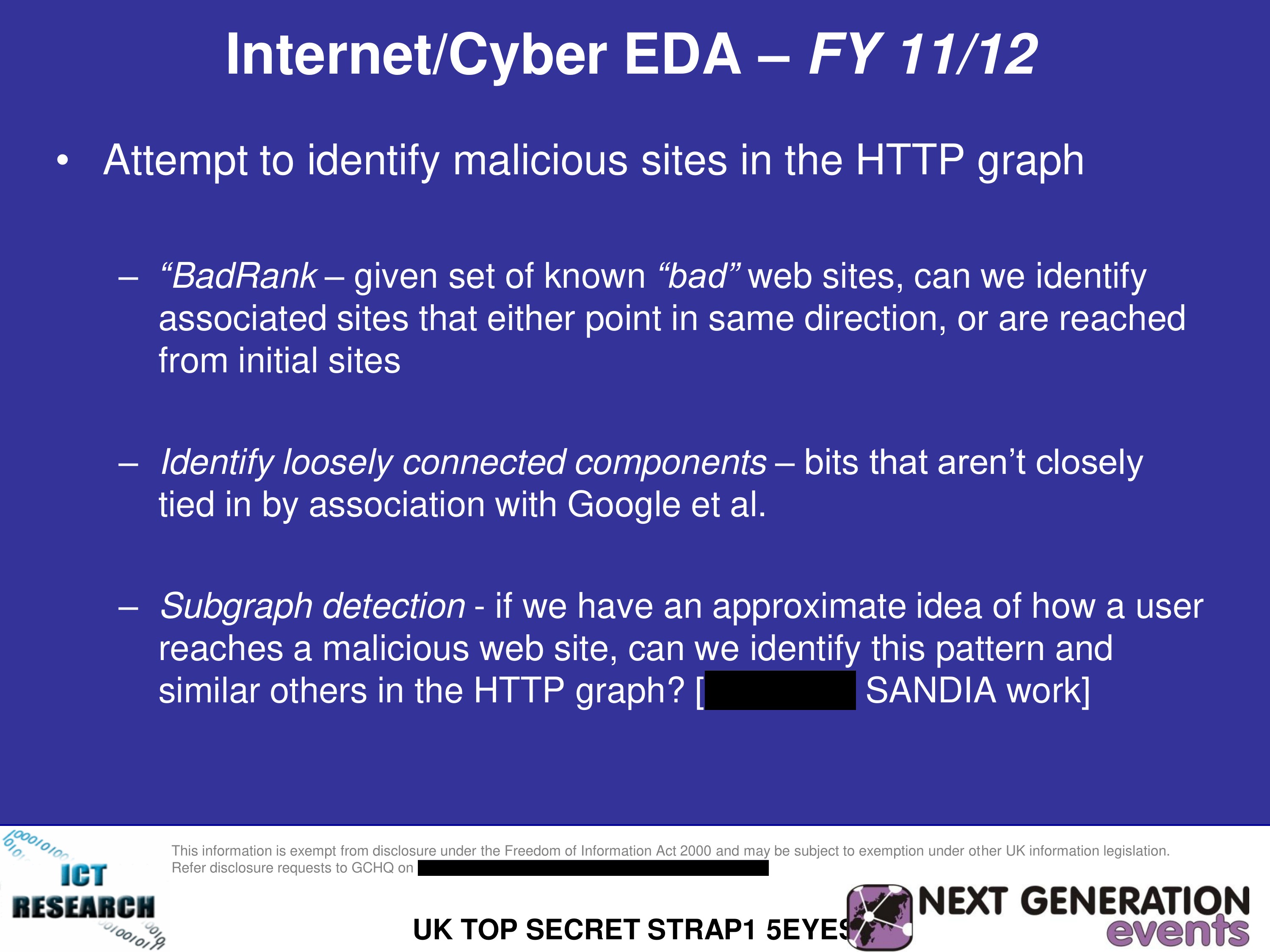
Internet/Cyber EDA – FY 11/12
- Attempt to identify malicious sites in the HTTP graph
- "BadRank – given set of known "bad" web sites, can we identify associated sites that either point in same direction, or are reached from initial sites
- Identify loosely connected components – bits that aren't closely tied in by association with Google et al.
- Subgraph detection - if we have an approximate idea of how a user reaches a malicious web site, can we identify this pattern and similar others in the HTTP graph? [[REDACTED] SANDIA work]
ICT RESEARCH
This information is exempt from disclosure under the Freedom of Information Act 2000 and may be subject to exemption under other UK information legislation. Refer disclosure requests to GCHQ on [REDACTED]
NEXT GENERATION events
UK TOP SECRET STRAP1 5EYES
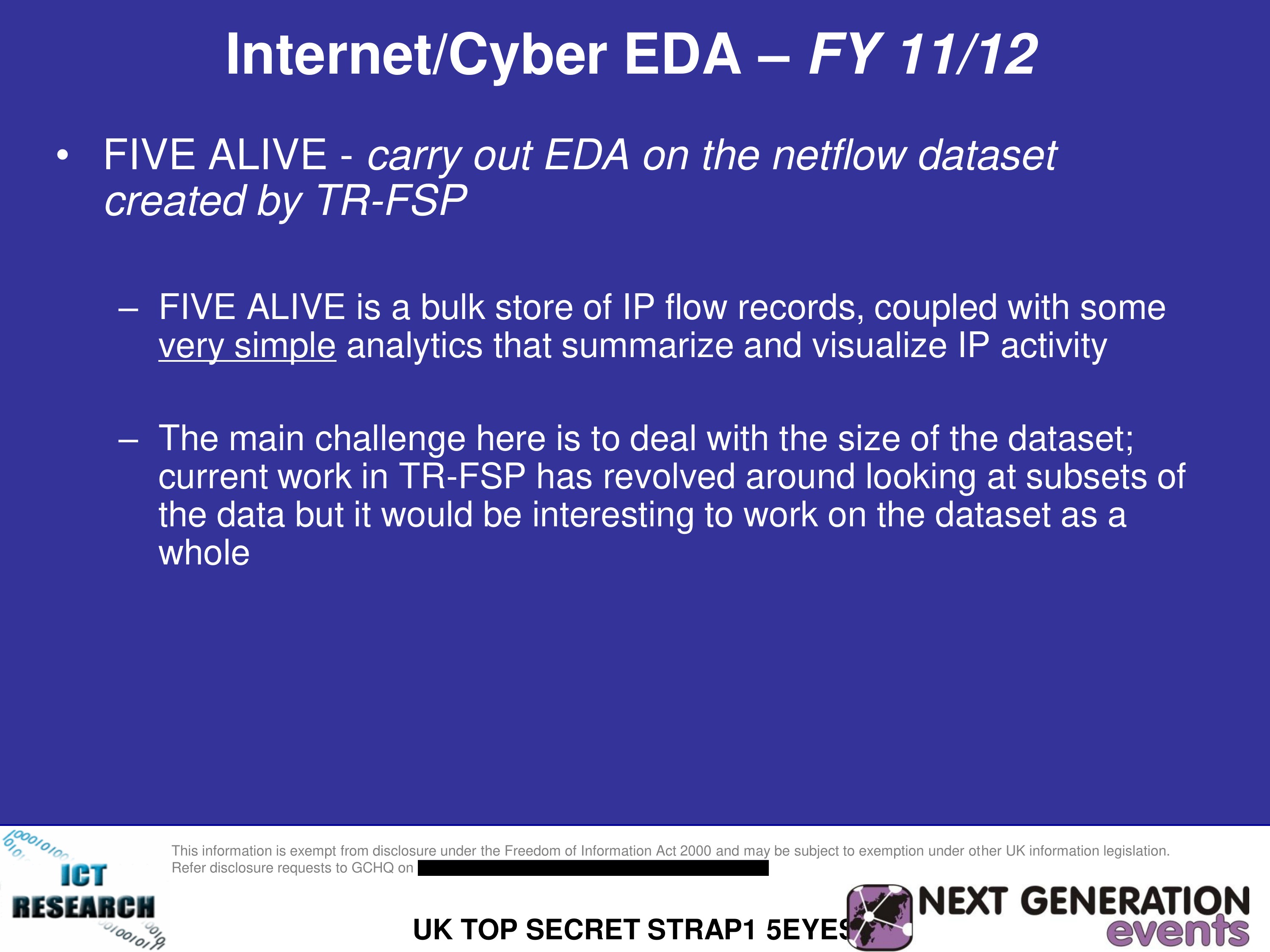
Internet/Cyber EDA – FY 11/12
- FIVE ALIVE - carry out EDA on the netflow dataset created by TR-FSP
- FIVE ALIVE is a bulk store of IP flow records, coupled with some very simple analytics that summarize and visualize IP activity
- The main challenge here is to deal with the size of the dataset; current work in TR-FSP has revolved around looking at subsets of the data but it would be interesting to work on the dataset as a whole
ICT RESEARCH
This information is exempt from disclosure under the Freedom of Information Act 2000 and may be subject to exemption under other UK information legislation. Refer disclosure requests to GCHQ on [REDACTED]
NEXT GENERATION events
UK TOP SECRET STRAP1 5EYES
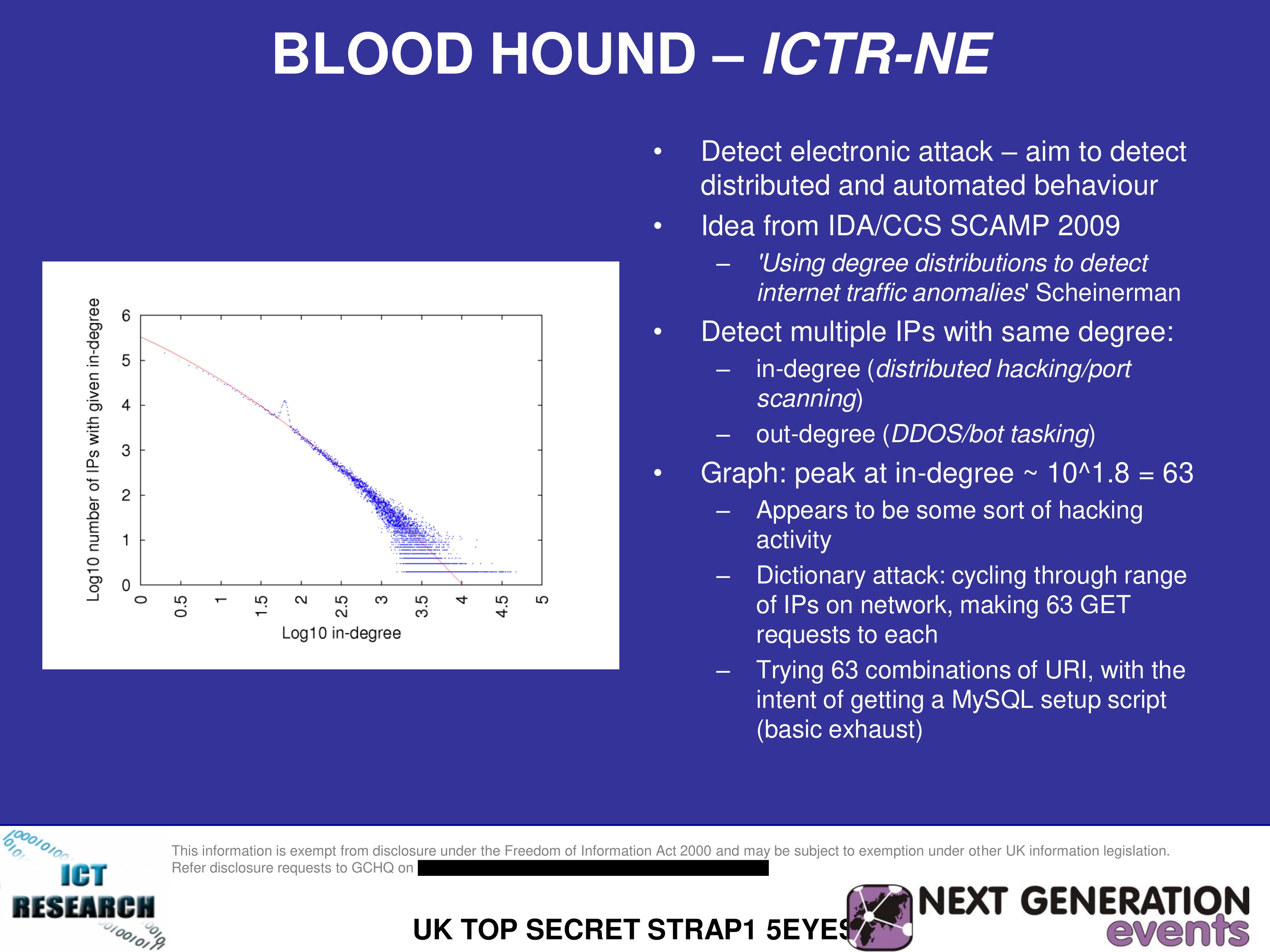
BLOOD HOUND – ICTR-NE
- Detect electronic attack – aim to detect distributed and automated behaviour
- Idea from IDA/CCS SCAMP 2009
- 'Using degree distributions to detect internet traffic anomalies' Scheinerman
- Detect multiple IPs with same degree:
- in-degree (distributed hacking/port scanning)
- out-degree (DDOS/bot tasking)
- Graph: peak at in-degree ~ 10^1.8 = 63
- Appears to be some sort of hacking activity
- Dictionary attack: cycling through range of IPs on network, making 63 GET requests to each
- Trying 63 combinations of URI, with the intent of getting a MySQL setup script (basic exhaust)
Log10 number of IPs with given in-degree
Log10 in-degree
6 5 4 3 2 1 0
0 0.5 1 1.5 2 2.5 3 3.5 4 4.5 5
ICT RESEARCH
This information is exempt from disclosure under the Freedom of Information Act 2000 and may be subject to exemption under other UK information legislation. Refer disclosure requests to GCHQ on [REDACTED]
NEXT GENERATION events
UK TOP SECRET STRAP1 5EYES
Summary
- Pattern-based data mining – unknown target discovery
- Bulk unselected events – population scale – all events for country
- Operational data mining – hard target discovery – real results
- Target modus operandi – behavioural based discovery
- Selector-based data mining - unprecedented scale
- Relationship scoring within multi-modal communications network
- Exploratory Data Analysis of Large-Scale Internet Events
- Gap in understanding of events at Internet Scale
- How can BIG DATA analytics contribute to Cyber target discovery?
ICT RESEARCH
This information is exempt from disclosure under the Freedom of Information Act 2000 and may be subject to exemption under other UK information legislation. Refer disclosure requests to GCHQ on [REDACTED]
NEXT GENERATION events
UK TOP SECRET STRAP1 5EYES
Published in the Same Report
(10 of 28 documents)
-
Supporting Internet Operations - Special Source Access [pdf]
In this document GCHQ outlines its plans for expanding internet operations, focusing on increasing access to 10G bearers and enhancing its intercept and egress capabilities by 2011. The agency highlighted that “25 percent of all internet traffic” transits the U.K. through approximately 1,600 different 10-gigabit cables, and it noted that it could “survey the majority of the 1,600” to “select the most valuable to switch into our processing systems.”
-
Event (SIGINT) [pdf]
5 p.This document explains that within GCHQ and NSA SIGINT operations, an “Event” refers to metadata about observable communications or user actions rather than message content, categorized into types like Communications, Presence, Social, and Geo-reference Events. These events are collected, stored in various databases, and analyzed through convergence and correlation processes, with standardized formats defined by Interface Control Documents such as INTERSTELLAR DUST (IDUST) and Actor Action (AA).
Programs: INTERSTELLAR DUST · HAUSTORIUM · SOCIAL ANTHROPOID · ACTOR-ACTION · SAMREF · GEOFUSION · HARD ASSOC · SALAMANCA · ASSOCIATION · BANYAN · MAINWAY · FASCIA · CULTWEAVE II · VOICESAIL · TEEDALE · PILBEAM · MUTANTBROTH · AUTOASSOC · MARBLEDGECKO · KARMAPOLICE · HRMAP · MEMORYHOLE · INFINITEMONKEYS · SOCIALANIMAL · AUTOTDI · SAMUELPEPYS · Mobile Applications Project · NGE · PPF · SLR -
Access: Vision 2013 [pdf]
This July 2010 GCHQ strategic document outlines the agency's vision for 2013 to create "the world's biggest SIGINT engine" with access to 800 10-gigabit connections (up from existing capacity), expanding overseas operations to 60% while reducing UK-based to 40%, and developing new capabilities including computer network exploitation (CNE), exfiltration, beaconry, geolocation, and collection of "Internet Pocket Litter" like cookies and browsing data. The strategy emphasizes "scale and pace," "balance," and "agility" while claiming to operate within legal frameworks of "necessity, proportionality and authorisation," and highlights partnerships with second and third parties to access "intractable and hard targets."
Marking: SECRET -
BLACK HOLE ANALYTICS, ADD/SD briefing, September 2009 [pdf]
This September 2009 GCHQ briefing describes the BLACK HOLE analytics infrastructure and Next Generation Events (NGE) project, which planned to scale from ~8 10-gigabit connections to ~200 10Gs by March 2011, storing intercepted data in massive flat-file repositories at Benhall and Bude before loading it into "Question Focused Dataset" (QFD) databases that power surveillance tools like MUTANT BROTH, KARMA POLICE, INFINITE MONKEYS, and others. The document outlines how "probes" extract Target Detection Identifiers (TDIs) from intercepted data feeds, store them in BLACK HOLE repositories, then enable analysts to profile targets' online activities, create social networks, investigate websites and forums, track web searches and Google Earth usage, and perform large-scale data mining across internet and telephony data.
Programs: BLACKHOLE · MUTANTBROTH · AUTOASSOC · INFINITEMONKEYS · KARMAPOLICE · SOCIALANIMAL · HRMAP · MEMORYHOLE · MARBLEDGECKO · HARDASSOC · SAMUELPEPYS · BLAZINGSADDLES · TELLURIAN · BUFFER · DISTILLERY · LOOKINGGLASS · NGEPeople: bin Laden, Osama -
Report on Architectural Risk 2012 - Summary [pdf]
This 2012 GCHQ report identifies that a historical under-investment in IT architecture has created significant risk, especially with new challenges like massive data growth, cyber defense, and increased partnering. The document recommends immediate, prioritized investment in big data strategies, integrated analytics frameworks, and security services to address the strain on the system.
Programs: BLACKHOLE -
Blazing Saddles [pdf]
This document describes BLAZING SADDLES, a GCHQ program designed to massively scale the storage and analysis of bulk internet surveillance data through multiple specialized databases that track website visits, online identities, communications patterns, and geolocation queries across the global internet population.
Programs: BLAZINGSADDLES · BLACKHOLE · SOCIALANTHROPOID · AUTOASSOC · HRMAP · INFINITEMONKEYS · KARMAPOLICE · MARBLEDGECKO · MUTANTBROTH · MEMORYHOLE · SAMUELPEPYS · SOCIALANIMAL · HAUSTORIUM · GOLDENAXE · NGE -
Broadcast/Internet Radio Exploitation and Analysis, 6th November 2009, GCHQ [pdf]
This GCHQ report analyzes 6.68 million internet radio listening events collected over three months in 2009, detailing global broadcasting patterns, user behaviors, and specifically examining Islamic radio stations and Pakistan-UK connections for potential radicalization intelligence, while recommending integration with bulk surveillance databases like KARMA POLICE for enhanced user profiling.
-
Content-Metadata Matrix [pdf]
GCHQ's internal taxonomy sorts intercepted data into "content" or "metadata" to determine what can be searched without individual warrants—email subject lines, full URLs, and buddy lists fall on opposite sides of the line, enabling analysts to mine massive troves of IP addresses, phone numbers, location data, and browsing history with just a few keystrokes and a brief justification.
-
Cyber Defence Operations Legal Policy [pdf]
GCHQ's internal wiki laying out the legal plumbing for its Cyber Defence Operations (formerly NDIST)—detailing warrant types (RIPA, ISA, CNE), data retention schedules, targeting rules for UK/Five Eyes infrastructure, XKEYSCORE query protocols, and the bureaucratic hoops analysts must jump through to search attacker IPs, fingerprint UK networks, and share malware intelligence without tripping over location/nationality safeguards or commercial sensitivities.
Programs: JTRIG · SPAY · GORDIANKNOT · CHORDAL · DISCOVER · EVENTS · CASPORT · XKEYSCORE · CONTENT CLOUD · SQUEAL · MIRAGE · MUTANTBROTH · ANXIOUS · HALTERHITCH · BROADOAK · DONKEYKONG · ZOOL · PALANTIR · OVERLINK · RT · GATEKEEPER · IRONHAND · HARUSPEX · B3M · LOOKINGGLASS · GOLDENEYE · BLAZINGSADDLES · MOONRAKER · TRITON -
Data Stored in BLACK HOLE [pdf]
This document describes BLACK HOLE, a TOP SECRET data repository that stores approximately 200GB per day of internet activity "events" such as webmail, chat, and browsing. It details the system's various datamarts, including MUTANT BROTH and KARMA POLICE, which collectively hold terabytes of data for intelligence analysis.
Programs: BLACKHOLE · B13B · MUTANTBROTH · KARMAPOLICE · MEMORYHOLE · AUTOASSOC · SOCIALANIMAL · HRMAP · INFINITEMONKEYS








Related Documents
-
GCHQ Analytic Cloud Challenges [pdf]
The 2012 GCHQ Analytic Cloud document outlines a sophisticated data processing infrastructure handling approximately 50 billion daily events across multiple sites, utilizing QFD databases and HADOOP clusters for various analytic capabilities targeting intelligence gathering and analysis. It describes architectural components, challenges in scaling and enabling analysts to cope with data complexity, and proposes future technology options including consolidation approaches and new cloud architectures to enhance capabilities.
Programs: EVOLVEDMUTANTBROTH · MUTANTBROTH · HARDASSOC · HRMAP · KARMAPOLICE · SOCIALANTHROPOID · AUTOASSOC · GEOFUSION · MVR · TERRAIN · SALAMANCA · BLACKHOLE · SAMUELPEPYS · BROKER · VAIL · GUIDINGLIGHT · FIRSTCONTACT · CLOUDYCOBRA · RUMOURMILL · EVERYASSOC · EVERYPOLICE · EVERYCREATURE · EVERYEAD · EVERYCIPHER · GREYFOX · SILVERFOX · GOLDENAXE · TRIBALCARNEM · PUBLICANEMONE · EPICFAIL · STERLINGMOTH · FOGHORN · LOOKINGGLASS · FIREENGINE · NGGEO · ALPHACENTAURI · CLOUDBASE · ACCUMULO · ASEM · SEM · HAKIM · STREAMING · HBASE · LAUREL · SKINNYCLOUD · HARDY · GCHQCORE -
HIMR Data Mining Research Problem Book [pdf]
This document is a research roadmap created by GCHQ for the Heilbronn Institute for Mathematical Research (HIMR). Its purpose is to guide long-term mathematical and data-mining research that could improve signals intelligence (SIGINT) capabilities. It outlines key research problems, datasets, and collaboration plans between intelligence agencies and academic researchers. The main goal is to develop new algorithms and mathematical tools to analyze extremely large communications datasets produced by modern surveillance systems.
Programs: CLOUD · DISTILLERY · DISCOVER · PRESTON · LECKWITH · TERRAIN · BROADOAK · NGE · FIVEALIVE · CHARTBREAKER · FIRSTCONTACT · GEOFUSION · RADONSHARPEN-B · PRIMETIME · HIDDENOTTER · BAKERSDOZEN · CLASP · SALTYOTTER · BIRCH · SOLIDINK · FLUIDINK · MAMBA · GRINNINGROACH · PIRATECAREBEAR · AUTOASSOC · CROUCHINGSQUIRREL · HRMAP · KACHINA · SQUEAL · QUESTA · METEORSHOWER · SUNSTORM · GOLDMINE · HAGERAWEL · WOODY · BUZZ · SILVERLIBRARY · SILVERLINING · VALHALLA · MOUNTMCKINLEY · SEPANG · BLACKHOLE · SALAMANCA · HAGELAWEL · LUCKYSTRIKE · SPIKYROCK · MYOFIBRIL · INJUNCTION · PSYCHICSALMON · RAGINGBULLFROG · ROBOTICFISH · TIMIDTOAD · AURA · CARBONCOPY · CASK · CHORDAL · CRAN · INSTINCT · MADFORGE · SWAMP · VOLSUNGA · WHITERAVEN · MVR · PPF · JTRIG · MAPREDUCE · MAILORDERPeople: Tukey, John -
Blazing Saddles [pdf]
This document describes BLAZING SADDLES, a GCHQ program designed to massively scale the storage and analysis of bulk internet surveillance data through multiple specialized databases that track website visits, online identities, communications patterns, and geolocation queries across the global internet population.
Programs: BLAZINGSADDLES · BLACKHOLE · SOCIALANTHROPOID · AUTOASSOC · HRMAP · INFINITEMONKEYS · KARMAPOLICE · MARBLEDGECKO · MUTANTBROTH · MEMORYHOLE · SAMUELPEPYS · SOCIALANIMAL · HAUSTORIUM · GOLDENAXE · NGE -
QFD BLACKHOLE Technology Behind INOC [pdf]
A UK SECRET STRAP2 COMINT ORCON GCHQ Applied Research presentation from March 2009 documenting the BLACK HOLE bulk data repository's scale and structure, and the suite of analytical tools — MUTANT BROTH, KARMA POLICE, INFINITE MONKEYS and MARBLED GECKO — built on top of it to answer specific intelligence questions about online presence, browsing activity, forum usage and geolocation searches.
Programs: BLACKHOLE · MESME · NETEZZA · CLOUDS · MUTANTBROTH · KARMAPOLICE · INFINITEMONKEYS · MARBLEDGECKO · GOOB · AUTOASSOC · PSOUP · SOCIALANIMAL · SAMUELPEPYS · MEMORYHOLE · HRMAP · PSOUPALERT · LAUGHINGHYENA -
Operational Engineering November 2010 [pdf]
This internal GCHQ briefing from late 2010 documents the Events Product Centre's suite of bulk internet and communications surveillance tools — including IMMINGLE, SALAMANCA, SOCIAL ANTHROPOID, MUTANT BROTH, KARMA POLICE, SAMUEL PEPYS and GUIDING LIGHT — covering scaling targets, new data sources, and operational capabilities across telephony, webmail, instant messaging, social media, GPRS and VoIP collection.
Programs: EVENTS · IMMINGLE · SALAMANCA · GUIDINGLIGHT · B3M · HARDASSOC · MAINWAY · THUGGEE · FASCIA · HAUSTORIUM · FIRESTORM · TERRAIN · SHAREOWN · ESCHAR · BRIO · INFINITEMONKEY · KARMAPOLICE · MARBLEDGECKO · MEMORYHOLE · MUTANTBROTH · SAMUELPEPYS · SOCIALANIMAL · SOCIALANTHROPOID · HEARTBEAT · SANTHROPOID · LEAKYGATEWAYS · GTPTUNNEL · LUSTRE · GLASSBACK · COLLATERAL · HRMAP · SWORDPLAY · BROADOAK · REFORMER · ARTEMIS · MERLOT · CONTRAOCTAVE · CRYINGFOWL · CULTWEAVE · SAMDYCE · GCQUERY · BLAZZINGSADDLES · EREPO · JTRIG · SOUNDER