Tag: selectors 36 documents
Search documents matching “selectors” →Free-text subjects the curators added. Unlike the other axes these are not necessarily from the documents' own vocabulary, so they are the loosest thing to browse by (and the most forgiving).
Graphs
By Banner
By Classification
Refine (combine with another filter, via search)
Sort: Title
Documents
-
Ask Raul: HTML Coding and Email SIDtoday [pdf]
Raul describes, for the benefit of Digital Network Intelligence analysts who run into weird jumbles of characters such as "D", how HTML special characters work.
Marking: SECRETPrograms: LIONHEARTThe Intercept ↗ (2017-04-24) -
Ask Raul: Numeric Character Reference SIDtoday [pdf]
Raul describes, for the benefit of Digital Network Intelligence analysts who run into weird jumbles of characters such as "D", how HTML special characters work.
Marking: SECRETPrograms: LionheartThe Intercept ↗ (2017-04-24) -
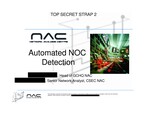
Automated NOC detection [pdf]
This slide deck lays out how GCHQ and Canada’s CSEC systematically identified and penetrated Network Operations Centers—most notably Belgacom—by automating NOC discovery and weaponizing that mapping for QUANTUM INSERT attacks. It reads like a blueprint for turning router configs, metadata, and bulk scans into cookie-based targeting against telecom engineers inside core networks.
Programs: SURGE · NOCTURNALSURGE · RT · NACSHACK · CHAINGUARD · TIDALSURGE · GLOBALSURGE · PENTAHO · OLYMPIA · HYPERION · TERMINALSURGE · HACIENDA · QUANTUMINSERT · MUTANTBROTH · OPSOCIALIST · SAMUEL PEPYS · GEOFUSION · FIVEALIVE · NRTA · RADIUS“Operation Socialist: The Inside Story of How British Spies Hacked Belgium’s Largest Telco” - The Intercept ↗ (2014-12-13) · “Lees hier hoe de Britse geheime dienst GCHQ Belgacom aanviel” - NRC ↗ (2014-12-13) · “Britse geheime dienst bespioneerde jarenlang Belgacom-klanten” - De Standaard ↗ (2014-12-13) · Gallagher, Ryan · Modderkolk, Huib · Vanhecke, Nikolas · Eeckhaut, Mark -
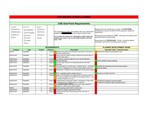
CNE End Point Requirements [pdf]
This NSA/GCHQ document outlines comprehensive requirements for an endpoint surveillance systems that enables analysts to systematically identify intelligence collection needs and discover appropriate tools for data extraction from compromised computers. The framework covers capabilities for remote data collection, cross-platform intelligence integration, query functions, tasking procedures, and visualization tools across implanted networks.
Programs: STARGATE · LOOKING GLASS · QUANTUM · GOLDENEYE · XKEYSCORE · MARINA · JTRIG · BROADOAK · UTT · GLOBALREACH · GLOBALSURGE · THUGGEE · EREPO · DANCINGBEAR · HAUSTORIUM · SHAREOWN · MUTANTBROTH · MOONRAKER · CARBONROD · RUFFLE · ROCKOPERA · QUINCEY · ECLIPSE · MUGSHOT · HIGHNOTE · UDAQ2 · EKB · TURBINE · ACNO · FLAMECARPET · FUMECUPBOARD · JACKPOT · SLIPSTREAM · B13B · PSC · QUINCY · DAREDEVIL · ROADBED -
Discovery SIGINT Targeting Scenarios and Compliance [pdf]
This document is a top-secret NSA guidance manual detailing SIGINT targeting scenarios, compliance procedures, and legal guidance for querying foreign actors, malware, and potentially U.S.-linked systems, including considerations for minimizing incidental collection of U.S. persons’ communications. It outlines specific rules, approvals, and exceptions for using SIGINT tools, foreign intelligence tasks, and cases involving ambiguous or dual-use selectors like WikiLeaks, The Pirate Bay, and foreign actors operating through U.S. infrastructure.
-
DNI Collection: Keeping the Dictionaries from Filling Up SIDtoday [pdf]
The presence of keywords or other “selectors” in communications trigger NSA surveillance, and these terms are stored in databases called “dictionaries.” Agency dictionaries for filtering internet traffic recently approached the limit of 200,000 terms. In order to free up space, unproductive selectors were marked for purging and counterterrorism-related selectors were moved into a separate dictionary. An upgrade will raise the limit to 500,000 selectors.
People: Strauss, JaniceThe Intercept ↗ (2018-08-15) -
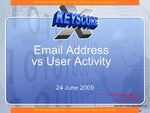
Email Address vs User Activity [pdf]
This 2009 NSA training presentation explains how to use the XKEYSCORE system to search raw SIGINT, detailing the differences between the "Email Address" query, which finds email addresses in full content, and the more flexible "User Activity" query, which can search for selectors like cookies, usernames, and phone numbers.
“XKEYSCORE: NSA’s Google for the World’s Private Communications” - The Intercept ↗ (2015-07-01) · “No Place to Hide” - Metropolitan Books ↗ (2014-05-13) · Marquis-Boire, Morgan · Greenwald, Glenn · Lee, Micah -
Expanding PRISM Sharing With FBI and CIA [pdf]
An SSO item describing two projects that widened PRISM sharing with the FBI and CIA: PRINTAURA software that compiles the tasked-selector list every two weeks for both agencies, and weekly operational PRISM news and guidance from the mission programme manager.
-
Finding and Querying Document Metadata [pdf]
This 2009 NSA training guide, created by Booz Allen Hamilton, explains how analysts can use the XKEYSCORE system to track targets by searching for "non-traditional selectors" embedded within documents, such as author names, company information, or even the hash values of company logos.
Programs: XKEYSCORE · TUNINGFORK · PINWALE · FOXACID · FOXBASE · CARBOY · CARDAMON · UNITEDRAKE · CADENCE -
FISA Amendments Act of 2008 Section 702 summary document [pdf]
This document summarizes the way the law works and describes the three types of certifications used to permit the surveillance, as well as targeting and minimization procedures. The three certification are for foreign governments, counterterrorism and WMD/proliferation.
-
FOXACID Overall Briefing [pdf]
FOXACID is the NSA's exploit server infrastructure designed to gain "initial access" to target computers by tricking them into visiting malicious websites through spam emails, man-in-the-middle attacks, or split-second packet injection techniques that redirect legitimate web traffic. The document reveals how the agency has evolved from low-success spam operations (less than 1% success rate) to sophisticated "QUANTUM" techniques that achieve up to 80% success rates by exploiting web browsers through services like Yahoo and Facebook, allowing the NSA to compromise any target whose web traffic passes through monitored network chokepoints—with the chilling assessment that "if we can get the target to visit us in some sort of web browser, we can probably own them."
Programs: FOXACID · WILLOWVIXEN · GENUINEDRAFT · SECONDDATE · QUANTUMTHEORY · TURMOIL · TURBINE · WEBSNIPER · QUANTUMINSERT · QUANTUMBISCUIT · QUANTUMDIRK · QUANTUM · VALIDATOR · OLYMPUS · MISTYVEAL · SSO · STRAIGHTBIZARRE · ISLANDTRANSPORT -
Free File Uploaders [pdf]
This 2009 NSA training presentation for the XKEYSCORE system details how analysts can monitor Free File Uploader (FFU) websites like Zshare and RapidShare, which are difficult to track due to a lack of strong selectors. The guide introduces the "Web File Transfer" plug-in, a specialized tool designed to extract key metadata like original filenames and download/delete links from FFU web traffic.
-
GCHQ Hopscotch [pdf]
An internal note argues for consolidating “edges”—summarized contact pairs—into a single cloud to unify relationship graphs, streamline analytics, and simplify management of HOPSCOTCH. It’s a mundane-sounding data-migration pitch with sharp operational teeth: centralize the social graph so surveillance queries run faster and wider.
Programs: HOPSCOTCH“Operation Socialist: The Inside Story of How British Spies Hacked Belgium’s Largest Telco” - The Intercept ↗ (2014-12-13) · “Lees hier hoe de Britse geheime dienst GCHQ Belgacom aanviel” - NRC ↗ (2014-12-13) · “Britse geheime dienst bespioneerde jarenlang Belgacom-klanten” - De Standaard ↗ (2014-12-13) · Gallagher, Ryan · Modderkolk, Huib · Vanhecke, Nikolas · Eeckhaut, Mark -
Intelligently filtering your data: Brazil and Mexico case studies [pdf]
These documents reveal that the NSA conducted targeted surveillance operations against high-profile Brazilian and Mexican figures, including President Dilma Rousseff and presidential candidate Enrique Peña Nieto, using advanced contact-graph filtering and data analysis techniques to extract relevant intelligence from intercepted communications. These documents show how NSA analysts systematically developed intelligence on foreign leaders during election periods and diplomatic activities, framing it as “target development,” but in practice enabling deep political espionage under the guise of analytical innovation.
“Veja os documentos ultrassecretos que comprovam espionagem a Dilma” - O Globo ↗ (2013-09-02) · “No Place to Hide” - Metropolitan Books ↗ (2014-05-13) · Greenwald, Glenn -
Intrusion Analysis – GCHQ [pdf]
An internal GCHQ write-up defines the Intrusion Analysis team’s remit inside the Joint Electronic Attack Cell: all‑source analysis of emerging and active electronic attacks, stewardship of electronic attack signatures, and SIGINT‑driven targeting under EITT oversight. It details sources, reporting channels, legal authorities, and auditing controls that govern how signatures are deployed and how selectors are managed.
-
LEVITATION and the FFU Hypothesis [pdf]
This document describes LEVITATION, a top-secret Canadian Communications Security Establishment (CSE) project that monitors millions of daily file uploads and downloads from free file-sharing sites to identify potential extremist activity. It details the program’s data collection methods, analytical workflow, use of partner databases, and examples of successful discoveries related to terrorist materials and hostage videos.
-
Mobile Networks in My NOC World [pdf]
This TOP SECRET STRAP 2 GCHQ document outlines the “MyNOC” operations, a specialized Network Operations Centre used by the UK’s GCHQ to coordinate cyber exploitation of international mobile and telecom infrastructure, with a particular focus on Belgacom’s GRX network under “Operation Socialist” (OP SOCIALIST). It details operational planning, toolsets, personnel roles, network mapping, QUANTUM INSERT targeting, and successful infiltration strategies that enabled CNE (Computer Network Exploitation) access to key Belgacom systems and staff infrastructure.
Programs: HIGHNOTE · COPPERHEAD · NEXUS · CADDIS · BRENT · RUSSETT PHONE · CERBERUS · E-BEAM · PIA · JEDI · WYLEKEY · INTERACTION · EREPO · QUANTUM · WOODCUTTER · MUTANT BROTH · QUANTUM INSERT · NRTA · MERION ZETA · JTRIG · A-SPACE · GEOFUSION“Operation Socialist: The Inside Story of How British Spies Hacked Belgium’s Largest Telco” - The Intercept ↗ (2014-12-13) · “Lees hier hoe de Britse geheime dienst GCHQ Belgacom aanviel” - NRC ↗ (2014-12-13) · “Britse geheime dienst bespioneerde jarenlang Belgacom-klanten” - De Standaard ↗ (2014-12-13) · “Britain's GCHQ Hacked Belgian Telecoms Firm” - Der Spiegel ↗ (2013-09-20) · Gallagher, Ryan · Modderkolk, Huib · Vanhecke, Nikolas · Eeckhaut, Mark -
New FAA702 Certification in the Works - Cyber Threat [pdf]
A 23 March 2012 SSO article on a draft FAA 702 certification for cyber threats. It would let analysts task selectors tied to malicious cyber activity without attributing them to a foreign government or terrorist group, and would codify tasking of IP addresses and code strings through PRISM and the upstream accesses.
-
New Session Added: Brown Bag on 'Persona Session Collection' SIDtoday [pdf]
An additional session has been scheduled for a top-secret discussion of strategies and tools for discovery and collection of the communications of important targets.
Programs: CONDENSER · MAM · UTT · GLOBALVISION · TURBULANCE · TRAFFICTHIEF · WEALTHYCLUSTER · XKEYSCORE · UIS · PSC · WEALTHYCLUSTER2The Intercept ↗ (2018-03-01) -
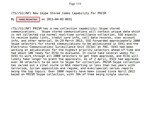
New Skype Stored Comms Capability For PRISM [pdf]
An SSO item on PRISM's new Skype stored-communications capability — buddy lists, credit card details, call data records and account information — with roughly 2,000 Skype selectors sent for FBI adjudication on 29 March 2013 and over 2,800 reports issued from PRISM Skype collection since April 2011.