Procedures Used By The National Security Agency For Targeting Non-United States Persons Reasonably Believed To Be Located Outside The United States To Acquire Foreign Intelligence Court Information Pursuant To Section 702 Of The Foreign Intelligence Surveillance Act Of 1978
Open PDFDocument date: 2009-07-29
Pages: 9
Genre: report
Banner: TOP SECRET//COMINT//NOFORN//20320108
Classification: TOP SECRET COMINT
Dissemination: NOFORN
The NSA’s 2009 Section 702 targeting procedures lay out how analysts decide who can be surveilled without a warrant, supposedly limiting spying to foreigners abroad. In reality, the rules give the agency wide latitude to presume people are foreign, rely on vague “totality of the circumstances” tests, and allow broad technical methods like IP filters and metadata checks. Oversight is mostly internal and after-the-fact, creating significant potential for U.S. communications to be swept up with little accountability.
My notes
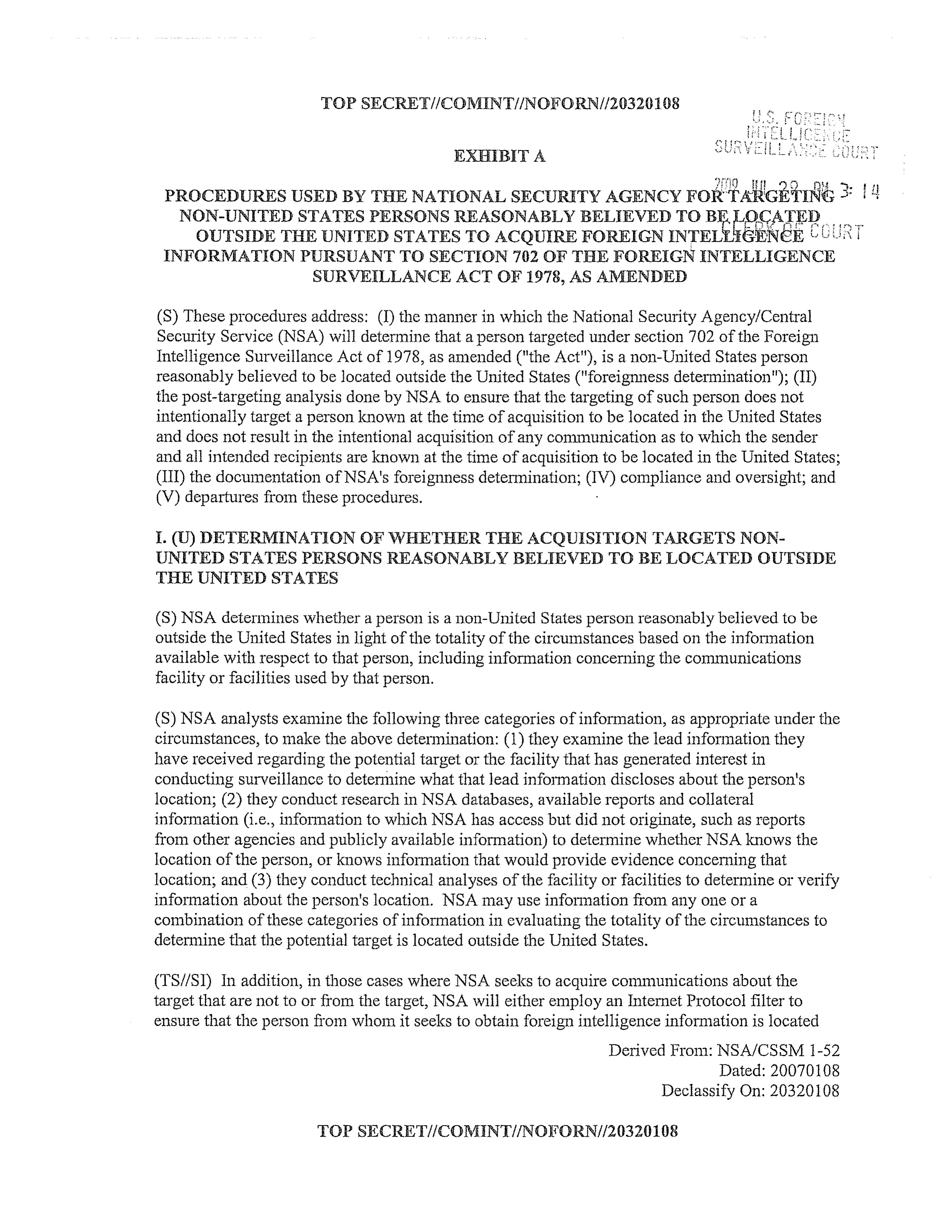
TOP SECRET//COMINT//NOFORN//20320108
EXHIBIT A
U.S. FOREIGN
INTELLIGENCE
SURVEILLANCE COURT
2009 JUL 29
PROCEDURES USED BY THE NATIONAL SECURITY AGENCY FOR TARGETING
NON-UNITED STATES PERSONS REASONABLY BELIEVED TO BE LOCATED
OUTSIDE THE UNITED STATES TO ACQUIRE FOREIGN INTELLIGENCE COURT
INFORMATION PURSUANT TO SECTION 702 OF THE FOREIGN INTELLIGENCE
SURVEILLANCE ACT OF 1978, AS AMENDED
(S) These procedures address: (I) the manner in which the National Security Agency/Central
Security Service (NSA) will determine that a person targeted under section 702 of the Foreign
Intelligence Surveillance Act of 1978, as amended ("the Act"), is a non-United States person
reasonably believed to be located outside the United States ("foreignness determination"); (II)
the post-targeting analysis done by NSA to ensure that the targeting of such person does not
intentionally target a person known at the time of acquisition to be located in the United States
and does not result in the intentional acquisition of any communication as to which the sender
and all intended recipients are known at the time of acquisition to be located in the United States;
(III) the documentation of NSA's foreignness determination; (IV) compliance and oversight; and
(V) departures from these procedures.
I. (U) DETERMINATION OF WHETHER THE ACQUISITION TARGETS NON-
UNITED STATES PERSONS REASONABLY BELIEVED TO BE LOCATED OUTSIDE
THE UNITED STATES
(S) NSA determines whether a person is a non-United States person reasonably believed to be
outside the United States in light of the totality of the circumstances based on the information
available with respect to that person, including information concerning the communications
facility or facilities used by that person.
(S) NSA analysts examine the following three categories of information, as appropriate under the
circumstances, to make the above determination: (1) they examine the lead information they
have received regarding the potential target or the facility that has generated interest in
conducting surveillance to determine what that lead information discloses about the person's
location; (2) they conduct research in NSA databases, available reports and collateral
information (i.e., information to which NSA has access but did not originate, such as reports
from other agencies and publicly available information) to determine whether NSA knows the
location of the person, or knows information that would provide evidence concerning that
location; and (3) they conduct technical analyses of the facility or facilities to determine or verify
information about the person's location. NSA may use information from any one or a
combination of these categories of information in evaluating the totality of the circumstances to
determine that the potential target is located outside the United States.
(TS//SI) In addition, in those cases where NSA seeks to acquire communications about the
target that are not to or from the target, NSA will either employ an Internet Protocol filter to
ensure that the person from whom it seeks to obtain foreign intelligence information is located
Derived From: NSA/CSSM 1-52
Dated: 20070108
Declassify On: 20320108
TOP SECRET//COMINT//NOFORN//20320108
TOP SECRET//COMINT//NOFORN//20320108
overseas, or it will target Internet links that terminate in a foreign country. In either event, NSA
will direct surveillance at a party to the communication reasonably believed to be outside the
United States.
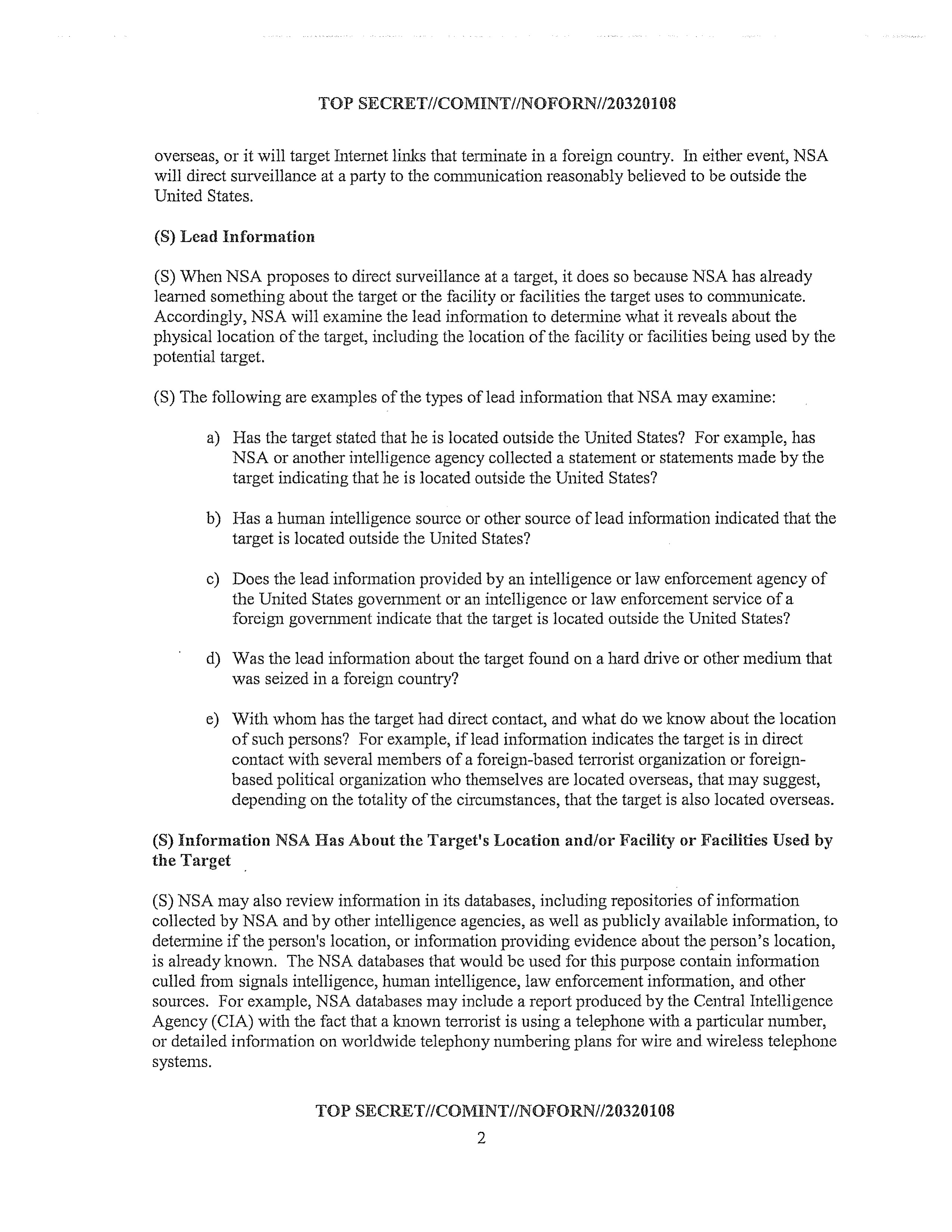
(S) Lead Information
(S) When NSA proposes to direct surveillance at a target, it does so because NSA has already
learned something about the target or the facility or facilities the target uses to communicate.
Accordingly, NSA will examine the lead information to determine what it reveals about the
physical location of the target, including the location of the facility or facilities being used by the
potential target.
(S) The following are examples of the types of lead information that NSA may examine:
a) Has the target stated that he is located outside the United States? For example, has
NSA or another intelligence agency collected a statement or statements made by the
target indicating that he is located outside the United States?
b) Has a human intelligence source or other source of lead information indicated that the
target is located outside the United States?
c) Does the lead information provided by an intelligence or law enforcement agency of
the United States government or an intelligence or law enforcement service of a
foreign government indicate that the target is located outside the United States?
d) Was the lead information about the target found on a hard drive or other medium that
was seized in a foreign country?
e) With whom has the target had direct contact, and what do we know about the location
of such persons? For example, if lead information indicates the target is in direct
contact with several members of a foreign-based terrorist organization or foreign-
based political organization who themselves are located overseas, that may suggest,
depending on the totality of the circumstances, that the target is also located overseas.
(S) Information NSA Has About the Target's Location and/or Facility or Facilities Used by
the Target
(S) NSA may also review information in its databases, including repositories of information
collected by NSA and by other intelligence agencies, as well as publicly available information, to
determine if the person's location, or information providing evidence about the person's location,
is already known. The NSA databases that would be used for this purpose contain information
culled from signals intelligence, human intelligence, law enforcement information, and other
sources. For example, NSA databases may include a report produced by the Central Intelligence
Agency (CIA) with the fact that a known terrorist is using a telephone with a particular number,
or detailed information on worldwide telephony numbering plans for wire and wireless telephone
systems.
TOP SECRET//COMINT//NOFORN//20320108
2
TOP SECRET//COMINT//NOFORN//20320108
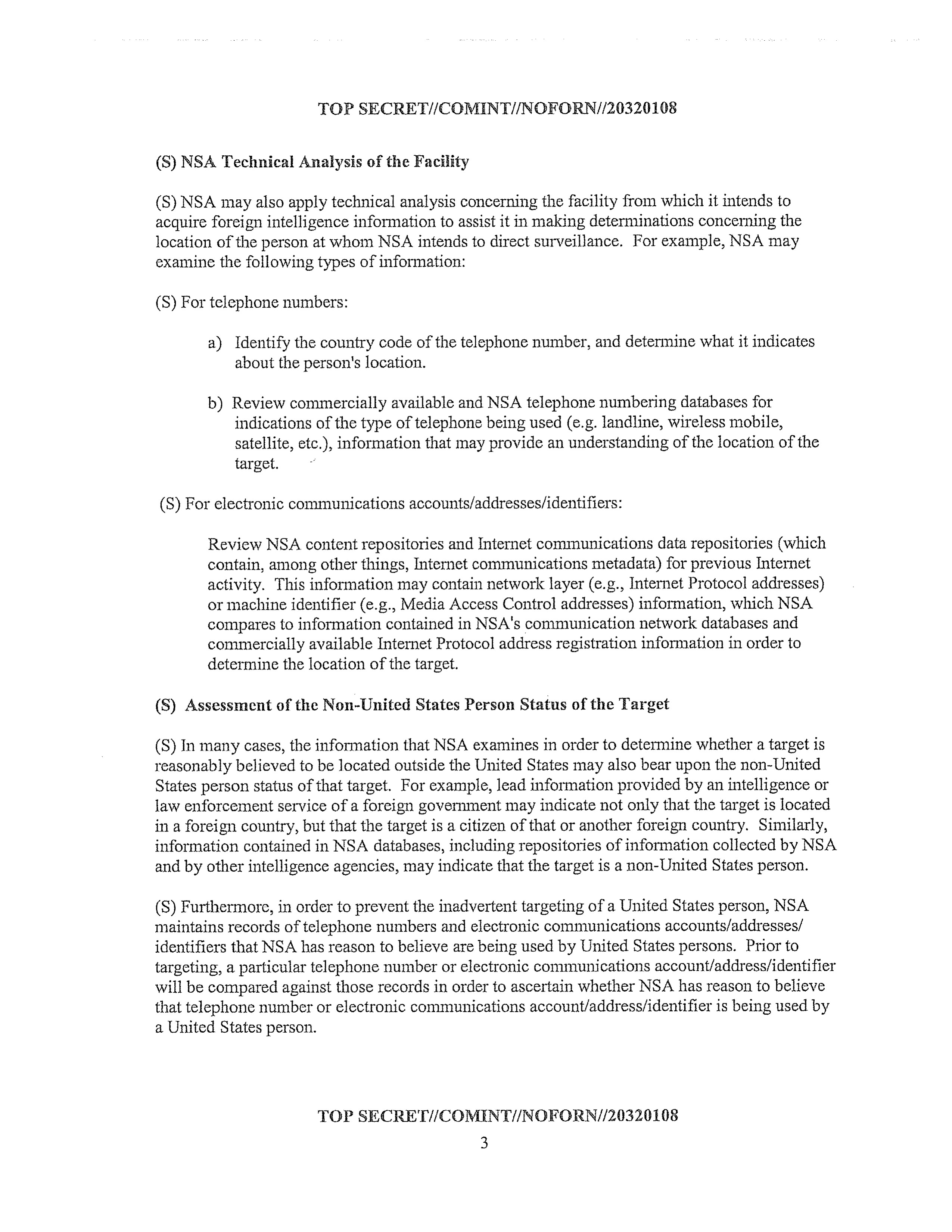
(S) NSA Technical Analysis of the Facility
(S) NSA may also apply technical analysis concerning the facility from which it intends to
acquire foreign intelligence information to assist it in making determinations concerning the
location of the person at whom NSA intends to direct surveillance. For example, NSA may
examine the following types of information:
(S) For telephone numbers:
a) Identify the country code of the telephone number, and determine what it indicates
about the person's location.
b) Review commercially available and NSA telephone numbering databases for
indications of the type of telephone being used (e.g. landline, wireless mobile,
satellite, etc.), information that may provide an understanding of the location of the
target.
(S) For electronic communications accounts/addresses/identifiers:
Review NSA content repositories and Internet communications data repositories (which
contain, among other things, Internet communications metadata) for previous Internet
activity. This information may contain network layer (e.g., Internet Protocol addresses)
or machine identifier (e.g., Media Access Control addresses) information, which NSA
compares to information contained in NSA's communication network databases and
commercially available Internet Protocol address registration information in order to
determine the location of the target.
(S) Assessment of the Non-United States Person Status of the Target
(S) In many cases, the information that NSA examines in order to determine whether a target is
reasonably believed to be located outside the United States may also bear upon the non-United
States person status of that target. For example, lead information provided by an intelligence or
law enforcement service of a foreign government may indicate not only that the target is located
in a foreign country, but that the target is a citizen of that or another foreign country. Similarly,
information contained in NSA databases, including repositories of information collected by NSA
and by other intelligence agencies, may indicate that the target is a non-United States person.
(S) Furthermore, in order to prevent the inadvertent targeting of a United States person, NSA
maintains records of telephone numbers and electronic communications accounts/addresses/
identifiers that NSA has reason to believe are being used by United States persons. Prior to
targeting, a particular telephone number or electronic communications account/address/identifier
will be compared against those records in order to ascertain whether NSA has reason to believe
that telephone number or electronic communications account/address/identifier is being used by
a United States person.
TOP SECRET//COMINT//NOFORN//20320108
3
TOP SECRET//COMINT//NOFORN//20320108
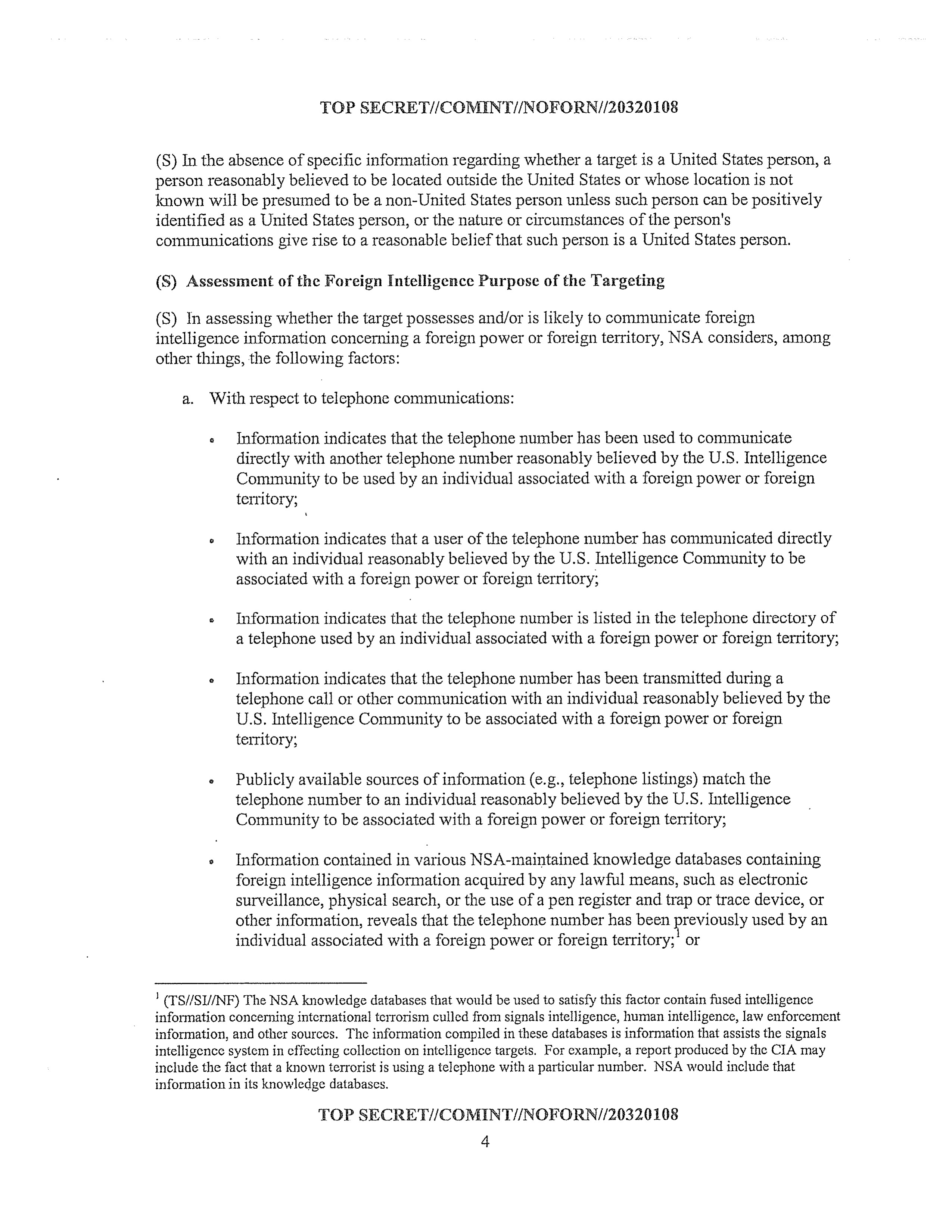
(S) In the absence of specific information regarding whether a target is a United States person, a
person reasonably believed to be located outside the United States or whose location is not
known will be presumed to be a non-United States person unless such person can be positively
identified as a United States person, or the nature or circumstances of the person's
communications give rise to a reasonable belief that such person is a United States person.
(S) Assessment of the Foreign Intelligence Purpose of the Targeting
(S) In assessing whether the target possesses and/or is likely to communicate foreign
intelligence information concerning a foreign power or foreign territory, NSA considers, among
other things, the following factors:
a. With respect to telephone communications:
- Information indicates that the telephone number has been used to communicate
directly with another telephone number reasonably believed by the U.S. Intelligence
Community to be used by an individual associated with a foreign power or foreign
territory;
- Information indicates that a user of the telephone number has communicated directly
with an individual reasonably believed by the U.S. Intelligence Community to be
associated with a foreign power or foreign territory;
- Information indicates that the telephone number is listed in the telephone directory of
a telephone used by an individual associated with a foreign power or foreign territory;
- Information indicates that the telephone number has been transmitted during a
telephone call or other communication with an individual reasonably believed by the
U.S. Intelligence Community to be associated with a foreign power or foreign
territory;
- Publicly available sources of information (e.g., telephone listings) match the
telephone number to an individual reasonably believed by the U.S. Intelligence
Community to be associated with a foreign power or foreign territory;
- Information contained in various NSA-maintained knowledge databases containing
foreign intelligence information acquired by any lawful means, such as electronic
surveillance, physical search, or the use of a pen register and trap or trace device, or
other information, reveals that the telephone number has been previously used by an
individual associated with a foreign power or foreign territory; or
(TS//SI//NF) The NSA knowledge databases that would be used to satisfy this factor contain fused intelligence
information concerning international terrorism culled from signals intelligence, human intelligence, law enforcement
information, and other sources. The information compiled in these databases is information that assists the signals
intelligence system in effecting collection on intelligence targets. For example, a report produced by the CIA may
include the fact that a known terrorist is using a telephone with a particular number. NSA would include that
information in its knowledge databases.
TOP SECRET//COMINT//NOFORN//20320108
4
TOP SECRET//COMINT//NOFORN//20320108
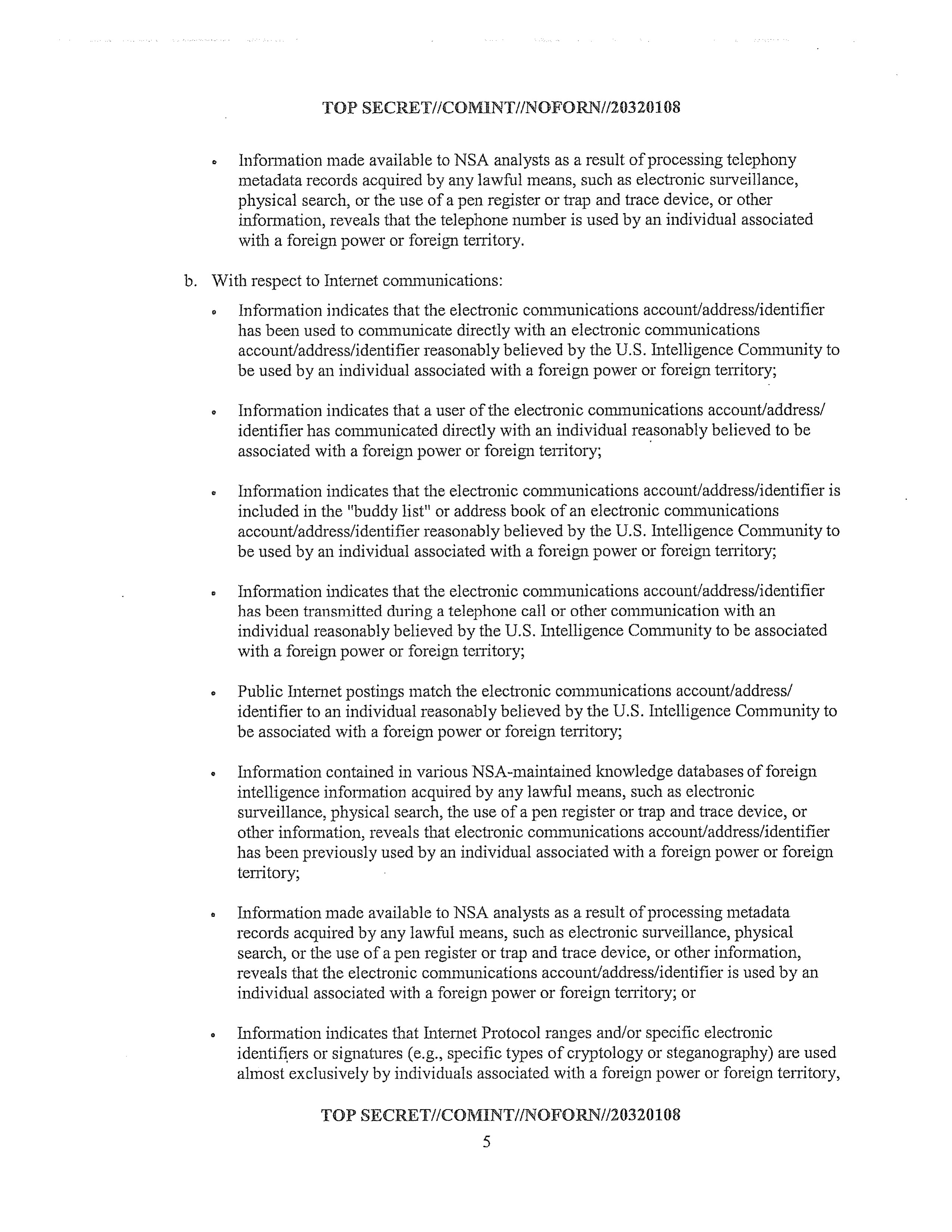
- Information made available to NSA analysts as a result of processing telephony
metadata records acquired by any lawful means, such as electronic surveillance,
physical search, or the use of a pen register or trap and trace device, or other
information, reveals that the telephone number is used by an individual associated
with a foreign power or foreign territory.
b. With respect to Internet communications:
- Information indicates that the electronic communications account/address/identifier
has been used to communicate directly with an electronic communications
account/address/identifier reasonably believed by the U.S. Intelligence Community to
be used by an individual associated with a foreign power or foreign territory;
- Information indicates that a user of the electronic communications account/address/
identifier has communicated directly with an individual reasonably believed to be
associated with a foreign power or foreign territory;
- Information indicates that the electronic communications account/address/identifier is
included in the "buddy list" or address book of an electronic communications
account/address/identifier reasonably believed by the U.S. Intelligence Community to
be used by an individual associated with a foreign power or foreign territory;
- Information indicates that the electronic communications account/address/identifier
has been transmitted during a telephone call or other communication with an
individual reasonably believed by the U.S. Intelligence Community to be associated
with a foreign power or foreign territory;
- Public Internet postings match the electronic communications account/address/
identifier to an individual reasonably believed by the U.S. Intelligence Community to
be associated with a foreign power or foreign territory;
- Information contained in various NSA-maintained knowledge databases of foreign
intelligence information acquired by any lawful means, such as electronic
surveillance, physical search, the use of a pen register or trap and trace device, or
other information, reveals that electronic communications account/address/identifier
has been previously used by an individual associated with a foreign power or foreign
territory;
- Information made available to NSA analysts as a result of processing metadata
records acquired by any lawful means, such as electronic surveillance, physical
search, or the use of a pen register or trap and trace device, or other information,
reveals that the electronic communications account/address/identifier is used by an
individual associated with a foreign power or foreign territory; or
- Information indicates that Internet Protocol ranges and/or specific electronic
identifiers or signatures (e.g., specific types of cryptology or steganography) are used
almost exclusively by individuals associated with a foreign power or foreign territory,
TOP SECRET//COMINT//NOFORN//20320108
5
TOP SECRET//COMINT//NOFORN//20320108
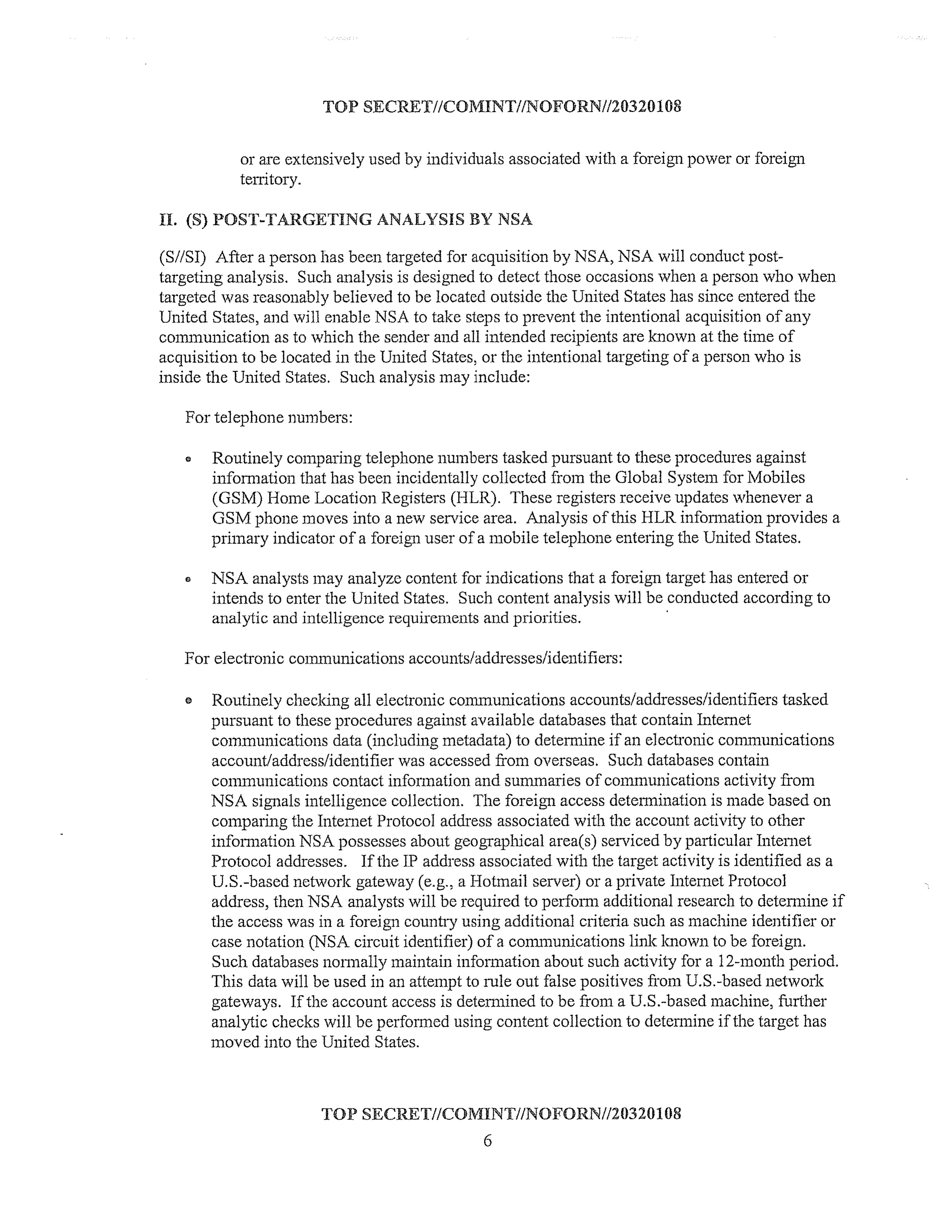
or are extensively used by individuals associated with a foreign power or foreign
territory.
II. (S) POST-TARGETING ANALYSIS BY NSA
(S//SI) After a person has been targeted for acquisition by NSA, NSA will conduct post-
targeting analysis. Such analysis is designed to detect those occasions when a person who when
targeted was reasonably believed to be located outside the United States has since entered the
United States, and will enable NSA to take steps to prevent the intentional acquisition of any
communication as to which the sender and all intended recipients are known at the time of
acquisition to be located in the United States, or the intentional targeting of a person who is
inside the United States. Such analysis may include:
For telephone numbers:
- Routinely comparing telephone numbers tasked pursuant to these procedures against
information that has been incidentally collected from the Global System for Mobiles
(GSM) Home Location Registers (HLR). These registers receive updates whenever a
GSM phone moves into a new service area. Analysis of this HLR information provides a
primary indicator of a foreign user of a mobile telephone entering the United States.
- NSA analysts may analyze content for indications that a foreign target has entered or
intends to enter the United States. Such content analysis will be conducted according to
analytic and intelligence requirements and priorities.
For electronic communications accounts/addresses/identifiers:
- Routinely checking all electronic communications accounts/addresses/identifiers tasked
pursuant to these procedures against available databases that contain Internet
communications data (including metadata) to determine if an electronic communications
account/address/identifier was accessed from overseas. Such databases contain
communications contact information and summaries of communications activity from
NSA signals intelligence collection. The foreign access determination is made based on
comparing the Internet Protocol address associated with the account activity to other
information NSA possesses about geographical area(s) serviced by particular Internet
Protocol addresses. If the IP address associated with the target activity is identified as a
U.S.-based network gateway (e.g., a Hotmail server) or a private Internet Protocol
address, then NSA analysts will be required to perform additional research to determine if
the access was in a foreign country using additional criteria such as machine identifier or
case notation (NSA circuit identifier) of a communications link known to be foreign.
Such databases normally maintain information about such activity for a 12-month period.
This data will be used in an attempt to rule out false positives from U.S.-based network
gateways. If the account access is determined to be from a U.S.-based machine, further
analytic checks will be performed using content collection to determine if the target has
moved into the United States.
TOP SECRET//COMINT//NOFORN//20320108
6
TOP SECRET//COMINT//NOFORN//20320108
- Routinely comparing electronic communications accounts/addresses/identifiers tasked
pursuant to these procedures against a list of electronic communications accounts/
addresses/identifiers already identified by NSA as being accessed from inside the United
States. This will help ensure that no target has been recognized to be located in the
United States.
- NSA analysts may analyze content for indications that a target has entered or intends to
enter the United States. Such content analysis will be conducted according to analytic
and intelligence requirements and priorities.
(S) If NSA determines that a target has entered the United States, it will follow the procedures
set forth in section IV of this document, including the termination of the acquisition from the
target without delay. In cases where NSA cannot resolve an apparent conflict between
information indicating that the target has entered the United States and information indicating
that the target remains located outside the United States, NSA will presume that the target has
entered the United States and will terminate the acquisition from that target. If at a later time
NSA determines that the target is in fact located outside the United States, NSA may re-initiate
the acquisition in accordance with these procedures.
(S) If NSA determines that a target who at the time of targeting was believed to be a non-United
States person was in fact a United States person, it will follow the procedures set forth in section
IV of this document, including the termination of the acquisition from the target without delay.
III. (U) DOCUMENTATION
(S) Analysts who request tasking will document in the tasking database a citation or citations to
the information that led them to reasonably believe that a targeted person is located outside the
United States. Before tasking is approved, the database entry for that tasking will be reviewed in
order to verify that the database entry contains the necessary citations.
(S) A citation is a reference that identifies the source of the information, such as a report number
or communications intercept identifier, which NSA will maintain. The citation will enable those
responsible for conducting oversight to locate and review the information that led NSA analysts
to conclude that a target is reasonably believed to be located outside the United States.
(S) Analysts also will identify the foreign power or foreign territory about which they expect to
obtain foreign intelligence information pursuant to the proposed targeting.
IV. (U) OVERSIGHT AND COMPLIANCE
(S) NSA's Signals Intelligence Directorate (SID) Oversight and Compliance, with NSA's Office
of General Counsel (OGC), will develop and deliver training regarding the applicable procedures
to ensure intelligence personnel responsible for approving the targeting of persons under these
procedures, as well as analysts with access to the acquired foreign intelligence information
understand their responsibilities and the procedures that apply to this acquisition. SID Oversight
and Compliance has established processes for ensuring that raw traffic is labeled and stored only
in authorized repositories, and is accessible only to those who have had the proper training. SID
TOP SECRET//COMINT//NOFORN//20320108
7
TOP SECRET//COMINT//NOFORN//20320108
Oversight and Compliance will conduct ongoing oversight activities and will make any
necessary reports, including those relating to incidents of noncompliance, to the NSA Inspector
General and OGC, in accordance with its NSA charter. SID Oversight and Compliance will also
ensure that necessary corrective actions are taken to address any identified deficiencies. To that
end, SID Oversight and Compliance will conduct periodic spot checks of targeting decisions and
intelligence disseminations to ensure compliance with established procedures, and conduct
periodic spot checks of queries in data repositories.
(S) The Department of Justice (DOJ) and the Office of the Director of National Intelligence
(ODNI) will conduct oversight of NSA's exercise of the authority under section 702 of the Act,
which will include periodic reviews by DOJ and ODNI personnel to evaluate the implementation
of the procedures. Such reviews will occur at least once every sixty days.
(S) NSA will report to DOJ, to the ODNI Office of General Counsel, and to the ODNI Civil
Liberties Protection Officer any incidents of noncompliance with these procedures by NSA
personnel that result in the intentional targeting of a person reasonably believed to be located in
the United States, the intentional targeting of a United States person, or the intentional
acquisition of any communication in which the sender and all intended recipients are known at
the time of acquisition to be located within the United States. NSA will provide such reports
within five business days of learning of the incident. Any information acquired by intentionally
targeting a United States person or a person not reasonably believed to be outside the United
States at the time of such targeting will be purged from NSA databases.
(S) NSA will report to DOJ through the Deputy Assistant Attorney General in the National
Security Division with responsibility for intelligence operations and oversight, to the ODNI
Office of General Counsel, and to the ODNI Civil Liberties Protection Officer, any incidents of
noncompliance (including overcollection) by any electronic communication service provider to
whom the Attorney General and Director of National Intelligence issued a directive under
section 702. Such report will be made within five business days after determining that the
electronic communication service provider has not complied or does not intend to comply with a
directive.
(S) In the event that NSA concludes that a person is reasonably believed to be located outside the
United States and after targeting this person learns that the person is inside the United States, or
if NSA concludes that a person who at the time of targeting was believed to be a non-United
States person was in fact a United States person, it will take the following steps:
1) Terminate the acquisition without delay and determine whether to seek a Court order
under another section of the Act. If NSA inadvertently acquires a communication
sent to or from the target while the target is or was located inside the United States,
including any communication where the sender and all intended recipients are
reasonably believed to be located inside the United States at the time of acquisition,
such communication will be treated in accordance with the applicable minimization
procedures.
TOP SECRET//COMINT//NOFORN//20320108
8
TOP SECRET//COMINT//NOFORN//20320108
2) Report the incident to DOJ through the Deputy Assistant Attorney General in the
National Security Division with responsibility for intelligence operations and
oversight, to the ODNI Office of General Counsel, and to the ODNI Civil Liberties
Protection Officer within five business days.
V. (U) DEPARTURE FROM PROCEDURES
(S) If, in order to protect against an immediate threat to the national security, NSA determines
that it must take action, on a temporary basis, in apparent departure from these procedures and
that it is not feasible to obtain a timely modification of these procedures from the Attorney
General and Director of National Intelligence, NSA may take such action and will report that
activity promptly to DOJ through the Deputy Assistant Attorney General in the National Security
Division with responsibility for intelligence operations and oversight, to the ODNI Office of
General Counsel, and to the ODNI Civil Liberties Protection Officer. Under such circumstances,
the Government will continue to adhere to all of the statutory limitations set forth in subsection
702(b) of the Act.
7-28-09
Date
Eric H. Holder, Jr.
Attorney General of the United States
TOP SECRET//COMINT//NOFORN//20320108
9
Published in the Same Report
(2 documents)
-
Minimization Procedures Used By The National Security Agency In Connection With Acquisitions Of Foreign Intelligence, Information Pursuant To Section 702 Of The Foreign Intelligence Court Surveillance Act Of 1978 [pdf]
The NSA’s Section 702 minimization rules expose how the agency can collect, keep, and use Americans’ communications without warrants, despite claiming to target only foreigners. While the document sets out procedures for handling U.S. data, it includes broad loopholes—like keeping “inadvertently” collected domestic messages for years, sharing unfiltered data with the FBI, CIA, and even foreign governments, and giving NSA analysts wide discretion over who gets surveilled—all under secret FISA Court approval.
People: Holder, Eric H. Jr. -
Fisa court warrant authorising NSA surveillance procedures [pdf]
One-paragraph order, signed by a Fisa court judge, declares procedures submitted by the attorney general on behalf of the NSA are consistent with US law and fourth amendment
Marking: SECRET
Related Documents
-
Minimization Procedures Used By The National Security Agency In Connection With Acquisitions Of Foreign Intelligence, Information Pursuant To Section 702 Of The Foreign Intelligence Court Surveillance Act Of 1978 [pdf]
The NSA’s Section 702 minimization rules expose how the agency can collect, keep, and use Americans’ communications without warrants, despite claiming to target only foreigners. While the document sets out procedures for handling U.S. data, it includes broad loopholes—like keeping “inadvertently” collected domestic messages for years, sharing unfiltered data with the FBI, CIA, and even foreign governments, and giving NSA analysts wide discretion over who gets surveilled—all under secret FISA Court approval.
People: Holder, Eric H. Jr. -
NSA inspector general report on email and internet data collection under Stellar Wind, 24 March 2009 [Working Draft] [pdf]
This 2009 NSA Inspector General draft report details the origins and legal framework of the President’s Surveillance Program (PSP), launched after 9/11 to bypass FISA limits and authorize bulk interception of internet and telephony content and metadata, including communications with one end inside the U.S. It reveals how NSA, with White House backing, expanded surveillance authority to cover “collection gaps” that existing law didn’t allow, effectively legalizing large-scale warrantless spying under a secret presidential directive.
People: Bush, George W. · Hayden, Michael · Tenet, George · Gonzales, Alberto R. · Addington, David S. · Graham, Robert · Deitz, Robert L. · Shelby, Richard · Pelosi, Nancy · Cheney, Dick · Libby, I. Lewis · Lamberth, Royce · Inouye, Daniel · Levin, Daniel · Stevens, Theodore · Kollar-Kotelly, Colleen · Rockefeller, Jay · Alexander, Keith B. · Potenza, Vito -
FAA702 Glossary - Section 702 of the Fisa Amendments Act (FAA) [pdf]
This document outlines NSA rules under Section 702 of the FISA Amendments Act, which prohibit directly targeting U.S. persons or individuals inside the U.S., but quietly note a 2011 rule change allowing analysts to use U.S. person identifiers to query data already collected under 702—pending internal oversight. This effectively establishes a “backdoor search” capability enabling warrantless searches of Americans’ communications stored in NSA databases. Section 702 also gives the NSA authority to target without warrant the communications of foreign targets.