Tag: location data 8 documents
Search documents matching “location data” →Free-text subjects the curators added. Unlike the other axes these are not necessarily from the documents' own vocabulary, so they are the loosest thing to browse by (and the most forgiving).
Graphs
By Banner
By Classification
Refine (combine with another filter, via search)
Sort: Title
Documents
-
Content-Metadata Matrix [pdf]
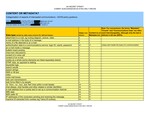
GCHQ's internal taxonomy sorts intercepted data into "content" or "metadata" to determine what can be searched without individual warrants—email subject lines, full URLs, and buddy lists fall on opposite sides of the line, enabling analysts to mine massive troves of IP addresses, phone numbers, location data, and browsing history with just a few keystrokes and a brief justification.
-
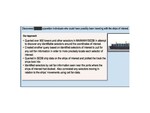
FASCIA: The NSA's huge trove of location records [pdf]
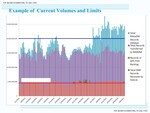
FASCIA is the National Security Agency's enormous database containing trillions of metadata records, many with device locations, that are collected from a variety of sources. This document shows the volume and types of device-location data collected by the agency.
“NSA tracking cellphone locations worldwide, Snowden documents show” - The Washington Post ↗ (2013-12-04) · “No Place to Hide” - Metropolitan Books ↗ (2014-05-13) · Gellman, Barton · Soltani, Ashkan · Greenwald, Glenn -
GSM tower geolocation [pdf]
This TOP SECRET STRAP 1 note describes DYMO, a prototype GSM-tower geolocation system that combines RUFIS-bis (which demodulates co-channel GSM ARFCN streams per cell-ID) with WHAMI Fast Image (WFI) to remodulate and correlate signals to produce high-quality tower geolocation and matching metadata. The remodulated “synthetic geolocation” improves accuracy and is under development in the NMDC/Midas studies.
-
How the NSA Accesses Smartphone Data [pdf]
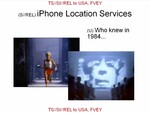
This document reveals how the NSA and its Five Eyes partners developed sophisticated methods to exploit iPhone location services and BlackBerry communications, framing smartphone users as “zombies” willingly sharing data. It includes examples of intercepted geolocation data and decrypted BlackBerry emails, illustrating targeted surveillance capabilities against both consumer and government communications.
-
Location Cookies [pdf]
These slides contain excerpts from an April 2013 National Security Agency presentation detailing signal surveillance techniques and successes. They reveal that the NSA and its British counterpart, Government Communications Headquarters (GCHQ), use a Google-specific tracking cookie to pinpoint targets for hacking.
-
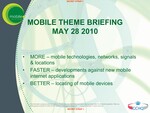
Mobile Theme Briefing (May 28, 2010) [pdf]
This 2010 GCHQ briefing document outlines the “Mobile Applications Project,” which aims to expand intelligence capabilities to exploit the growing shift from fixed to mobile internet usage. It details objectives for targeting mobile apps and roaming network traffic (GRX), enabling converged analysis of voice, text, command-and-control, and geolocation data across multiple mobile platforms such as iPhone, Symbian, Android, and Windows Mobile. See also: EFF_-_20140128-guard-leaky_phone_apps_0 (includes other slides from the same slideset)
Programs: Mobile Applications Project -
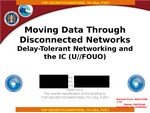
Moving Data Through Disconnected Networks - Delay-Tolerant Networking and the IC [pdf]
This June 2012 NSA Laboratory for Telecommunications Sciences presentation details Delay-Tolerant Networking (DTN) applications for surveillance operations, including covert communications in denied areas, data exfiltration from isolated networks, unwitting data mules, and integration with TAO's CHIMNEYPOOL implant framework. The document reveals R4 development of FUZZYLINT, an ultra-lightweight DTN implementation designed to enable multi-hop exfiltration from implants without requiring direct physical access.
People: Vahdat, Amin · Becker, David · Juang, Philo · Oki, Hidekazu · Wang, Yong · Martonosi, Margaret · Peh, Li-Shiuan · Rubenstein, Daniel · Grossglauser, Matthias · Tse, David N. C. · Fall, Kevin · Shah, Rahul C. · Roy, Sumit · Jain, Sushant · Brunette, Waylon · Lindgren, Anders · Doria, Avri · Schelen, Olov · Small, Tara · Haas, Zygmunt J. · Zhao, Wenrui · Ammar, Mostafa · Zegura, Ellen · Ginzboorg, Philip · Kärkkäinen, Teemu · Nagata, Akira · Lenders, Vincent · Legendre, Franck · May, Martin · Karlsson, Gunnar · Du, Bowei · Demmer, Michael · Brewer, Eric · Ott, Jörg · Pitkänen, Mikko Juhani · Han, Bo · Hui, Pan -
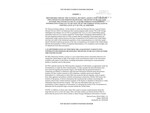
Procedures Used By The National Security Agency For Targeting Non-United States Persons Reasonably Believed To Be Located Outside The United States To Acquire Foreign Intelligence Court Information Pursuant To Section 702 Of The Foreign Intelligence Surveillance Act Of 1978 [pdf]
The NSA’s 2009 Section 702 targeting procedures lay out how analysts decide who can be surveilled without a warrant, supposedly limiting spying to foreigners abroad. In reality, the rules give the agency wide latitude to presume people are foreign, rely on vague “totality of the circumstances” tests, and allow broad technical methods like IP filters and metadata checks. Oversight is mostly internal and after-the-fact, creating significant potential for U.S. communications to be swept up with little accountability.
People: Holder, Eric H. Jr.