Tag: U.S. persons 14 documents
Search documents matching “U.S. persons” →Free-text subjects the curators added. Unlike the other axes these are not necessarily from the documents' own vocabulary, so they are the loosest thing to browse by (and the most forgiving).
Graphs
By Banner
By Classification
Refine (combine with another filter, via search)
Sort: Title
Documents
-
A&P; Distributes 'Information Sharing Card' SIDtoday [pdf]
A card will be distributed to help SID analysts understand what is permissible when sharing information. Article restates analysts' obligation "to protect the 4th Amendment rights of US persons, to protect our sources and methods, and to protect the integrity of our discipline."
People: Allen, JimThe Intercept ↗ (2016-12-07) -
Disseminating the Identity of a U.S. Person When an Imminent Threat Exists SIDtoday [pdf]
Under USSID SP0018, a signals intelligence organization can publicly disclose a U.S. person mentioned in an intercepted communication if there is an “imminent or immediate threat” to a person’s safety. “Imminent and immediate” means within a 24-hour period, so an agent could reveal the identity of someone who has just been kidnapped, but not someone who could be kidnapped in two weeks.
The Intercept ↗ (2018-03-01) -
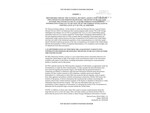
DNI, attorney general certify surveillance targets 'reasonably believed' to be outside U.S. [pdf]
In this document, the director of national intelligence and the attorney general certify that there are procedures in place to ensure that surveillance conducted under Section 702 of the FISA Amendments Act will be limited to targeting people "reasonably believed to be located outside the United States." They state that the foreign intelligence to be collected "concerns foreign powers" as defined by statute. The list of foreign powers is in Exhibit F.
-
FAA702 Glossary - Section 702 of the Fisa Amendments Act (FAA) [pdf]
This document outlines NSA rules under Section 702 of the FISA Amendments Act, which prohibit directly targeting U.S. persons or individuals inside the U.S., but quietly note a 2011 rule change allowing analysts to use U.S. person identifiers to query data already collected under 702—pending internal oversight. This effectively establishes a “backdoor search” capability enabling warrantless searches of Americans’ communications stored in NSA databases. Section 702 also gives the NSA authority to target without warrant the communications of foreign targets.
-
FISA Amendments Act of 2008 Section 702 summary document [pdf]
This document summarizes the way the law works and describes the three types of certifications used to permit the surveillance, as well as targeting and minimization procedures. The three certification are for foreign governments, counterterrorism and WMD/proliferation.
-
IG Office Studies R&D; Laboratories' Access to SIGINT SIDtoday [pdf]
The NSA’s inspector general will be studying access to signals intelligence by military and civilian research and development laboratories. Signals Intelligence Directorate staff may be interviewed.
The Intercept ↗ (2018-03-01) -
New Contact-Chaining Procedures to Allow Better, Faster Analysis SIDtoday [pdf]
The SIGINT Management Directive 424 briefing (Jan 2011) announces a major procedural shift at the NSA, allowing analysts to conduct contact chaining and large-scale metadata analysis from any selector, regardless of nationality or location. This change removes prior restrictions on U.S. data, enabling more powerful social network mapping for foreign intelligence purposes.
Programs: GATEKEEPER -
NSA director's affidavit on foreign surveillance [pdf]
The affidavit was submitted in support of the 2010 certification concerning foreign governments, factions and other entities. In it, Alexander states that pursuant to the certification, NSA seeks to acquire foreign intelligence information concerning foreign powers. The list of foreign powers is in Exhibit F.
People: Alexander, Keith B. -
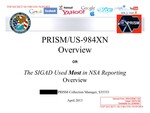
PRISM/US-984XN Overview [pdf]
A 2013 NSA training presentation revealing that major U.S. tech companies — including Google, Facebook, Apple, Microsoft, and Skype — secretly gave the NSA direct access to their servers, allowing the agency to collect users' emails, chats, photos, and files in real time, with the FBI acting as intermediary.
Programs: PRISM · FAIRVIEW · STORMBREW · BLARNEY · OAKSTAR · UTT · PRINTAURA · PINWALE · NUCLEON · TRAFFICTHIEF · SCISSORS · MARINA · MAINWAY · FALLOUT · CONVEYANCE · REPRISMFISA · SSO“U.S., British intelligence mining data from nine U.S. Internet companies in broad secret program” - The Washington Post ↗ (2013-06-06) · “NSA Prism program taps in to user data of Apple, Google and others” - The Guardian ↗ (2013-06-07) · “L'ampleur de l'espionnage mondial par la NSA” - Le Monde ↗ (2013-10-21) · “NSA files decoded: Edward Snowden's surveillance revelations explained” - The Guardian ↗ (2013-11-01) · “No Place to Hide” - Metropolitan Books ↗ (2014-05-13) · “Dark Mirror: Edward Snowden and the American Surveillance State” - Penguin Press ↗ (2020-05-19) · Gellman, Barton · Poitras, Laura · Greenwald, Glenn · MacAskill, Ewen · Untersinger, Martin · Dance, Gabriel -
Procedures Used By The National Security Agency For Targeting Non-United States Persons Reasonably Believed To Be Located Outside The United States To Acquire Foreign Intelligence Court Information Pursuant To Section 702 Of The Foreign Intelligence Surveillance Act Of 1978 [pdf]
The NSA’s 2009 Section 702 targeting procedures lay out how analysts decide who can be surveilled without a warrant, supposedly limiting spying to foreigners abroad. In reality, the rules give the agency wide latitude to presume people are foreign, rely on vague “totality of the circumstances” tests, and allow broad technical methods like IP filters and metadata checks. Oversight is mostly internal and after-the-fact, creating significant potential for U.S. communications to be swept up with little accountability.
People: Holder, Eric H. Jr. -
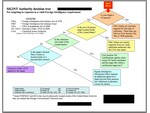
SIGINT Authority decision tree [pdf]
A one-page NSA training chart that walks an analyst from a targeting request to the legal authority that covers it, branching on whether the target is a US person, where the target is, where the collection site is, and whether the target is a Second Party citizen.
-
Write Right: Frequently Asked Question: Where Do I Go for Help With USSID SP0018 Issues? SIDtoday [pdf]
Questions regarding U.S. persons’ identities should be directed to the Office of Oversight and Compliance or the Office of the General Counsel. A two-day course teaches signals intelligence reporters how to obscure U.S. persons’ identities while “still retaining foreign intelligence value.”
The Intercept ↗ (2018-08-15) -
Write Right: Loaded Words: Don't Politicize Reports SIDtoday [pdf]
This article explains how to avoid editorializing signals intelligence reports. If, for example, the raw intelligence says that a specific official accepted bribes, this should be included as a footnote — including the provenance of the information — as opposed to inappropriately using loaded adjectives or descriptions about the official.
People: Powell, ColinThe Intercept ↗ (2018-08-15) -
Write Right: Seven Things Not To Do in a SIGINT Report SIDtoday [pdf]
The seven deadly sins when writing signals intelligence reports include releasing intelligence about a target to that same target; focusing on the United States (persons, companies, or activities); and omitting information.
The Intercept ↗ (2018-08-15)