Tag: global surveillance 18 documents
Search documents matching “global surveillance” →Free-text subjects the curators added. Unlike the other axes these are not necessarily from the documents' own vocabulary, so they are the loosest thing to browse by (and the most forgiving).
Graphs
By Banner
By Classification
Refine (combine with another filter, via search)
Sort: Title
Documents
-
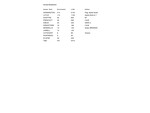
Access Breakdown [pdf]
This GCHQ document provides a technical breakdown of surveillance access points showing 11 different interception sites (with codenames like DONNINGTON, LATUS, SCEPTRE) accessing various undersea cables including Flag, Apollo North/South, BT, Cable & Wireless (C&W), SMW-3, Solas, and Verizon, totaling 541 10-gigabit connections representing 5,410 gigabits of surveillance capacity across the network.
Programs: DONNINGTON · LATUS · SCEPTRE · PRESCOTT · GIBUS · KIRKISTOWN · MONDELLO · LINNELL · CATEGORY · KNAPWEED · ELAPSE · BROKER“Vodafone – der lange Arm des britischen Geheimdienstes?” - WDR ↗ (2014-11-20) · “Spy cable revealed: how telecoms firm worked with GCHQ” - Channel 4 ↗ (2014-11-20) · “Der lange Arm des Geheimdienstes?” - NDR ↗ (2014-11-21) · “Snowden-Leaks: How Vodafone-Subsidiary Cable & Wireless Aided GCHQ’s Spying Efforts” - Süddeutsche Zeitung ↗ (2014-11-25) · Restle, Georg · White, Geoff · Strozyk, Jan · Moltke, Henrik · Poitras, Laura · Obermaier, Frederik -
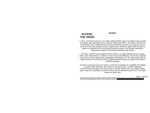
Access: Vision 2013 [pdf]
This July 2010 GCHQ strategic document outlines the agency's vision for 2013 to create "the world's biggest SIGINT engine" with access to 800 10-gigabit connections (up from existing capacity), expanding overseas operations to 60% while reducing UK-based to 40%, and developing new capabilities including computer network exploitation (CNE), exfiltration, beaconry, geolocation, and collection of "Internet Pocket Litter" like cookies and browsing data. The strategy emphasizes "scale and pace," "balance," and "agility" while claiming to operate within legal frameworks of "necessity, proportionality and authorisation," and highlights partnerships with second and third parties to access "intractable and hard targets."
Marking: SECRET -
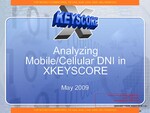
Analyzing Mobile/Cellular DNI in XKEYSCORE, May 2009 [pdf]
The XKEYSCORE document explains how the agency analyzes mobile/cellular device internet usage by collecting and processing both converged DNI/DNR data within cellular networks and traditional internet traffic, using various tools and indicators to identify mobile users even when their device type isn't immediately evident. The document demonstrates how the system can track mobile internet activity across applications like Yahoo Mail and identifies devices through various technical "hints" including MSISDN codes, browser fingerprints, and user agent strings.
-
AND THEY SAID TO THE TITANS: « WATCH OUT OLYMPIANS IN THE HOUSE! » [pdf]
This Top Secret CSEC “Olympia” document details a Canadian intelligence program that analyzed and tracked the Brazilian Ministry of Mines and Energy’s telecommunications, mapping IPs, servers, proxies, and mobile devices while automating data collection and network analysis to develop actionable intelligence. It outlines tools, workflows, and contacts used for surveillance, though the presentation does not explain the specific purpose of the operation.
Programs: OLYMPIA · QUOVA · PROMETHEUS · PEITHO · SLINGSHOT · LEVITATE · STRATOS · EVILOLIVE · GCHQ Geofusion · ATLAS · HYPERION · ATHENA · DANAUS · TIDALSURGE · BLACKPEARL · MARINA · STARSEARCH · PEPPERBOX · TRITON · PACKAGEDGOODS · ARK · TOYGRIPPE · FRIARTUCK · MASTERSHAKE · COEUS · STALKER · MAINWAY · FASCIA · SEDB · OCTSKYWARD · FASTBAT · TWINSERPENT · EONBLUE · DISHFIRE · GNDB“Read a CSEC document that was first acquired by Edward Snowden” - The Globe and Mail ↗ (2013-11-30) · “Ministério de Minas e Energia está na mira de espiões americanos e canadenses” - O Globo ↗ (2013-10-06) · “No Place to Hide” - Metropolitan Books ↗ (2014-05-13) · Freeze, Colin · Bridi, Sônia · Greenwald, Glenn -
Cable Master List [pdf]
This GCHQ document is a comprehensive master list of undersea fiber optic cables tracked for surveillance purposes, including both cables with UK landing points and international cables without UK connections, detailing technical specifications, ownership, capacity data, and code names for telecommunications partner companies that provided the intelligence agency with surveillance access.
Programs: PINNAGE · PFENNINGALPHA · NIGELLA · REMEDY · HIASCO · GERONTIC · SCEPTRE · PRESCOTT · KIRKISTOWN · LINNELL · CATEGORY · DACRON · KNAPWEED · ELAPSE · VITREOUS · LITTLE · STREETCAR · GIBBUS · VISAGE · LATUS · NUMDAH“Vodafone – der lange Arm des britischen Geheimdienstes?” - WDR ↗ (2014-11-20) · “Spy cable revealed: how telecoms firm worked with GCHQ” - Channel 4 ↗ (2014-11-20) · “Der lange Arm des Geheimdienstes?” - NDR ↗ (2014-11-21) · “Snowden-Leaks: How Vodafone-Subsidiary Cable & Wireless Aided GCHQ’s Spying Efforts” - Süddeutsche Zeitung ↗ (2014-11-25) · Restle, Georg · White, Geoff · Strozyk, Jan · Moltke, Henrik · Poitras, Laura · Obermaier, Frederik -
CNE Analysis in XKEYSCORE [pdf]
This document is an NSA training presentation from October 2009 demonstrating how XKEYSCORE integrates with Computer Network Exploitation (CNE) operations, allowing analysts to search and analyze data extracted from compromised computers including keystrokes, browser history, registry files, documents, emails, and directory structures collected through implants like UNITEDRAKE and OLYMPUS.
Programs: XKEYSCORE · OLYMPUS · UNITEDRAKE · PINWALE · TUNINGFORK · TURBOCHASER · MARINA · JOLLYROGER · TREASUREMAP · TURBINE · PRESSUREWAVE · MAD · TUCKER · EXPANDINGPULLY · UNIX · SEARCHLIGHT · KEYLOGGER · PILBEAM · FOXACID · WAYTIDE · SHADOWQUEST · SEAGULLFARO · DARKHELMET · LUTEUSICARUS · FOGGYBOTTOM · GREENCHAOS · RADIUS · NKB · VALIDATOR -
Content Extraction Enhancements For Target Analytics: SMS Text Messages: A Goldmine to Exploit (9 June 2011) [pdf]
The document describes the NSA’s Dishfire program, which collects hundreds of millions of global SMS messages daily, and the PREFER system, which extracts detailed metadata—including contacts, geolocation, travel, and financial information—from these messages for analytic purposes. It highlights the scale, operational processes, and types of data exploited to support intelligence and target analysis.
-
FOXACID Overall Briefing [pdf]
FOXACID is the NSA's exploit server infrastructure designed to gain "initial access" to target computers by tricking them into visiting malicious websites through spam emails, man-in-the-middle attacks, or split-second packet injection techniques that redirect legitimate web traffic. The document reveals how the agency has evolved from low-success spam operations (less than 1% success rate) to sophisticated "QUANTUM" techniques that achieve up to 80% success rates by exploiting web browsers through services like Yahoo and Facebook, allowing the NSA to compromise any target whose web traffic passes through monitored network chokepoints—with the chilling assessment that "if we can get the target to visit us in some sort of web browser, we can probably own them."
Programs: FOXACID · WILLOWVIXEN · GENUINEDRAFT · SECONDDATE · QUANTUMTHEORY · TURMOIL · TURBINE · WEBSNIPER · QUANTUMINSERT · QUANTUMBISCUIT · QUANTUMDIRK · QUANTUM · VALIDATOR · OLYMPUS · MISTYVEAL · SSO · STRAIGHTBIZARRE · ISLANDTRANSPORT -
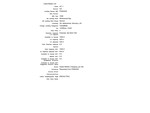
How to tell if a target is 'foreign' [pdf]
The document describes a human intelligence (HUMINT) report indicating that a specific intelligence target, identified by a Foreign Source ID, is located outside the U.S., including details such as email, telephone number, and mobile network type, with checks confirming no U.S. roaming over a 60-day period. It illustrates the use of HUMINT to corroborate foreign location data for surveillance purposes.
-
Japan official NSA visit, cyber briefing [pdf]
This document outlines cooperation between the NSA and Japan’s Directorate for SIGINT (DFS) to develop Japan’s capabilities for providing signals intelligence (SIGINT) support to cyber defense operations, particularly against Chinese cyber activities. It details meetings, training, and data-sharing efforts from 2012–2013 aimed at enhancing Japan’s cyber intelligence capacity under U.S. guidance.
“Japan Made Secret Deals With the NSA That Expanded Global Surveillance” - The Intercept ↗ (2017-04-24) · “アメリカに監視される日本 ~スノーデン“未公開ファイル”の衝撃” - NHK ↗ (2017-04-24) · Gallagher, Ryan · Ikegami, Akira -
LEVITATION and the FFU Hypothesis [pdf]
This document describes LEVITATION, a top-secret Canadian Communications Security Establishment (CSE) project that monitors millions of daily file uploads and downloads from free file-sharing sites to identify potential extremist activity. It details the program’s data collection methods, analytical workflow, use of partner databases, and examples of successful discoveries related to terrorist materials and hostage videos.
-
NSA Intelligence Relationship with Canada's Communications Security Establishment Canada (CSEC) [pdf]
This document describes the close, long-standing SIGINT partnership between the NSA and Canada’s CSEC, emphasizing cooperative efforts in global intelligence collection, cyber operations, information assurance, and critical infrastructure defense. It highlights mutual contributions, including CSEC’s unique geographic access, covert sites, cryptographic capabilities, and R&D collaboration, supporting U.S. and North American security objectives.
“Communication Security Establishment's cyberwarfare toolbox revealed” - CBC News ↗ (2015-03-23) · “Documents Reveal Canada’s Secret Hacking Tactics” - The Intercept ↗ (2015-03-23) · “No Place to Hide” - Metropolitan Books ↗ (2014-05-13) · Seglins, Dave · Hildebrandt, Amber · Pereira, Michael · Greenwald, Glenn · Gallagher, Ryan -
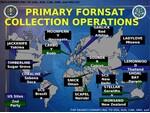
PRIMARY FORNSAT COLLECTION OPERATIONS [pdf]
This document is a TOP SECRET NSA/CSS slide mapping the global locations of primary FORNSAT (foreign satellite) collection operations, showing U.S. and second-party ground stations used to intercept satellite communications worldwide. It illustrates the geographic spread and allied integration of NSA satellite surveillance infrastructure rather than specific technical capabilities.
-
Procedures Used By The National Security Agency For Targeting Non-United States Persons Reasonably Believed To Be Located Outside The United States To Acquire Foreign Intelligence Court Information Pursuant To Section 702 Of The Foreign Intelligence Surveillance Act Of 1978 [pdf]
The NSA’s 2009 Section 702 targeting procedures lay out how analysts decide who can be surveilled without a warrant, supposedly limiting spying to foreigners abroad. In reality, the rules give the agency wide latitude to presume people are foreign, rely on vague “totality of the circumstances” tests, and allow broad technical methods like IP filters and metadata checks. Oversight is mostly internal and after-the-fact, creating significant potential for U.S. communications to be swept up with little accountability.
People: Holder, Eric H. Jr. -
SKIDROWE [pdf]
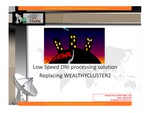
This document reveals the extensive surveillance capabilities of the NSA's SKIDROWE program at TITANPOINTE, specifically designed to intercept and analyze satellite communications and internet data. It highlights how intercepted data is processed and filtered through advanced systems like XKEYSCORE, which enables real-time intelligence gathering by sifting through massive amounts of digital content, including emails, calls, and internet activity.
Programs: SKIDROWE · WEALTHYCLUSTER2 · WEALTHYCLUSTER · TURNWEALTHY · VPCS · XKEYSCORE · GENESIS · CONTROLAND · ATM · FITBOY · DARKTHUNDER · FIP · METTLESOME · SKYFRAME · PVOICE · XXPY0012 · AGITATOR · STARPROC · SPELLBINDER · BLACKPEARL · BLACKALCHEMY · BLACKGOLD · BLACKFIRE · MONKEYMIND · BCD · EVVIPER · QUANTUM · MISTYPEAK · VALIANTSURF · GALLANTWAVE · SWINE · BLUESNORT · TOSSSWUNG · GNOMEVISION · GNOMEGOGGLES · HIDDENSALAMANDER · TURMOIL · PSC -
SSO dictionary relevant entries [pdf]
This document provides a detailed list of relevant entries related to NSA's Special Source Operations (SSO), highlighting various NSA surveillance and data collection systems used to monitor global communications. It includes descriptions of programs such as BIGBIRD and DISHFIRE, which focus on cable and SMS interception, as well as tools like LOPERS and COURIERSKILL for processing telephony metadata and refining target selection. The entries emphasize the extensive and automated nature of the NSA's intelligence-gathering operations, particularly in relation to undersea cables and telecommunication networks, and underscore the secretive and expansive scope of SSO's global surveillance activities.
Programs: ARTIFICE · BIGBIRD · FAIRVIEW · SSO · POORWILL · PINECONE · BLACKBELT · CADENCE · BLACKNIGHT · SHIPMASTER · COURIERSKILL · THEORYMASTER · WEALTHYCLUSTER · CLIFFSIDE · DISHFIRE · MARINA · MAINWAY · NUCLEON · PINWALE · FASCIA · BANYAN · LAMPSHADE · ASSOCIATION · HOMEBASE · SEDB · FRIAR · KEYCARD · TURMOIL · TURBULENCE · UTT · IRISHBEAUTY · OCTAVE · KOZYKOVE · LITHIUM · BLARNEY · LOPERS · MAILORDER · LUMBERYARD · MERLIN · NODDY · SAGUARO · NUTHATCH · CONTRAOCTAVE · XKEYSCORE · PLANK · RODEOSTAR · SAGURA · SERENADE · STARGATE · SILVERCOLLAM · SEALION · SEAGULL · SLIVER · SORA-2 · TITANPOINTE · TUBE · VPCS · STONEGATE“NSA Spying Relies on AT&T’s ‘Extreme Willingness to Help’” - ProPublica ↗ (2015-08-15) · “AT&T Helped U.S. Spy on Internet on a Vast Scale” - The New York Times ↗ (2015-08-15) · “The Wiretap Rooms: The NSA’s Hidden Spy Hubs in Eight U.S. Cities” - The Intercept ↗ (2018-06-25) · Angwin, Julia · Larson, Jeff · Savage, Charlie · Moltke, Henrik · Poitras, Laura · Risen, James · Gallagher, Ryan -
Tailored Access Operations, FOXACID, QUANTUM [pdf]
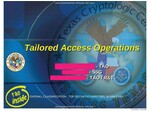
These NSA presentation slides detail "QUANTUM," a sophisticated system that allows the agency to intercept internet traffic and inject malware onto target computers with up to 80% success rates, far exceeding traditional spam-based methods. The system works by monitoring internet traffic for specific identifiers (like Yahoo or Facebook cookies), then racing to inject malicious code before legitimate web servers can respond, thereby compromising targets' computers without their knowledge and establishing persistent backdoor access.
Programs: FOXACID · QUANTUM · QUANTUMTHEORY · QUANTUMBISCUIT · VALIDATOR · OLYMPUS · UNITEDRAKE · OLYMPUSFIRE · SSO · FORESTPLACE -
WINDSTOP - Last 30 Days [pdf]
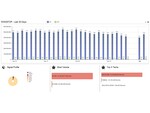
The WINDSTOP report shows massive NSA collection activity over a 30-day period, with daily DNI (Digital Network Intelligence) and DNR (Dialed Number Recognition) records reaching up to 600 million per day. Most data volume came from DS-300 and DS-200B collection points, processed primarily through XKEYSCORE and TURMOIL, and included a mix of signal types such as PCS, INMAR, MCIP, VSAT, and PSTN. The chart follows the same structure as BOUNDLESSINFORMANT, the NSA’s global SIGINT visualization tool, using bar and pie charts to track and categorize collection volume by signal type, SIGAD, and processing system.