SPIN 15 VPN Story
Open PDFDocument date: -
Pages: 4
Genre: report
Banner: TOP SECRET//COMINT//REL TO USA, AUS, CAN, GBR, NZL
Classification: TOP SECRET COMINT
Dissemination: REL TO USA, AUS, CAN, GBR, NZL
A TOP SECRET planning document describing two parallel workstreams in SPIN 15: the deployment of VPN decryption capabilities to SMOKYSINK (US-3237), a unilateral NSA RAMPART-T cable tap site operating without a third-party partner, and a risk reduction benchmarking activity measuring TURMOIL's VPN and SSL exploitation performance against the Net-Centric Capabilities (NCC) programme's Key Performance Parameters — which targeted 100,000 VPN decrypt requests per hour by the end of fiscal year 2011, and 10 million SSL sessions per day by the end of fiscal year 2012.
My notes
TOP SECRET//COMINT//REL TO USA, AUS, CAN, GBR, NZL//20320108
DRAFT
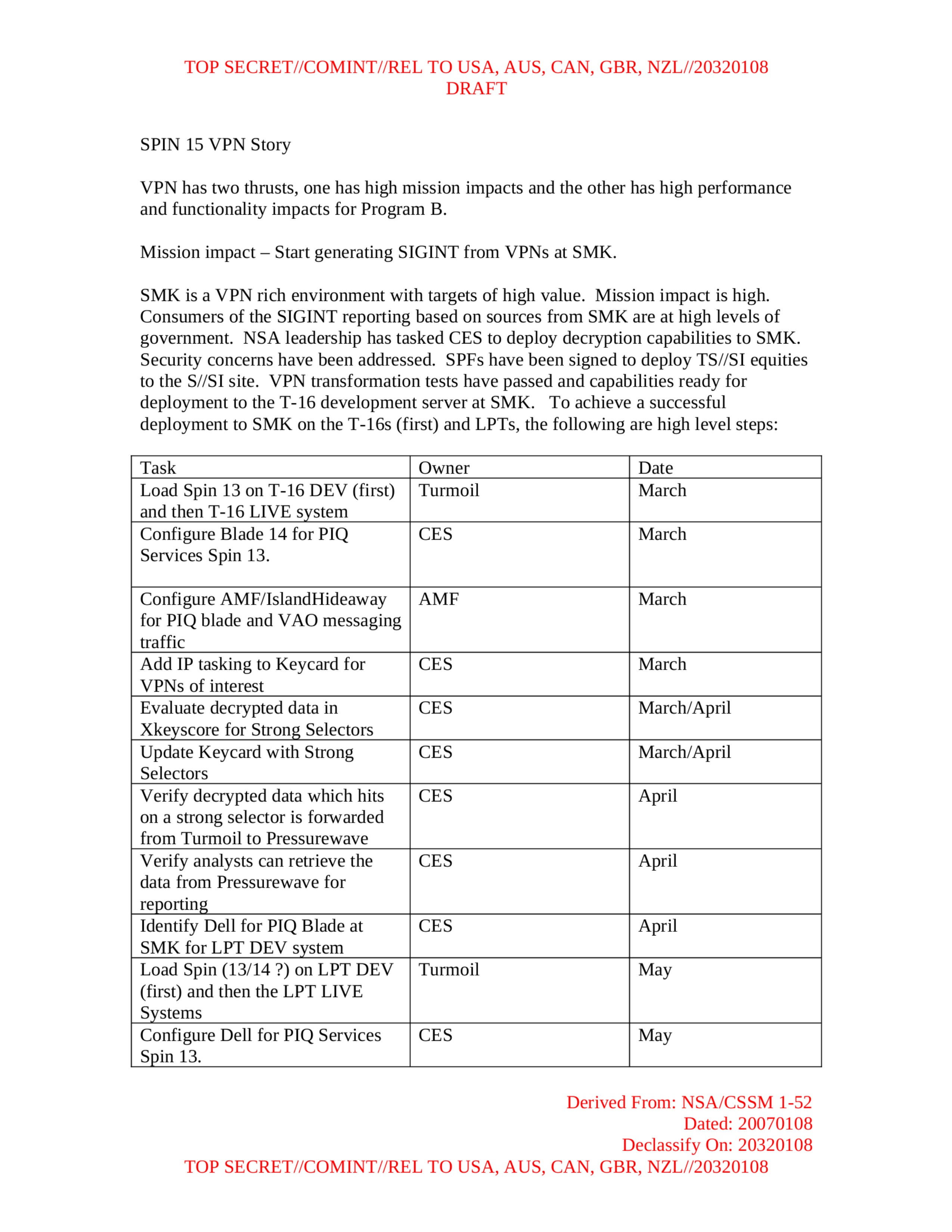
SPIN 15 VPN Story
VPN has two thrusts, one has high mission impacts and the other has high performance and functionality impacts for Program B.
Mission impact - Start generating SIGINT from VPNs at SMK.
SMK is a VPN rich environment with targets of high value. Mission impact is high. Consumers of the SIGINT reporting based on sources from SMK are at high levels of government. NSA leadership has tasked CES to deploy decryption capabilities to SMK. Security concerns have been addressed. SPFs have been signed to deploy TS//SI equities to the S//SI site. VPN transformation tests have passed and capabilities ready for deployment to the T-16 development server at SMK. To achieve a successful deployment to SMK on the T-16s (first) and LPTs, the following are high level steps:
| Task | Owner | Date |
|---|---|---|
| Load Spin 13 on T-16 DEV (first) and then T-16 LIVE system | Turmoil | March |
| Configure Blade 14 for PIQ Services Spin 13. | CES | March |
| Configure AMF/IslandHideaway for PIQ blade and VAO messaging traffic | AMF | March |
| Add IP tasking to Keycard for VPNs of interest | CES | March |
| Evaluate decrypted data in Xkeyscore for Strong Selectors | CES | March/April |
| Update Keycard with Strong Selectors | CES | March/April |
| Verify decrypted data which hits on a strong selector is forwarded from Turmoil to Pressurewave | CES | April |
| Verify analysts can retrieve the data from Pressurewave for reporting | CES | April |
| Identify Dell for PIQ Blade at SMK for LPT DEV system | CES | April |
| Load Spin (13/14?) on LPT DEV (first) and then the LPT LIVE Systems | Turmoil | May |
| Configure Dell for PIQ Services Spin 13. | CES | May |
Derived From: NSA/CSSM 1-52
Dated: 20070108
Declassify On: 20320108
TOP SECRET//COMINT//REL TO USA, AUS, CAN, GBR, NZL//20320108
TOP SECRET//COMINT//REL TO USA, AUS, CAN, GBR, NZL//20320108
DRAFT
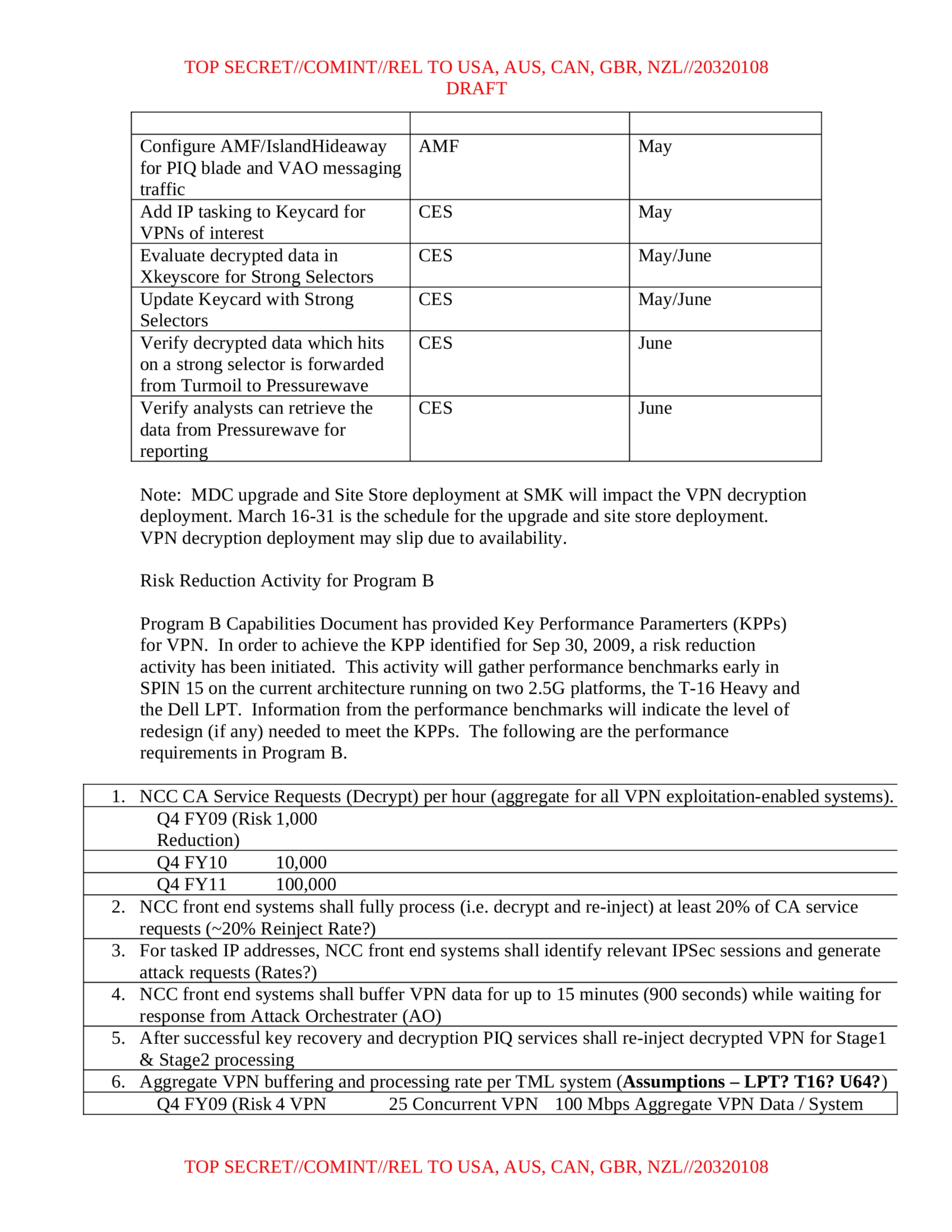
| Configure AMF/IslandHideaway for PIQ blade and VAO messaging traffic | AMF | May |
| Add IP tasking to Keycard for VPNs of interest | CES | May |
| Evaluate decrypted data in Xkeyscore for Strong Selectors | CES | May/June |
| Update Keycard with Strong Selectors | CES | May/June |
| Verify decrypted data which hits on a strong selector is forwarded from Turmoil to Pressurewave | CES | June |
| Verify analysts can retrieve the data from Pressurewave for reporting | CES | June |
Note: MDC upgrade and Site Store deployment at SMK will impact the VPN decryption deployment. March 16-31 is the schedule for the upgrade and site store deployment. VPN decryption deployment may slip due to availability.
Risk Reduction Activity for Program B
Program B Capabilities Document has provided Key Performance Paramerters (KPPs) for VPN. In order to achieve the KPP identified for Sep 30, 2009, a risk reduction activity has been initiated. This activity will gather performance benchmarks early in SPIN 15 on the current architecture running on two 2.5G platforms, the T-16 Heavy and the Dell LPT. Information from the performance benchmarks will indicate the level of redesign (if any) needed to meet the KPPs. The following are the performance requirements in Program B.
- NCC CA Service Requests (Decrypt) per hour (aggregate for all VPN exploitation-enabled systems).
Q4 FY09 (Risk 1,000 Reduction)
Q4 FY10 10,000
Q4 FY11 100,000
- NCC front end systems shall fully process (i.e. decrypt and re-inject) at least 20% of CA service requests (~20% Reinject Rate?)
- For tasked IP addresses, NCC front end systems shall identify relevant IPSec sessions and generate attack requests (Rates?)
- NCC front end systems shall buffer VPN data for up to 15 minutes (900 seconds) while waiting for response from Attack Orchestrater (AO)
- After successful key recovery and decryption PIQ services shall re-inject decrypted VPN for Stage1 & Stage2 processing
- Aggregate VPN buffering and processing rate per TML system (Assumptions – LPT? T16? U64?)
Q4 FY09 (Risk 4 VPN 25 Concurrent VPN 100 Mbps Aggregate VPN Data / System
TOP SECRET//COMINT//REL TO USA, AUS, CAN, GBR, NZL//20320108
TOP SECRET//COMINT//REL TO USA, AUS, CAN, GBR, NZL//20320108
DRAFT
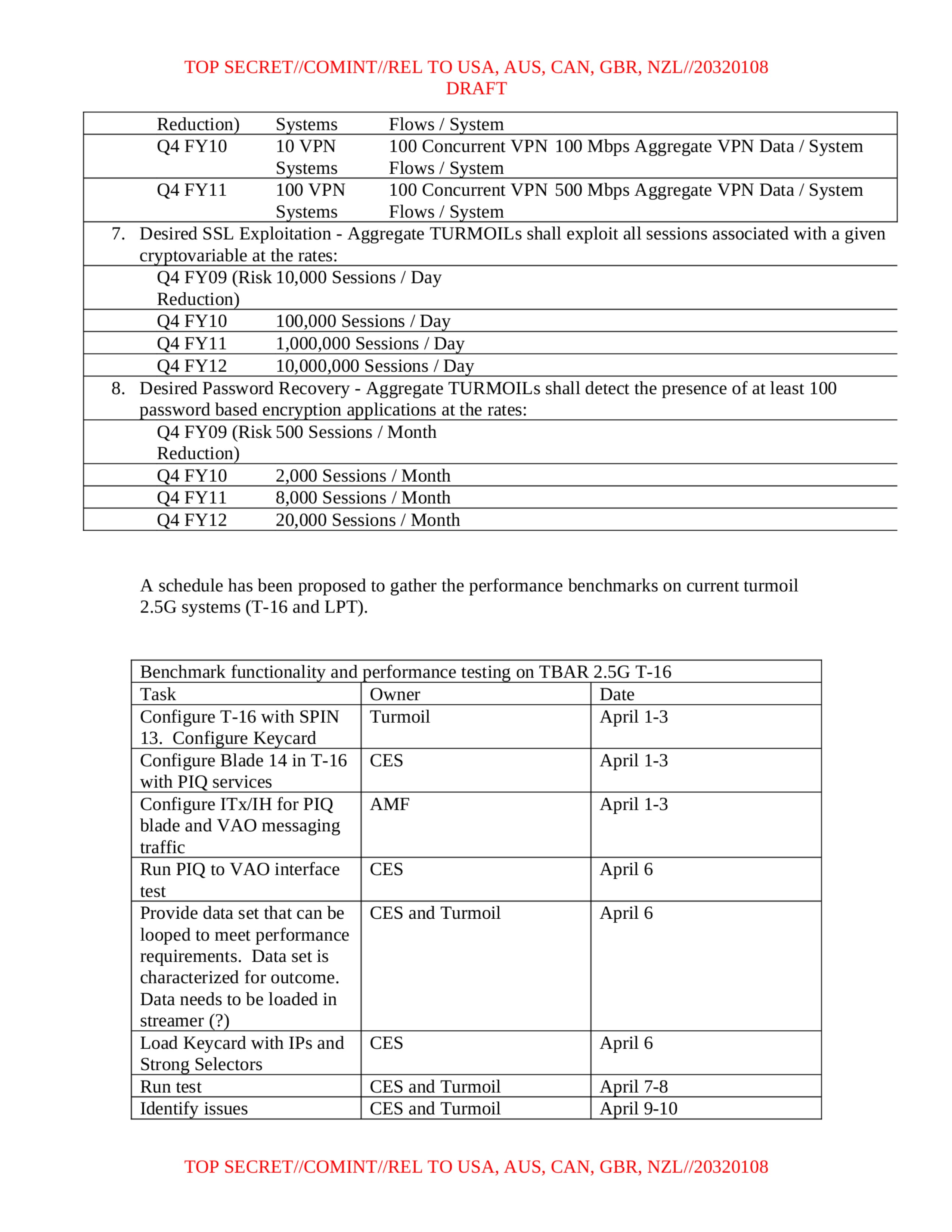
Reduction Systems Flows / System
Q4 FY10 10 VPN Systems 100 Concurrent VPN 100 Mbps Aggregate VPN Data / System Flows / System
Q4 FY11 100 VPN Systems 100 Concurrent VPN 500 Mbps Aggregate VPN Data / System Flows / System
- Desired SSL Exploitation - Aggregate TURMOILs shall exploit all sessions associated with a given cryptovariable at the rates:
Q4 FY09 (Risk 10,000 Sessions / Day Reduction)
Q4 FY10 100,000 Sessions / Day
Q4 FY11 1,000,000 Sessions / Day
Q4 FY12 10,000,000 Sessions / Day
- Desired Password Recovery - Aggregate TURMOILS shall detect the presence of at least 100 password based encryption applications at the rates:
Q4 FY09 (Risk 500 Sessions / Month Reduction)
Q4 FY10 2,000 Sessions / Month
Q4 FY11 8,000 Sessions / Month
Q4 FY12 20,000 Sessions / Month
A schedule has been proposed to gather the performance benchmarks on current turmoil 2.5G systems (T-16 and LPT).
Benchmark functionality and performance testing on TBAR 2.5G T-16
| Task | Owner | Date |
|---|---|---|
| Configure T-16 with SPIN 13. Configure Keycard | Turmoil | April 1-3 |
| Configure Blade 14 in T-16 with PIQ services | CES | April 1-3 |
| Configure ITx/IH for PIQ blade and VAO messaging traffic | AMF | April 1-3 |
| Run PIQ to VAO interface test | CES | April 6 |
| Provide data set that can be looped to meet performance requirements. Data set is characterized for outcome. Data needs to be loaded in streamer (?) | CES and Turmoil | April 6 |
| Load Keycard with IPs and Strong Selectors | CES | April 6 |
| Run test | CES and Turmoil | April 7-8 |
| Identify issues | CES and Turmoil | April 9-10 |
TOP SECRET//COMINT//REL TO USA, AUS, CAN, GBR, NZL//20320108
TOP SECRET//COMINT//REL TO USA, AUS, CAN, GBR, NZL//20320108
DRAFT
| Fix issues | CES and Turmoil | April 9-10 |
| Rerun test | CES and Turmoil | April 9-10 |
| Document Benchmarks | CES and Turmoil | April 13-15 |
April 16 will be a review date of the performance benchmarks gathered on a 2.5G T-16 Heavy system. This information will guide decisions to pursue architectural and design planning and implementation to meet the Sep 30, 2009 KPPs.
Benchmark functionality and performance testing on 2.5G LPT (T-16)
| Task | Owner | Date |
|---|---|---|
| Configure LPT with SPIN 14. Configure Keycard | Turmoil | April 30 |
| Configure Dell with PIQ services | CES | April 30 |
| Configure ITx/IH for PIQ blade and VAO messaging traffic | AMF | April 30 |
| Run PIQ to VAO interface test | CES | April 30 |
| Provide data set that can be looped to meet performance requirements. Data set is characterized for outcome. Data needs to be loaded in streamer (?) | CES and Turmoil | April 31 |
| Load Keycard with IPs and Strong Selectors | CES | April 31 |
| Run test | CES and Turmoil | May 1 |
| Identify issues | CES and Turmoil | May 1 |
| Fix issues | CES and Turmoil | May 4-5 |
| Rerun test | CES and Turmoil | May 6 |
| Document Benchmarks | CES and Turmoil | May 7 |
May 8 is the second review date of the performance benchmarks. This will include the benchmarks from the 2.5G LPT system. This information will guide decisions to pursue architectural/design planning and implementation to meet the Sep 30, 2009 KPPs.
Turmoil technical discussion can be hosted in parallel to the benchmark testing. The purpose of the discussions is to ??????.
TOP SECRET//COMINT//REL TO USA, AUS, CAN, GBR, NZL//20320108
Published in the Same Report
(10 of 43 documents)
-
BULLRUN CoI - Briefing Sheet [pdf]
A GCHQ briefing sheet introducing the BULLRUN Community of Interest — the access control framework protecting Five Eyes capabilities to defeat encryption across TLS/SSL, HTTPS, SSH, VPNs, IPSec, encrypted chat and encrypted VoIP — covering the classification structure, handling procedures and protective marking guidance for intelligence derived from cryptanalytic exploitation.
“N.S.A. Able to Foil Basic Safeguards of Privacy on Web” - The New York Times ↗ (2013-09-05) · “Revealed: The NSA's Secret Campaign to Crack, Undermine Internet Security” - ProPublica ↗ (2013-09-05) · “Prying Eyes: Inside the NSA's War on Internet Security” - Der Spiegel ↗ (2014-12-28) · Perlroth, Nicole · Larson, Jeff · Shane, Scott · Appelbaum, Jacob · Gibson, Aaron · Grothoff, Christian · Müller-Maguhn, Andy · Poitras, Laura · Sontheimer, Michael · Stöcker, Christian -
CLASSIFICATION GUIDE FOR CRYPTANALYSIS, 2-12 [pdf]
An NSA/CSS classification guide for cryptanalysis establishing the precise classification level for each type of information about NSA's capabilities to exploit commercial and indigenous encryption systems — from the unclassified acknowledgement that NSA exploits cryptographic devices, through to the Top Secret protection of cryptographic modifications made to commercial products to render them exploitable and industry relationships used to obtain cryptographic details.
“Revealed: how US and UK spy agencies defeat internet privacy and security” - The Guardian ↗ (2013-09-05) · “Prying Eyes: Inside the NSA's War on Internet Security” - Der Spiegel ↗ (2014-12-28) · Ball, James · Borger, Julian · Greenwald, Glenn · Appelbaum, Jacob · Gibson, Aaron · Grothoff, Christian · Müller-Maguhn, Andy · Poitras, Laura · Sontheimer, Michael · Stöcker, Christian -
Innov8 Experiment Profile Template [pdf]
A TOP SECRET STRAP1 joint NSA/GCHQ experiment profile documenting a 2010-2011 Joint Capability Experiment to test hardware-accelerated bulk decryption of common internet encryption technologies at scale, integrating TURMOIL's passive collection with NSA's LONGHAUL key recovery service via the ISLANDTRANSPORT messaging system, as part of the broader BULLRUN assault on internet encryption.
“Prying Eyes: Inside the NSA's War on Internet Security” - Der Spiegel ↗ (2014-12-28) · “Revealed: how US and UK spy agencies defeat internet privacy and security” - The Guardian ↗ (2013-09-05) · Appelbaum, Jacob · Gibson, Aaron · Grothoff, Christian · Müller-Maguhn, Andy · Poitras, Laura · Sontheimer, Michael · Stöcker, Christian · Ball, James · Borger, Julian · Greenwald, Glenn -
TLS Trends: A roundtable discussion on current usage and future directions [pdf]
A presentation by Canada's Communications Security Establishment describing their TLS trend analysis programme, which systematically tracked SSL/TLS encryption parameters across warranted collection and Special Source access to identify cryptanalytic opportunities, monitor target behaviour and collaborate with GCHQ on exploiting weaknesses in widely-used encryption implementations.
-
Secure Sockets Layer (SSL) / Transport Layer Security (TLS) [pdf]
A classified NSA Network Security Products training presentation providing a comprehensive technical overview of SSL/TLS protocol mechanics and NSA's exploitation approaches, including observed usage statistics from intercepted traffic, RSA key exchange decryption methodology, exploitation of the Debian OpenSSL RNG weakness, and the practical challenges of decrypting millions of SSL sessions per day at scale.
Programs: SCARLETFEVER -
TLS trends at GCHQ [pdf]
A GCHQ presentation describing their TLS trends analysis programme, which processed approximately 10 billion SSL/TLS Server Hello events per week from Special Source cable tapping and COMSAT collection to produce weekly trend reports, alongside two operational tools — TargeTLS for matching TLS events against BROAD OAK target profiles, and FLYING PIG, a TLS knowledge base enabling analysts to query certificate, IP and client data across the full intercept base.
-
TURMOIL/APEX/APEX High Level Description Document [pdf]
NSA WikiInfo page providing the high-level design description of APEX — the Active-Passive Integration capability integrating HAMMERMILL router implants with TURMOIL passive collection — enabling real-time exfiltration of targeted VPN (HAMMERSTEIN) and VoIP (HAMMERCHANT) traffic from compromised routers directly into NSA's passive collection and cryptanalytic attack infrastructure, with TURBINE providing automated command and control of the combined active-passive system.
Programs: TURMOIL · APEX · HAMMERMILL · HAMMERCHANT · HAMMERSTEIN · FASHIONCLEFT · TURBINE · TOYGRIPPE · METROTUBE · CHIMNEYPOOL · PIQBLADE · KEYCARD · FASCIA · ISLANDTRANSPORT · PRESSUREWAVE · ASDF · CONVEYANCE · TURBULENCE -
GALLANTWAVE [pdf]
NSA presentation describing GALLANTWAVE — a LONGHAUL capability for VPN decryption — specifically its scaling architecture to handle increased collection volumes and a peering mechanism allowing partner agencies to share single-sided VPN key exchange events so that LONGHAUL can complete decryption attempts that would otherwise fail due to one-sided collection.
-
Intro to the VPN Exploitation Process [pdf]
NSA introduction to the VPN exploitation process from September 2010, presented by the OTP VPN Exploitation Team, covering the full workflow from initial collection through to sustained decryption of IPSec, PPTP, SSL and SSH traffic, with named exploitation successes including airlines, diplomatic missions, banks and intelligence services across Iran, Jordan, Russia, Turkey, Pakistan, Afghanistan, Somalia, Indonesia and Mexico.
Programs: BLEAKINQUIRY · TOYGRIPPE · XKEYSCORE · MAILORDER · CORALREEF · VULCANDEATHGRIP · SCISSORS · TURTLEPOWER · PINWALE · FOURSCORE · CADENCE · UTT · VULCANMINDMELD · CAPRIOS · AGILITY · NKB · FOLLOWTHEMONEY -
Analytic Challenges from Active-Passive Integration [pdf]
This NSA briefing addresses the technical and administrative friction caused by "shaping" operations. Shaping occurs when an active malware implant, typically situated on network infrastructure like a router, copies specific data streams and redirects them past a passive surveillance sensor such as TURMOIL. While this ensures the capture of data that might otherwise be missed, it creates a "double metadata" conflict where a single piece of intelligence carries two competing sets of identifiers: one from the active Tailored Access Operations (TAO) implant and another from the passive collection site. The document tasks analysts with finding a way to reconcile these source notations to ensure the data remains searchable and legally compliant within legacy databases.
Programs: BRAVENICKEL · HAMMERMILL · APEX · TURMOIL · HAMMERSTONE · PRESSUREWAVE · METROTUBE · TOYGRIPPE · TURBULENCE · METAWAVE · MARINA · SSO · CONVEYANCE · NUCLEON · FASCIA · HAMMERCHANT

Related Documents
-
VALIANTSURF [pdf]
An NSA WikiInfo page for VALIANTSURF — the coverterm for NSA's IPSec VPN decryption capability within the TURMOIL collection platform — describing the four data flow types for intercepting and breaking encrypted VPN traffic, the full deployment roster across collection sites including Menwith Hill, SMOKYSINK, MUSCULAR, CROSSCUT and others, and the architectural taxonomy of the VALIANTSURF programme including its MALIBU and WAIMEA processing architectures and their relationship to LONGHAUL, POISONNUT and GALLANTWAVE.
Programs: VALIANTSURF · TURMOIL · TURBULENCE · HOOKED · HOOKEDHAND · CINDER · CINDERASH · CINDERTRACK · SCARLETFEVER · LONGHAUL · FALLOUT · TOYGRIPPE · PICARESQUE · XKEYSCORE · PRESSUREWAVE · ASDF · MAILORDER · TUBE · KEYCARD · POISONNUT · ISLANDHIDEAWAY · ISLANDTRANSPORT · EXOPUMP · CORALREEF · PINWALE · TUSCARORA · ONEROOF · CONVEYANCE · TURTLEPOWER · WDM · CADENCE · UTT · SCISSORS · FISHWAY · BTUBE · DNCA · ROMULANALE · GALLANTWAVE · ROMULANGAWK · ROMULANGOWL · MALIBU · WAIMEA · WAIMEAVISAGE · ROMULANVISAGE · WAIMEAVISE · ROMULANVISE · APEX · METROTUBE · MADFORGE · JSORCERER · CROSSCUT · CIET · LATTICE · STARQUAKE · SARATOGA · MUSCULAR · SMOKYSINK · SLACKKEY · TUMMS · PURGE · SURGE · NUCLEON · SPAGIC · PPF · SOAP · TUMULT · FIP · PIQBLADE · DEEPDIVE · IBRIDGE -
TURMOIL VPN PROCESSING [pdf]
A TURMOIL VPN Processing technical briefing from October 2009 describing the full architecture for intercepting and decrypting IPSec VPN traffic within the TURMOIL passive collection platform — covering IKE/ESP protocol handling, five distinct data flow types, the Dell LPT hardware implementation, and live operational metrics showing over 8 million packets decrypted at Menwith Hill and 1.4 million at SMOKYSINK during a single week in October 2009.
-
TURBULENCE - Fielded Capability: End-to-End VPN, SPIN 9 Design Review [pdf]
An NSA SPIN 9 design review presentation describing the transition of TURMOIL's VPN decryption capability from the legacy Red Architecture to the new Blue Architecture — covering the full end-to-end dataflow, component interfaces, test scenarios and detailed processing specifications for each system in the VPN decryption pipeline.
Programs: TURBULENCE · TURMOIL · KEYCARD · WEALTHYCLUSTER · TUBE · XKEYSCORE · PRESSUREWAVE · EXOPUMP · PWV · TOYGRIPPE · PICARESQUE · AGILITY · MAILORDER · ISLANDTRANSPORT · PIQBLADE · PINWALE · TRAFFICTHIEF · IBRIDGE · PPF · METROTUBE · FIP · SSO -
TURBULENCE - APEX - Active/passive Exfiltration [pdf]
This 2009 NSA presentation details APEX (Active/Passive Exfiltration), a TURBULENCE program component that combines passive collection infrastructure with active TAO implants to exfiltrate VPN and VoIP traffic from deep within target networks back to NSA collection systems. The system uses the FASHIONCLEFT protocol to tunnel captured packets through compromised routers and network devices, enabling decryption of VPN tunnels and collection of voice communications that would otherwise be invisible to passive surveillance.
Programs: TURBULENCE · TURMOIL · HAMMERSTEIN · HAMMERCHANT · FASHIONCLEFT · TUTELAGE · TURBINE · TRAFFICTHIEF · XKEYSCORE · ANALYTICS · PRESSUREWAVE · TOYGRIPPE · POISONNUT · FLAXENPRECEPT · FOGYNULL · FUNNELAPS · SHELLGREY · METROTUBE · VINYLSEAT · OLYMPUS · UNITEDRAKE · FIGBUILD · SURPASSPIN · ROOTKNOT · OPTICPINCH · SEAGULFARO · TREBLECLEF · CONVEY · PINWALE · SWEEPFORWARD · QUANTUM · KEYCARD · ASDF · TUBE · PUZZLECUBE · WEALTHYCLUSTER2 · COALSHOVEL · HAMMERMILL · ISLANDTRANSPORT · FASCIA · TURBINIE · APEX · PPF · AEG · FIP · SSO · PICARESQUE · PSP · IVE · PSC · CHIMNEYPOOL · CORESSC · FLASHHANDLE · IBRIDGE · CORALREEF · VAO · NUCLEON · PIQBLADE“The Digital Arms Race: NSA Preps America for Future Battle” - Der Spiegel ↗ (2015-01-17) · “How the NSA Plans to Infect ‘Millions’ of Computers with Malware” - The Intercept ↗ (2014-03-12) · “How the NSA Plans to Infect ‘Millions’ of Computers with Malware” - The Intercept ↗ (2014-03-12) · Appelbaum, Jacob · Gibson, Aaron · Guarnieri, Claudio · Müller-Maguhn, Andy · Poitras, Laura · Rosenbach, Marcel · Ryge, Leif · Schmundt, Hilmar · Sontheimer, Michael · Gallagher, Ryan · Greenwald, Glenn -
TURMOIL/APEX/APEX High Level Description Document [pdf]
NSA WikiInfo page providing the high-level design description of APEX — the Active-Passive Integration capability integrating HAMMERMILL router implants with TURMOIL passive collection — enabling real-time exfiltration of targeted VPN (HAMMERSTEIN) and VoIP (HAMMERCHANT) traffic from compromised routers directly into NSA's passive collection and cryptanalytic attack infrastructure, with TURBINE providing automated command and control of the combined active-passive system.
Programs: TURMOIL · APEX · HAMMERMILL · HAMMERCHANT · HAMMERSTEIN · FASHIONCLEFT · TURBINE · TOYGRIPPE · METROTUBE · CHIMNEYPOOL · PIQBLADE · KEYCARD · FASCIA · ISLANDTRANSPORT · PRESSUREWAVE · ASDF · CONVEYANCE · TURBULENCE