Secure Sockets Layer (SSL) / Transport Layer Security (TLS)
Open PDFDocument date: -
Pages: 42
Genre: slides
Banner: TOP SECRET//COMINT//REL TO USA, FVEY
Classification: TOP SECRET COMINT
Dissemination: REL TO USA, FVEY
A classified NSA Network Security Products training presentation providing a comprehensive technical overview of SSL/TLS protocol mechanics and NSA's exploitation approaches, including observed usage statistics from intercepted traffic, RSA key exchange decryption methodology, exploitation of the Debian OpenSSL RNG weakness, and the practical challenges of decrypting millions of SSL sessions per day at scale.
My notes
Secure Sockets Layer (SSL) / Transport Layer Security (TLS)
[REDACTED]
Network Security Products
S31213
UNCLASSIFIED
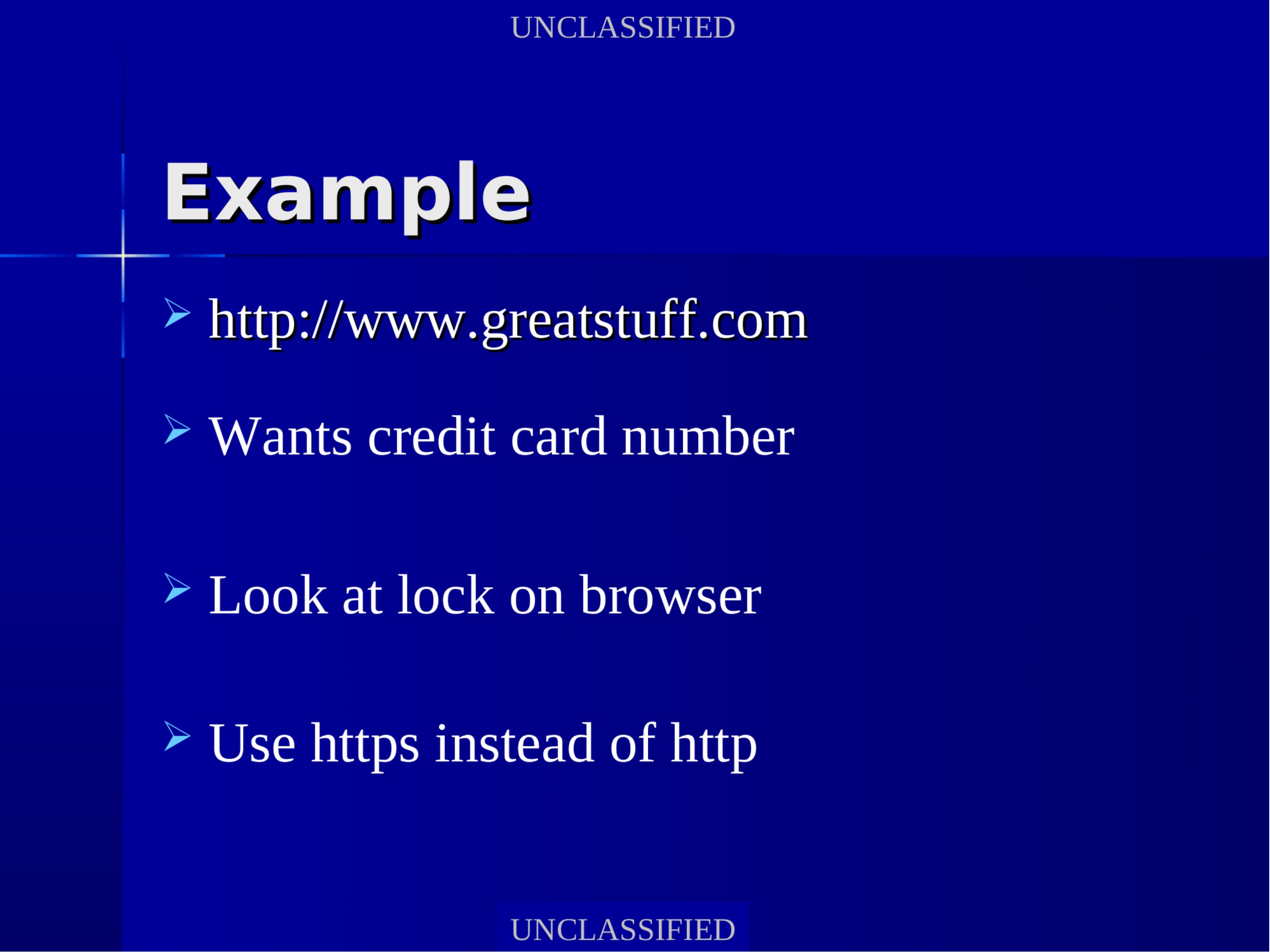
Example
- http://www.greatstuff.com
- Wants credit card number
- Look at lock on browser
- Use https instead of http
UNCLASSIFIED
UNCLASSIFIED
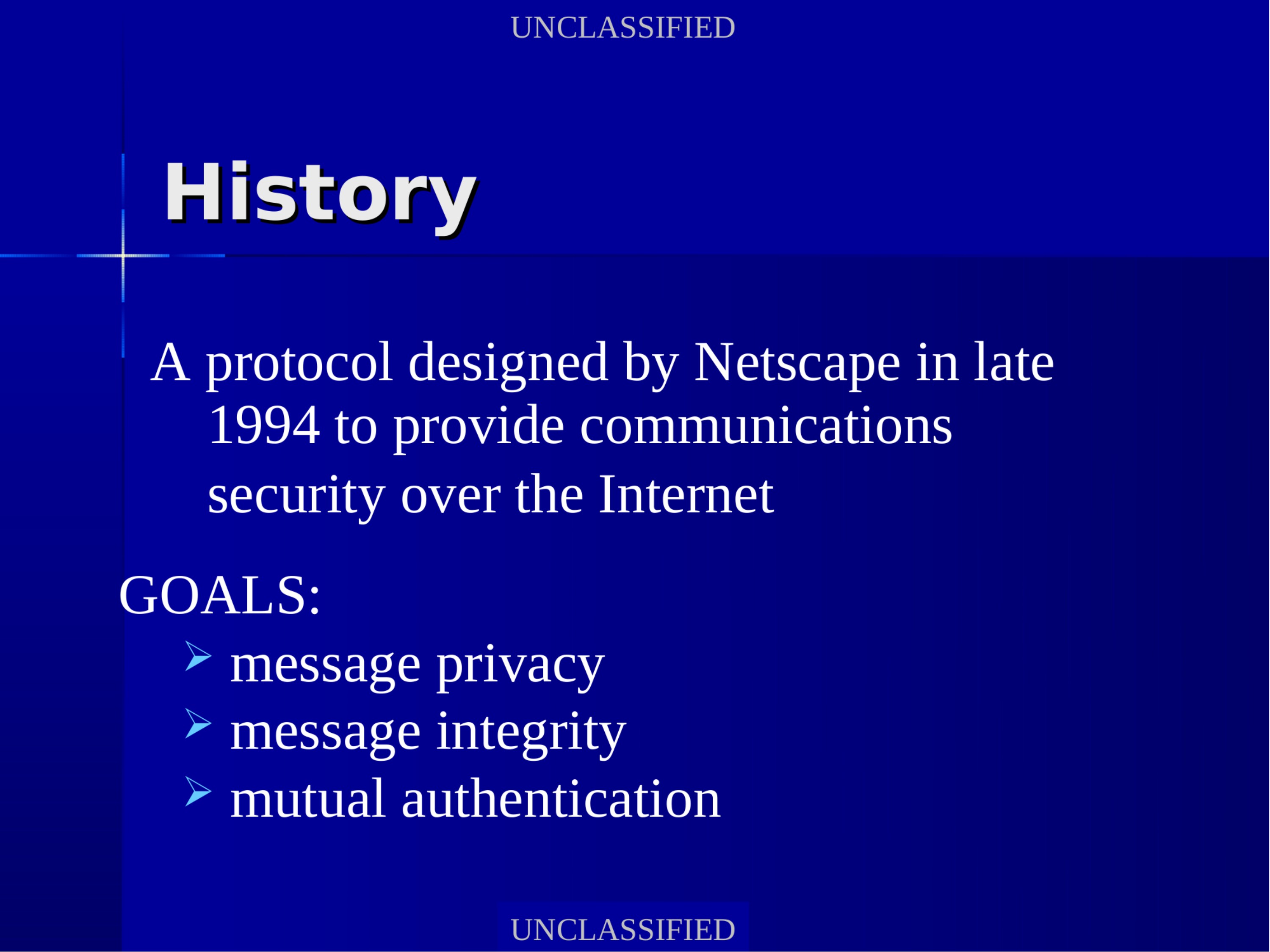
History
A protocol designed by Netscape in late
1994 to provide communications
security over the Internet
GOALS:
- message privacy
- message integrity
- mutual authentication
UNCLASSIFIED
UNCLASSIFIED
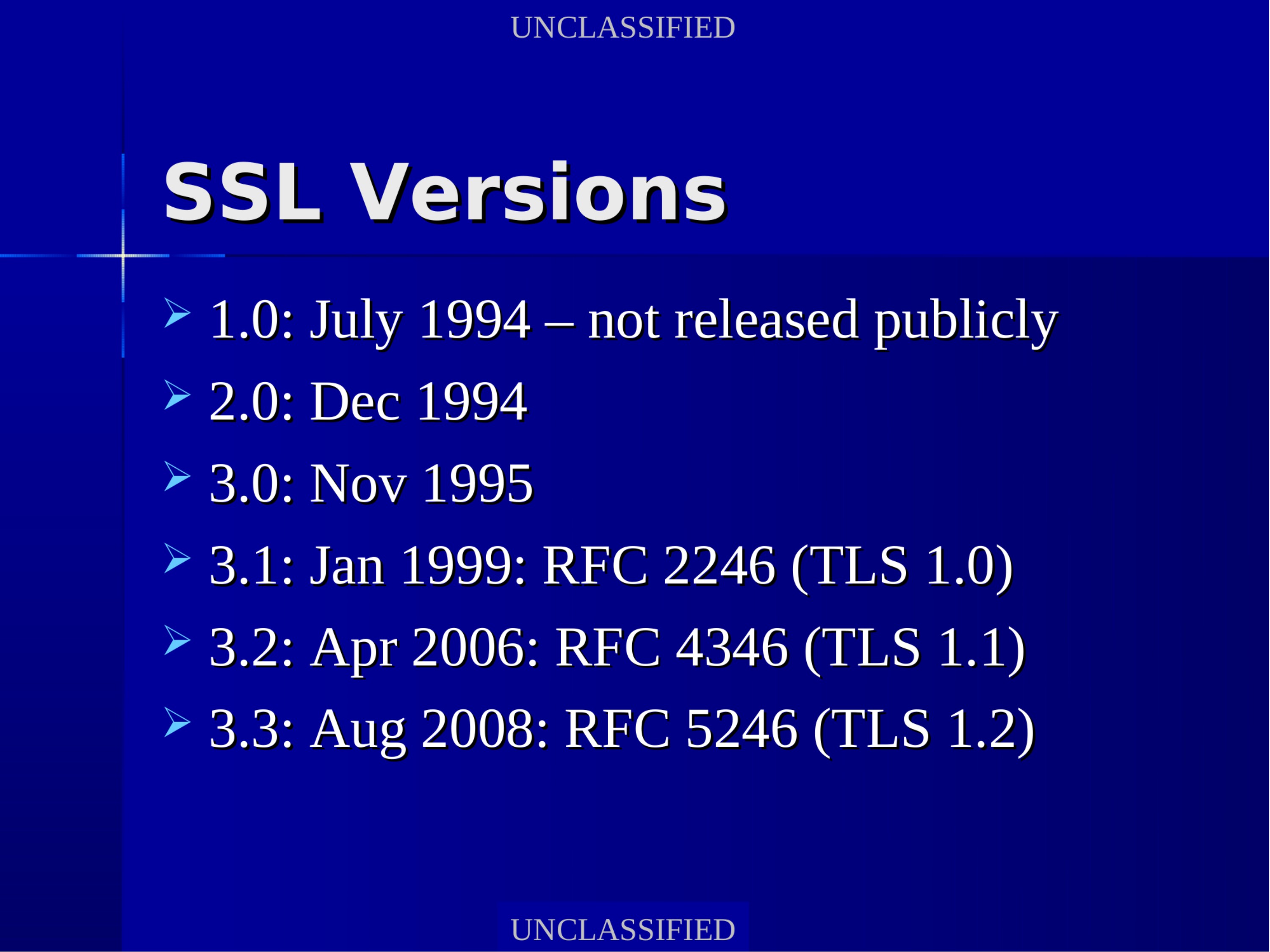
SSL Versions
- 1.0: July 1994 – not released publicly
- 2.0: Dec 1994
- 3.0: Nov 1995
- 3.1: Jan 1999: RFC 2246 (TLS 1.0)
- 3.2: Apr 2006: RFC 4346 (TLS 1.1)
- 3.3: Aug 2008: RFC 5246 (TLS 1.2)
UNCLASSIFIED
TOP SECRET//COMINT//REL TO USA, FVEY
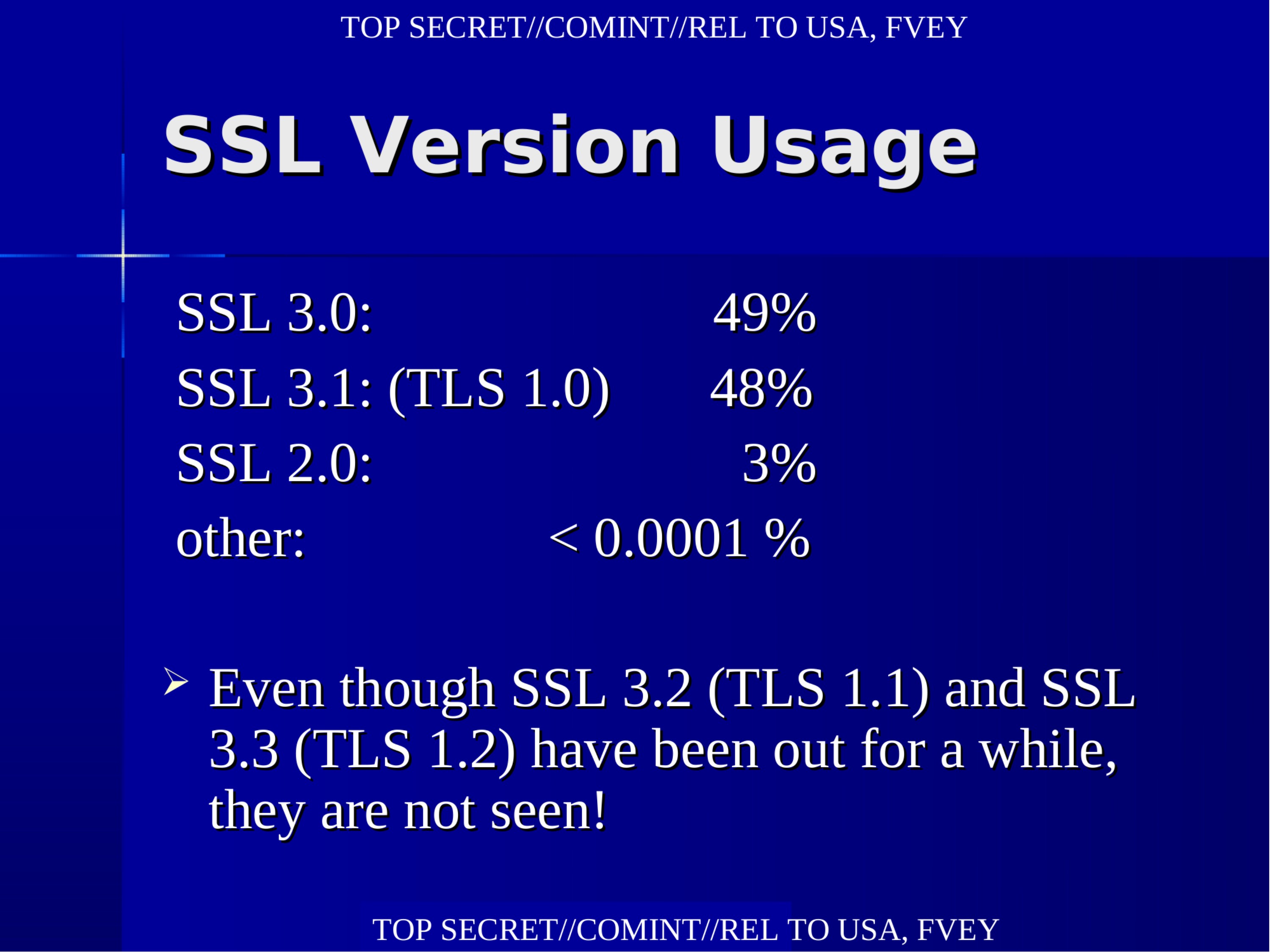
SSL Version Usage
SSL 3.0: 49%
SSL 3.1: (TLS 1.0) 48%
SSL 2.0: 3%
other: < 0.0001 %
- Even though SSL 3.2 (TLS 1.1) and SSL 3.3 (TLS 1.2) have been out for a while, they are not seen!
TOP SECRET//COMINT//REL TO USA, FVEY
UNCLASSIFIED
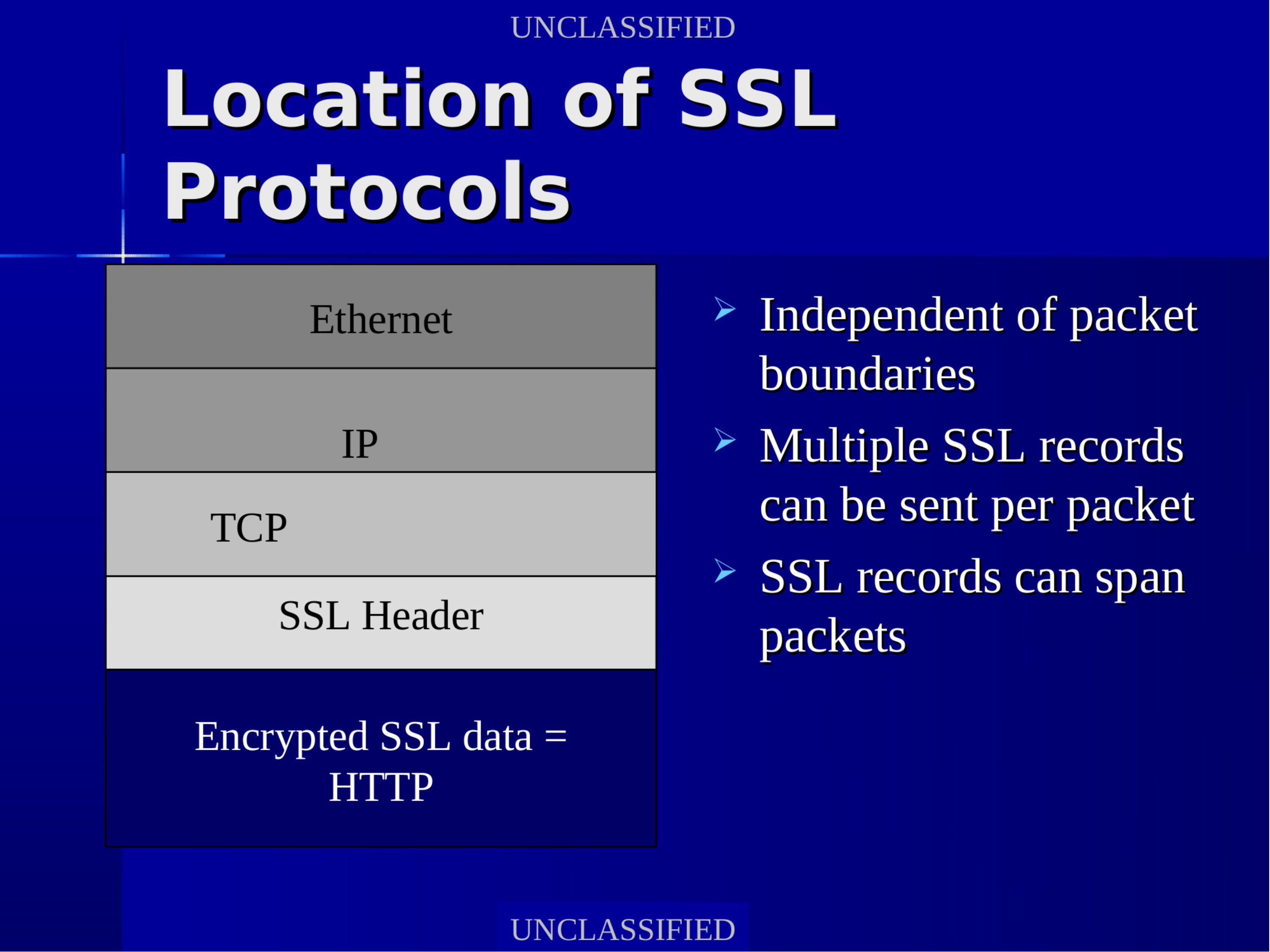
Location of SSL Protocols
Ethernet
IP
TCP
SSL Header
Encrypted SSL data =
HTTP
- Independent of packet boundaries
- Multiple SSL records can be sent per packet
- SSL records can span packets
UNCLASSIFIED
TOP SECRET//COMINT//REL TO USA, FVEY
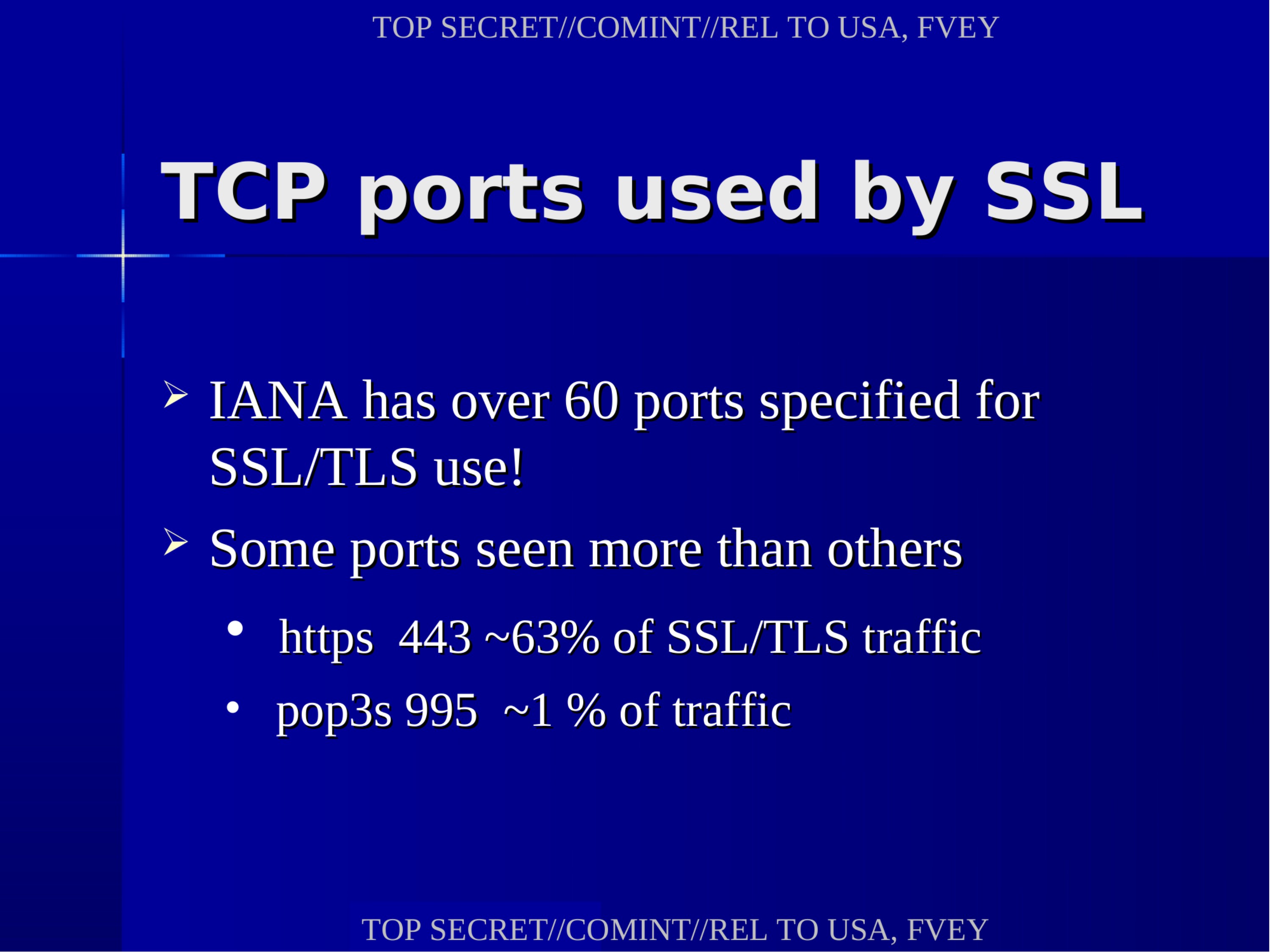
TCP ports used by SSL
- IANA has over 60 ports specified for SSL/TLS use!
- Some ports seen more than others
- https 443 ~63% of SSL/TLS traffic
- pop3s 995 ~1% of traffic
TOP SECRET//COMINT//REL TO USA, FVEY
TOP SECRET//COMINT//REL TO USA, FVEY
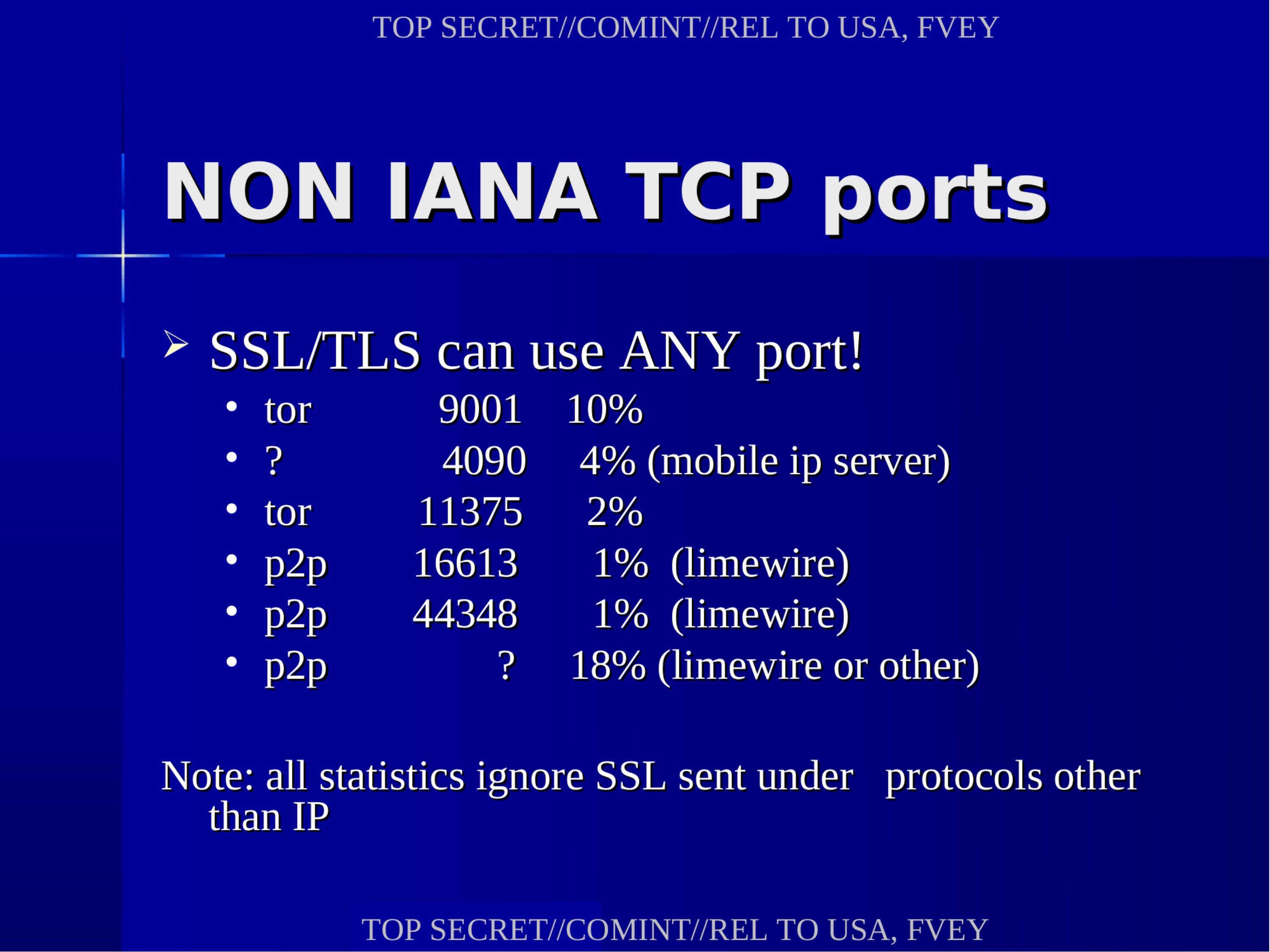
NON IANA TCP ports
- SSL/TLS can use ANY port!
- tor 9001 10%
- ? 4090 4% (mobile ip server)
- tor 11375 2%
- p2p 16613 1% (limewire)
- p2p 44348 1% (limewire)
- p2p ? 18% (limewire or other)
Note: all statistics ignore SSL sent under protocols other than IP
TOP SECRET//COMINT//REL TO USA, FVEY
UNCLASSIFIED
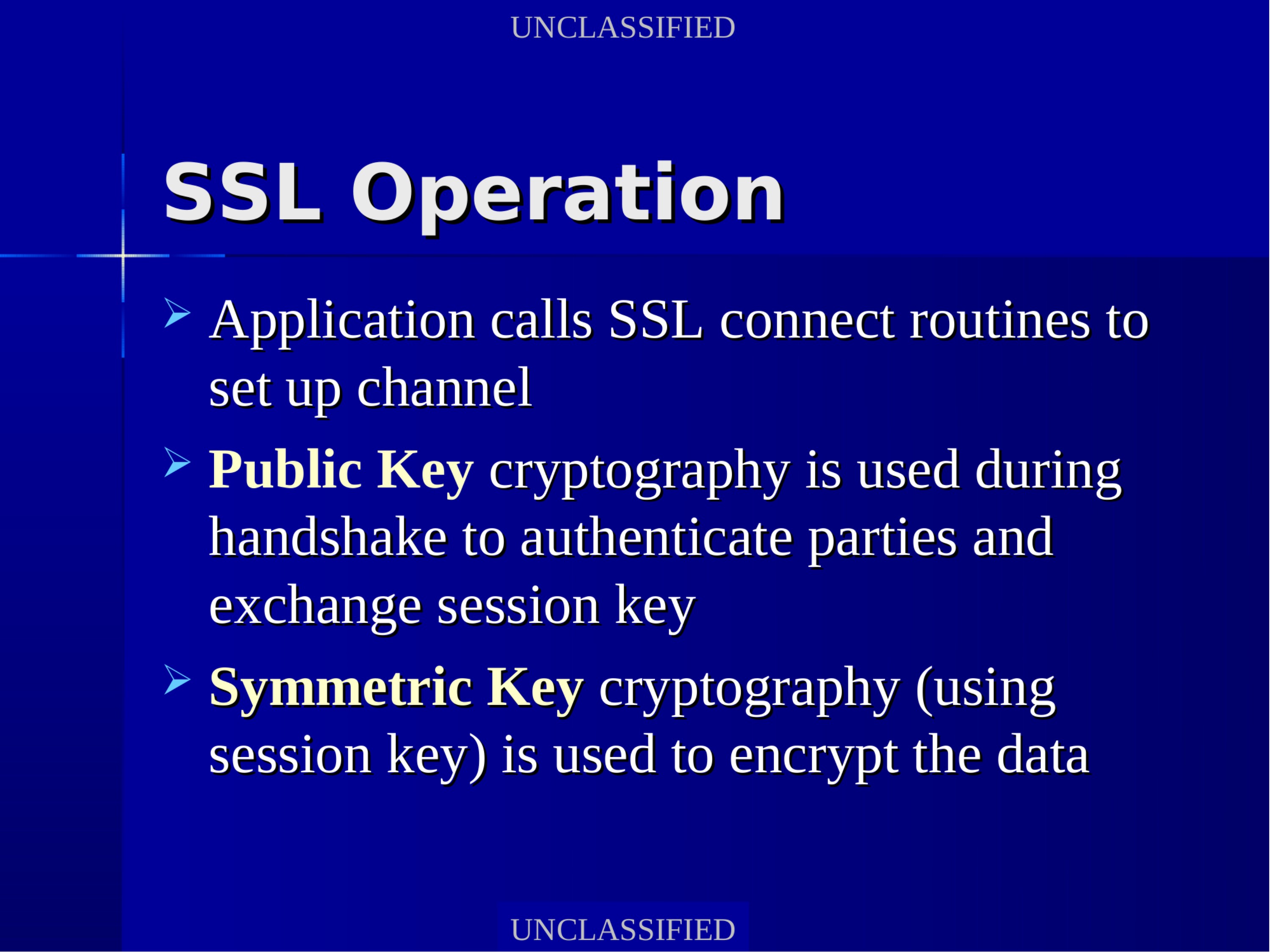
SSL Operation
- Application calls SSL connect routines to set up channel
- Public Key cryptography is used during handshake to authenticate parties and exchange session key
- Symmetric Key cryptography (using session key) is used to encrypt the data
UNCLASSIFIED
UNCLASSIFIED
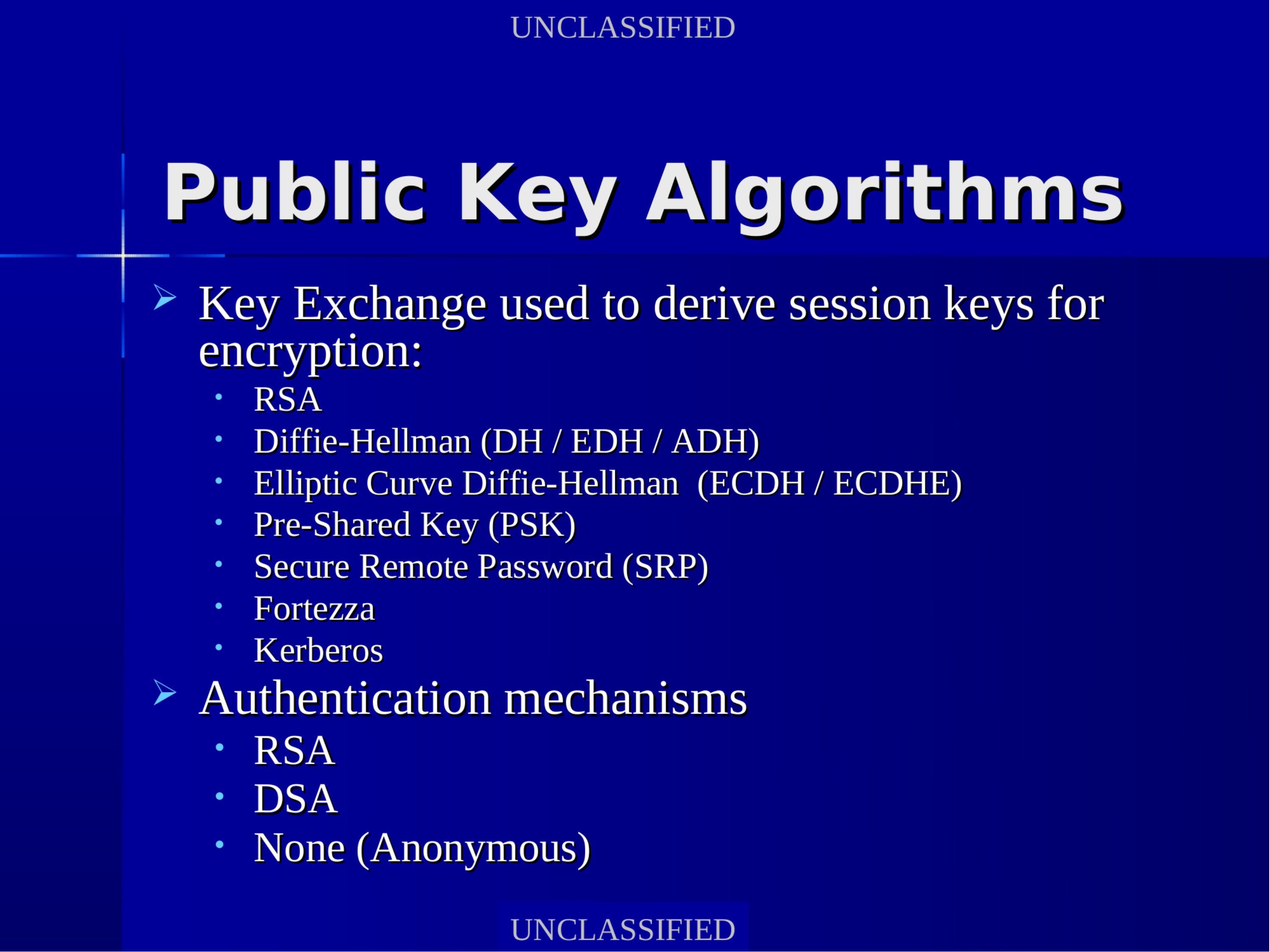
Public Key Algorithms
- Key Exchange used to derive session keys for encryption:
- RSA
- Diffie-Hellman (DH / EDH / ADH)
- Elliptic Curve Diffie-Hellman (ECDH / ECDHE)
- Pre-Shared Key (PSK)
- Secure Remote Password (SRP)
- Fortezza
- Kerberos
- Authentication mechanisms
- RSA
- DSA
- None (Anonymous)
UNCLASSIFIED
UNCLASSIFIED
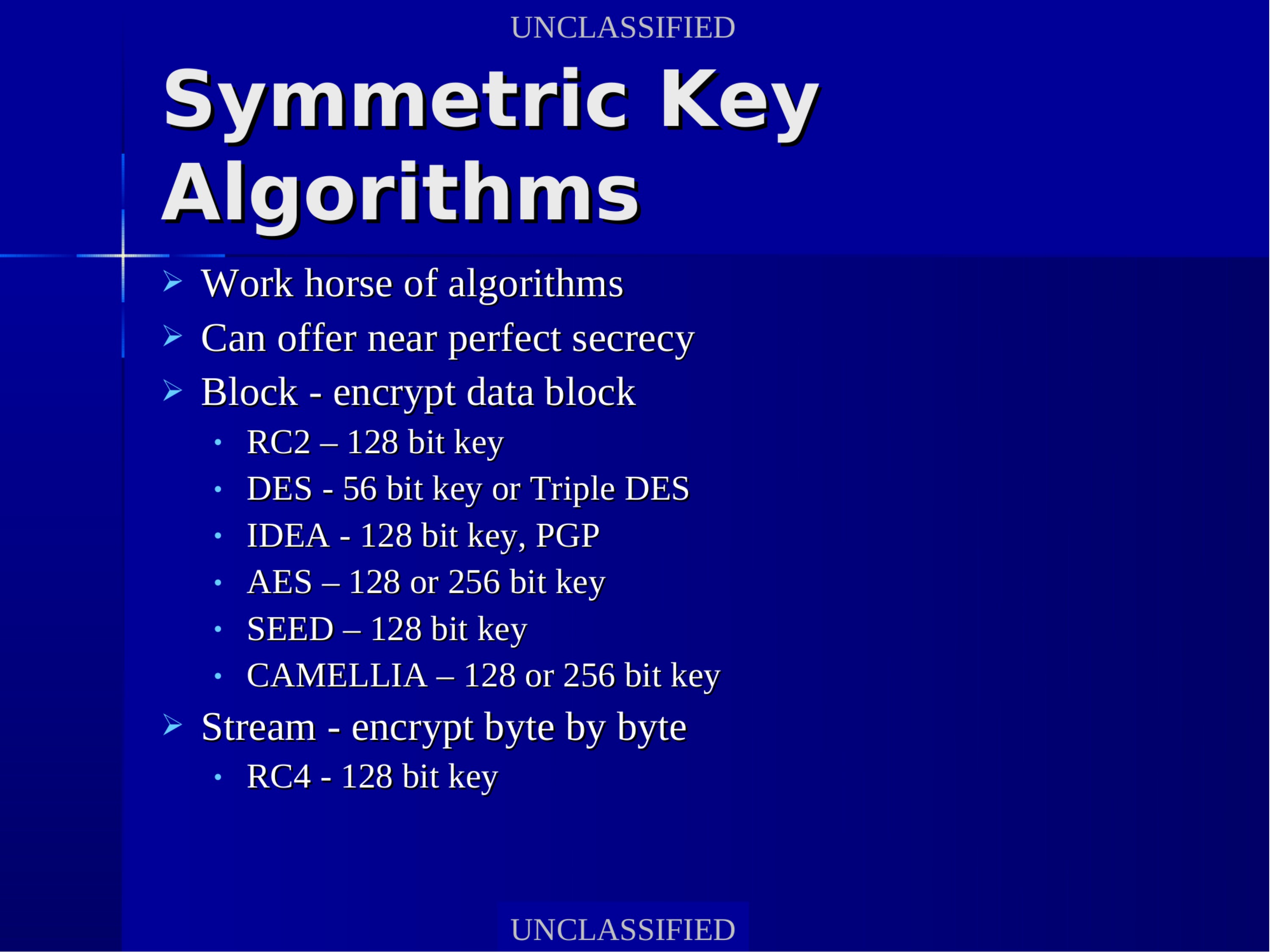
Symmetric Key Algorithms
- Work horse of algorithms
- Can offer near perfect secrecy
- Block - encrypt data block
- RC2 – 128 bit key
- DES - 56 bit key or Triple DES
- IDEA - 128 bit key, PGP
- AES – 128 or 256 bit key
- SEED – 128 bit key
- CAMELLIA – 128 or 256 bit key
- Stream - encrypt byte by byte
- RC4 - 128 bit key
UNCLASSIFIED
UNCLASSIFIED
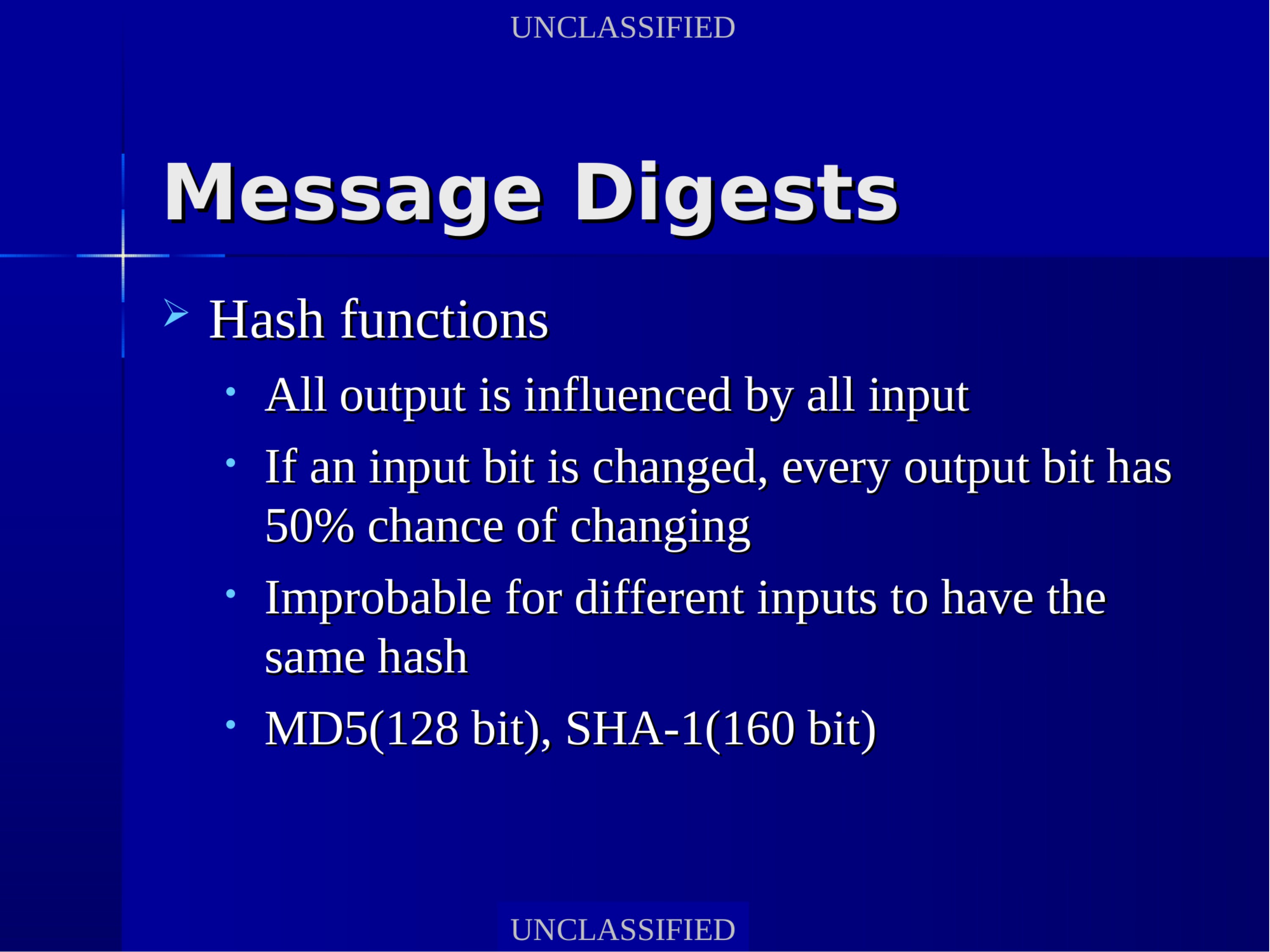
Message Digests
- Hash functions
- All output is influenced by all input
- If an input bit is changed, every output bit has 50% chance of changing
- Improbable for different inputs to have the same hash
- MD5(128 bit), SHA-1(160 bit)
UNCLASSIFIED
TOP SECRET//COMINT//REL TO USA, FVEY
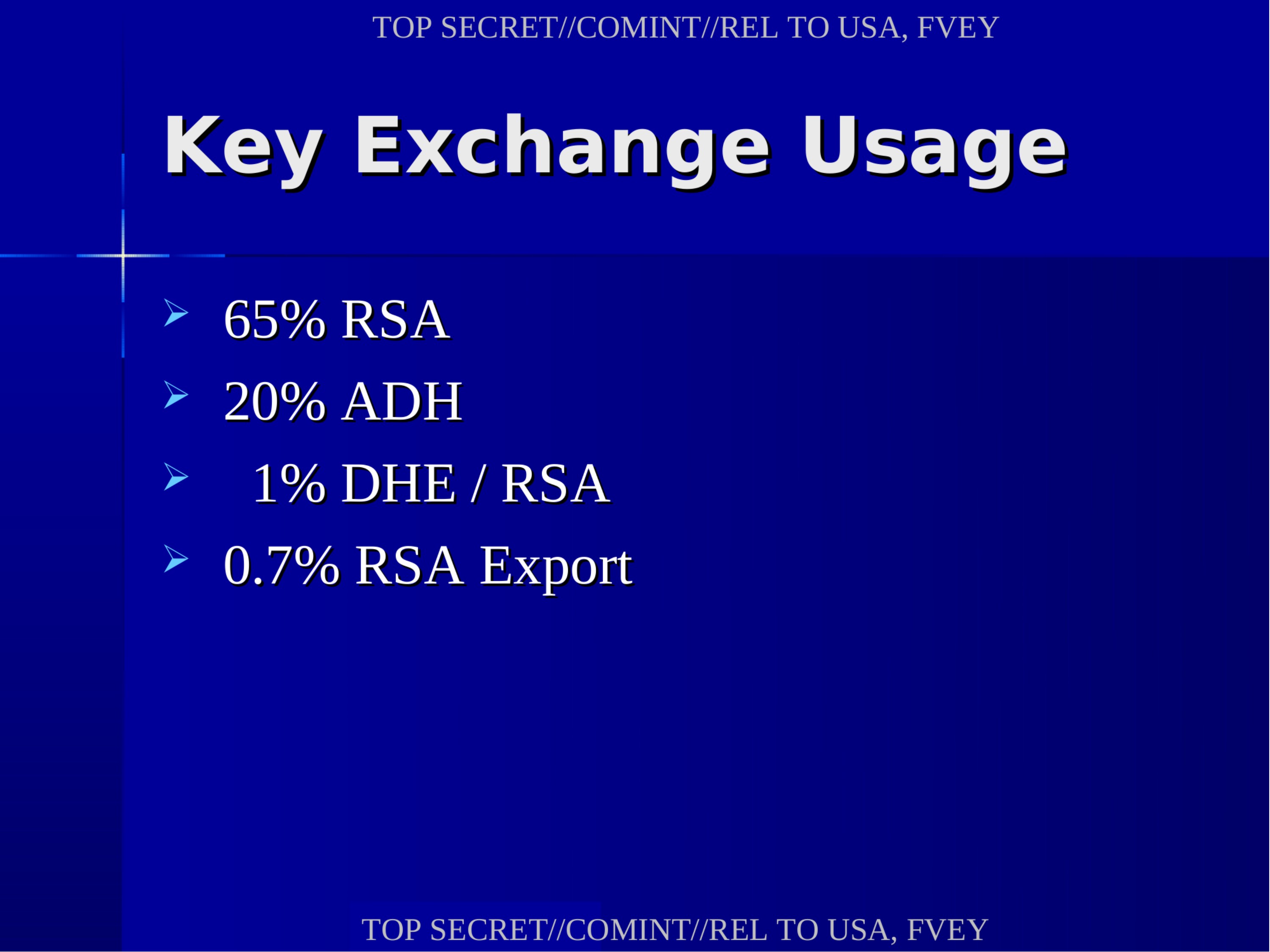
Key Exchange Usage
- 65% RSA
- 20% ADH
- 1% DHE / RSA
- 0.7% RSA Export
TOP SECRET//COMINT//REL TO USA, FVEY
UNCLASSIFIED
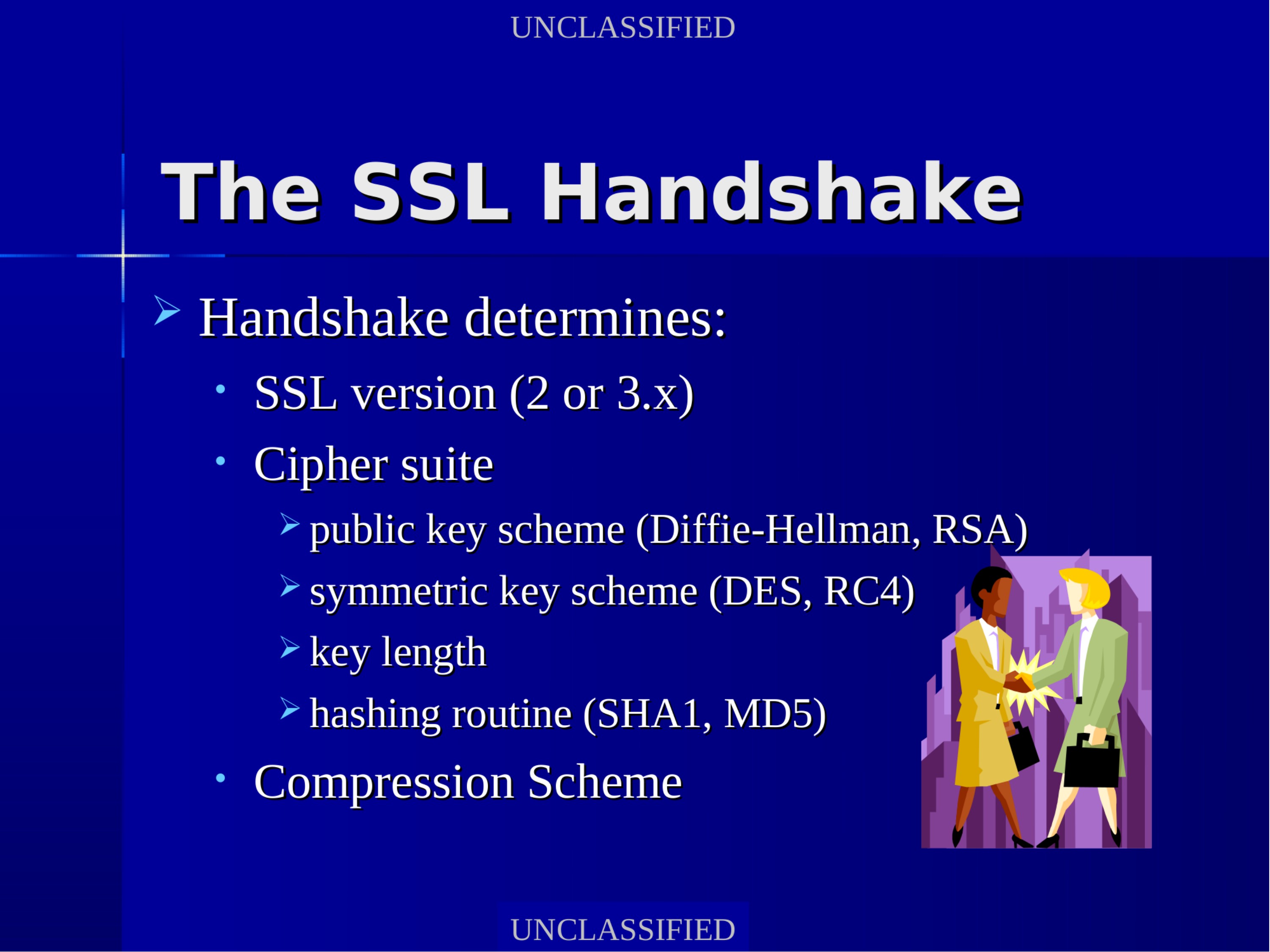
The SSL Handshake
- Handshake determines:
- SSL version (2 or 3.x)
- Cipher suite
- public key scheme (Diffie-Hellman, RSA)
- symmetric key scheme (DES, RC4)
- key length
- hashing routine (SHA1, MD5)
- Compression Scheme
UNCLASSIFIED
UNCLASSIFIED
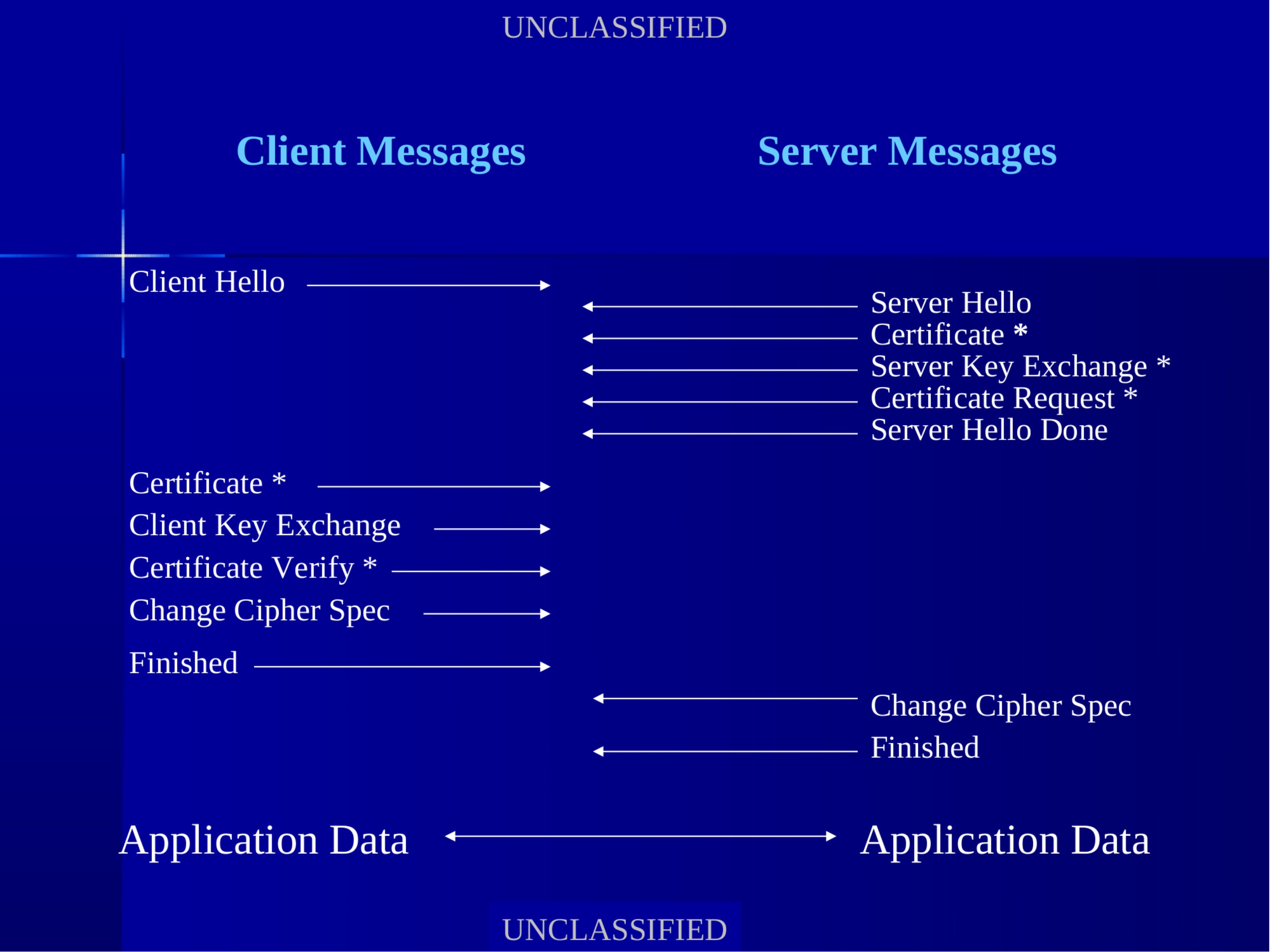
Client Messages              Server Messages

Client Hello ------------>
                   <-------- Server Hello
                   <-------- Certificate *
                   <-------- Server Key Exchange *
                   <-------- Certificate Request *
                   <-------- Server Hello Done
Certificate  ------------>
Client Key Exchange ----->
Certificate Verify ------>
Change Cipher Spec ------>
Finished ---------------->
                   <-------- Change Cipher Spec
                   <-------- Finished
Application Data <---------> Application Data
UNCLASSIFIED
SECRET//COMINT//20320108
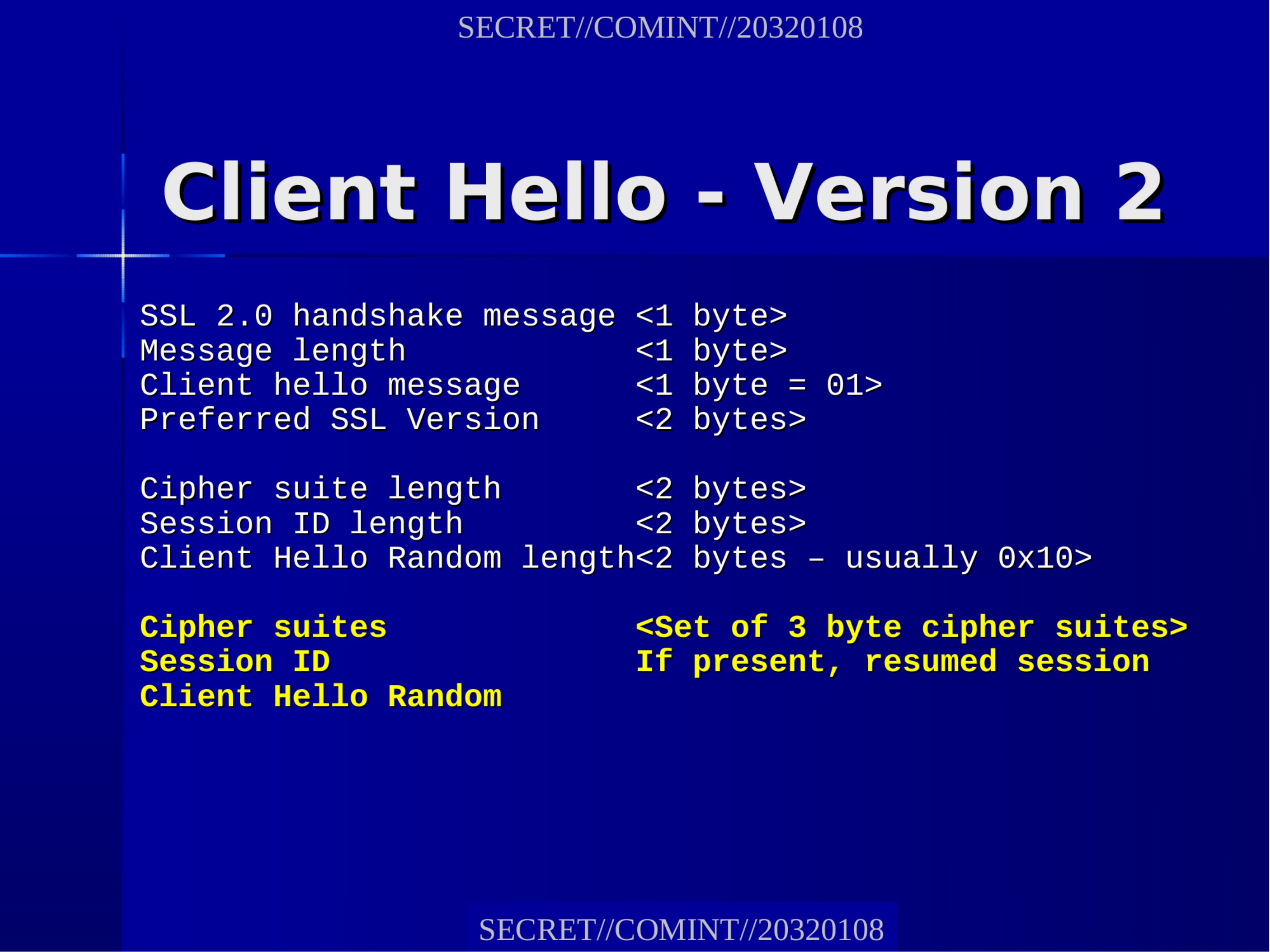
Client Hello - Version 2
SSL 2.0 handshake message <1 byte>
Message length            <1 byte>
Client hello message      <1 byte = 01>
Preferred SSL Version     <2 bytes>

Cipher suite length       <2 bytes>
Session ID length         <2 bytes>
Client Hello Random length<2 bytes - usually 0x10>

Cipher suites             <Set of 3 byte cipher suites>
Session ID                If present, resumed session
Client Hello Random
SECRET//COMINT//20320108
SECRET//COMINT//20320108
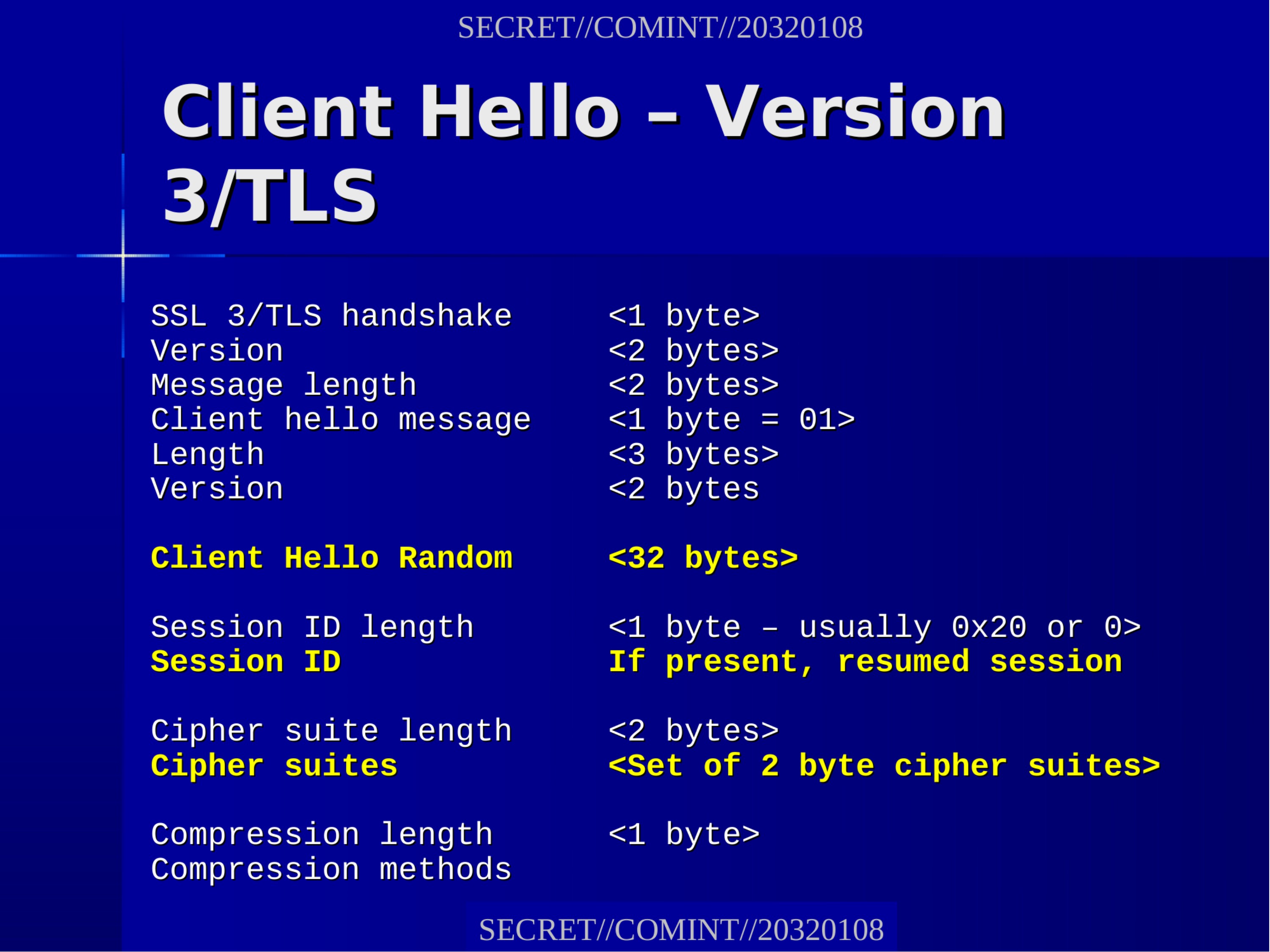
Client Hello - Version 3/TLS
SSL 3/TLS handshake     <1 byte>
Version                 <2 bytes>
Message length          <2 bytes>
Client hello message    <1 byte = 01>
Length                  <3 bytes>
Version                 <2 bytes

Client Hello Random     <32 bytes>

Session ID length       <1 byte - usually 0x20 or 0>
Session ID              If present, resumed session

Cipher suite length     <2 bytes>
Cipher suites           <Set of 2 byte cipher suites>

Compression length      <1 byte>
Compression methods
SECRET//COMINT//20320108
SECRET//COMINT//20320108
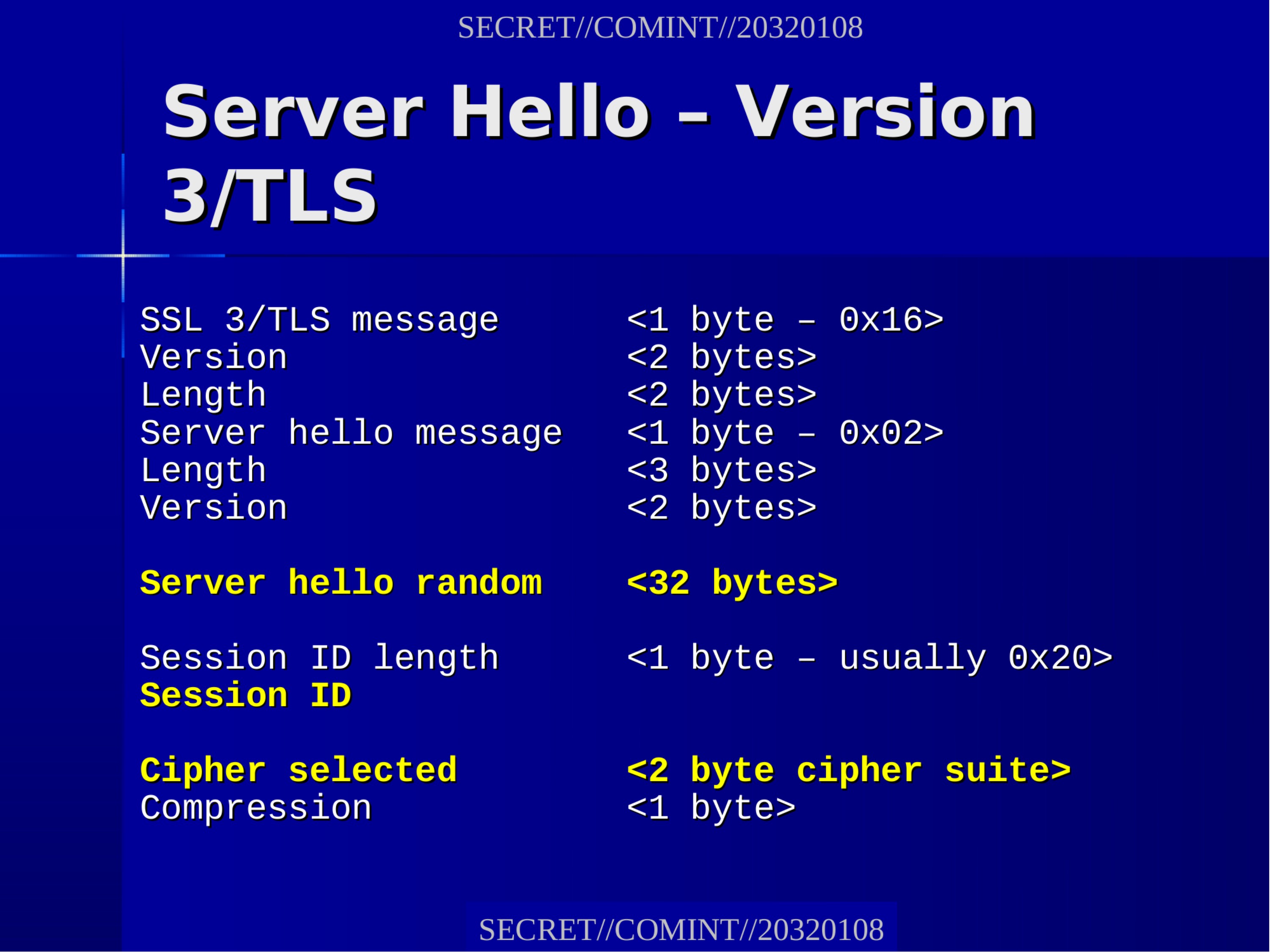
Server Hello - Version3/TLS
SSL 3/TLS message       <1 byte - 0x16>
Version                 <2 bytes>
Length                  <2 bytes>
Server hello message    <1 byte - 0x02>
Length                  <3 bytes>
Version                 <2 bytes>

Server hello random     <32 bytes>

Session ID length       <1 byte - usually 0x20>
Session ID

Cipher selected         <2 byte cipher suite>
Compression             <1 byte>
SECRET//COMINT//20320108
UNCLASSIFIED
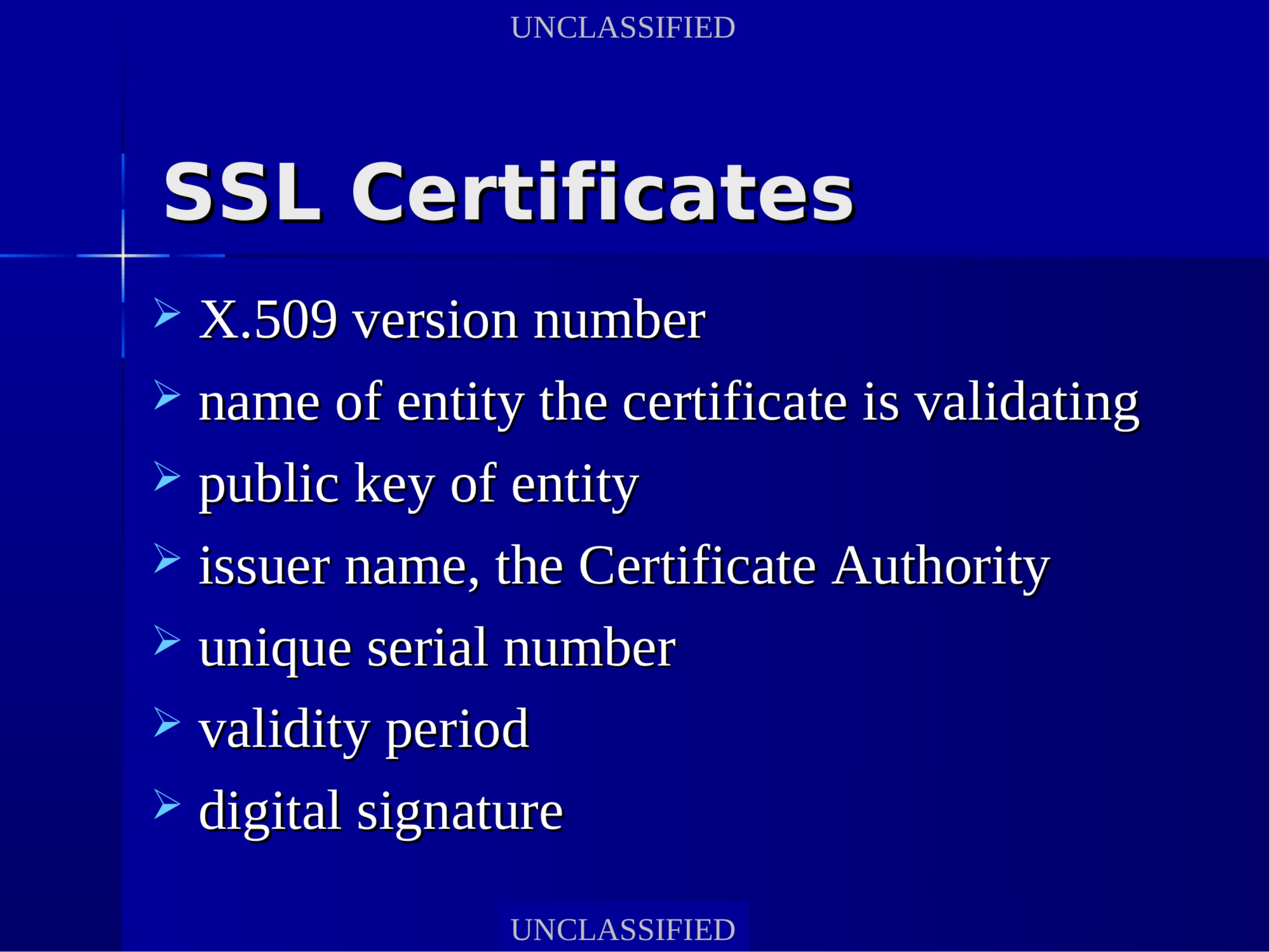
SSL Certificates
- X.509 version number
- name of entity the certificate is validating
- public key of entity
- issuer name, the Certificate Authority
- unique serial number
- validity period
- digital signature
UNCLASSIFIED
SECRET//COMINT//20320108
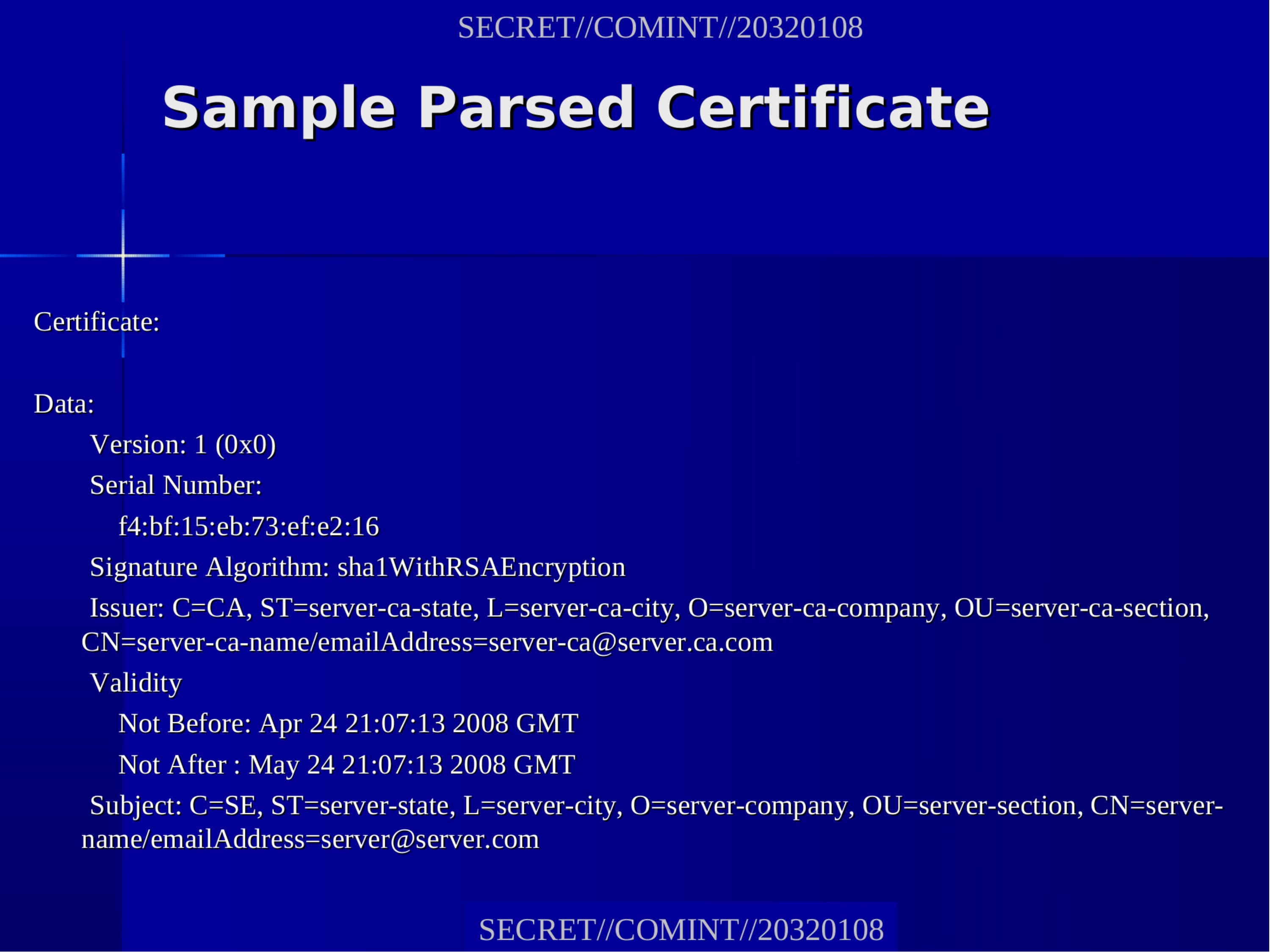
Sample Parsed Certificate
Certificate:

Data:
    Version: 1 (0x0)
    Serial Number:
      f4:bf:15:eb:73:ef:e2:16
    Signature Algorithm: sha1WithRSAEncryption
    Issuer: C=CA, ST=server-ca-state, L=server-ca-city, O=server-ca-company, OU=server-ca-section,
   CN=server-ca-name/emailAddress=server-ca@server.ca.com
    Validity
      Not Before: Apr 24 21:07:13 2008 GMT
      Not After: May 24 21:07:13 2008 GMT
    Subject: C=SE, ST=server-state, L=server-city, O=server-company, OU=server-section, CN=server-
   name/emailAddress=server@server.com
SECRET//COMINT//20320108
SECRET//COMINT//20320108
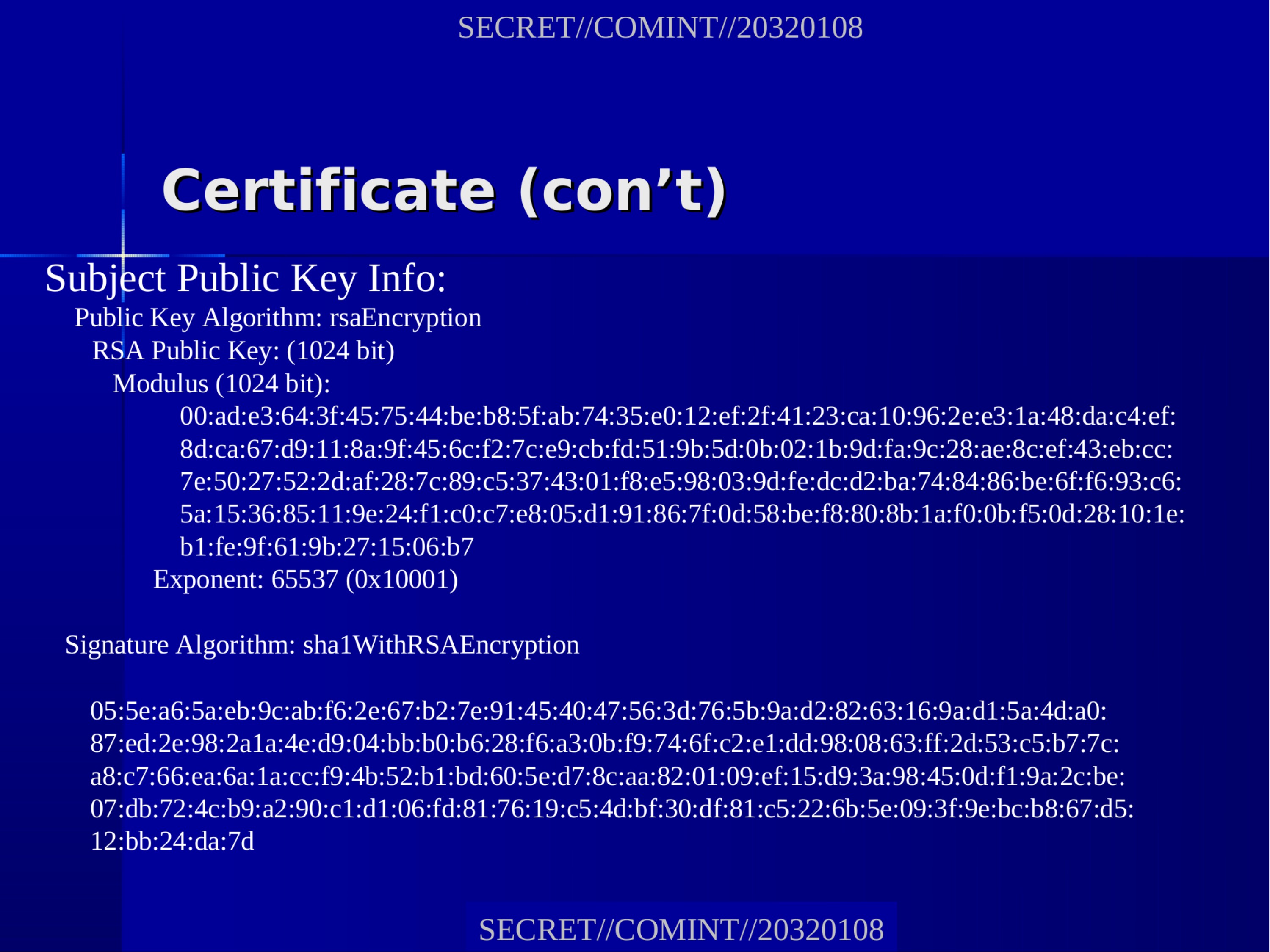
Certificate (con't)
Subject Public Key Info:
Public Key Algorithm: rsaEncryption
  RSA Public Key: (1024 bit)
    Modulus (1024 bit):
         00:ad:e3:64:3f:45:75:44:be:b8:5f:ab:74:35:e0:12:ef:2f:41:23:ca:10:96:2e:e3:1a:48:da:c4:ef:
         8d:ca:67:d9:11:8a:9f:45:6c:f2:7c:e9:cb:fd:51:9b:5d:0b:02:1b:9d:fa:9c:28:ae:8c:ef:43:eb:cc:
         7e:50:27:52:2d:af:28:7c:89:c5:37:43:01:f8:e5:98:03:9d:fe:dc:d2:ba:74:84:86:be:6f:f6:93:c6:
         5a:15:36:85:11:9e:24:f1:c0:c7:e8:05:d1:91:86:7f:0d:58:be:f8:80:8b:1a:f0:0b:f5:0d:28:10:1e:
         b1:fe:9f:61:9b:27:15:06:b7
       Exponent: 65537 (0x10001)
Signature Algorithm: sha1WithRSAEncryption

  05:5e:a6:5a:eb:9c:ab:f6:2e:67:b2:7e:91:45:40:47:56:3d:76:5b:9a:d2:82:63:16:9a:d1:5a:4d:a0:
  87:ed:2e:98:2a1a:4e:d9:04:bb:b0:b6:28:f6:a3:0b:f9:74:6f:c2:e1:dd:98:08:63:ff:2d:53:c5:b7:7c:
  a8:c7:66:ea:6a:1a:cc:f9:4b:52:b1:bd:60:5e:d7:8c:aa:82:01:09:ef:15:d9:3a:98:45:0d:f1:9a:2c:be:
  07:db:72:4c:b9:a2:90:c1:d1:06:fd:81:76:19:c5:4d:bf:30:df:81:c5:22:6b:5e:09:3f:9e:bc:b8:67:d5:
  12:bb:24:da:7d
SECRET//COMINT//20320108
UNCLASSIFIED
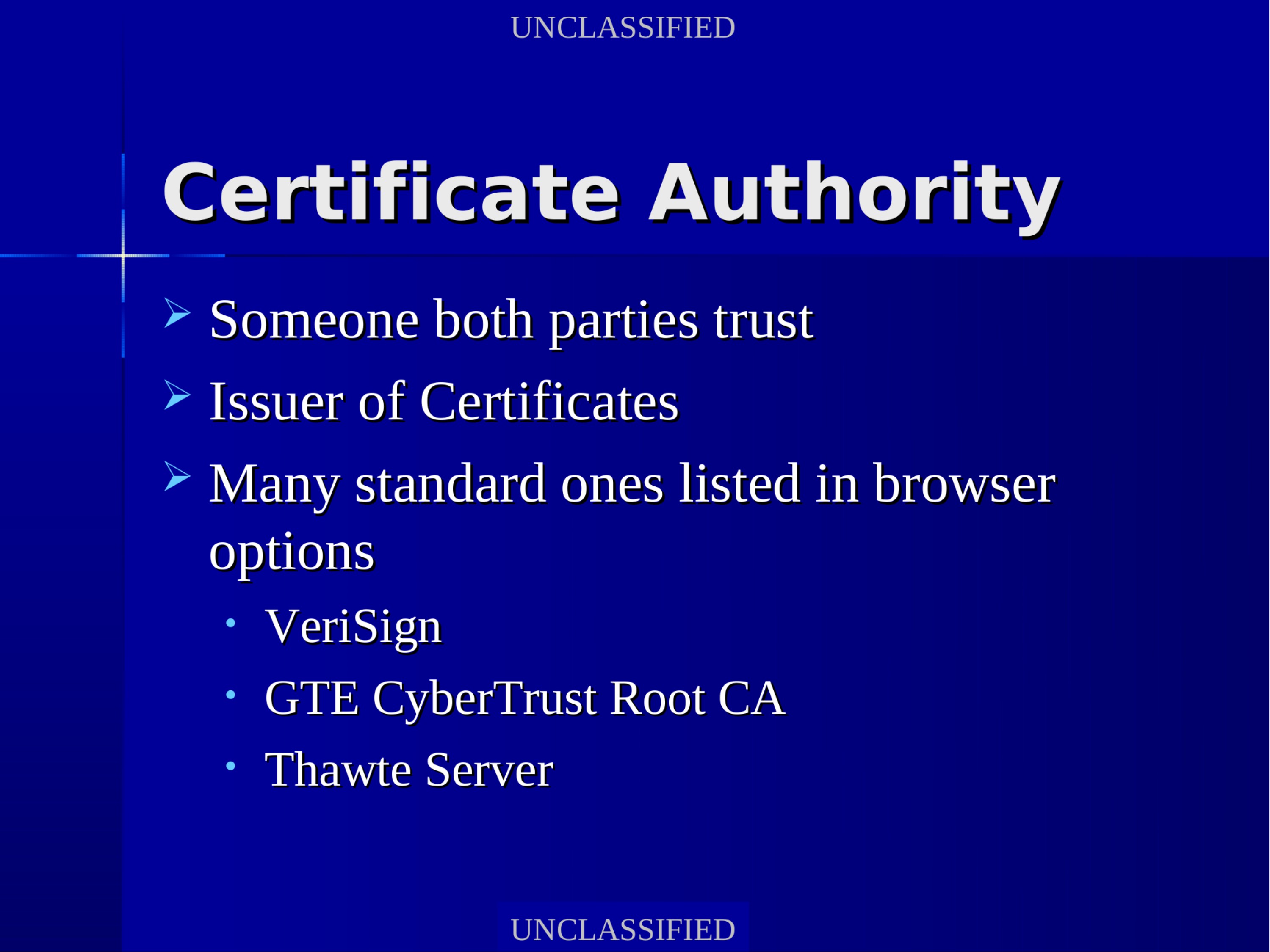
Certificate Authority
- Someone both parties trust
- Issuer of Certificates
- Many standard ones listed in browser options
- VeriSign
- GTE CyberTrust Root CA
- Thawte Server
UNCLASSIFIED
UNCLASSIFIED
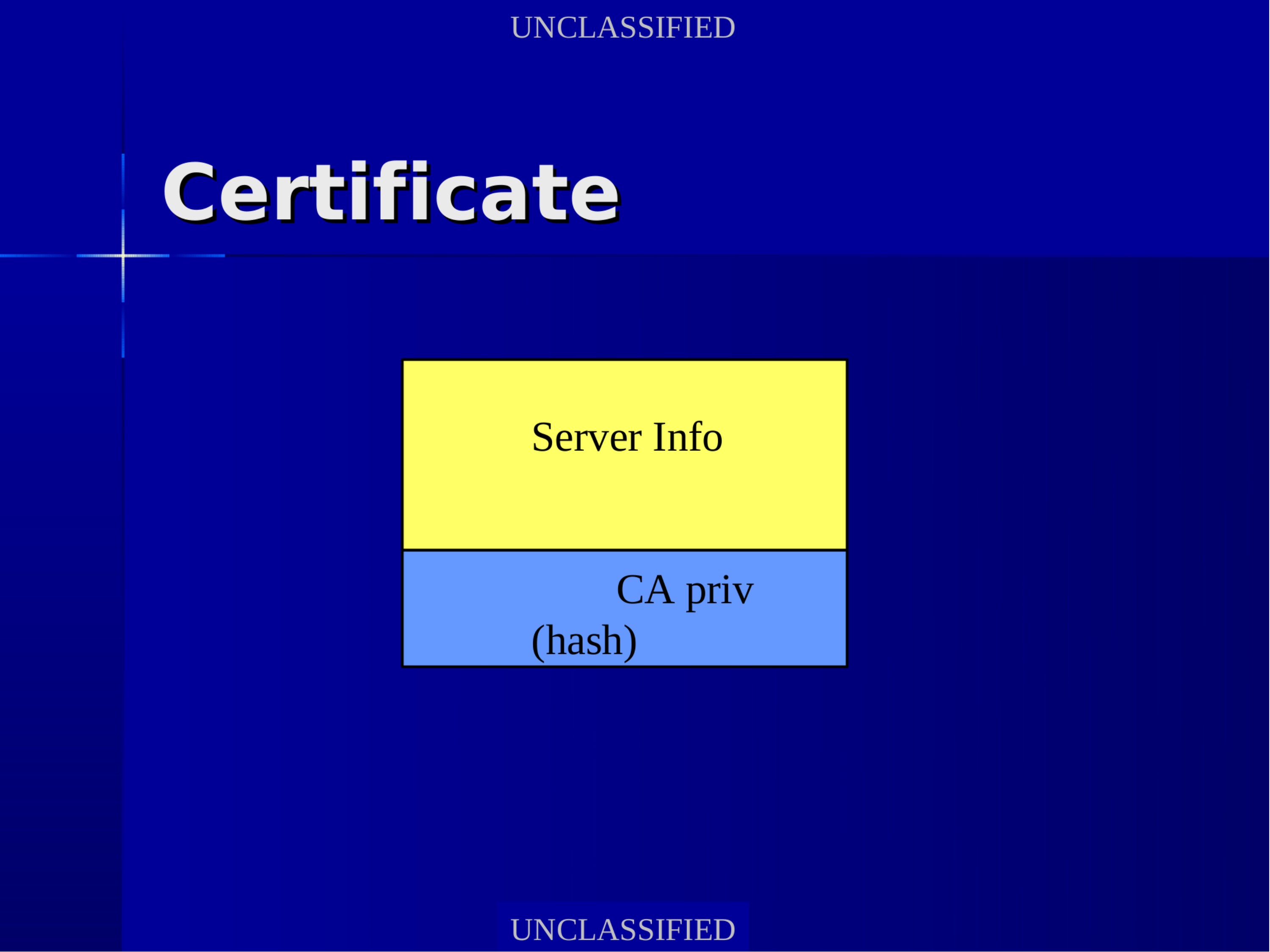
Certificate
Server Info
CA priv
(hash)
UNCLASSIFIED
UNCLASSIFIED
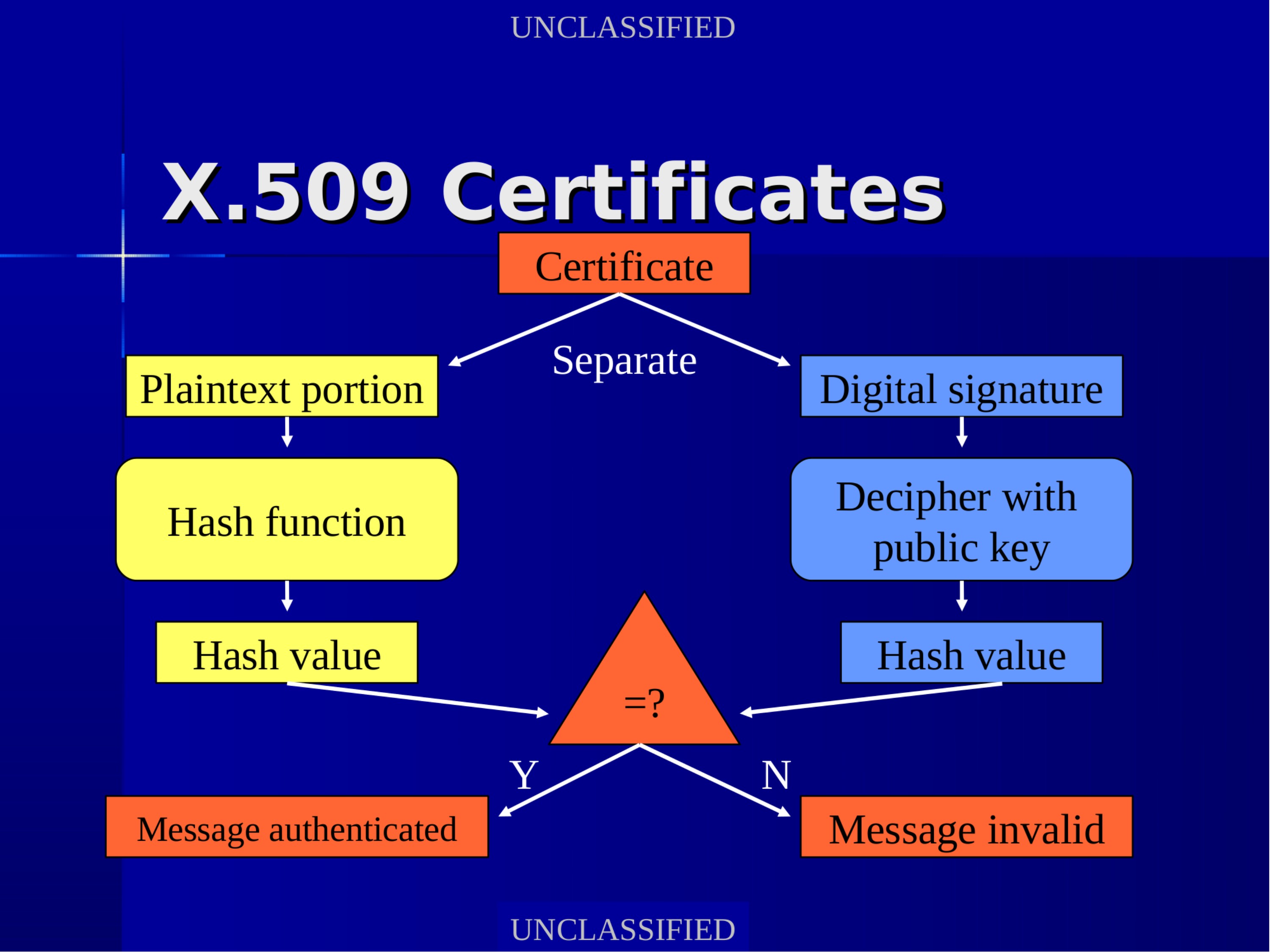
X.509 Certificates
Certificate
Separate
Plaintext portion
Digital signature
Hash function
Decipher with
public key
Hash value
=?
Y
N
Message authenticated
Hash value
Message invalid
UNCLASSIFIED
UNCLASSIFIED
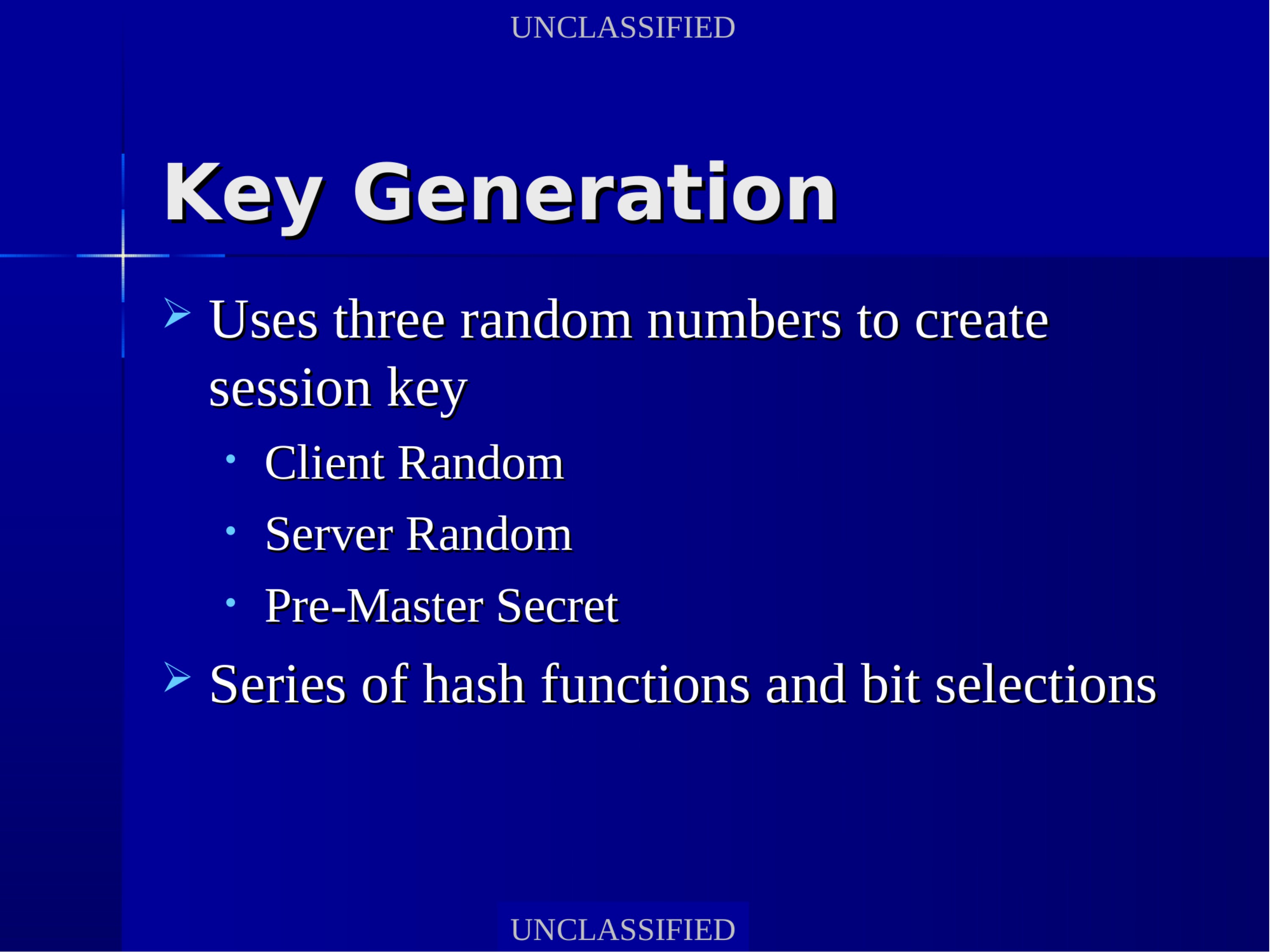
Key Generation
- Uses three random numbers to create session key
- Client Random
- Server Random
- Pre-Master Secret
- Series of hash functions and bit selections
UNCLASSIFIED
UNCLASSIFIED
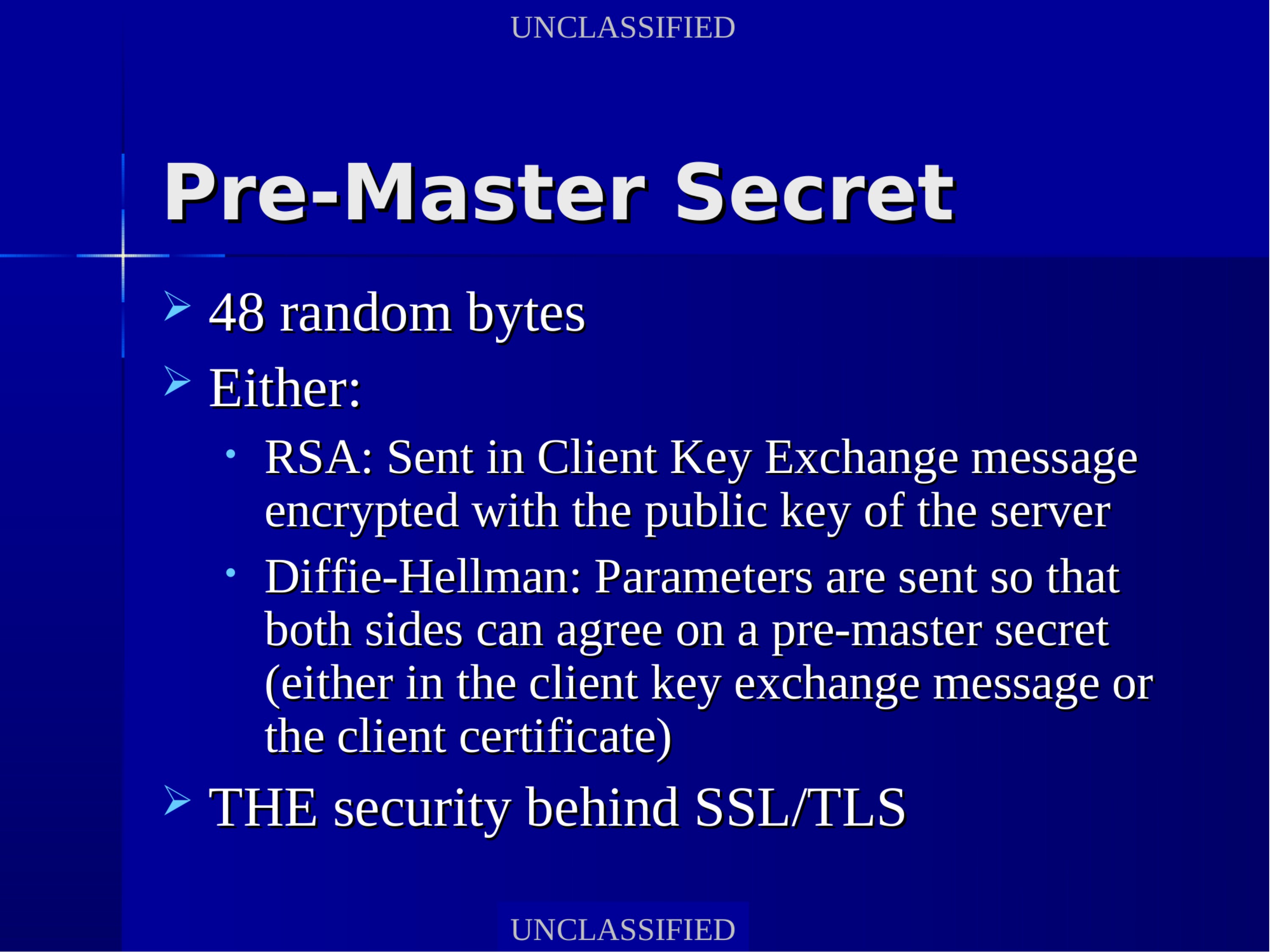
Pre-Master Secret
- 48 random bytes
- Either:
- RSA: Sent in Client Key Exchange message encrypted with the public key of the server
- Diffie-Hellman: Parameters are sent so that both sides can agree on a pre-master secret (either in the client key exchange message or the client certificate)
- THE security behind SSL/TLS
UNCLASSIFIED
SECRET//COMINT//20320108
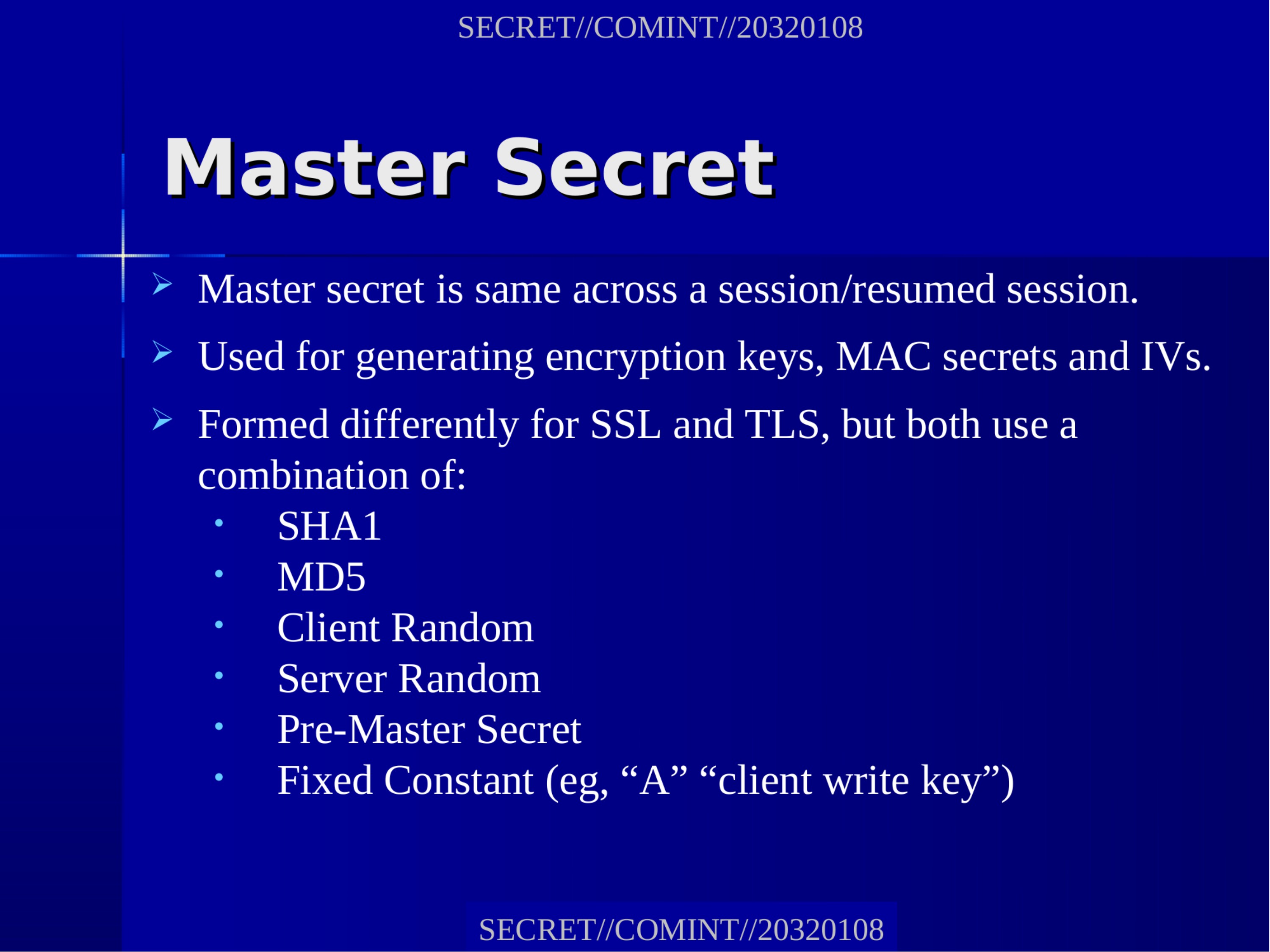
Master Secret
- Master secret is same across a session/resumed session.
- Used for generating encryption keys, MAC secrets and IVs.
- Formed differently for SSL and TLS, but both use a combination of:
- SHA1
- MD5
- Client Random
- Server Random
- Pre-Master Secret
- Fixed Constant (eg, "A" "client write key")
SECRET//COMINT//20320108
UNCLASSIFIED
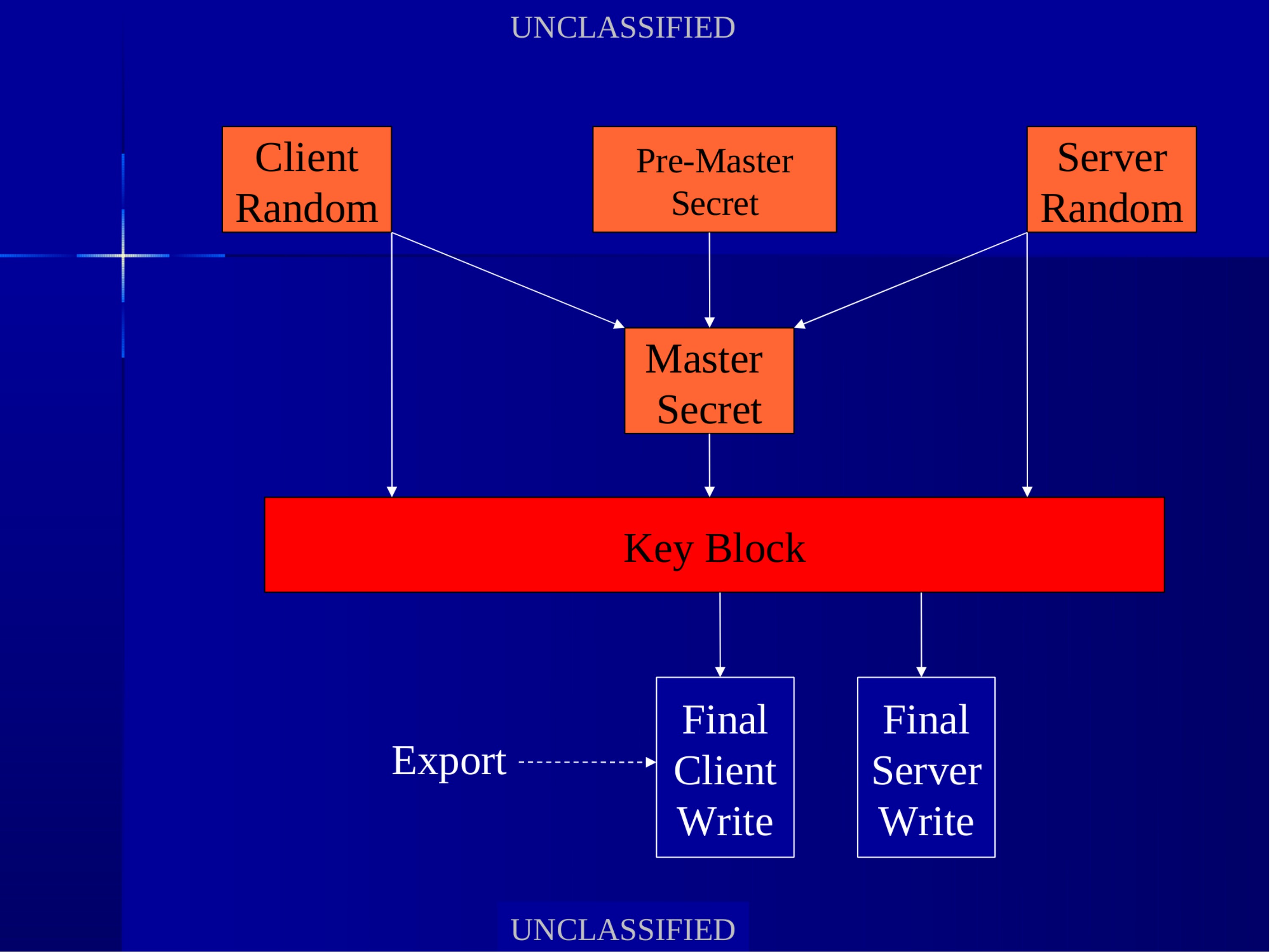
Client
Random
Pre-Master
Secret
Server
Random
Master
Secret
Key Block
Export
Final
Client
Write
Final
Server
Write
UNCLASSIFIED
SECRET//COMINT//20320108
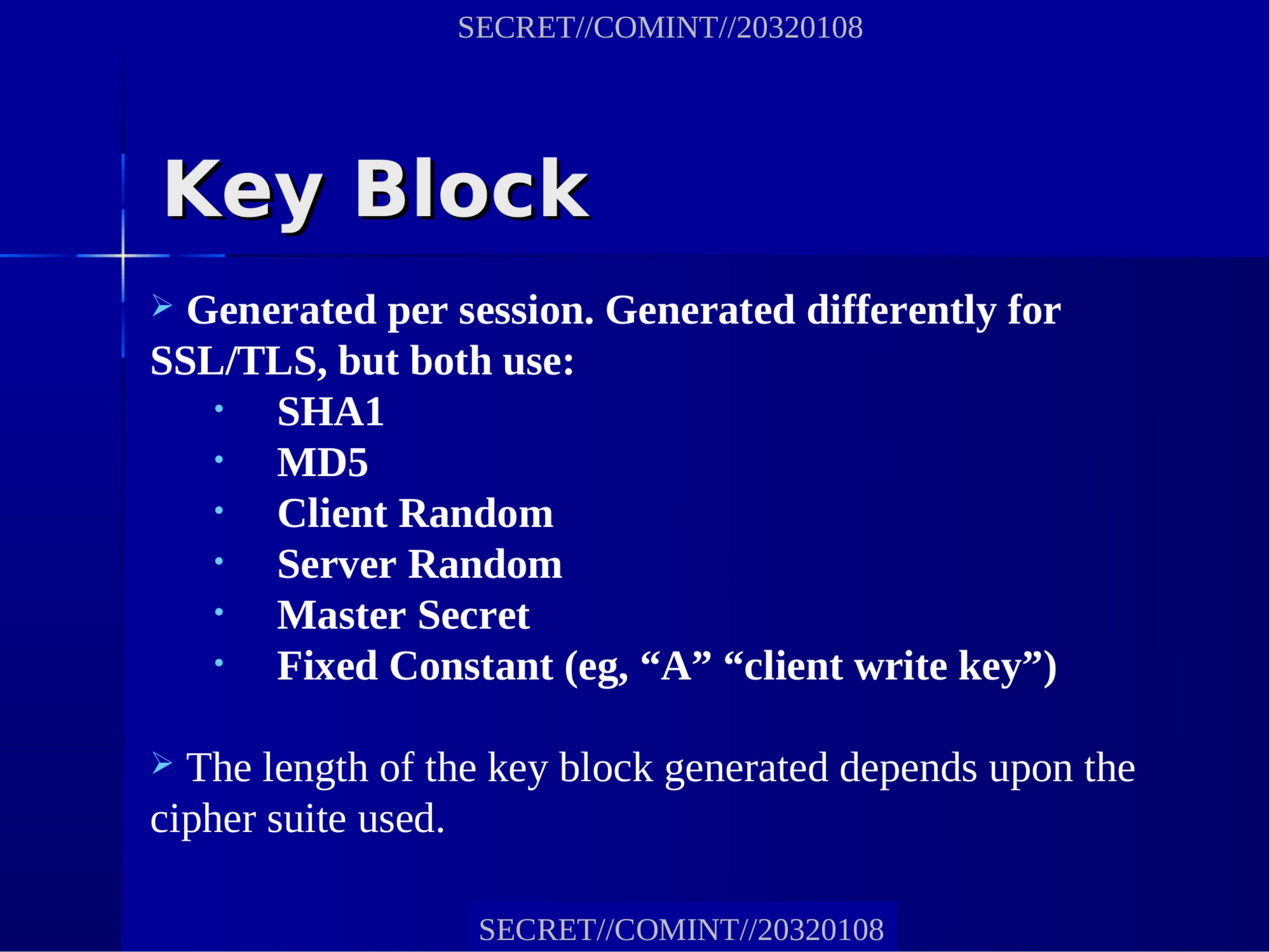
Key Block
- Generated per session. Generated differently for SSL/TLS, but both use:
- SHA1
- MD5
- Client Random
- Server Random
- Master Secret
- Fixed Constant (eg, “A” “client write key")
- The length of the key block generated depends upon the cipher suite used.
SECRET//COMINT//20320108
SECRET//COMINT//REL TO USA, FVEY//20320108
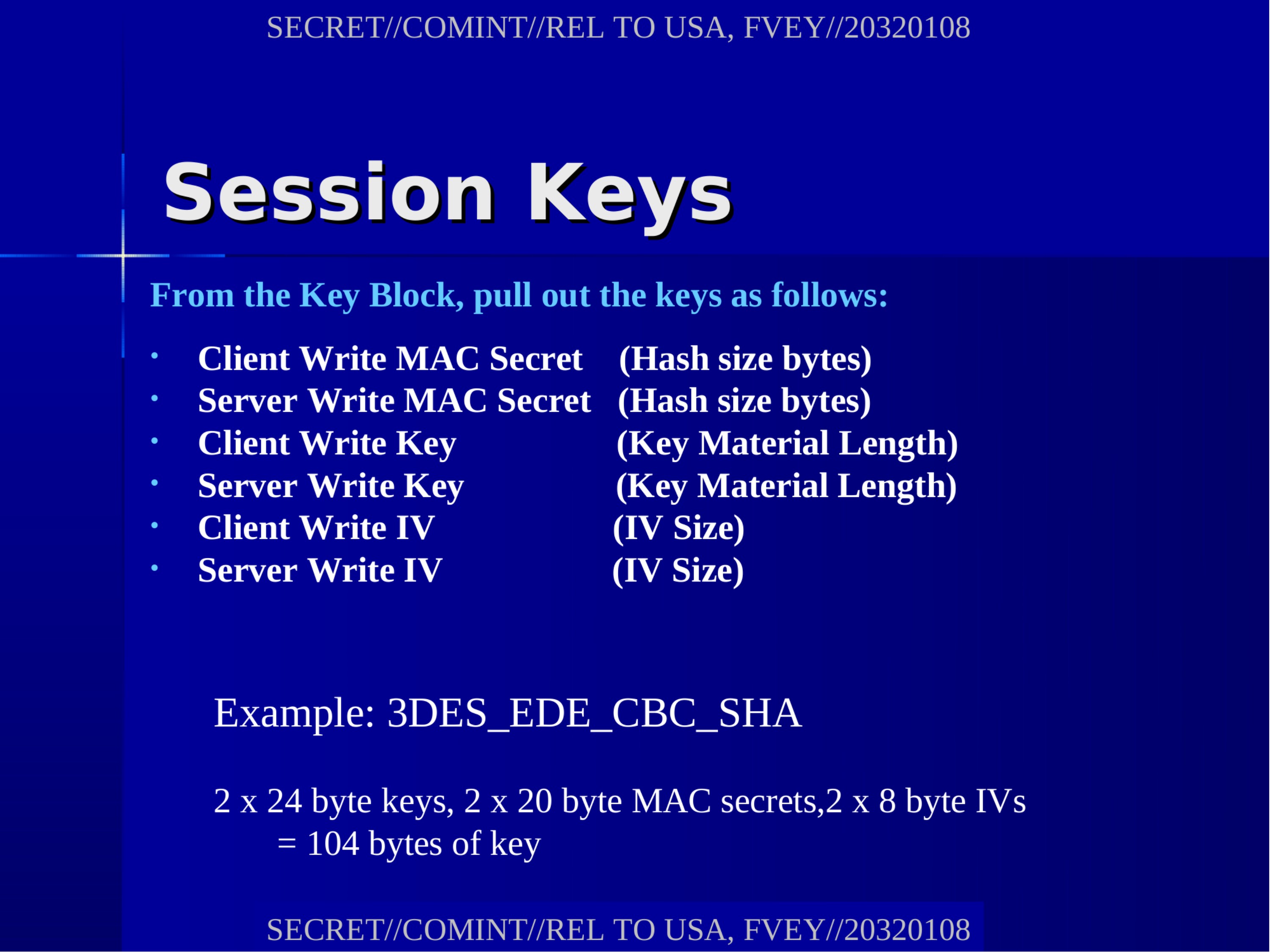
Session Keys
From the Key Block, pull out the keys as follows:
- Client Write MAC Secret (Hash size bytes)
- Server Write MAC Secret (Hash size bytes)
- Client Write Key (Key Material Length)
- Server Write Key (Key Material Length)
- Client Write IV (IV Size)
- Server Write IV (IV Size)
Example: 3DES_EDE_CBC_SHA
2 x 24 byte keys, 2 x 20 byte MAC secrets,2 x 8 byte IVs
= 104 bytes of key
SECRET//COMINT//REL TO USA, FVEY//20320108
UNCLASSIFIED
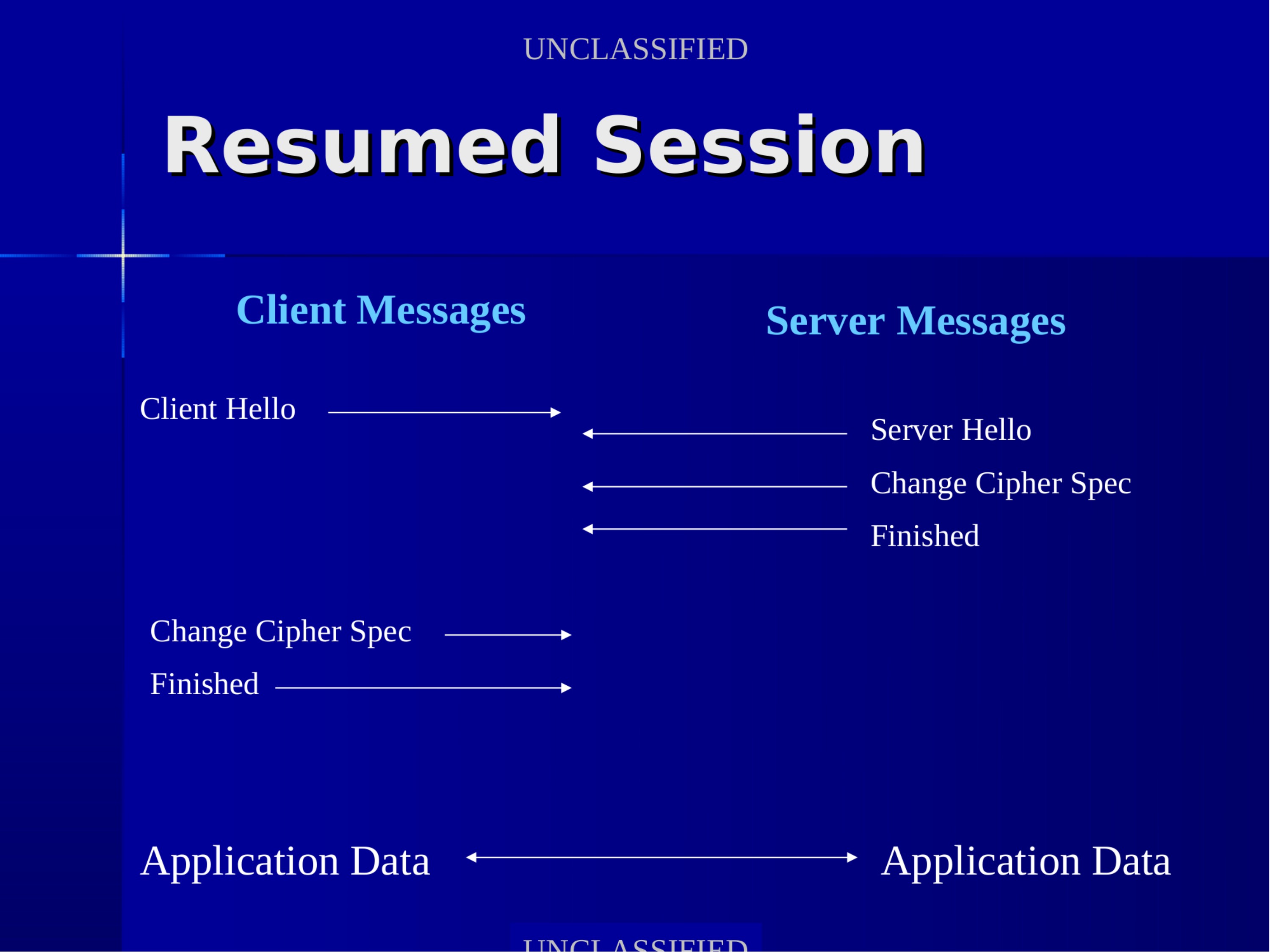
Resumed Session
Client Messages               Server Messages

Client Hello --------->
                      <------ Server Hello
                      <------ Change Cipher Spec
                      <------ Finished
Change Cipher Spec -->
Finished ------------>

Application Data <----------> Application Data
UNCLASSIFIED
UNCLASSIFIED
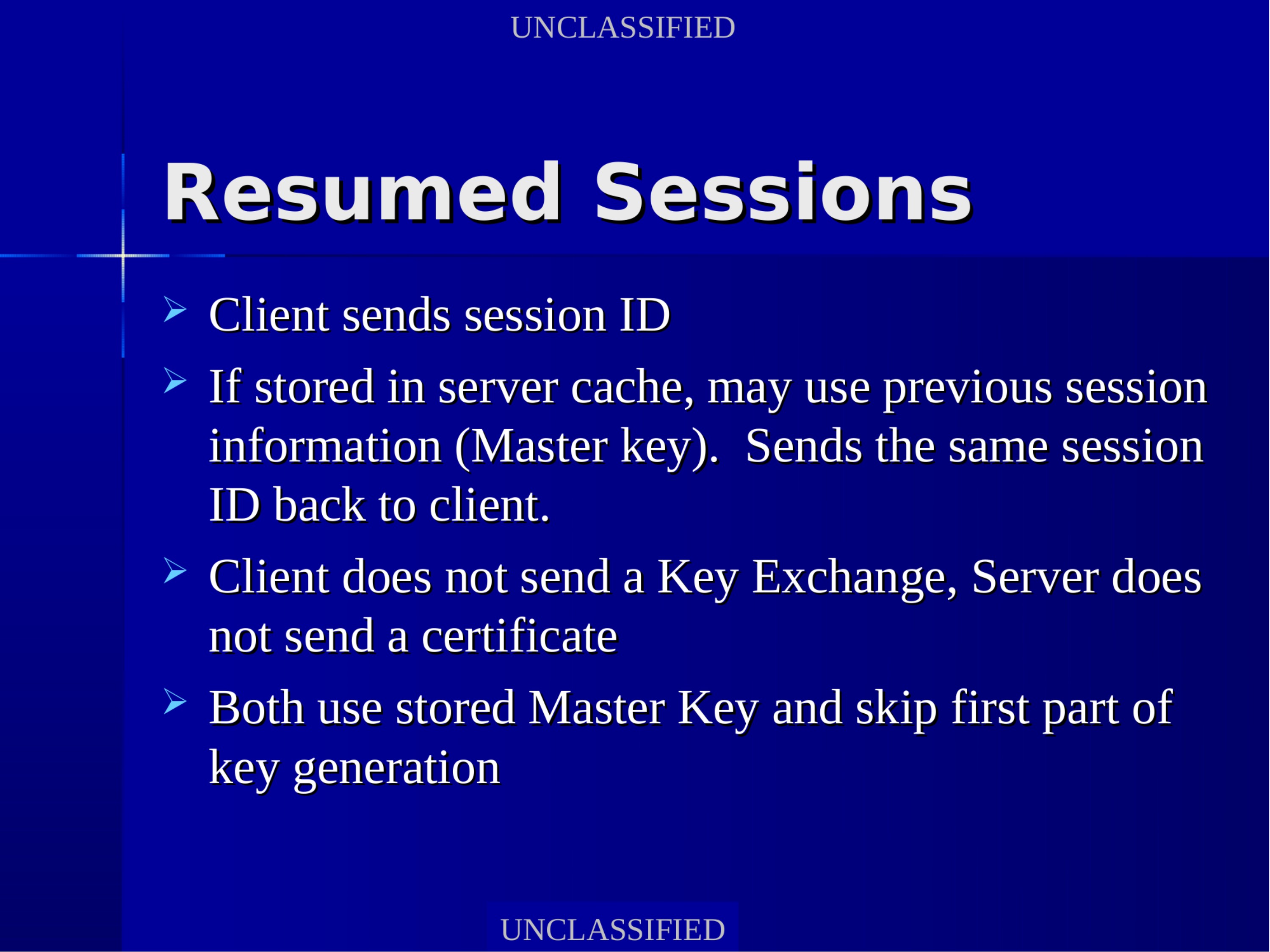
Resumed Sessions
- Client sends session ID
- If stored in server cache, may use previous session information (Master key). Sends the same session ID back to client.
- Client does not send a Key Exchange, Server does not send a certificate
- Both use stored Master Key and skip first part of key generation
UNCLASSIFIED
TOP SECRET//COMINT//REL TO USA, FVEY
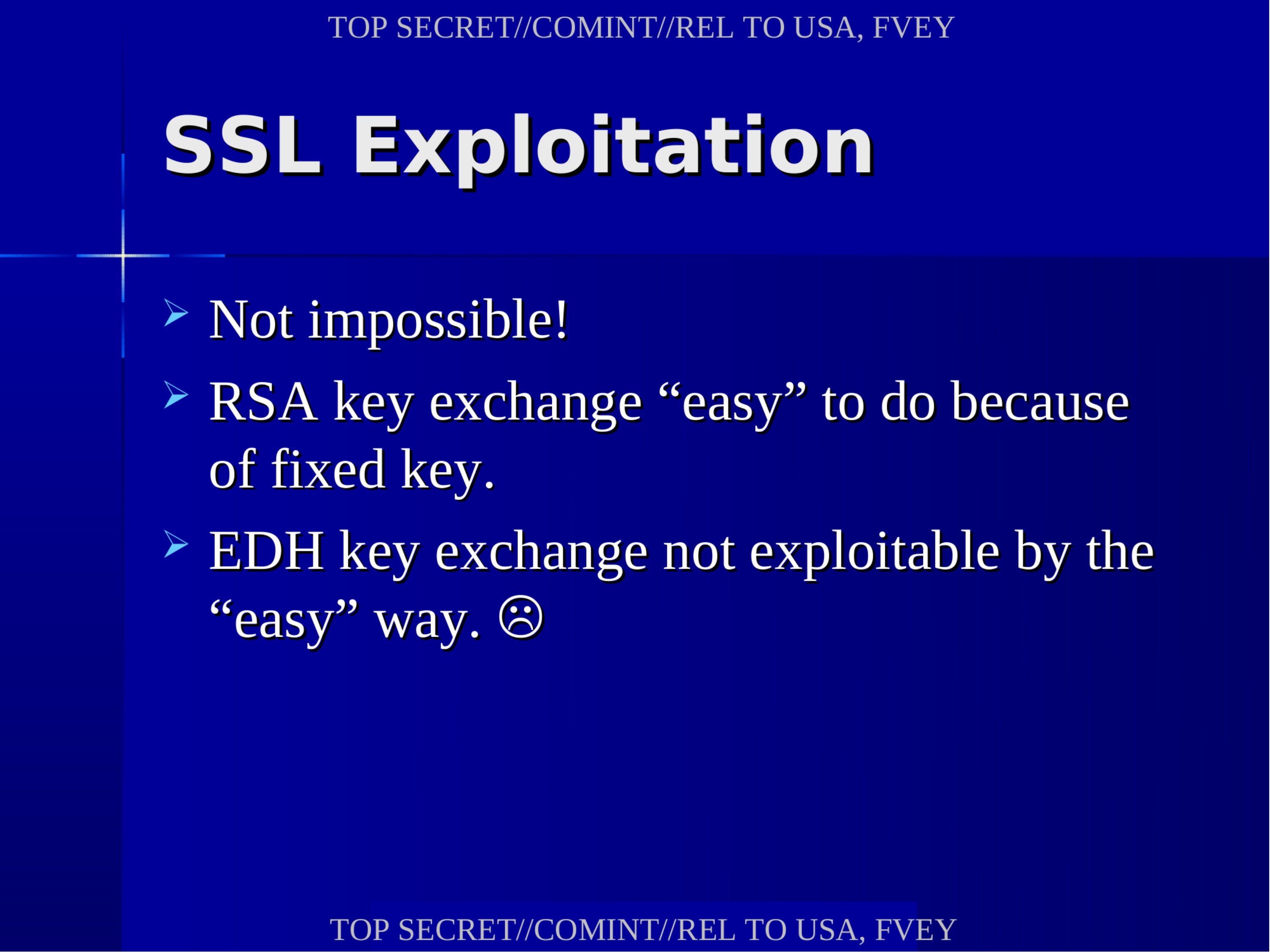
SSL Exploitation
- Not impossible!
- RSA key exchange "easy” to do because of fixed key.
- EDH key exchange not exploitable by the "easy” way. :(
TOP SECRET//COMINT//REL TO USA, FVEY
UNCLASSIFIED
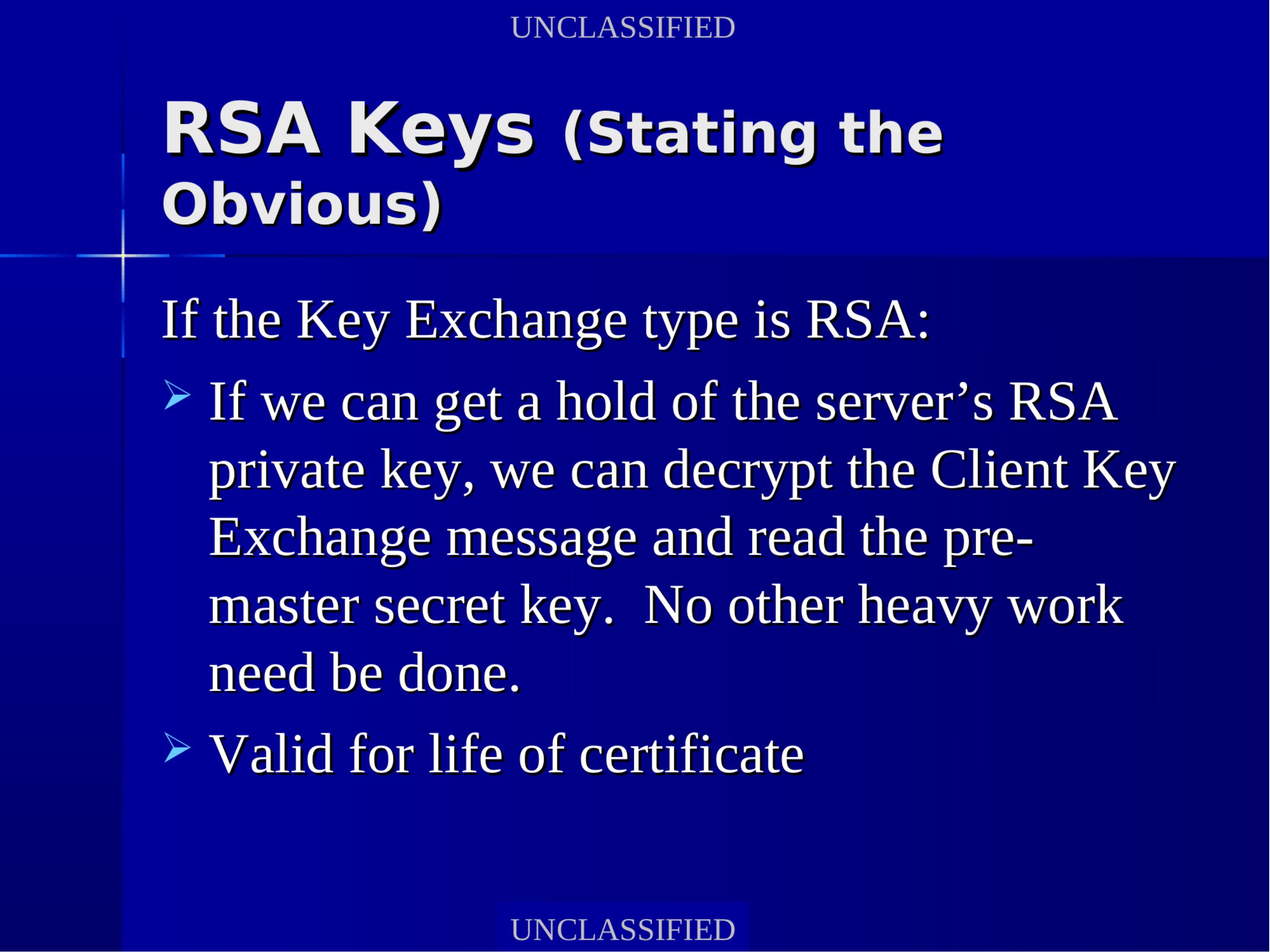
RSA Keys (Stating the Obvious)
If the Key Exchange type is RSA:
- If we can get a hold of the server's RSA private key, we can decrypt the Client Key Exchange message and read the pre-master secret key. No other heavy work need be done.
- Valid for life of certificate
UNCLASSIFIED
TOP SECRET//COMINT//REL TO USA, FVEY
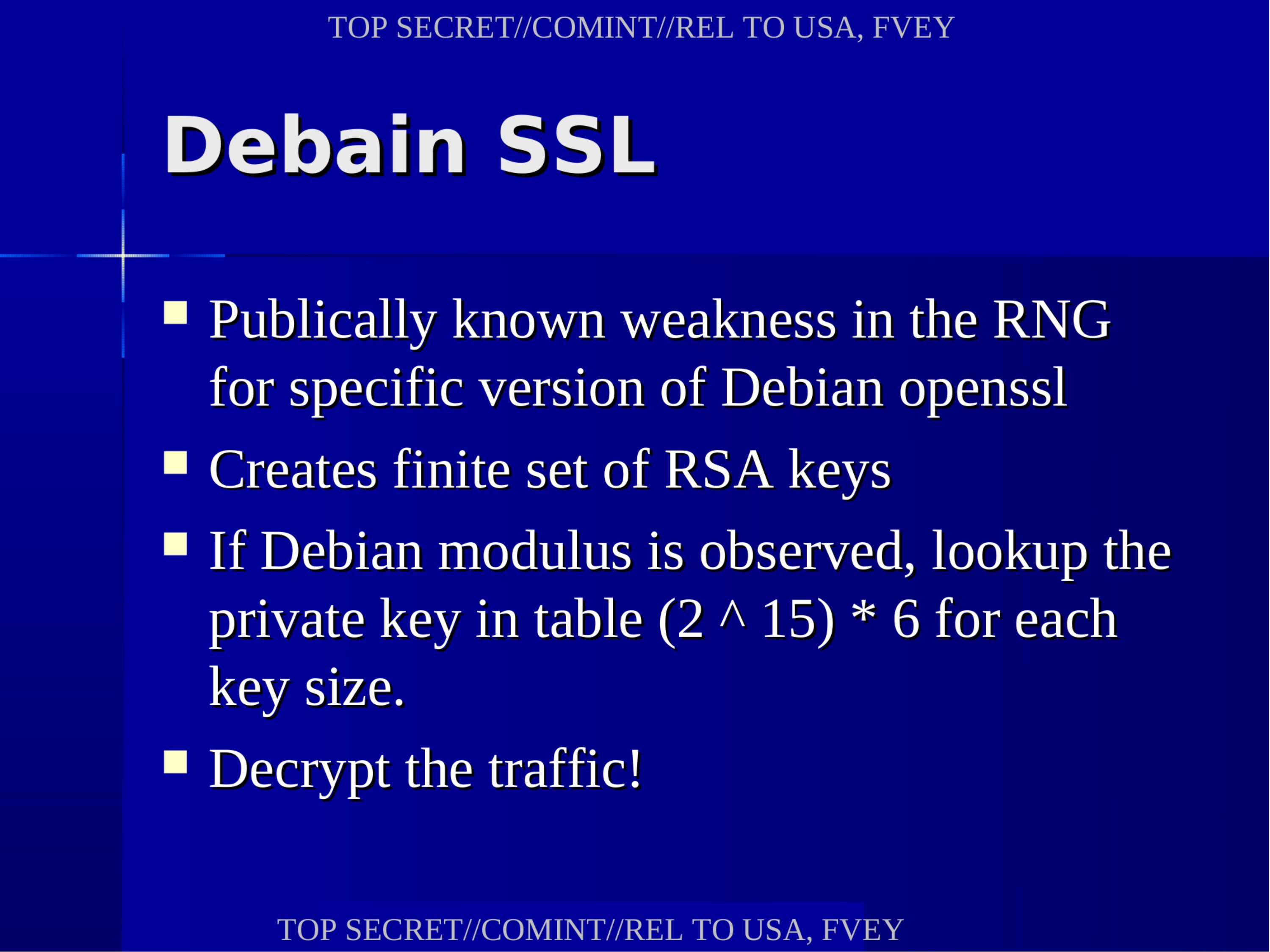
Debain SSL
- Publically known weakness in the RNG for specific version of Debian openssl
- Creates finite set of RSA keys
- If Debian modulus is observed, lookup the private key in table (2 ^ 15) * 6 for each key size.
- Decrypt the traffic!
TOP SECRET//COMINT//REL TO USA, FVEY
TOP SECRET//COMINT//REL TO USA, FVEY
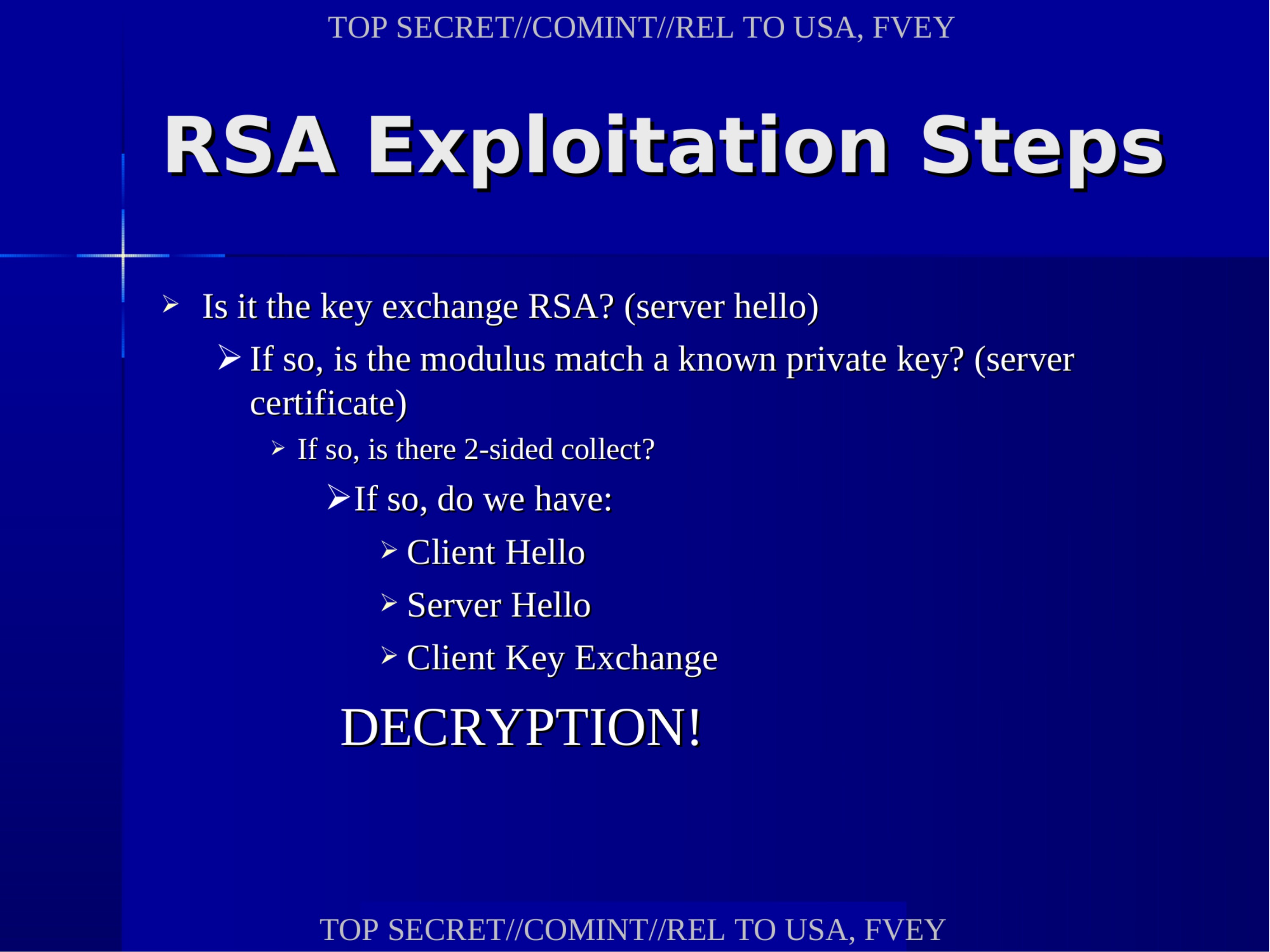
RSA Exploitation Steps
- Is it the key exchange RSA? (server hello)
- If so, is the modulus match a known private key? (server certificate)
- If so, is there 2-sided collect?
- If so, do we have:
- Client Hello
- Server Hello
- Client Key Exchange
DECRYPTION!
- If so, do we have:
- If so, is there 2-sided collect?
- If so, is the modulus match a known private key? (server certificate)
TOP SECRET//COMINT//REL TO USA, FVEY
TOP SECRET//COMINT//REL TO USA, FVEY
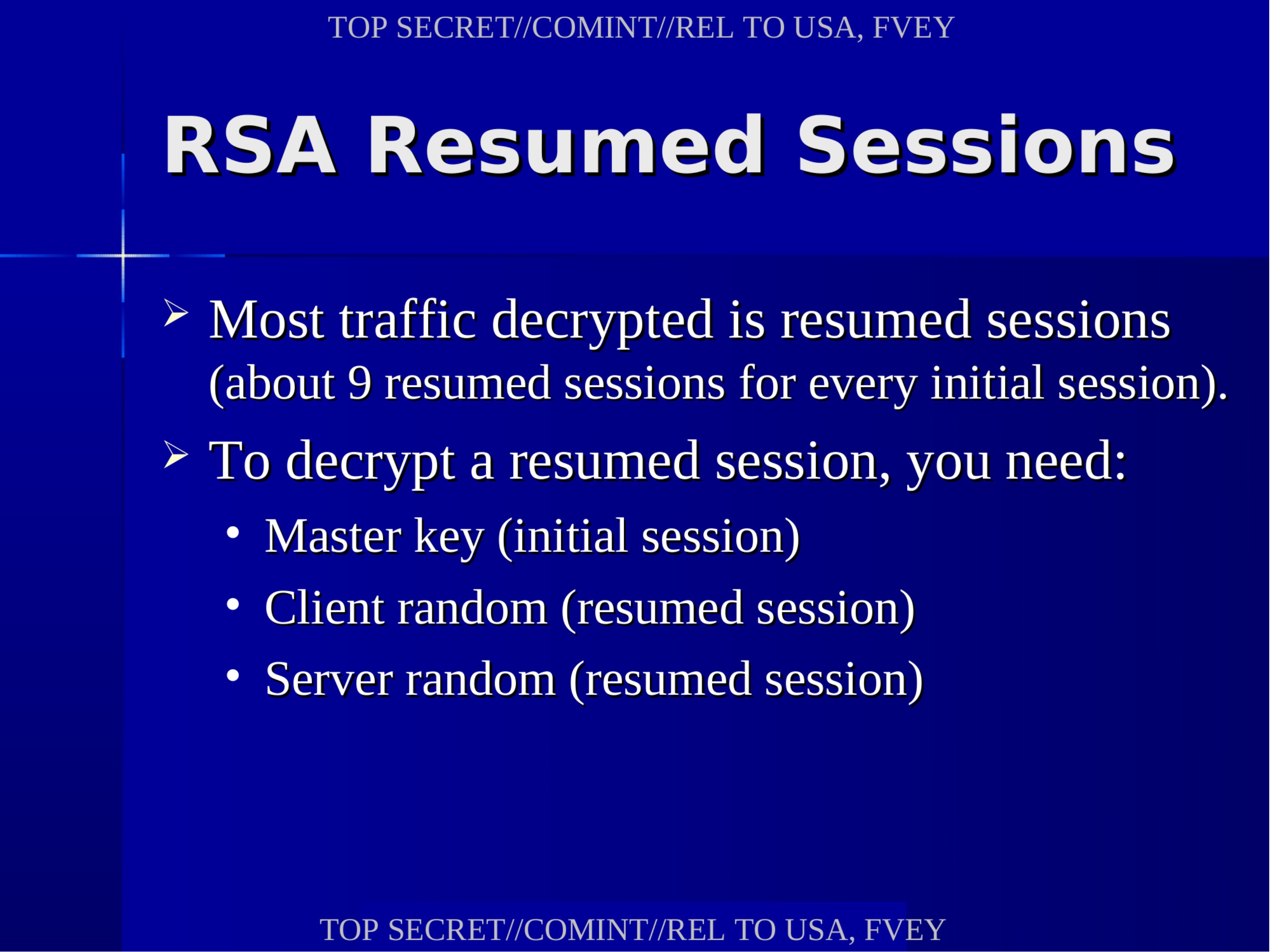
RSA Resumed Sessions
- Most traffic decrypted is resumed sessions (about 9 resumed sessions for every initial session).
- To decrypt a resumed session, you need:
- Master key (initial session)
- Client random (resumed session)
- Server random (resumed session)
TOP SECRET//COMINT//REL TO USA, FVEY
CONFIDENTIAL//COMINT
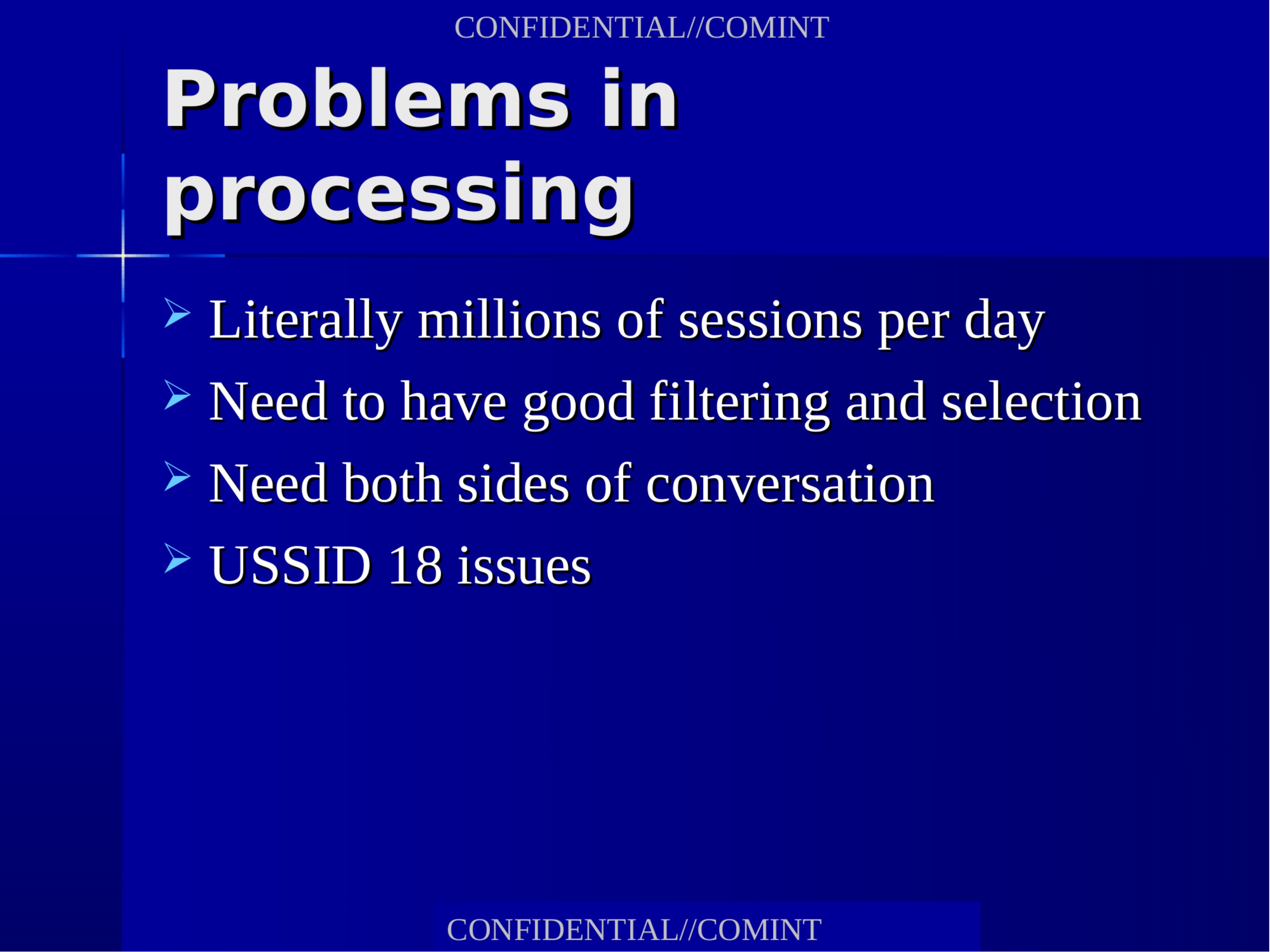
Problems in processing
- Literally millions of sessions per day
- Need to have good filtering and selection
- Need both sides of conversation
- USSID 18 issues
CONFIDENTIAL//COMINT
CONFIDENTIAL//COMINT//REL TO USA, FVEY
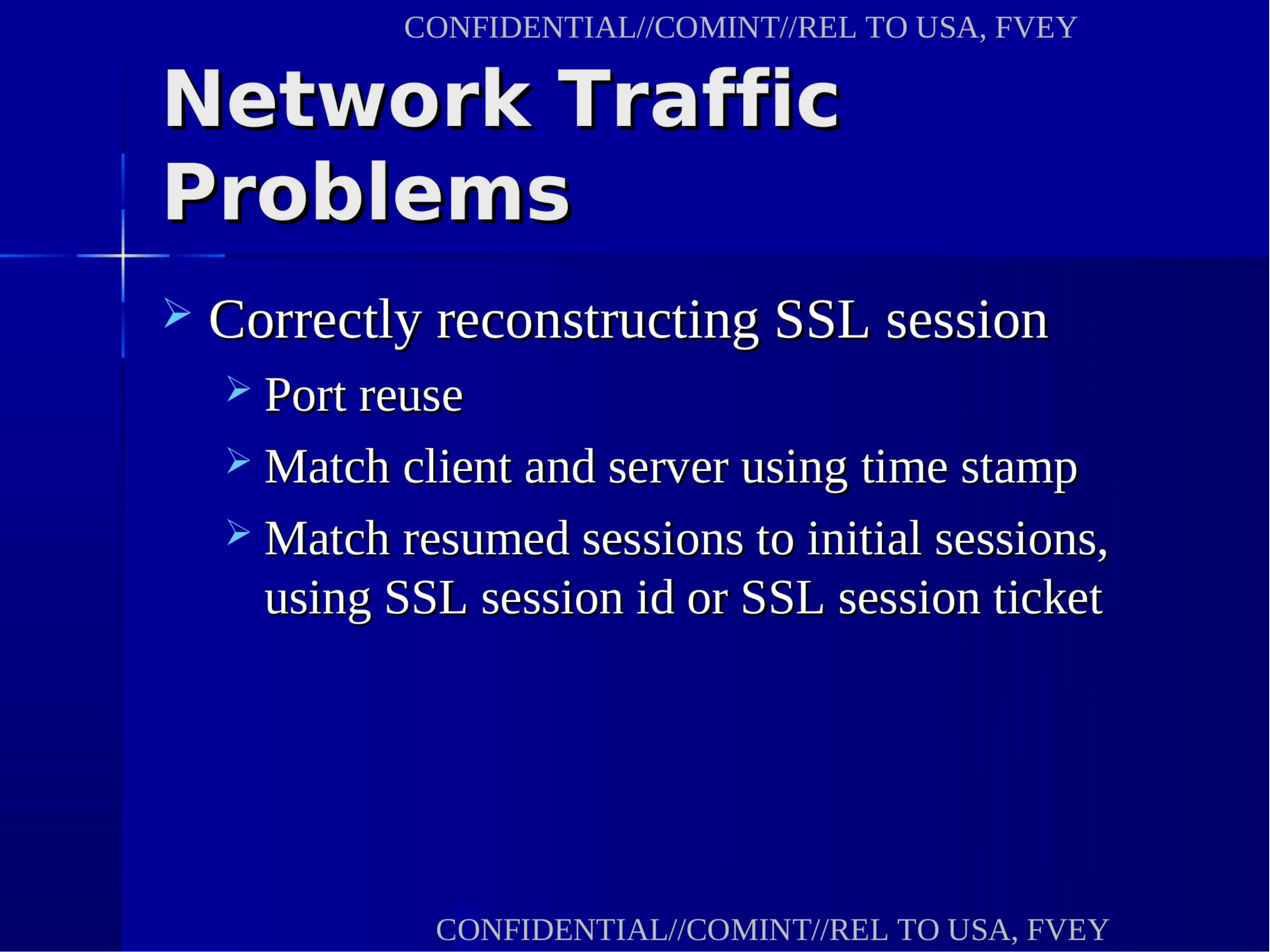
Network Traffic Problems
- Correctly reconstructing SSL session
- Port reuse
- Match client and server using time stamp
- Match resumed sessions to initial sessions, using SSL session id or SSL session ticket
CONFIDENTIAL//COMINT//REL TO USA, FVEY
TOP SECRET//COMINT//REL TO USA, FVEY
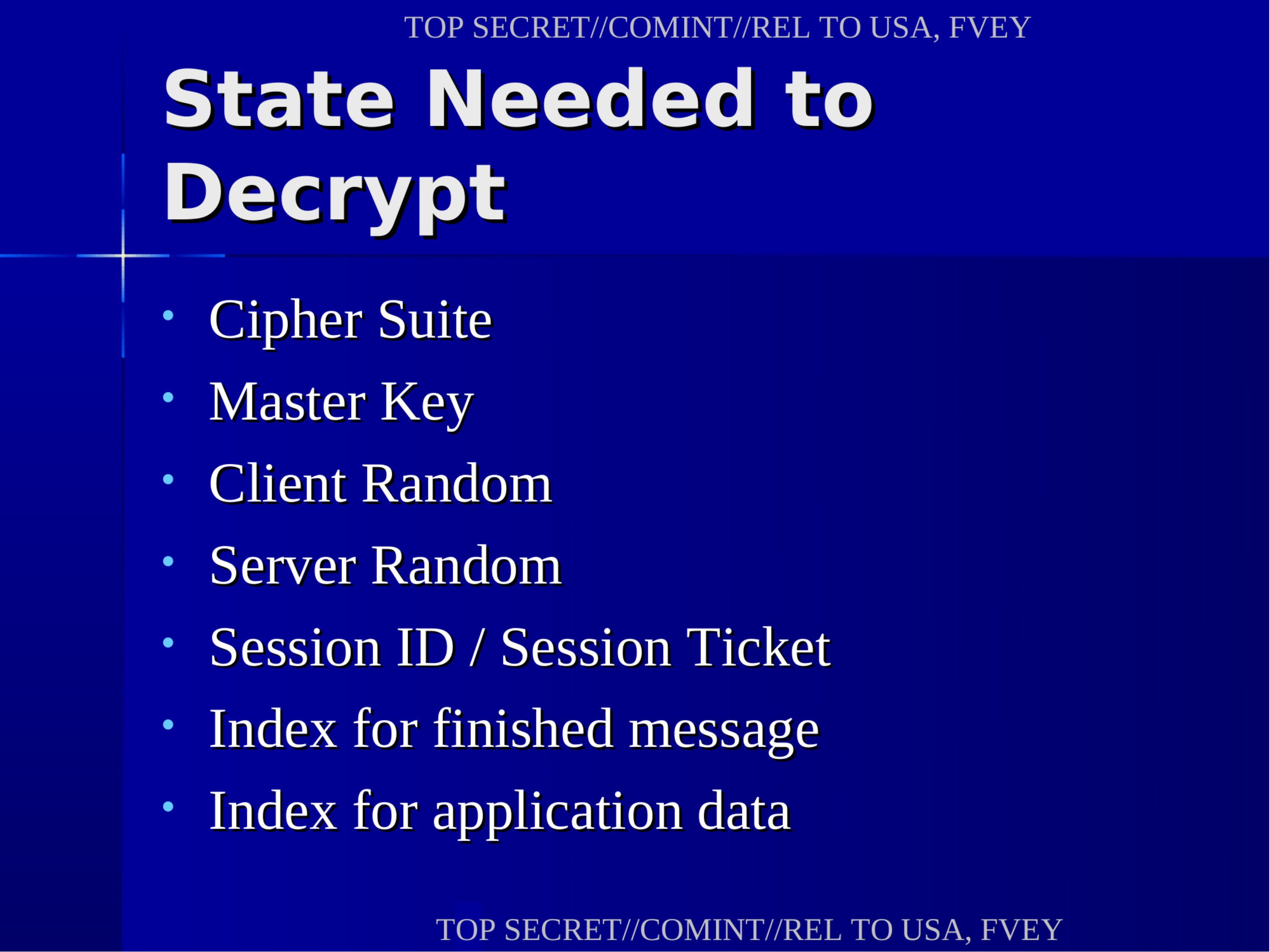
State Needed to Decrypt
- Cipher Suite
- Master Key
- Client Random
- Server Random
- Session ID / Session Ticket
- Index for finished message
- Index for application data
TOP SECRET//COMINT//REL TO USA, FVEY
UNCLASSIFIED//FOR OFFICIAL USE ONLY
Contact Information
[REDACTED]
Network Security Products
S31213
[REDACTED]
UNCLASSIFIED//FOR OFFICIAL USE ONLY
UNCLASSIFIED
Questions?
UNCLASSIFIED
Published in the Same Report
(10 of 43 documents)
-
BULLRUN CoI - Briefing Sheet [pdf]
A GCHQ briefing sheet introducing the BULLRUN Community of Interest — the access control framework protecting Five Eyes capabilities to defeat encryption across TLS/SSL, HTTPS, SSH, VPNs, IPSec, encrypted chat and encrypted VoIP — covering the classification structure, handling procedures and protective marking guidance for intelligence derived from cryptanalytic exploitation.
“N.S.A. Able to Foil Basic Safeguards of Privacy on Web” - The New York Times ↗ (2013-09-05) · “Revealed: The NSA's Secret Campaign to Crack, Undermine Internet Security” - ProPublica ↗ (2013-09-05) · “Prying Eyes: Inside the NSA's War on Internet Security” - Der Spiegel ↗ (2014-12-28) · Perlroth, Nicole · Larson, Jeff · Shane, Scott · Appelbaum, Jacob · Gibson, Aaron · Grothoff, Christian · Müller-Maguhn, Andy · Poitras, Laura · Sontheimer, Michael · Stöcker, Christian -
CLASSIFICATION GUIDE FOR CRYPTANALYSIS, 2-12 [pdf]
An NSA/CSS classification guide for cryptanalysis establishing the precise classification level for each type of information about NSA's capabilities to exploit commercial and indigenous encryption systems — from the unclassified acknowledgement that NSA exploits cryptographic devices, through to the Top Secret protection of cryptographic modifications made to commercial products to render them exploitable and industry relationships used to obtain cryptographic details.
“Revealed: how US and UK spy agencies defeat internet privacy and security” - The Guardian ↗ (2013-09-05) · “Prying Eyes: Inside the NSA's War on Internet Security” - Der Spiegel ↗ (2014-12-28) · Ball, James · Borger, Julian · Greenwald, Glenn · Appelbaum, Jacob · Gibson, Aaron · Grothoff, Christian · Müller-Maguhn, Andy · Poitras, Laura · Sontheimer, Michael · Stöcker, Christian -
Innov8 Experiment Profile Template [pdf]
A TOP SECRET STRAP1 joint NSA/GCHQ experiment profile documenting a 2010-2011 Joint Capability Experiment to test hardware-accelerated bulk decryption of common internet encryption technologies at scale, integrating TURMOIL's passive collection with NSA's LONGHAUL key recovery service via the ISLANDTRANSPORT messaging system, as part of the broader BULLRUN assault on internet encryption.
“Prying Eyes: Inside the NSA's War on Internet Security” - Der Spiegel ↗ (2014-12-28) · “Revealed: how US and UK spy agencies defeat internet privacy and security” - The Guardian ↗ (2013-09-05) · Appelbaum, Jacob · Gibson, Aaron · Grothoff, Christian · Müller-Maguhn, Andy · Poitras, Laura · Sontheimer, Michael · Stöcker, Christian · Ball, James · Borger, Julian · Greenwald, Glenn -
TLS Trends: A roundtable discussion on current usage and future directions [pdf]
A presentation by Canada's Communications Security Establishment describing their TLS trend analysis programme, which systematically tracked SSL/TLS encryption parameters across warranted collection and Special Source access to identify cryptanalytic opportunities, monitor target behaviour and collaborate with GCHQ on exploiting weaknesses in widely-used encryption implementations.
-
TLS trends at GCHQ [pdf]
A GCHQ presentation describing their TLS trends analysis programme, which processed approximately 10 billion SSL/TLS Server Hello events per week from Special Source cable tapping and COMSAT collection to produce weekly trend reports, alongside two operational tools — TargeTLS for matching TLS events against BROAD OAK target profiles, and FLYING PIG, a TLS knowledge base enabling analysts to query certificate, IP and client data across the full intercept base.
-
TURMOIL/APEX/APEX High Level Description Document [pdf]
NSA WikiInfo page providing the high-level design description of APEX — the Active-Passive Integration capability integrating HAMMERMILL router implants with TURMOIL passive collection — enabling real-time exfiltration of targeted VPN (HAMMERSTEIN) and VoIP (HAMMERCHANT) traffic from compromised routers directly into NSA's passive collection and cryptanalytic attack infrastructure, with TURBINE providing automated command and control of the combined active-passive system.
Programs: TURMOIL · APEX · HAMMERMILL · HAMMERCHANT · HAMMERSTEIN · FASHIONCLEFT · TURBINE · TOYGRIPPE · METROTUBE · CHIMNEYPOOL · PIQBLADE · KEYCARD · FASCIA · ISLANDTRANSPORT · PRESSUREWAVE · ASDF · CONVEYANCE · TURBULENCE -
GALLANTWAVE [pdf]
NSA presentation describing GALLANTWAVE — a LONGHAUL capability for VPN decryption — specifically its scaling architecture to handle increased collection volumes and a peering mechanism allowing partner agencies to share single-sided VPN key exchange events so that LONGHAUL can complete decryption attempts that would otherwise fail due to one-sided collection.
-
Intro to the VPN Exploitation Process [pdf]
NSA introduction to the VPN exploitation process from September 2010, presented by the OTP VPN Exploitation Team, covering the full workflow from initial collection through to sustained decryption of IPSec, PPTP, SSL and SSH traffic, with named exploitation successes including airlines, diplomatic missions, banks and intelligence services across Iran, Jordan, Russia, Turkey, Pakistan, Afghanistan, Somalia, Indonesia and Mexico.
Programs: BLEAKINQUIRY · TOYGRIPPE · XKEYSCORE · MAILORDER · CORALREEF · VULCANDEATHGRIP · SCISSORS · TURTLEPOWER · PINWALE · FOURSCORE · CADENCE · UTT · VULCANMINDMELD · CAPRIOS · AGILITY · NKB · FOLLOWTHEMONEY -
Analytic Challenges from Active-Passive Integration [pdf]
This NSA briefing addresses the technical and administrative friction caused by "shaping" operations. Shaping occurs when an active malware implant, typically situated on network infrastructure like a router, copies specific data streams and redirects them past a passive surveillance sensor such as TURMOIL. While this ensures the capture of data that might otherwise be missed, it creates a "double metadata" conflict where a single piece of intelligence carries two competing sets of identifiers: one from the active Tailored Access Operations (TAO) implant and another from the passive collection site. The document tasks analysts with finding a way to reconcile these source notations to ensure the data remains searchable and legally compliant within legacy databases.
Programs: BRAVENICKEL · HAMMERMILL · APEX · TURMOIL · HAMMERSTONE · PRESSUREWAVE · METROTUBE · TOYGRIPPE · TURBULENCE · METAWAVE · MARINA · SSO · CONVEYANCE · NUCLEON · FASCIA · HAMMERCHANT -
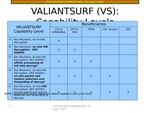
VALIANTSURF (VS): Capability Levels [pdf]
A capability status document for VALIANTSURF — NSA's programme for large-scale IPSec VPN decryption integrated with TURMOIL passive collection and LONGHAUL key recovery — defining five capability levels from basic key recovery through full hardware-accelerated on-site decryption with XKEYSCORE integration, and showing deployment status across named collection sites.

Related Documents
-
SCARLETFEVER [pdf]
NSA WikiInfo page describing SCARLETFEVER — the second LONGHAUL cryptanalytic capability, a message-driven cryptologic exploitation service for DNSC (Data Network Session Cipher) traffic serving clients including TURMOIL, WEALTHYCLUSTER and the TEe, communicating via ISLANDTRANSPORT with ISLANDHIDEAWAY encryption.
Programs: SCARLETFEVER · LONGHAUL · TURMOIL · WEALTHYCLUSTER · TEE · ISLANDTRANSPORT · ISLANDHIDEAWAY · POISONNUT · PICARESQUE -
TLS trends at GCHQ [pdf]
A GCHQ presentation describing their TLS trends analysis programme, which processed approximately 10 billion SSL/TLS Server Hello events per week from Special Source cable tapping and COMSAT collection to produce weekly trend reports, alongside two operational tools — TargeTLS for matching TLS events against BROAD OAK target profiles, and FLYING PIG, a TLS knowledge base enabling analysts to query certificate, IP and client data across the full intercept base.
-
TLS Trends: A roundtable discussion on current usage and future directions [pdf]
A presentation by Canada's Communications Security Establishment describing their TLS trend analysis programme, which systematically tracked SSL/TLS encryption parameters across warranted collection and Special Source access to identify cryptanalytic opportunities, monitor target behaviour and collaborate with GCHQ on exploiting weaknesses in widely-used encryption implementations.
-
Intro to the VPN Exploitation Process [pdf]
NSA introduction to the VPN exploitation process from September 2010, presented by the OTP VPN Exploitation Team, covering the full workflow from initial collection through to sustained decryption of IPSec, PPTP, SSL and SSH traffic, with named exploitation successes including airlines, diplomatic missions, banks and intelligence services across Iran, Jordan, Russia, Turkey, Pakistan, Afghanistan, Somalia, Indonesia and Mexico.
Programs: BLEAKINQUIRY · TOYGRIPPE · XKEYSCORE · MAILORDER · CORALREEF · VULCANDEATHGRIP · SCISSORS · TURTLEPOWER · PINWALE · FOURSCORE · CADENCE · UTT · VULCANMINDMELD · CAPRIOS · AGILITY · NKB · FOLLOWTHEMONEY -
POISONNUT [pdf]
NSA Wiki page describing POISONNUT — also known as the VPN Attack Orchestrator (VAO) — a LONGHAUL cryptologic exploitation service for IPSec VPN decryption that has existed in various forms since 2003, serving clients including TURMOIL, WEALTHYCLUSTER and the Transform Engine emulator via ISLANDTRANSPORT with ISLANDHIDEAWAY encryption.
Programs: POISONNUT · TURMOIL · WEALTHYCLUSTER · ISLANDTRANSPORT · ISLANDHIDEAWAY · LONGHAUL · OAKLEY · SCARLETFEVER · PICARESQUE · VALIANTSURF