Tag: passive collection 38 documents
Search documents matching “passive collection” →Free-text subjects the curators added. Unlike the other axes these are not necessarily from the documents' own vocabulary, so they are the loosest thing to browse by (and the most forgiving).
Graphs
By Banner
By Classification
Refine (combine with another filter, via search)
Sort: Title
Documents
-
BLARNEY report April 2013 [pdf]
This NSA document describes the deployment of surveillance systems (RINGBILL, TURTLEPOWER, SKIDROWE) at "TITAN POINTE" to process bulk communications data including VoIP and video teleconferencing traffic. The systems are designed to intercept, filter, and analyze high-volume network traffic using legacy architecture initially, with plans to transfer to newer processing solutions for long-term mass surveillance capabilities.
Programs: BLARNEY · RINGBILL · WEALTHYCLUSTER2 · XKEYSCORE · TRIREME · SKIDROWE · PINWALE · TITANPOINTE · VISIONQUEST · TURTLEPOWER · SKINNY -
CNE End Point Requirements [pdf]
This NSA/GCHQ document outlines comprehensive requirements for an endpoint surveillance systems that enables analysts to systematically identify intelligence collection needs and discover appropriate tools for data extraction from compromised computers. The framework covers capabilities for remote data collection, cross-platform intelligence integration, query functions, tasking procedures, and visualization tools across implanted networks.
Programs: STARGATE · LOOKING GLASS · QUANTUM · GOLDENEYE · XKEYSCORE · MARINA · JTRIG · BROADOAK · UTT · GLOBALREACH · GLOBALSURGE · THUGGEE · EREPO · DANCINGBEAR · HAUSTORIUM · SHAREOWN · MUTANTBROTH · MOONRAKER · CARBONROD · RUFFLE · ROCKOPERA · QUINCEY · ECLIPSE · MUGSHOT · HIGHNOTE · UDAQ2 · EKB · TURBINE · ACNO · FLAMECARPET · FUMECUPBOARD · JACKPOT · SLIPSTREAM · B13B · PSC · QUINCY · DAREDEVIL · ROADBED -
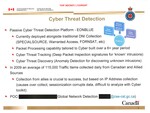
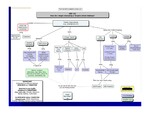
CSEC Cyber Threat Detection [pdf]
This document details the Communications Security Establishment’s (CSEC) cyber threat detection and intelligence infrastructure, including systems like EONBLUE, CROSSBOW, CRUCIBLE, and LODESTONE, which enable passive monitoring, anomaly detection, and botnet identification through metadata and deep packet inspection. It outlines how CSEC integrates SIGINT, cryptanalysis, and network forensics to detect and mitigate cyber intrusions using both SIGINT and domestic sensors, while collaborating with Five Eyes partners to enhance Canada’s cyber defense and situational awareness. The presentation is duplicated from page 7 onwards - one of the duplicated slide has internal CSE comments.
Programs: EONBLUE · SPECIALSOURCE · WARRANTEDACCESS · COVENANT · SEEDSPHERE · DIESELRATTLE · SIENNABLUE · DOWNGRADE · CROSSBOW · CRUCIBLE · LODESTONE -
CSEC ITS/N2E Cyber Threat Discovery [pdf]
A CSEC IT Security presentation to the DISCOCON 2010 conference, given with speakers' notes, on how the agency's cyber threat discovery team hunts for intrusions in the traffic it collects from Government of Canada networks. It describes the PonyExpress email processing system, which the notes record as handling 400,000 emails a day, the 8Ball attachment scanner and the Stripsearch binary analyser, and reports experiments in reducing the volume of metadata analysts see — including a machine learning model that discards 85% of email before deep scanning.
Marking: TOP SECRETPrograms: PONYEXPRESS · 8BALL · STRIPSEARCH · POPQUIZ · SLIPSTREAM · FINDMASK · SAWUNEH · TROPPUSNU · N2E · DISCOCON -
Cyber Network Defence R&D Activities [pdf]
A September 2010 CSEC briefing to the Five Eyes 5IARC conference on cyber defence R&D, giving the full PONY EXPRESS email attachment scanning architecture and the PHOTONIC PRISM sensor, with speaker notes in which the presenter concedes CSEC does little research of its own.
Marking: SECRETPrograms: PHOTONICPRISM · PONYEXPRESS · SLIPSTREAM · POPQUIZ · 8BALL · SNORT · POPEYESEAR · FLOWPONY · SMTPPONY · MAILPONY · METAPONY · SCANPONY · AGGPONY · SYNCPONY · POOLTABLE · POOLCUE · CORNERPOCKET · TONTO · MULASSES · MULVAL · ASSETRANK · JNDMS · ARMOUR · SWAD · MINISSL · SSLFUZZER · N3C · N3 · CTEC · DCITS · 5IARC -
DNI101 [pdf]
This TOP SECRET training guide, "DNI 101," provides a workflow for Digital Network Intelligence analysts on how to investigate a target's email address, detailing the specific tools, databases, and methodology used, and stressing the critical difference between initial open-source/classified research and the active "targeting" of raw SIGINT repositories like XKEYSCORE, PINWALE, and MARINA.
Programs: NKB · FOXTRAIL · FOREMAN · PINWALE · LIONHEART · XKEYSCORE · DISHFIRE · MARINA · MECWEB · MAINWAY · TRAFFICTHIEF · MAUI · ANCHORY · M3 · INTELLINK · HOMEBASE · PROTON · UTT · CADENCE · SPEEDBUMP · TUNINGFORK · MASTERSHAKE · BLACKPEARL · JACKSPARROW · ROADBED · STORYDUTY · LIONROAR · DOPHONE · UIS -
Exploiting Facebook traffic in the passive environment to obtain specific information [pdf]
A GCHQ Global Telecommunications Exploitation presentation on extracting information about Facebook users from passively collected traffic: why online social networks are a rich source, how Facebook's use of the Akamai content delivery network exposes a user's ID inside image URLs, and how profile and album images are then obtained through SPRING BISHOP, GODFATHER and JTRIG.
-
Finding and Querying Document Metadata [pdf]
This 2009 NSA training guide, created by Booz Allen Hamilton, explains how analysts can use the XKEYSCORE system to track targets by searching for "non-traditional selectors" embedded within documents, such as author names, company information, or even the hash values of company logos.
Programs: XKEYSCORE · TUNINGFORK · PINWALE · FOXACID · FOXBASE · CARBOY · CARDAMON · UNITEDRAKE · CADENCE -
Fourth Party Opportunities [pdf]
This presentation document explains how NSA identifies, prioritizes, and exploits “fourth party” opportunities by passively or actively leveraging foreign computer network exploitation operations, including victim stealing and tool repurposing, to collect intelligence without initiating original intrusions.
Programs: VOYEUR · UIS · PINWALE · YNKE · TUNINGFORK · DIRTSHED · SEEKER · CLOUD · ABR · SILVERBOLT · DEADSEA · XKEYSCORE · BYZANTINERAPTOR · HAWALA · ZEBEDEE · DATAFLURRY · ECLECTICPLOT · HAPPYFOOT · BLUESMOKE · CROSSBONES2 · CYBERQUEST · VICDB · PLAIDDIANA · TRANSGRESSION -
FOXACID Overall Briefing [pdf]
FOXACID is the NSA's exploit server infrastructure designed to gain "initial access" to target computers by tricking them into visiting malicious websites through spam emails, man-in-the-middle attacks, or split-second packet injection techniques that redirect legitimate web traffic. The document reveals how the agency has evolved from low-success spam operations (less than 1% success rate) to sophisticated "QUANTUM" techniques that achieve up to 80% success rates by exploiting web browsers through services like Yahoo and Facebook, allowing the NSA to compromise any target whose web traffic passes through monitored network chokepoints—with the chilling assessment that "if we can get the target to visit us in some sort of web browser, we can probably own them."
Programs: FOXACID · WILLOWVIXEN · GENUINEDRAFT · SECONDDATE · QUANTUMTHEORY · TURMOIL · TURBINE · WEBSNIPER · QUANTUMINSERT · QUANTUMBISCUIT · QUANTUMDIRK · QUANTUM · VALIDATOR · OLYMPUS · MISTYVEAL · SSO · STRAIGHTBIZARRE · ISLANDTRANSPORT -
GALLANTWAVE [pdf]
NSA presentation describing GALLANTWAVE — a LONGHAUL capability for VPN decryption — specifically its scaling architecture to handle increased collection volumes and a peering mechanism allowing partner agencies to share single-sided VPN key exchange events so that LONGHAUL can complete decryption attempts that would otherwise fail due to one-sided collection.
-
GCHQ Application for Renewal of Warrant GPW/1160 [pdf]
GCHQ’s 2008 application to renew warrant GPW/1160 seeks blanket cover under ISA section 5 to reverse engineer and modify commercial software—explicitly breaching copyright and licensing—to enable CNE, vulnerability research, and even police forensics. It catalogues concrete ops against web forums, routers, and antivirus, and asserts a novel legal theory blessed by the Intelligence Services Commissioner to immunize intellectual‑property interference.
-
GCHQ – Making network sense of the encryption problem (2011) [pdf]
GCHQ’s Network Analysis Centre convened a 2011 roundtable on “making network sense” of encryption, pushing a metadata-first strategy to triage SSL/TLS, IKE, OpenVPN, and SSH flows, pivot from “seed” indicators, and zero in on targets and subnets worth decrypting. The playbook leans on enrichment, AS-level scoping (explicitly citing Belgacom AS6774 GRX VPNs), and “access optimisation” to collect data pre‑encryption—passively or actively.
Programs: SQUEAL · BEARDEDPIGGY · CLOUD · IRASCIBLEHARE · IRASCIBLERABBIT · IRASCIBLEMOOSE · IRASCIBLEEMITT“Operation Socialist: The Inside Story of How British Spies Hacked Belgium’s Largest Telco” - The Intercept ↗ (2014-12-13) · “Lees hier hoe de Britse geheime dienst GCHQ Belgacom aanviel” - NRC ↗ (2014-12-13) · “Britse geheime dienst bespioneerde jarenlang Belgacom-klanten” - De Standaard ↗ (2014-12-13) · Gallagher, Ryan · Modderkolk, Huib · Vanhecke, Nikolas · Eeckhaut, Mark -
HIDDENSALAMANDER - Alerting and Characterization of Botnet Activity in TURMOIL [pdf]
This NSA briefing describes HIDDENSALAMANDER, a TURMOIL component that detects, tracks, and characterizes botnet command-and-control traffic on passive collection sensors worldwide, generating enriched metadata about bot herders, infected machines, attack commands, and malware families while providing low-latency defensive alerts when botnet activity involves high-value targets or protected networks. The system extends beyond traditional signature matching by decrypting Zeus RC4-encrypted traffic, extracting payload details like target IPs and DDoS commands, tracking C2 servers across multiple sessions, and categorizing botnet lifecycle stages (configuration, infection, reconnaissance, C&C communication, attack, exfiltration) to support both offensive attribution and defensive response.
Programs: HIDDENSALAMANDER · TURMOIL · CLOUDSHIELD · NETEZZA · TUTELAGE · GMPLACE · RONIN · CYBERCLOUD · MARINA · GHOSTMACHINE · QBOT · ASDF · MARIPOSA · XKEYSCORE · GOGADGET · TURQI · TRAFFICTHIEF · FALLOUT · POUNDSAND · BLUESMOKE · AEG · TURNABOUT · QUANTUMBOT -
I hunt sys admins [pdf]
These internal documents outline the NSA’s strategy for identifying and targeting foreign system administrators to gain "keys to the kingdom" access to global network infrastructure. By correlating disparate datasets—such as passive telnet/SSH metadata and personal social media/webmail logins—the agency identifies personal accounts to facilitate QUANTUM-based hacking operations and network "pwnage."
-
Intro to the VPN Exploitation Process [pdf]
NSA introduction to the VPN exploitation process from September 2010, presented by the OTP VPN Exploitation Team, covering the full workflow from initial collection through to sustained decryption of IPSec, PPTP, SSL and SSH traffic, with named exploitation successes including airlines, diplomatic missions, banks and intelligence services across Iran, Jordan, Russia, Turkey, Pakistan, Afghanistan, Somalia, Indonesia and Mexico.
Programs: BLEAKINQUIRY · TOYGRIPPE · XKEYSCORE · MAILORDER · CORALREEF · VULCANDEATHGRIP · SCISSORS · TURTLEPOWER · PINWALE · FOURSCORE · CADENCE · UTT · VULCANMINDMELD · CAPRIOS · AGILITY · NKB · FOLLOWTHEMONEY -
Is there "fifth party" collection? [pdf]
This NSA internal Q&A forum discussion reveals "fifth party collection"—where the NSA passively intercepts data from one intelligence service (South Korea) that has compromised another service's (North Korea) computer network exploitation operations, creating a three-layer chain where NSA exploits Actor One's access to Actor Two's CNE activities against shared targets. The thread provides concrete examples including NSA leveraging South Korean implants on North Korean officials' computers (who themselves were conducting CNE operations) and stealing zero-day exploits from unidentified foreign intelligence services by passively monitoring their successful attacks.
-
Network Shaping 101 [pdf]
An NSA top-secret training presentation that uses Yemen as a case study to explain how to "shape" a nation's Internet traffic by exploiting Autonomous Systems, upstream providers, BGP routing, and physical link topology to redirect or collect communications. The slide deck walks through practical router/IP/link details, passive SIGINT collection points and limitations, and warns that many assumptions are fabricated for the lesson and that real-world capabilities and link behavior can vary.
-
New Technique Geolocates Targets Active at Yemeni Cafes SIDtoday [pdf]
A 2010 NSA document from Menwith Hill Station details a new geolocation technique used in Yemen that combines HUMINT café surveys with SIGINT data — including RADIUS logs, passive collection tools, and TAO access — to track targets frequenting internet cafés linked to Al Qaeda. The method, integrating systems like MORK, WINDCHASER, MARINA, and SPARKLEPONY, enabled analysts to identify and monitor dozens of cafés and correlate user activity with high-priority targets.
Programs: GHOSTHUNTER · MORK · RADIUS · WINDCHASER · MARINA · XKEYSCORE · SPARKLEPONY · GHOSTWOLF · TELIR -
Next Generation Events [pdf]
A 2009 TOP SECRET briefing outlines the “Next Generation Events” program to scale internet metadata and content analysis across Five Eyes, addressing explosive growth in data volume and the limits of legacy ingest systems. It presents a phased roadmap combining cloud infrastructure, large‑scale event processing, and enhanced profiling to enable bulk analytics and contact chaining.
Programs: NGE · HAUSTORIUM · BLAZINGSADDLES · HARBOURPILOT · MUTANTBROTH · AUTOASSOC · KARMAPOLICE · SOCIALANIMAL · INFINITEMONKEYS · HRMAP · MEMORYHOLE · MARBLEDGECKO · SIMMER · ROCKRIDGE · SAMUELPEPYS · CAFFEINEHIT · LAUGHINGHYENA · SALAMANCA · CLOUD · MONTEVISTA · LOOKINGGLASS · XKEYSCORE · FUMECUPBOARD · IIB · MoaG