How to tell if a target is 'foreign'
Open PDFDocument date: -
Pages: 1
Genre: other
Classification: -
Dissemination: -
The document describes a human intelligence (HUMINT) report indicating that a specific intelligence target, identified by a Foreign Source ID, is located outside the U.S., including details such as email, telephone number, and mobile network type, with checks confirming no U.S. roaming over a 60-day period. It illustrates the use of HUMINT to corroborate foreign location data for surveillance purposes.
My notes
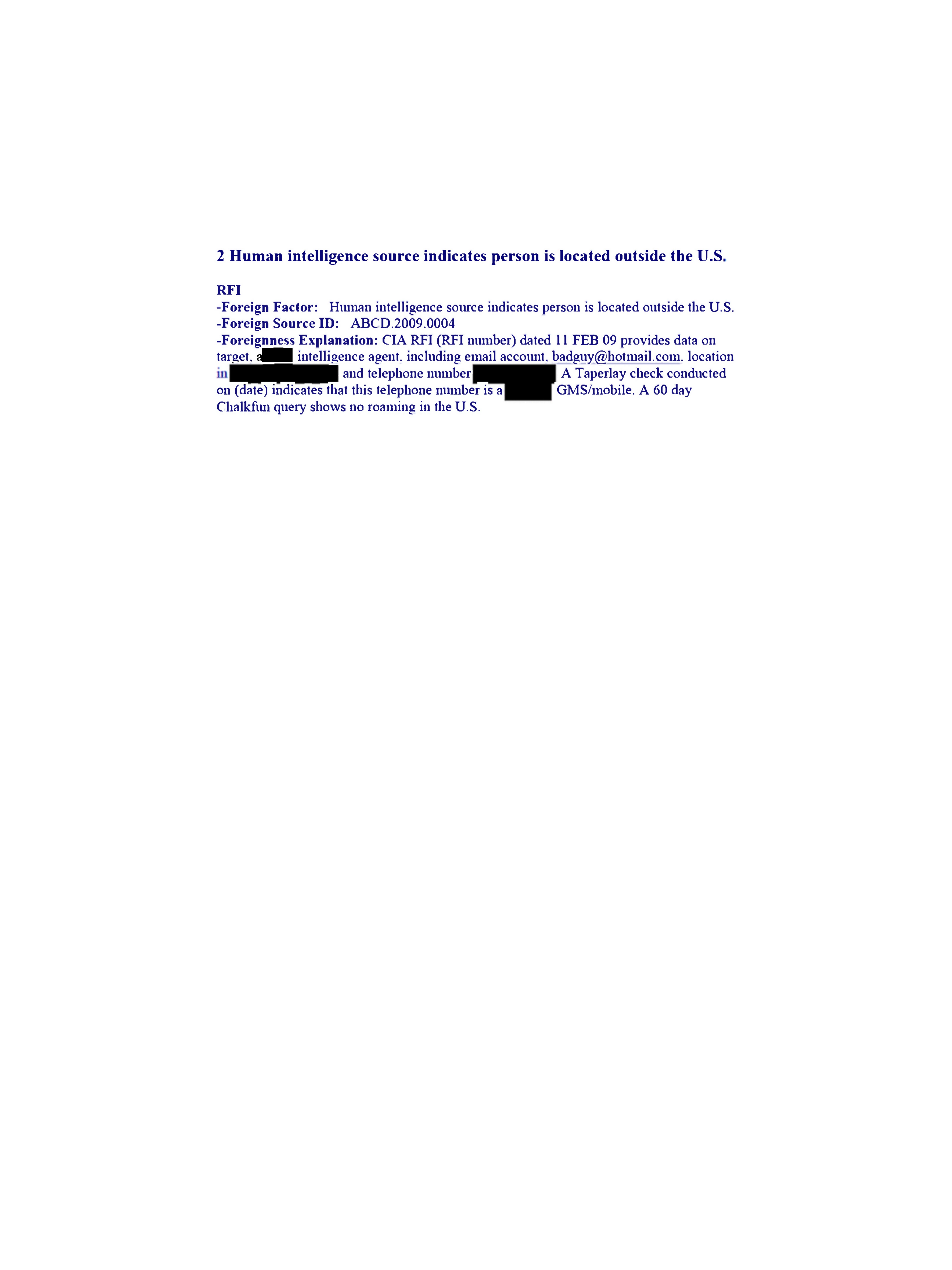
2 Human intelligence source indicates person is located outside the U.S.
RFI
-Foreign Factor: Human intelligence source indicates person is located outside the U.S.
-Foreign Source ID: ABCD.2009.0004
-Foreignness Explanation: CIA RFI (RFI number) dated 11 FEB 09 provides data on
target, a [REDACTED] intelligence agent, including email account, badguy@hotmail.com. location
in [REDACTED] and telephone number [REDACTED]. A Taperlay check conducted
on (date) indicates that this telephone number is a [REDACTED] GMS/mobile. A 60 day
Chalkfun query shows no roaming in the U.S.
Published in the Same Report
(1 documents)
-
FASCIA: The NSA's huge trove of location records [pdf]
FASCIA is the National Security Agency's enormous database containing trillions of metadata records, many with device locations, that are collected from a variety of sources. This document shows the volume and types of device-location data collected by the agency.
“NSA tracking cellphone locations worldwide, Snowden documents show” - The Washington Post ↗ (2013-12-04) · “No Place to Hide” - Metropolitan Books ↗ (2014-05-13) · Gellman, Barton · Soltani, Ashkan · Greenwald, Glenn
Related Documents
-
Summary of DNR and DNI Co-Travel Analytics [pdf]
The document outlines the NSA’s development and testing of multiple “co-traveler” analytics—sophisticated tools that analyze bulk mobile location data to identify people who travel together or follow similar patterns, even if they are not known intelligence targets. It details various analytic systems, their data sources (such as FASCIA, VLR, GCID), architectures, scoring methods, and future enhancements, illustrating a large-scale surveillance framework for mapping human movement and relationships.
Programs: CO-TRAVELER · CHALKFUN · TMI · PACT · RT-RG · SORTINGLEAD · FASCIA · Hectic Snare · DRT · Juggernaut · GM-PLACE · Fast Follower · MGSC · ELKPRINTS · VOICESAIL · CULTWEAVE · OCTAVE · OCTSKYWARD · SEDB · JEMA · The Café · UTT · ASDF · GHOSTMACHINE · CLOUDBASE · FASTSCOPE · GOLDMINER · CHET · GEOT · TMAC · SPCMA · MAPREDUCE · ACCUMULO · GAMBIT · ICREACH -
How the NSA Pinpoints a Mobile Device [pdf]
This document is an internal National Security Agency classification guide outlining the agency's abilities to intercept cellular communications.
Programs: ARCVIEW -
How the NSA verifies a target's location [pdf]
This is an excerpt from a transcript of National Security Agency training videos that describe how to verify the location of a targeted device. It explains how the NSA monitors different types of mobile signaling information known as HLR and VLR registrations in order to locate individuals. It also makes clear that the agency is able to use location tracking to ascertain whether a target is in the United States.
-
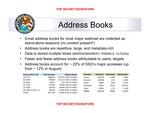
Bulk collection of webmail address books and emerging protocols [pdf]
TOP SECRET NSA document details the large-scale collection of email address books and contact lists from major webmail and social media providers, emphasizing their metadata value despite low attribution rates to known targets. It also highlights ongoing efforts to identify and analyze emerging communication protocols, such as those used by Hotmail Messenger.
-
Location Cookies [pdf]
These slides contain excerpts from an April 2013 National Security Agency presentation detailing signal surveillance techniques and successes. They reveal that the NSA and its British counterpart, Government Communications Headquarters (GCHQ), use a Google-specific tracking cookie to pinpoint targets for hacking.