Tag: mobile networks 15 documents
Search documents matching “mobile networks” →Free-text subjects the curators added. Unlike the other axes these are not necessarily from the documents' own vocabulary, so they are the loosest thing to browse by (and the most forgiving).
Graphs
By Banner
By Classification
Refine (combine with another filter, via search)
Sort: Title
Documents
-
Mobile Networks in My NOC World [pdf]
This TOP SECRET STRAP 2 GCHQ document outlines the “MyNOC” operations, a specialized Network Operations Centre used by the UK’s GCHQ to coordinate cyber exploitation of international mobile and telecom infrastructure, with a particular focus on Belgacom’s GRX network under “Operation Socialist” (OP SOCIALIST). It details operational planning, toolsets, personnel roles, network mapping, QUANTUM INSERT targeting, and successful infiltration strategies that enabled CNE (Computer Network Exploitation) access to key Belgacom systems and staff infrastructure.
Programs: HIGHNOTE · COPPERHEAD · NEXUS · CADDIS · BRENT · RUSSETT PHONE · CERBERUS · E-BEAM · PIA · JEDI · WYLEKEY · INTERACTION · EREPO · QUANTUM · WOODCUTTER · MUTANT BROTH · QUANTUM INSERT · NRTA · MERION ZETA · JTRIG · A-SPACE · GEOFUSION“Operation Socialist: The Inside Story of How British Spies Hacked Belgium’s Largest Telco” - The Intercept ↗ (2014-12-13) · “Lees hier hoe de Britse geheime dienst GCHQ Belgacom aanviel” - NRC ↗ (2014-12-13) · “Britse geheime dienst bespioneerde jarenlang Belgacom-klanten” - De Standaard ↗ (2014-12-13) · “Britain's GCHQ Hacked Belgian Telecoms Firm” - Der Spiegel ↗ (2013-09-20) · Gallagher, Ryan · Modderkolk, Huib · Vanhecke, Nikolas · Eeckhaut, Mark -
Automated NOC detection [pdf]
This slide deck lays out how GCHQ and Canada’s CSEC systematically identified and penetrated Network Operations Centers—most notably Belgacom—by automating NOC discovery and weaponizing that mapping for QUANTUM INSERT attacks. It reads like a blueprint for turning router configs, metadata, and bulk scans into cookie-based targeting against telecom engineers inside core networks.
Programs: SURGE · NOCTURNALSURGE · RT · NACSHACK · CHAINGUARD · TIDALSURGE · GLOBALSURGE · PENTAHO · OLYMPIA · HYPERION · TERMINALSURGE · HACIENDA · QUANTUMINSERT · MUTANTBROTH · OPSOCIALIST · SAMUEL PEPYS · GEOFUSION · FIVEALIVE · NRTA · RADIUS“Operation Socialist: The Inside Story of How British Spies Hacked Belgium’s Largest Telco” - The Intercept ↗ (2014-12-13) · “Lees hier hoe de Britse geheime dienst GCHQ Belgacom aanviel” - NRC ↗ (2014-12-13) · “Britse geheime dienst bespioneerde jarenlang Belgacom-klanten” - De Standaard ↗ (2014-12-13) · Gallagher, Ryan · Modderkolk, Huib · Vanhecke, Nikolas · Eeckhaut, Mark -
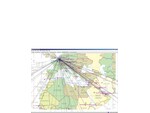
Belgacom connections [pdf]
A "Belgacom connections" map lays out the carrier’s sprawling roaming and backbone interconnects, precisely the arteries GCHQ wanted to get access into. Under Operation Socialist GCHQ successfully gained access to Belgacom’s infrastructure, including internal employee computers and encrypted and unencrypted streams of private communications handled by the company.
Programs: CARBONROD“Operation Socialist: The Inside Story of How British Spies Hacked Belgium’s Largest Telco” - The Intercept ↗ (2014-12-13) · “Lees hier hoe de Britse geheime dienst GCHQ Belgacom aanviel” - NRC ↗ (2014-12-13) · “Britse geheime dienst bespioneerde jarenlang Belgacom-klanten” - De Standaard ↗ (2014-12-13) · Gallagher, Ryan · Modderkolk, Huib · Vanhecke, Nikolas · Eeckhaut, Mark -
COMPUTER NETWORK OPERATIONS - GENIE [pdf]
A TOP SECRET Congressional Budget Justification entry for the NSA/CSS GENIE project — the Tailored Access Operations programme underpinning all endpoint Computer Network Operations — requesting $651.7 million and 1,870 military and civilian positions for FY2013, with plans to maintain 85,000-96,000 implant points-of-presence worldwide and 9,000-10,000 active accesses, including $25.1 million for covert purchase of software vulnerabilities and a $3.4 million supply chain implant operation targeting al-Qaeda.
-
FASCIA: The NSA's huge trove of location records [pdf]
FASCIA is the National Security Agency's enormous database containing trillions of metadata records, many with device locations, that are collected from a variety of sources. This document shows the volume and types of device-location data collected by the agency.
“NSA tracking cellphone locations worldwide, Snowden documents show” - The Washington Post ↗ (2013-12-04) · “No Place to Hide” - Metropolitan Books ↗ (2014-05-13) · Gellman, Barton · Soltani, Ashkan · Greenwald, Glenn -
GCHQ - PCS Harvesting [pdf]
A TOP SECRET STRAP1 report details how GCHQ industrialized the theft of GSM subscriber authentication keys (Ki) by automating trawls of bulk “C2C” content to extract IMSI/Ki pairs from emails and FTP transfers between SIM personalisation centers and mobile operators. It shows the program scaling key harvesting across networks and countries, complementing computer network exploitation against core mobile infrastructure to suppress billing and lift authentication secrets.
-
Graph theory in the operational environment – GCHQ [pdf]
This document details GCHQ’s research on identifying “closed loops” of communication, where targets use a small set of phones to communicate exclusively among themselves, often with cheap, disposable handsets like the Nokia 1100. It explains the methodology for analyzing anonymized metadata, constructing contact graphs, and extracting non-giant, non-tree components to discover operationally relevant closed loops for intelligence and counterterrorism purposes.
Programs: VOICESAILPeople: Rumsfeld, Donald -
How the NSA Pinpoints a Mobile Device [pdf]
This document is an internal National Security Agency classification guide outlining the agency's abilities to intercept cellular communications.
Programs: ARCVIEW -
How to tell if a target is 'foreign' [pdf]
The document describes a human intelligence (HUMINT) report indicating that a specific intelligence target, identified by a Foreign Source ID, is located outside the U.S., including details such as email, telephone number, and mobile network type, with checks confirming no U.S. roaming over a 60-day period. It illustrates the use of HUMINT to corroborate foreign location data for surveillance purposes.
-
In-Flight GSM [pdf]
This NSA presentation outlines how the agency is reacting to the growth of mobile phone services on board commercial aircraft.
-
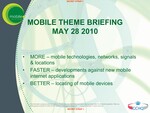
Mobile Theme Briefing (May 28, 2010) [pdf]
This 2010 GCHQ briefing document outlines the “Mobile Applications Project,” which aims to expand intelligence capabilities to exploit the growing shift from fixed to mobile internet usage. It details objectives for targeting mobile apps and roaming network traffic (GRX), enabling converged analysis of voice, text, command-and-control, and geolocation data across multiple mobile platforms such as iPhone, Symbian, Android, and Windows Mobile. See also: EFF_-_20140128-guard-leaky_phone_apps_0 (includes other slides from the same slideset)
Programs: Mobile Applications Project -
New Technology Making Waves: MMS SIDtoday [pdf]
At the time of writing, Multimedia Messaging Service, was a new technology that allowed cell phone users to send text, sound, pictures, and videos. "No doubt you've seen advertisements of MMS-capable phones, some of which are called camera phones." Because the technology is so new, SID is not yet able to collect SIGINT from MMS. But not for long. They're taking steps to build automated systems to spy on MMS.
Programs: DISHFIREThe Intercept ↗ (2017-04-24) -
-
SIGINT Mission Strategic Plan FY2008-2013 [pdf]
This five-year mission plan for the National Security Agency shows how the agency’s leaders view its mission and culture.
-
Synergising Network Analysis Tradecraft [pdf]
These Five Eyes slides give an overview of Synergising Network Analysis Tradecraft, a program the NSA and its closest allies developed to plant spyware on smartphones without the knowledge or consent of the user. Specifically, the method seeked to alter the content of data packets moving between targeted smartphones and app servers, causing the spyware to be downloaded along with the app.
Programs: ATLAS · ATHENA · FRETTINGYETI · CRAFTYSHACK · IRRITANTHORN · XKEYSCORE · BLAZINGSADDLES · SPLUNK · SCORPIOFORE · PLINKO · MASTERSHAKE · PEITHO · HYPERION · DANAUS · CONVERGENCE · UCWEB · EONBLUE