How the NSA verifies a target's location
Open PDFDocument date: -
Pages: 1
Genre: guide
Banner: TOP SECRET//SI//NOFORN
Classification: TOP SECRET SI
Dissemination: NOFORN
This is an excerpt from a transcript of National Security Agency training videos that describe how to verify the location of a targeted device. It explains how the NSA monitors different types of mobile signaling information known as HLR and VLR registrations in order to locate individuals. It also makes clear that the agency is able to use location tracking to ascertain whether a target is in the United States.
My notes
TOP SECRET//SI//NOFORN
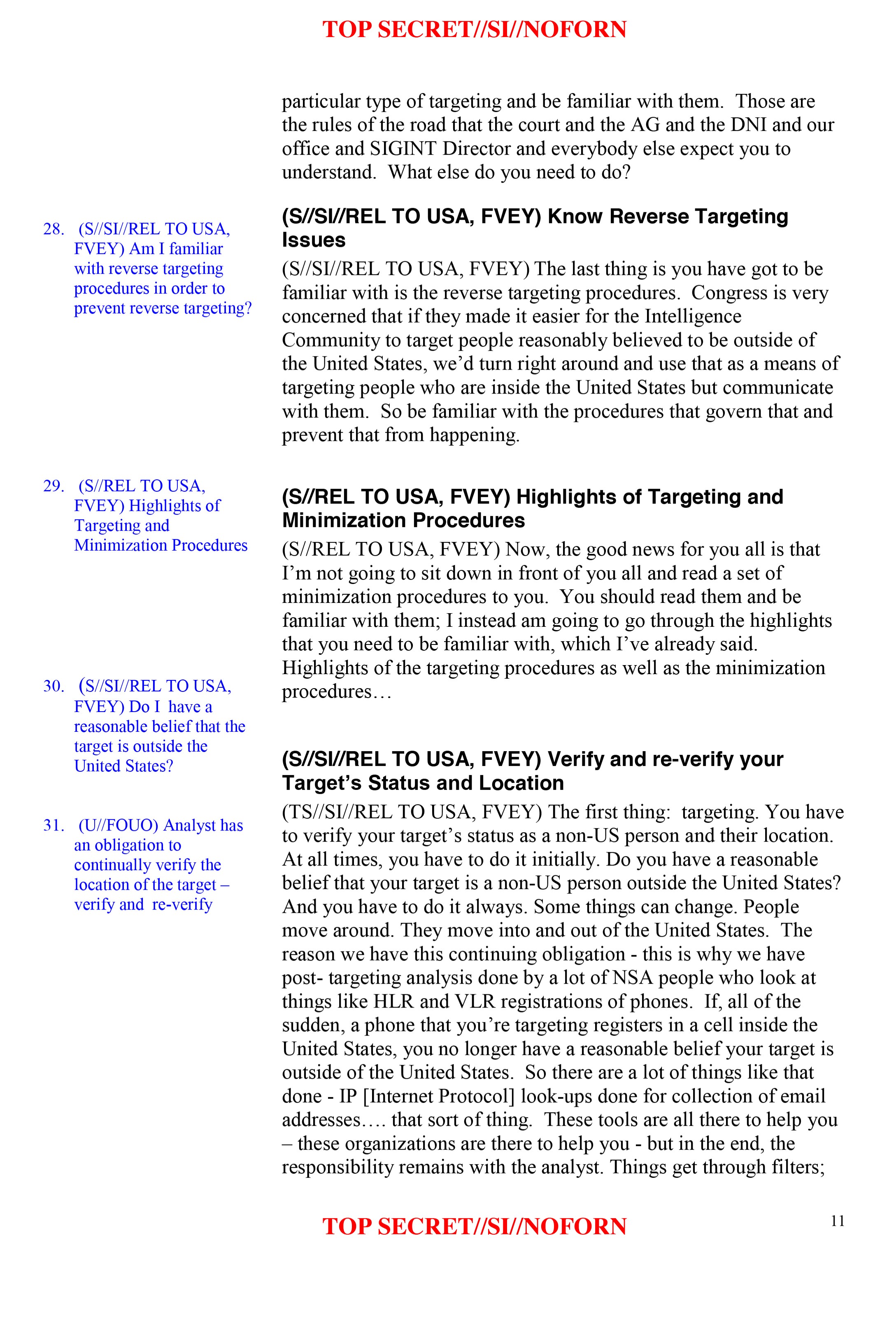
particular type of targeting and be familiar with them. Those are the rules of the road that the court and the AG and the DNI and our office and SIGINT Director and everybody else expect you to understand. What else do you need to do?
- (S//SI//REL TO USA, FVEY) Am I familiar with reverse targeting procedures in order to prevent reverse targeting?
(S//SI//REL TO USA, FVEY) Know Reverse Targeting Issues
(S//SI//REL TO USA, FVEY) The last thing is you have got to be familiar with is the reverse targeting procedures. Congress is very concerned that if they made it easier for the Intelligence Community to target people reasonably believed to be outside of the United States, we'd turn right around and use that as a means of targeting people who are inside the United States but communicate with them. So be familiar with the procedures that govern that and prevent that from happening.
- (S//REL TO USA, FVEY) Highlights of Targeting and Minimization Procedures
(S//REL TO USA, FVEY) Highlights of Targeting and Minimization Procedures
(S//REL TO USA, FVEY) Now, the good news for you all is that I'm not going to sit down in front of you all and read a set of minimization procedures to you. You should read them and be familiar with them; I instead am going to go through the highlights that you need to be familiar with, which I've already said. Highlights of the targeting procedures as well as the minimization procedures...
- (S//SI//REL TO USA, FVEY) Do I have a reasonable belief that the target is outside the United States?
- (U//FOUO) Analyst has an obligation to continually verify the location of the target - verify and re-verify
(S//SI//REL TO USA, FVEY) Verify and re-verify your Target's Status and Location
(TS//SI//REL TO USA, FVEY) The first thing: targeting. You have to verify your target's status as a non-US person and their location. At all times, you have to do it initially. Do you have a reasonable belief that your target is a non-US person outside the United States? And you have to do it always. Some things can change. People move around. They move into and out of the United States. The reason we have this continuing obligation - this is why we have post- targeting analysis done by a lot of NSA people who look at things like HLR and VLR registrations of phones. If, all of the sudden, a phone that you're targeting registers in a cell inside the United States, you no longer have a reasonable belief your target is outside of the United States. So there are a lot of things like that done - IP [Internet Protocol] look-ups done for collection of email addresses.... that sort of thing. These tools are all there to help you - these organizations are there to help you - but in the end, the responsibility remains with the analyst. Things get through filters;
TOP SECRET//SI//NOFORN
Published in the Same Report
(4 documents)
-
How the NSA Pinpoints a Mobile Device [pdf]
This document is an internal National Security Agency classification guide outlining the agency's abilities to intercept cellular communications.
Programs: ARCVIEW -
Summary of DNR and DNI Co-Travel Analytics [pdf]
The document outlines the NSA’s development and testing of multiple “co-traveler” analytics—sophisticated tools that analyze bulk mobile location data to identify people who travel together or follow similar patterns, even if they are not known intelligence targets. It details various analytic systems, their data sources (such as FASCIA, VLR, GCID), architectures, scoring methods, and future enhancements, illustrating a large-scale surveillance framework for mapping human movement and relationships.
Programs: CO-TRAVELER · CHALKFUN · TMI · PACT · RT-RG · SORTINGLEAD · FASCIA · Hectic Snare · DRT · Juggernaut · GM-PLACE · Fast Follower · MGSC · ELKPRINTS · VOICESAIL · CULTWEAVE · OCTAVE · OCTSKYWARD · SEDB · JEMA · The Café · UTT · ASDF · GHOSTMACHINE · CLOUDBASE · FASTSCOPE · GOLDMINER · CHET · GEOT · TMAC · SPCMA · MAPREDUCE · ACCUMULO · GAMBIT · ICREACH -
SSO GHOSTMACHINE Analytics [pdf]
This document describes the NSA’s cloud analytics platform GHOSTMACHINE, used by Special Source Operations (SSO) to process and analyze massive volumes of data (e.g., from FASCIA) using Hadoop-based infrastructure. It’s essentially the backbone system for querying, correlating, and enriching surveillance data at scale — not just a single analytic, but the analytic/cloud environment powering many programs.
Programs: GHOSTMACHINE · FASCIA · CERF · POPTOP · DRT · SIGDASYS · JUGGERNAUT · SEADIVER · AST128 · TUSKATTIRE · ASDF · BROKENRECORD · REDHAWK · SSO -
Location Cookies [pdf]
These slides contain excerpts from an April 2013 National Security Agency presentation detailing signal surveillance techniques and successes. They reveal that the NSA and its British counterpart, Government Communications Headquarters (GCHQ), use a Google-specific tracking cookie to pinpoint targets for hacking.
Related Documents
-
How to tell if a target is 'foreign' [pdf]
The document describes a human intelligence (HUMINT) report indicating that a specific intelligence target, identified by a Foreign Source ID, is located outside the U.S., including details such as email, telephone number, and mobile network type, with checks confirming no U.S. roaming over a 60-day period. It illustrates the use of HUMINT to corroborate foreign location data for surveillance purposes.
-
FASCIA: The NSA's huge trove of location records [pdf]
FASCIA is the National Security Agency's enormous database containing trillions of metadata records, many with device locations, that are collected from a variety of sources. This document shows the volume and types of device-location data collected by the agency.
“NSA tracking cellphone locations worldwide, Snowden documents show” - The Washington Post ↗ (2013-12-04) · “No Place to Hide” - Metropolitan Books ↗ (2014-05-13) · Gellman, Barton · Soltani, Ashkan · Greenwald, Glenn -
Location Cookies [pdf]
These slides contain excerpts from an April 2013 National Security Agency presentation detailing signal surveillance techniques and successes. They reveal that the NSA and its British counterpart, Government Communications Headquarters (GCHQ), use a Google-specific tracking cookie to pinpoint targets for hacking.
-
Summary of DNR and DNI Co-Travel Analytics [pdf]
The document outlines the NSA’s development and testing of multiple “co-traveler” analytics—sophisticated tools that analyze bulk mobile location data to identify people who travel together or follow similar patterns, even if they are not known intelligence targets. It details various analytic systems, their data sources (such as FASCIA, VLR, GCID), architectures, scoring methods, and future enhancements, illustrating a large-scale surveillance framework for mapping human movement and relationships.
Programs: CO-TRAVELER · CHALKFUN · TMI · PACT · RT-RG · SORTINGLEAD · FASCIA · Hectic Snare · DRT · Juggernaut · GM-PLACE · Fast Follower · MGSC · ELKPRINTS · VOICESAIL · CULTWEAVE · OCTAVE · OCTSKYWARD · SEDB · JEMA · The Café · UTT · ASDF · GHOSTMACHINE · CLOUDBASE · FASTSCOPE · GOLDMINER · CHET · GEOT · TMAC · SPCMA · MAPREDUCE · ACCUMULO · GAMBIT · ICREACH -
Procedures Used By The National Security Agency For Targeting Non-United States Persons Reasonably Believed To Be Located Outside The United States To Acquire Foreign Intelligence Court Information Pursuant To Section 702 Of The Foreign Intelligence Surveillance Act Of 1978 [pdf]
The NSA’s 2009 Section 702 targeting procedures lay out how analysts decide who can be surveilled without a warrant, supposedly limiting spying to foreigners abroad. In reality, the rules give the agency wide latitude to presume people are foreign, rely on vague “totality of the circumstances” tests, and allow broad technical methods like IP filters and metadata checks. Oversight is mostly internal and after-the-fact, creating significant potential for U.S. communications to be swept up with little accountability.
People: Holder, Eric H. Jr.