Classification: SI 265 documents
Search documents matching “SI” →Each document's classification level, as component values. If a document contains multiple classifications, the highest is used here.
Graphs
By Banner
Refine (combine with another filter, via search)
Sort: Title
Documents
-
ICREACH Black Budget Extracts [pdf]
This document provides fiscal and strategic justifications for the continued expansion of ICREACH, detailing its role as a primary vehicle for disseminating both telephony and Digital Network Intelligence (DNI) metadata across the Intelligence Community. It outlines the platform's transition to the NSA/CSS cloud architecture, a move intended to enhance data enrichment services and ensure the system remains responsive to the evolving requirements of the National Intelligence Priorities Framework (NIPF).
Programs: ICREACH -
ICREACH: Sharing SIGINT Comms Metadata with the Intel Community SIDtoday [pdf]
This document serves as an internal announcement marking the 2007 operational launch of ICREACH, a massive signals intelligence (SIGINT) metadata-sharing platform designed to provide real-time access to raw communication records for authorized analysts across the U.S. Intelligence Community. By consolidating telephony, cellular, and satellite data into a "one-stop shop" similar to the NSA’s internal GLOBALREACH tool, the program aimed to fulfill post-9/11 mandates for increased inter-agency collaboration and enhanced target development.
-
India: Support to Terrorist Attacks in Mumbai [pdf]
A top secret NSA intelligence report on GCHQ's surveillance of Lashkar-e-Taiba technology chief Zarrar Shah before and during the November 2008 Mumbai attacks, documenting how analysis of his internet browsing and viewing habits revealed reconnaissance activity and operational planning against Mumbai targets including the Taj Hotel.
People: Shah, Zarrar“In 2008 Mumbai Attacks, Piles of Spy Data, but an Uncompleted Puzzle” - The New York Times ↗ (2014-12-21) · “In 2008 Mumbai Attacks, Piles of Spy Data, But an Uncompleted Puzzle” - ProPublica ↗ (2014-12-21) · “In 2008 Mumbai Attacks, Piles of Spy Data, but an Uncompleted Puzzle” - PBS ↗ (2014-12-21) · Glanz, James · Rotella, Sebastian · Sanger, David E. · Jennings, Tom · Peevey, Anna Belle · Nieling, Michael -
Instability creates opportunity against counter-terrorism targets SIDtoday [pdf]
This document reveals how the NSA’s collaboration with Ethiopia during and after the 2006 Ethiopian invasion of Somalia was leveraged to advance U.S. counterterrorism objectives, using SIGINT tools and shared intelligence to track and eliminate al-Qaida targets across the Horn of Africa.
-
Intellipedia – Air Gapped Network Threats [pdf]
This document from an internal wiki for the U.S. intelligence community, surveys threats to so-called air-gapped systems, arguing that supply-chain compromises, physical implants (BIOS, KVMs, peripherals), infected removable media, and enabled wireless/emanations present realistic paths for adversaries to bridge isolated networks. It assesses likelihoods and attack vectors (including insider help and CDS/guard exploitation), highlights specific historic incidents (Agent.BTZ/MAKERSMARK), and recommends strict removable-media policies, TEMPEST countermeasures, and rigorous cross-domain guard protections to mitigate the risk.
People: Witte, Griff · Warren, Peter · Streeter, Michael · Watson, Paul · Louchard, Bjørn · Crawford, George · Rudge, David · Terrazas, Michael -
Intellipedia – BIOS Threats [pdf]
This from an internal wiki for the U.S. intelligence community, titled “BIOS Threats” details the use of malicious BIOS implants as a means of achieving persistent system compromise for cyber espionage and attack purposes. It discusses the history, technical challenges, detection limitations, and global development of BIOS-based malware by both state and non-state actors, including U.S. and Chinese cyber units.
-
Intellipedia – Supply Chain Cyber Threats [pdf]
This document on Supply Chain Cyber Threats, from an internal wiki for the U.S. intelligence community, outlines vulnerabilities in hardware and firmware components such as power supplies, NICs, RAID controllers, GPUs, and peripheral devices that could be exploited by adversaries through the supply chain. It details assessments from U.S. intelligence agencies (CIA, DIA, FBI, CYBERCOM) highlighting risks from foreign companies, insider threats, and malicious modifications that could compromise critical U.S. government and military systems.
Programs: A-SPACE -
Interview with a SID "Hacker" -- Part 1: How Does TAO Do Its Work? SIDtoday [pdf]
A SIDToday interview from July 2012 with a counterterrorism subject-matter expert in TAO's Requirements and Targeting organisation, explaining how TAO plans and executes computer network exploitation operations.
“The Digital Arms Race: NSA Preps America for Future Battle” - Der Spiegel ↗ (2015-01-17) · “Arbeiten mit geheimen Snowden-Dokumenten” - Der Spiegel ↗ (2015-07-03) · Appelbaum, Jacob · Gibson, Aaron · Guarnieri, Claudio · Müller-Maguhn, Andy · Poitras, Laura · Rosenbach, Marcel · Ryge, Leif · Schmundt, Hilmar · Sontheimer, Michael · Eckert, Svea · Stark, Holger -
Interview with a SID "Hacker" -- Part 2: Hacker Culture and Worker Retention SIDtoday [pdf]
A SIDtoday internal NSA newsletter interview with a redacted TAO employee discussing hacker culture within the agency's offensive cyber unit, worker retention challenges, and the team's role in operations including the raid that killed Osama bin Laden.
Programs: SCQAWKPeople: bin Laden, Osama -
INTOLERANT – Who Else Is Targeting Your Target? Collecting Data Stolen by Hackers – SIDtoday SIDtoday [pdf]
A TOP SECRET SIDToday article from Menwith Hill Station describing how NSA and CSEC discovered and began exploiting INTOLERANT — a sophisticated email-stealing hacking operation targeting Indian diplomats, Central Asian diplomats, Chinese human rights defenders, Tibetan pro-democracy activists, Uighur activists and European officials — by intercepting the stolen emails as they transited satellite links, a technique internally called "fourth party collection" or "outsourcing SIGINT."
Programs: INTOLERANT -
Introduction to WLAN / 802.11 Active CNE Operations [pdf]
This NSA powerpoint introduces computer network exploitation (CNE) criteria and assesment as well as active CNE operations. It also introduces the FOXACID program, which is a program to deliver content based exploits to web browsers.
-
Is there "fifth party" collection? [pdf]
This NSA internal Q&A forum discussion reveals "fifth party collection"—where the NSA passively intercepts data from one intelligence service (South Korea) that has compromised another service's (North Korea) computer network exploitation operations, creating a three-layer chain where NSA exploits Actor One's access to Actor Two's CNE activities against shared targets. The thread provides concrete examples including NSA leveraging South Korean implants on North Korean officials' computers (who themselves were conducting CNE operations) and stealing zero-day exploits from unidentified foreign intelligence services by passively monitoring their successful attacks.
-
Is There a Sustainable Ops Tempo in S2? How Can Analysts Deal with the Flood of Collection? SIDtoday [pdf]
The NSA's Deputy Director for Analysis and Production discusses the unsustainable operational tempo caused by overwhelming data collection volumes, advocating for "Analytic Modernization" that would shift from treating SIGINT as "radioactive" NSA-only material to sharing raw intelligence with other agencies for collaborative exploitation.
Programs: A-SPACE -
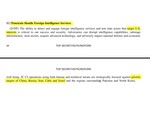
Israel targets the U.S. government for invasive electronic surveillance [pdf]
Israel targets the U.S. government for invasive electronic surveillance, and does so more aggressively and threateningly than almost any other country in the world. Indeed, so concerted and aggressive are Israeli efforts against the U.S. that some key U.S. government documents — including the top secret 2013 intelligence budget — list Israel among the U.S.’s most threatening cyber-adversaries and as a “hostile” foreign intelligence service.
-
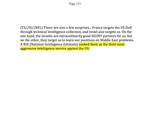
Israel targets US [pdf]
2 p.An NSA assessment noting that France targets the US Department of Defense and that Israel, while an extraordinarily good SIGINT partner, also targets the United States — ranked by a National Intelligence Estimate as the third most aggressive intelligence service against the US — and that the exchange has tilted heavily toward Israeli needs.
-
Japan official NSA visit, cyber briefing [pdf]
This document outlines cooperation between the NSA and Japan’s Directorate for SIGINT (DFS) to develop Japan’s capabilities for providing signals intelligence (SIGINT) support to cyber defense operations, particularly against Chinese cyber activities. It details meetings, training, and data-sharing efforts from 2012–2013 aimed at enhancing Japan’s cyber intelligence capacity under U.S. guidance.
“Japan Made Secret Deals With the NSA That Expanded Global Surveillance” - The Intercept ↗ (2017-04-24) · “アメリカに監視される日本 ~スノーデン“未公開ファイル”の衝撃” - NHK ↗ (2017-04-24) · Gallagher, Ryan · Ikegami, Akira -
Japan: Eternal Land of the Rising Sun SIDtoday [pdf]
This document contains the NSA's SIGINT Deputy Director's reflections on his experiences in Japan, both during and after the devastating 2011 earthquake and tsunami. It highlights the resilience of the Japanese people, the swift recovery of U.S. personnel stationed in Japan, and their contributions to humanitarian efforts. The author also emphasizes the importance of SIGINT operations in the region and encourages others to consider field assignments in Japan, praising the country’s cultural richness and the strong sense of community among U.S. personnel stationed there.
Programs: SCQAWK -
Legal issues UK regarding Sweden and Quantum [pdf]
An internal NSA document from April 2013 that describes the status of the relationship with a number of partners. It takes up a three-party agreement regarding the hacker programme Quantum, between the Swedish FRA, American NSA and British GCHQ, initiated by NSA chief Keith Alexander. The document shows that the project has so far resulted in a “proof of concept” – i.e., the system works, but it has not yet generated any substantial intelligence results. It also shows that the GCHQ are doubtful about continuing in the project because of restrictions in British legislation, but that the NSA’s intention all along has been to carry out the project with the Swedish FRA rather than GCHQ.
Programs: QUANTUM -
LEVITATION and the FFU Hypothesis [pdf]
This document describes LEVITATION, a top-secret Canadian Communications Security Establishment (CSE) project that monitors millions of daily file uploads and downloads from free file-sharing sites to identify potential extremist activity. It details the program’s data collection methods, analytical workflow, use of partner databases, and examples of successful discoveries related to terrorist materials and hostage videos.
-
Linguistic Resource Sharing in Asia-Pacific Region Takes Step Forward SIDtoday [pdf]
This document highlights a significant development in linguistic resource sharing within the Asia-Pacific region, where NSA Hawaii initiated the first successful voice cut exchange among SIGINT Seniors Pacific (SSPAC) members in June 2007. The use of the CRUSHED ICE data-sharing network to facilitate this exchange marks a key step in enhancing collaborative counterterrorism efforts by expanding the linguistic resources available for terrorist communications analysis.
Programs: CRUSHEDICE