Linguistic Resource Sharing in Asia-Pacific Region Takes Step Forward
Open PDFDocument date: 2007-11-05
Type: SIDtoday
Pages: 1
Genre: newsletter
Banner: DYNAMIC PAGE -- HIGHEST POSSIBLE CLASSIFICATION IS TOP SECRET // SI / TK // REL TO USA AUS CAN GBR NZL
Classification: TOP SECRET SI TK
Dissemination: REL TO USA AUS CAN GBR NZL
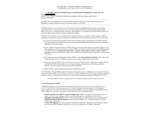
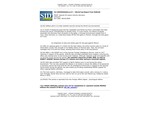
This document highlights a significant development in linguistic resource sharing within the Asia-Pacific region, where NSA Hawaii initiated the first successful voice cut exchange among SIGINT Seniors Pacific (SSPAC) members in June 2007. The use of the CRUSHED ICE data-sharing network to facilitate this exchange marks a key step in enhancing collaborative counterterrorism efforts by expanding the linguistic resources available for terrorist communications analysis.
My notes
DYNAMIC PAGE -- HIGHEST POSSIBLE CLASSIFICATION IS
TOP SECRET // SI / TK // REL TO USA AUS CAN GBR NZL
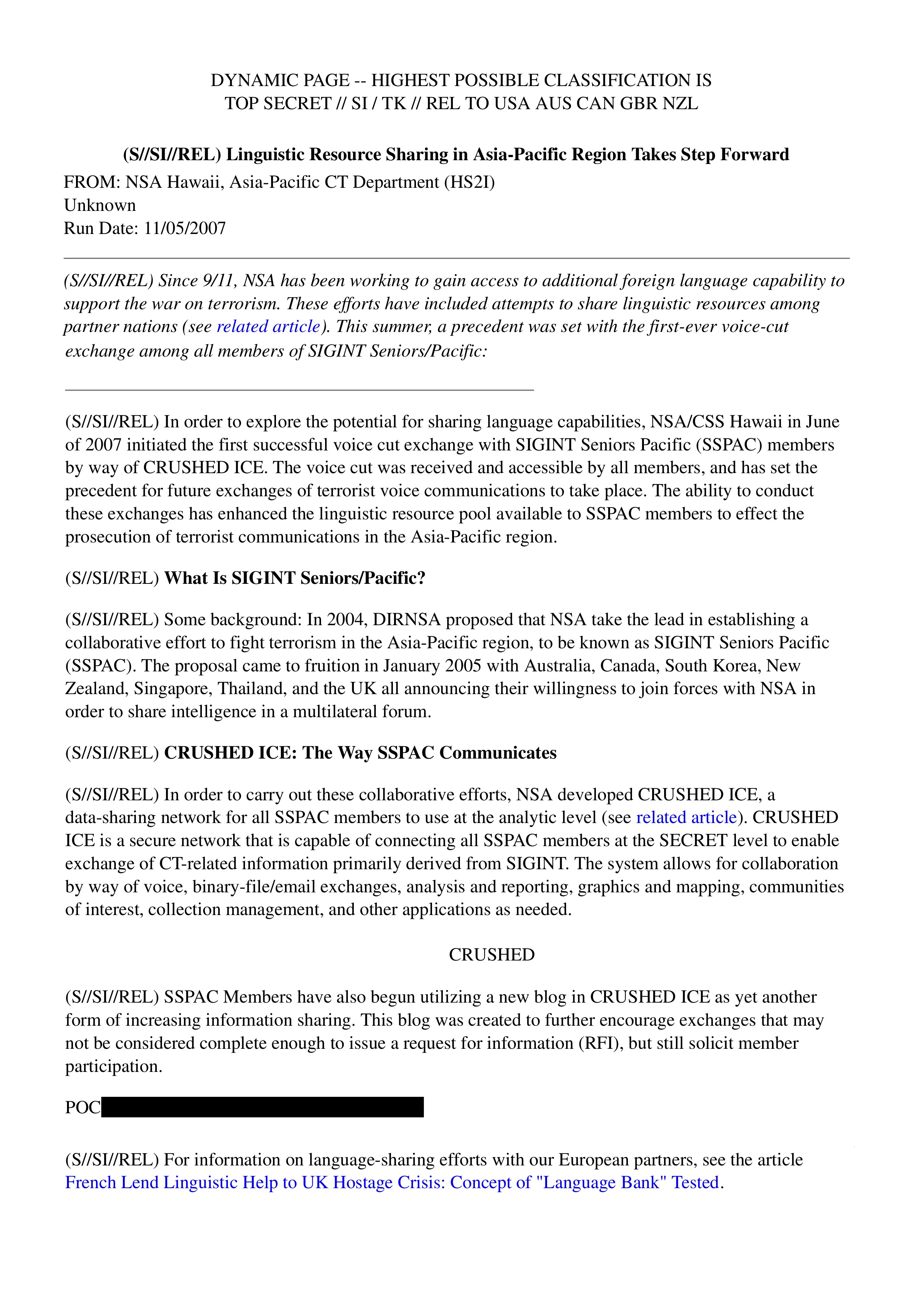
(S//SI//REL) Linguistic Resource Sharing in Asia-Pacific Region Takes Step Forward
FROM: NSA Hawaii, Asia-Pacific CT Department (HS2I)
Unknown
Run Date: 11/05/2007
(S//SI//REL) Since 9/11, NSA has been working to gain access to additional foreign language capability to support the war on terrorism. These efforts have included attempts to share linguistic resources among partner nations (see related article). This summer, a precedent was set with the first-ever voice-cut exchange among all members of SIGINT Seniors/Pacific:
(S//SI//REL) In order to explore the potential for sharing language capabilities, NSA/CSS Hawaii in June of 2007 initiated the first successful voice cut exchange with SIGINT Seniors Pacific (SSPAC) members by way of CRUSHED ICE. The voice cut was received and accessible by all members, and has set the precedent for future exchanges of terrorist voice communications to take place. The ability to conduct these exchanges has enhanced the linguistic resource pool available to SSPAC members to effect the prosecution of terrorist communications in the Asia-Pacific region.
(S//SI//REL) What Is SIGINT Seniors/Pacific?
(S//SI//REL) Some background: In 2004, DIRNSA proposed that NSA take the lead in establishing a collaborative effort to fight terrorism in the Asia-Pacific region, to be known as SIGINT Seniors Pacific (SSPAC). The proposal came to fruition in January 2005 with Australia, Canada, South Korea, New Zealand, Singapore, Thailand, and the UK all announcing their willingness to join forces with NSA in order to share intelligence in a multilateral forum.
(S//SI//REL) CRUSHED ICE: The Way SSPAC Communicates
(S//SI//REL) In order to carry out these collaborative efforts, NSA developed CRUSHED ICE, a data-sharing network for all SSPAC members to use at the analytic level (see related article). CRUSHED ICE is a secure network that is capable of connecting all SSPAC members at the SECRET level to enable exchange of CT-related information primarily derived from SIGINT. The system allows for collaboration by way of voice, binary-file/email exchanges, analysis and reporting, graphics and mapping, communities of interest, collection management, and other applications as needed.
CRUSHED
(S//SI//REL) SSPAC Members have also begun utilizing a new blog in CRUSHED ICE as yet another form of increasing information sharing. This blog was created to further encourage exchanges that may not be considered complete enough to issue a request for information (RFI), but still solicit member participation.
POC [REDACTED]
(S//SI//REL) For information on language-sharing efforts with our European partners, see the article French Lend Linguistic Help to UK Hostage Crisis: Concept of "Language Bank" Tested.
Published in the Same Report
(7 documents)
-
Counterterrorism Analytic Working Group Meets in Madrid SIDtoday [pdf]
This SIDtoday document details the 11th SIGINT Seniors Counterterrorism (SISECT) Analytic Working Group meeting in Madrid, which focused on enhancing counterterrorism collaboration through topics like terrorist use of the Internet, metadata sharing, and language capabilities. Key outcomes included initiatives for SIGINT exploitation of the Internet, improving language processing and translation via SIGDASYS, and fostering deeper cooperation between nations on counterterrorism efforts.
-
SIGINT Seniors Pacific: Successes and Future CT Goals Highlighted at Conference SIDtoday [pdf]
This SIDtoday document details the second annual SIGINT Seniors Pacific (SSPAC) conference held in November 2006, where counterterrorism (CT) officials from eight nations reviewed the progress of their intelligence-sharing and collaboration efforts, set strategic goals for 2007, and discussed the establishment of the CRUSHED ICE communication network. The conference underscored the alliance's successes in producing CT reports, sharing language capabilities, and fostering joint analysis, while also setting ambitious goals for expanding operational collaboration and enhancing the global response to terrorist threats in the Pacific region.
People: Solaiman, Abu -
NSA's Changing Counterterrorism Relationship with India SIDtoday [pdf]
This document details the evolving counterterrorism relationship between NSA and India, highlighting the strengthening of collaboration, particularly after India's 2008 Mumbai attacks, and the integration of India into the SIGINT Seniors Pacific (SSPAC) forum. While the partnership has led to increased intelligence sharing and the deployment of NSA analysts to India, challenges such as leaks of sensitive information have impeded the full maturation of the relationship, necessitating tighter controls and ongoing diplomatic efforts.
-
Who's Who in Afghanistan? SIDtoday [pdf]
This SIDtoday document outlines the structure and organization of U.S. and NATO forces in Afghanistan, detailing the roles of various military and intelligence units, including NSA's deployment of Cryptologic Services Groups (CSGs) and Cryptologic Support Teams (CSTs) to support counterterrorism and tactical operations. It also highlights key NSA locations in Afghanistan, such as Kabul, Bagram, and Kandahar, where NSA personnel provide SIGINT support to U.S. and coalition forces, contributing to intelligence fusion, targeting, and operational support.
People: McChrystal, Stanley -
SIGINT Partnership Agrees to Greater Sharing on Afghanistan, CT, Piracy, and CND SIDtoday [pdf]
This SIDtoday document, covering the 2010 SIGINT Seniors Europe (SSEUR) Principals Conference in Berlin, outlines an agreement to enhance intelligence sharing on Afghanistan, counterterrorism, piracy, and computer-network defense. The conference focused on improving SIGINT support for military operations, counter-IED efforts, and expanding collaboration on global piracy issues, while emphasizing the sharing of critical intelligence such as Terrorist Identities Intelligence (T12) and supporting key leader engagement (KLE) and governance operations in Afghanistan.
People: Uhrlau, Ernst -
GOOOOAAAALLLL!!! -- World Cup Report from SUSLAG SIDtoday [pdf]
NSA kept a watchful eye during the soccer World Cup in Germany, providing "extended-hours support" to the hosts, and in coordination with a number of additional partner nations.
Programs: SISECT“The Powerful Global Spy Alliance You Never Knew Existed” - The Intercept ↗ (2018-03-01) · The Intercept ↗ (2019-05-29) · Gallagher, Ryan -
Global Collaboration Environment: Director’s talking points [pdf]
This NSA document reveals discussions between the agency and GCHQ about establishing a permanent joint surveillance facility in the UK to host the "SIGINT Seniors Europe" coalition, with both agencies coordinating messaging to overcome "persistent pushback" from some member nations. The memo indicates concerns that some European partners were reluctant due to "uncertainty on what missions the center will support, and associated concerns for European human rights laws," while the NSA preferred UK hosting as "optimal in terms of having the most flexibility in tuning the operation to benefit the Five Eyes."
Related Documents
-
SIGINT Seniors Pacific: Successes and Future CT Goals Highlighted at Conference SIDtoday [pdf]
This SIDtoday document details the second annual SIGINT Seniors Pacific (SSPAC) conference held in November 2006, where counterterrorism (CT) officials from eight nations reviewed the progress of their intelligence-sharing and collaboration efforts, set strategic goals for 2007, and discussed the establishment of the CRUSHED ICE communication network. The conference underscored the alliance's successes in producing CT reports, sharing language capabilities, and fostering joint analysis, while also setting ambitious goals for expanding operational collaboration and enhancing the global response to terrorist threats in the Pacific region.
People: Solaiman, Abu -
NSA's Changing Counterterrorism Relationship with India SIDtoday [pdf]
This document details the evolving counterterrorism relationship between NSA and India, highlighting the strengthening of collaboration, particularly after India's 2008 Mumbai attacks, and the integration of India into the SIGINT Seniors Pacific (SSPAC) forum. While the partnership has led to increased intelligence sharing and the deployment of NSA analysts to India, challenges such as leaks of sensitive information have impeded the full maturation of the relationship, necessitating tighter controls and ongoing diplomatic efforts.
-
SIGINT Seniors Pacific - An Update SIDtoday [pdf]
The eight founding members of the Signals Intelligence Seniors Pacific Principals -- Australia, Canada, South Korea, New Zealand, Thailand, Singapore, the U.K., and the U.S. -- met to formalize and establish parameters for their mission of sharing SIGINT that could aid in counterterrorism efforts in the Asia-Pacific region.
Programs: FOLLOWTHEPEOPLEThe Intercept ↗ (2017-09-13) -
New CT Intelligence Exchange With Asia-Pacific Partners SIDtoday [pdf]
The NSA has begun signals intelligence-sharing partnerships with seven other countries' intelligence agencies about 12 specific terrorist groups active in the Asia-Pacific region.
People: Meals, CharlieThe Intercept ↗ (2017-09-13) -
Real-Time Regional Gateway Cloud Analytics for Forward Users [pdf]
This document outlines the NSA’s Real-Time Regional Gateway (RT-RG) program, a global cloud-based signals intelligence system designed to provide near real-time data analysis and targeting support for military and intelligence operations. It details the transition to scalable cloud architectures such as GHOSTMACHINE and Cloudbase, enabling massive data retention, exploitation, advanced geolocation, and automated analytics for tracking high-value targets across multiple theaters, including Afghanistan, Iraq, and the Horn of Africa.
Programs: RT-RG · GOLDMINER · GEOT · AGENTLOGIC · SHARKFINN · SKS · PANOPTICON · DRT · CIDNE · JUGGERNAUT · LOPERS · TALIS · MATTERHORN · AIRHANDLER · LYCANTHROPE · VOICESAIL · RETURNSPRING · SORTINGLEAD · GHOSTMACHINE · GMROYALE · GMREGAL · GMGEIST · GMIDEA · GMTOTE · GMPEN · GMPAC · GMCALM · GMMATE · GMAPPLE · GMCAVE · GMPEACH · GMDEN · GMMOUNT · GMALAMO · GMLIGHT · GMBALTIC · GMPLACE · GMPARK · GMHALO · GMCARBON · DRAGONFIRE · DOMEEXPOSE · GIANTSQUID · MAINWAY · FURIOUSCHAINSAW · SHARKFURY · NIAGARAFILES · SHARKQUERY · SHARKDOCS · OCTAVE · UTT · BEDDOWN · CHEEKYMONKEY · LAYERCAKE · CYBERTRANS · GMSEMINOLE · GMGULF · GMZILLA · HLT · JEMA · NEVIS · SEDB · CLOUDBASE · MAPREDUCE · CASPORT · WAVELEGAL“Mission Creep: How the NSA’s Game-Changing Targeting System Built for Iraq and Afghanistan Ended Up on the Mexico Border” - The Intercept ↗ (2019-05-29) · “Norges hemmelige krig i Afghanistan” - NRK ↗ (2019-05-29) · Moltke, Henrik · Skille, Øyvind Bye · Døvik, Olav · Hansen, Ståle Ellingsgard · Fjørtoft, Martin