India: Support to Terrorist Attacks in Mumbai
Open PDFDocument date: -
Pages: 1
Genre: report
Banner: TOP SECRET//COMINT//REL TO USA, AUS, CAN, GBR//
Classification: TOP SECRET SI
Dissemination: REL TO USA, FVEY
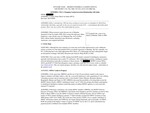
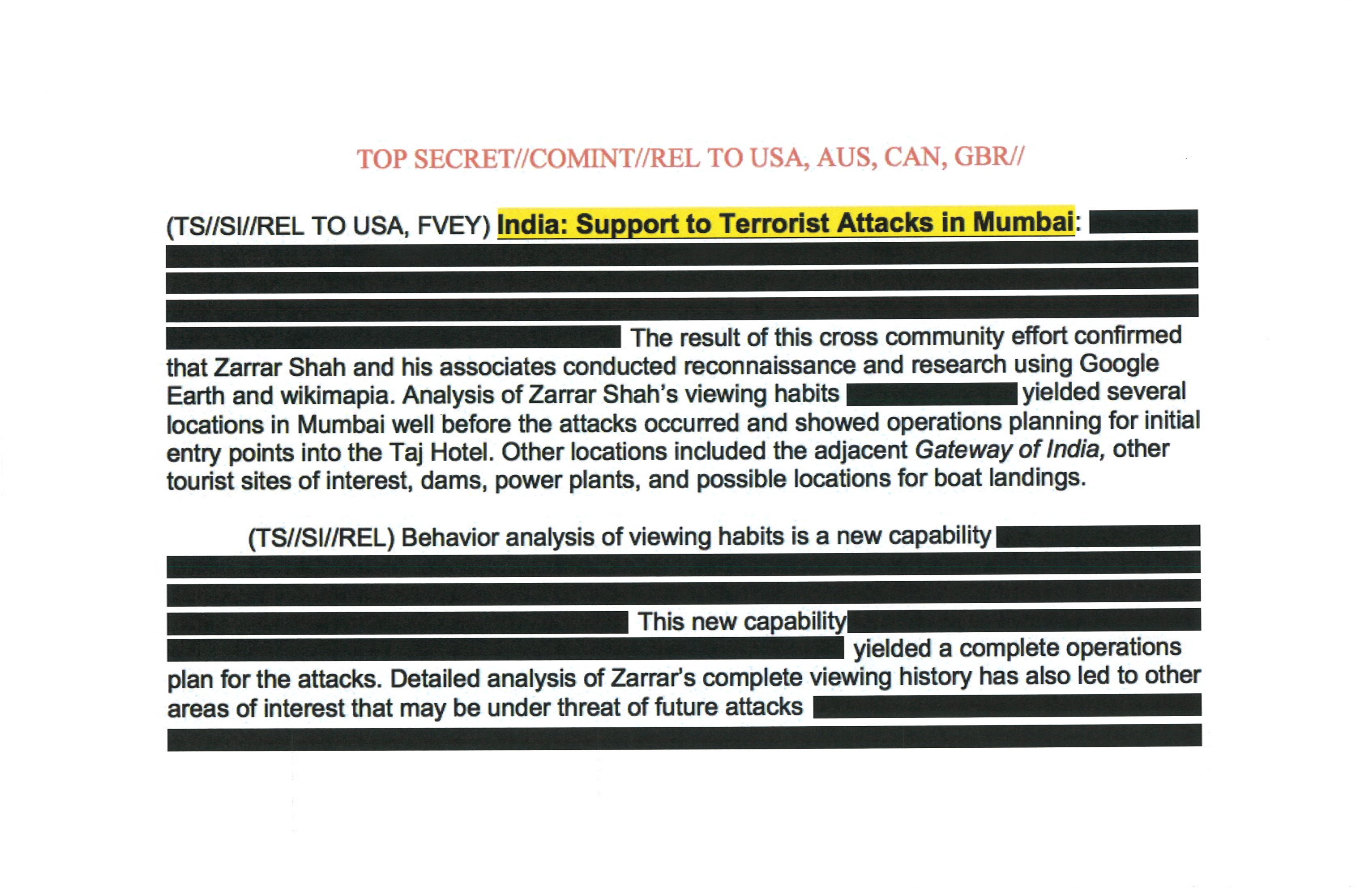
A top secret NSA intelligence report on GCHQ's surveillance of Lashkar-e-Taiba technology chief Zarrar Shah before and during the November 2008 Mumbai attacks, documenting how analysis of his internet browsing and viewing habits revealed reconnaissance activity and operational planning against Mumbai targets including the Taj Hotel.
My notes
TOP SECRET//COMINT//REL TO USA, AUS, CAN, GBR//
(TS//SI//REL TO USA, FVEY) India: Support to Terrorist Attacks in Mumbai: [REDACTED]
[REDACTED]
[REDACTED]
[REDACTED]
[REDACTED] The result of this cross community effort confirmed
that Zarrar Shah and his associates conducted reconnaissance and research using Google
Earth and wikimapia. Analysis of Zarrar Shah's viewing habits [REDACTED] yielded several
locations in Mumbai well before the attacks occurred and showed operations planning for initial
entry points into the Taj Hotel. Other locations included the adjacent Gateway of India, other
tourist sites of interest, dams, power plants, and possible locations for boat landings.
(TS//SI//REL) Behavior analysis of viewing habits is a new capability [REDACTED]
[REDACTED]
[REDACTED]
[REDACTED] This new capability [REDACTED]
[REDACTED] yielded a complete operations
plan for the attacks. Detailed analysis of Zarrar's complete viewing history has also led to other
areas of interest that may be under threat of future attacks [REDACTED]
[REDACTED]
Related Documents
-
Temporary SCS Site Established for Presidential Visit to India; Threats to President Reported SIDtoday [pdf]
In preparation for President George W. Bush’s first visit to India, a temporary Special Collection Service site has been set up in Hyderabad. A letter intercepted by Indian intelligence indicates a potential terrorist attack, and “predominately Muslim and Left Wing groups” plan demonstrations.
People: Bush, George W.The Intercept ↗ (2018-08-15) -
New Staff Supports Network Attack SIDtoday [pdf]
In the summer of 2004, DIRNSA got new responsibilities. In addition to computer network exploitation, which involved hacking networks and extracting information, NSA will be in charge of computer network attack, which are "operations to disrupt, deny, degrade, or destroy information resident in computers and computer networks, or the computers and networks themselves." Lt. Gen. Michael Hayden established the Network Attack Support Staff organization to support these responsibilities.
The Intercept ↗ (2017-04-24) -
NSA's Changing Counterterrorism Relationship with India SIDtoday [pdf]
This document details the evolving counterterrorism relationship between NSA and India, highlighting the strengthening of collaboration, particularly after India's 2008 Mumbai attacks, and the integration of India into the SIGINT Seniors Pacific (SSPAC) forum. While the partnership has led to increased intelligence sharing and the deployment of NSA analysts to India, challenges such as leaks of sensitive information have impeded the full maturation of the relationship, necessitating tighter controls and ongoing diplomatic efforts.
-
NSA Lends Support to Upcoming G8 and G20 Summits in Canada SIDtoday [pdf]
This document details how NSA spied the 2010 G8 and G20 summits in Canada, including coordination with Canadian partner CSEC to provide intelligence, threat monitoring, and policy support from a Threat Integration Center at the U.S. Embassy in Ottawa. It outlines operational plans, situational awareness, and reporting structures to assist executive protection and event security during the summits.
Programs: SCQAWKPeople: Obama, Barack -
2009: A Watershed Year in the Fight Against Terrorism SIDtoday [pdf]
SIDtoday celebrated “a watershed period in the fight against terrorism and radical extremist groups,” noting that the NSA first discovered Najibullah Zazi’s email connections to Al-Qaeda operatives in Pakistan.
Programs: SCQAWKPeople: Zazi, Najibullah