GCHQ - PCS Harvesting
Open PDFDocument date: 2010-04-27
Pages: 33
Genre: report
Banner: TOP SECRET STRAP1
Classification: TOP SECRET STRAP 1
Dissemination: -
A TOP SECRET STRAP1 report details how GCHQ industrialized the theft of GSM subscriber authentication keys (Ki) by automating trawls of bulk “C2C” content to extract IMSI/Ki pairs from emails and FTP transfers between SIM personalisation centers and mobile operators. It shows the program scaling key harvesting across networks and countries, complementing computer network exploitation against core mobile infrastructure to suppress billing and lift authentication secrets.
My notes

TOP SECRET STRAP1
Reference: OPC-TDSD/TECH/21
Date: 27th April 2010
PCS Harvesting at Scale
[REDACTED] (OPC-TDSD)
[REDACTED] (OPC-TDSD)
[REDACTED] (OPC-CAP)
[REDACTED] (OPC-TDSD)
Summary
This report explores the introduction of an automated approach to Ki harvesting in OPC-TDSD with the aim of increasing the volume of keys that can be collected. Methods are also explored to use data from the automated system to assess the effectiveness of current techniques and improve TDSD's knowledge of mobile network operations. Work was carried out between January and April 2010 in OPC-TDSD and OPC-CAP.
Distribution (all softcopies, via email)
OPC-TDSD ([REDACTED])
OPC-HQ ([REDACTED])
OPC-CDP ([REDACTED])
OPC-MCR ([REDACTED])
ICTR ([REDACTED])
OPC-CAP ([REDACTED])
OPD-GTAC ([REDACTED])
NSA ([REDACTED])
TDB ([REDACTED])
OPD-SDH ([REDACTED])
TEA ([REDACTED])
1 of 24
This information is exempt from disclosure under the Freedom of Information Act 2000 and may be subject to exemption under other UK information legislation. Refer disclosure requests to GCHQ on [REDACTED] (non-sec) or email [REDACTED]
TOP SECRET STRAP1
TOP SECRET STRAP1
OPC-TDSD/TECH/21
PCS Harvesting at Scale
Introducing Automation to Ki Harvesting Efforts in TDSD
[REDACTED] OPC-TDSD
April 2010
Contributions from [REDACTED], [REDACTED] and [REDACTED]
Summary
Individual Subscriber Authentication Keys, or Ki values, are required to decrypt GSM communications. They are stored both on the mobile user's SIM card and at a Home Location Register operated by the provider. TDSD has developed a methodology for intercepting these keys as they are transferred between various network operators and SIM card providers. This is now a core part of TDSD's business carried out by analysts in the team. This report
explores the introduction of an automated technique with the aim of increasing the volume of keys that can be harvested. Methods are also explored to use data from the automated system to assess the effectiveness of current techniques and improve TDSD's knowledge of mobile network operations.
2 of 24
This information is exempt from disclosure under the Freedom of Information Act 2000 and may be subject to exemption under other UK information legislation. Refer disclosure requests to GCHQ on [REDACTED] (non-sec) or email [REDACTED]
TOP SECRET STRAP1
TOP SECRET STRAP1
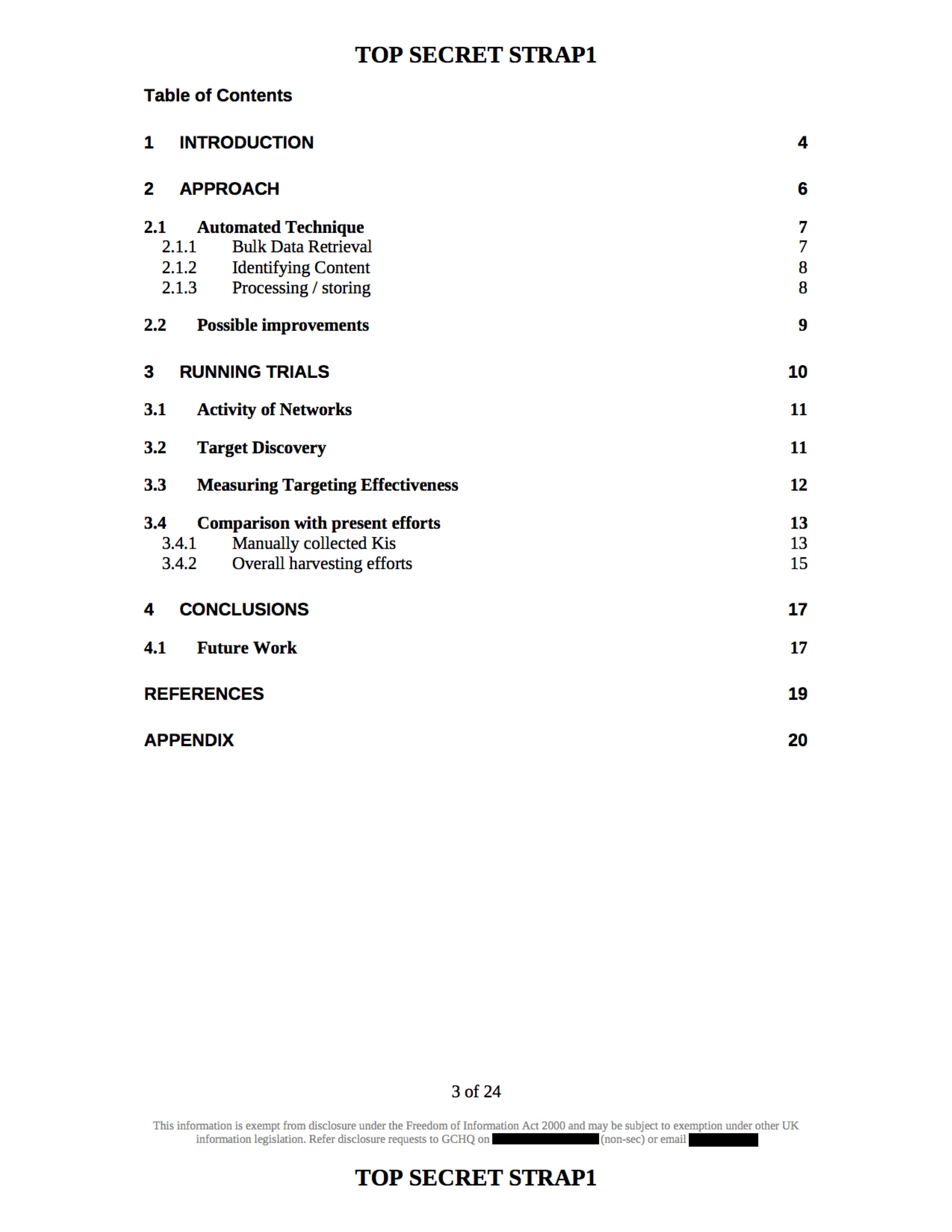
Table of Contents
1 INTRODUCTION 4
2 APPROACH 6
2.1 Automated Technique 7
2.1.1 Bulk Data Retrieval 7
2.1.2 Identifying Content 8
2.1.3 Processing / storing 8
2.2 Possible improvements 9
3 RUNNING TRIALS 10
3.1 Activity of Networks 11
3.2 Target Discovery 11
3.3 Measuring Targeting Effectiveness 12
3.4 Comparison with present efforts 13
3.4.1 Manually collected Kis 13
3.4.2 Overall harvesting efforts 15
4 CONCLUSIONS 17
4.1 Future Work 17
REFERENCES 19
APPENDIX 20
3 of 24
This information is exempt from disclosure under the Freedom of Information Act 2000 and may be subject to exemption under other UK information legislation. Refer disclosure requests to GCHQ on [REDACTED] (non-sec) or email [REDACTED]
TOP SECRET STRAP1
TOP SECRET STRAP1
1 Introduction
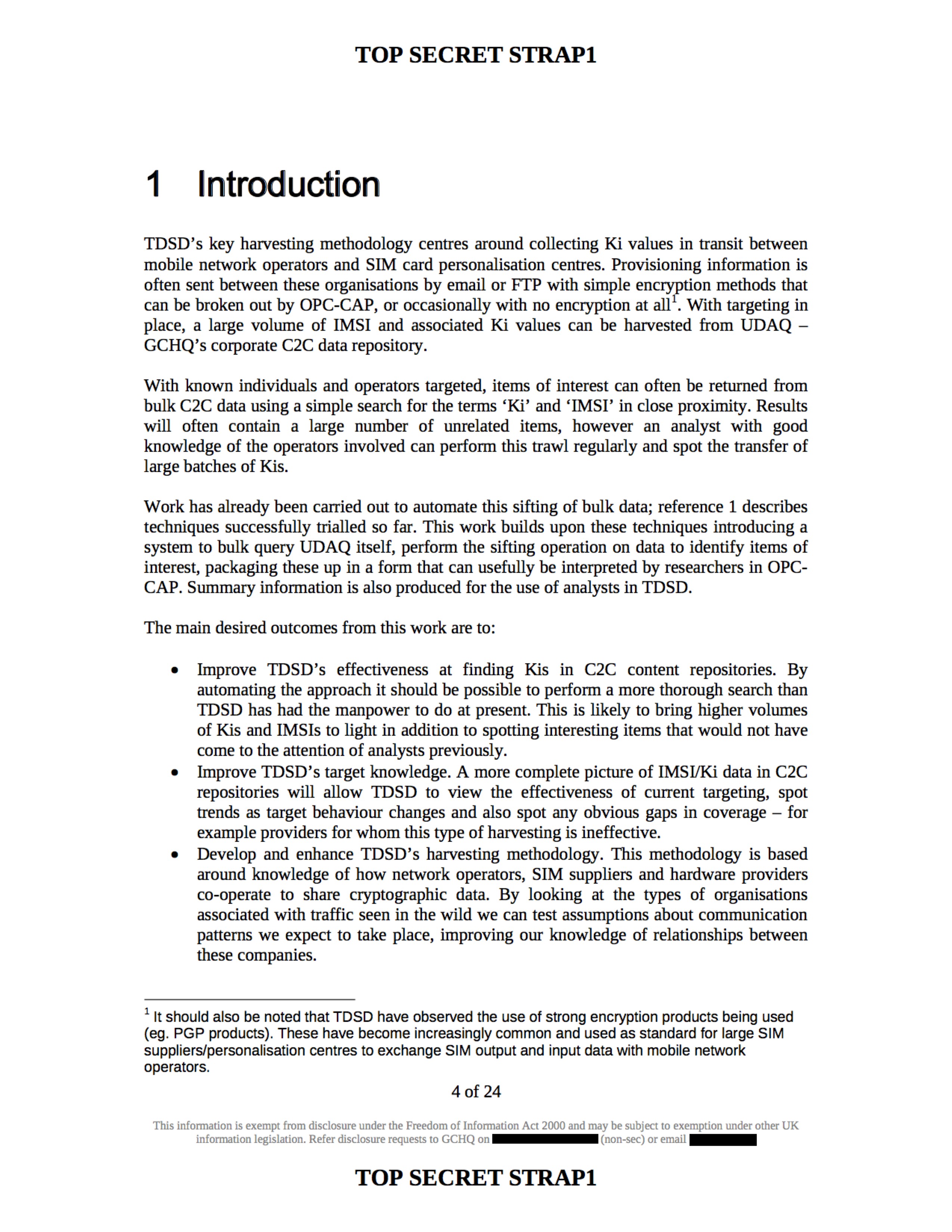
TDSD's key harvesting methodology centres around collecting Ki values in transit between mobile network operators and SIM card personalisation centres. Provisioning information is often sent between these organisations by email or FTP with simple encryption methods that can be broken out by OPC-CAP, or occasionally with no encryption at all¹. With targeting in place, a large volume of IMSI and associated Ki values can be harvested from UDAQ GCHQ's corporate C2C data repository.
With known individuals and operators targeted, items of interest can often be returned from bulk C2C data using a simple search for the terms 'Ki' and 'IMSI' in close proximity. Results will often contain a large number of unrelated items, however an analyst with good knowledge of the operators involved can perform this trawl regularly and spot the transfer of large batches of Kis.
Work has already been carried out to automate this sifting of bulk data; reference 1 describes techniques successfully trialled so far. This work builds upon these techniques introducing a system to bulk query UDAQ itself, perform the sifting operation on data to identify items of interest, packaging these up in a form that can usefully be interpreted by researchers in OPC-CAP. Summary information is also produced for the use of analysts in TDSD.
The main desired outcomes from this work are to:
- Improve TDSD's effectiveness at finding Kis in C2C content repositories. By automating the approach it should be possible to perform a more thorough search than TDSD has had the manpower to do at present. This is likely to bring higher volumes of Kis and IMSIs to light in addition to spotting interesting items that would not have come to the attention of analysts previously.
- Improve TDSD's target knowledge. A more complete picture of IMSI/Ki data in C2C repositories will allow TDSD to view the effectiveness of current targeting, spot trends as target behaviour changes and also spot any obvious gaps in coverage - for example providers for whom this type of harvesting is ineffective.
- Develop and enhance TDSD's harvesting methodology. This methodology is based around knowledge of how network operators, SIM suppliers and hardware providers co-operate to share cryptographic data. By looking at the types of organisations associated with traffic seen in the wild we can test assumptions about communication patterns we expect to take place, improving our knowledge of relationships between these companies.
¹ It should also be noted that TDSD have observed the use of strong encryption products being used (eg. PGP products). These have become increasingly common and used as standard for large SIM suppliers/personalisation centres to exchange SIM output and input data with mobile network operators.
4 of 24
This information is exempt from disclosure under the Freedom of Information Act 2000 and may be subject to exemption under other UK information legislation. Refer disclosure requests to GCHQ on [REDACTED] (non-sec) or email [REDACTED]
TOP SECRET STRAP1
TOP SECRET STRAP1
Additionally it is likely that similar opportunities exist to introduce this type of automation to other analyst tasks. This work will help develop requirements for such services and bring more automation opportunities to light.
5 of 24
This information is exempt from disclosure under the Freedom of Information Act 2000 and may be subject to exemption under other UK information legislation. Refer disclosure requests to GCHQ on [REDACTED] (non-sec) or email [REDACTED]
TOP SECRET STRAP1
TOP SECRET STRAP1
2 Approach
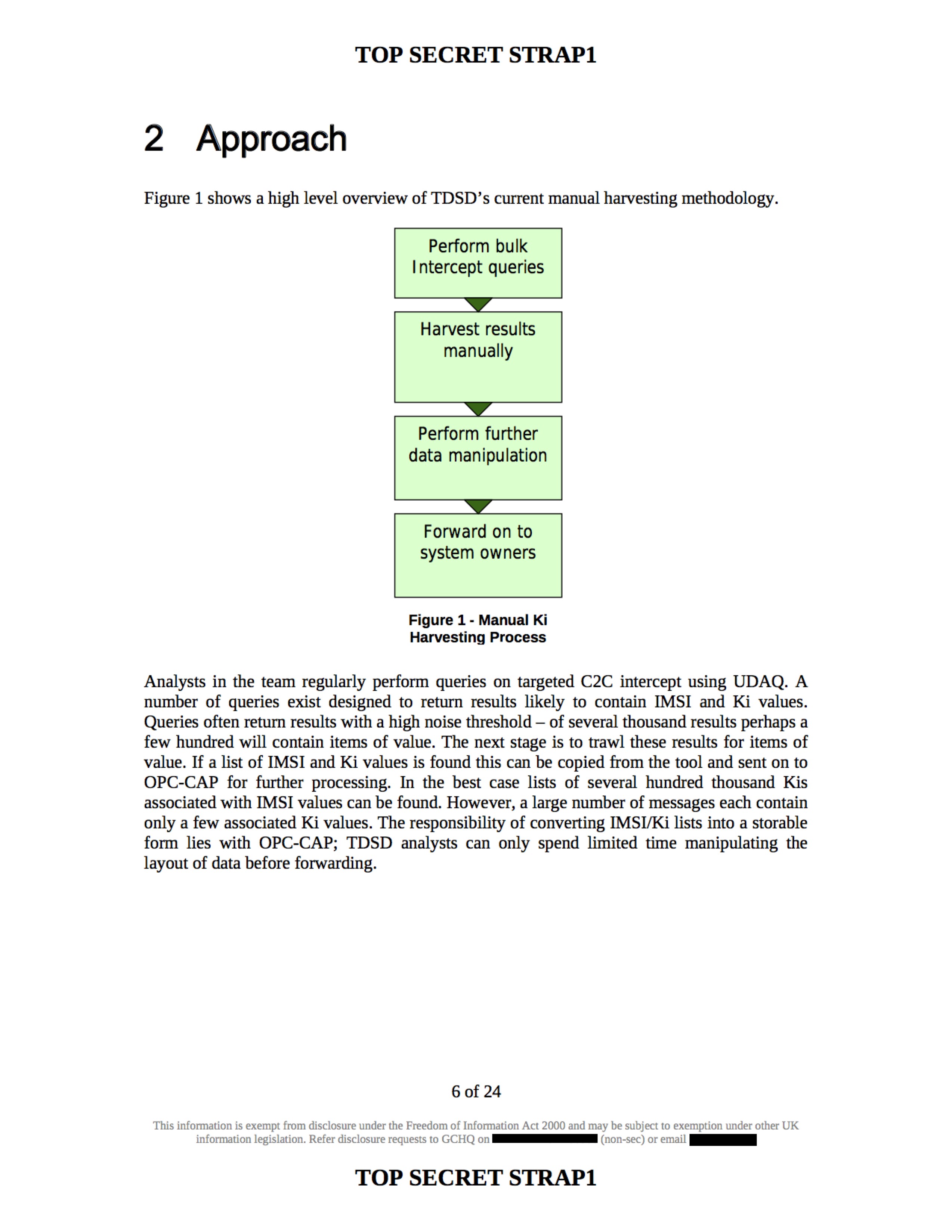
Figure 1 shows a high level overview of TDSD's current manual harvesting methodology.
+---------------------------+
| Perform bulk              |
| Intercept queries         |
+---------------------------+
          |
          v
+---------------------------+
| Harvest results           |
| manually                  |
+---------------------------+
          |
          v
+---------------------------+
| Perform further           |
| data manipulation         |
+---------------------------+
          |
          v
+---------------------------+
| Forward on to             |
| system owners             |
+---------------------------+
Figure 1 - Manual Ki Harvesting Process
Analysts in the team regularly perform queries on targeted C2C intercept using UDAQ. A number of queries exist designed to return results likely to contain IMSI and Ki values. Queries often return results with a high noise threshold - of several thousand results perhaps a few hundred will contain items of value. The next stage is to trawl these results for items of value. If a list of IMSI and Ki values is found this can be copied from the tool and sent on to OPC-CAP for further processing. In the best case lists of several hundred thousand Kis associated with IMSI values can be found. However, a large number of messages each contain only a few associated Ki values. The responsibility of converting IMSI/Ki lists into a storable form lies with OPC-CAP; TDSD analysts can only spend limited time manipulating the layout of data before forwarding.
6 of 24
This information is exempt from disclosure under the Freedom of Information Act 2000 and may be subject to exemption under other UK information legislation. Refer disclosure requests to GCHQ on [REDACTED] (non-sec) or email [REDACTED]
TOP SECRET STRAP1
TOP SECRET STRAP1
2.1 Automated Technique
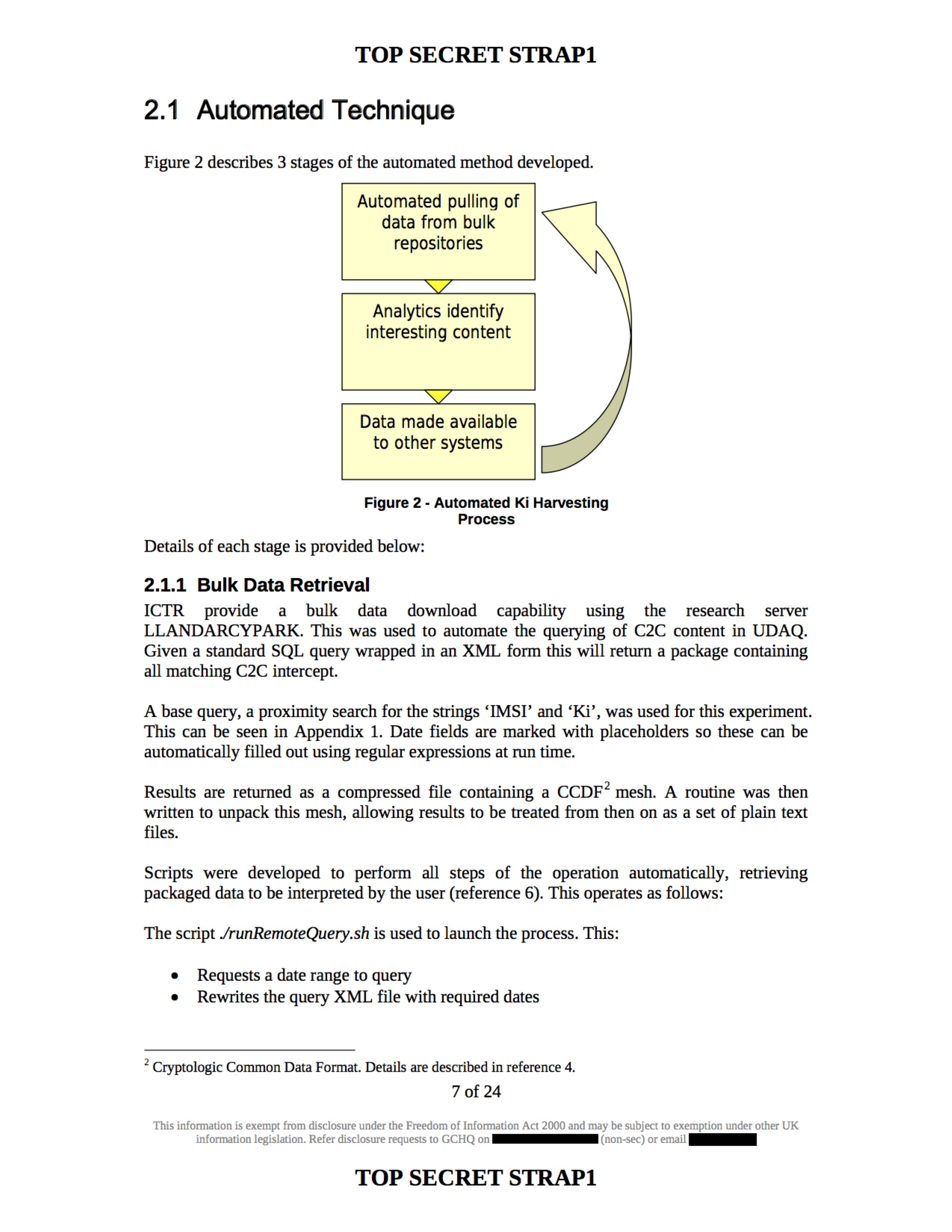
Figure 2 describes 3 stages of the automated method developed.
+---------------------------+
| Automated pulling of      |
| data from bulk            |
| repositories              |
+---------------------------+
          |
          v
+---------------------------+
| Analytics identify        |
| interesting content       |
+---------------------------+
          |
          v
+---------------------------+
| Data made available       |
| to other systems          |
+---------------------------+
Figure 2 - Automated Ki Harvesting Process
Details of each stage is provided below:
2.1.1 Bulk Data Retrieval
ICTR provide a bulk data download capability using the research server LLANDARCYPARK. This was used to automate the querying of C2C content in UDAQ. Given a standard SQL query wrapped in an XML form this will return a package containing all matching C2C intercept.
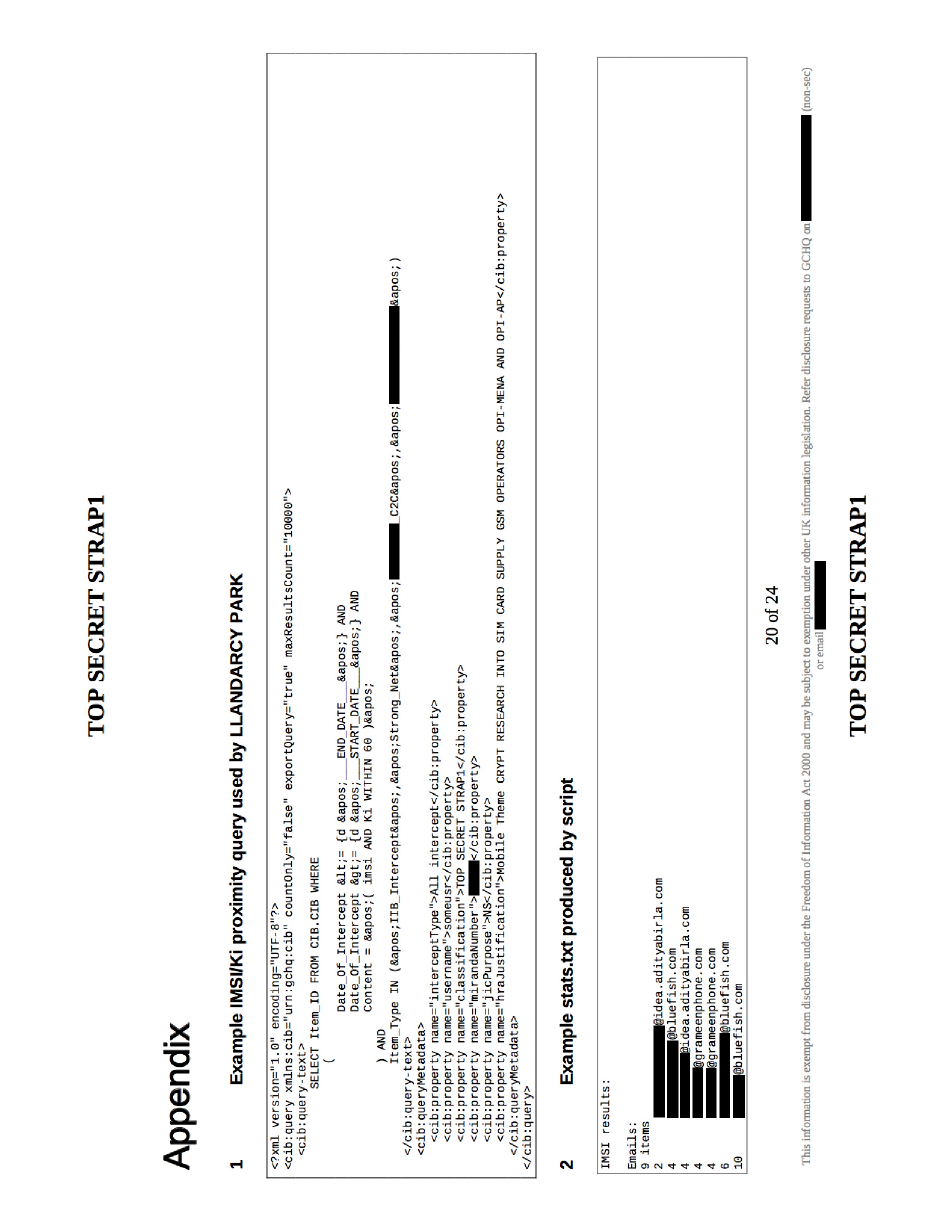
A base query, a proximity search for the strings 'IMSI' and 'Ki', was used for this experiment. This can be seen in Appendix 1. Date fields are marked with placeholders so these can be automatically filled out using regular expressions at run time.
Results are returned as a compressed file containing a CCDF² mesh. A routine was then written to unpack this mesh, allowing results to be treated from then on as a set of plain text files.
Scripts were developed to perform all steps of the operation automatically, retrieving packaged data to be interpreted by the user (reference 6). This operates as follows:
The script ./runRemoteQuery.sh is used to launch the process. This:
- Requests a date range to query
- Rewrites the query XML file with required dates
² Cryptologic Common Data Format. Details are described in reference 4.
7 of 24
This information is exempt from disclosure under the Freedom of Information Act 2000 and may be subject to exemption under other UK information legislation. Refer disclosure requests to GCHQ on [REDACTED] (non-sec) or email [REDACTED]
TOP SECRET STRAP1
TOP SECRET STRAP1
- Transfers all required files onto the LLANDARCYPARK server, including
pulludaq.sh
pulludaq.sh is then executed on LLANDARCYPARK. This:
- Executes the bulk IIB query (can take 5-10 mins)
- Retrieves query results as compressed CCDF files
- Unpacks the CCDF contents into a directory as plain text for processing.
The next stage is to identify content of interest in the processed files.
2.1.2 Identifying Content
Once plain text is retrieved from IIB this is parsed to identify items containing IMSI and Ki values. A previously proven rule based approach is used to identify content of interest.
The routine scrapes the plain text identifying lines containing IMSI and Ki values, which may appear in intercept in any conceivable format. The technique also attempts to identify header information describing the contents, as well as associating results with a UDAQ identifier that can be later researched. Further technical discussion on this technique is available in reference 1, TDSD Technical Note 11: What Makes a Good PCS Key Harvester?.
A final stage generates statistics and additional information linked to the results, developed in consultation with TDSD analysts. This includes:
- A list of unique UDAQ item identifiers resulting in valid Ki / IMSI data. This allows analysts to conduct further research into these traffic sources. These are ranked according to the number of sections of IMSI data seen in each UDAQ item.
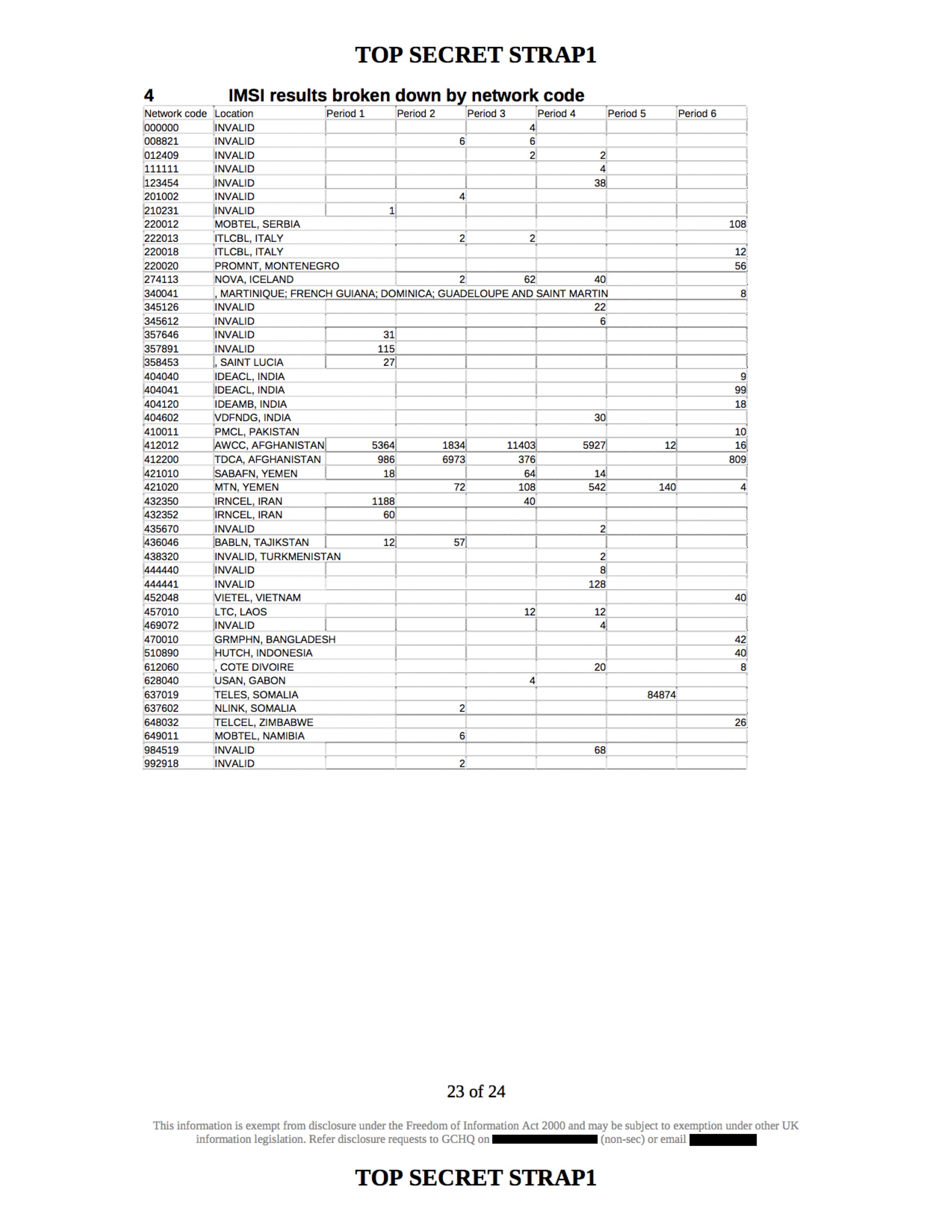
- A list of network and country codes identified. These are derived from the first 6 characters of an IMSI and used to provide an overview of countries and networks identified.
- A list of associated email addresses. This is generated by scraping all email addresses from results found to contain valid Ki data. These are then ranked by the number of occurrences of each address.
Care should be taken when interpreting ranking positions. In the case of email addresses a higher score does not necessarily indicate association with more Kis, however they can provide an indication of how active an address is.
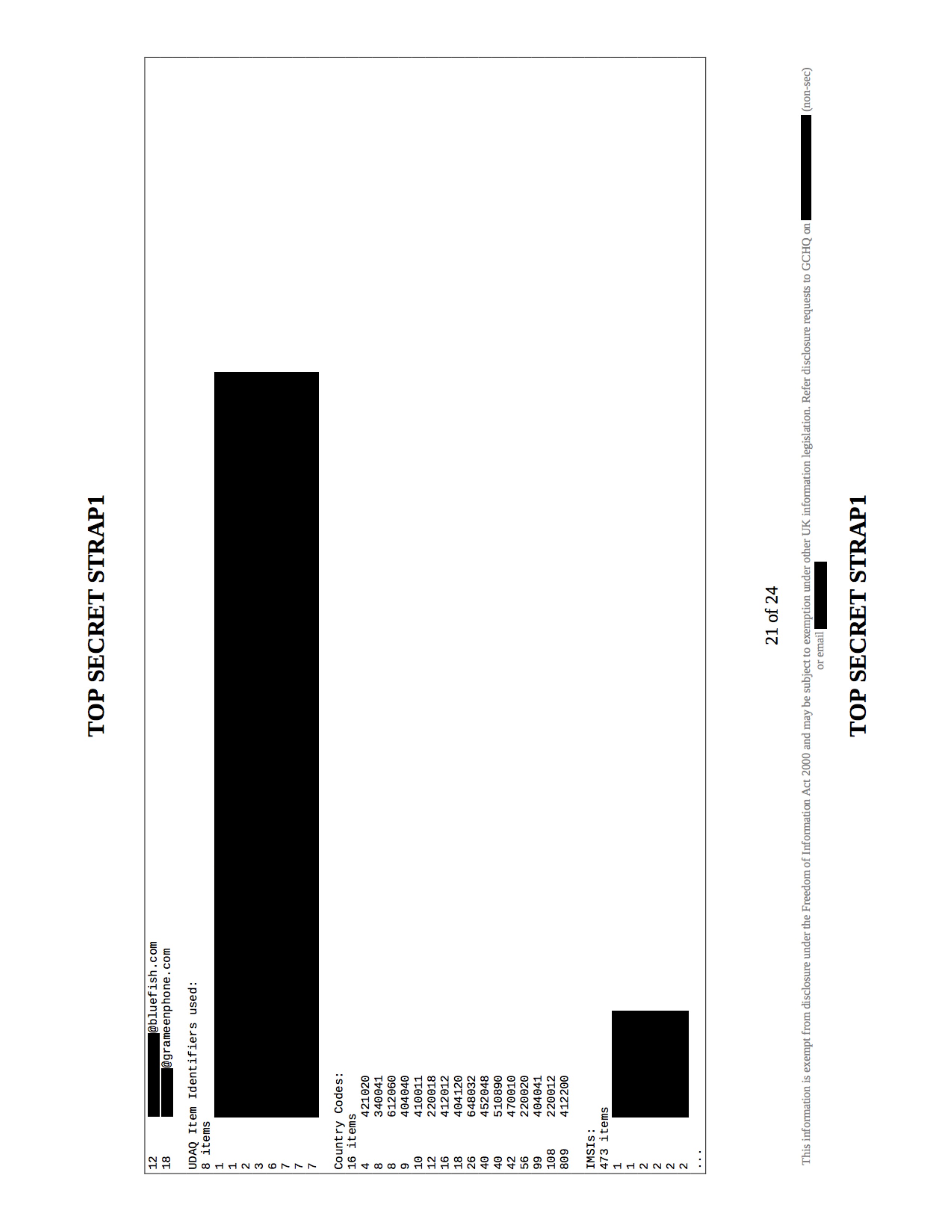
An example set of statistics produced is shown in Appendix 2.
2.1.3 Processing / storing
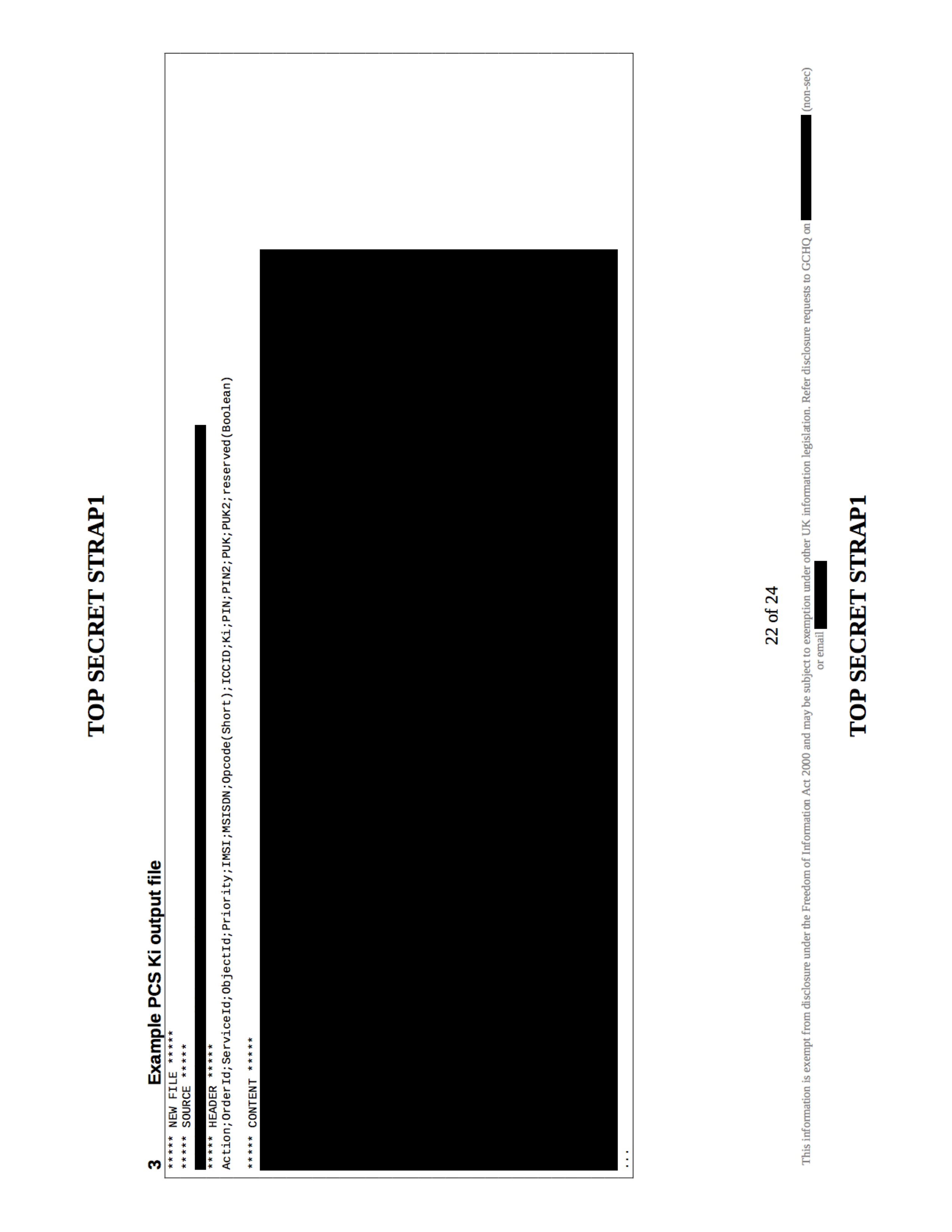
Output files generated by the previous step typically take the form shown in Appendix 3 – section markers separate the UDAQ item reference, potential header information and IMSI/Ki content. This format was developed alongside OPC-CAP. It should be noted that although the content will contain IMSI and Ki data it could take any conceivable form - it is presented as found in raw intercept. It is the task of OPC-CAP to interpret any additional data in any recognised header section, decoding as necessary. Ki values may still be encrypted at this
stage.
8 of 24
This information is exempt from disclosure under the Freedom of Information Act 2000 and may be subject to exemption under other UK information legislation. Refer disclosure requests to GCHQ on [REDACTED] (non-sec) or email [REDACTED]
TOP SECRET STRAP1
TOP SECRET STRAP1
OPC-CAP have developed and successfully trialled techniques to speed up the task of importing these scripts, indentifying expected column header names and mapping these to data fields, and even automating the final decryption stage.
Once properly interpreted these Ki values can be stored, encrypted or clear, in relevant databases and shared with partners as necessary.
2.2 Possible improvements
A number of improvements have been identified for the above technique. These are described below:
- Improved access rights for bulk data retrieval
Access to ICTR's bulk access capability runs on research prototype hardware and is supported only on a best endeavours basis. Making use of a processing user to obtain data, the maximum classification that can be returned is TOP SECRET STRAP2 UK Eyes Only. This means that some data currently retrieved using the manual method, such as password-recovered items, is not available to the automated system. An improved system would allow bulk access to more intercept data. - Processing performance
Performance of queries on LLANDARCYPARK is comparable to that of UDAQ, however when large numbers of items are retrieved the generation of statistics can take some time (sometimes hours for large sets). Some simple code optimisations could significantly improve this performance. - Improvements to summary information scores and ranking
The value of using ranks to assess the usefulness of an email or UDAQ item identified is limited, since the score used relates to the number of sections of Ki data in a given file. This means where a very large number of IMSIs are identified, but they appear in a single block, a low score is awarded. A value relating to the number of IMSI items would be more useful to identify the most important results.
9 of 24
This information is exempt from disclosure under the Freedom of Information Act 2000 and may be subject to exemption under other UK information legislation. Refer disclosure requests to GCHQ on [REDACTED] (non-sec) or email [REDACTED]
TOP SECRET STRAP1
TOP SECRET STRAP1
3 Running Trials
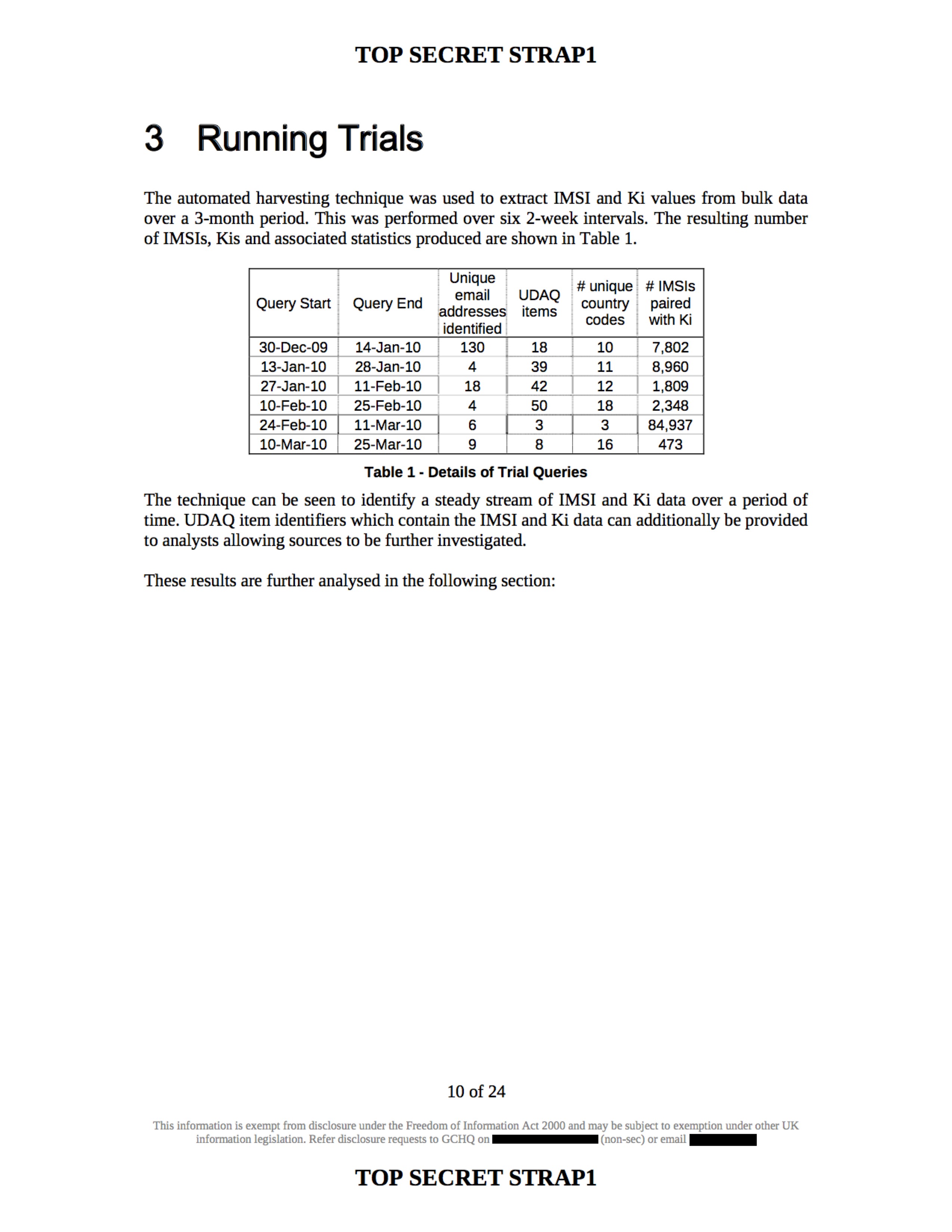
The automated harvesting technique was used to extract IMSI and Ki values from bulk data over a 3-month period. This was performed over six 2-week intervals. The resulting number of IMSIs, Kis and associated statistics produced are shown in Table 1.
| Query Start | Query End | Unique email addresses identified | UDAQ items | # unique country codes | # IMSIs paired with Ki |
|---|---|---|---|---|---|
| 30-Dec-09 | 14-Jan-10 | 130 | 18 | 10 | 7,802 |
| 13-Jan-10 | 28-Jan-10 | 4 | 39 | 11 | 8,960 |
| 27-Jan-10 | 11-Feb-10 | 18 | 42 | 12 | 1,809 |
| 10-Feb-10 | 25-Feb-10 | 4 | 50 | 18 | 2,348 |
| 24-Feb-10 | 11-Mar-10 | 6 | 3 | 3 | 84,937 |
| 10-Mar-10 | 25-Mar-10 | 9 | 8 | 16 | 473 |
Table 1 - Details of Trial Queries
The technique can be seen to identify a steady stream of IMSI and Ki data over a period of time. UDAQ item identifiers which contain the IMSI and Ki data can additionally be provided to analysts allowing sources to be further investigated.
These results are further analysed in the following section:
10 of 24
This information is exempt from disclosure under the Freedom of Information Act 2000 and may be subject to exemption under other UK information legislation. Refer disclosure requests to GCHQ on [REDACTED] (non-sec) or email [REDACTED]
TOP SECRET STRAP1
TOP SECRET STRAP1
3.1 Activity of Networks
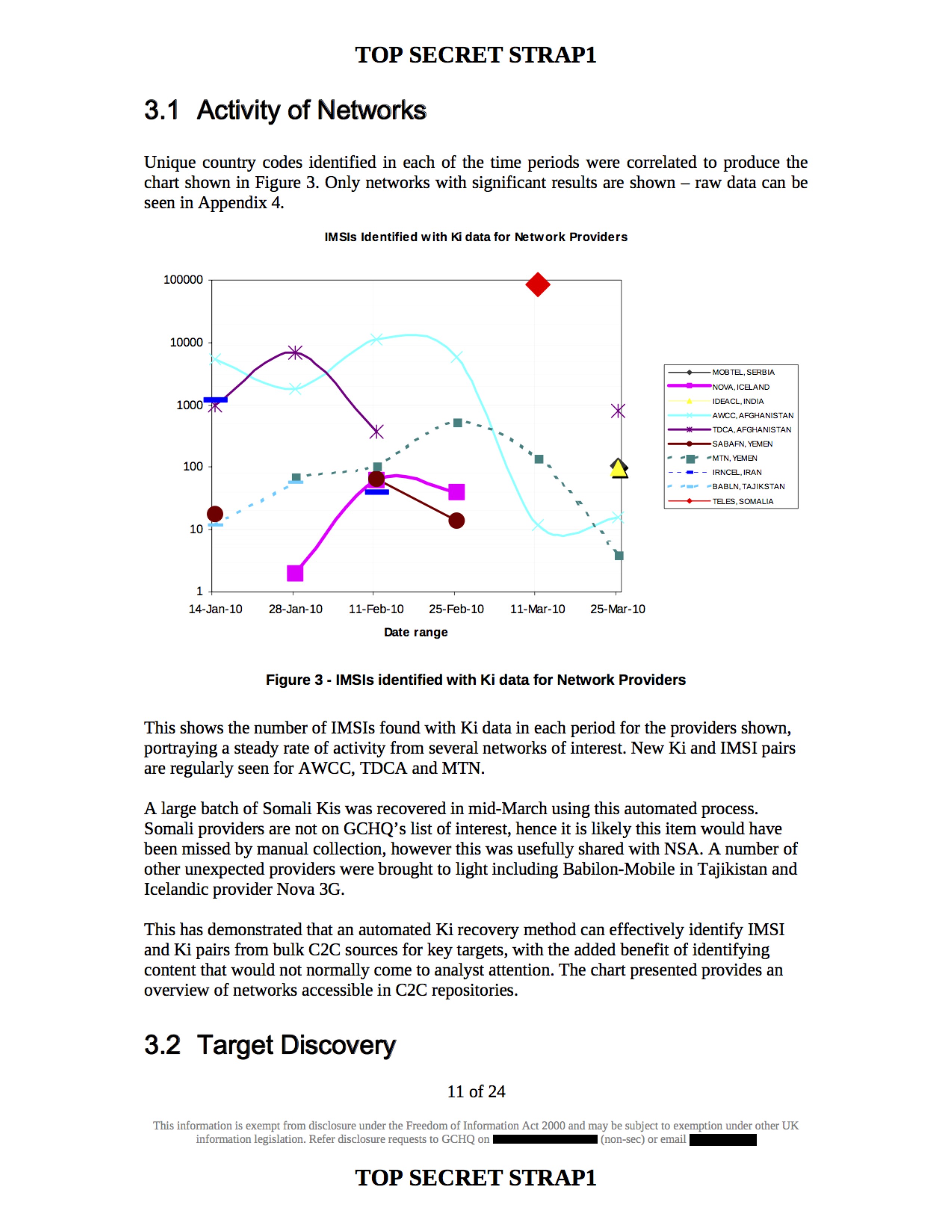
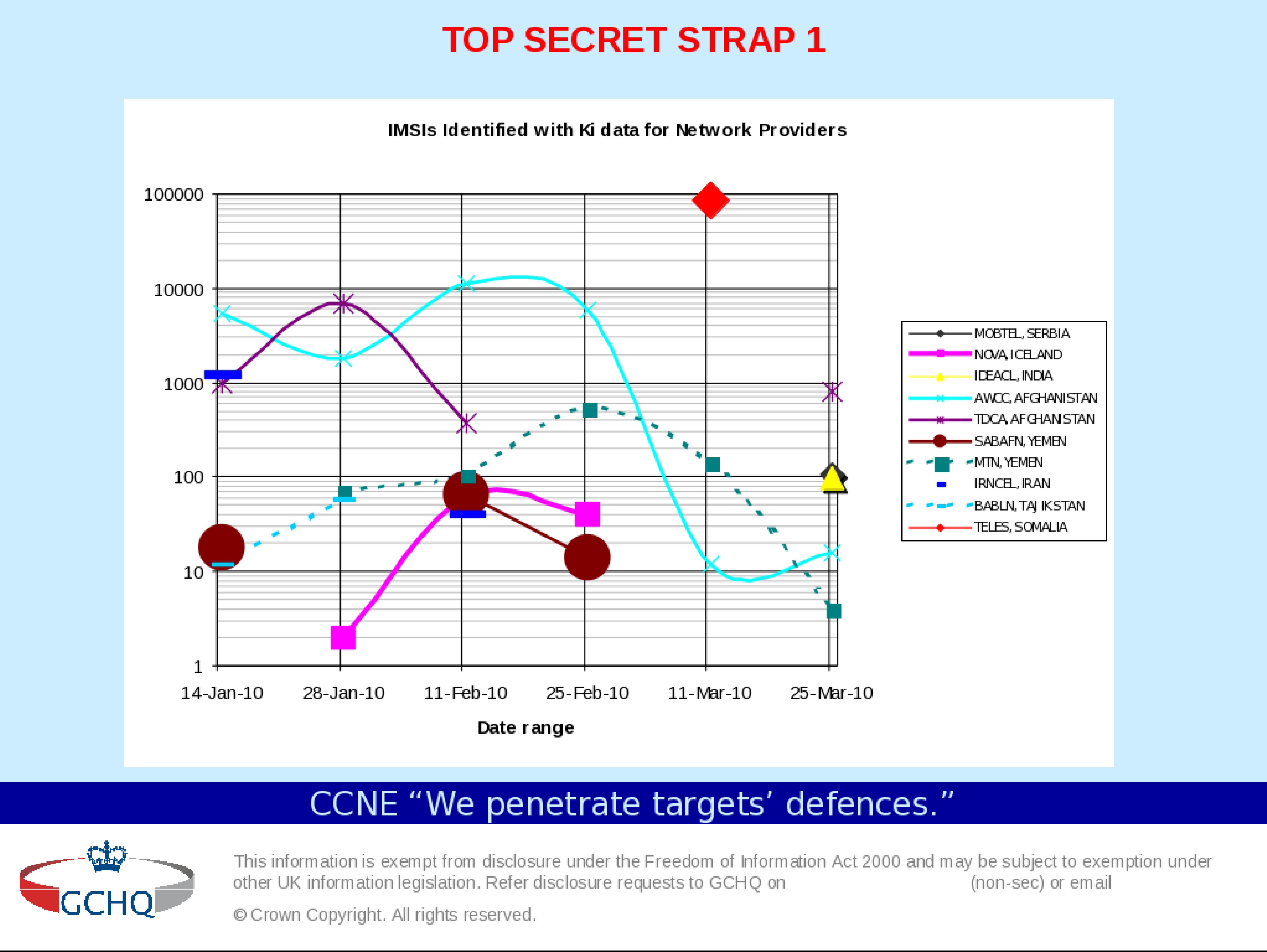
Unique country codes identified in each of the time periods were correlated to produce the chart shown in Figure 3. Only networks with significant results are shown – raw data can be seen in Appendix 4.
IMSIs identified with Ki data for Network Providers
100000
10000
1000
100
10
1
14-Jan-10
28-Jan-10
11-Feb-10
25-Feb-10
11-Mar-10
25-Mar-10
Date range
MOBTEL, SERBIA
NOVA, ICELAND
IDEACL, INDIA
AWCC, AFGHANISTAN
TDCA, AFGHANISTAN
SABAFN, YEMEN
MTN, YEMEN
IRNCEL, IRAN
BABLN, TAJIKSTAN
TELES, SOMALIA
Figure 3 - IMSIs identified with Ki data for Network Providers
This shows the number of IMSIs found with Ki data in each period for the providers shown, portraying a steady rate of activity from several networks of interest. New Ki and IMSI pairs are regularly seen for AWCC, TDCA and MTN.
A large batch of Somali Kis was recovered in mid-March using this automated process. Somali providers are not on GCHQ's list of interest, hence it is likely this item would have been missed by manual collection, however this was usefully shared with NSA. A number of other unexpected providers were brought to light including Babilon-Mobile in Tajikistan and Icelandic provider Nova 3G.
This has demonstrated that an automated Ki recovery method can effectively identify IMSI and Ki pairs from bulk C2C sources for key targets, with the added benefit of identifying content that would not normally come to analyst attention. The chart presented provides an overview of networks accessible in C2C repositories.
3.2 Target Discovery
11 of 24
This information is exempt from disclosure under the Freedom of Information Act 2000 and may be subject to exemption under other UK information legislation. Refer disclosure requests to GCHQ on [REDACTED] (non-sec) or email [REDACTED]
TOP SECRET STRAP1
TOP SECRET STRAP1
An experiment was carried out to make use of results from this technique for target discovery.
Statistics produced alongside IMSI/Ki results include email addresses appearing in communications alongside this content. These email addresses are scored by the number of times they are seen. It was proposed that analysis of these addresses should bring to light common communication patterns between operators, as well as help identify actors most involved in the sharing of Ki data.
UDAQ C2C collection is targeted; hence any traffic found will originate from an identifier in GCHQ's corporate systems. However it was surmised that additional useful contact addresses could be found associated with traffic.
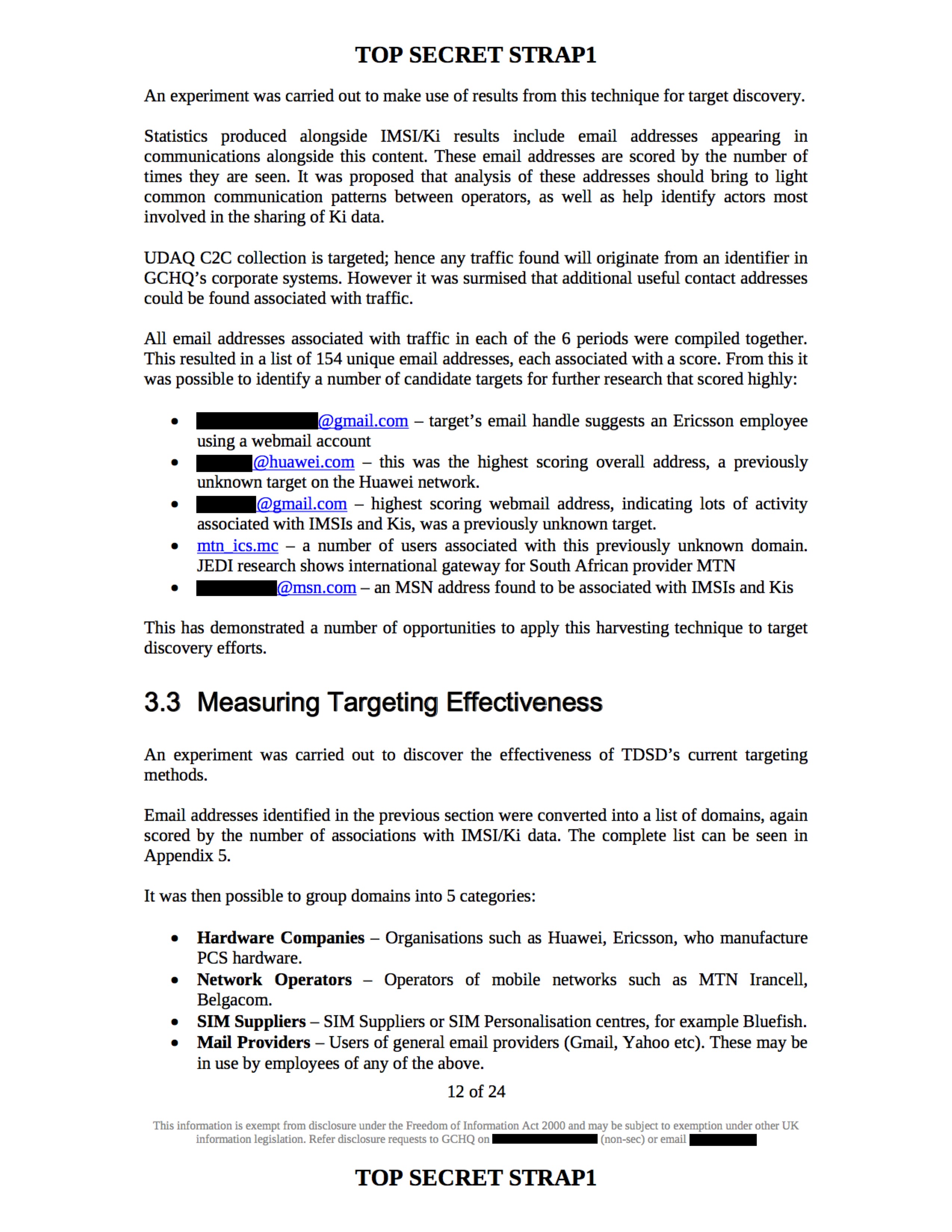
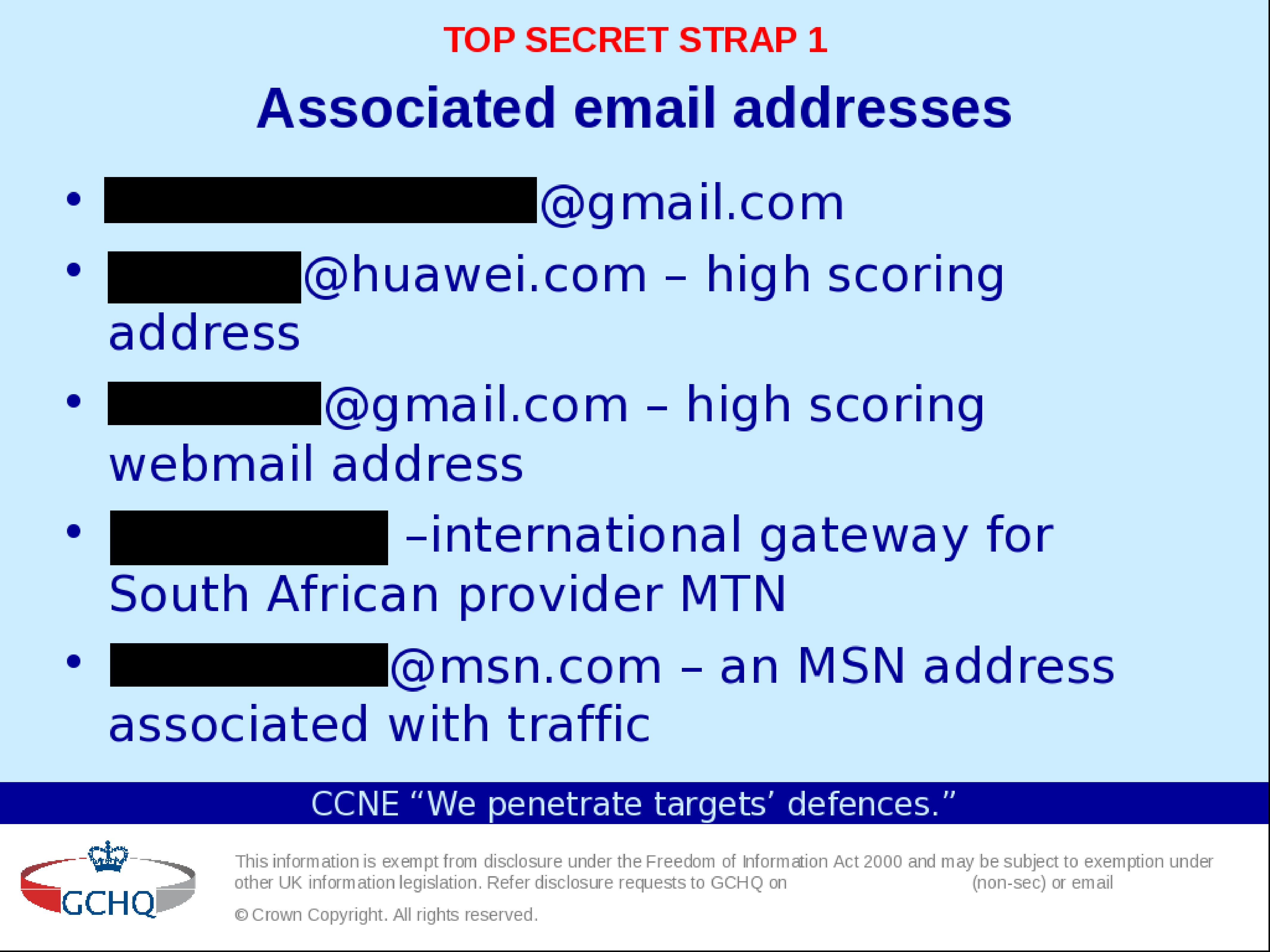
All email addresses associated with traffic in each of the 6 periods were compiled together. This resulted in a list of 154 unique email addresses, each associated with a score. From this it was possible to identify a number of candidate targets for further research that scored highly:
- [REDACTED]@gmail.com - target's email handle suggests an Ericsson employee using a webmail account
- [REDACTED]@huawei.com - this was the highest scoring overall address, a previously unknown target on the Huawei network.
- [REDACTED]@gmail.com - highest scoring webmail address, indicating lots of activity associated with IMSIs and Kis, was a previously unknown target.
- mtn_ics.mc - a number of users associated with this previously unknown domain. JEDI research shows international gateway for South African provider MTN
- [REDACTED]@msn.com - an MSN address found to be associated with IMSIs and Kis
This has demonstrated a number of opportunities to apply this harvesting technique to target discovery efforts.
3.3 Measuring Targeting Effectiveness
An experiment was carried out to discover the effectiveness of TDSD's current targeting methods.
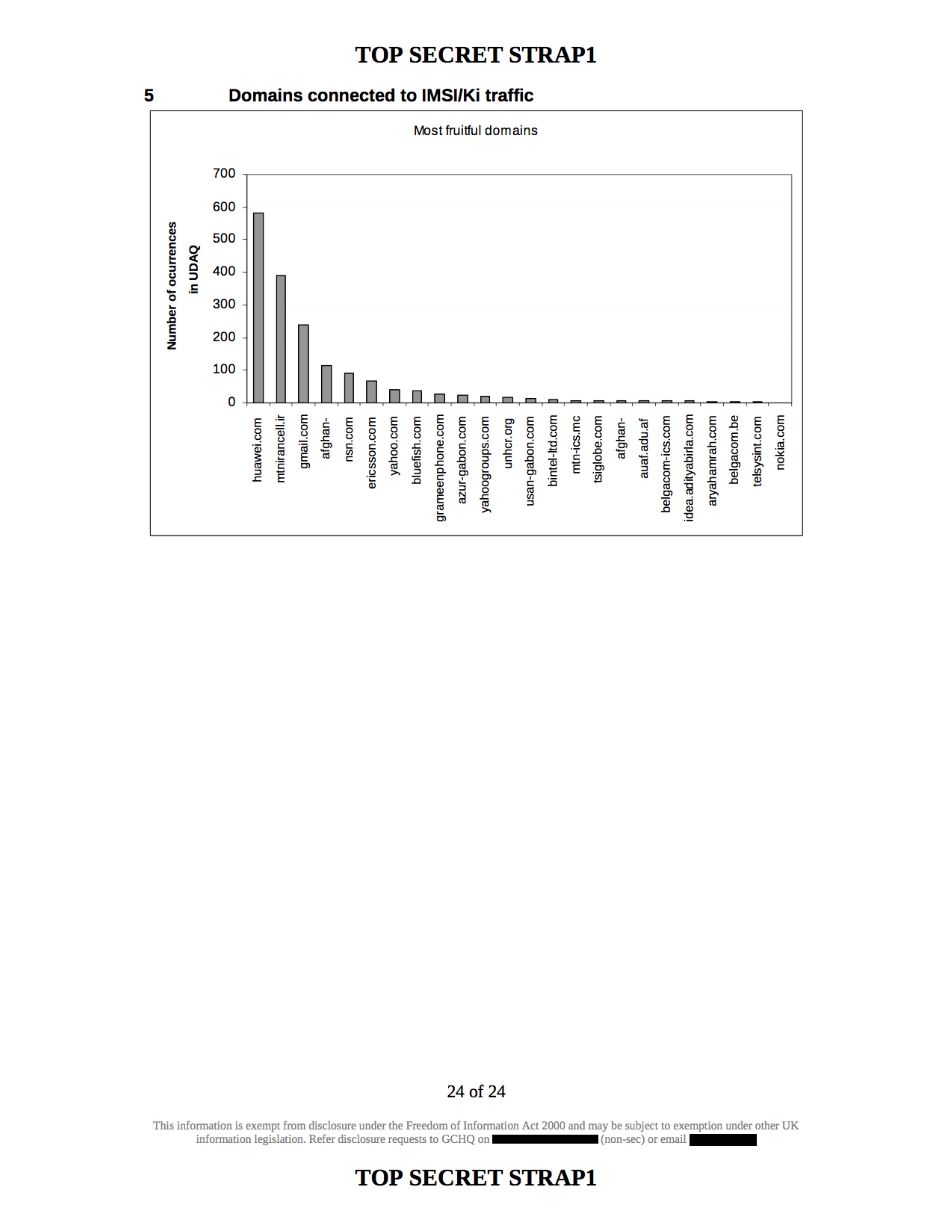
Email addresses identified in the previous section were converted into a list of domains, again scored by the number of associations with IMSI/Ki data. The complete list can be seen in
Appendix 5.
It was then possible to group domains into 5 categories:
- Hardware Companies - Organisations such as Huawei, Ericsson, who manufacture PCS hardware.
- Network Operators - Operators of mobile networks such as MTN Irancell, Belgacom.
- SIM Suppliers - SIM Suppliers or SIM Personalisation centres, for example Bluefish.
- Mail Providers - Users of general email providers (Gmail, Yahoo etc). These may be in use by employees of any of the above.
12 of 24
This information is exempt from disclosure under the Freedom of Information Act 2000 and may be subject to exemption under other UK information legislation. Refer disclosure requests to GCHQ on [REDACTED] (non-sec) or email [REDACTED]
TOP SECRET STRAP1
TOP SECRET STRAP1
- Other / Unknown
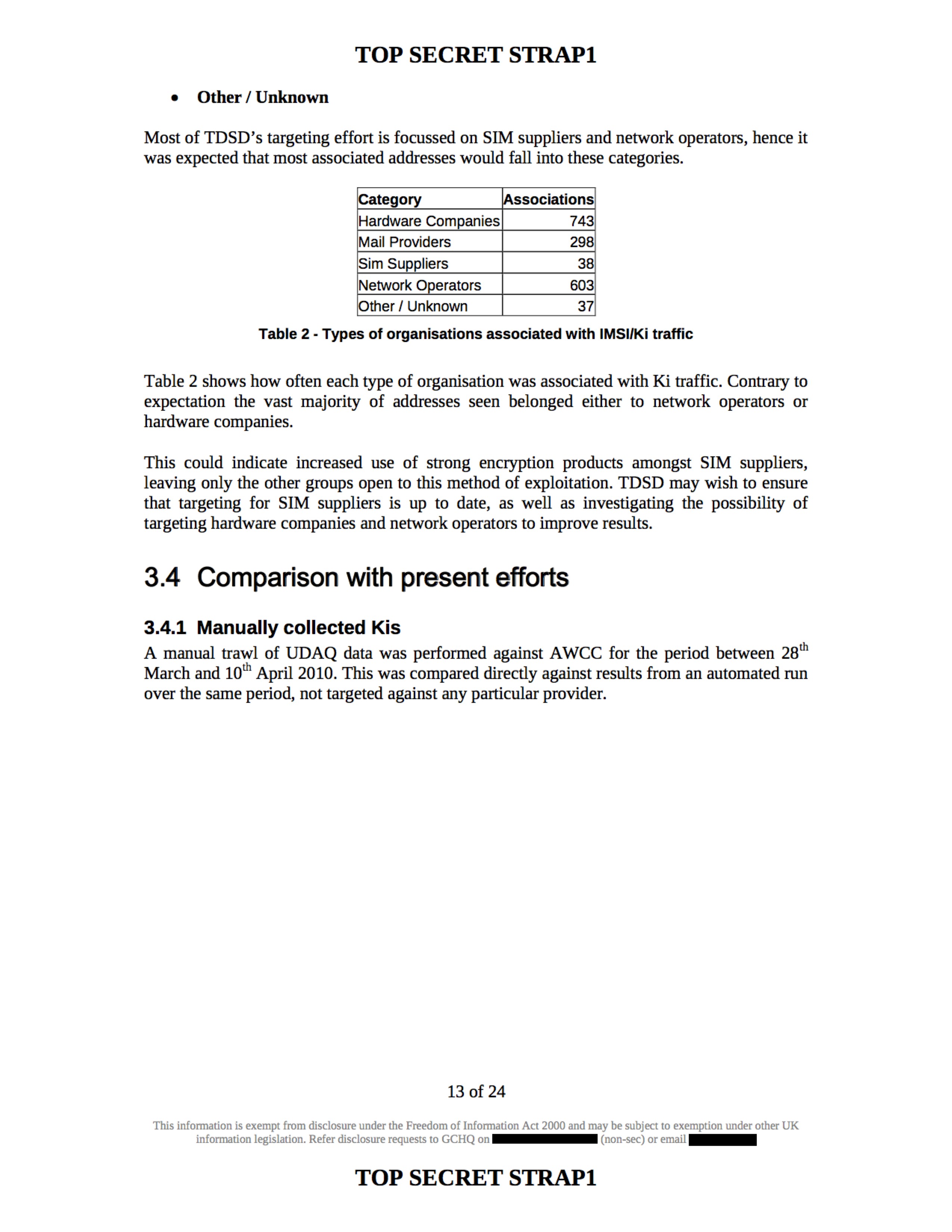
Most of TDSD's targeting effort is focussed on SIM suppliers and network operators, hence it was expected that most associated addresses would fall into these categories.
| Category | Associations |
|---|---|
| Hardware Companies | 743 |
| Mail Providers | 298 |
| Sim Suppliers | 38 |
| Network Operators | 603 |
| Other / Unknown | 37 |
Table 2 - Types of organisations associated with IMSI/Ki traffic
Table 2 shows how often each type of organisation was associated with Ki traffic. Contrary to expectation the vast majority of addresses seen belonged either to network operators or hardware companies.
This could indicate increased use of strong encryption products amongst SIM suppliers, leaving only the other groups open to this method of exploitation. TDSD may wish to ensure that targeting for SIM suppliers is up to date, as well as investigating the possibility of targeting hardware companies and network operators to improve results.
3.4 Comparison with present efforts
3.4.1 Manually collected Kis
A manual trawl of UDAQ data was performed against AWCC for the period between 28th March and 10th April 2010. This was compared directly against results from an automated run over the same period, not targeted against any particular provider.
13 of 24
This information is exempt from disclosure under the Freedom of Information Act 2000 and may be subject to exemption under other UK information legislation. Refer disclosure requests to GCHQ on [REDACTED] (non-sec) or email [REDACTED]
TOP SECRET STRAP1
TOP SECRET STRAP1
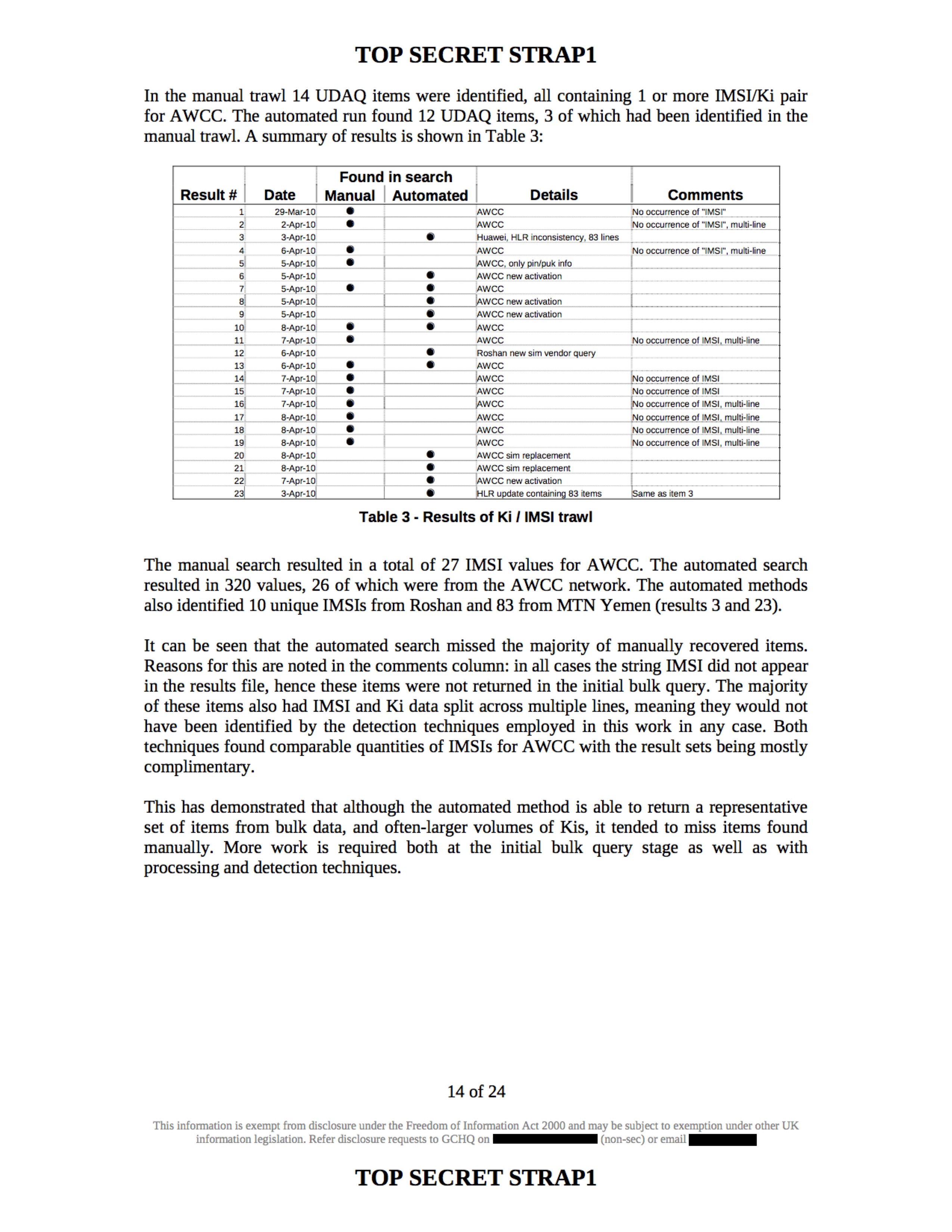
In the manual trawl 14 UDAQ items were identified, all containing 1 or more IMSI/Ki pair for AWCC. The automated run found 12 UDAQ items, 3 of which had been identified in the manual trawl. A summary of results is shown in Table 3:
| Result # | Date | Found in search Manual | Found in search Automated | Details | Comments |
|---|---|---|---|---|---|
| 1 | 29-Mar-10 | • | AWCC | No occurrence of "IMSI" | |
| 2 | 2-Apr-10 | • | AWCC | No occurrence of "IMSI", multi-line | |
| 3 | 3-Apr-10 | • | Huawei, HLR inconsistency, 83 lines | ||
| 4 | 6-Apr-10 | • | AWCC | No occurrence of "IMSI", multi-line | |
| 5 | 5-Apr-10 | • | AWCC, only pin/puk info | ||
| 6 | 5-Apr-10 | • | AWCC new activation | ||
| 7 | 5-Apr-10 | • | AWCC | ||
| 8 | 5-Apr-10 | • | • | AWCC new activation | |
| 9 | 5-Apr-10 | • | AWCC new activation | ||
| 10 | 8-Apr-10 | • | • | AWCC | |
| 11 | 7-Apr-10 | • | AWCC | No occurrence of IMSI, multi-line | |
| 12 | 6-Apr-10 | • | Roshan new sim vendor query | ||
| 13 | 6-Apr-10 | • | • | AWCC | |
| 14 | 7-Apr-10 | • | AWCC | No occurrence of IMSI | |
| 15 | 7-Apr-10 | • | AWCC | No occurrence of IMSI | |
| 16 | 7-Apr-10 | • | AWCC | No occurrence of IMSI, multi-line | |
| 17 | 8-Apr-10 | • | AWCC | No occurrence of IMSI, multi-line | |
| 18 | 8-Apr-10 | • | AWCC | No occurrence of IMSI, multi-line | |
| 19 | 8-Apr-10 | • | AWCC | No occurrence of IMSI, multi-line | |
| 20 | 8-Apr-10 | • | AWCC sim replacement | ||
| 21 | 8-Apr-10 | • | AWCC sim replacement | ||
| 22 | 7-Apr-10 | • | AWCC new activation | ||
| 23 | 3-Apr-10 | • | HLR update containing 83 items | Same as item 3 |
Table 3 - Results of Ki / IMSI trawl
The manual search resulted in a total of 27 IMSI values for AWCC. The automated search resulted in 320 values, 26 of which were from the AWCC network. The automated methods also identified 10 unique IMSIs from Roshan and 83 from MTN Yemen (results 3 and 23).
It can be seen that the automated search missed the majority of manually recovered items. Reasons for this are noted in the comments column: in all cases the string IMSI did not appear in the results file, hence these items were not returned in the initial bulk query. The majority of these items also had IMSI and Ki data split across multiple lines, meaning they would not have been identified by the detection techniques employed in this work in any case. Both techniques found comparable quantities of IMSIs for AWCC with the result sets being mostly
complimentary.
This has demonstrated that although the automated method is able to return a representative set of items from bulk data, and often-larger volumes of Kis, it tended to miss items found manually. More work is required both at the initial bulk query stage as well as with processing and detection techniques.
14 of 24
This information is exempt from disclosure under the Freedom of Information Act 2000 and may be subject to exemption under other UK information legislation. Refer disclosure requests to GCHQ on [REDACTED] (non-sec) or email [REDACTED]
TOP SECRET STRAP1
TOP SECRET STRAP1
3.4.2 Overall harvesting efforts
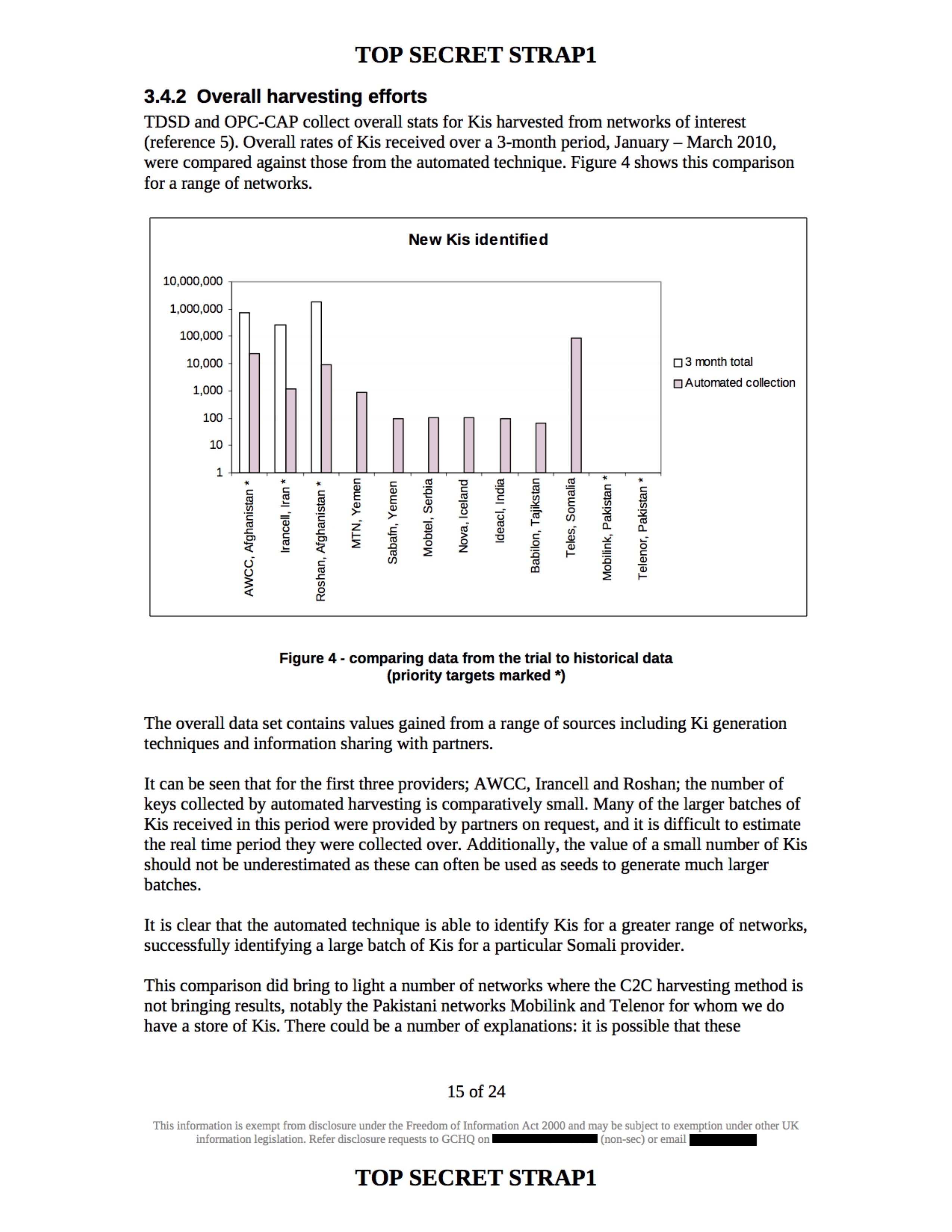
TDSD and OPC-CAP collect overall stats for Kis harvested from networks of interest (reference 5). Overall rates of Kis received over a 3-month period, January - March 2010, were compared against those from the automated technique. Figure 4 shows this comparison for a range of networks.
New Kis identified
10,000,000
1,000,000
100,000
10,000
1,000
100
10
1
AWCC, Afghanistan *
Irancell, Iran *
Roshan, Afghanistan *
MTN, Yemen
Sabafn, Yemen
Mobtel, Serbia
Nova, Iceland
Ideacl, India
Babilon, Tajikstan
Teles, Somalia
Mobilink, Pakistan *
Telenor, Pakistan *
Figure 4 - comparing data from the trial to historical data
(priority targets marked *)
The overall data set contains values gained from a range of sources including Ki generation techniques and information sharing with partners.
It can be seen that for the first three providers; AWCC, Irancell and Roshan; the number of keys collected by automated harvesting is comparatively small. Many of the larger batches of Kis received in this period were provided by partners on request, and it is difficult to estimate the real time period they were collected over. Additionally, the value of a small number of Kis should not be underestimated as these can often be used as seeds to generate much larger batches.
It is clear that the automated technique is able to identify Kis for a greater range of networks, successfully identifying a large batch of Kis for a particular Somali provider.
This comparison did bring to light a number of networks where the C2C harvesting method is not bringing results, notably the Pakistani networks Mobilink and Telenor for whom we do have a store of Kis. There could be a number of explanations: it is possible that these
15 of 24
This information is exempt from disclosure under the Freedom of Information Act 2000 and may be subject to exemption under other UK information legislation. Refer disclosure requests to GCHQ on [REDACTED] (non-sec) or email [REDACTED]
TOP SECRET STRAP1
TOP SECRET STRAP1
networks now use more secure methods to transfer Kis, or targeting for those networks might be ineffective.
In summary, the automated technique is unlikely to bring in very large batches of Ki data of the size produced with Ki generation schemes or received from partner repositories. However it can bring in a steady stream of data over a period of time. These smaller volumes can fill gaps where no other data is available, and also provide essential seed points from which Ki generation can be applied.
16 of 24
This information is exempt from disclosure under the Freedom of Information Act 2000 and may be subject to exemption under other UK information legislation. Refer disclosure requests to GCHQ on [REDACTED] (non-sec) or email [REDACTED]
TOP SECRET STRAP1
TOP SECRET STRAP1
4 Conclusions
This work has demonstrated that an automated method of Ki recovery, once in place, can deliver significant results with little manual effort compared to current harvesting methods. In addition to Ki harvesting a number of further applications have been demonstrated: the monitoring of mobile network activity, where views have been provided over a 3-month period; discovery of new target identifiers associated with detected traffic; and methods of measuring the effectiveness of current techniques.
A picture of types of organisations associated with Ki traffic has been constructed providing a new view of mobile network operations to TDSD.
It has also been shown that although the automated method is able to return a representative set of items from bulk data, it often fails to detect all items that would be found manually. More work is required at the initial bulk query stage and also with detection techniques to ensure accurate and full coverage of Ki data.
Whilst problems have been identified such as limits on coverage due to access restrictions, this work makes a strong case that such harvesting efforts will continue to deliver results in TDSD and areas such as the CP SD team.
It is the author's view that increased levels of corporate support for such bulk data processing activities would allow TDSD, as well as many other business areas, to benefit from more applications of these techniques.
4.1 Future Work
A number of items of follow-up work have been identified:
- Improving initial query effectiveness
It has been shown that the initial base 'proximity' query is not effective enough to return all results currently found using manual harvesting. Work should be carried out to identify more effective queries to process data on. An alternative option is to run the technique repeatedly against a number of result sets. - Improved detection techniques
Detection techniques are unable to identify Ki and IMSI data where the fields of interest appear on separate lines (see section 3.4.2). An improved technique would ensure these results are also detected and included. - Improved summary information
Summary information currently consists of a list of email addresses, UDAQ item identifiers and network codes associated with simple scores. Analysts would like to be able to find the UDAQ item associated with a particular IMSI or email address more easily. An improved scoring system would also help analysts more accurately
17 of 24
This information is exempt from disclosure under the Freedom of Information Act 2000 and may be subject to exemption under other UK information legislation. Refer disclosure requests to GCHQ on [REDACTED] (non-sec) or email [REDACTED]
TOP SECRET STRAP1
TOP SECRET STRAP1
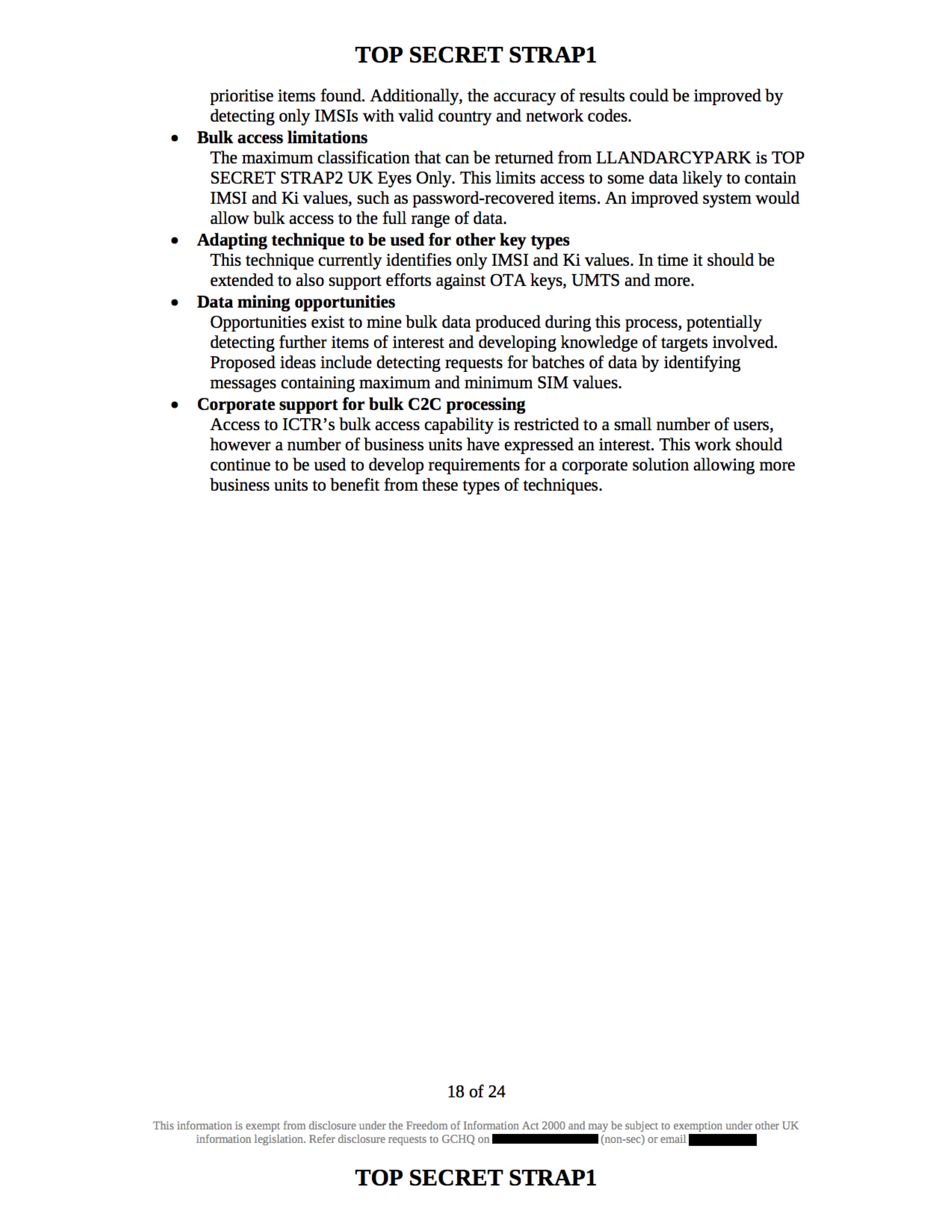
prioritise items found. Additionally, the accuracy of results could be improved by detecting only IMSIs with valid country and network codes.
- Bulk access limitations
The maximum classification that can be returned from LLANDARCYPARK is TOP SECRET STRAP2 UK Eyes Only. This limits access to some data likely to contain IMSI and Ki values, such as password-recovered items. An improved system would allow bulk access to the full range of data. - Adapting technique to be used for other key types
This technique currently identifies only IMSI and Ki values. In time it should be extended to also support efforts against OTA keys, UMTS and more. - Data mining opportunities
Opportunities exist to mine bulk data produced during this process, potentially detecting further items of interest and developing knowledge of targets involved. Proposed ideas include detecting requests for batches of data by identifying messages containing maximum and minimum SIM values. - Corporate support for bulk C2C processing
Access to ICTR's bulk access capability is restricted to a small number of users, however a number of business units have expressed an interest. This work should continue to be used to develop requirements for a corporate solution allowing more business units to benefit from these types of techniques.
18 of 24
This information is exempt from disclosure under the Freedom of Information Act 2000 and may be subject to exemption under other UK information legislation. Refer disclosure requests to GCHQ on [REDACTED] (non-sec) or email [REDACTED]
TOP SECRET STRAP1
TOP SECRET STRAP1
References
- TDSD Technical Note 11: What Makes a Good PCS Key Harvester?
[REDACTED], TDSD, 12th January 2010, available on request from TDSD - DRAFT METHODOLOGY for investigating SIM card supplier relationships with Target Mobile phone operators
[REDACTED], TDSD, 2010, available from [REDACTED] - ICTR Bulk IIB Download Capability [REDACTED]
- Cryptologic Common Data Model FAQ [REDACTED]
- TDSD Non EPR Statistics [REDACTED]
- PCS Harvesting Scripts are stored under ClearCase and can be accessed and run from the following location: [REDACTED]
19 of 24
This information is exempt from disclosure under the Freedom of Information Act 2000 and may be subject to exemption under other UK information legislation. Refer disclosure requests to GCHQ on [REDACTED] (non-sec) or email [REDACTED]
TOP SECRET STRAP1
TOP SECRET STRAP1
Appendix
1 Example IMSI/Ki proximity query used by LLANDARCY PARK
<?xml version="1.0" encoding="UTF-8"?>
<cib:query xmlns:cib="urn:gchq:cib" countOnly="false" exportQuery="true" maxResultsCount="10000">
<cib:query-text>
SELECT Item_ID FROM CIB.CIB WHERE
(
Date_Of_Intercept <= {d '___END_DATE___'} AND
Date_Of_Intercept >= {d '___START_DATE___'} AND
Content = '(imsi AND Ki WITHIN 60 )'
) AND
Item_Type IN ('IIB_Intercept','Strong_Net'[REDACTED]_C2C','[REDACTED]')
</cib:query-text>
<cib:queryMetadata>
<cib:property name="interceptType">All intercept</cib:property>
<cib:property name="username">someusr</cib:property>
<cib:property name="classification">TOP SECRET STRAP1</cib:property>
<cib:property name="mirandaNumber">[REDACTED]</cib:property>
<cib:property name="jicPurpose">NS</cib:property>
<cib:property name="hraJustification">Mobile Theme CRYPT RESEARCH INTO SIM CARD SUPPLY GSM OPERATORS OPI-MENA AND OPI-AP</cib:property>
</cib:queryMetadata>
</cib:query>
2 Example stats.txt produced by script
IMSI results:

Emails:
9 items
2      [REDACTED]@idea.adityabirla.com
4      [REDACTED]@bluefish.com
4      [REDACTED]@idea.adityabirla.com
4      [REDACTED]@grameenphone.com
4      [REDACTED]@grameenphone.com
6      [REDACTED]@bluefish.com
10     [REDACTED]@bluefish.com
20 of 24
This information is exempt from disclosure under the Freedom of Information Act 2000 and may be subject to exemption under other UK information legislation. Refer disclosure requests to GCHQ on [REDACTED] (non-sec) or email [REDACTED]
TOP SECRET STRAP1
TOP SECRET STRAP1
12     [REDACTED]@bluefish.com
18     [REDACTED]@grameenphone.com

UDAQ Item Identifiers used:
8 items
1      [REDACTED]
1      [REDACTED]
2      [REDACTED]
3      [REDACTED]
6      [REDACTED]
7      [REDACTED]
7      [REDACTED]
7      [REDACTED]

Country Codes:
16 items
4      421020
8      340041
8      612060
9      404040
10     410011
12     220018
16     412012
18     404120
26     648032
40     452048
40     510890
42     470010
56     220020
99     404041
108    220012
809    412200

IMSIS:
473 items
1       [REDACTED]
1       [REDACTED]
2       [REDACTED]
2       [REDACTED]
2       [REDACTED]
2       [REDACTED]
...
21 of 24
This information is exempt from disclosure under the Freedom of Information Act 2000 and may be subject to exemption under other UK information legislation. Refer disclosure requests to GCHQ on [REDACTED] (non-sec) or email [REDACTED]
TOP SECRET STRAP1
TOP SECRET STRAP1
3 Example PCS Ki output file
***** NEW FILE *****
***** SOURCE *****
[REDACTED]
***** HEADER *****
Action;OrderId;ServiceId;ObjectId;Priority;IMSI;MSISDN;Opcode(Short);ICCID;Ki;PIN;PIN2;PUK;PUK2;reserved(Boolean)
***** CONTENT *****
[REDACTED]
22 of 24
This information is exempt from disclosure under the Freedom of Information Act 2000 and may be subject to exemption under other UK information legislation. Refer disclosure requests to GCHQ on [REDACTED] (non-sec) or email [REDACTED]
TOP SECRET STRAP1
TOP SECRET STRAP1
4 IMSI results broken down by network code
| Network code | Location | Period 1 | Period 2 | Period 3 | Period 4 | Period 5 | Period 6 |
|---|---|---|---|---|---|---|---|
| 000000 | INVALID | 4 | |||||
| 008821 | INVALID | 6 | 6 | ||||
| 012409 | INVALID | 2 | 2 | ||||
| 111111 | INVALID | 4 | |||||
| 123454 | INVALID | 38 | |||||
| 201002 | INVALID | 4 | |||||
| 210231 | INVALID | 1 | |||||
| 220012 | MOBTEL, SERBIA | 108 | |||||
| 222013 | ITLCBL, ITALY | 2 | 2 | ||||
| 220018 | ITLCBL, ITALY | 12 | |||||
| 220020 | PROMNT, MONTENEGRO | 56 | |||||
| 274113 | NOVA, ICELAND | 2 | 62 | 40 | |||
| 340041 | MARTINIQUE; FRENCH GUIANA; DOMINICA; GUADELOUPE AND SAINT MARTIN | 8 | |||||
| 345126 | INVALID | 22 | |||||
| 345612 | INVALID | 6 | |||||
| 357646 | INVALID | 31 | |||||
| 357891 | INVALID | 115 | |||||
| 358453 | SAINT LUCIA | 27 | |||||
| 404040 | IDEACL, INDIA | 9 | |||||
| 404041 | IDEACL, INDIA | 99 | |||||
| 404120 | IDEAMB, INDIA | 18 | |||||
| 404602 | VDFNDG, INDIA | 30 | |||||
| 410011 | PMCL, PAKISTAN | 10 | |||||
| 412012 | AWCC, AFGHANISTAN | 5364 | 1834 | 11403 | 5927 | 12 | 16 |
| 412200 | TDCA, AFGHANISTAN | 986 | 6973 | 376 | 809 | ||
| 421010 | SABAFN, YEMEN | 18 | 64 | 14 | |||
| 421020 | MTN, YEMEN | 72 | 108 | 542 | 140 | 4 | |
| 432350 | IRNCEL, IRAN | 1188 | 40 | ||||
| 432352 | IRNCEL, IRAN | 60 | |||||
| 435670 | INVALID | 2 | |||||
| 436046 | BABLN, TAJIKSTAN | 12 | 57 | ||||
| 438320 | INVALID, TURKMENISTAN | 2 | |||||
| 444440 | INVALID | 8 | |||||
| 444441 | INVALID | 128 | |||||
| 452048 | VIETEL, VIETNAM | 40 | |||||
| 457010 | LTC, LAOS | 12 | 12 | ||||
| 469072 | INVALID | 4 | |||||
| 470010 | GRMPHN, BANGLADESH | 42 | |||||
| 510890 | HUTCH, INDONESIA | 40 | |||||
| 612060 | COTE DIVOIRE | 20 | 8 | ||||
| 628040 | USAN, GABON | 4 | |||||
| 637019 | TELES, SOMALIA | 84874 | |||||
| 637602 | NLINK, SOMALIA | 2 | |||||
| 648032 | TELCEL, ZIMBABWE | 26 | |||||
| 649011 | MOBTEL, NAMIBIA | 6 | |||||
| 984519 | INVALID | 68 | |||||
| 992918 | INVALID | 2 |
23 of 24
This information is exempt from disclosure under the Freedom of Information Act 2000 and may be subject to exemption under other UK information legislation. Refer disclosure requests to GCHQ on [REDACTED] (non-sec) or email [REDACTED]
TOP SECRET STRAP1
TOP SECRET STRAP1
5 Domains connected to IMSI/Ki traffic
Most fruitful domains
Number of ocurrences in UDAQ
700
600
500
400
300
200
100
0
- huawei.com
- mtnirancell.ir
- gmail.com
- afghan-[REDACTED]
- nsn.com
- ericsson.com
- yahoo.com
- bluefish.com
- grameenphone.com
- azur-gabon.com
- yahoogroups.com
- unhcr.org
- usan-gabon.com
- bintel-ltd.com
- mtn-ics.mc
- tsiglobe.com
- afghan-[REDACTED]
- auaf.adu.af
- belgacom-ics.com
- idea.adityabirla.com
- aryahamrah.com
- belgacom.be
- telsyint.com
- nokia.com
24 of 24
This information is exempt from disclosure under the Freedom of Information Act 2000 and may be subject to exemption under other UK information legislation. Refer disclosure requests to GCHQ on [REDACTED] (non-sec) or email [REDACTED]
TOP SECRET STRAP1
TOP SECRET STRAP 1
Associated email addresses
- [REDACTED]@gmail.com
- [REDACTED]@huawei.com - high scoring address
- [REDACTED]@gmail.com - high scoring webmail address
- [REDACTED]-international gateway for South African provider MTN
- [REDACTED]@msn.com – an MSN address associated with traffic
CCNE "We penetrate targets' defences.”
This information is exempt from disclosure under the Freedom of Information Act 2000 and may be subject to exemption under other UK information legislation. Refer disclosure requests to GCHQ on [REDACTED] (non-sec) or email [REDACTED]
© Crown Copyright. All rights reserved.
TOP SECRET STRAP 1
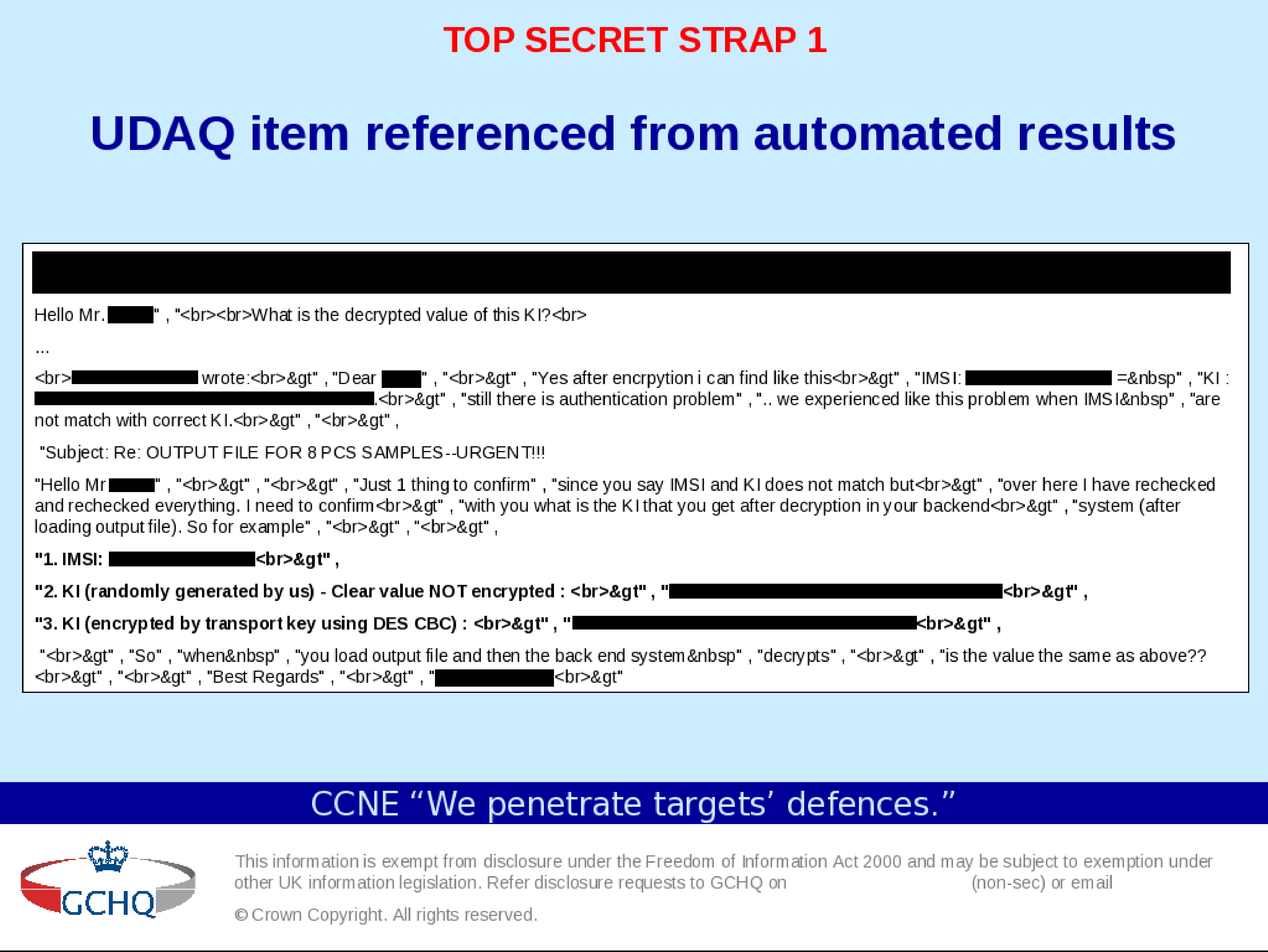
UDAQ item referenced from automated results
Hello Mr. [REDACTED]",
What is the decrypted value of this KI?
...
[REDACTED] wrote:
>", "Dear [REDACTED]", "
>", "Yes after encrpytion i can find like this
>", "IMSI: [REDACTED]= ", "KI: [REDACTED].
>", "still there is authentication problem", ".. we experienced like this problem when IMSI ", "are not match with correct KI.
>", "
>",
"Subject: Re: OUTPUT FILE FOR 8 PCS SAMPLES--URGENT!!!
"Hello Mr [REDACTED]", "
>", "
>", "Just 1 thing to confirm", "since you say IMSI and KI does not match but
>", "over here I have rechecked and rechecked everything. I need to confirm
>", "with you what is the KI you get after decryption in your backend
>", "system (after loading output file). So for example", "
>", "
>",
"1. IMSI: [REDACTED]
>",
"2. KI (randomly generated by us) - Clear value NOT encrypted:
>", "[REDACTED]
>",
"3. KI (encrypted by transport key using DES CBC) :
>", "[REDACTED]
>",
"
>", "So", "when ", "you load output file and then the back end system ", "decrypts", "
>", "is the value the same as above??
>", "
>", "Best Regards", "
>", "[REDACTED]
>"
CCNE “We penetrate targets' defences.”
This information is exempt from disclosure under the Freedom of Information Act 2000 and may be subject to exemption under other UK information legislation. Refer disclosure requests to GCHQ on [REDACTED] (non-sec) or email [REDACTED]
© Crown Copyright. All rights reserved.
TOP SECRET STRAP 1
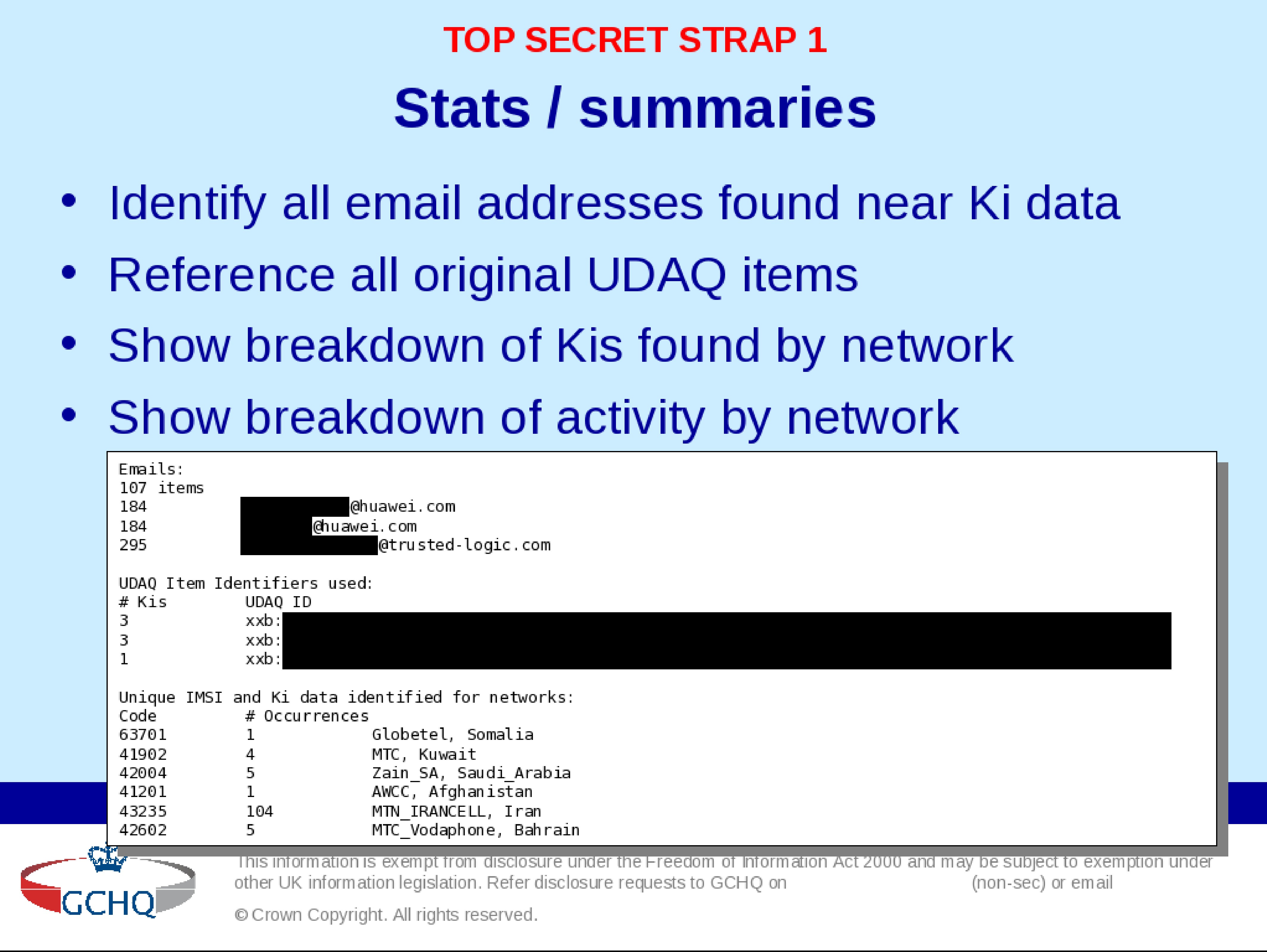
Stats / summaries
- Identify all email addresses found near Ki data
- Reference all original UDAQ items
- Show breakdown of Kis found by network
- Show breakdown of activity by network
Emails:
107 items
184           [REDACTED]@huawei.com
184           [REDACTED]@huawei.com
295           [REDACTED]@trusted-logic.com

UDAQ Item Identifiers used:
# Kis         UDAQ ID
3             xxb:[REDACTED]
3             xxb:[REDACTED]
1             xxb:[REDACTED]

Unique IMSI and Ki data identified for networks:
Code         # Occurrences
63701        1            Globetel, Somalia
41902        4            MTC, Kuwait
42004        5            Zain_SA, Saudi_Arabia
41201        1            AWCC, Afghanistan
43235        104          MTN_IRANCELL, Iran
42602        5            MTC_Vodaphone, Bahrain
This information is exempt from disclosure under the Freedom of Information Act 2000 and may be subject to exemption under other UK information legislation. Refer disclosure requests to GCHQ on [REDACTED] (non-sec) or email [REDACTED]
© Crown Copyright. All rights reserved.
TOP SECRET STRAP 1
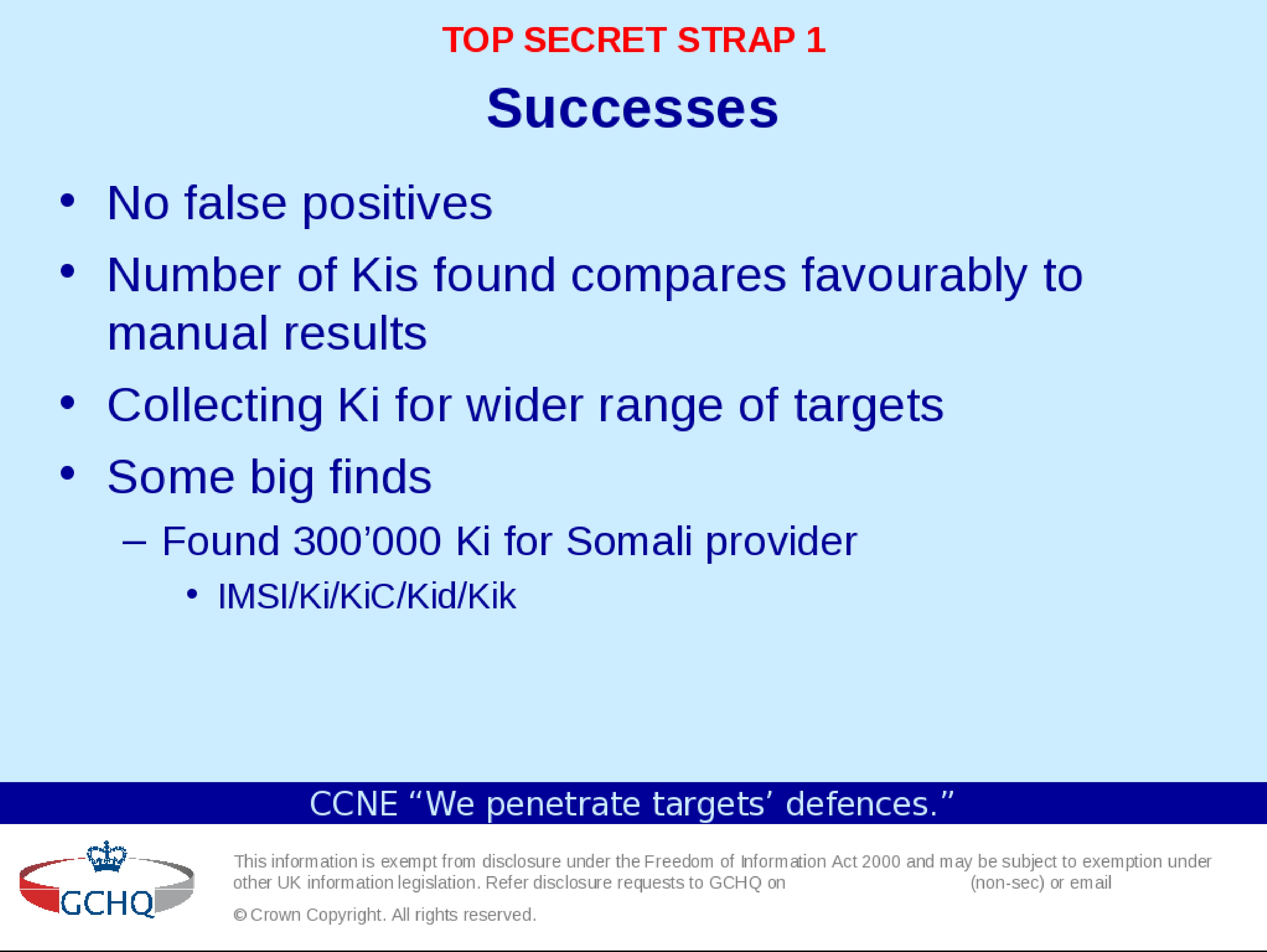
Successes
- No false positives
- Number of Kis found compares favourably to manual results
- Collecting Ki for wider range of targets
- Some big finds
- Found 300'000 Ki for Somali provider
- IMSI/Ki/KiC/Kid/Kik
CCNE “We penetrate targets' defences.”
This information is exempt from disclosure under the Freedom of Information Act 2000 and may be subject to exemption under other UK information legislation. Refer disclosure requests to GCHQ on [REDACTED] (non-sec) or email [REDACTED]
© Crown Copyright. All rights reserved.
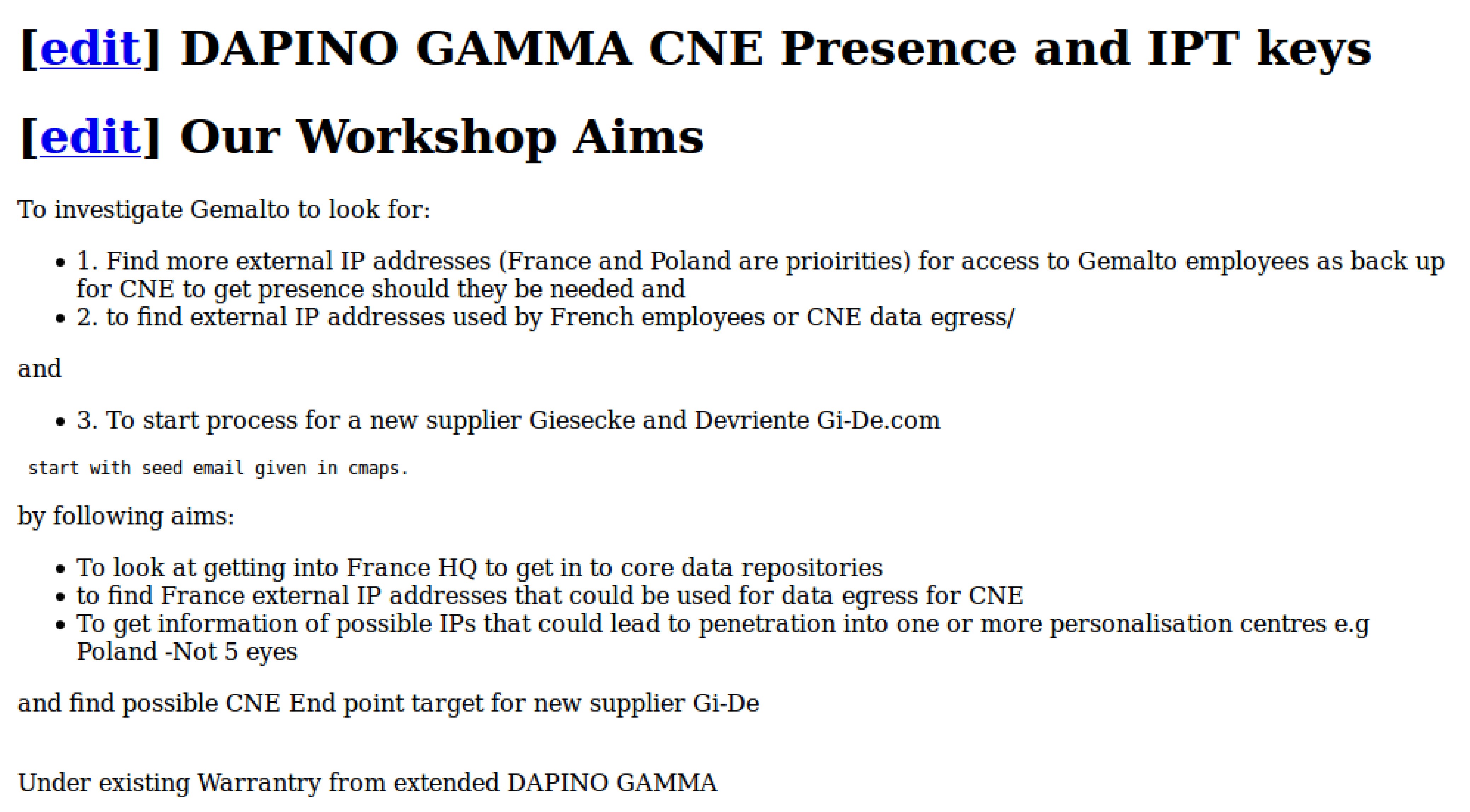
[edit] DAPINO GAMMA CNE Presence and IPT keys
[edit] Our Workshop Aims
To investigate Gemalto to look for:
- 1. Find more external IP addresses (France and Poland are prioirities) for access to Gemalto employees as back up for CNE to get presence should they be needed and
- 2. to find external IP addresses used by French employees or CNE data egress/
and
- 3. To start process for a new supplier Giesecke and Devriente Gi-De.com
start with seed email given in cmaps.
by following aims:
- To look at getting into France HQ to get in to core data repositories
- to find France external IP addresses that could be used for data egress for CNE
- To get information of possible IPs that could lead to penetration into one or more personalisation centres e.g Poland -Not 5 eyes
and find possible CNE End point target for new supplier Gi-De
Under existing Warrantry from extended DAPINO GAMMA
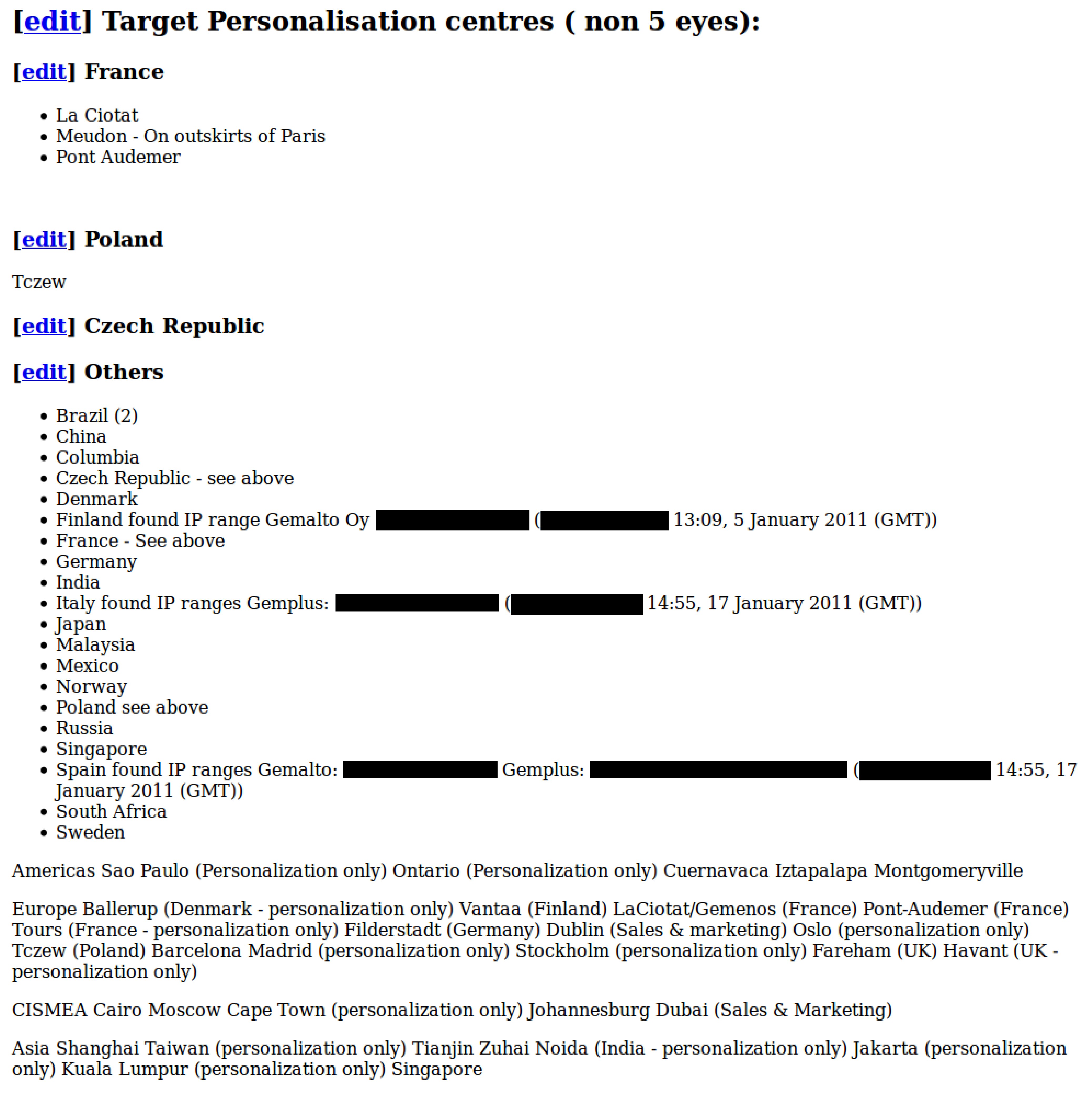
[edit] Target Personalisation centres (non 5 eyes):
[edit] France
- La Ciotat
- Meudon - On outskirts of Paris
- Pont Audemer
[edit] Poland
Tczew
[edit] Czech Republic
[edit] Others
- Brazil (2)
- China
- Columbia
- Czech Republic - see above
- Denmark
- Finland found IP range Gemalto Oy [REDACTED] ([REDACTED] 13:09, 5 January 2011 (GMT))
- France - See above
- Germany
- India
- Italy found IP ranges Gemplus: [REDACTED] ([REDACTED] 14:55, 17 January 2011 (GMT))
- Japan
- Malaysia
- Mexico
- Norway
- Poland see above
- Russia
- Singapore
- Spain found IP ranges Gemalto: [REDACTED] Gemplus: [REDACTED] ([REDACTED] 14:55, 17 January 2011 (GMT))
- South Africa
- Sweden
Americas Sao Paulo (Personalization only) Ontario (Personalization only) Cuernavaca Iztapalapa Montgomeryville
Europe Ballerup (Denmark - personalization only) Vantaa (Finland) LaCiotat/Gemenos (France) Pont-Audemer (France) Tours (France - personalization only) Filderstadt (Germany) Dublin (Sales & marketing) Oslo (personalization only) Tczew (Poland) Barcelona Madrid (personalization only) Stockholm (personalization only) Fareham (UK) Havant (UK - personalization only)
CISMEA Cairo Moscow Cape Town (personalization only) Johannesburg Dubai (Sales & Marketing)
Asia Shanghai Taiwan (personalization only) Tianjin Zuhai Noida (India - personalization only) Jakarta (personalization only) Kuala Lumpur (personalization only) Singapore
TOP SECRET STRAP 1
IMSIs Identified with Ki data for Network Providers
100000
10000
1000
100
10
1
14-Jan-10
28-Jan-10
11-Feb-10
25-Feb-10
11-Mar-10
25-Mar-10
Date range
MOBTEL, SERBIA
NOVA, ICELAND
IDEACL, INDIA
AWCC, AFGHANISTAN
TDCA, AFGHANISTAN
SABAFN, YEMEN
MTN, YEMEN
IRNCEL, IRAN
BABLN, TAJIKSTAN
TELES, SOMALIA
CCNE “We penetrate targets' defences.”
This information is exempt from disclosure under the Freedom of Information Act 2000 and may be subject to exemption under other UK information legislation. Refer disclosure requests to GCHQ on [REDACTED] (non-sec) or email [REDACTED]
© Crown Copyright. All rights reserved.
TOP SECRET STRAP 1
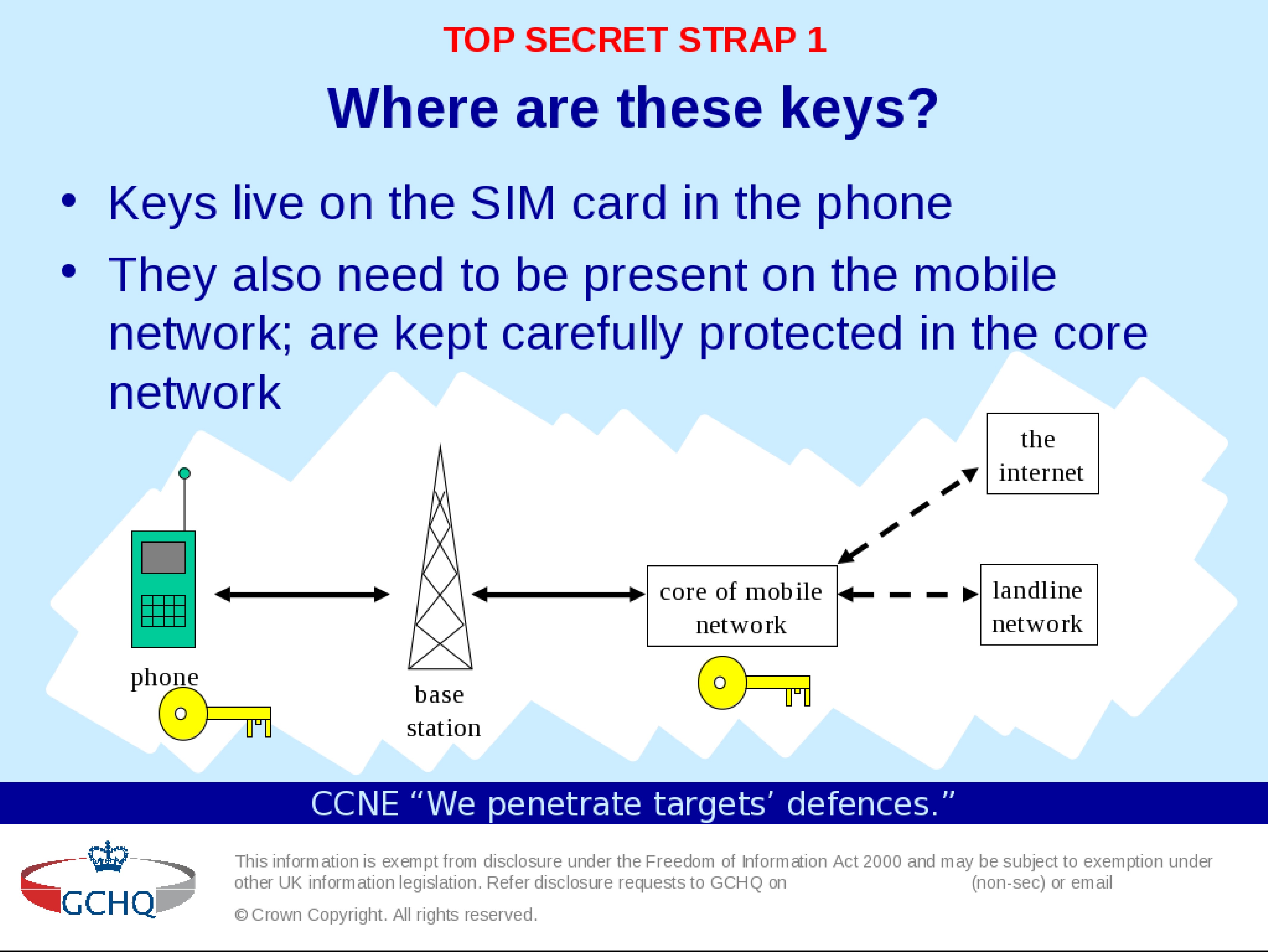
Where are these keys?
- Keys live on the SIM card in the phone
- They also need to be present on the mobile network; are kept carefully protected in the core network
phone
base station
core of mobile network
the internet
landline network
CCNE "We penetrate targets' defences.”
This information is exempt from disclosure under the Freedom of Information Act 2000 and may be subject to exemption under other UK information legislation. Refer disclosure requests to GCHQ on [REDACTED] (non-sec) or email [REDACTED]
© Crown Copyright. All rights reserved.
SECRET STRAP 1
mobile
info on the go
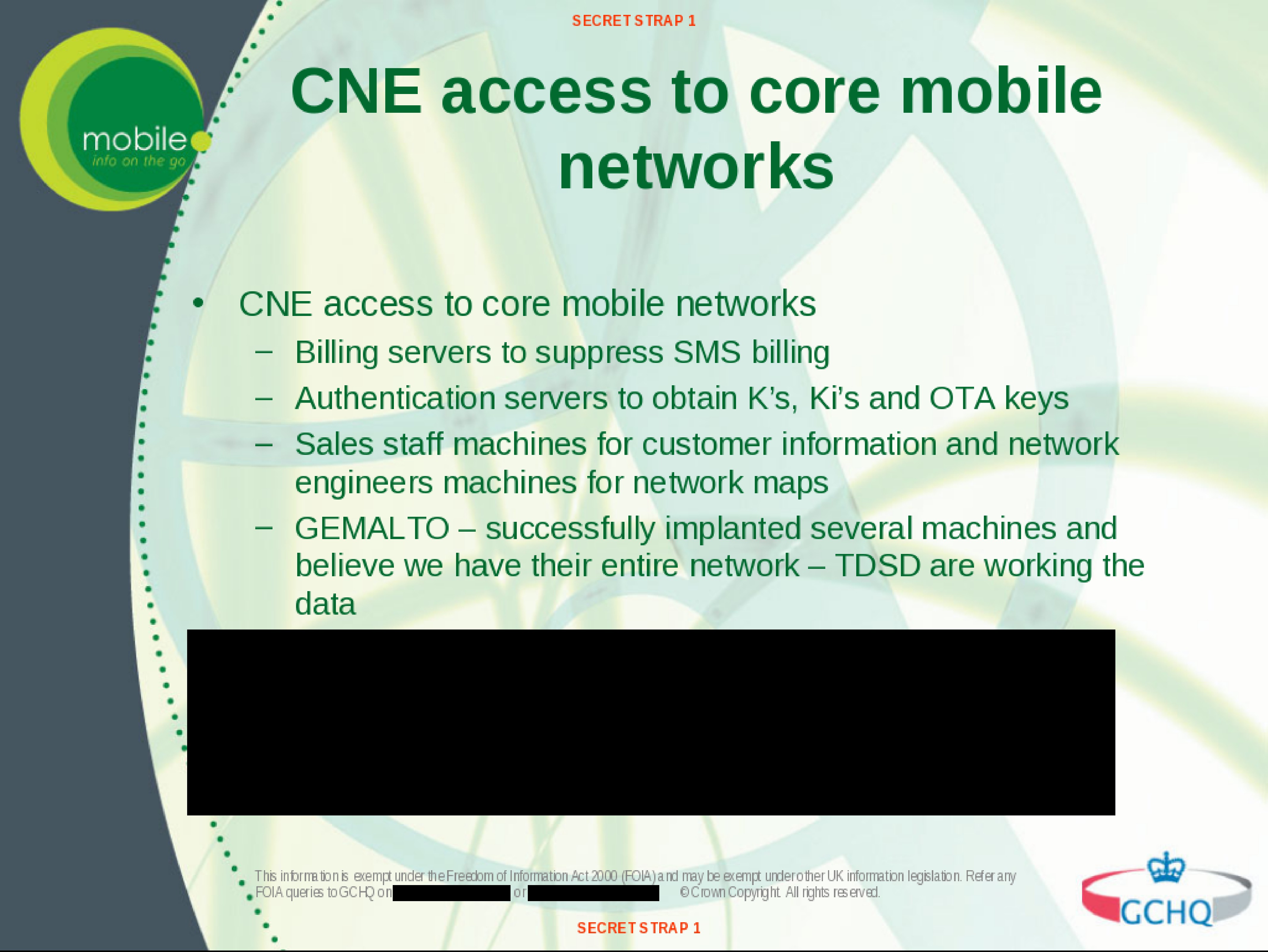
CNE access to core mobile networks
- CNE access to core mobile networks
- Billing servers to suppress SMS billing
- Authentication servers to obtain K's, Ki's and OTA keys
- Sales staff machines for customer information and network engineers machines for network maps
- GEMALTO - successfully implanted several machines and believe we have their entire network - TDSD are working the data
[REDACTED]
This information is exempt under the Freedom of Information Act 2000 (FOIA) and may be exempt under other UK information legislation. Refer any FOIA queries to GCHQ on [REDACTED] or [REDACTED]
© Crown Copyright. All rights reserved.
Published in the Same Report
(1 documents)
-
DAPINO GAMMA Gemalto Yuaawaa Wiki [pdf]
This document details the identification of Yuaawaa, a secure file-sharing service sold and used by Gemalto employees, and assesses several of these employees as potential future intelligence targets. Key individuals are noted based on their roles, locations, and observed activities, such as sending PGP-encrypted files.
Related Documents
-
Belgacom connections [pdf]
A "Belgacom connections" map lays out the carrier’s sprawling roaming and backbone interconnects, precisely the arteries GCHQ wanted to get access into. Under Operation Socialist GCHQ successfully gained access to Belgacom’s infrastructure, including internal employee computers and encrypted and unencrypted streams of private communications handled by the company.
Programs: CARBONROD“Operation Socialist: The Inside Story of How British Spies Hacked Belgium’s Largest Telco” - The Intercept ↗ (2014-12-13) · “Lees hier hoe de Britse geheime dienst GCHQ Belgacom aanviel” - NRC ↗ (2014-12-13) · “Britse geheime dienst bespioneerde jarenlang Belgacom-klanten” - De Standaard ↗ (2014-12-13) · Gallagher, Ryan · Modderkolk, Huib · Vanhecke, Nikolas · Eeckhaut, Mark -
Operational Legalities – GCHQ Powerpoint Presentation [pdf]
GCHQ’s “Operational Legalities” deck is an internal compliance playbook that translates the UK’s surveillance laws into day‑to‑day SIGINT procedure—drilling staff on authorisation, necessity, and proportionality, and walking through warrants, targeting justifications, database queries, dissemination, and oversight. Half slides and half speaker notes, it shows how analysts are trained to document, audit, and defend operations under ISA, RIPA, HRA, and WTA while navigating edge cases like location, nationality, second‑party constraints, and “indirect targeting.”
-
DAPINO GAMMA Gemalto Yuaawaa Wiki [pdf]
This document details the identification of Yuaawaa, a secure file-sharing service sold and used by Gemalto employees, and assesses several of these employees as potential future intelligence targets. Key individuals are noted based on their roles, locations, and observed activities, such as sending PGP-encrypted files.
-
Mobile Networks in My NOC World [pdf]
This TOP SECRET STRAP 2 GCHQ document outlines the “MyNOC” operations, a specialized Network Operations Centre used by the UK’s GCHQ to coordinate cyber exploitation of international mobile and telecom infrastructure, with a particular focus on Belgacom’s GRX network under “Operation Socialist” (OP SOCIALIST). It details operational planning, toolsets, personnel roles, network mapping, QUANTUM INSERT targeting, and successful infiltration strategies that enabled CNE (Computer Network Exploitation) access to key Belgacom systems and staff infrastructure.
Programs: HIGHNOTE · COPPERHEAD · NEXUS · CADDIS · BRENT · RUSSETT PHONE · CERBERUS · E-BEAM · PIA · JEDI · WYLEKEY · INTERACTION · EREPO · QUANTUM · WOODCUTTER · MUTANT BROTH · QUANTUM INSERT · NRTA · MERION ZETA · JTRIG · A-SPACE · GEOFUSION“Operation Socialist: The Inside Story of How British Spies Hacked Belgium’s Largest Telco” - The Intercept ↗ (2014-12-13) · “Lees hier hoe de Britse geheime dienst GCHQ Belgacom aanviel” - NRC ↗ (2014-12-13) · “Britse geheime dienst bespioneerde jarenlang Belgacom-klanten” - De Standaard ↗ (2014-12-13) · “Britain's GCHQ Hacked Belgian Telecoms Firm” - Der Spiegel ↗ (2013-09-20) · Gallagher, Ryan · Modderkolk, Huib · Vanhecke, Nikolas · Eeckhaut, Mark -
Internet Anonymity 2011 [pdf]
A TOP SECRET NSA presentation from 2011 providing a comprehensive survey of Internet Anonymity Technologies (IAT) — covering HTTP proxies, VPN anonymity providers, multi-hop networks including Tor and JAP, anonymous remailers and circumvention tools — alongside NSA's capabilities and limitations against each, including XKEYSCORE fingerprints for VPN identification, the PARTNERSNIPPET Tor deanonymisation team, GOLDENFORTIN Netflow data, and a candid assessment that Tor offers "no passive exploitation."
Programs: FOXTRAIL · NKB · NACIRONIN · PONTENTPOTABLES · RONIN · XKEYSCORE · PARTNERSNIPPET · GOLDENFORTIN · SNAPEPeople: Heap, Austin