A potential technique to deanonymise users of the TOR network
Open PDFDocument date: -
Pages: 23
Genre: slides
Banner: UK TOP SECRET STRAP1 COMINT
Classification: UK TOP SECRET STRAP 1 COMINT
Dissemination: -
A TOP SECRET GCHQ research presentation describing a traffic correlation attack against Tor — using cumulative packet counts observed simultaneously at a controlled exit node and at SIGINT collection points near a target's guard node to deanonymise Tor users without breaking the encryption — with GTE and JTRIG having adapted owned exit nodes to collect the required data for live deployment.
My notes
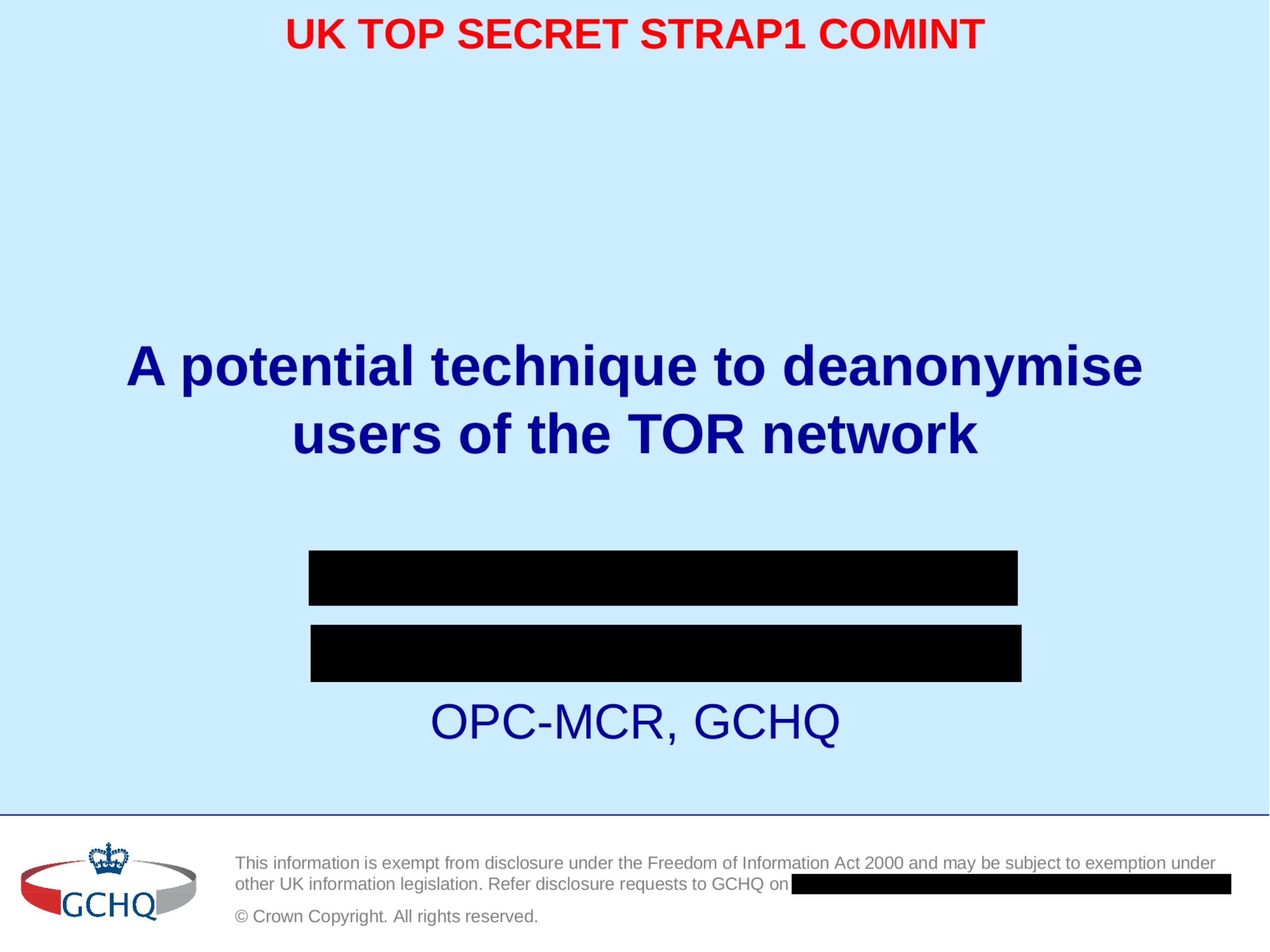
UK TOP SECRET STRAP1 COMINT
A potential technique to deanonymise users of the TOR network
[REDACTED]
[REDACTED]
OPC-MCR, GCHQ
This information is exempt from disclosure under the Freedom of Information Act 2000 and may be subject to exemption under other UK information legislation. Refer disclosure requests to GCHQ on [REDACTED]
© Crown Copyright. All rights reserved.
UK TOP SECRET STRAP1 COMINT
Outline
- TOR and the need for deanonymisation
- Data transformation
- Scoring
- Results
- Current status
- Software
This information is exempt from disclosure under the Freedom of Information Act 2000 and may be subject to exemption under other UK information legislation. Refer disclosure requests to GCHQ on [REDACTED]
© Crown Copyright. All rights reserved.
UK TOP SECRET STRAP1 COMINT
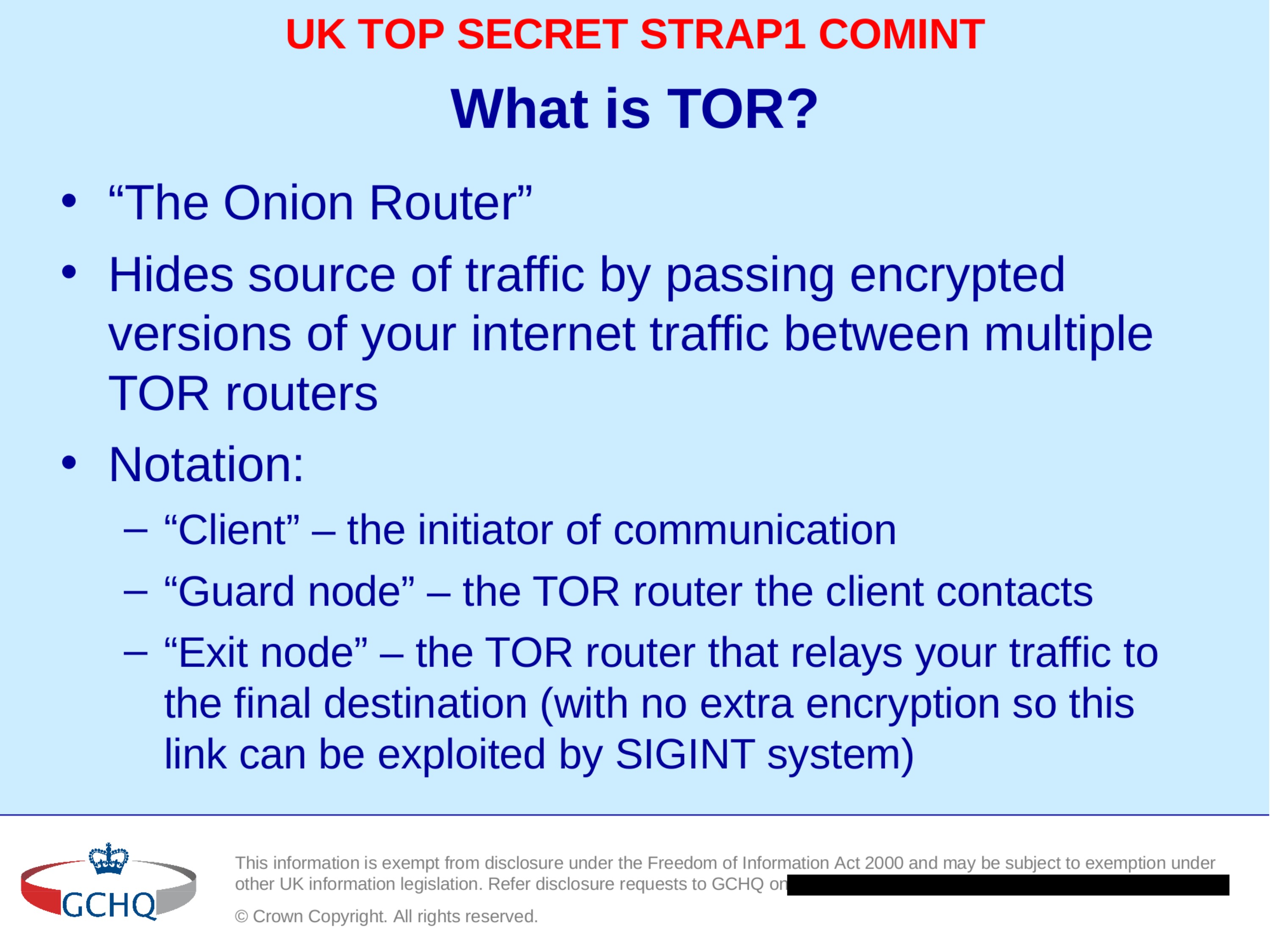
What is TOR?
- "The Onion Router"
- Hides source of traffic by passing encrypted versions of your internet traffic between multiple TOR routers
- Notation:
- "Client" – the initiator of communication
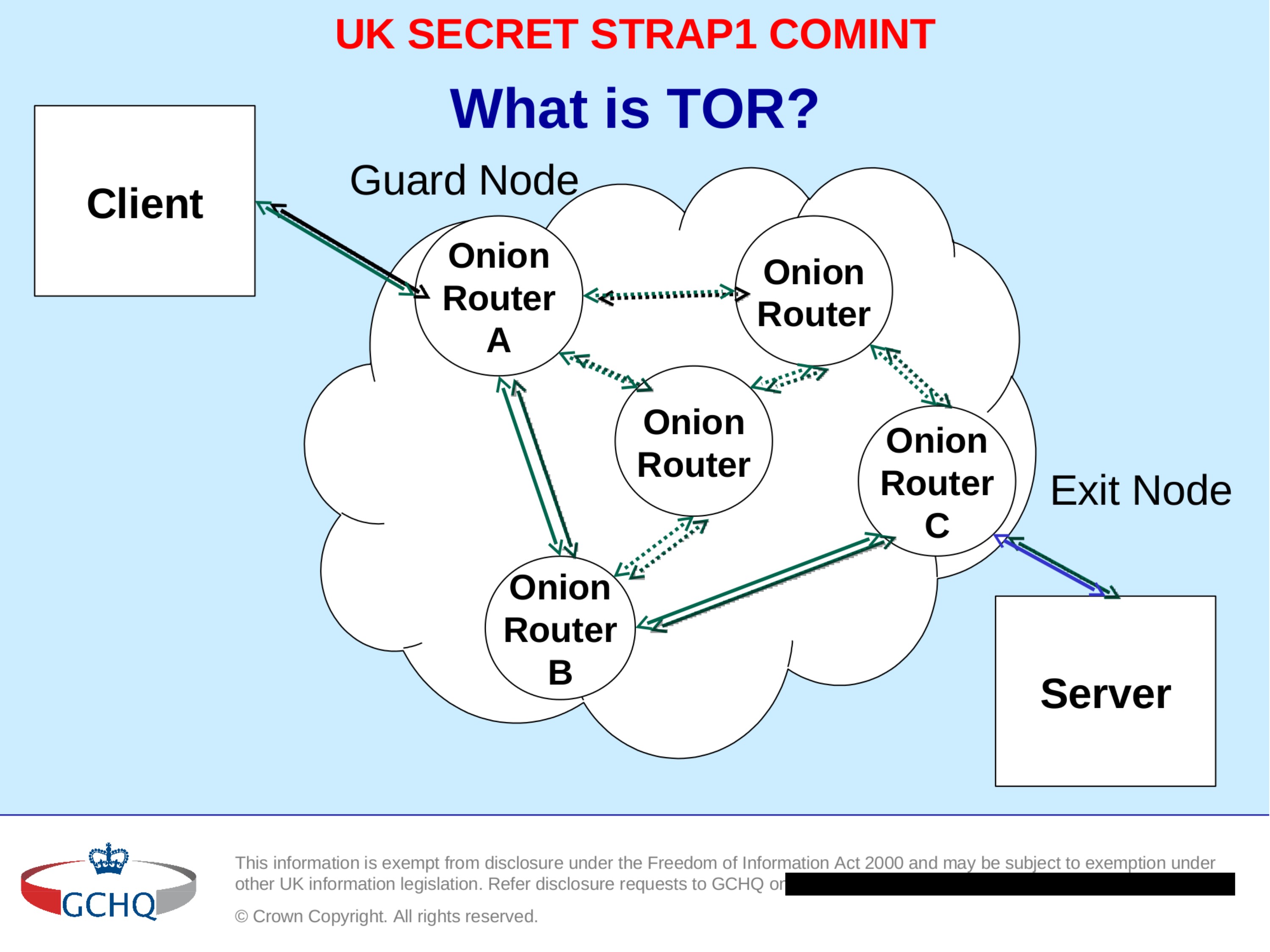
- "Guard node" – the TOR router the client contacts
- "Exit node” – the TOR router that relays your traffic to the final destination (with no extra encryption so this link can be exploited by SIGINT system)
This information is exempt from disclosure under the Freedom of Information Act 2000 and may be subject to exemption under other UK information legislation. Refer disclosure requests to GCHQ or [REDACTED]
© Crown Copyright. All rights reserved.
UK SECRET STRAP1 COMINT
What is TOR?
Client
Guard Node
Onion Router A
Onion Router
Onion Router B
Onion Router
Onion Router C
Exit Node
Server
This information is exempt from disclosure under the Freedom of Information Act 2000 and may be subject to exemption under other UK information legislation. Refer disclosure requests to GCHQ or [REDACTED]
© Crown Copyright. All rights reserved.
UK TOP SECRET STRAP1 COMINT
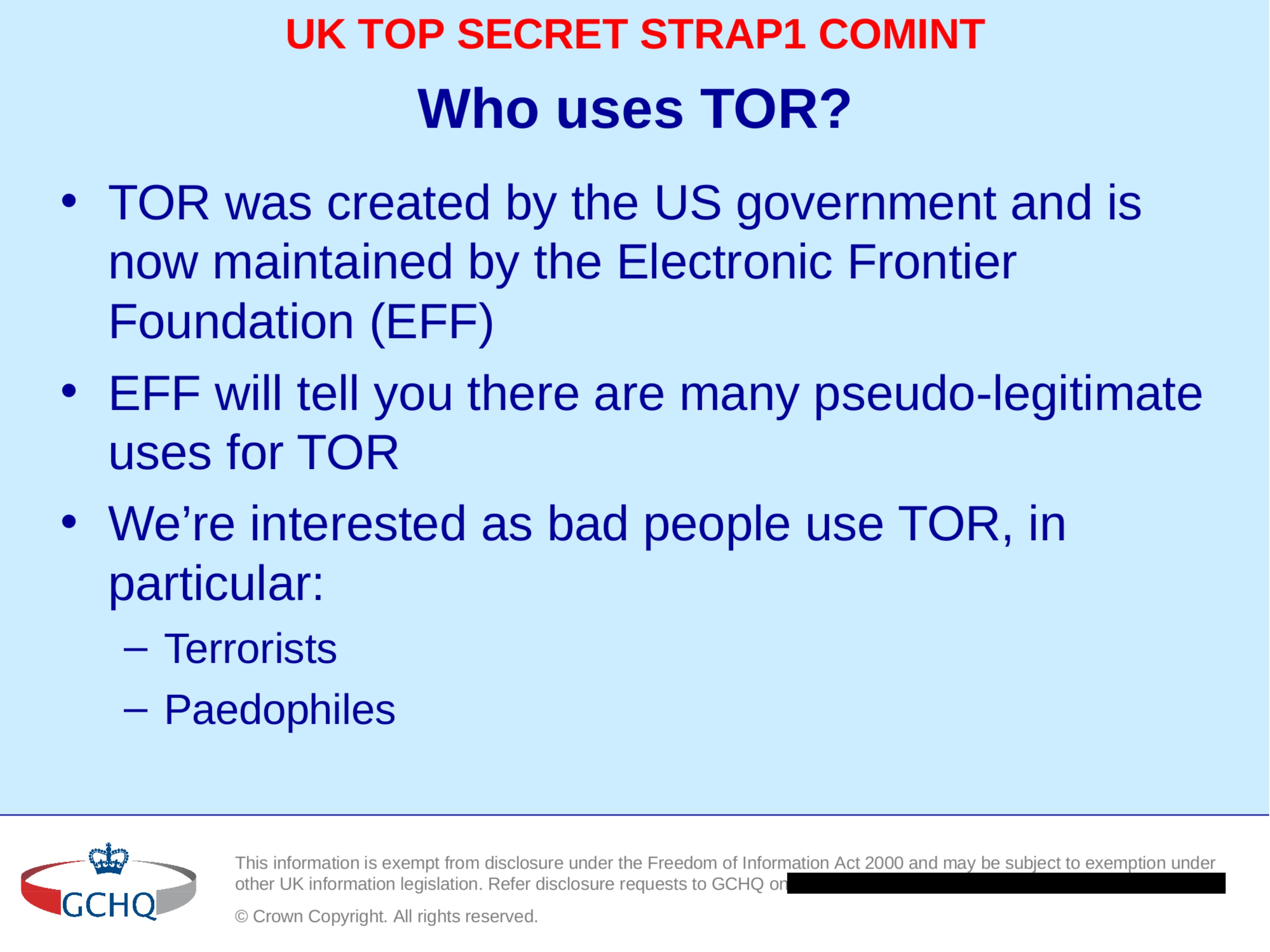
Who uses TOR?
- TOR was created by the US government and is now maintained by the Electronic Frontier Foundation (EFF)
- EFF will tell you there are many pseudo-legitimate uses for TOR
- We're interested as bad people use TOR, in particular:
- Terrorists
- Paedophiles
This information is exempt from disclosure under the Freedom of Information Act 2000 and may be subject to exemption under other UK information legislation. Refer disclosure requests to GCHQ or [REDACTED]
© Crown Copyright. All rights reserved.
UK TOP SECRET STRAP1 COMINT
Aim
- Find client IP address associated with TOR exit node traffic
- Attack based on externals – specifically packet timings
- Strong crypt is being used
This information is exempt from disclosure under the Freedom of Information Act 2000 and may be subject to exemption under other UK information legislation. Refer disclosure requests to GCHQ on [REDACTED]
© Crown Copyright. All rights reserved.
UK TOP SECRET STRAP1 COMINT
Aim
- We'll make our task easier by assuming we own the exit node being used
- Allows us to see all the traffic associated with a TOR circuit
- Demultiplex traffic by (unknown) user
This information is exempt from disclosure under the Freedom of Information Act 2000 and may be subject to exemption under other UK information legislation. Refer disclosure requests to GCHQ on [REDACTED]
© Crown Copyright. All rights reserved.
UK TOP SECRET STRAP1 COMINT
Side note: Circuit tracing
- One suggestion was to track packets through each hop in the TOR network
- We experimented with spotting all links in circuits created by GCHQ
- Visibility was too low to be a sensible approach
- 13 out of 8294 potential inter-TOR-router links were seen
- We will directly correlate:
- exit node traffic, and
- traffic between client and guard node
This information is exempt from disclosure under the Freedom of Information Act 2000 and may be subject to exemption under other UK information legislation. Refer disclosure requests to GCHQ on [REDACTED]
© Crown Copyright. All rights reserved.
UK SECRET STRAP1 COMINT
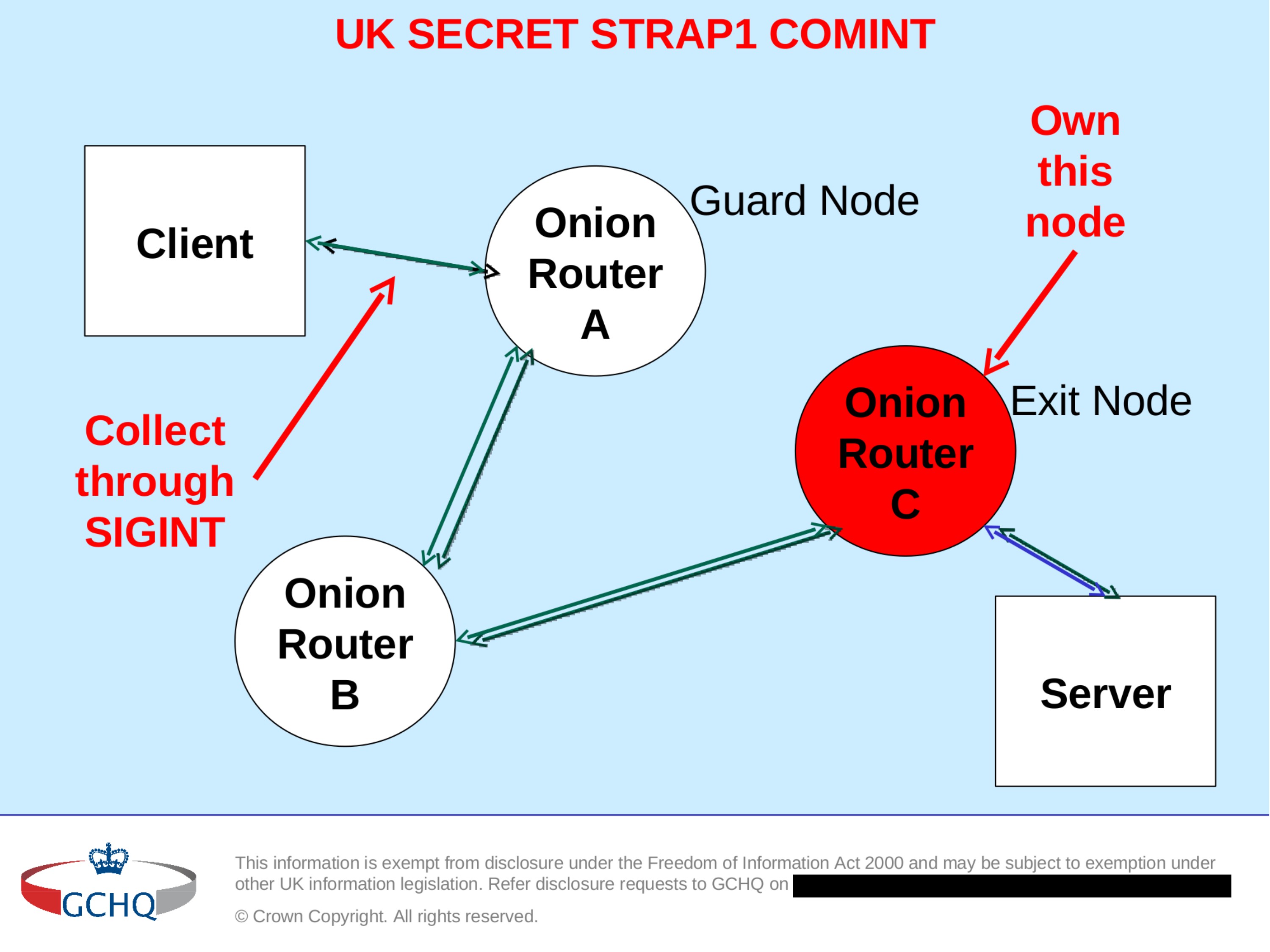
Client

Collect through SIGINT

Onion Router A
Guard Node

Onion Router B

Onion Router C
Exit Node
Own this node

Server
This information is exempt from disclosure under the Freedom of Information Act 2000 and may be subject to exemption under other UK information legislation. Refer disclosure requests to GCHQ on [REDACTED]
© Crown Copyright. All rights reserved.
UK TOP SECRET STRAP1 COMINT
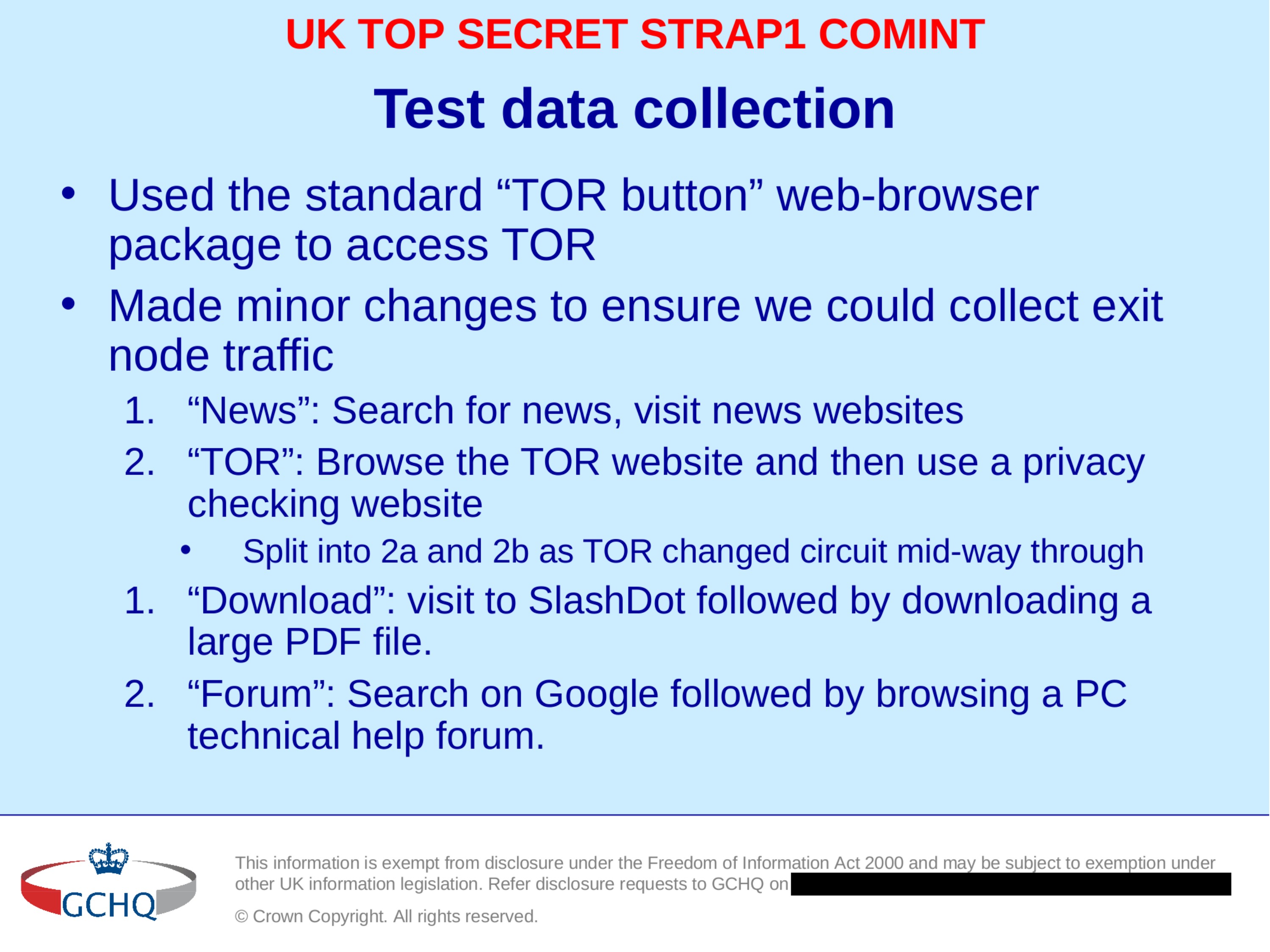
Test data collection
- Used the standard "TOR button" web-browser package to access TOR
- Made minor changes to ensure we could collect exit node traffic
- "News": Search for news, visit news websites
- "TOR": Browse the TOR website and then use a privacy checking website
- Split into 2a and 2b as TOR changed circuit mid-way through
- "Download": visit to SlashDot followed by downloading a large PDF file.
- "Forum”: Search on Google followed by browsing a PC technical help forum.
This information is exempt from disclosure under the Freedom of Information Act 2000 and may be subject to exemption under other UK information legislation. Refer disclosure requests to GCHQ on [REDACTED]
© Crown Copyright. All rights reserved.
UK TOP SECRET STRAP1 COMINT
UK TOP SECRET STRAP1 COMINT
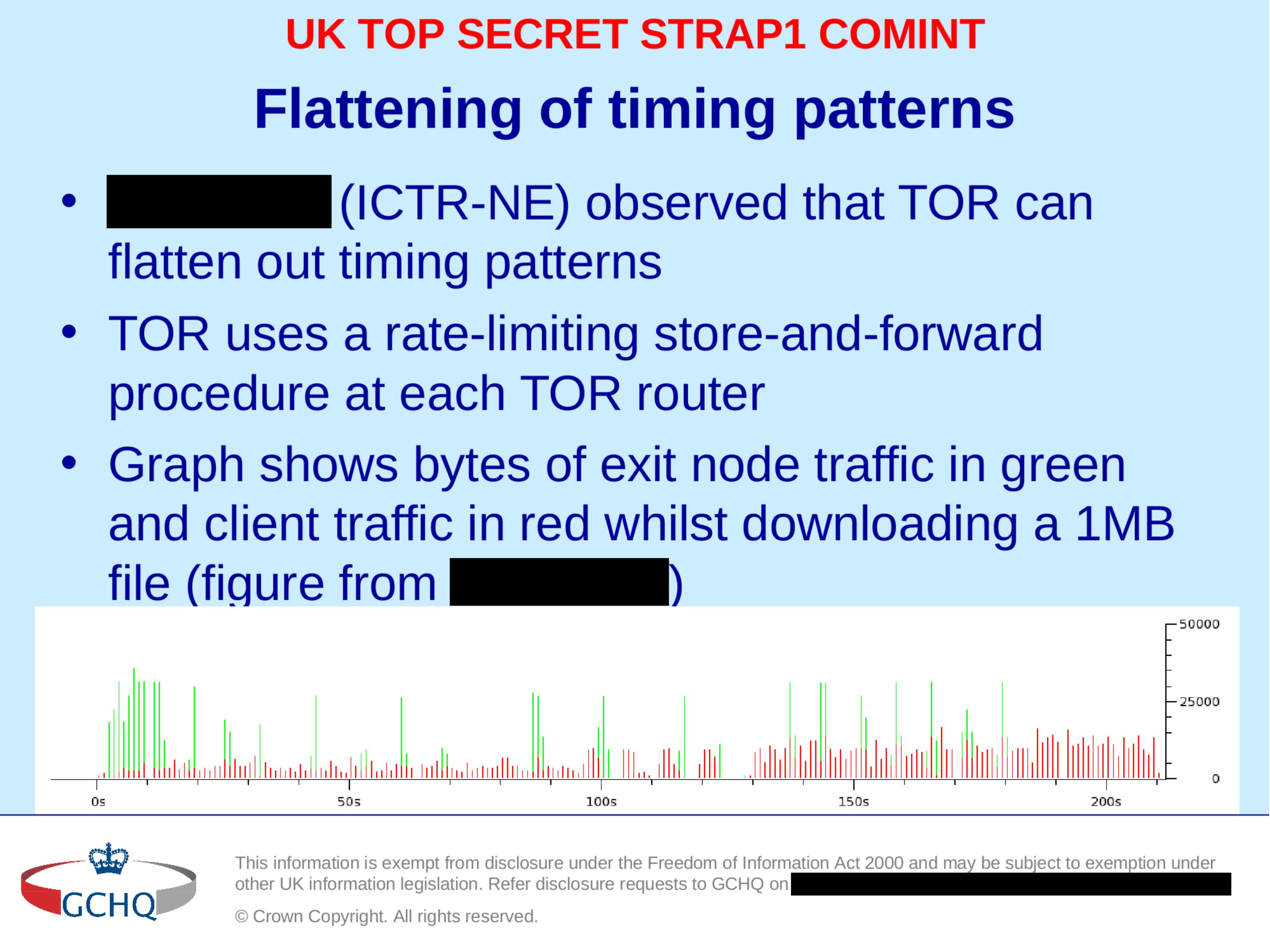
Flattening of timing patterns
- [REDACTED] (ICTR-NE) observed that TOR can flatten out timing patterns
- TOR uses a rate-limiting store-and-forward procedure at each TOR router
- Graph shows bytes of exit node traffic in green and client traffic in red whilst downloading a 1MB file (figure from [REDACTED])
50000
25000
0
0s
50s
100s
150s
200s
This information is exempt from disclosure under the Freedom of Information Act 2000 and may be subject to exemption under other UK information legislation. Refer disclosure requests to GCHQ on [REDACTED]
© Crown Copyright. All rights reserved.
UK TOP SECRET STRAP1 COMINT
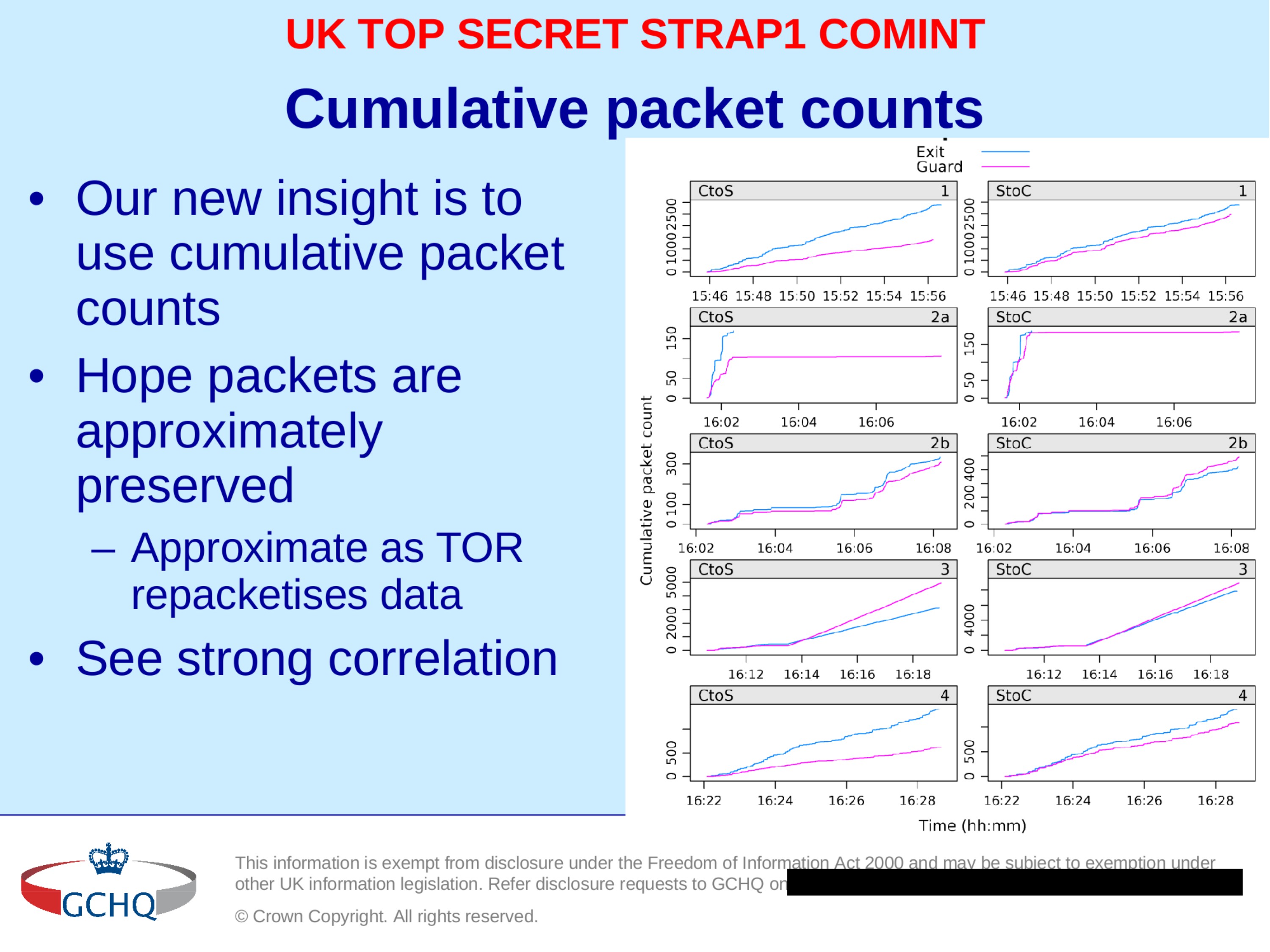
Cumulative packet counts
- Our new insight is to use cumulative packet counts
- Hope packets are approximately preserved
- Approximate as TOR repacketises data
- See strong correlation
Exit
Guard

Cumulative packet count

CtoS  1
15:46 15:48 15:50 15:52 15:54 15:56
StoC  1
15:46 15:48 15:50 15:52 15:54 15:56
CtoS  2a
16:02 16:04 16:06
StoC  2a
16:02 16:04 16:06
CtoS 2b
16:02 16:04 16:06 16:08
StoC 2b
16:02 16:04 16:06 16:08
CtoS 3
16:12 16:14 16:16 16:18
StoC 3
16:12 16:14 16:16 16:18
CtoS 4
16:22 16:24 16:26 16:28
StoC 4
16:22 16:24 16:26 16:28
Time (hh:mm)
This information is exempt from disclosure under the Freedom of Information Act 2000 and may be subject to exemption under other UK information legislation. Refer disclosure requests to GCHQ or [REDACTED]
© Crown Copyright. All rights reserved.
UK TOP SECRET STRAP1 COMINT
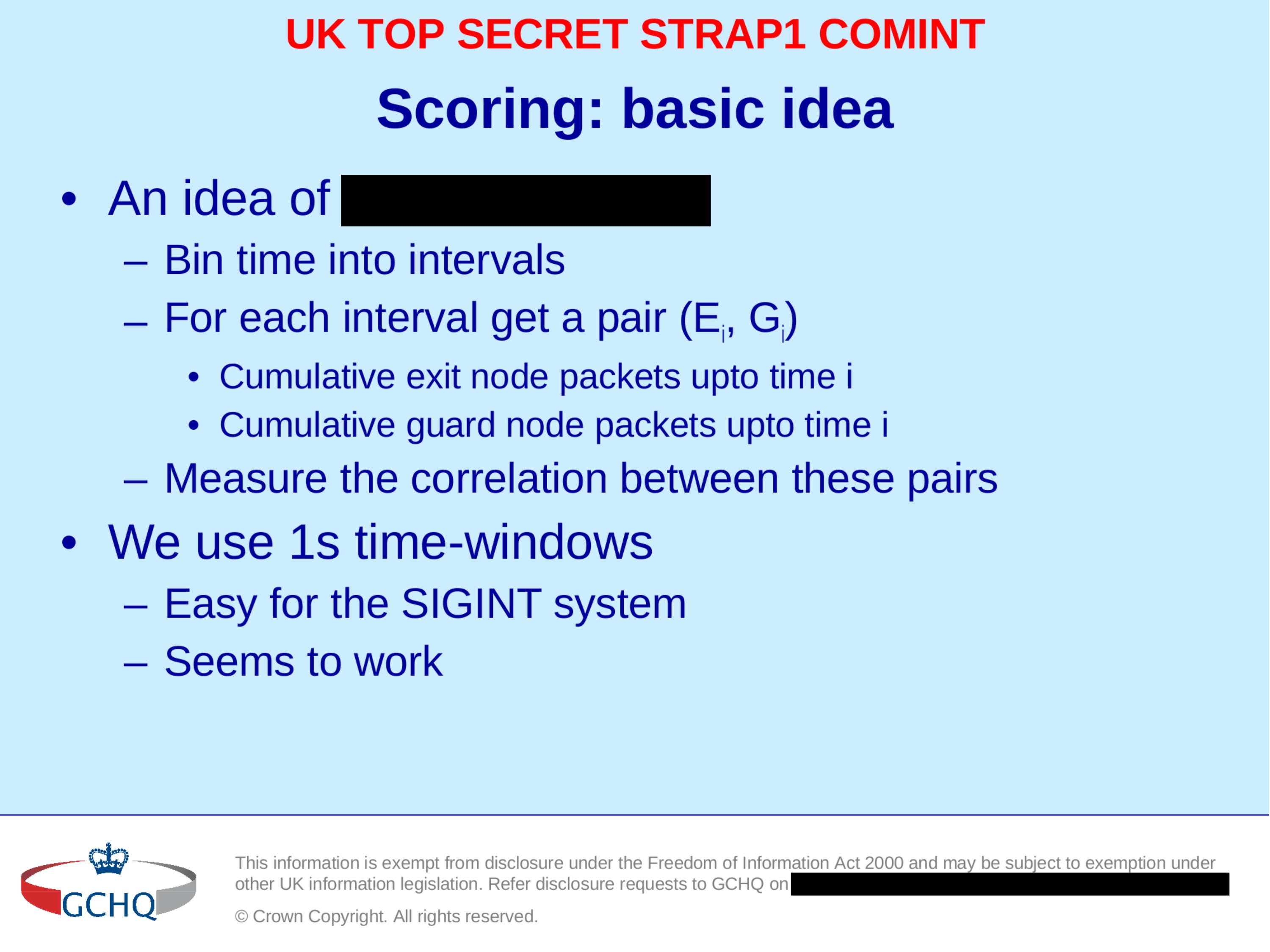
Scoring: basic idea
- An idea of [REDACTED]
- Bin time into intervals
- For each interval get a pair (Ei, Gi)
- Cumulative exit node packets upto time i
- Cumulative guard node packets upto time i
- Measure the correlation between these pairs
- We use 1s time-windows
- Easy for the SIGINT system
- Seems to work
This information is exempt from disclosure under the Freedom of Information Act 2000 and may be subject to exemption under other UK information legislation. Refer disclosure requests to GCHQ on [REDACTED]
© Crown Copyright. All rights reserved.
UK TOP SECRET STRAP1 COMINT
Scoring: refinements
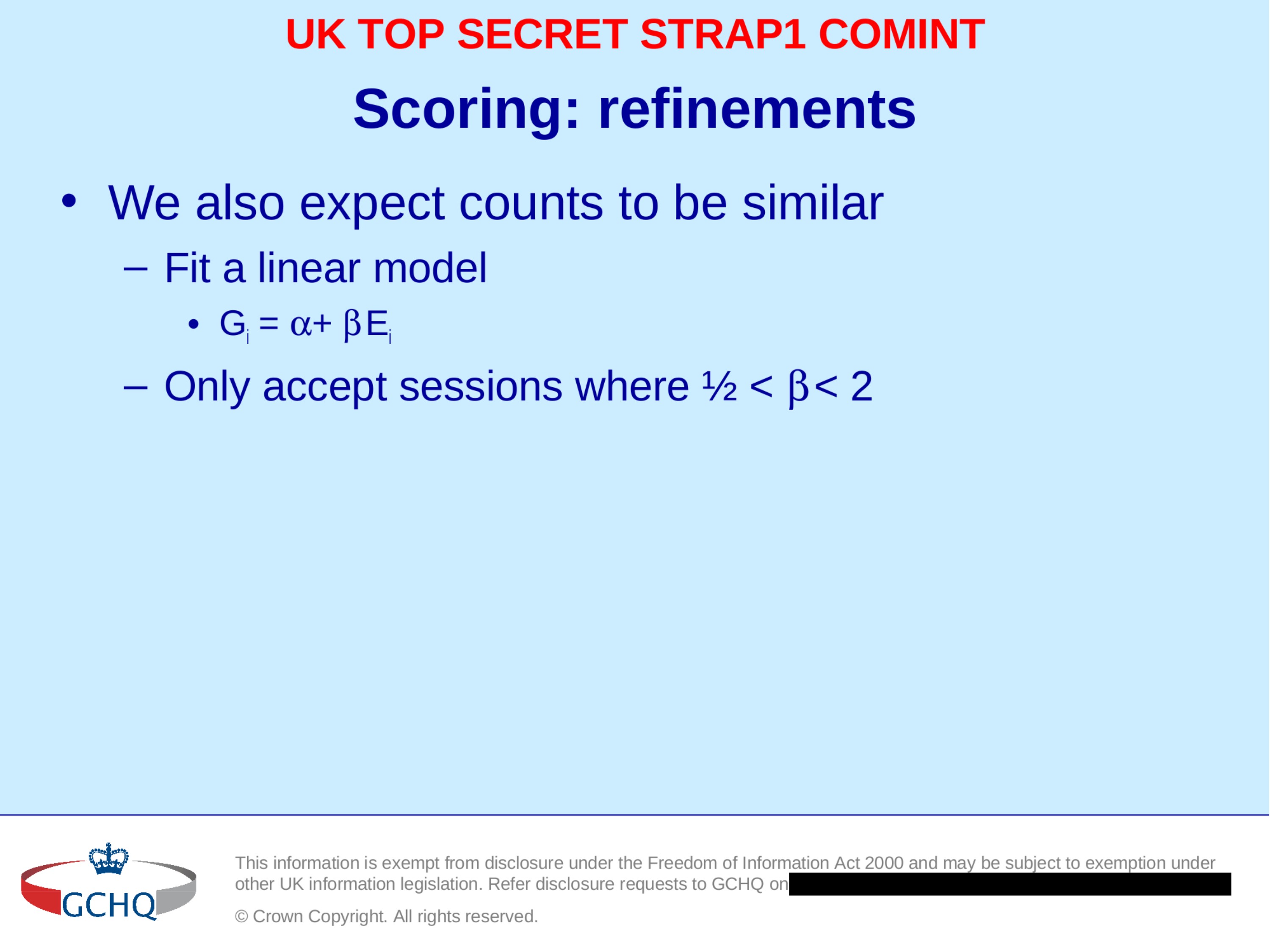
- We also expect counts to be similar
- Fit a linear model
- G = α+ βEᵢ
- Only accept sessions where ½ < β < 2
- Fit a linear model
This information is exempt from disclosure under the Freedom of Information Act 2000 and may be subject to exemption under other UK information legislation. Refer disclosure requests to GCHQ on [REDACTED]
© Crown Copyright. All rights reserved.
UK TOP SECRET STRAP1 COMINT
Scoring: refinements
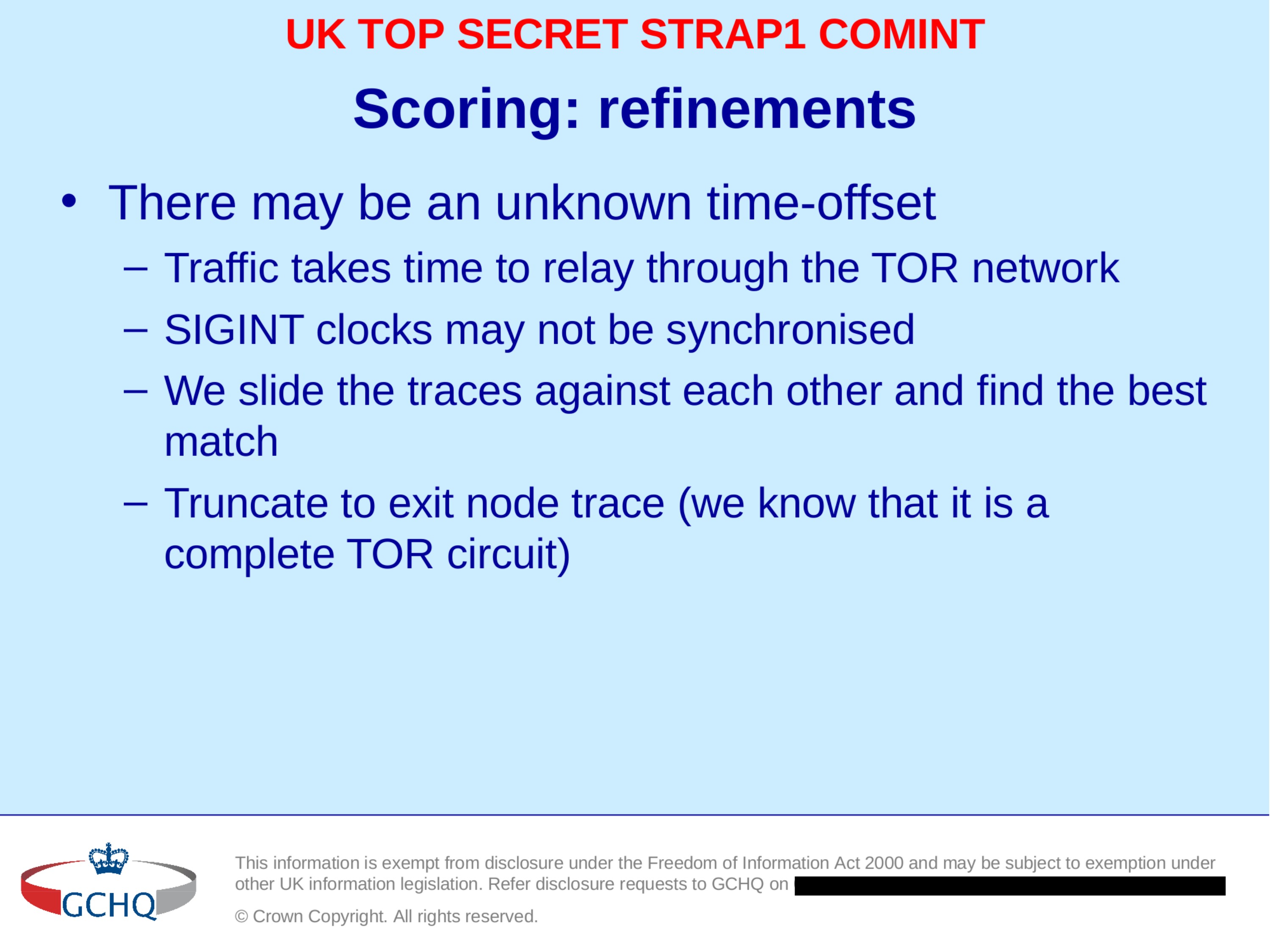
- There may be an unknown time-offset
- Traffic takes time to relay through the TOR network
- SIGINT clocks may not be synchronised
- We slide the traces against each other and find the best match
- Truncate to exit node trace (we know that it is a complete TOR circuit)
This information is exempt from disclosure under the Freedom of Information Act 2000 and may be subject to exemption under other UK information legislation. Refer disclosure requests to GCHQ on [REDACTED]
© Crown Copyright. All rights reserved.
UK TOP SECRET STRAP1 COMINT
Self-comparison
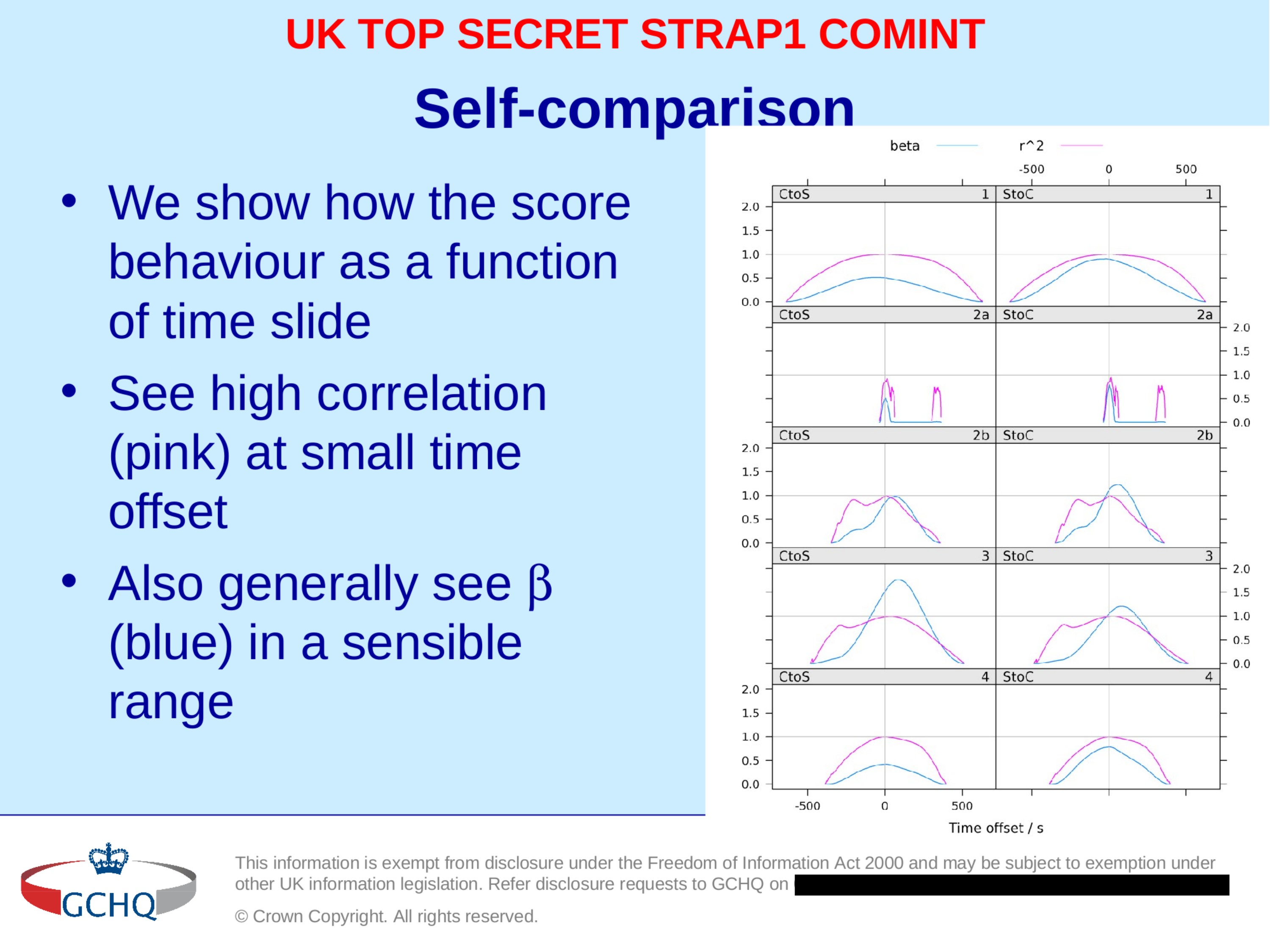
- We show how the score behaviour as a function of time slide
- See high correlation (pink) at small time offset
- Also generally see β (blue) in a sensible range
beta
r^2

-500  0  500
CtoS 1
2.0 1.5 1.0 0.5 0.0
StoC 1
CtoS 2a
StoC 2a
2.0 1.5 1.0 0.5 0.0
CtoS 2b
StoC 2b
2.0 1.5 1.0 0.5 0.0
CtoS 3
StoC 3
2.0 1.5 1.0 0.5 0.0
CtoS 4
StoC 4
2.0 1.5  1.0 0.5 0.0

-500
0
500
Time offset / s
This information is exempt from disclosure under the Freedom of Information Act 2000 and may be subject to exemption under other UK information legislation. Refer disclosure requests to GCHQ on [REDACTED]
© Crown Copyright. All rights reserved.
UK TOP SECRET STRAP1 COMINT
UK TOP SECRET STRAP1 COMINT
False positives
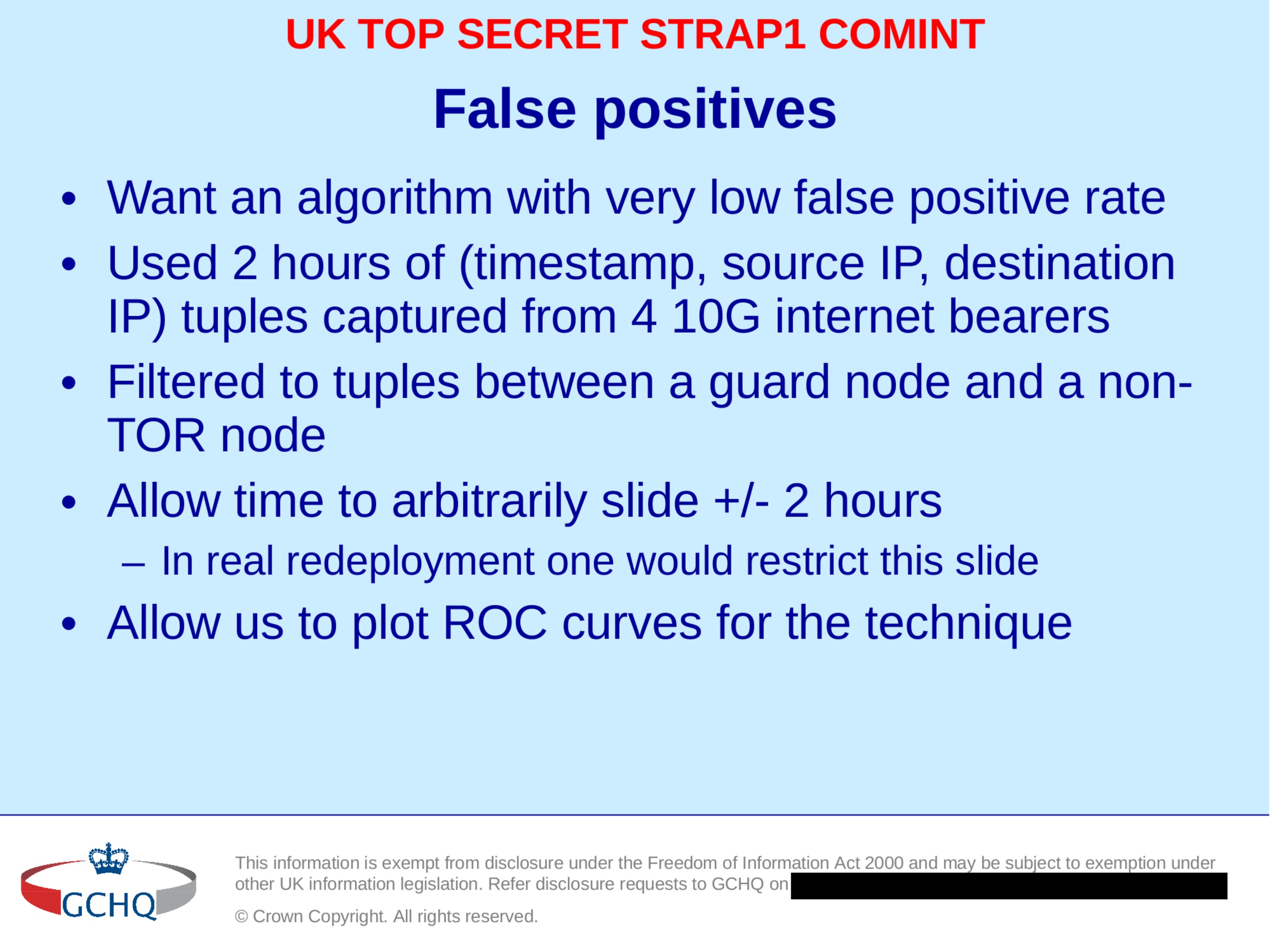
- Want an algorithm with very low false positive rate
- Used 2 hours of (timestamp, source IP, destination IP) tuples captured from 4 10G internet bearers
- Filtered to tuples between a guard node and a non-TOR node
- Allow time to arbitrarily slide +/- 2 hours
- In real redeployment one would restrict this slide
- Allow us to plot ROC curves for the technique
This information is exempt from disclosure under the Freedom of Information Act 2000 and may be subject to exemption under other UK information legislation. Refer disclosure requests to GCHQ on [REDACTED]
© Crown Copyright. All rights reserved.
UK TOP SECRET STRAP1 COMINT
False positives
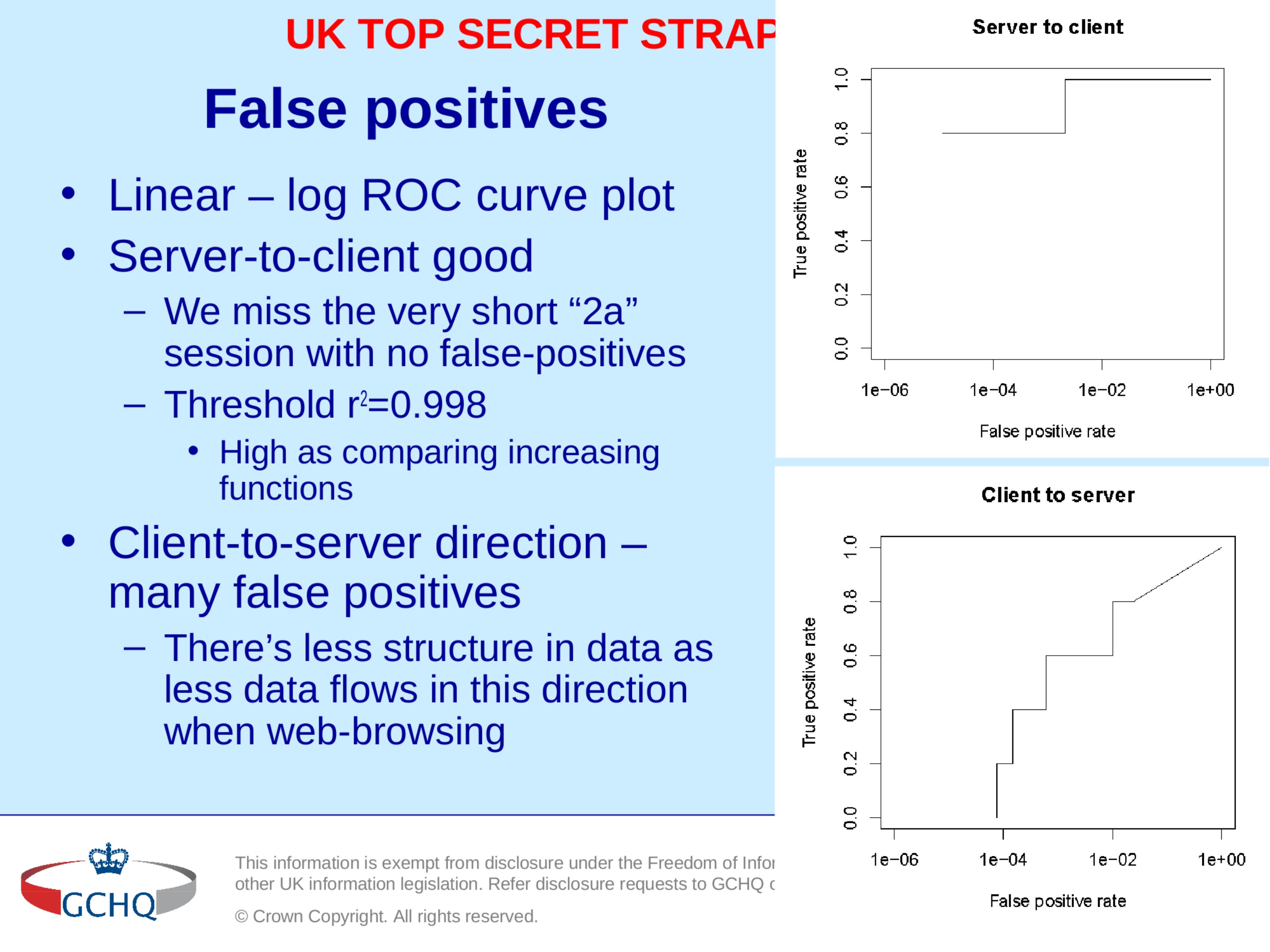
- Linear – log ROC curve plot
- Server-to-client good
- We miss the very short "2a" session with no false-positives
- Threshold r²=0.998
- High as comparing increasing functions
- Client-to-server direction – many false positives
- There's less structure in data as less data flows in this direction when web-browsing
Server to client
1.0 0.8 0.6 0.4 0.2 0.0
True positive rate
1e-06 1e-04 1e-02 1e+00
False positive rate

Client to server
1.0 0.8 0.6 0.4 0.2 0.0
True positive rate
1e-06 1e-04 1e-02 1e+00
False positive rate
This information is exempt from disclosure under the Freedom of Information Act 2000 and may be subject to exemption under other UK information legislation. Refer disclosure requests to GCHQ on [REDACTED]
© Crown Copyright. All rights reserved.
UK TOP SECRET STRAP1 COMINT
A larger experiment
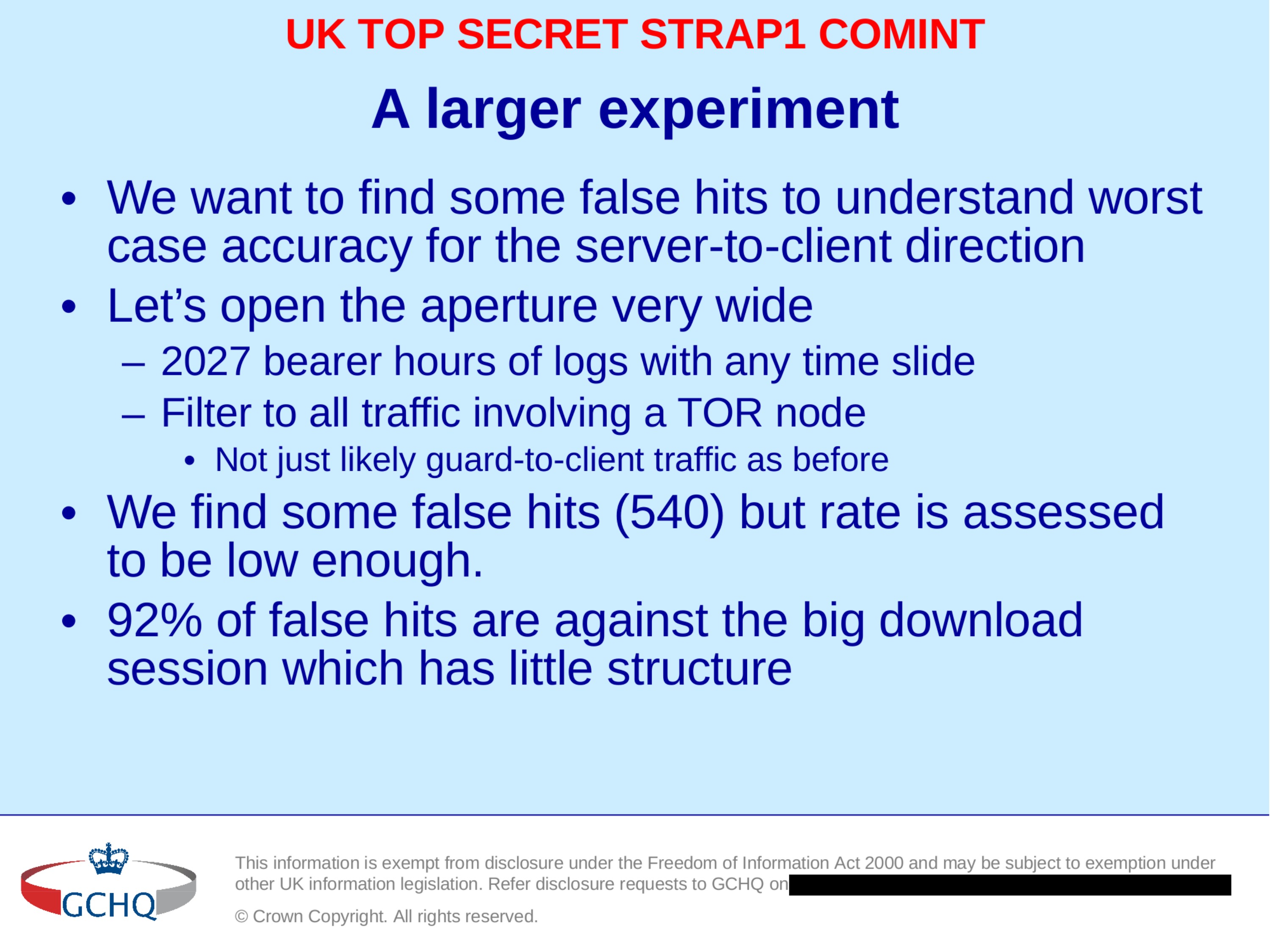
- We want to find some false hits to understand worst case accuracy for the server-to-client direction
- Let's open the aperture very wide
- 2027 bearer hours of logs with any time slide
- Filter to all traffic involving a TOR node
- Not just likely guard-to-client traffic as before
- We find some false hits (540) but rate is assessed to be low enough.
- 92% of false hits are against the big download session which has little structure
This information is exempt from disclosure under the Freedom of Information Act 2000 and may be subject to exemption under other UK information legislation. Refer disclosure requests to GCHQ on [REDACTED]
© Crown Copyright. All rights reserved.
UK TOP SECRET STRAP1 COMINT
The next step
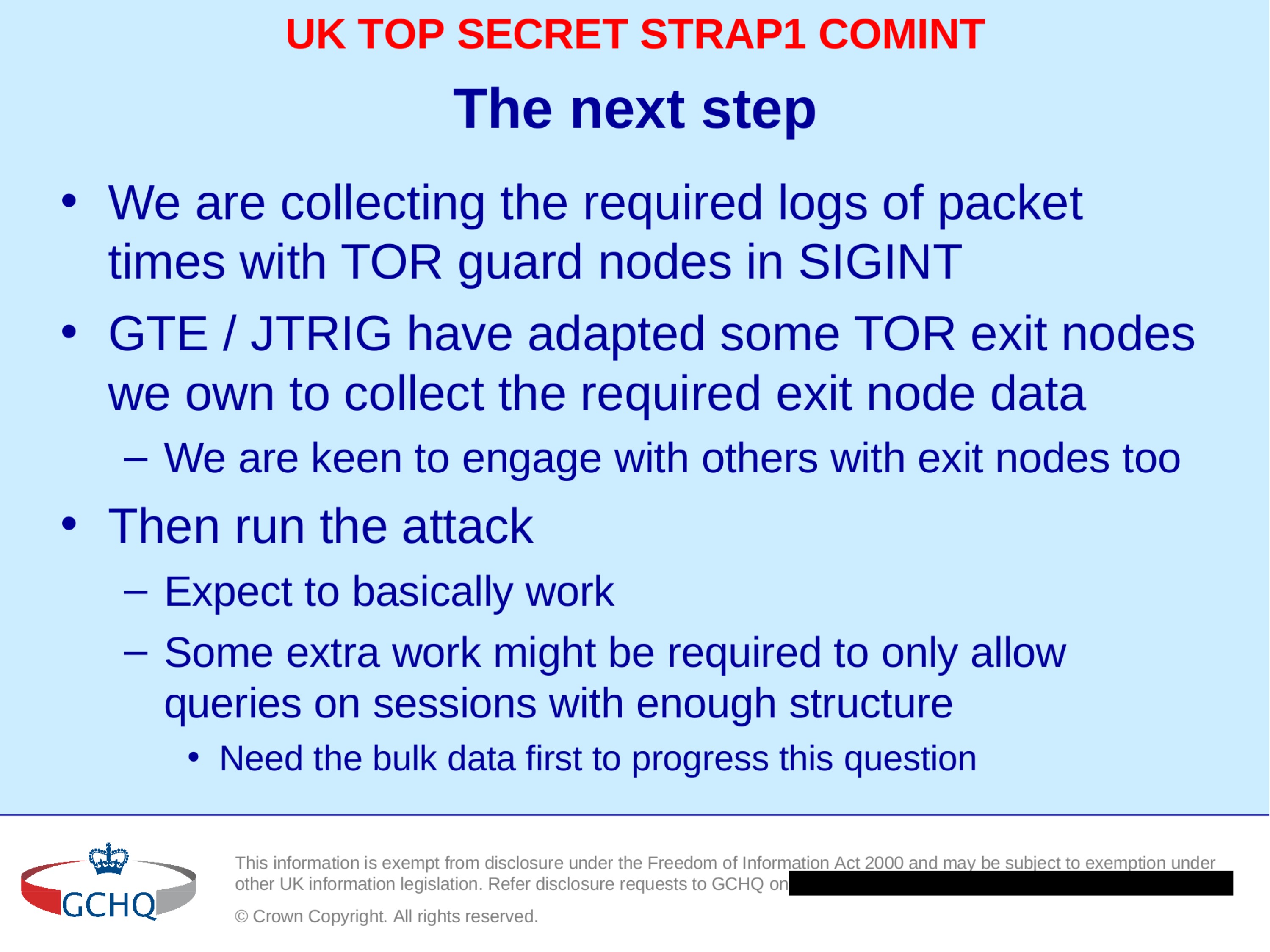
- We are collecting the required logs of packet times with TOR guard nodes in SIGINT
- GTE / JTRIG have adapted some TOR exit nodes we own to collect the required exit node data
- We are keen to engage with others with exit nodes too
- Then run the attack
- Expect to basically work
- Some extra work might be required to only allow queries on sessions with enough structure
- Need the bulk data first to progress this question
This information is exempt from disclosure under the Freedom of Information Act 2000 and may be subject to exemption under other UK information legislation. Refer disclosure requests to GCHQ on [REDACTED]
© Crown Copyright. All rights reserved.
UK TOP SECRET STRAP1 COMINT
R package
- An R package can be downloaded from [REDACTED]
- Includes algorithm and the collected web-browsing data
- Recommend R packages for sharing analytics, can contain:
- R / C / Fortran code
- Example data
- Runnable examples and documentation
- Unit tests
This information is exempt from disclosure under the Freedom of Information Act 2000 and may be subject to exemption under other UK information legislation. Refer disclosure requests to GCHQ on [REDACTED]
© Crown Copyright. All rights reserved.
UK TOP SECRET STRAP1 COMINT
Conclusion
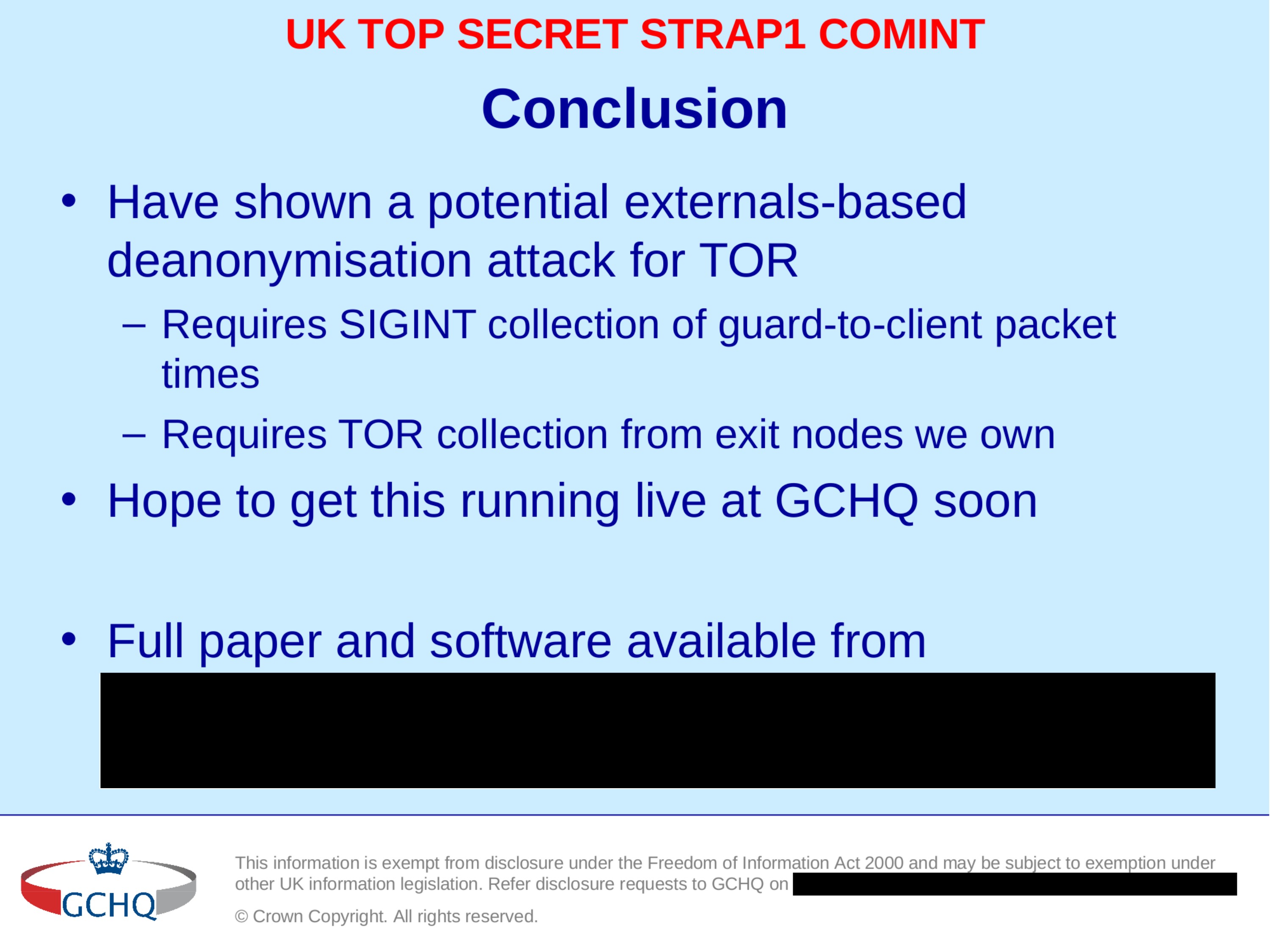
- Have shown a potential externals-based deanonymisation attack for TOR
- Requires SIGINT collection of guard-to-client packet times
- Requires TOR collection from exit nodes we own
- Hope to get this running live at GCHQ soon
- Full paper and software available from [REDACTED]
This information is exempt from disclosure under the Freedom of Information Act 2000 and may be subject to exemption under other UK information legislation. Refer disclosure requests to GCHQ on [REDACTED]
© Crown Copyright. All rights reserved.
UK TOP SECRET STRAP1 COMINT
Questions?
1st
- Work by [REDACTED]
- [REDACTED]
This information is exempt from disclosure under the Freedom of Information Act 2000 and may be subject to exemption under other UK information legislation. Refer disclosure requests to GCHQ on [REDACTED]
© Crown Copyright. All rights reserved.
Published in the Same Report
(10 of 43 documents)
-
BULLRUN CoI - Briefing Sheet [pdf]
A GCHQ briefing sheet introducing the BULLRUN Community of Interest — the access control framework protecting Five Eyes capabilities to defeat encryption across TLS/SSL, HTTPS, SSH, VPNs, IPSec, encrypted chat and encrypted VoIP — covering the classification structure, handling procedures and protective marking guidance for intelligence derived from cryptanalytic exploitation.
“N.S.A. Able to Foil Basic Safeguards of Privacy on Web” - The New York Times ↗ (2013-09-05) · “Revealed: The NSA's Secret Campaign to Crack, Undermine Internet Security” - ProPublica ↗ (2013-09-05) · “Prying Eyes: Inside the NSA's War on Internet Security” - Der Spiegel ↗ (2014-12-28) · Perlroth, Nicole · Larson, Jeff · Shane, Scott · Appelbaum, Jacob · Gibson, Aaron · Grothoff, Christian · Müller-Maguhn, Andy · Poitras, Laura · Sontheimer, Michael · Stöcker, Christian -
CLASSIFICATION GUIDE FOR CRYPTANALYSIS, 2-12 [pdf]
An NSA/CSS classification guide for cryptanalysis establishing the precise classification level for each type of information about NSA's capabilities to exploit commercial and indigenous encryption systems — from the unclassified acknowledgement that NSA exploits cryptographic devices, through to the Top Secret protection of cryptographic modifications made to commercial products to render them exploitable and industry relationships used to obtain cryptographic details.
“Revealed: how US and UK spy agencies defeat internet privacy and security” - The Guardian ↗ (2013-09-05) · “Prying Eyes: Inside the NSA's War on Internet Security” - Der Spiegel ↗ (2014-12-28) · Ball, James · Borger, Julian · Greenwald, Glenn · Appelbaum, Jacob · Gibson, Aaron · Grothoff, Christian · Müller-Maguhn, Andy · Poitras, Laura · Sontheimer, Michael · Stöcker, Christian -
Innov8 Experiment Profile Template [pdf]
A TOP SECRET STRAP1 joint NSA/GCHQ experiment profile documenting a 2010-2011 Joint Capability Experiment to test hardware-accelerated bulk decryption of common internet encryption technologies at scale, integrating TURMOIL's passive collection with NSA's LONGHAUL key recovery service via the ISLANDTRANSPORT messaging system, as part of the broader BULLRUN assault on internet encryption.
“Prying Eyes: Inside the NSA's War on Internet Security” - Der Spiegel ↗ (2014-12-28) · “Revealed: how US and UK spy agencies defeat internet privacy and security” - The Guardian ↗ (2013-09-05) · Appelbaum, Jacob · Gibson, Aaron · Grothoff, Christian · Müller-Maguhn, Andy · Poitras, Laura · Sontheimer, Michael · Stöcker, Christian · Ball, James · Borger, Julian · Greenwald, Glenn -
TLS Trends: A roundtable discussion on current usage and future directions [pdf]
A presentation by Canada's Communications Security Establishment describing their TLS trend analysis programme, which systematically tracked SSL/TLS encryption parameters across warranted collection and Special Source access to identify cryptanalytic opportunities, monitor target behaviour and collaborate with GCHQ on exploiting weaknesses in widely-used encryption implementations.
-
Secure Sockets Layer (SSL) / Transport Layer Security (TLS) [pdf]
A classified NSA Network Security Products training presentation providing a comprehensive technical overview of SSL/TLS protocol mechanics and NSA's exploitation approaches, including observed usage statistics from intercepted traffic, RSA key exchange decryption methodology, exploitation of the Debian OpenSSL RNG weakness, and the practical challenges of decrypting millions of SSL sessions per day at scale.
Programs: SCARLETFEVER -
TLS trends at GCHQ [pdf]
A GCHQ presentation describing their TLS trends analysis programme, which processed approximately 10 billion SSL/TLS Server Hello events per week from Special Source cable tapping and COMSAT collection to produce weekly trend reports, alongside two operational tools — TargeTLS for matching TLS events against BROAD OAK target profiles, and FLYING PIG, a TLS knowledge base enabling analysts to query certificate, IP and client data across the full intercept base.
-
TURMOIL/APEX/APEX High Level Description Document [pdf]
NSA WikiInfo page providing the high-level design description of APEX — the Active-Passive Integration capability integrating HAMMERMILL router implants with TURMOIL passive collection — enabling real-time exfiltration of targeted VPN (HAMMERSTEIN) and VoIP (HAMMERCHANT) traffic from compromised routers directly into NSA's passive collection and cryptanalytic attack infrastructure, with TURBINE providing automated command and control of the combined active-passive system.
Programs: TURMOIL · APEX · HAMMERMILL · HAMMERCHANT · HAMMERSTEIN · FASHIONCLEFT · TURBINE · TOYGRIPPE · METROTUBE · CHIMNEYPOOL · PIQBLADE · KEYCARD · FASCIA · ISLANDTRANSPORT · PRESSUREWAVE · ASDF · CONVEYANCE · TURBULENCE -
GALLANTWAVE [pdf]
NSA presentation describing GALLANTWAVE — a LONGHAUL capability for VPN decryption — specifically its scaling architecture to handle increased collection volumes and a peering mechanism allowing partner agencies to share single-sided VPN key exchange events so that LONGHAUL can complete decryption attempts that would otherwise fail due to one-sided collection.
-
Intro to the VPN Exploitation Process [pdf]
NSA introduction to the VPN exploitation process from September 2010, presented by the OTP VPN Exploitation Team, covering the full workflow from initial collection through to sustained decryption of IPSec, PPTP, SSL and SSH traffic, with named exploitation successes including airlines, diplomatic missions, banks and intelligence services across Iran, Jordan, Russia, Turkey, Pakistan, Afghanistan, Somalia, Indonesia and Mexico.
Programs: BLEAKINQUIRY · TOYGRIPPE · XKEYSCORE · MAILORDER · CORALREEF · VULCANDEATHGRIP · SCISSORS · TURTLEPOWER · PINWALE · FOURSCORE · CADENCE · UTT · VULCANMINDMELD · CAPRIOS · AGILITY · NKB · FOLLOWTHEMONEY -
Analytic Challenges from Active-Passive Integration [pdf]
This NSA briefing addresses the technical and administrative friction caused by "shaping" operations. Shaping occurs when an active malware implant, typically situated on network infrastructure like a router, copies specific data streams and redirects them past a passive surveillance sensor such as TURMOIL. While this ensures the capture of data that might otherwise be missed, it creates a "double metadata" conflict where a single piece of intelligence carries two competing sets of identifiers: one from the active Tailored Access Operations (TAO) implant and another from the passive collection site. The document tasks analysts with finding a way to reconcile these source notations to ensure the data remains searchable and legally compliant within legacy databases.
Programs: BRAVENICKEL · HAMMERMILL · APEX · TURMOIL · HAMMERSTONE · PRESSUREWAVE · METROTUBE · TOYGRIPPE · TURBULENCE · METAWAVE · MARINA · SSO · CONVEYANCE · NUCLEON · FASCIA · HAMMERCHANT

Related Documents
-
A potential technique to deanonymise users of the TOR network [pdf]
The GCHQ technical report documenting the entry-exit traffic correlation attack against Tor — providing the complete mathematical specification, test methodology, experimental results and software reference implementation, with distribution to NSA R1, NSA R4, NSA CES, CSE, DSD, SEQUOIA, ICTR, JTRIG, TEA, GTE and multiple OPC divisions.
-
Tor Hidden Services - How Hidden is 'Hidden'? [pdf]
A TOP SECRET GCHQ presentation analysing the security of Tor hidden services — covering the hidden service protocol architecture, possible exploitation vectors including the Coil Attack against introduction points, a beaconing pattern discovered in idle hidden services, and the HOMING TROLL bridge discovery capability — concluding that hidden services are "near impossible" to deanonymise but noting several research avenues including PRESTON integration.
-
Tor: Overview of Existing Techniques [pdf]
A TOP SECRET GCHQ presentation summarising existing Tor exploitation techniques and 2012/13 plans documenting GCHQ's Tor-related programmes, naming QUICK ANT, HOMING TROLL, NEWTONS CRADLE, TRIBAL CARNEM, EPIC FAIL, THEMP, NATURAL SELECTION and HAKIM alongside the MCR deanonymisation research, traffic shaping, hidden service investigation and bridge discovery work.
Programs: HOMINGTROLL · NEWTONSCRADLE · JTRIG · TRIBALCARNEM · EPICFAIL · QUICKANT · NATURALSELECTION · REMATION · HAKIM · THEMP -
TOR deanonymisation research (MIP) [pdf]
A TOP SECRET GCHQ wiki page documenting the research task on Tor deanonymisation — the project page linking the entry-exit correlation attack described in the OPC-MCR presentation to its formal research output, confirming the attack was successfully documented in OPC-M/TECH.B/61, presented at SANAR11, and planned for prototyping in the REMATION II workshop.
-
PROFILING SSL AND ATTRIBUTING PRIVATE NETWORKS [pdf]
A TOP SECRET GCHQ presentation introducing two prototype cloud analytics — FLYING PIG, a knowledge base for investigating TLS/SSL traffic at scale across approximately 20 billion events per week, and HUSH PUPPY, a tool for attributing private network traffic to identifiable organisations — with live interface screenshots demonstrating queries against mail.ru infrastructure and operational successes including identification of the Afghan Ministry of Defence network and a foreign Ministry of Foreign Affairs VSAT network.
Programs: FLYINGPIG · HUSHPUPPY · QUICKANT · GEOFUSION · LEGIONJADE · LEGIONRUBY · MAKERSMARK · XKEYSCORE · NOSEYPARKER“Prying Eyes: Inside the NSA's War on Internet Security” - Der Spiegel ↗ (2014-12-28) · “'Brasil é um grande alvo', diz jornalista sobre vigilância dos EUA” - O Globo ↗ (2013-07-07) · Appelbaum, Jacob · Gibson, Aaron · Grothoff, Christian · Müller-Maguhn, Andy · Poitras, Laura · Sontheimer, Michael · Stöcker, Christian · Greenwald, Glenn · Kaz, Roberto · Casado, José