Tag: de-anonymization 10 documents
Search documents matching “de-anonymization” →Free-text subjects the curators added. Unlike the other axes these are not necessarily from the documents' own vocabulary, so they are the loosest thing to browse by (and the most forgiving).
Graphs
By Banner
By Classification
Refine (combine with another filter, via search)
Sort: Title
Documents
-
A potential technique to deanonymise users of the TOR network [pdf]
A TOP SECRET GCHQ research presentation describing a traffic correlation attack against Tor — using cumulative packet counts observed simultaneously at a controlled exit node and at SIGINT collection points near a target's guard node to deanonymise Tor users without breaking the encryption — with GTE and JTRIG having adapted owned exit nodes to collect the required data for live deployment.
-
A potential technique to deanonymise users of the TOR network [pdf]
The GCHQ technical report documenting the entry-exit traffic correlation attack against Tor — providing the complete mathematical specification, test methodology, experimental results and software reference implementation, with distribution to NSA R1, NSA R4, NSA CES, CSE, DSD, SEQUOIA, ICTR, JTRIG, TEA, GTE and multiple OPC divisions.
-
BLACK HOLE ANALYTICS, ADD/SD briefing, September 2009 [pdf]
This September 2009 GCHQ briefing describes the BLACK HOLE analytics infrastructure and Next Generation Events (NGE) project, which planned to scale from ~8 10-gigabit connections to ~200 10Gs by March 2011, storing intercepted data in massive flat-file repositories at Benhall and Bude before loading it into "Question Focused Dataset" (QFD) databases that power surveillance tools like MUTANT BROTH, KARMA POLICE, INFINITE MONKEYS, and others. The document outlines how "probes" extract Target Detection Identifiers (TDIs) from intercepted data feeds, store them in BLACK HOLE repositories, then enable analysts to profile targets' online activities, create social networks, investigate websites and forums, track web searches and Google Earth usage, and perform large-scale data mining across internet and telephony data.
Programs: BLACKHOLE · MUTANTBROTH · AUTOASSOC · INFINITEMONKEYS · KARMAPOLICE · SOCIALANIMAL · HRMAP · MEMORYHOLE · MARBLEDGECKO · HARDASSOC · SAMUELPEPYS · BLAZINGSADDLES · TELLURIAN · BUFFER · DISTILLERY · LOOKINGGLASS · NGEPeople: bin Laden, Osama -
Op MULLENIZE and beyond - Staining machines 10/10/12 [pdf]
This 2012 report from the NSA's British counterpart, the GCHQ, describes a method of "staining" electronic traffic to distinguish otherwise anonymous users. It is used to unmask Tor users and devices on networks in which many computers share the same Internet address. The method relies on planting code in a web browser to change the "user agent," which is the way the browser identifies itself on the web. In a two month period, the report says, GCHQ managed to implant about 200 computers with uniquely identifying stains.
-
TOR deanonymisation research (MIP) [pdf]
A TOP SECRET GCHQ wiki page documenting the research task on Tor deanonymisation — the project page linking the entry-exit correlation attack described in the OPC-MCR presentation to its formal research output, confirming the attack was successfully documented in OPC-M/TECH.B/61, presented at SANAR11, and planned for prototyping in the REMATION II workshop.
-
Tor Hidden Services - How Hidden is 'Hidden'? [pdf]
A TOP SECRET GCHQ presentation analysing the security of Tor hidden services — covering the hidden service protocol architecture, possible exploitation vectors including the Coil Attack against introduction points, a beaconing pattern discovered in idle hidden services, and the HOMING TROLL bridge discovery capability — concluding that hidden services are "near impossible" to deanonymise but noting several research avenues including PRESTON integration.
-
Tor Stinks [pdf]
A June 2012 joint NSA-GCHQ presentation titled "Tor Stinks" detailing the two agencies' attempts to de-anonymize Tor users through analytics, exploitation, and network disruption — candidly admitting they will never be able to identify all Tor users, but outlining a range of techniques including cookie leakage tracking, QUANTUM attacks, circuit reconstruction, timing analysis, and deliberate network degradation.
Programs: REMATION · EPICFAIL · QUANTUM · NEWTONSCRADLE · QUICKANT · GREATEXPECTATIONS · RONIN · ONIONBREATH · QUANTUMCOOKIE · SHORTSHEET · FOXACID -
Tor: Overview of Existing Techniques [pdf]
A TOP SECRET GCHQ presentation summarising existing Tor exploitation techniques and 2012/13 plans documenting GCHQ's Tor-related programmes, naming QUICK ANT, HOMING TROLL, NEWTONS CRADLE, TRIBAL CARNEM, EPIC FAIL, THEMP, NATURAL SELECTION and HAKIM alongside the MCR deanonymisation research, traffic shaping, hidden service investigation and bridge discovery work.
Programs: HOMINGTROLL · NEWTONSCRADLE · JTRIG · TRIBALCARNEM · EPICFAIL · QUICKANT · NATURALSELECTION · REMATION · HAKIM · THEMP -
Tracking Targets Through Proxies & Anonymizers [pdf]
This NSA presentation details methods for tracking and de-anonymizing internet users who employ privacy tools like Tor, proxies, and VPN services such as AnchorFree's Hotspot Shield. The document explains how the agency reverse-engineers anonymization tools, creates "fingerprints" to identify their traffic in surveillance systems, and correlates encrypted connections to reveal users' real IP addresses and locations—acknowledging this work "makes for sad analysts" when targets successfully obscure their identities.
-
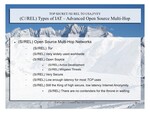
Types of IAT - Advanced Open Source Multi-hop [pdf]
This top-secret NSA/GCHQ document provides a detailed technical overview of the Tor network, including how it works, its strengths as the “king of high secure, low-latency Internet anonymity,” methods for identifying Tor traffic, censorship-driven protocol obfuscation, and ongoing intelligence efforts to analyze, fingerprint, and exploit Tor through passive SIGINT and active research, including collaboration between US and UK agencies.
People: Appelbaum, Jacob