TOR deanonymisation research (MIP)
Open PDFDocument date: -
Pages: 3
Genre: wiki
Banner: TOP SECRET STRAP1 COMINT
Classification: TOP SECRET STRAP 1 COMINT
Dissemination: -
A TOP SECRET GCHQ wiki page documenting the research task on Tor deanonymisation — the project page linking the entry-exit correlation attack described in the OPC-MCR presentation to its formal research output, confirming the attack was successfully documented in OPC-M/TECH.B/61, presented at SANAR11, and planned for prototyping in the REMATION II workshop.
My notes
TOR deanonymisation research (MIP) - GCWiki
TOP SECRET STRAP1 COMINT
The maximum classification allowed on GCWiki is TOP SECRET STRAP1 COMINT. Click to report inappropriate content.
TOR deanonymisation research (MIP)
From GCWiki
Jump to: navigation, search
OPC-MCR Mathematical Information Processing Research Task:
TOR deanonymisation
Customer: ICTR-NE
Status: in pullthrough (started December 2010)
MCR lead: [REDACTED]
Team: [REDACTED]
(ICTR-NE)
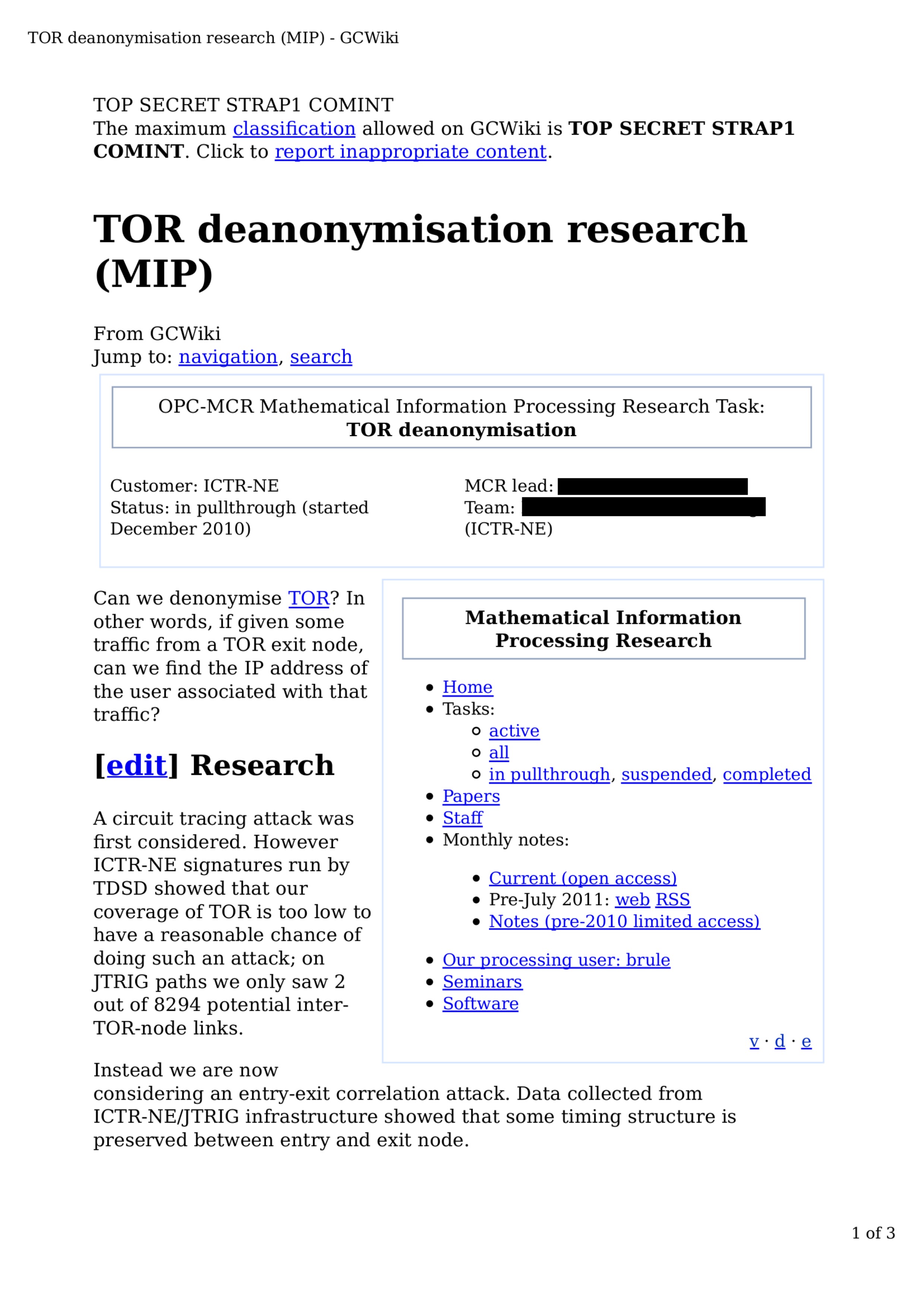
Can we denonymise TOR? In other words, if given some traffic from a TOR exit node, can we find the IP address of the user associated with that traffic?
[edit] Research
A circuit tracing attack was first considered. However ICTR-NE signatures run by TDSD showed that our coverage of TOR is too low to have a reasonable chance of doing such an attack; on JTRIG paths we only saw 2 out of 8294 potential inter-TOR-node links.
Instead we are now considering an entry-exit correlation attack. Data collected from ICTR-NE/JTRIG infrastructure showed that some timing structure is preserved between entry and exit node.
Mathematical Information Processing Research
- Home
- Tasks:
- active
- all
- in pullthrough, suspended, completed
- Papers
- Staff
- Monthly notes:
- Current (open access)
- Pre-July 2011: web RSS
- Notes (pre-2010 limited access)
- Our processing user: brule
- Seminars
- Software
v - d - e
1 of 3
TOR deanonymisation research (MIP) - GCWiki
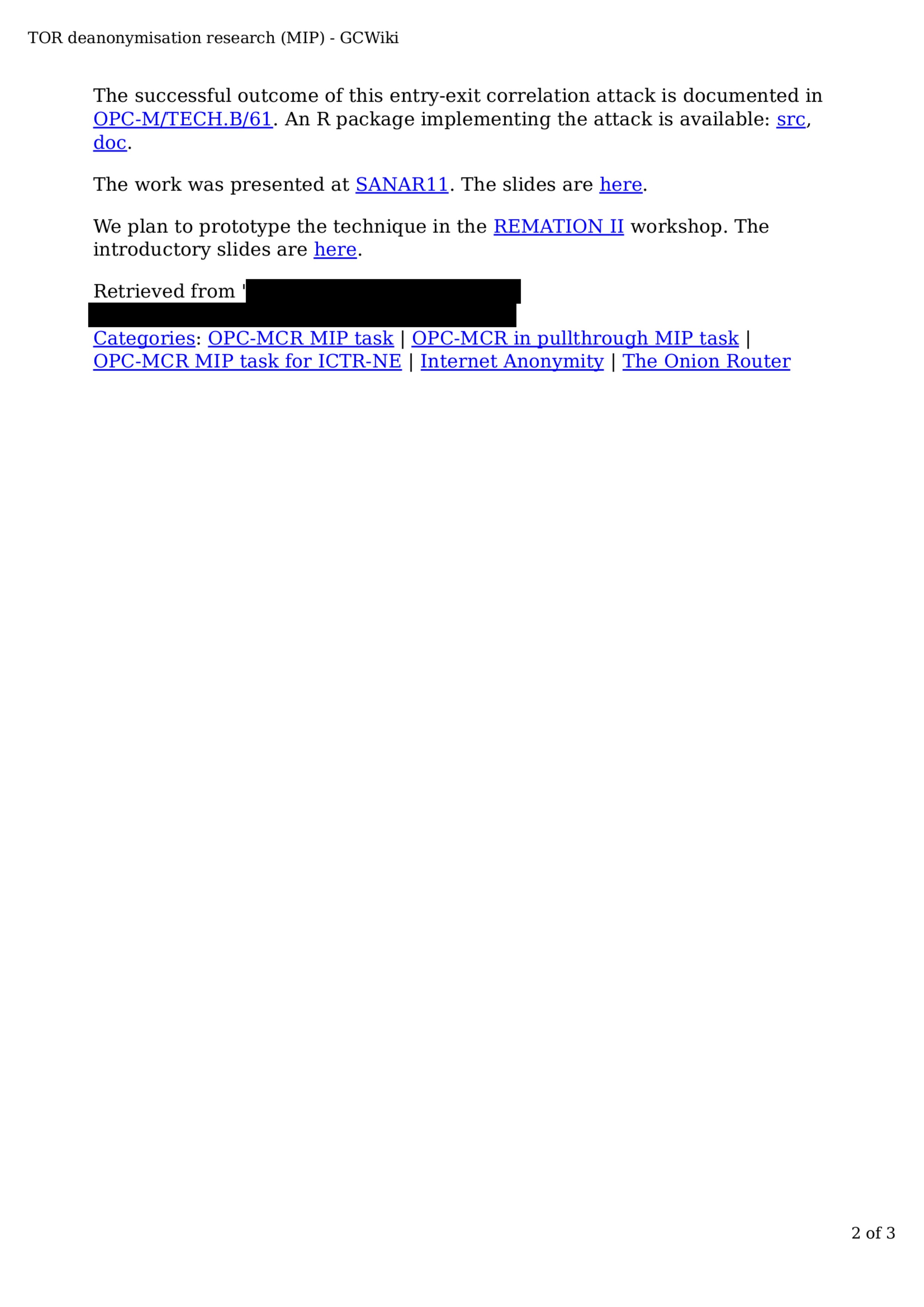
The successful outcome of this entry-exit correlation attack is documented in OPC-M/TECH.B/61. An R package implementing the attack is available: src, doc.
The work was presented at SANAR11. The slides are here.
We plan to prototype the technique in the REMATION II workshop. The introductory slides are here.
Retrieved from '[REDACTED]
Categories: OPC-MCR MIP task | OPC-MCR in pullthrough MIP task | OPC-MCR MIP task for ICTR-NE | Internet Anonymity | The Onion Router
2 of 3
TOR deanonymisation research (MIP) - GCWiki
Go Search
TOP SECRET STRAP1 COMINT
The maximum classification allowed on GCWiki is TOP SECRET STRAP1 COMINT. Click to report inappropriate content.
3 of 3
Published in the Same Report
(10 of 43 documents)
-
BULLRUN CoI - Briefing Sheet [pdf]
A GCHQ briefing sheet introducing the BULLRUN Community of Interest — the access control framework protecting Five Eyes capabilities to defeat encryption across TLS/SSL, HTTPS, SSH, VPNs, IPSec, encrypted chat and encrypted VoIP — covering the classification structure, handling procedures and protective marking guidance for intelligence derived from cryptanalytic exploitation.
“N.S.A. Able to Foil Basic Safeguards of Privacy on Web” - The New York Times ↗ (2013-09-05) · “Revealed: The NSA's Secret Campaign to Crack, Undermine Internet Security” - ProPublica ↗ (2013-09-05) · “Prying Eyes: Inside the NSA's War on Internet Security” - Der Spiegel ↗ (2014-12-28) · Perlroth, Nicole · Larson, Jeff · Shane, Scott · Appelbaum, Jacob · Gibson, Aaron · Grothoff, Christian · Müller-Maguhn, Andy · Poitras, Laura · Sontheimer, Michael · Stöcker, Christian -
CLASSIFICATION GUIDE FOR CRYPTANALYSIS, 2-12 [pdf]
An NSA/CSS classification guide for cryptanalysis establishing the precise classification level for each type of information about NSA's capabilities to exploit commercial and indigenous encryption systems — from the unclassified acknowledgement that NSA exploits cryptographic devices, through to the Top Secret protection of cryptographic modifications made to commercial products to render them exploitable and industry relationships used to obtain cryptographic details.
“Revealed: how US and UK spy agencies defeat internet privacy and security” - The Guardian ↗ (2013-09-05) · “Prying Eyes: Inside the NSA's War on Internet Security” - Der Spiegel ↗ (2014-12-28) · Ball, James · Borger, Julian · Greenwald, Glenn · Appelbaum, Jacob · Gibson, Aaron · Grothoff, Christian · Müller-Maguhn, Andy · Poitras, Laura · Sontheimer, Michael · Stöcker, Christian -
Innov8 Experiment Profile Template [pdf]
A TOP SECRET STRAP1 joint NSA/GCHQ experiment profile documenting a 2010-2011 Joint Capability Experiment to test hardware-accelerated bulk decryption of common internet encryption technologies at scale, integrating TURMOIL's passive collection with NSA's LONGHAUL key recovery service via the ISLANDTRANSPORT messaging system, as part of the broader BULLRUN assault on internet encryption.
“Prying Eyes: Inside the NSA's War on Internet Security” - Der Spiegel ↗ (2014-12-28) · “Revealed: how US and UK spy agencies defeat internet privacy and security” - The Guardian ↗ (2013-09-05) · Appelbaum, Jacob · Gibson, Aaron · Grothoff, Christian · Müller-Maguhn, Andy · Poitras, Laura · Sontheimer, Michael · Stöcker, Christian · Ball, James · Borger, Julian · Greenwald, Glenn -
TLS Trends: A roundtable discussion on current usage and future directions [pdf]
A presentation by Canada's Communications Security Establishment describing their TLS trend analysis programme, which systematically tracked SSL/TLS encryption parameters across warranted collection and Special Source access to identify cryptanalytic opportunities, monitor target behaviour and collaborate with GCHQ on exploiting weaknesses in widely-used encryption implementations.
-
Secure Sockets Layer (SSL) / Transport Layer Security (TLS) [pdf]
A classified NSA Network Security Products training presentation providing a comprehensive technical overview of SSL/TLS protocol mechanics and NSA's exploitation approaches, including observed usage statistics from intercepted traffic, RSA key exchange decryption methodology, exploitation of the Debian OpenSSL RNG weakness, and the practical challenges of decrypting millions of SSL sessions per day at scale.
Programs: SCARLETFEVER -
TLS trends at GCHQ [pdf]
A GCHQ presentation describing their TLS trends analysis programme, which processed approximately 10 billion SSL/TLS Server Hello events per week from Special Source cable tapping and COMSAT collection to produce weekly trend reports, alongside two operational tools — TargeTLS for matching TLS events against BROAD OAK target profiles, and FLYING PIG, a TLS knowledge base enabling analysts to query certificate, IP and client data across the full intercept base.
-
TURMOIL/APEX/APEX High Level Description Document [pdf]
NSA WikiInfo page providing the high-level design description of APEX — the Active-Passive Integration capability integrating HAMMERMILL router implants with TURMOIL passive collection — enabling real-time exfiltration of targeted VPN (HAMMERSTEIN) and VoIP (HAMMERCHANT) traffic from compromised routers directly into NSA's passive collection and cryptanalytic attack infrastructure, with TURBINE providing automated command and control of the combined active-passive system.
Programs: TURMOIL · APEX · HAMMERMILL · HAMMERCHANT · HAMMERSTEIN · FASHIONCLEFT · TURBINE · TOYGRIPPE · METROTUBE · CHIMNEYPOOL · PIQBLADE · KEYCARD · FASCIA · ISLANDTRANSPORT · PRESSUREWAVE · ASDF · CONVEYANCE · TURBULENCE -
GALLANTWAVE [pdf]
NSA presentation describing GALLANTWAVE — a LONGHAUL capability for VPN decryption — specifically its scaling architecture to handle increased collection volumes and a peering mechanism allowing partner agencies to share single-sided VPN key exchange events so that LONGHAUL can complete decryption attempts that would otherwise fail due to one-sided collection.
-
Intro to the VPN Exploitation Process [pdf]
NSA introduction to the VPN exploitation process from September 2010, presented by the OTP VPN Exploitation Team, covering the full workflow from initial collection through to sustained decryption of IPSec, PPTP, SSL and SSH traffic, with named exploitation successes including airlines, diplomatic missions, banks and intelligence services across Iran, Jordan, Russia, Turkey, Pakistan, Afghanistan, Somalia, Indonesia and Mexico.
Programs: BLEAKINQUIRY · TOYGRIPPE · XKEYSCORE · MAILORDER · CORALREEF · VULCANDEATHGRIP · SCISSORS · TURTLEPOWER · PINWALE · FOURSCORE · CADENCE · UTT · VULCANMINDMELD · CAPRIOS · AGILITY · NKB · FOLLOWTHEMONEY -
Analytic Challenges from Active-Passive Integration [pdf]
This NSA briefing addresses the technical and administrative friction caused by "shaping" operations. Shaping occurs when an active malware implant, typically situated on network infrastructure like a router, copies specific data streams and redirects them past a passive surveillance sensor such as TURMOIL. While this ensures the capture of data that might otherwise be missed, it creates a "double metadata" conflict where a single piece of intelligence carries two competing sets of identifiers: one from the active Tailored Access Operations (TAO) implant and another from the passive collection site. The document tasks analysts with finding a way to reconcile these source notations to ensure the data remains searchable and legally compliant within legacy databases.
Programs: BRAVENICKEL · HAMMERMILL · APEX · TURMOIL · HAMMERSTONE · PRESSUREWAVE · METROTUBE · TOYGRIPPE · TURBULENCE · METAWAVE · MARINA · SSO · CONVEYANCE · NUCLEON · FASCIA · HAMMERCHANT
Related Documents
-
Tor: Overview of Existing Techniques [pdf]
A TOP SECRET GCHQ presentation summarising existing Tor exploitation techniques and 2012/13 plans documenting GCHQ's Tor-related programmes, naming QUICK ANT, HOMING TROLL, NEWTONS CRADLE, TRIBAL CARNEM, EPIC FAIL, THEMP, NATURAL SELECTION and HAKIM alongside the MCR deanonymisation research, traffic shaping, hidden service investigation and bridge discovery work.
Programs: HOMINGTROLL · NEWTONSCRADLE · JTRIG · TRIBALCARNEM · EPICFAIL · QUICKANT · NATURALSELECTION · REMATION · HAKIM · THEMP -
A potential technique to deanonymise users of the TOR network [pdf]
The GCHQ technical report documenting the entry-exit traffic correlation attack against Tor — providing the complete mathematical specification, test methodology, experimental results and software reference implementation, with distribution to NSA R1, NSA R4, NSA CES, CSE, DSD, SEQUOIA, ICTR, JTRIG, TEA, GTE and multiple OPC divisions.
-
A potential technique to deanonymise users of the TOR network [pdf]
A TOP SECRET GCHQ research presentation describing a traffic correlation attack against Tor — using cumulative packet counts observed simultaneously at a controlled exit node and at SIGINT collection points near a target's guard node to deanonymise Tor users without breaking the encryption — with GTE and JTRIG having adapted owned exit nodes to collect the required data for live deployment.
-
Tor Hidden Services - How Hidden is 'Hidden'? [pdf]
A TOP SECRET GCHQ presentation analysing the security of Tor hidden services — covering the hidden service protocol architecture, possible exploitation vectors including the Coil Attack against introduction points, a beaconing pattern discovered in idle hidden services, and the HOMING TROLL bridge discovery capability — concluding that hidden services are "near impossible" to deanonymise but noting several research avenues including PRESTON integration.
-
Internet Anonymity 2011 [pdf]
A TOP SECRET NSA presentation from 2011 providing a comprehensive survey of Internet Anonymity Technologies (IAT) — covering HTTP proxies, VPN anonymity providers, multi-hop networks including Tor and JAP, anonymous remailers and circumvention tools — alongside NSA's capabilities and limitations against each, including XKEYSCORE fingerprints for VPN identification, the PARTNERSNIPPET Tor deanonymisation team, GOLDENFORTIN Netflow data, and a candid assessment that Tor offers "no passive exploitation."
Programs: FOXTRAIL · NKB · NACIRONIN · PONTENTPOTABLES · RONIN · XKEYSCORE · PARTNERSNIPPET · GOLDENFORTIN · SNAPEPeople: Heap, Austin