N.S.A. Timeline of Surveillance Law Developments
Open PDFDocument date: -
Pages: 1
Genre: other
Banner: UNCLASSIFIED//FOR OFFICIAL USE ONLY
Classification: UNCLASSIFIED
Dissemination: FOUO
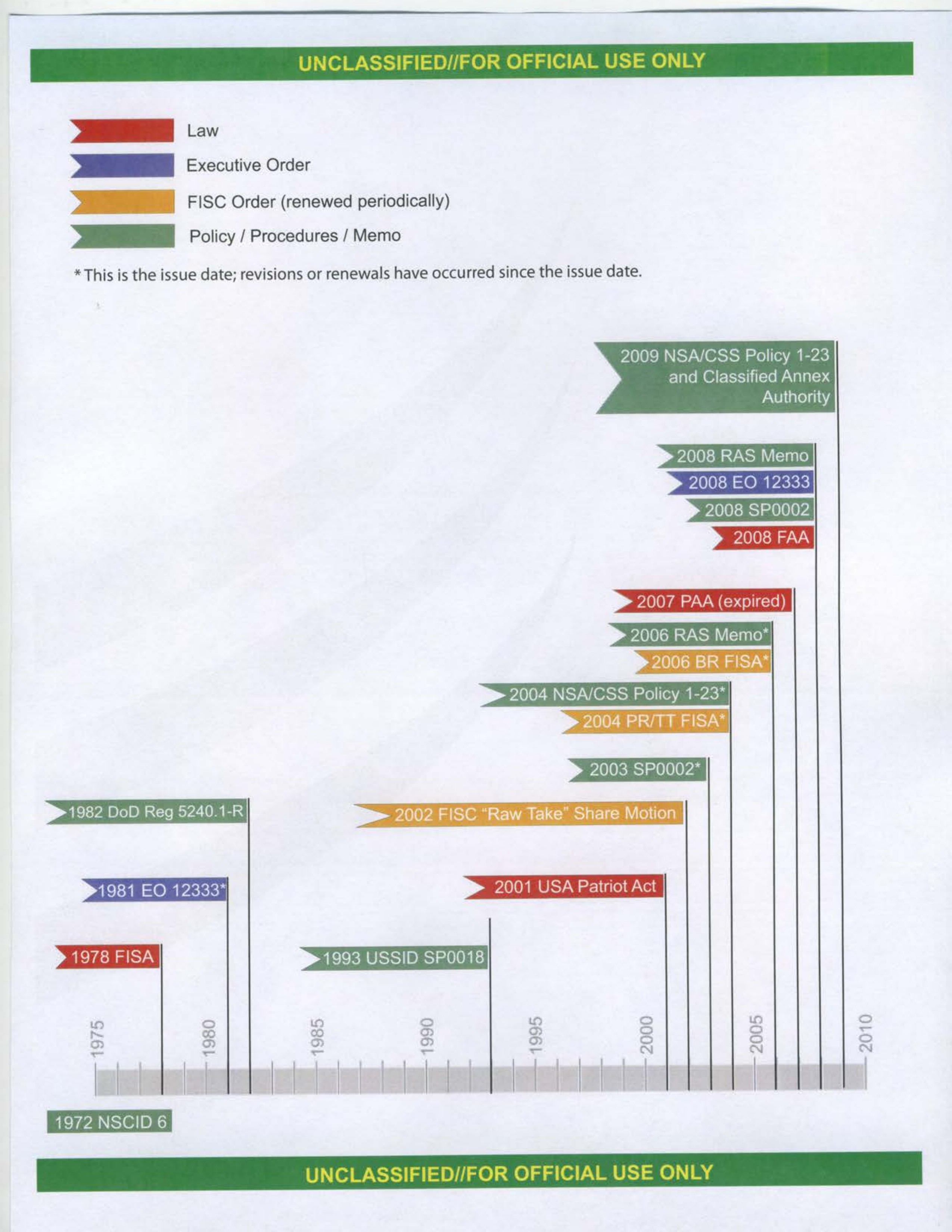
This chart, apparently from an internal N.S.A. presentation, lists milestones in surveillance rules over nearly four decades. The July 2002 “Raw Take” sharing order, whose existence has not previously been disclosed, is just one of three rulings by the Foreign Intelligence Surveillance Court to make the list. The other two were 2004 and 2006 rulings allowing bulk collection of data about emails and phone calls.
My notes
UNCLASSIFIED//FOR OFFICIAL USE ONLY
- Law
- Executive Order
- FISC Order (renewed periodically)
- Policy / Procedures / Memo
- This is the issue date; revisions or renewals have occurred since the issue date.
1972 NSCID 6
1978 FISA
1981 EO 12333*
1982 DoD Reg 5240.1-R
1993 USSID SP0018
2001 USA Patriot Act
2002 FISC "Raw Take" Share Motion
2003 SP0002*
2004 NSA/CSS Policy 1-23*
2004 PR/TT FISA*
2006 RAS Memo*
2006 BR FISA*
2007 PAA (expired)
2008 RAS Memo
2008 EO 12333
2008 SP0002
2008 FAA
2009 NSA/CSS Policy 1-23 and Classified Annex Authority
UNCLASSIFIED//FOR OFFICIAL USE ONLY
Published in the Same Report
(4 documents)
-
Classification Guide for FISA, the Protect America Act and the FISA Amendments Act [pdf]
The Foreign Intelligence Surveillance Act regulates spying for national security purposes on domestic soil. This guide lays out secrecy restrictions for various aspects of those programs. Among other things, it mentions the Large Content FISA order, a term that has not previously been disclosed.
-
Ashcroft Memo on Intelligence Sharing Procedures [pdf]
In August 2002, citing a recent surveillance court ruling, then-Attorney General John Ashcroft issued new procedures that lowered safeguards on providing to foreign governments information about Americans that was deemed relevant intelligence about terrorism issues. Under procedures disclosed in a 1984 report on the Foreign Intelligence Surveillance Act, the attorney general had to approve any international dissemination; the new procedures have allowed the National Security Agency to share such information without Justice Department clearance.
People: Ashcroft, John -
N.S.A. Memo Expands Access to FISA Information [pdf]
In 2006, the National Security Agency sought to expand access to Foreign Intelligence Surveillance Act information — previously limited to its headquarters in Fort Meade, Md. — to its code-breakers in Georgia, Texas and Hawaii. Part of the deliberations focused on a problem that raised the possibility that the agency had violated rules the surveillance court established for handling the information.
-
STELLARWIND Classification Guide [pdf]
Stellarwind was the code name for the Bush administration’s surveillance and data collection programs that operated from 2001 to 2007 outside rules set by the Foreign Intelligence Surveillance Act. This guide lays out secrecy restrictions for various aspects of the program. It discusses the “Large Content” FISA order as part of the “sequence of transition events” from the warrantless wiretapping program to the Protect America Act.
Related Documents
-
STELLARWIND Classification Guide [pdf]
Stellarwind was the code name for the Bush administration’s surveillance and data collection programs that operated from 2001 to 2007 outside rules set by the Foreign Intelligence Surveillance Act. This guide lays out secrecy restrictions for various aspects of the program. It discusses the “Large Content” FISA order as part of the “sequence of transition events” from the warrantless wiretapping program to the Protect America Act.
-
Minimization Procedures Used By The National Security Agency In Connection With Acquisitions Of Foreign Intelligence, Information Pursuant To Section 702 Of The Foreign Intelligence Court Surveillance Act Of 1978 [pdf]
The NSA’s Section 702 minimization rules expose how the agency can collect, keep, and use Americans’ communications without warrants, despite claiming to target only foreigners. While the document sets out procedures for handling U.S. data, it includes broad loopholes—like keeping “inadvertently” collected domestic messages for years, sharing unfiltered data with the FBI, CIA, and even foreign governments, and giving NSA analysts wide discretion over who gets surveilled—all under secret FISA Court approval.
People: Holder, Eric H. Jr. -
NSA inspector general report on email and internet data collection under Stellar Wind, 24 March 2009 [Working Draft] [pdf]
This 2009 NSA Inspector General draft report details the origins and legal framework of the President’s Surveillance Program (PSP), launched after 9/11 to bypass FISA limits and authorize bulk interception of internet and telephony content and metadata, including communications with one end inside the U.S. It reveals how NSA, with White House backing, expanded surveillance authority to cover “collection gaps” that existing law didn’t allow, effectively legalizing large-scale warrantless spying under a secret presidential directive.
People: Bush, George W. · Hayden, Michael · Tenet, George · Gonzales, Alberto R. · Addington, David S. · Graham, Robert · Deitz, Robert L. · Shelby, Richard · Pelosi, Nancy · Cheney, Dick · Libby, I. Lewis · Lamberth, Royce · Inouye, Daniel · Levin, Daniel · Stevens, Theodore · Kollar-Kotelly, Colleen · Rockefeller, Jay · Alexander, Keith B. · Potenza, Vito -
Procedures Used By The National Security Agency For Targeting Non-United States Persons Reasonably Believed To Be Located Outside The United States To Acquire Foreign Intelligence Court Information Pursuant To Section 702 Of The Foreign Intelligence Surveillance Act Of 1978 [pdf]
The NSA’s 2009 Section 702 targeting procedures lay out how analysts decide who can be surveilled without a warrant, supposedly limiting spying to foreigners abroad. In reality, the rules give the agency wide latitude to presume people are foreign, rely on vague “totality of the circumstances” tests, and allow broad technical methods like IP filters and metadata checks. Oversight is mostly internal and after-the-fact, creating significant potential for U.S. communications to be swept up with little accountability.
People: Holder, Eric H. Jr. -
N.S.A. Memo Expands Access to FISA Information [pdf]
In 2006, the National Security Agency sought to expand access to Foreign Intelligence Surveillance Act information — previously limited to its headquarters in Fort Meade, Md. — to its code-breakers in Georgia, Texas and Hawaii. Part of the deliberations focused on a problem that raised the possibility that the agency had violated rules the surveillance court established for handling the information.