Tag: minimization 17 documents
Search documents matching “minimization” →Free-text subjects the curators added. Unlike the other axes these are not necessarily from the documents' own vocabulary, so they are the loosest thing to browse by (and the most forgiving).
Graphs
By Banner
By Classification
Refine (combine with another filter, via search)
Sort: Title
Documents
-
Minimization Procedures Used By The National Security Agency In Connection With Acquisitions Of Foreign Intelligence, Information Pursuant To Section 702 Of The Foreign Intelligence Court Surveillance Act Of 1978 [pdf]
The NSA’s Section 702 minimization rules expose how the agency can collect, keep, and use Americans’ communications without warrants, despite claiming to target only foreigners. While the document sets out procedures for handling U.S. data, it includes broad loopholes—like keeping “inadvertently” collected domestic messages for years, sharing unfiltered data with the FBI, CIA, and even foreign governments, and giving NSA analysts wide discretion over who gets surveilled—all under secret FISA Court approval.
People: Holder, Eric H. Jr. -
Discovery SIGINT Targeting Scenarios and Compliance [pdf]
This document is a top-secret NSA guidance manual detailing SIGINT targeting scenarios, compliance procedures, and legal guidance for querying foreign actors, malware, and potentially U.S.-linked systems, including considerations for minimizing incidental collection of U.S. persons’ communications. It outlines specific rules, approvals, and exceptions for using SIGINT tools, foreign intelligence tasks, and cases involving ambiguous or dual-use selectors like WikiLeaks, The Pirate Bay, and foreign actors operating through U.S. infrastructure.
-
Disseminating the Identity of a U.S. Person When an Imminent Threat Exists SIDtoday [pdf]
Under USSID SP0018, a signals intelligence organization can publicly disclose a U.S. person mentioned in an intercepted communication if there is an “imminent or immediate threat” to a person’s safety. “Imminent and immediate” means within a 24-hour period, so an agent could reveal the identity of someone who has just been kidnapped, but not someone who could be kidnapped in two weeks.
The Intercept ↗ (2018-03-01) -
Exploiting US/UK/CAN Phone Numbers -- In Compliance with USSID-18 Policy SIDtoday [pdf]
The NSA can now classify certain U.S. phone numbers as foreign, allowing them to be targeted. Such targeting may occur on a U.S. number if the phone number is “identified on foreign links” and if it is associated with a “Pick Your Own Number” internet service such as Vonage.
The Intercept ↗ (2018-08-15) -
GCHQ Covert Mobile Phones Policy [pdf]
A 2010 GCHQ policy lays out strict, granular rules for covert mobile phone use by traveling operatives, mandating geofenced device discipline around Cheltenham, non-attributable communications, and hard separations from personal devices to minimize traceability and exposure. It’s a clinical OPSEC playbook for the management plane of human mobility—battery pulls, charging only at the airport or destination, out‑of‑area routing—designed to reduce the digital exhaust that links officers to headquarters.
Marking: SECRETPrograms: TRYST -
Letter to the Editor: About Skype... SIDtoday [pdf]
A letter in response to a previous article about Skype points out that Special Collection Service sites may have access to Skype traffic, and that Skype also introduces a problem with USSID-18 compliance, or U.S. persons minimization procedures. “Anyone with any brains” will register their VOIP account with a U.S. phone number, even though they can use it anywhere in the world.
The Intercept ↗ (2018-03-01) -
Memorandum Of Understanding between the NSA/CSS and the Israeli Sigint National Unit (ISNU) [pdf]
This document is a highly classified Memorandum of Understanding (MOU) between the NSA and the Israeli SIGINT National Unit (ISNU) regarding the sharing of raw, unminimized Signals Intelligence (SIGINT). The agreement establishes formal procedures to protect the privacy rights of U.S. persons contained within the data provided by the U.S. to Israel. While it mandates the "masking" of U.S. identities in Israeli reports, it notably allows Israel to receive and process massive streams of unevaluated data—including metadata and content—before the NSA has reviewed or filtered it.
Programs: CHIPPEWA -
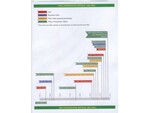
N.S.A. Timeline of Surveillance Law Developments [pdf]
This chart, apparently from an internal N.S.A. presentation, lists milestones in surveillance rules over nearly four decades. The July 2002 “Raw Take” sharing order, whose existence has not previously been disclosed, is just one of three rulings by the Foreign Intelligence Surveillance Court to make the list. The other two were 2004 and 2006 rulings allowing bulk collection of data about emails and phone calls.
-
New Contact-Chaining Procedures to Allow Better, Faster Analysis SIDtoday [pdf]
The SIGINT Management Directive 424 briefing (Jan 2011) announces a major procedural shift at the NSA, allowing analysts to conduct contact chaining and large-scale metadata analysis from any selector, regardless of nationality or location. This change removes prior restrictions on U.S. data, enabling more powerful social network mapping for foreign intelligence purposes.
Programs: GATEKEEPER -
NSA and DSD relationship [pdf]
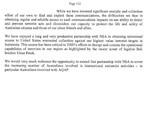
An extract from a February 2011 letter in which the acting deputy director of Australia's Defence Signals Directorate asks the NSA to extend their partnership to Australians involved in extremist activity, citing minimised access to US warranted collection against targets in Indonesia and the arrest of Bali bomber Umar Patek.
People: Patek, Umar -
NSA Implements New Policy for Sharing Data with CIA SIDtoday [pdf]
New policy established by Michael Hayden for raw SIGINT data to be shared with CIA for clandestine espionage and counterintelligence activities. Article says the two agencies are “collaborating more closely than ever before” and touches on the process to limit intelligence on U.S. persons.
The Intercept ↗ (2016-08-10) -
NSA target package [pdf]
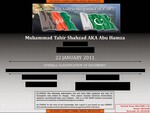
This 2011 target package focuses on Muhammad Tahir Shahzad (alias Abu Hamza), a Pakistan-based bomb builder and Al-Qaeda facilitator. The document was produced by the Counter IED Analysis Integration Cell (CAIC) at the NSA. Notably, the document credits the tracking of Shahzad’s 60+ digital selectors with the eventual capture of high-value targets, including himself and Bali bombing suspect Umar Patek. The accompanying Washington Post investigation uses this specific case to highlight the massive scale of "incidental collection." While Shahzad was a valid foreign target under Section 702 of the FISA Amendments Act (FAA), the investigation revealed that for every legitimate target like him, the NSA intercepted nine "non-targeted" users—many of whom were Americans—capturing deeply personal photos, medical records, and private correspondence.
-
NSA to Share Sanitized US Traffic With Select Third Party Nations SIDtoday [pdf]
In order to increase access, avoid duplicate collection, and draw on individual strengths, a small group of the NSA’s “most trusted partners” will share sanitized traffic.
The Intercept ↗ (2018-08-15) -
NSA's New Information Sharing Policy: How It Affects the Dissemination of SIGINT SIDtoday [pdf]
A new policy allows for more rapid sharing of signals intelligence with other branches of government and allies, as long as agents comply with the appropriate regulations. Open sharing represents a “major cultural shift” for the NSA, and as the agency drafts new policies, analysts must judge whether information they find is both eligible and appropriate for sharing.
The Intercept ↗ (2018-03-01) -
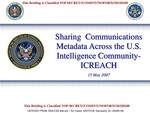
Sharing Communications Metadata Across the U.S. Intelligence Community - ICREACH [pdf]
ICREACH is a "one-stop shopping" tool and federated query architecture that allows thousands of analysts across 23 U.S. agencies to search billions of communications metadata records. It consolidates telephony and digital network intelligence (DNI) from various sources—including NSA holdings, Second Party (Five Eyes) partners, and other IC databases like the CIA/FBI's PROTON—into a single, searchable interface. At its launch, the system increased shared metadata records from 50 billion to over 850 billion.
“How the NSA Built Its Own Secret Google” - The Intercept ↗ (2014-08-25) · “No Place to Hide” - Metropolitan Books ↗ (2014-05-13) · Gallagher, Ryan · Greenwald, Glenn -
SID Mailbag: Need-to-Share vs Need-to-Know SIDtoday [pdf]
The NSA is trying to share more information within the intelligence community as recommended in the 9/11 Commission report. There are several factors that hamper information-sharing, including minimization rules, lack of bandwidth to transfer data, and training other agencies to understand signals intelligence.
Marking: CONFIDENTIALPrograms: WEBWORLDThe Intercept ↗ (2018-03-01) -
The Real Scoop on USSID SP0018 Briefings SIDtoday [pdf]
The Signals Intelligence Directorate has trained over 5,000 staff in a minimization policy known as SP0018, which must be understood in order to look at raw signals intelligence. The directorate offers eight to 10 trainings each month, as well as shortened web versions of the training that are available in an emergency.
Marking: CONFIDENTIALThe Intercept ↗ (2018-03-01)