Tag: FAA 23 documents
Search documents matching “FAA” →Free-text subjects the curators added. Unlike the other axes these are not necessarily from the documents' own vocabulary, so they are the loosest thing to browse by (and the most forgiving).
Graphs
By Banner
By Classification
Refine (combine with another filter, via search)
Sort: Title
Documents
-
FAA Certification Renewals with Caveats [pdf]
This NSA document shows that after the FISA Court found NSA’s upstream internet collection unconstitutional and illegal, the agency’s response was less about reform and more about finding technical and procedural workarounds to keep surveillance running as usual. While the court ordered changes within 30 days, NSA officials planned to sequester and filter “higher-risk” data to appease the judge—not halt collection—revealing a mindset focused on preserving operations rather than addressing legal violations.
-
FAA702 Glossary - Section 702 of the Fisa Amendments Act (FAA) [pdf]
This document outlines NSA rules under Section 702 of the FISA Amendments Act, which prohibit directly targeting U.S. persons or individuals inside the U.S., but quietly note a 2011 rule change allowing analysts to use U.S. person identifiers to query data already collected under 702—pending internal oversight. This effectively establishes a “backdoor search” capability enabling warrantless searches of Americans’ communications stored in NSA databases. Section 702 also gives the NSA authority to target without warrant the communications of foreign targets.
-
SILVERZEPHYR FAA DNI Access Initiated at NSAW [pdf]
An SSO item on the OAKSTAR SILVERZEPHYR access beginning FAA DNI forwarding to NSAW on 5 November 2009 through a WealthyCluster2/Tellurian system at the partner's site, after a 12-day survey that identified over 200 new links, with snapshots examined from Brazil and Colombia.
-
Attention, SIGINT Analysts: E.O. 12333 Transit Communications -- What Are They? SIDtoday [pdf]
This SIDtoday article clarifies the difference between NSA's longstanding authority to collect "transit communications" and FISA Amendment Act (FAA) Section 702 authorizations. The Office of Special Source Operations (SSO) manages these transit communications under various programs like US-990, US-983, and US-3273.
Programs: SSO -
BLARNEY program overview [pdf]
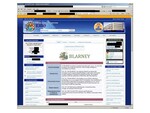
The document is an NSA Special Source Operations (SSO) portal page screenshot for the BLARNEY program, describing it as a top-secret collection initiative established in the 1970s that leverages government and commercial partnerships to intercept foreign intelligence under FISA authority. It highlights BLARNEY’s major intelligence value—contributing heavily to counterterrorism reporting and the President’s Daily Brief—and lists its primary targets as diplomatic, economic, foreign government, and counterterrorism communications.
-
Collection Accesses 30 Nov - 06 Dec 2009 [pdf]
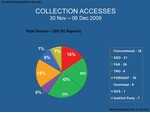
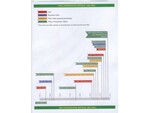
This National Security Agency chart shows the varied sources of 103 “accesses” to communications or computers collected in a single week in 2009 at the N.S.A.’s big station in San Antonio, Texas.
Programs: SSO -
DNI, attorney general certify surveillance targets 'reasonably believed' to be outside U.S. [pdf]
In this document, the director of national intelligence and the attorney general certify that there are procedures in place to ensure that surveillance conducted under Section 702 of the FISA Amendments Act will be limited to targeting people "reasonably believed to be located outside the United States." They state that the foreign intelligence to be collected "concerns foreign powers" as defined by statute. The list of foreign powers is in Exhibit F.
-
DNI101 [pdf]
This TOP SECRET training guide, "DNI 101," provides a workflow for Digital Network Intelligence analysts on how to investigate a target's email address, detailing the specific tools, databases, and methodology used, and stressing the critical difference between initial open-source/classified research and the active "targeting" of raw SIGINT repositories like XKEYSCORE, PINWALE, and MARINA.
Programs: NKB · FOXTRAIL · FOREMAN · PINWALE · LIONHEART · XKEYSCORE · DISHFIRE · MARINA · MECWEB · MAINWAY · TRAFFICTHIEF · MAUI · ANCHORY · M3 · INTELLINK · HOMEBASE · PROTON · UTT · CADENCE · SPEEDBUMP · TUNINGFORK · MASTERSHAKE · BLACKPEARL · JACKSPARROW · ROADBED · STORYDUTY · LIONROAR · DOPHONE · UIS -
FISA Amendments Act Certifications and Operations [pdf]
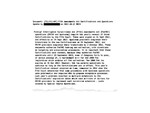
This document exposes how, after the FISA Court found flaws in NSA’s upstream surveillance in 2011, the agency pushed through new certifications on schedule the following year and quietly used taxpayer money to cover millions in compliance costs for PRISM companies like Google and Yahoo. Rather than scaling back unconstitutional collection, the NSA treated the ruling as a logistical hurdle to manage with corporate partners, underscoring its deep financial and operational entanglement with major tech firms. Check also the document "FAA Certification Renewals with Caveats"
Programs: PRISM -
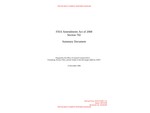
FISA Amendments Act of 2008 Section 702 summary document [pdf]
This document summarizes the way the law works and describes the three types of certifications used to permit the surveillance, as well as targeting and minimization procedures. The three certification are for foreign governments, counterterrorism and WMD/proliferation.
-
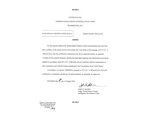
FISA judge's order authorizing surveillance of foreign governments and organizations [pdf]
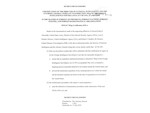
With this order dated Aug. 19, 2010, John D. Bates, then-Chief Judge of the Foreign Intelligence Surveillance Court, approved an annual certification permitting the National Security Agency to conduct surveillance about 193 foreign governments, foreign factions, foreign-based political organizations and foreign entities such as the World Bank. Each year, a new certification must be approved by the court to permit such surveillance under Section 702 of the FISA Amendments Act.
Marking: SECRETPeople: Bates, John D. -
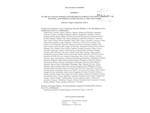
List of foreign governments and organizations authorized for surveillance [pdf]
This exhibit lists the 193 foreign governments as well as foreign factions, political organizations and other entities that were part of a 2010 certification approved by the Foreign Intelligence Surveillance Court. These are the entities about which the NSA may conduct surveillance, for the purpose of gathering foreign intelligence. Each year a new certification must be approved by the court to permit such surveillance under Section 702 of the FISA Amendments Act.
-
N.S.A. Timeline of Surveillance Law Developments [pdf]
This chart, apparently from an internal N.S.A. presentation, lists milestones in surveillance rules over nearly four decades. The July 2002 “Raw Take” sharing order, whose existence has not previously been disclosed, is just one of three rulings by the Foreign Intelligence Surveillance Court to make the list. The other two were 2004 and 2006 rulings allowing bulk collection of data about emails and phone calls.
-
NSA director's affidavit on foreign surveillance [pdf]
The affidavit was submitted in support of the 2010 certification concerning foreign governments, factions and other entities. In it, Alexander states that pursuant to the certification, NSA seeks to acquire foreign intelligence information concerning foreign powers. The list of foreign powers is in Exhibit F.
People: Alexander, Keith B. -
NSA inspector general report on email and internet data collection under Stellar Wind, 24 March 2009 [Working Draft] [pdf]
This 2009 NSA Inspector General draft report details the origins and legal framework of the President’s Surveillance Program (PSP), launched after 9/11 to bypass FISA limits and authorize bulk interception of internet and telephony content and metadata, including communications with one end inside the U.S. It reveals how NSA, with White House backing, expanded surveillance authority to cover “collection gaps” that existing law didn’t allow, effectively legalizing large-scale warrantless spying under a secret presidential directive.
People: Bush, George W. · Hayden, Michael · Tenet, George · Gonzales, Alberto R. · Addington, David S. · Graham, Robert · Deitz, Robert L. · Shelby, Richard · Pelosi, Nancy · Cheney, Dick · Libby, I. Lewis · Lamberth, Royce · Inouye, Daniel · Levin, Daniel · Stevens, Theodore · Kollar-Kotelly, Colleen · Rockefeller, Jay · Alexander, Keith B. · Potenza, Vito -
NSA target package [pdf]
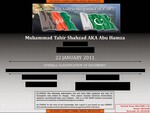
This 2011 target package focuses on Muhammad Tahir Shahzad (alias Abu Hamza), a Pakistan-based bomb builder and Al-Qaeda facilitator. The document was produced by the Counter IED Analysis Integration Cell (CAIC) at the NSA. Notably, the document credits the tracking of Shahzad’s 60+ digital selectors with the eventual capture of high-value targets, including himself and Bali bombing suspect Umar Patek. The accompanying Washington Post investigation uses this specific case to highlight the massive scale of "incidental collection." While Shahzad was a valid foreign target under Section 702 of the FISA Amendments Act (FAA), the investigation revealed that for every legitimate target like him, the NSA intercepted nine "non-targeted" users—many of whom were Americans—capturing deeply personal photos, medical records, and private correspondence.
-
OTR encrypted messages can't be decrypted by the NSA [pdf]
Three intercepted chat sessions from 16 March 2012 collected under PRISM, showing a target switching mid-conversation from unencrypted to OTR-encrypted messaging — with NSA able to collect the session metadata and unencrypted portions but unable to decrypt the OTR messages, each annotated "No decrypt available for this OTR encrypted message."
Programs: PRISM -
PGP encrypted email can't be decrypted by the NSA [pdf]
Two intercepted Yahoo email messages collected under FAA counterterrorism authority through PRISM (SIGAD US-984XN), both containing PGP-encrypted content that NSA was unable to decrypt — published by Der Spiegel as direct evidence that PGP encryption defeated NSA collection at the time of interception in January 2012.
Programs: PRISM -
SIGDEV Conference 2012 - Making Things Measureable: Technology Trending Challenges and Approaches [pdf]
An NSA presentation from the 2012 SIGDEV Conference describing NSA's technology trending methodology — a framework for identifying which encryption and communications technologies targets are adopting, measuring the SIGINT risk they pose, and prioritising capabilities development responses — notable for containing the risk matrix that was later cited in Der Spiegel's December 2014 encryption investigation showing NSA's difficulty levels against specific technologies including Tor, TrueCrypt, OTR and ZRTP.
Programs: XKEYSCORE · SEEKER · BIONICTURTLE · JEMA · JOLLYROGER · MARINA · TUNINGFORK · STARPROC · MICROEXPANSE · ECHOBASE · PRISM · GMHALO · UTT · TKB · LAE · FAMT · WPMO · AMOD · FORTREND · GAMBIT · DATAEXPLORER · MYNOC -
SIGINT Authority decision tree [pdf]
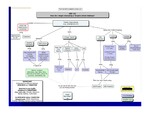
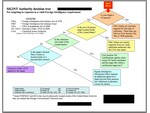
A one-page NSA training chart that walks an analyst from a targeting request to the legal authority that covers it, branching on whether the target is a US person, where the target is, where the collection site is, and whether the target is a Second Party citizen.