Tag: oversight 24 documents
Search documents matching “oversight” →Free-text subjects the curators added. Unlike the other axes these are not necessarily from the documents' own vocabulary, so they are the loosest thing to browse by (and the most forgiving).
Graphs
By Banner
By Classification
Refine (combine with another filter, via search)
Sort: Title
Documents
-
CNO Core Secrets Security Structure [pdf]
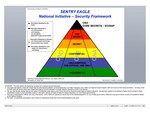
A 3-slide NSA presentation outlining the classification architecture of Sentry Eagle, a national cyber operations initiative, showing how its most sensitive components — covering network hacking, encryption sabotage, and covert industry relationships — are locked behind ECI and SAP designations accessible only to a tiny circle of government officials.
Programs: SENTRYEAGLE · SENTRYHAWK · SENTRYFALCON · SENTRYOSPREY · SENTRYRAVEN · SENTRYCONDOR · SENTRYOWL -
DNI, attorney general certify surveillance targets 'reasonably believed' to be outside U.S. [pdf]
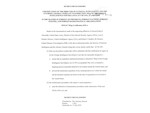
In this document, the director of national intelligence and the attorney general certify that there are procedures in place to ensure that surveillance conducted under Section 702 of the FISA Amendments Act will be limited to targeting people "reasonably believed to be located outside the United States." They state that the foreign intelligence to be collected "concerns foreign powers" as defined by statute. The list of foreign powers is in Exhibit F.
-
FISA Amendments Act of 2008 Section 702 summary document [pdf]
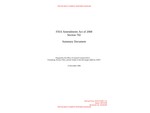
This document summarizes the way the law works and describes the three types of certifications used to permit the surveillance, as well as targeting and minimization procedures. The three certification are for foreign governments, counterterrorism and WMD/proliferation.
-
How the NSA verifies a target's location [pdf]
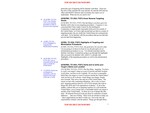
This is an excerpt from a transcript of National Security Agency training videos that describe how to verify the location of a targeted device. It explains how the NSA monitors different types of mobile signaling information known as HLR and VLR registrations in order to locate individuals. It also makes clear that the agency is able to use location tracking to ascertain whether a target is in the United States.
-
IG Office Studies R&D; Laboratories' Access to SIGINT SIDtoday [pdf]
The NSA’s inspector general will be studying access to signals intelligence by military and civilian research and development laboratories. Signals Intelligence Directorate staff may be interviewed.
The Intercept ↗ (2018-03-01) -
Inspector General Conducting Special Study: You May Be Contacted SIDtoday [pdf]
The inspector general will be conducting a study on consolidating function under centralized leadership within NSA.
The Intercept ↗ (2016-08-10) -
Intrusion Analysis – GCHQ [pdf]
An internal GCHQ write-up defines the Intrusion Analysis team’s remit inside the Joint Electronic Attack Cell: all‑source analysis of emerging and active electronic attacks, stewardship of electronic attack signatures, and SIGINT‑driven targeting under EITT oversight. It details sources, reporting channels, legal authorities, and auditing controls that govern how signatures are deployed and how selectors are managed.
-
Keeping Congress Informed SIDtoday [pdf]
A "Congressional Notification" is a letter the NSA sends to various congressional committees to inform them of a "significant intelligence activity" or a "significant intelligence failure," as required by the National Security Act of 1947. The article lists defining criteria for a "significant activity" or a "significant intelligence failure."
The Intercept ↗ (2016-12-07) -
Minimization Procedures Used By The National Security Agency In Connection With Acquisitions Of Foreign Intelligence, Information Pursuant To Section 702 Of The Foreign Intelligence Court Surveillance Act Of 1978 [pdf]
The NSA’s Section 702 minimization rules expose how the agency can collect, keep, and use Americans’ communications without warrants, despite claiming to target only foreigners. While the document sets out procedures for handling U.S. data, it includes broad loopholes—like keeping “inadvertently” collected domestic messages for years, sharing unfiltered data with the FBI, CIA, and even foreign governments, and giving NSA analysts wide discretion over who gets surveilled—all under secret FISA Court approval.
People: Holder, Eric H. Jr. -
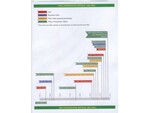
N.S.A. Timeline of Surveillance Law Developments [pdf]
This chart, apparently from an internal N.S.A. presentation, lists milestones in surveillance rules over nearly four decades. The July 2002 “Raw Take” sharing order, whose existence has not previously been disclosed, is just one of three rulings by the Foreign Intelligence Surveillance Court to make the list. The other two were 2004 and 2006 rulings allowing bulk collection of data about emails and phone calls.
-
NSA to Share Sanitized US Traffic With Select Third Party Nations SIDtoday [pdf]
In order to increase access, avoid duplicate collection, and draw on individual strengths, a small group of the NSA’s “most trusted partners” will share sanitized traffic.
The Intercept ↗ (2018-08-15) -
OIG Inspection and Audit Schedule for 2004 Unveiled SIDtoday [pdf]
The NSA's Office of the Inspector General releases its audit and inspection schedule for 2004.
The Intercept ↗ (2016-12-07) -
OIG Inspection and Audit Schedule for 2004 Unveiled (repost) SIDtoday [pdf]
(Repost) The NSA's Office of the Inspector General releases its audit and inspection schedule for 2004.
Marking: SECRETThe Intercept ↗ (2016-12-07) -
Operational Legalities – GCHQ Powerpoint Presentation [pdf]
GCHQ’s “Operational Legalities” deck is an internal compliance playbook that translates the UK’s surveillance laws into day‑to‑day SIGINT procedure—drilling staff on authorisation, necessity, and proportionality, and walking through warrants, targeting justifications, database queries, dissemination, and oversight. Half slides and half speaker notes, it shows how analysts are trained to document, audit, and defend operations under ISA, RIPA, HRA, and WTA while navigating edge cases like location, nationality, second‑party constraints, and “indirect targeting.”
-
Power of the Purse Strings SIDtoday [pdf]
For the NSA to get funded, the president submits a Congressional Budget Justification Book to Congress, which is reviewed by four congressional committees, that make suggestions and sometimes request more information about the NSA's programs to help them "gauge the appropriate level of funding," before the full Congress finally votes to approve it.
The Intercept ↗ (2017-09-13) -
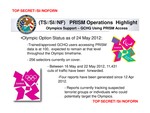
PRISM Olympic Option [pdf]
A May 2012 NSA operational highlight revealing that Britain's GCHQ was given access to the NSA's PRISM surveillance system during the London Olympics, with 100 trained British operatives secretly monitoring 256 targets and intercepting over 11,000 communications in a single week.
-
SID's Interactions with Congress: Part I - Setting the Budget (repost) SIDtoday [pdf]
(Repost) Part 1 of the Congress series explains the budget process and SID’s part in putting together the Congressional Budget Justification Book.
The Intercept ↗ (2016-08-10) -
SID's Interactions with Congress: Part III - Communications and Orgs (repost) SIDtoday [pdf]
(Repost) Part 3 of the Congress series provides the number of queries from congressional staff and briefings per month. It also describes “Congressional Notifications,” where NSA alerts Congress to reports of “bad news” and other items of interest.
The Intercept ↗ (2016-08-10) -
SROB Plans the Future of SIGINT SIDtoday [pdf]
The SIGINT Requirement Oversight Board is the senior forum for discussion of the future of signals intelligence and validates documents concerning the acquisition process.
People: Quirk, RichardThe Intercept ↗ (2017-09-13) -
STELLARWIND Classification Guide [pdf]
Stellarwind was the code name for the Bush administration’s surveillance and data collection programs that operated from 2001 to 2007 outside rules set by the Foreign Intelligence Surveillance Act. This guide lays out secrecy restrictions for various aspects of the program. It discusses the “Large Content” FISA order as part of the “sequence of transition events” from the warrantless wiretapping program to the Protect America Act.