NSA Intelligence Relationship with Canada's Communications Security Establishment Canada (CSEC)
Open PDF +1 other copyDocument date: 2013-04-03
Pages: 4
Genre: report
Banner: TOP SECRET//SI//REL USA, FVEY
Classification: TOP SECRET SI
Dissemination: REL USA, FVEY
This document describes the close, long-standing SIGINT partnership between the NSA and Canada’s CSEC, emphasizing cooperative efforts in global intelligence collection, cyber operations, information assurance, and critical infrastructure defense. It highlights mutual contributions, including CSEC’s unique geographic access, covert sites, cryptographic capabilities, and R&D collaboration, supporting U.S. and North American security objectives.
My notes


TOP SECRET//SI//REL USA, FVEY
NATIONAL SECURITY AGENCY
UNITED STATES OF AMERICA
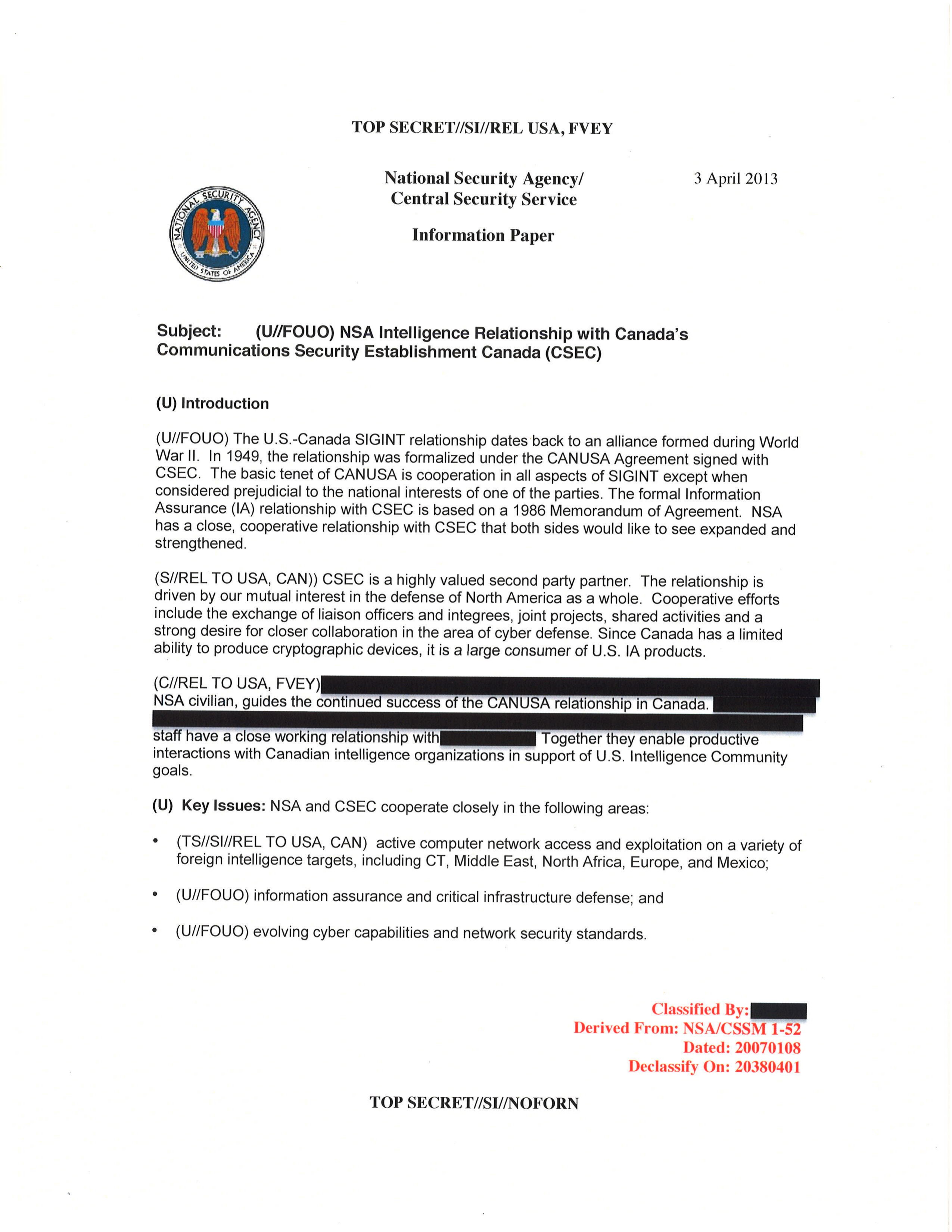
National Security Agency/Central Security Service
Information Paper
3 April 2013
Subject: (U//FOUO) NSA Intelligence Relationship with Canada's Communications Security Establishment Canada (CSEC)
(U) Introduction
(U//FOUO) The U.S.-Canada SIGINT relationship dates back to an alliance formed during World War II. In 1949, the relationship was formalized under the CANUSA Agreement signed with CSEC. The basic tenet of CANUSA is cooperation in all aspects of SIGINT except when considered prejudicial to the national interests of one of the parties. The formal Information Assurance (IA) relationship with CSEC is based on a 1986 Memorandum of Agreement. NSA has a close, cooperative relationship with CSEC that both sides would like to see expanded and strengthened.
(S//REL TO USA, CAN)) CSEC is a highly valued second party partner. The relationship is driven by our mutual interest in the defense of North America as a whole. Cooperative efforts include the exchange of liaison officers and integrees, joint projects, shared activities and a strong desire for closer collaboration in the area of cyber defense. Since Canada has a limited ability to produce cryptographic devices, it is a large consumer of U.S. IA products.
(C//REL TO USA, FVEY) [REDACTED] NSA civilian, guides the continued success of the CANUSA relationship in Canada. [REDACTED] staff have a close working relationship with [REDACTED] Together they enable productive interactions with Canadian intelligence organizations in support of U.S. Intelligence Community goals.
(U) Key Issues: NSA and CSEC cooperate closely in the following areas:
- (TS//SI//REL TO USA, CAN) active computer network access and exploitation on a variety of foreign intelligence targets, including CT, Middle East, North Africa, Europe, and Mexico;
- (U//FOUO) information assurance and critical infrastructure defense; and
- (U//FOUO) evolving cyber capabilities and network security standards.
Classified By: [REDACTED]
Derived From: NSA/CSSM 1-52
Dated: 20070108
Declassify On: 20380401
TOP SECRET//SI//NOFORN
TOP SECRET//SI//REL USA, FVEY
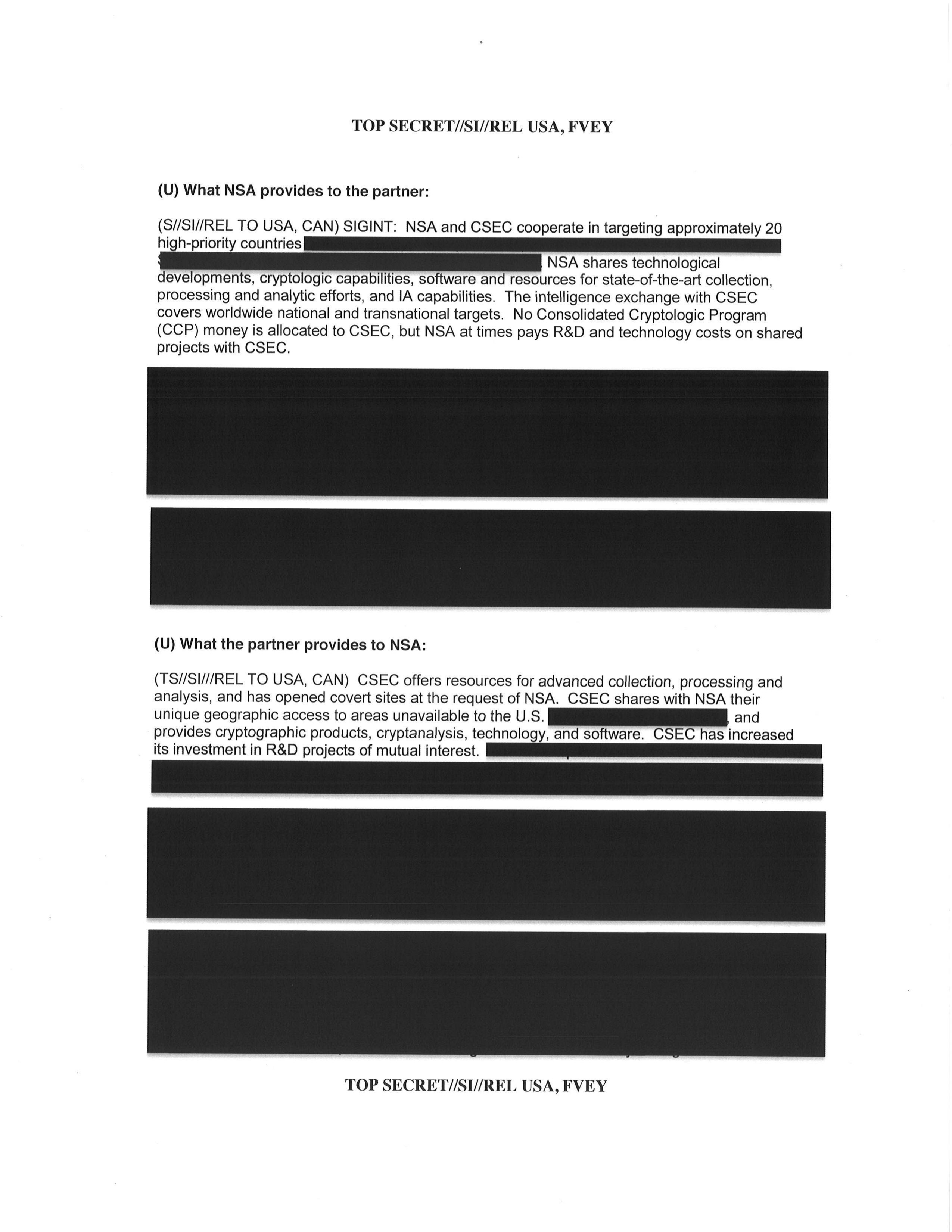
(U) What NSA provides to the partner:
(S//SI//REL TO USA, CAN) SIGINT: NSA and CSEC cooperate in targeting approximately 20 high-priority countries [REDACTED] NSA shares technological developments, cryptologic capabilities, software and resources for state-of-the-art collection, processing and analytic efforts, and IA capabilities. The intelligence exchange with CSEC covers worldwide national and transnational targets. No Consolidated Cryptologic Program (CCP) money is allocated to CSEC, but NSA at times pays R&D and technology costs on shared projects with CSEC.
[REDACTED]
[REDACTED]
(U) What the partner provides to NSA:
(TS//SI///REL TO USA, CAN) CSEC offers resources for advanced collection, processing and analysis, and has opened covert sites at the request of NSA. CSEC shares with NSA their unique geographic access to areas unavailable to the U.S. [REDACTED] and provides cryptographic products, cryptanalysis, technology, and software. CSEC has increased
its investment in R&D projects of mutual interest. [REDACTED]
[REDACTED]
[REDACTED]
TOP SECRET//SI//REL USA, FVEY
[REDACTED]
TOP SECRET//SI//REL USA, FVEY
[REDACTED]
TOP SECRET//SI//REL USA, FVEY
TOP SECRET//SI//REL USA, FVEY
[REDACTED]
TOP SECRET//SI//REL USA, FVEY
Published in the Same Report
(10 of 66 documents)
-
CSEC Cyber Threat Capabilities [pdf]
This document details CSEC’s full-spectrum cyber operations architecture, integrating SIGINT and IT Security to conduct both defensive and offensive activities under the guise of “information superiority.” While early sections emphasize detection, anomaly analysis, and collaboration with Five Eyes partners, later portions reveal active measures including network infiltration (implant deployment), command-and-control tracking, traffic manipulation and redirection, DNS interference, and potential disruption or deception operations—illustrating CSEC’s capacity not only to defend Canadian networks but also to surveil, exploit, and influence foreign and domestic digital infrastructure.
Programs: EONBLUE · CYBERDMZ · SEEDSPHERE · PHOTONICPRISM · SPECIALSOURCE · SUPERDRAKE · DARKSPACE · QUANTUM · MANDATE · STREAMING SENTRY · SSO · TKB · COVENANT -
CASCADE - Joint Cyber Sensor Architecture [pdf]
This presentation outlines the Communications Security Establishment’s (CSE) plans to unify and expand its cyber sensor networks (ITS and SIGINT) to create a comprehensive, multi-layered national cyber defense system, enabling threat detection, intelligence collection, and defensive operations across Canadian and foreign networks. It emphasizes standardizing sensor deployments, integrating analytic capabilities, and preparing for “Effects” operations to mitigate cyber threats by 2015. The presentation is duplicated from page 33 onwards - three slides of the duplicated slides have internal CSE comments.
Programs: CASCADE · PHOTONICPRISM · EONBLUE · INDUCTION · THIRDEYE · CRUCIBLE · CHOKEPOINT · SUNWHEEL · CASSIOPEIA · SCNET · JAZZFLUTE · GAZEBO · SEEDSPHERE · TEXPRO · SSO -
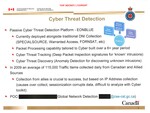
CSEC Cyber Threat Detection [pdf]
This document details the Communications Security Establishment’s (CSEC) cyber threat detection and intelligence infrastructure, including systems like EONBLUE, CROSSBOW, CRUCIBLE, and LODESTONE, which enable passive monitoring, anomaly detection, and botnet identification through metadata and deep packet inspection. It outlines how CSEC integrates SIGINT, cryptanalysis, and network forensics to detect and mitigate cyber intrusions using both SIGINT and domestic sensors, while collaborating with Five Eyes partners to enhance Canada’s cyber defense and situational awareness. The presentation is duplicated from page 7 onwards - one of the duplicated slide has internal CSE comments.
Programs: EONBLUE · SPECIALSOURCE · WARRANTEDACCESS · COVENANT · SEEDSPHERE · DIESELRATTLE · SIENNABLUE · DOWNGRADE · CROSSBOW · CRUCIBLE · LODESTONE -
CSEC SIGINT Cyber Discovery: Summary of the current effort [pdf]
This document provides a overview of the Communications Security Establishment Canada (CSEC) cyber operations, detailing its SIGINT, CNE (Computer Network Exploitation), and cyber counterintelligence programs, including tools like WARRIORPRIDE, REPLICANTFARM, and EONBLUE for threat detection, anomaly discovery, and metadata production. It outlines operational procedures, analytic methodologies, and collaborative frameworks with domestic and Five Eyes partners for sharing intelligence, tipping/cueing, and integrating cyber and traditional counterintelligence efforts.
Programs: REPLICANTFARM · SLIPSTREAM · WARRIORPRIDE · DAREDEVIL · CHORDFLIER · NAMEDROPPER · WORMWOOD · OBELIX · SHEPHERD · CARBON · REGBACKUP · DOGHOUSE · WALKER · ALOOFNESS · BLAZINGANGEL · TINYWEB · QUIVERINGSQUAB · WINDO · DIESELRATTLE · WIDOWKEY · CIVETCAT · WINBEE · SSLINST · PULLEDPORK · EONBLUE · SNIFFLE · QUANTUM · XKEYSCORE · HALTERHITCH · FASTFLUX · DEADSEA · NSPACES · PPF · SSO · TKB“The Digital Arms Race: NSA Preps America for Future Battle” - Der Spiegel ↗ (2015-01-17) · “Communication Security Establishment's cyberwarfare toolbox revealed” - CBC News ↗ (2015-03-23) · “Documents Reveal Canada’s Secret Hacking Tactics” - The Intercept ↗ (2015-03-23) · Appelbaum, Jacob · Gibson, Aaron · Guarnieri, Claudio · Müller-Maguhn, Andy · Poitras, Laura · Rosenbach, Marcel · Ryge, Leif · Schmundt, Hilmar · Sontheimer, Michael · Seglins, Dave · Hildebrandt, Amber · Pereira, Michael · Greenwald, Glenn · Gallagher, Ryan -
Close Access SIGADS [pdf]
A 10 September 2010 NSA reference list of Close Access SIGADs revealing the codenames, locations and collection methods used to bug the embassies and UN missions of 38 targets — including US allies France, Italy, Greece, Japan, India, Mexico, South Korea and the EU — through implants, computer-screen capture, hard-drive imaging and electromagnetic emanation collection, most conducted against diplomatic facilities in Washington DC and New York.
Programs: KATEEL · POCOMOKE · MERCED · BANISTER · PERDIDO · MAGOTHY · BLACKFOOT · WABASH · NAVARRO · POWELL · KLONDIKE · NASHUA · OSAGE · OSWAYO · BRUNEAU · HEMLOCK · MULBERRY · ALAMITO · FLEMING · DOBIE · SULPHUR · REQUETTE · YUKON · WESTPORT · NAVAJO · PANTHER · LIFESAVER · HIGHLANDS · VAGRANT · MINERALIZ · DROPMIRE · PBX · MAGNETIC · OCEAN · GENIE · BLACKHEART · CRYPTOENABLED · CUSTOMS · DEWSWEEPER · RADON · MINERALIZE · COOP · STARRUBY · TRASHINT“No Place to Hide” - Metropolitan Books ↗ (2014-05-13) · “Espionnage de la NSA : la diplomatie française était sur écoute aux Etats-Unis” - Le Monde ↗ (2013-10-22) · “Da qui ci spiano gli americani” - L'Espresso ↗ (2013-12-05) · Greenwald, Glenn · Follorou, Jacques · Maurizi, Stefania -
Cyber Integration [pdf]
The leaked 2012 GCHQ JTRIG presentation detail a wide range of offensive cyber and influence operations designed to “deny, disrupt, degrade, and deceive” targets, including hackers, foreign governments, companies, and individuals. Tactics include hacking, DDOS attacks, disinformation, honey traps, credential harvesting, and psychological operations, reflecting a shift from traditional surveillance to active disruption and manipulation campaigns.
“Exclusive: Snowden Docs Show British Spies Used Sex and 'Dirty Tricks'” - NBC News ↗ (2014-02-07) · “No Place to Hide” - Metropolitan Books ↗ (2014-05-13) · Cole, Matthew · Esposito, Richard · Schone, Mark · Greenwald, Glenn -
XKEYSCORE intro [pdf]
A TOP SECRET NSA presentation from 2008 introducing XKeyscore — one of the earliest overview documents in the archive — describing the system as a globally distributed Linux cluster across approximately 150 sites and 700+ servers that stores a ~3-day rolling buffer of all unfiltered internet traffic, and demonstrating its core capabilities for finding previously unknown targets by mining metadata, tracking documents by embedded image hashes, detecting encryption and VPN use, and language tracking.
Programs: XKEYSCORE · TURMOIL · TURBULENCE · TRAFFICTHIEF · WEALTHYCLUSTER · MOONSHINE · SEARCHLIGHT · MARINA · PSC · SSO · TIMBERLINEPeople: bin Laden, Osama“'Brasil é um grande alvo', diz jornalista sobre vigilância dos EUA” - O Globo ↗ (2013-07-07) · “XKeyscore: NSA tool collects 'nearly everything a user does on the internet'” - The Guardian ↗ (2013-07-31) · “No Place to Hide” - Metropolitan Books ↗ (2014-05-13) · “XKEYSCORE: NSA’s Google for the World’s Private Communications” - The Intercept ↗ (2015-07-01) · Greenwald, Glenn · Bridi, Sônia · Marquis-Boire, Morgan · Lee, Micah -
Intelligently filtering your data: Brazil and Mexico case studies [pdf]
These documents reveal that the NSA conducted targeted surveillance operations against high-profile Brazilian and Mexican figures, including President Dilma Rousseff and presidential candidate Enrique Peña Nieto, using advanced contact-graph filtering and data analysis techniques to extract relevant intelligence from intercepted communications. These documents show how NSA analysts systematically developed intelligence on foreign leaders during election periods and diplomatic activities, framing it as “target development,” but in practice enabling deep political espionage under the guise of analytical innovation.
“Veja os documentos ultrassecretos que comprovam espionagem a Dilma” - O Globo ↗ (2013-09-02) · “No Place to Hide” - Metropolitan Books ↗ (2014-05-13) · Greenwald, Glenn -
Sharing Computer Network Operations Cryptologic Information with Foreign Partners [pdf]
The document is a secret NSA/CSS policy outlining guidelines for sharing Computer Network Operations (CNO) cryptologic information with foreign partners, including rules for cooperation in CNE and CND within existing intelligence relationships. The “Purpose and Scope” section on the first page appears to be unpublished elsewhere, while the Tier A and Tier B country lists match those publicly revealed in sources like Glenn Greenwald’s No Place to Hide.
“El CNI facilitó el espionaje masivo de EEUU a España” - El Mundo ↗ (2013-10-30) · “No Place to Hide” - Metropolitan Books ↗ (2014-05-13) · Greenwald, Glenn · Aranda, Germán -
NSA Spied On Porn Habits As Part Of Plan To Discredit 'Radicalizers' [pdf]
Top-secret document reveals how NSA has been gathering records of online sexual activity and evidence of visits to pornographic websites as part of a proposed plan to harm the reputations of those whom the agency believes are radicalizing others through incendiary speeches
See all 5 documents published with “Documents Reveal Canada’s Secret Hacking Tactics” →
Related Documents
-
NSA CSEC Partnership [pdf]
This NSA paper outlines the long-standing intelligence partnership between the U.S. and Canada’s Communications Security Establishment Canada (CSEC), dating back to WWII. It highlights mutual SIGINT cooperation, shared technological resources, and the role of CSEC in cryptography, cyber defense, and intelligence sharing, particularly in high-priority global and transnational targets.
-
CSEC Cyber Threat Detection [pdf]
This document details the Communications Security Establishment’s (CSEC) cyber threat detection and intelligence infrastructure, including systems like EONBLUE, CROSSBOW, CRUCIBLE, and LODESTONE, which enable passive monitoring, anomaly detection, and botnet identification through metadata and deep packet inspection. It outlines how CSEC integrates SIGINT, cryptanalysis, and network forensics to detect and mitigate cyber intrusions using both SIGINT and domestic sensors, while collaborating with Five Eyes partners to enhance Canada’s cyber defense and situational awareness. The presentation is duplicated from page 7 onwards - one of the duplicated slide has internal CSE comments.
Programs: EONBLUE · SPECIALSOURCE · WARRANTEDACCESS · COVENANT · SEEDSPHERE · DIESELRATTLE · SIENNABLUE · DOWNGRADE · CROSSBOW · CRUCIBLE · LODESTONE -
CSEC Cyber Threat Capabilities [pdf]
This document details CSEC’s full-spectrum cyber operations architecture, integrating SIGINT and IT Security to conduct both defensive and offensive activities under the guise of “information superiority.” While early sections emphasize detection, anomaly analysis, and collaboration with Five Eyes partners, later portions reveal active measures including network infiltration (implant deployment), command-and-control tracking, traffic manipulation and redirection, DNS interference, and potential disruption or deception operations—illustrating CSEC’s capacity not only to defend Canadian networks but also to surveil, exploit, and influence foreign and domestic digital infrastructure.
Programs: EONBLUE · CYBERDMZ · SEEDSPHERE · PHOTONICPRISM · SPECIALSOURCE · SUPERDRAKE · DARKSPACE · QUANTUM · MANDATE · STREAMING SENTRY · SSO · TKB · COVENANT -
CSEC SIGINT Cyber Discovery: Summary of the current effort [pdf]
This document provides a overview of the Communications Security Establishment Canada (CSEC) cyber operations, detailing its SIGINT, CNE (Computer Network Exploitation), and cyber counterintelligence programs, including tools like WARRIORPRIDE, REPLICANTFARM, and EONBLUE for threat detection, anomaly discovery, and metadata production. It outlines operational procedures, analytic methodologies, and collaborative frameworks with domestic and Five Eyes partners for sharing intelligence, tipping/cueing, and integrating cyber and traditional counterintelligence efforts.
Programs: REPLICANTFARM · SLIPSTREAM · WARRIORPRIDE · DAREDEVIL · CHORDFLIER · NAMEDROPPER · WORMWOOD · OBELIX · SHEPHERD · CARBON · REGBACKUP · DOGHOUSE · WALKER · ALOOFNESS · BLAZINGANGEL · TINYWEB · QUIVERINGSQUAB · WINDO · DIESELRATTLE · WIDOWKEY · CIVETCAT · WINBEE · SSLINST · PULLEDPORK · EONBLUE · SNIFFLE · QUANTUM · XKEYSCORE · HALTERHITCH · FASTFLUX · DEADSEA · NSPACES · PPF · SSO · TKB“The Digital Arms Race: NSA Preps America for Future Battle” - Der Spiegel ↗ (2015-01-17) · “Communication Security Establishment's cyberwarfare toolbox revealed” - CBC News ↗ (2015-03-23) · “Documents Reveal Canada’s Secret Hacking Tactics” - The Intercept ↗ (2015-03-23) · Appelbaum, Jacob · Gibson, Aaron · Guarnieri, Claudio · Müller-Maguhn, Andy · Poitras, Laura · Rosenbach, Marcel · Ryge, Leif · Schmundt, Hilmar · Sontheimer, Michael · Seglins, Dave · Hildebrandt, Amber · Pereira, Michael · Greenwald, Glenn · Gallagher, Ryan -
NSA Intelligence Relationship with Sweden [pdf]
A 2013 NSA information paper documenting the agency's long-standing intelligence partnership with Sweden's signals intelligence service FRA, covering joint collection on Russian targets, counterterrorism, cryptanalysis, and cyber defense — a relationship kept classified due to Sweden's official political neutrality.