NSA CSEC Partnership
Open PDFDocument date: 2013-04-03
Pages: 2
Genre: report
Banner: TOP SECRET//SI//REL USA, FVEY
Classification: TOP SECRET SI
Dissemination: NOFORN
This NSA paper outlines the long-standing intelligence partnership between the U.S. and Canada’s Communications Security Establishment Canada (CSEC), dating back to WWII. It highlights mutual SIGINT cooperation, shared technological resources, and the role of CSEC in cryptography, cyber defense, and intelligence sharing, particularly in high-priority global and transnational targets.
My notes
TOP SECRET//SI//REL USA, FVEY
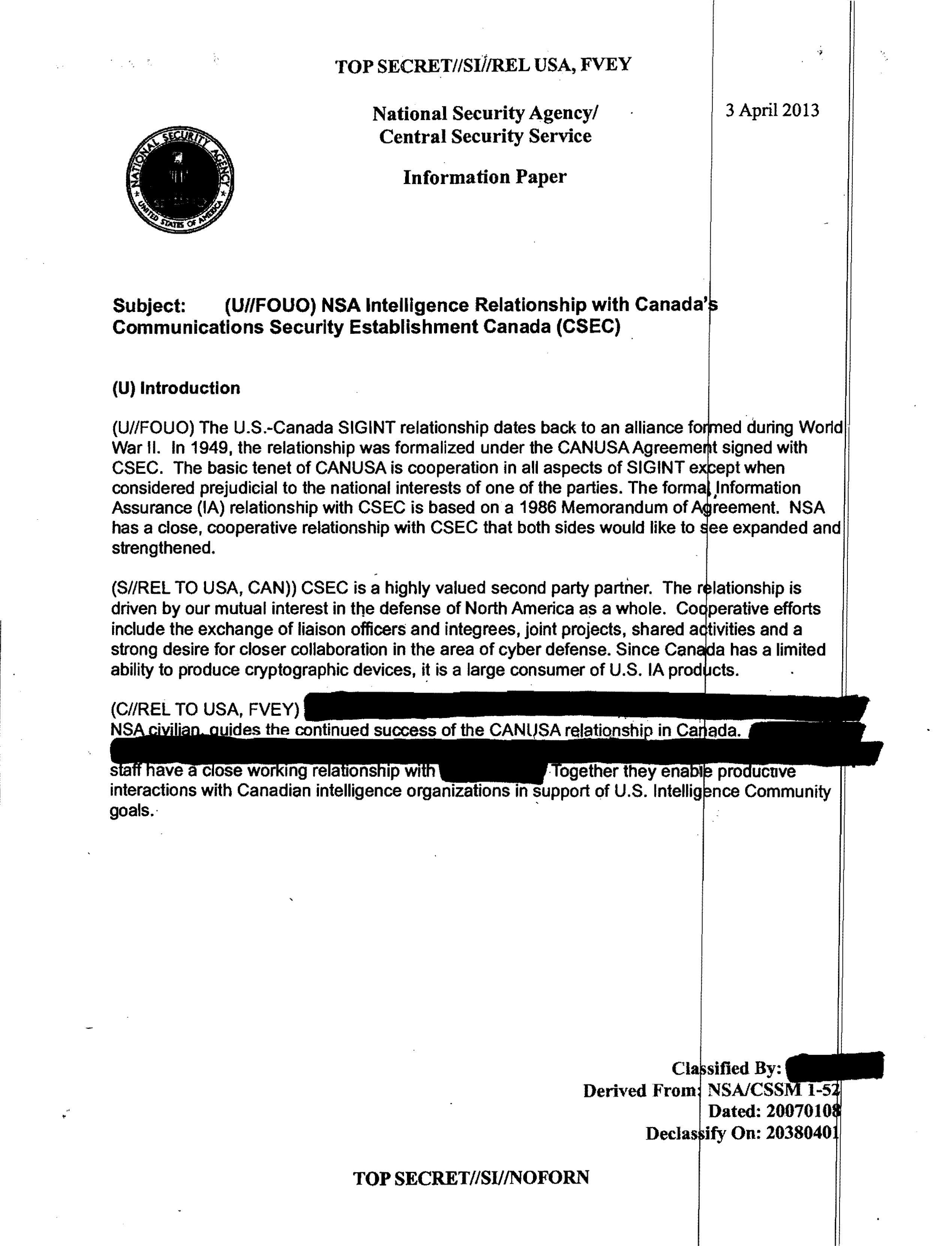
National Security Agency/
Central Security Service
Information Paper
3 April 2013
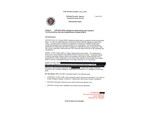
Subject: (U//FOUO) NSA Intelligence Relationship with Canada's Communications Security Establishment Canada (CSEC)
(U) Introduction
(U//FOUO) The U.S.-Canada SIGINT relationship dates back to an alliance formed during World War II. In 1949, the relationship was formalized under the CANUSA Agreement signed with CSEC. The basic tenet of CANUSA is cooperation in all aspects of SIGINT except when considered prejudicial to the national interests of one of the parties. The formal Information Assurance (IA) relationship with CSEC is based on a 1986 Memorandum of Agreement. NSA has a close, cooperative relationship with CSEC that both sides would like to see expanded and strengthened.
(S//REL TO USA, CAN)) CSEC is a highly valued second party partner. The relationship is driven by our mutual interest in the defense of North America as a whole. Cooperative efforts include the exchange of liaison officers and integrees, joint projects, shared activities and a strong desire for closer collaboration in the area of cyber defense. Since Canada has a limited ability to produce cryptographic devices, it is a large consumer of U.S. IA products.
(C//REL TO USA, FVEY) [REDACTED] NSA civilian guides the continued success of the CANUSA relationship in Canada. [REDACTED] staff have a close working relationship with [REDACTED]. Together they enable productive interactions with Canadian intelligence organizations in support of U.S. Intelligence Community goals.
Classified By: [REDACTED]
Derived From NSA/CSSM 1-52
Dated: 20070108
Declassify On: 20380401
TOP SECRET//SI//NOFORN
TOP SECRET//SI//REL TO USA, CAN
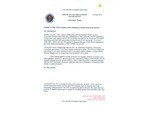
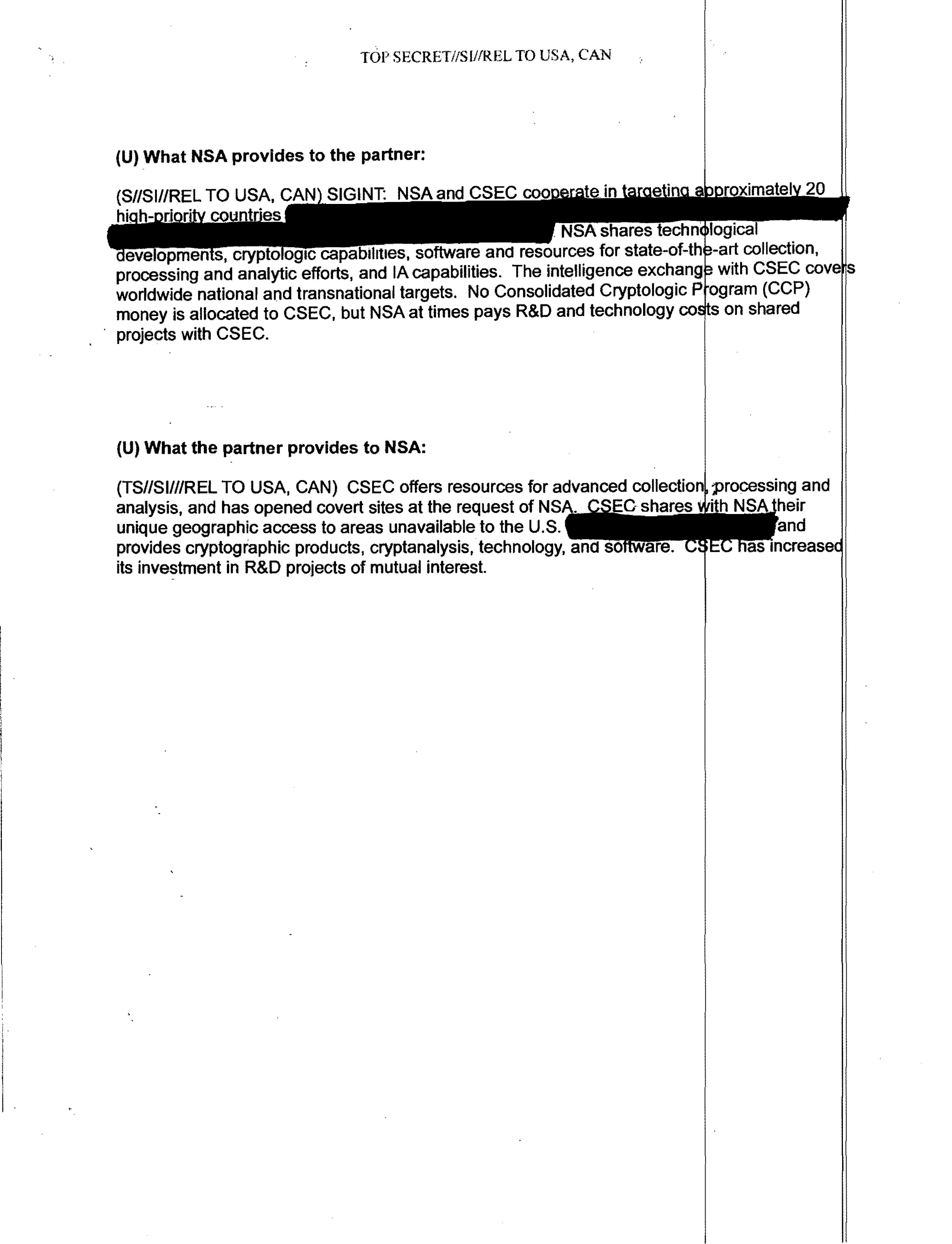
(U) What NSA provides to the partner:
(S//SI//REL TO USA, CAN) SIGINT: NSA and CSEC cooperate in targeting approximately 20 high-priority countries [REDACTED] NSA shares technological developments, cryptologic capabilities, software and resources for state-of-the-art collection, processing and analytic efforts, and IA capabilities. The intelligence exchange with CSEC covers worldwide national and transnational targets. No Consolidated Cryptologic Program (CCP) money is allocated to CSEC, but NSA at times pays R&D and technology costs on shared projects with CSEC.
(U) What the partner provides to NSA:
(TS//SI//REL TO USA, CAN) CSEC offers resources for advanced collection, processing and analysis, and has opened covert sites at the request of NSA. CSEC shares with NSA their unique geographic access to areas unavailable to the U.S. [REDACTED] and provides cryptographic products, cryptanalysis, technology, and software. CSEC has increased its investment in R&D projects of mutual interest.
Related Documents
-
NSA Intelligence Relationship with Canada's Communications Security Establishment Canada (CSEC) [pdf]
This document describes the close, long-standing SIGINT partnership between the NSA and Canada’s CSEC, emphasizing cooperative efforts in global intelligence collection, cyber operations, information assurance, and critical infrastructure defense. It highlights mutual contributions, including CSEC’s unique geographic access, covert sites, cryptographic capabilities, and R&D collaboration, supporting U.S. and North American security objectives.
“Communication Security Establishment's cyberwarfare toolbox revealed” - CBC News ↗ (2015-03-23) · “Documents Reveal Canada’s Secret Hacking Tactics” - The Intercept ↗ (2015-03-23) · “No Place to Hide” - Metropolitan Books ↗ (2014-05-13) · Seglins, Dave · Hildebrandt, Amber · Pereira, Michael · Greenwald, Glenn · Gallagher, Ryan -
NSA Intelligence Relationship with Sweden [pdf]
A 2013 NSA information paper documenting the agency's long-standing intelligence partnership with Sweden's signals intelligence service FRA, covering joint collection on Russian targets, counterterrorism, cryptanalysis, and cyber defense — a relationship kept classified due to Sweden's official political neutrality.
-
Guidelines for the classification of NSA SIGINT details (1945-1967) [pdf]
This document is an NSA classification guide that defines how and why historical SIGINT material from 1945–1967 remains classified, in many cases for 75 years. It systematically explains which intelligence activities, targets, partnerships, and technical methods must stay protected because they still reveal sensitive sources, methods, and diplomatic equities.
-
CSEC Cyber Threat Detection [pdf]
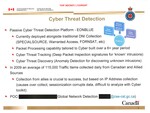
This document details the Communications Security Establishment’s (CSEC) cyber threat detection and intelligence infrastructure, including systems like EONBLUE, CROSSBOW, CRUCIBLE, and LODESTONE, which enable passive monitoring, anomaly detection, and botnet identification through metadata and deep packet inspection. It outlines how CSEC integrates SIGINT, cryptanalysis, and network forensics to detect and mitigate cyber intrusions using both SIGINT and domestic sensors, while collaborating with Five Eyes partners to enhance Canada’s cyber defense and situational awareness. The presentation is duplicated from page 7 onwards - one of the duplicated slide has internal CSE comments.
Programs: EONBLUE · SPECIALSOURCE · WARRANTEDACCESS · COVENANT · SEEDSPHERE · DIESELRATTLE · SIENNABLUE · DOWNGRADE · CROSSBOW · CRUCIBLE · LODESTONE -
CSEC Surveillance of Travellers Through Airport Wi-Fi Tracking [pdf]
The leaked 2012 top secret CSEC presentation details a trial program that used airport Wi-Fi metadata to identify and track travellers’ devices across Canada and internationally, developing advanced “IP profiling” techniques to map movements through hotels, airports, and public hotspots. The program, conducted with NSA support, aimed to build powerful analytic tools for surveillance and real-time alerts within the Five Eyes intelligence network.
Marking: TOP SECRET