Tag: cryptanalysis 78 documents
Search documents matching “cryptanalysis” →Free-text subjects the curators added. Unlike the other axes these are not necessarily from the documents' own vocabulary, so they are the loosest thing to browse by (and the most forgiving).
Graphs
By document date (11 years)
By Banner
By Classification
Refine (combine with another filter, via search)
Sort: Title
Documents
-
Black Budget: Cryptanalysis & Exploitation Services – Analysis of Target Systems [pdf]
This document is a budget justification for the NSA's Cryptanalysis & Exploitation Services project, which develops capabilities to defeat commercial encryption systems, exploit emerging communications technologies, and conduct vulnerability analysis against both foreign and domestic security products.
“The CIA Campaign to Steal Apple's Secrets” - The Intercept ↗ (2015-03-10) · Scahill, Jeremy · Begley, Josh -
CLASSIFICATION GUIDE FOR CRYPTANALYSIS, 2-12 [pdf]
An NSA/CSS classification guide for cryptanalysis establishing the precise classification level for each type of information about NSA's capabilities to exploit commercial and indigenous encryption systems — from the unclassified acknowledgement that NSA exploits cryptographic devices, through to the Top Secret protection of cryptographic modifications made to commercial products to render them exploitable and industry relationships used to obtain cryptographic details.
“Revealed: how US and UK spy agencies defeat internet privacy and security” - The Guardian ↗ (2013-09-05) · “Prying Eyes: Inside the NSA's War on Internet Security” - Der Spiegel ↗ (2014-12-28) · Ball, James · Borger, Julian · Greenwald, Glenn · Appelbaum, Jacob · Gibson, Aaron · Grothoff, Christian · Müller-Maguhn, Andy · Poitras, Laura · Sontheimer, Michael · Stöcker, Christian -
What Is It Like to Do Cryptanalysis in the Year 2006? SIDtoday [pdf]
A cryptanalyst describes the main responsibilities of his role: examining the encrypted data they receive, determining how the data was encrypted, and exploiting any weakness he may discover that would allow him to decrypt the data. Although cryptanalysis is no longer done with pen and paper like it was in WWII, it's also not as simple as TV shows make it seem.
The Intercept ↗ (2019-05-29) -
11th Annual SADC a Spectacular Success! SIDtoday [pdf]
The Signals Analysis Development Conference welcomed more than 400 members of the intelligence community. The theme was "Signals Analysis: Following Through to SIGINT Successes."
The Intercept ↗ (2016-12-07) -
Analytic Challenges from Active-Passive Integration [pdf]
This NSA presentation examines metadata attribution challenges arising when active TAO implants exfiltrate traffic through passive TURMOIL collection infrastructure, creating conflicts where intercepted data carries dual classification markings, case notations, and legal authorities from both collection systems. The briefing highlights how existing databases and analytic tools were not designed to handle traffic with two simultaneous sets of metadata parameters, requiring enterprise-wide solutions to consistently attribute and track actively-shaped intelligence collection.
Programs: BRAVENICKEL · HAMMERMILL · APEX · MARINA · TURMOIL · PRESSUREWAVE · METROTUBE · TOYGRIPPE · HAMMERSTEIN · HAMMERSTONE · METAWAVE · TURBULENCE · SSO -
Analytic Challenges from Active-Passive Integration [pdf]
This NSA briefing addresses the technical and administrative friction caused by "shaping" operations. Shaping occurs when an active malware implant, typically situated on network infrastructure like a router, copies specific data streams and redirects them past a passive surveillance sensor such as TURMOIL. While this ensures the capture of data that might otherwise be missed, it creates a "double metadata" conflict where a single piece of intelligence carries two competing sets of identifiers: one from the active Tailored Access Operations (TAO) implant and another from the passive collection site. The document tasks analysts with finding a way to reconcile these source notations to ensure the data remains searchable and legally compliant within legacy databases.
Programs: BRAVENICKEL · HAMMERMILL · APEX · TURMOIL · HAMMERSTONE · PRESSUREWAVE · METROTUBE · TOYGRIPPE · TURBULENCE · METAWAVE · MARINA · SSO · CONVEYANCE · NUCLEON · FASCIA · HAMMERCHANT -
Apple A4/A5 Application Processors Analysis [pdf]
This document appears in a collection of presentations from a secret CIA-sponsored conference called the "Jamboree," where security researchers shared methods for exploiting vulnerabilities in consumer electronics. The presentation focused on analyzing Apple's A4 and A5 processors, which were used in iPhones and iPads, as part of broader intelligence agency efforts to extract encryption keys and find security weaknesses in Apple devices.
“The CIA Campaign to Steal Apple's Secrets” - The Intercept ↗ (2015-03-10) · Scahill, Jeremy · Begley, Josh -
Battlefield SIGINT Conference SIDtoday [pdf]
A conference took place to discuss improving cryptanalytic support for frontline military operations, including the PINERIDGE unmanned aerial vehicle project.
Programs: PINERIDGEThe Intercept ↗ (2017-04-24) -
Bletchley Park Veterans to Speak at National Cryptologic Museum SIDtoday [pdf]
Two veterans of the British WWII-era cryptographic operations at Bletchley Park will present and answer questions about their experiences.
The Intercept ↗ (2019-05-29) -
Book Review: Cryptonomicon SIDtoday [pdf]
Short book review of Neal Stephenson’s Cryptonomicon.
Marking: UNCLASSIFIEDPeople: Stephenson, NealThe Intercept ↗ (2016-05-16) -
Brits at NSA: The United Kingdom of Great Britain and Northern Ireland Liaison Office, NSA (or UKLO for short) SIDtoday [pdf]
About 40 civilian and military GCHQ employees are based with the NSA through the U.K. Liaison Team. They coordinate visits from British government and intelligence officials and work to build and enhance collaborations between the two agencies.
Marking: CONFIDENTIALThe Intercept ↗ (2017-04-24) -
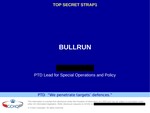
BULLRUN [pdf]
A GCHQ TOP SECRET STRAP1 briefing presentation on BULLRUN — summarising the programme's purpose, the network security technologies it targets, the sensitivities surrounding cryptanalytic capabilities, and the access control framework protecting both technical details and the "fact of" capability — notable for explicitly naming three ECIs protecting the technical underpinnings: PICARESQUE, PAWLEYS and AMBULANT.
-
CLASSIFICATION GUIDE FOR ECI PAWLEYS (PAW) [pdf]
This 2006 NSA classification guide outlines the protocols for ECI PAWLEYS (PAW). PAWLEYS is an Exceptionally Compartmented Information (ECI) category designed to protect clandestine operations—both physical (HUMINT) and digital (CNE)—specifically aimed at acquiring foreign cryptographic information and material. The document confirms that the NSA actively seeks to circumvent encryption through clandestine HUMINT and computer network access aimed at cryptographic information and material, rather than relying solely on traditional codebreaking.
Programs: PAWLEYS -
Classification guide for NSA/CSS Quantum Computing Research (10-25) [pdf]
The NSA/CSS Quantum Computing Research Classification Guide (10-25) outlines how information related to the NSA’s quantum computing research should be classified, distinguishing between unclassified academic work and classified cryptanalytic programs. It defines classification levels for research activities, breakthroughs, algorithms, collaborations, and materials, with the goal of protecting U.S. cryptographic systems while advancing the agency’s offensive capabilities in quantum cryptanalysis.
-
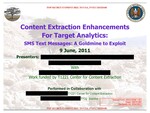
Content Extraction Enhancements For Target Analytics: SMS Text Messages: A Goldmine to Exploit (9 June 2011) [pdf]
The document describes the NSA’s Dishfire program, which collects hundreds of millions of global SMS messages daily, and the PREFER system, which extracts detailed metadata—including contacts, geolocation, travel, and financial information—from these messages for analytic purposes. It highlights the scale, operational processes, and types of data exploited to support intelligence and target analysis.
-
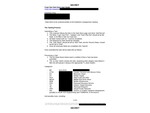
Crypt Ops Data Store User Guide [pdf]
A SECRET GCHQ user guide for the Crypt Ops Data Store — the internal task management system used by GCHQ's cryptanalytic operations division to receive, triage, assign and track decryption and cryptanalytic requests — notable for its category list which maps task types to operational programmes including BULLRUN, BEARDED PIGGY and VPN exploitation.
Marking: SECRET -
CSEC Cyber Threat Capabilities [pdf]
This document details CSEC’s full-spectrum cyber operations architecture, integrating SIGINT and IT Security to conduct both defensive and offensive activities under the guise of “information superiority.” While early sections emphasize detection, anomaly analysis, and collaboration with Five Eyes partners, later portions reveal active measures including network infiltration (implant deployment), command-and-control tracking, traffic manipulation and redirection, DNS interference, and potential disruption or deception operations—illustrating CSEC’s capacity not only to defend Canadian networks but also to surveil, exploit, and influence foreign and domestic digital infrastructure.
Programs: EONBLUE · CYBERDMZ · SEEDSPHERE · PHOTONICPRISM · SPECIALSOURCE · SUPERDRAKE · DARKSPACE · QUANTUM · MANDATE · STREAMING SENTRY · SSO · TKB · COVENANT -
CSEC Cyber Threat Detection [pdf]
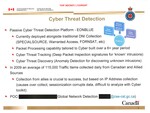
This document details the Communications Security Establishment’s (CSEC) cyber threat detection and intelligence infrastructure, including systems like EONBLUE, CROSSBOW, CRUCIBLE, and LODESTONE, which enable passive monitoring, anomaly detection, and botnet identification through metadata and deep packet inspection. It outlines how CSEC integrates SIGINT, cryptanalysis, and network forensics to detect and mitigate cyber intrusions using both SIGINT and domestic sensors, while collaborating with Five Eyes partners to enhance Canada’s cyber defense and situational awareness. The presentation is duplicated from page 7 onwards - one of the duplicated slide has internal CSE comments.
Programs: EONBLUE · SPECIALSOURCE · WARRANTEDACCESS · COVENANT · SEEDSPHERE · DIESELRATTLE · SIENNABLUE · DOWNGRADE · CROSSBOW · CRUCIBLE · LODESTONE -
Data Acquisition Update SIDtoday [pdf]
SID's deputy director for Data Acquisition gives an update on what his department has been doing. He points out that the capture of terrorist Umar Baziyani was an example of seamless interaction between many diverse parts of NSA, an operation that included "cryptoanalytic exploitation using special purpose hardware." He outlines some of Data Acquisition's activities to build tools and infrastructure to make similar operations much easier in the future, including the establishment of the Global Network Forum, "a 5 Eyes construct to manage midpoint accesses on a community basis."
People: Baziyani, UmarThe Intercept ↗ (2017-04-24) -
Efforts Against Virtual Private Networks Bear Fruit SIDtoday [pdf]
Recent progress in exploiting Virtual Private Networks has resulted in access to “hundreds” of secure links, including Al Jazeera’s internal communications.
The Intercept ↗ (2018-08-15)