Publication year: 2015-05 33 documents
Search documents matching “2015-05” →When a publisher first published each document. If a document is published multiple times, only the oldest one is used here.
Graphs
By document date (7 years)
By published date (2 years)
Sort: Title
Documents
-
“Black Budget” — FY 2013 Congressional Budget Justification/National Intelligence Program, p. 262 (February 2012) [pdf]
This excerpt from the Fiscal Year 2013 Congressional Budget Justification (the "Black Budget") details the NSA's financial and performance metrics for "Analytics Modernization," specifically focusing on the transition to high-volume, automated speech-to-text systems. It records the decommissioning of legacy voice processing systems (VoiceRT) in favor of more robust, scalable capabilities aimed at rendering millions of intercepted voice files searchable via text queries and paired dialogue transcription.
Programs: VoiceRT -
“Black Budget” — FY 2013 Congressional Budget Justification/National Intelligence Program, pp. 360-364 (February 2012) [pdf]
The "Human Language Technology (HLT) Research" section of the FY 2013 "Black Budget" details a specialized research project focused on creating "force multipliers" for the NSA workforce through automated speech-to-text, machine translation, and content extraction. With a requested budget of $29.4 million, the project aims to bridge the gap between foundational academic research (via Johns Hopkins University) and the practical exploitation of the volume and velocity of global SIGINT.
Programs: HLT -
Classification Guide for Human Language Technology (HLT) Models (May 18, 2011) [pdf]
This document is an NSA administrative policy document that establishes the rules for what information regarding speech analytics remains public versus what must be kept secret. It explicitly confirms that the NSA possesses automated tools for gender, language, dialect, and speaker recognition, as well as speech-to-text and phonetic tokenization. While the existence of these capabilities is unclassified, the specific data used to "train" the models and the actual identity of targeted speakers are protected at the SECRET level.
Programs: HLT -
Coming Soon! A Tool that Enables Non-Linguists to Analyze Foreign-TV News Programs SIDtoday [pdf]
This document introduces eViTAP (Enhanced Video Text and Audio Processing), a fully automated system designed to monitor and translate international television broadcasts. Primarily aimed at analysts who do not possess specific foreign language skills, the tool leverages automated processing to transform open-source media into actionable intelligence.
-
'Data Is Not Intelligence' SIDtoday [pdf]
A 2007 NSA SIDtoday summary of a keynote address by Deputy DNI for Analysis Thomas Fingar at the Analytic Transformation Symposium, outlining the Intelligence Community's agenda for improving analytical quality, cross-agency collaboration, and integrated operations through training, shared standards, and new tools like A-Space and the Library of National Intelligence.
Programs: A-SPACE -
ELINT Analysts - Overcome by Overload? Help is Here with IM&S SIDtoday [pdf]
A 2011 NSA SIDtoday article announcing the Initial Operational Capability of the ELINT Modernization Information Management and Storage system, designed to give analysts worldwide unified access to five years of ELINT reports and raw data from an expanding range of traditional and non-traditional collection platforms.
-
Finding Nuggets -- Quickly -- in a Heap of Voice Collection, From Mexico to Afghanistan SIDtoday [pdf]
A 2011 article by an NSA Texas analyst describing the deployment of Human Language Technology analytics — including speech-to-text, speaker identification, gender recognition and language identification — to Special Collection Service sites in the Americas and to the Afghanistan Remote Operations Cryptologic Center, with operational examples ranging from tunnel detection in Tijuana to intelligence support in Kandahar.
Programs: HLT -
FY2013 Congressional Budget Justification Bin Laden Excerpts [pdf]
This document includes excerpts from the 2013 National Intelligence Program budget justification describing the integrated intelligence community efforts that led to locating and raiding Osama bin Laden's compound, detailing contributions from NSA's signal intelligence, CIA's geolocation analysis, NGA's imagery modeling, and post-raid forensic DNA confirmation.
People: bin Laden, Osama -
How Is Human Language Technology (HLT) Progressing? SIDtoday [pdf]
This document provides an operational update on the deployment of "HLT Labs"—a specialized suite of voice analytics designed to automate the discovery of intelligence "nuggets" within massive volumes of audio collection. The document highlights successful field applications in Afghanistan, Georgia, Texas, and Latin America, noting that these tools are becoming "force multipliers" that allow linguists to bypass manual listening in favor of automated keyword searching and speaker recognition.
-
Interview with a SID "Hacker" -- Part 2: Hacker Culture and Worker Retention SIDtoday [pdf]
A SIDtoday internal NSA newsletter interview with a redacted TAO employee discussing hacker culture within the agency's offensive cyber unit, worker retention challenges, and the team's role in operations including the raid that killed Osama bin Laden.
Programs: SCQAWKPeople: bin Laden, Osama -
Is There a Sustainable Ops Tempo in S2? How Can Analysts Deal with the Flood of Collection? SIDtoday [pdf]
The NSA's Deputy Director for Analysis and Production discusses the unsustainable operational tempo caused by overwhelming data collection volumes, advocating for "Analytic Modernization" that would shift from treating SIGINT as "radioactive" NSA-only material to sharing raw intelligence with other agencies for collaborative exploitation.
Programs: A-SPACE -
JTAC Attack Methodology Team [pdf]
This September 2011 GCWiki page describes GCHQ's Joint Terrorism Analysis Centre (JTAC) Attack Methodology Team, a thematic assessment unit staffed by secondees from various government and military departments with access to Five Eyes intelligence, specializing in analyzing Islamist weaponry, tactics, training, IED construction, and terrorist attack methodologies.
Programs: RUSSETT -
June 2011 Nato Afghanistan Intelligence Report [pdf]
A June 2011 SHAPE weekly report to NATO HQ assessing the state of ISAF operations in Afghanistan, covering Taliban command and control deterioration, insurgent supply shortages, the post-bin Laden strain on NATO's Pakistani logistics routes, and notable attacks across regional commands.
Marking: NATO SECRET -
May 2011 Nato Afghanistan Intelligence Report [pdf]
A May 2011 SHAPE weekly report to NATO HQ assessing ISAF operations in Afghanistan — including a major failed Taliban spring offensive in Kandahar, insurgent cache dispersal tactics, and the limited impact of bin Laden's death on Taliban operational capacity — alongside an update on Operation Unified Protector in Libya covering the Misrata siege and Gaddafi regime military activity.
Marking: NATO SECRET -
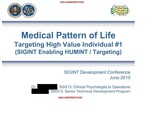
Medical Pattern of Life - Targeting High Value Individual #1 - (SIGINT Enabling HUMINT / Targeting) [pdf]
This presentation dates from June 2010 and outlines a highly specialized intelligence strategy: using a target's medical needs as a "geospatial beacon" to bypass traditional security measures. In this context, High Value Individual #1 (HVI #1) refers to Osama bin Laden (UBL), and the document details a plan to track him via his suspected chronic kidney disease and related medical supplies.
People: bin Laden, Osama -
NCTC Current Status of Major Terrorism Figures [pdf]
A TOP SECRET joint HUMINT–COMINT status report from June 2008 summarizes the whereabouts and threat posture of senior al‑Qaida leaders, highlighting Usama bin Ladin, Ayman al‑Zawahiri, and a key courier assessed as critical to locating them. The document reflects U.S. intelligence tracking priorities just three years before bin Ladin’s death.
-
Op-ed: Leave Bright Pebbles, Not Breadcrumbs, for Those Coming After You SIDtoday [pdf]
A 2010 NSA SIDtoday op-ed by a Chinese language analyst urging analysts to actively document and share their target knowledge through available tools rather than hoarding expertise in personal files or spreadsheets, arguing that the agency's increasing reliance on short tours and rotating assignments makes institutional knowledge-sharing an operational necessity.
-
Regional Command Southwest Intelligence Report June 19 2011 [pdf]
A June 2011 intelligence summary from Regional Command Southwest in Afghanistan assessing the destabilizing aftermath of the Osama bin Laden raid on U.S.-Pakistan relations, Pakistani internal security, Taliban activity along the RC(SW) border, and local governance developments in Helmand Province.
-
Regional Command Southwest Intelligence Report June 23 2011 [pdf]
A June 2011 RC Southwest intelligence summary documenting a covert ALP-Taliban collusion arrangement in Nad'Ali district, and a separate intelligence report detailing Taliban internal supply shortages, infighting, and morale deterioration across northern Helmand Province in the aftermath of Osama bin Laden's death.
-
RT10 Overview [pdf]
This RT10 overview document is a high-level briefing on the implementation of a real-time SIGINT architecture designed to modernize intelligence operations in the Iraq theater, specifically Baghdad. The project aims to replace legacy, "manual-intensive" processes with a "SIGINT Brain"—a distributed database and automated analytic framework capable of processing over 50 million GSM metadata events per day.
Programs: RT10 · OBELISK · WISPYKNIT · VICTORYUNIFORM · JUGGERNAUT · COBRAFOCUS · MATTERHORN · EXPIATION · VoiceRT · GREENDRAGON · TAREX · KEYCARD