June 2011 Nato Afghanistan Intelligence Report
Open PDFDocument date: 2011-06-01
Pages: 2
Genre: report
Banner: NATO SECRET
Classification: NATO SECRET
Dissemination: -
A June 2011 SHAPE weekly report to NATO HQ assessing the state of ISAF operations in Afghanistan, covering Taliban command and control deterioration, insurgent supply shortages, the post-bin Laden strain on NATO's Pakistani logistics routes, and notable attacks across regional commands.
My notes
NATO SECRET
NATO
OTAN
VIGILIA PRETIUM LIBERTATIS
SUPREME HEADQUARTERS ALLIED POWERS
EUROPE
GRAND QUARTIER GÉNÉRAL DES PUISSANCES ALLIÉES
EN EUROPE
B-7010 SHAPE, BELGIUM
Our ref: 0106/SOC/SCT
Date: 01 Jun 11
Tel: +32-(0)[REDACTED] (Operator)
Tel: +32-(0)[REDACTED]
NCN: [REDACTED]
Fax: +32-(0)[REDACTED] (Registry)
TO: NATO HEADQUARTERS, SITUATION CENTRE
SUBJECT: SHAPE Weekly Report on NATO-led Operations
INTERNATIONAL SECURITY ASSISTANCE FORCE (ISAF) - AFGHANISTAN
Overview
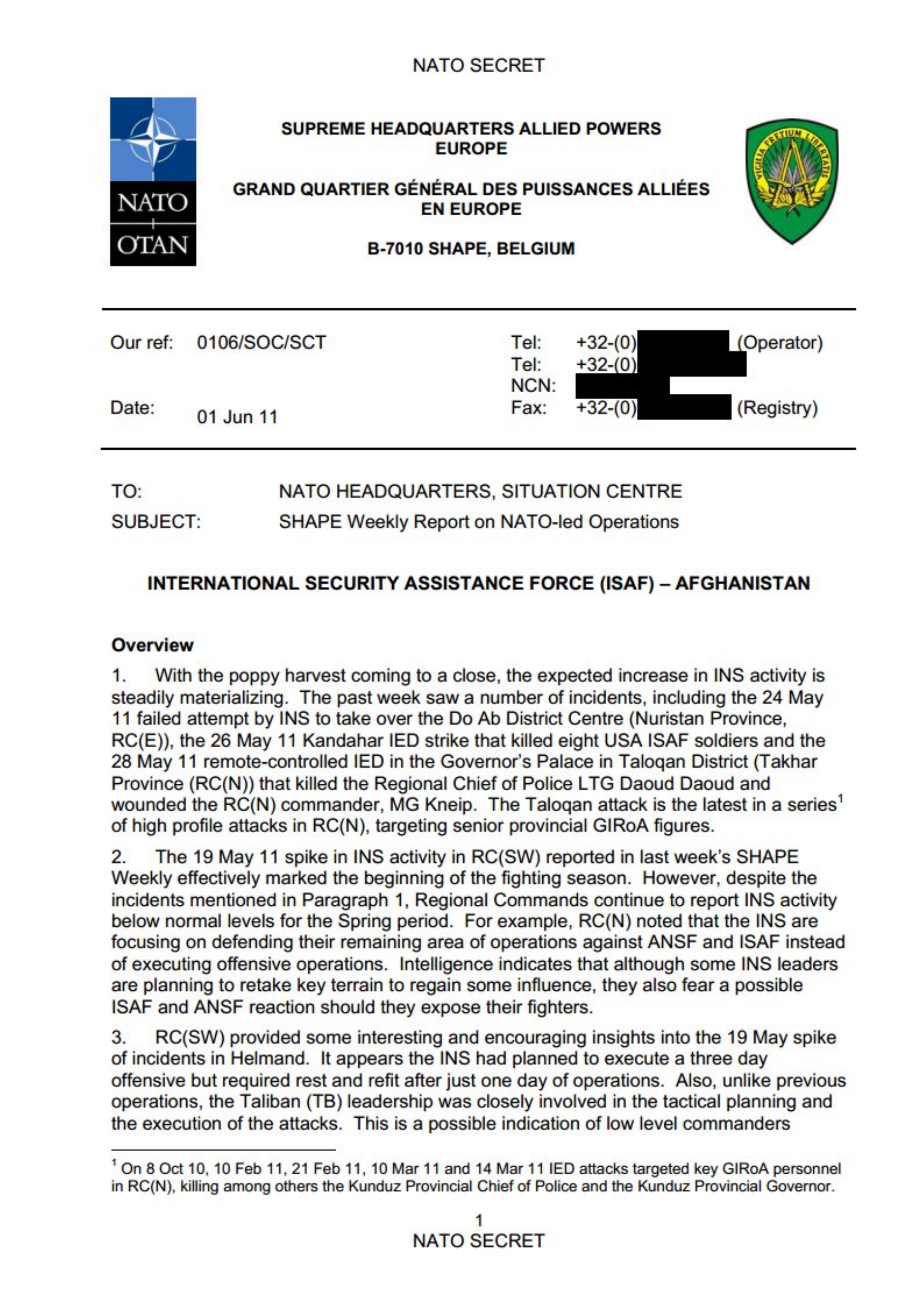
- With the poppy harvest coming to a close, the expected increase in INS activity is steadily materializing. The past week saw a number of incidents, including the 24 May 11 failed attempt by INS to take over the Do Ab District Centre (Nuristan Province, RC(E)), the 26 May 11 Kandahar IED strike that killed eight USA ISAF soldiers and the 28 May 11 remote-controlled IED in the Governor's Palace in Taloqan District (Takhar Province (RC(N)) that killed the Regional Chief of Police LTG Daoud Daoud and wounded the RC(N) commander, MG Kneip. The Taloqan attack is the latest in a series¹ of high profile attacks in RC(N), targeting senior provincial GIROA figures.
- The 19 May 11 spike in INS activity in RC(SW) reported in last week's SHAPE Weekly effectively marked the beginning of the fighting season. However, despite the incidents mentioned in Paragraph 1, Regional Commands continue to report INS activity below normal levels for the Spring period. For example, RC(N) noted that the INS are focusing on defending their remaining area of operations against ANSF and ISAF instead of executing offensive operations. Intelligence indicates that although some INS leaders are planning to retake key terrain to regain some influence, they also fear a possible ISAF and ANSF reaction should they expose their fighters.
- RC(SW) provided some interesting and encouraging insights into the 19 May spike of incidents in Helmand. It appears the INS had planned to execute a three day offensive but required rest and refit after just one day of operations. Also, unlike previous operations, the Taliban (TB) leadership was closely involved in the tactical planning and the execution of the attacks. This is a possible indication of low level commanders
¹ On 8 Oct 10, 10 Feb 11, 21 Feb 11, 10 Mar 11 and 14 Mar 11 IED attacks targeted key GIRoA personnel in RC(N), killing among others the Kunduz Provincial Chief of Police and the Kunduz Provincial Governor.
1
NATO SECRET
NATO SECRET
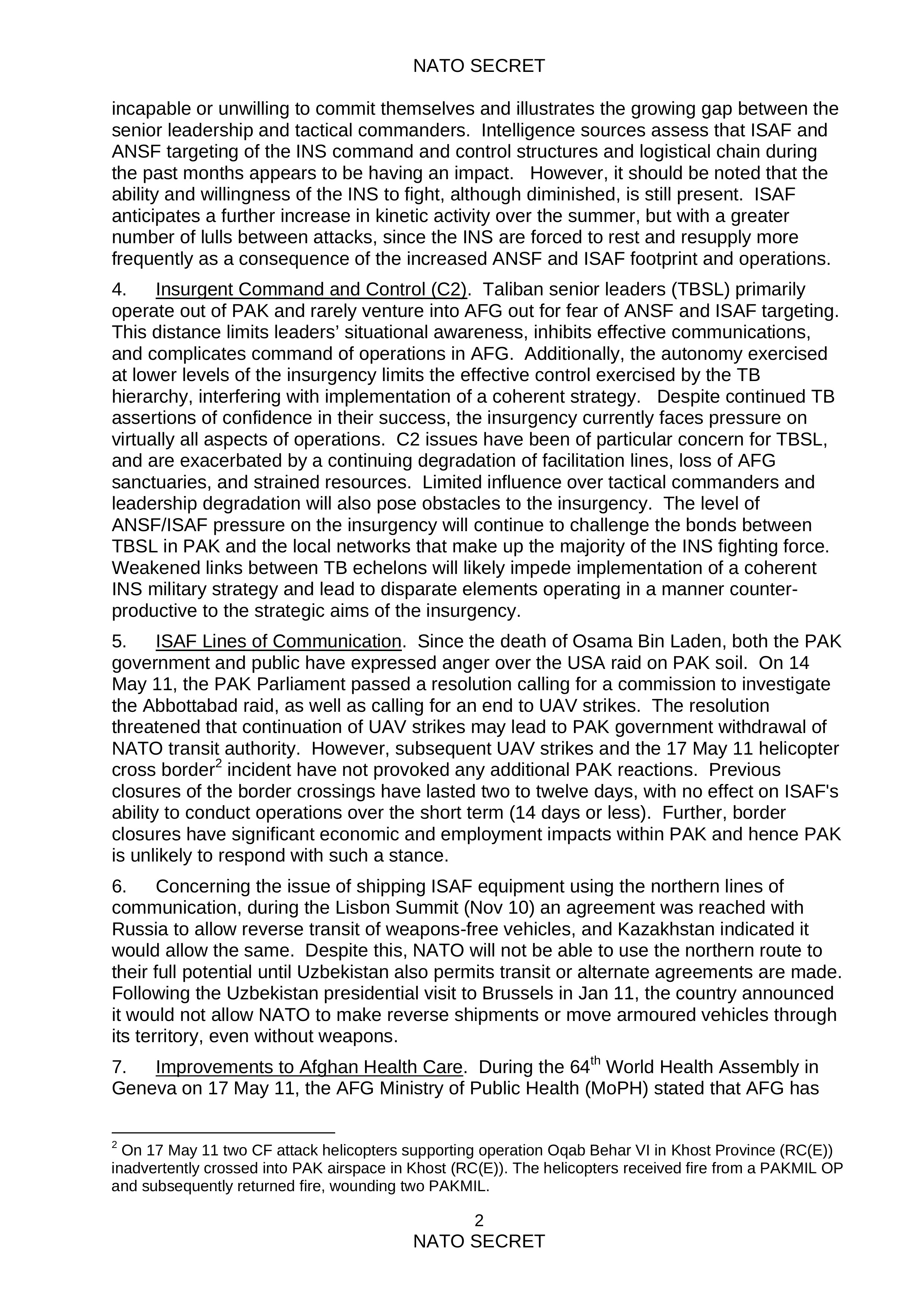
incapable or unwilling to commit themselves and illustrates the growing gap between the senior leadership and tactical commanders. Intelligence sources assess that ISAF and ANSF targeting of the INS command and control structures and logistical chain during the past months appears to be having an impact. However, it should be noted that the ability and willingness of the INS to fight, although diminished, is still present. ISAF anticipates a further increase in kinetic activity over the summer, but with a greater number of lulls between attacks, since the INS are forced to rest and resupply more frequently as a consequence of the increased ANSF and ISAF footprint and operations.
- Insurgent Command and Control (C2). Taliban senior leaders (TBSL) primarily operate out of PAK and rarely venture into AFG out for fear of ANSF and ISAF targeting. This distance limits leaders' situational awareness, inhibits effective communications, and complicates command of operations in AFG. Additionally, the autonomy exercised at lower levels of the insurgency limits the effective control exercised by the TB hierarchy, interfering with implementation of a coherent strategy. Despite continued TB assertions of confidence in their success, the insurgency currently faces pressure on virtually all aspects of operations. C2 issues have been of particular concern for TBSL, and are exacerbated by a continuing degradation of facilitation lines, loss of AFG sanctuaries, and strained resources. Limited influence over tactical commanders and leadership degradation will also pose obstacles to the insurgency. The level of ANSF/ISAF pressure on the insurgency will continue to challenge the bonds between TBSL in PAK and the local networks that make up the majority of the INS fighting force. Weakened links between TB echelons will likely impede implementation of a coherent INS military strategy and lead to disparate elements operating in a manner counter-productive to the strategic aims of the insurgency.
- ISAF Lines of Communication. Since the death of Osama Bin Laden, both the PAK government and public have expressed anger over the USA raid on PAK soil. On 14 May 11, the PAK Parliament passed a resolution calling for a commission to investigate the Abbottabad raid, as well as calling for an end to UAV strikes. The resolution threatened that continuation of UAV strikes may lead to PAK government withdrawal of NATO transit authority. However, subsequent UAV strikes and the 17 May 11 helicopter cross border² incident have not provoked any additional PAK reactions. Previous closures of the border crossings have lasted two to twelve days, with no effect on ISAF's ability to conduct operations over the short term (14 days or less). Further, border closures have significant economic and employment impacts within PAK and hence PAK is unlikely to respond with such a stance.
- Concerning the issue of shipping ISAF equipment using the northern lines of communication, during the Lisbon Summit (Nov 10) an agreement was reached with Russia to allow reverse transit of weapons-free vehicles, and Kazakhstan indicated it would allow the same. Despite this, NATO will not be able to use the northern route to their full potential until Uzbekistan also permits transit or alternate agreements are made. Following the Uzbekistan presidential visit to Brussels in Jan 11, the country announced it would not allow NATO to make reverse shipments or move armoured vehicles through its territory, even without weapons.
- Improvements to Afghan Health Care. During the 64th World Health Assembly in Geneva on 17 May 11, the AFG Ministry of Public Health (MoPH) stated that AFG has
² On 17 May 11 two CF attack helicopters supporting operation Oqab Behar VI in Khost Province (RC(E)) inadvertently crossed into PAK airspace in Khost (RC(E)). The helicopters received fire from a PAKMIL OP and subsequently returned fire, wounding two PAKMIL.
2
NATO SECRET
Published in the Same Report
(10 documents)
-
SIGINT Obtains Details of Usama bin Laden Message to Top al-Qa'ida Leader in Iraq SIDtoday [pdf]
A 2007 NSA SIDtoday article describing how SIGINT analysts intercepted and decoded a message from Osama bin Laden to al-Qaeda's leader in Iraq, revealing bin Laden's strategic thinking on the Iraq war, his anger toward the UAE, and the communications pathway used by senior al-Qaeda figures between Pakistan, Iran, and Iraq.
Programs: SCQAWK -
What Does the Death of Usama bin Laden Mean? SIDtoday [pdf]
A 2011 NSA SIDtoday interview with SID's Associate Deputy Director for Counterterrorism assessing the significance of Osama bin Laden's death, revealing that NSA played a central role in identifying his compound and providing force-protection support during the SEAL raid, while also disclosing that bin Laden had been invisible to SIGINT since 1998.
Programs: SCQAWK -
SIGINT Year in Review, November 2011 SIDtoday [pdf]
A 2011 year-in-review message from NSA SIGINT Director Teresa Shea summarizing the directorate's major operational and capability accomplishments over the past year, including SIGINT contributions to the killing of Osama bin Laden, operations against Anwar al-Awlaki and other al-Qaeda figures, and support for military campaigns and crises across the Middle East.
Programs: SCQAWK -
FY2013 Congressional Budget Justification Bin Laden Excerpts [pdf]
This document includes excerpts from the 2013 National Intelligence Program budget justification describing the integrated intelligence community efforts that led to locating and raiding Osama bin Laden's compound, detailing contributions from NSA's signal intelligence, CIA's geolocation analysis, NGA's imagery modeling, and post-raid forensic DNA confirmation.
People: bin Laden, Osama -
JTAC Attack Methodology Team [pdf]
This September 2011 GCWiki page describes GCHQ's Joint Terrorism Analysis Centre (JTAC) Attack Methodology Team, a thematic assessment unit staffed by secondees from various government and military departments with access to Five Eyes intelligence, specializing in analyzing Islamist weaponry, tactics, training, IED construction, and terrorist attack methodologies.
Programs: RUSSETT -
NCTC Current Status of Major Terrorism Figures [pdf]
A TOP SECRET joint HUMINT–COMINT status report from June 2008 summarizes the whereabouts and threat posture of senior al‑Qaida leaders, highlighting Usama bin Ladin, Ayman al‑Zawahiri, and a key courier assessed as critical to locating them. The document reflects U.S. intelligence tracking priorities just three years before bin Ladin’s death.
-
Interview with a SID "Hacker" -- Part 2: Hacker Culture and Worker Retention SIDtoday [pdf]
A SIDtoday internal NSA newsletter interview with a redacted TAO employee discussing hacker culture within the agency's offensive cyber unit, worker retention challenges, and the team's role in operations including the raid that killed Osama bin Laden.
Programs: SCQAWKPeople: bin Laden, Osama -
Regional Command Southwest Intelligence Report June 19 2011 [pdf]
A June 2011 intelligence summary from Regional Command Southwest in Afghanistan assessing the destabilizing aftermath of the Osama bin Laden raid on U.S.-Pakistan relations, Pakistani internal security, Taliban activity along the RC(SW) border, and local governance developments in Helmand Province.
-
Regional Command Southwest Intelligence Report June 23 2011 [pdf]
A June 2011 RC Southwest intelligence summary documenting a covert ALP-Taliban collusion arrangement in Nad'Ali district, and a separate intelligence report detailing Taliban internal supply shortages, infighting, and morale deterioration across northern Helmand Province in the aftermath of Osama bin Laden's death.
-
May 2011 Nato Afghanistan Intelligence Report [pdf]
A May 2011 SHAPE weekly report to NATO HQ assessing ISAF operations in Afghanistan — including a major failed Taliban spring offensive in Kandahar, insurgent cache dispersal tactics, and the limited impact of bin Laden's death on Taliban operational capacity — alongside an update on Operation Unified Protector in Libya covering the Misrata siege and Gaddafi regime military activity.
Marking: NATO SECRET
Related Documents
-
May 2011 Nato Afghanistan Intelligence Report [pdf]
A May 2011 SHAPE weekly report to NATO HQ assessing ISAF operations in Afghanistan — including a major failed Taliban spring offensive in Kandahar, insurgent cache dispersal tactics, and the limited impact of bin Laden's death on Taliban operational capacity — alongside an update on Operation Unified Protector in Libya covering the Misrata siege and Gaddafi regime military activity.
Marking: NATO SECRET -
Regional Command Southwest Intelligence Report June 19 2011 [pdf]
A June 2011 intelligence summary from Regional Command Southwest in Afghanistan assessing the destabilizing aftermath of the Osama bin Laden raid on U.S.-Pakistan relations, Pakistani internal security, Taliban activity along the RC(SW) border, and local governance developments in Helmand Province.
-
Regional Command Southwest Intelligence Report June 23 2011 [pdf]
A June 2011 RC Southwest intelligence summary documenting a covert ALP-Taliban collusion arrangement in Nad'Ali district, and a separate intelligence report detailing Taliban internal supply shortages, infighting, and morale deterioration across northern Helmand Province in the aftermath of Osama bin Laden's death.
-
SIGINT Year in Review, November 2011 SIDtoday [pdf]
A 2011 year-in-review message from NSA SIGINT Director Teresa Shea summarizing the directorate's major operational and capability accomplishments over the past year, including SIGINT contributions to the killing of Osama bin Laden, operations against Anwar al-Awlaki and other al-Qaeda figures, and support for military campaigns and crises across the Middle East.
Programs: SCQAWK -
What Does the Death of Usama bin Laden Mean? SIDtoday [pdf]
A 2011 NSA SIDtoday interview with SID's Associate Deputy Director for Counterterrorism assessing the significance of Osama bin Laden's death, revealing that NSA played a central role in identifying his compound and providing force-protection support during the SEAL raid, while also disclosing that bin Laden had been invisible to SIGINT since 1998.
Programs: SCQAWK