'Data Is Not Intelligence'
Open PDFDocument date: 2007-09-18
Type: SIDtoday
Pages: 2
Genre: newsletter
Classification: UNCLASSIFIED
Dissemination: FOUO
A 2007 NSA SIDtoday summary of a keynote address by Deputy DNI for Analysis Thomas Fingar at the Analytic Transformation Symposium, outlining the Intelligence Community's agenda for improving analytical quality, cross-agency collaboration, and integrated operations through training, shared standards, and new tools like A-Space and the Library of National Intelligence.
My notes

(U) 'Data Is Not Intelligence'
FROM: [REDACTED]
SID Reporting Board (S12R)
Run Date: 09/18/2007
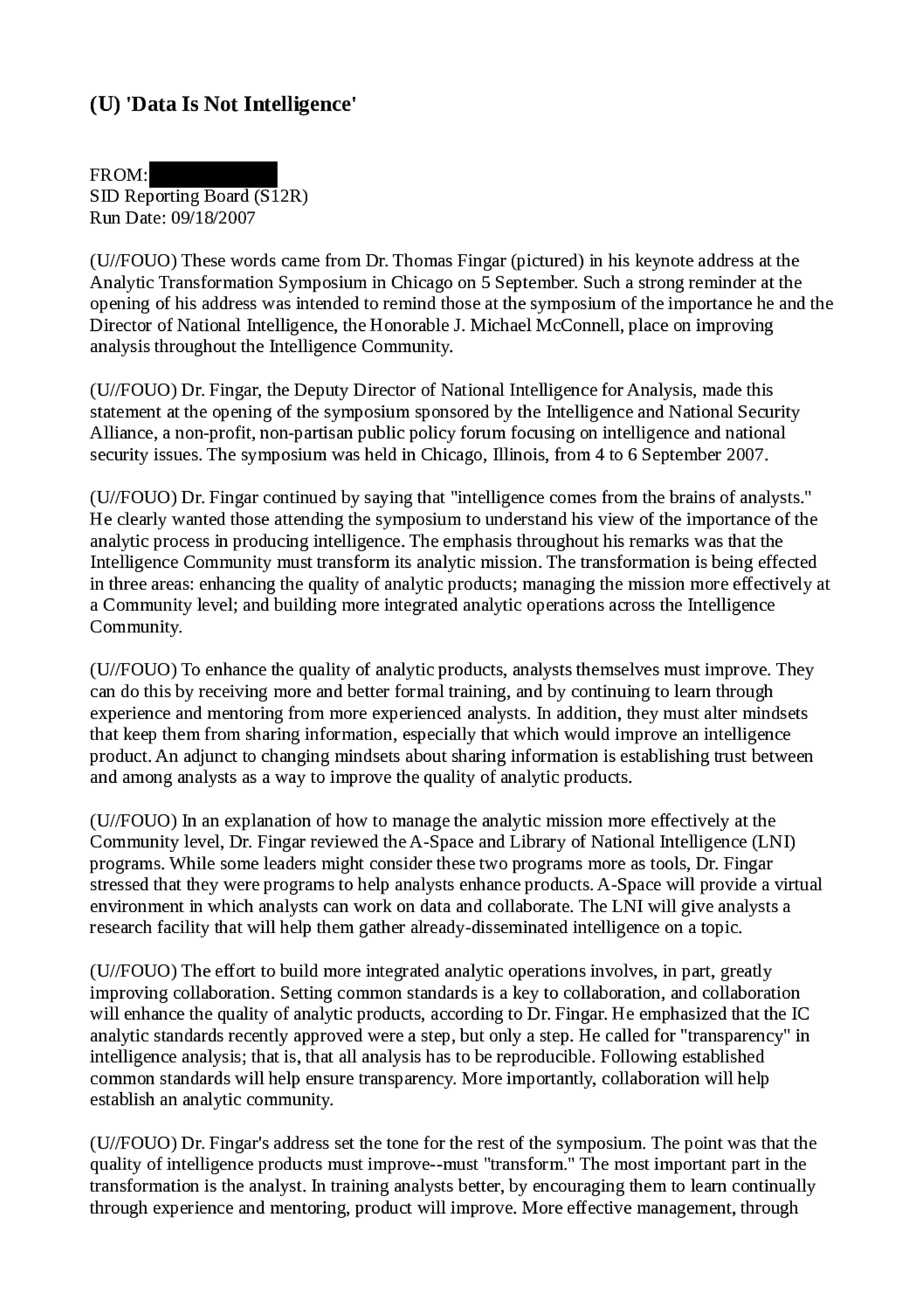
(U//FOUO) These words came from Dr. Thomas Fingar (pictured) in his keynote address at the Analytic Transformation Symposium in Chicago on 5 September. Such a strong reminder at the opening of his address was intended to remind those at the symposium of the importance he and the Director of National Intelligence, the Honorable J. Michael McConnell, place on improving analysis throughout the Intelligence Community.
(U//FOUO) Dr. Fingar, the Deputy Director of National Intelligence for Analysis, made this statement at the opening of the symposium sponsored by the Intelligence and National Security Alliance, a non-profit, non-partisan public policy forum focusing on intelligence and national security issues. The symposium was held in Chicago, Illinois, from 4 to 6 September 2007.
(U//FOUO) Dr. Fingar continued by saying that "intelligence comes from the brains of analysts." He clearly wanted those attending the symposium to understand his view of the importance of the analytic process in producing intelligence. The emphasis throughout his remarks was that the Intelligence Community must transform its analytic mission. The transformation is being effected in three areas: enhancing the quality of analytic products; managing the mission more effectively at a Community level; and building more integrated analytic operations across the Intelligence Community.
(U//FOUO) To enhance the quality of analytic products, analysts themselves must improve. They can do this by receiving more and better formal training, and by continuing to learn through experience and mentoring from more experienced analysts. In addition, they must alter mindsets that keep them from sharing information, especially that which would improve an intelligence product. An adjunct to changing mindsets about sharing information is establishing trust between and among analysts as a way to improve the quality of analytic products.
(U//FOUO) In an explanation of how to manage the analytic mission more effectively at the Community level, Dr. Fingar reviewed the A-Space and Library of National Intelligence (LNI) programs. While some leaders might consider these two programs more as tools, Dr. Fingar stressed that they were programs to help analysts enhance products. A-Space will provide a virtual environment in which analysts can work on data and collaborate. The LNI will give analysts a research facility that will help them gather already-disseminated intelligence on a topic.
(U//FOUO) The effort to build more integrated analytic operations involves, in part, greatly improving collaboration. Setting common standards is a key to collaboration, and collaboration will enhance the quality of analytic products, according to Dr. Fingar. He emphasized that the IC analytic standards recently approved were a step, but only a step. He called for "transparency" in intelligence analysis; that is, that all analysis has to be reproducible. Following established common standards will help ensure transparency. More importantly, collaboration will help establish an analytic community.
(U//FOUO) Dr. Fingar's address set the tone for the rest of the symposium. The point was that the quality of intelligence products must improve--must "transform." The most important part in the transformation is the analyst. In training analysts better, by encouraging them to learn continually through experience and mentoring, product will improve. More effective management, through programs such as A-Space and the LNI, will help give analysts data and intelligence they need, and a better environment in which to work. Collaboration is encouraged and made easier by these programs, and collaboration is part of building integrated operations. All of these together will help ensure that the quality of analytic products improves--that customers receive intelligence, not data.
Published in the Same Report
(10 documents)
-
Dealing With a 'Tsunami' of Intercept SIDtoday [pdf]
As part of NSAs efforts to implement Human Language Technology, prototype processors located at collection sites will soon be able to query content at "line speed" based on the language, it is written in.
People: Kulman, Anita H.The Intercept ↗ (2019-05-29) · “Inside NSA, Officials Privately Criticize "Collect It All" Surveillance” - The Intercept ↗ (2015-05-28) · Maass, Peter -
Is There a Sustainable Ops Tempo in S2? How Can Analysts Deal with the Flood of Collection? SIDtoday [pdf]
The NSA's Deputy Director for Analysis and Production discusses the unsustainable operational tempo caused by overwhelming data collection volumes, advocating for "Analytic Modernization" that would shift from treating SIGINT as "radioactive" NSA-only material to sharing raw intelligence with other agencies for collaborative exploitation.
Programs: A-SPACE -
The SIGINT Philosopher: Cognitive Overflow? SIDtoday [pdf]
A 2011 NSA SIDtoday opinion column reflecting on whether the SIGINT Directorate's collective analytical capacity has a finite "channel capacity" — borrowing from cognitive psychology to ask whether SID's ever-expanding mission, tools, and information load risks exceeding the combined cognitive limits of its workforce.
Marking: UNCLASSIFIED -
"Signal v Noise" Column: Do We Need a Bigger SIGINT Truck? SIDtoday [pdf]
A 2012 NSA SIDtoday opinion column arguing that SID lacks adequate internal metrics to evaluate the value and cost of its SIGINT collection capabilities, using the analogy of melon sellers buying a bigger truck to illustrate how expanding capacity without measuring effectiveness is a flawed response to resource constraints.
-
Op-ed: Leave Bright Pebbles, Not Breadcrumbs, for Those Coming After You SIDtoday [pdf]
A 2010 NSA SIDtoday op-ed by a Chinese language analyst urging analysts to actively document and share their target knowledge through available tools rather than hoarding expertise in personal files or spreadsheets, arguing that the agency's increasing reliance on short tours and rotating assignments makes institutional knowledge-sharing an operational necessity.
-
The SIGINT Philosopher: The Fallacies Behind the Scenes SIDtoday [pdf]
A 2011 NSA SIDtoday opinion column in the "SIGINT Philosopher" series examining four cognitive fallacies — the Texas Sharpshooter, Gambler's, Sunk-Cost, and Appeal to Probability fallacies — and their implications for how analysts unconsciously distort intelligence assessments and decision-making.
-
SIGINT Mission Thread 3 SIDtoday [pdf]
A 2011 NSA SIDtoday article outlining SIGINT Mission Thread 3's strategic initiative to shift the SIGINT Directorate's analytical culture away from data production toward discovery and understanding, introducing tools like the Analytic Body of Knowledge, Analytics Taxonomy, and GAMBIT portal to systematize tradecraft sharing across the Five Eyes enterprise.
Programs: GAMBITPeople: Gladwell, Malcolm -
ELINT Analysts - Overcome by Overload? Help is Here with IM&S SIDtoday [pdf]
A 2011 NSA SIDtoday article announcing the Initial Operational Capability of the ELINT Modernization Information Management and Storage system, designed to give analysts worldwide unified access to five years of ELINT reports and raw data from an expanding range of traditional and non-traditional collection platforms.
-
"Signal v. Noise" Column: Summit Fever SIDtoday [pdf]
A 2012 NSA opinion column in the "Signal v. Noise" series using the mountaineering concept of "summit fever" — the dangerous fixation on reaching a goal despite worsening conditions — as a metaphor for the institutional tendency within SIGINT to continue pursuing failing projects, collection sites, or targets long past the point where objective data would justify stopping.
-
The SIGINT Philosopher: Too Many Choices SIDtoday [pdf]
The inaugural 2011 NSA SIDtoday "SIGINT Philosopher" column by a Russian language analyst, using the everyday paralysis of grocery shopping to introduce the concept of "analysis paralysis" and argue that the SIGINT enterprise's greatest challenge is not a lack of access or information but the cognitive difficulty of prioritizing among an overwhelming abundance of choices.
People: Simon, Herbert
Related Documents
-
Is There a Sustainable Ops Tempo in S2? How Can Analysts Deal with the Flood of Collection? SIDtoday [pdf]
The NSA's Deputy Director for Analysis and Production discusses the unsustainable operational tempo caused by overwhelming data collection volumes, advocating for "Analytic Modernization" that would shift from treating SIGINT as "radioactive" NSA-only material to sharing raw intelligence with other agencies for collaborative exploitation.
Programs: A-SPACE -
Op-ed: Leave Bright Pebbles, Not Breadcrumbs, for Those Coming After You SIDtoday [pdf]
A 2010 NSA SIDtoday op-ed by a Chinese language analyst urging analysts to actively document and share their target knowledge through available tools rather than hoarding expertise in personal files or spreadsheets, arguing that the agency's increasing reliance on short tours and rotating assignments makes institutional knowledge-sharing an operational necessity.
-
SIGINT Mission Thread 3 SIDtoday [pdf]
A 2011 NSA SIDtoday article outlining SIGINT Mission Thread 3's strategic initiative to shift the SIGINT Directorate's analytical culture away from data production toward discovery and understanding, introducing tools like the Analytic Body of Knowledge, Analytics Taxonomy, and GAMBIT portal to systematize tradecraft sharing across the Five Eyes enterprise.
Programs: GAMBITPeople: Gladwell, Malcolm -
The SIGINT Philosopher: The Fallacies Behind the Scenes SIDtoday [pdf]
A 2011 NSA SIDtoday opinion column in the "SIGINT Philosopher" series examining four cognitive fallacies — the Texas Sharpshooter, Gambler's, Sunk-Cost, and Appeal to Probability fallacies — and their implications for how analysts unconsciously distort intelligence assessments and decision-making.
-
450 Intelligence Professionals Collaborating and Sharing: Your 2004 Analysis Conference SIDtoday [pdf]
The Analysis and Production 2004 Analysis Conference addressed information-sharing issues with over 450 participants.
The Intercept ↗ (2016-12-07)