FY2013 Congressional Budget Justification Bin Laden Excerpts
Open PDFDocument date: 2012-02-01
Pages: 1
Genre: other
Banner: TOP SECRET//SI/TK//NOFORN
Classification: TOP SECRET SI TK
Dissemination: NOFORN
This document includes excerpts from the 2013 National Intelligence Program budget justification describing the integrated intelligence community efforts that led to locating and raiding Osama bin Laden's compound, detailing contributions from NSA's signal intelligence, CIA's geolocation analysis, NGA's imagery modeling, and post-raid forensic DNA confirmation.
My notes
TOP SECRET//SI/TK//NOFORN
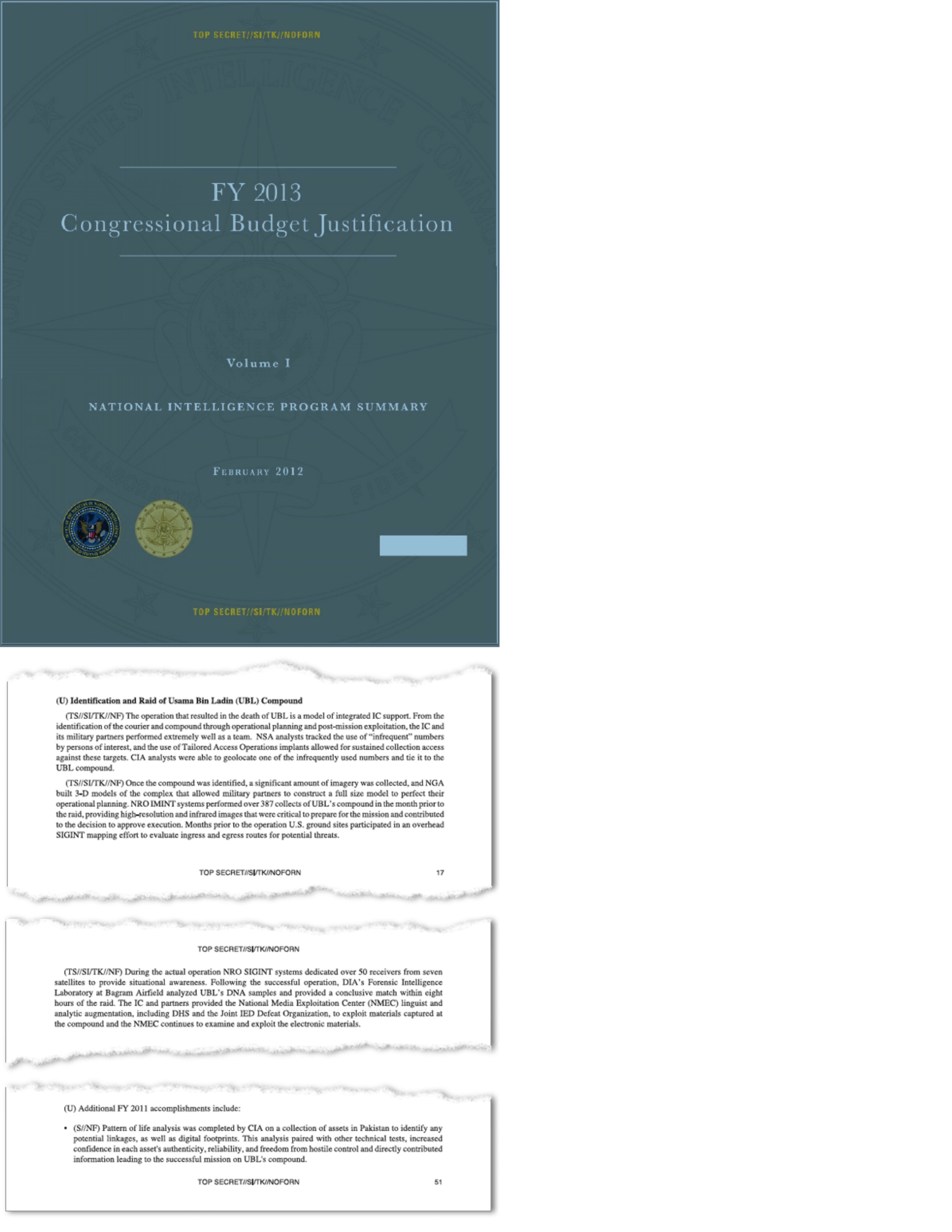
FY 2013
Congressional Budget Justification
Volume I
NATIONAL INTELLIGENCE PROGRAM SUMMARY
FEBRUARY 2012
TOP SECRET//SI/TK//NOFORN
(U) Identification and Raid of Usama Bin Ladin (UBL) Compound
(TS//SI/TK//NF) The operation that resulted in the death of UBL is a model of integrated IC support. From the identification of the courier and compound through operational planning and post-mission exploitation, the IC and its military partners performed extremely well as a team. NSA analysts tracked the use of "infrequent" numbers by persons of interest, and the use of Tailored Access Operations implants allowed for sustained collection access against these targets. CIA analysts were able to geolocate one of the infrequently used numbers and tie it to the UBL compound.
(TS//SI/TK//NF) Once the compound was identified, a significant amount of imagery was collected, and NGA built 3-D models of the complex that allowed military partners to construct a full size model to perfect their operational planning. NRO IMINT systems performed over 387 collects of UBL's compound in the month prior to the raid, providing high-resolution and infrared images that were critical to prepare for the mission and contributed to the decision to approve execution. Months prior to the operation U.S. ground sites participated in an overhead SIGINT mapping effort to evaluate ingress and egress routes for potential threats.
TOP SECRET//SI/TK//NOFORN
17
TOP SECRET/S/TK/NOFORN
(TS//SI/TK//NF) During the actual operation NRO SIGINT systems dedicated over 50 receivers from seven satellites to provide situational awareness. Following the successful operation, DIA's Forensic Intelligence Laboratory at Bagram Airfield analyzed UBL's DNA samples and provided a conclusive match within eight hours of the raid. The IC and partners provided the National Media Exploitation Center (NMEC) linguist and analytic augmentation, including DHS and the Joint IED Defeat Organization, to exploit materials captured at the compound and the NMEC continues to examine and exploit the electronic materials,
(U) Additional FY 2011 accomplishments include:
- (S/NF) Pattern of life analysis was completed by CIA on a collection of assets in Pakistan to identify any potential linkages, as well as digital footprints. This analysis paired with other technical tests, increased confidence in each asset's authenticity, reliability, and freedom from hostile control and directly contributed information leading to the successful mission on UBL's compound.
TOP SECRET/S/TK/NOFORN
51
Published in the Same Report
(10 documents)
-
SIGINT Obtains Details of Usama bin Laden Message to Top al-Qa'ida Leader in Iraq SIDtoday [pdf]
A 2007 NSA SIDtoday article describing how SIGINT analysts intercepted and decoded a message from Osama bin Laden to al-Qaeda's leader in Iraq, revealing bin Laden's strategic thinking on the Iraq war, his anger toward the UAE, and the communications pathway used by senior al-Qaeda figures between Pakistan, Iran, and Iraq.
Programs: SCQAWK -
What Does the Death of Usama bin Laden Mean? SIDtoday [pdf]
A 2011 NSA SIDtoday interview with SID's Associate Deputy Director for Counterterrorism assessing the significance of Osama bin Laden's death, revealing that NSA played a central role in identifying his compound and providing force-protection support during the SEAL raid, while also disclosing that bin Laden had been invisible to SIGINT since 1998.
Programs: SCQAWK -
SIGINT Year in Review, November 2011 SIDtoday [pdf]
A 2011 year-in-review message from NSA SIGINT Director Teresa Shea summarizing the directorate's major operational and capability accomplishments over the past year, including SIGINT contributions to the killing of Osama bin Laden, operations against Anwar al-Awlaki and other al-Qaeda figures, and support for military campaigns and crises across the Middle East.
Programs: SCQAWK -
JTAC Attack Methodology Team [pdf]
This September 2011 GCWiki page describes GCHQ's Joint Terrorism Analysis Centre (JTAC) Attack Methodology Team, a thematic assessment unit staffed by secondees from various government and military departments with access to Five Eyes intelligence, specializing in analyzing Islamist weaponry, tactics, training, IED construction, and terrorist attack methodologies.
Programs: RUSSETT -
NCTC Current Status of Major Terrorism Figures [pdf]
A TOP SECRET joint HUMINT–COMINT status report from June 2008 summarizes the whereabouts and threat posture of senior al‑Qaida leaders, highlighting Usama bin Ladin, Ayman al‑Zawahiri, and a key courier assessed as critical to locating them. The document reflects U.S. intelligence tracking priorities just three years before bin Ladin’s death.
-
Interview with a SID "Hacker" -- Part 2: Hacker Culture and Worker Retention SIDtoday [pdf]
A SIDtoday internal NSA newsletter interview with a redacted TAO employee discussing hacker culture within the agency's offensive cyber unit, worker retention challenges, and the team's role in operations including the raid that killed Osama bin Laden.
Programs: SCQAWKPeople: bin Laden, Osama -
Regional Command Southwest Intelligence Report June 19 2011 [pdf]
A June 2011 intelligence summary from Regional Command Southwest in Afghanistan assessing the destabilizing aftermath of the Osama bin Laden raid on U.S.-Pakistan relations, Pakistani internal security, Taliban activity along the RC(SW) border, and local governance developments in Helmand Province.
-
Regional Command Southwest Intelligence Report June 23 2011 [pdf]
A June 2011 RC Southwest intelligence summary documenting a covert ALP-Taliban collusion arrangement in Nad'Ali district, and a separate intelligence report detailing Taliban internal supply shortages, infighting, and morale deterioration across northern Helmand Province in the aftermath of Osama bin Laden's death.
-
June 2011 Nato Afghanistan Intelligence Report [pdf]
A June 2011 SHAPE weekly report to NATO HQ assessing the state of ISAF operations in Afghanistan, covering Taliban command and control deterioration, insurgent supply shortages, the post-bin Laden strain on NATO's Pakistani logistics routes, and notable attacks across regional commands.
Marking: NATO SECRET -
May 2011 Nato Afghanistan Intelligence Report [pdf]
A May 2011 SHAPE weekly report to NATO HQ assessing ISAF operations in Afghanistan — including a major failed Taliban spring offensive in Kandahar, insurgent cache dispersal tactics, and the limited impact of bin Laden's death on Taliban operational capacity — alongside an update on Operation Unified Protector in Libya covering the Misrata siege and Gaddafi regime military activity.
Marking: NATO SECRET
Related Documents
-
What Does the Death of Usama bin Laden Mean? SIDtoday [pdf]
A 2011 NSA SIDtoday interview with SID's Associate Deputy Director for Counterterrorism assessing the significance of Osama bin Laden's death, revealing that NSA played a central role in identifying his compound and providing force-protection support during the SEAL raid, while also disclosing that bin Laden had been invisible to SIGINT since 1998.
Programs: SCQAWK -
SIGINT Obtains Details of Usama bin Laden Message to Top al-Qa'ida Leader in Iraq SIDtoday [pdf]
A 2007 NSA SIDtoday article describing how SIGINT analysts intercepted and decoded a message from Osama bin Laden to al-Qaeda's leader in Iraq, revealing bin Laden's strategic thinking on the Iraq war, his anger toward the UAE, and the communications pathway used by senior al-Qaeda figures between Pakistan, Iran, and Iraq.
Programs: SCQAWK -
SIGINT Year in Review, November 2011 SIDtoday [pdf]
A 2011 year-in-review message from NSA SIGINT Director Teresa Shea summarizing the directorate's major operational and capability accomplishments over the past year, including SIGINT contributions to the killing of Osama bin Laden, operations against Anwar al-Awlaki and other al-Qaeda figures, and support for military campaigns and crises across the Middle East.
Programs: SCQAWK -
Interview with a SID "Hacker" -- Part 2: Hacker Culture and Worker Retention SIDtoday [pdf]
A SIDtoday internal NSA newsletter interview with a redacted TAO employee discussing hacker culture within the agency's offensive cyber unit, worker retention challenges, and the team's role in operations including the raid that killed Osama bin Laden.
Programs: SCQAWKPeople: bin Laden, Osama -
FY 2013 Congressional Budget Justification, Volume I, National Intelligence Program Summary, February 2012 [pdf]
This document outlines the $52.6 billion “black budget,” detailing the structure, priorities, successes, and shortcomings of the 16 U.S. intelligence agencies. It reveals unprecedented insight into funding allocations, operations, and intelligence gaps—including the CIA’s dominant role, expanding cyber operations, and persistent challenges in areas such as North Korea and counterterrorism—while emphasizing the tension between secrecy and public accountability.