Classification Guide for Human Language Technology (HLT) Models (May 18, 2011)
Open PDFDocument date: 2011-05-18
Pages: 4
Genre: guide
Banner: UNCLASSIFIED// FOR OFFICIAL USE ONLY
Classification: UNCLASSIFIED
Dissemination: FOUO
This document is an NSA administrative policy document that establishes the rules for what information regarding speech analytics remains public versus what must be kept secret. It explicitly confirms that the NSA possesses automated tools for gender, language, dialect, and speaker recognition, as well as speech-to-text and phonetic tokenization. While the existence of these capabilities is unclassified, the specific data used to "train" the models and the actual identity of targeted speakers are protected at the SECRET level.
My notes
UNCLASSIFIED//FOR OFFICIAL USE ONLY
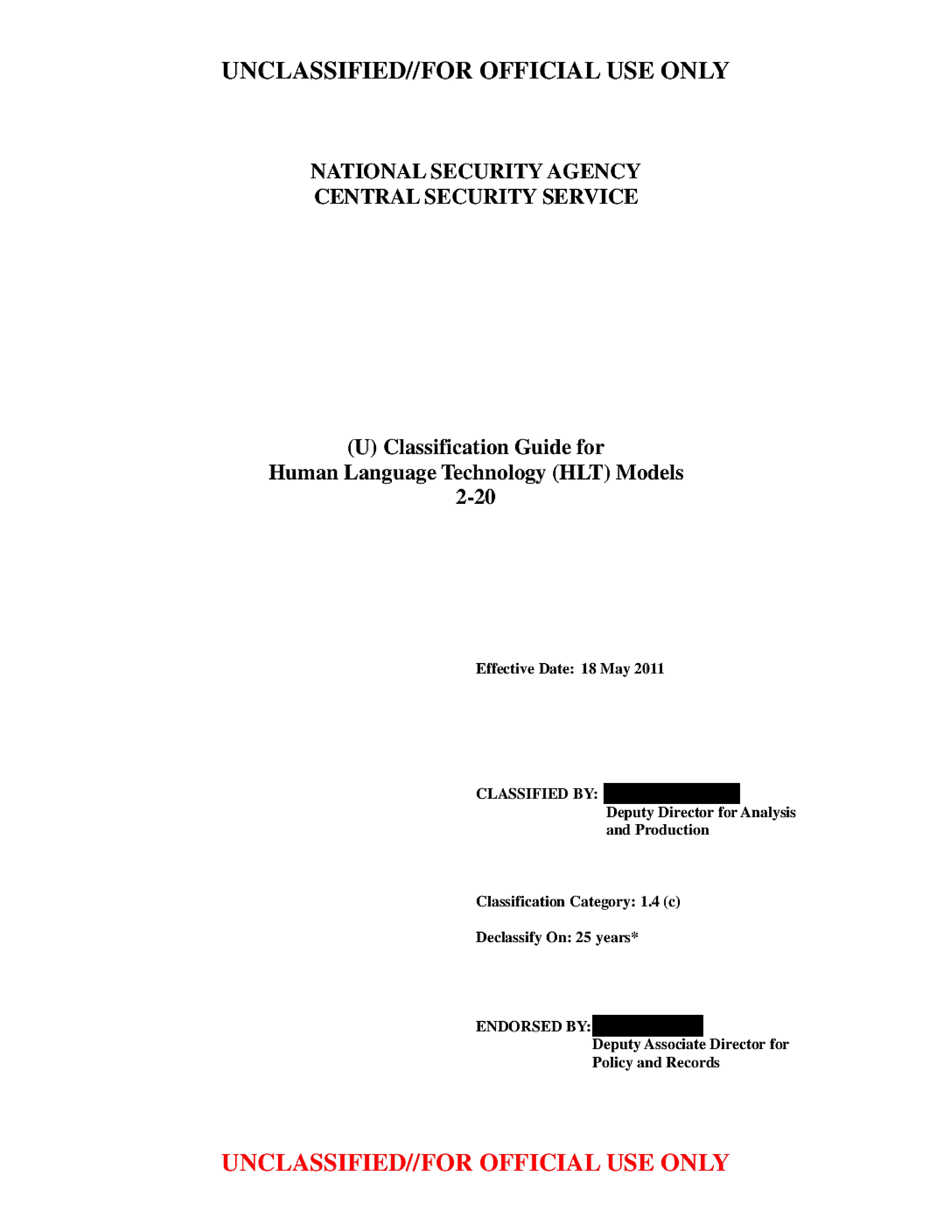
NATIONAL SECURITY AGENCY
CENTRAL SECURITY SERVICE
(U) Classification Guide for Human Language Technology (HLT) Models, 2-20
Effective Date: 18 May 2011
CLASSIFIED BY: [REDACTED]
Deputy Director for Analysis and Production
Classification Category: 1.4 (c)
Declassify On: 25 years*
ENDORSED BY: [REDACTED]
Deputy Associate Director for Policy and Records
UNCLASSIFIED//FOR OFFICIAL USE ONLY
UNCLASSIFIED//FOR OFFICIAL USE ONLY
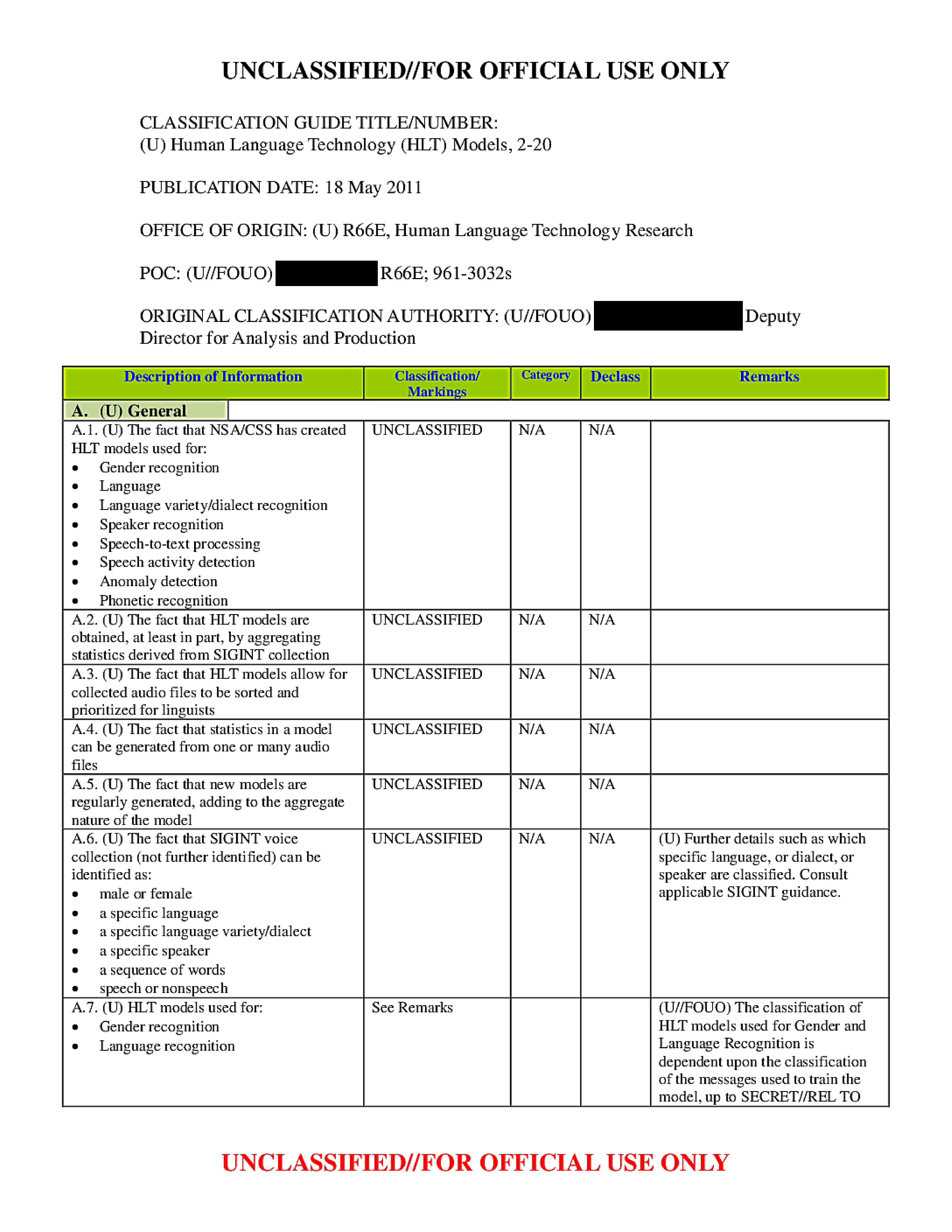
CLASSIFICATION GUIDE TITLE/NUMBER:
(U) Human Language Technology (HLT) Models, 2-20
PUBLICATION DATE: 18 May 2011
OFFICE OF ORIGIN: (U) R66E, Human Language Technology Research
POC: (U//FOUO) [REDACTED] R66E; 961-3032s
ORIGINAL CLASSIFICATION AUTHORITY: (U//FOUO) [REDACTED] Deputy Director for Analysis and Production
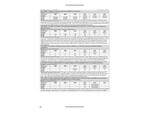
| Description of Information | Classification/ Markings | Category | Declass | Remarks |
|---|---|---|---|---|
| A. (U) General | ||||
| A.1. (U) The fact that NSA/CSS has created HLT models used for: • Gender recognition • Language • Language variety/dialect recognition • Speaker recognition • Speech-to-text processing • Speech activity detection • Anomaly detection • Phonetic recognition |
UNCLASSIFIED | N/A | N/A | |
| A.2. (U) The fact that HLT models are obtained, at least in part, by aggregating statistics derived from SIGINT collection | UNCLASSIFIED | N/A | N/A | |
| A.3. (U) The fact that HLT models allow for collected audio files to be sorted and prioritized for linguists | UNCLASSIFIED | N/A | N/A | |
| A.4. (U) The fact that statistics in a model can be generated from one or many audio files | UNCLASSIFIED | N/A | N/A | |
| A.5. (U) The fact that new models are regularly generated, adding to the aggregate nature of the model | UNCLASSIFIED | N/A | N/A | |
| A.6. (U) The fact that SIGINT voice collection (not further identified) can be identified as: • male or female • a specific language • a specific language variety/dialect • a specific speaker • a sequence of words • speech or nonspeech |
UNCLASSIFIED | N/A | N/A | (U) Further details such as which specific language, or dialect, or speaker are classified. Consult applicable SIGINT guidance. |
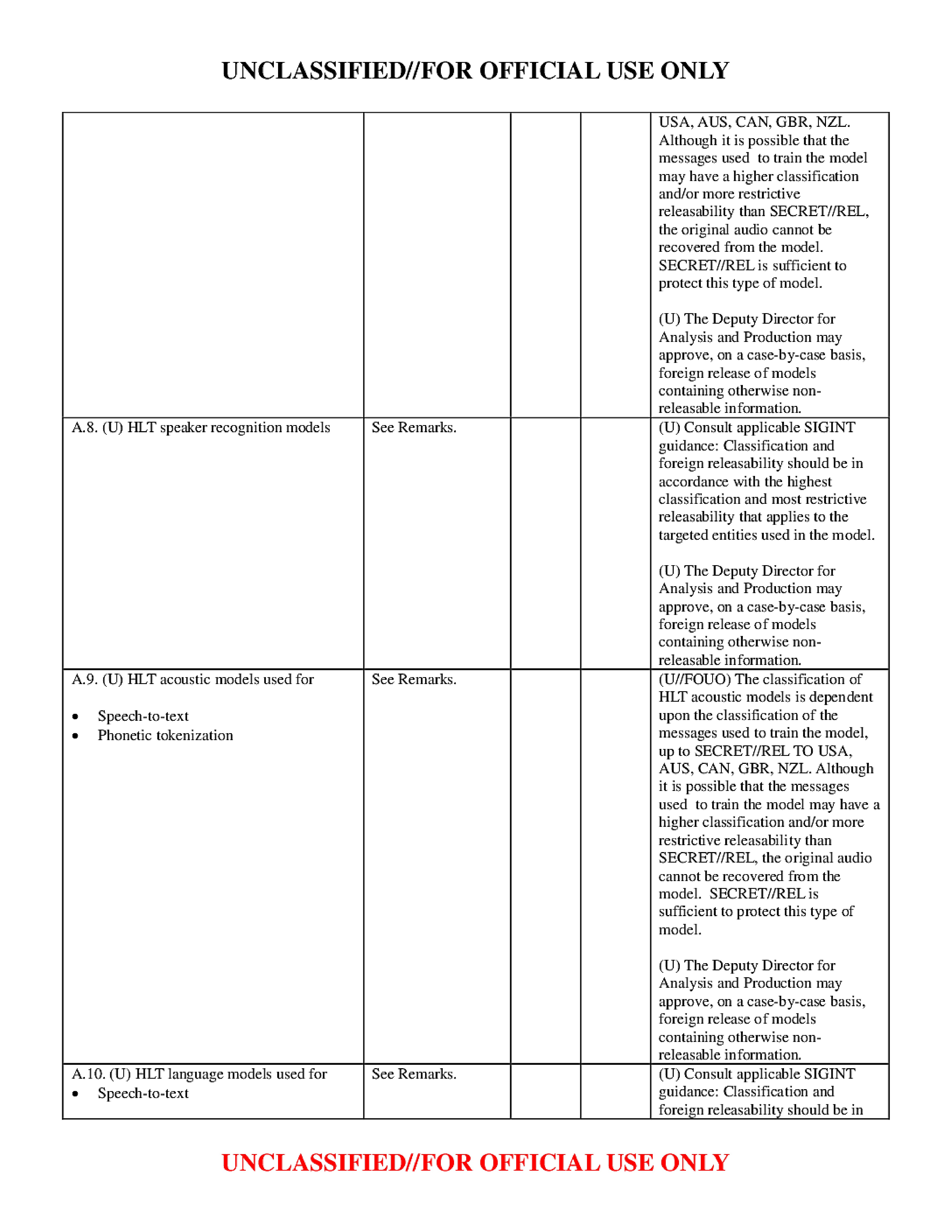
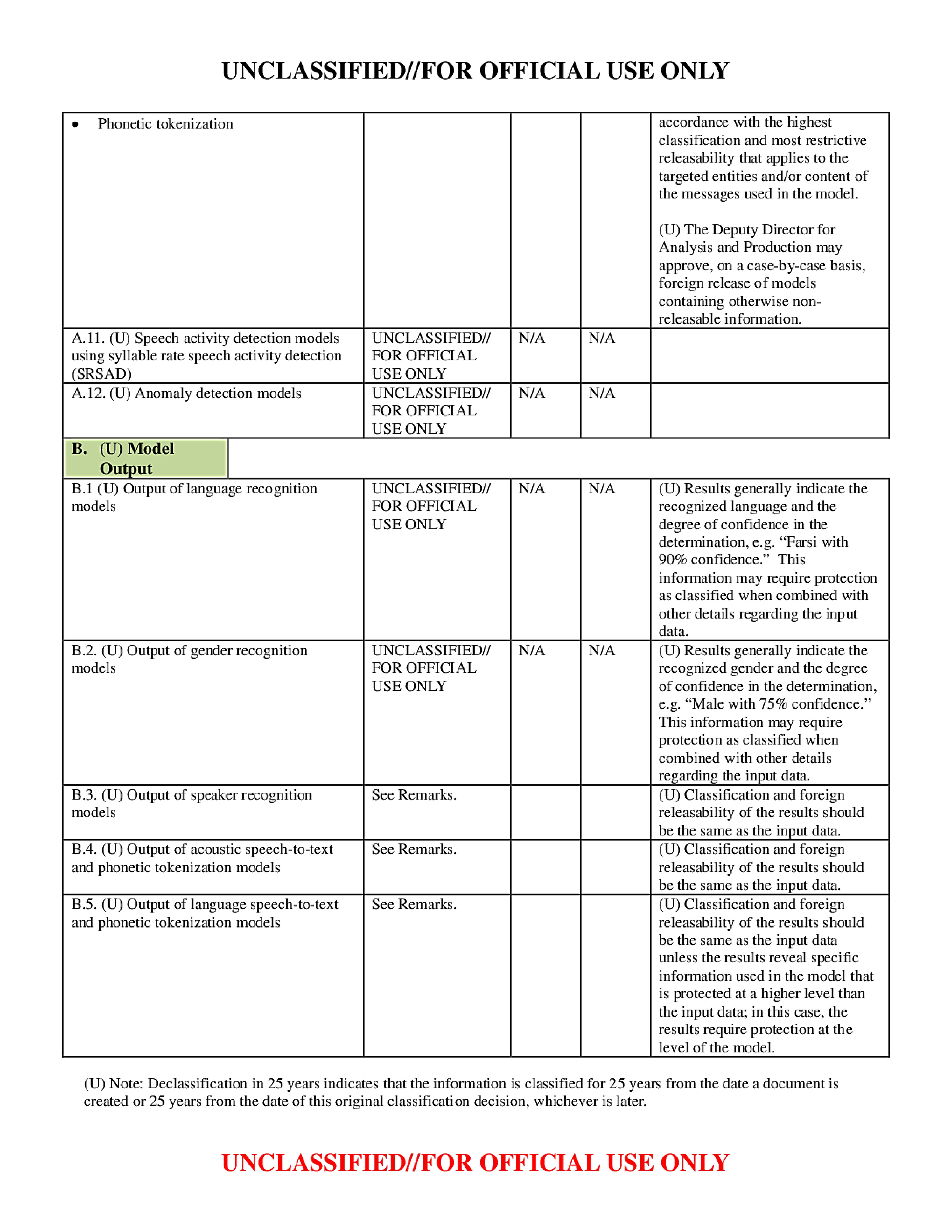
| A.7. (U) HLT models used for: • Gender recognition • Language recognition |
See Remarks | (U//FOUO) The classification of HLT models used for Gender and Language Recognition is dependent upon the classification of the messages used to train the model, up to SECRET//REL TO |
UNCLASSIFIED//FOR OFFICIAL USE ONLY
UNCLASSIFIED//FOR OFFICIAL USE ONLY
| USA, AUS, CAN, GBR, NZL. Although it is possible that the messages used to train the model may have a higher classification and/or more restrictive releasability than SECRET//REL, the original audio cannot be recovered from the model. SECRET//REL is sufficient to protect this type of model. (U) The Deputy Director for Analysis and Production may approve, on a case-by-case basis, foreign release of models containing otherwise non-releasable information. |
||||
| A.8. (U) HLT speaker recognition models | See Remarks. | (U) Consult applicable SIGINT guidance: Classification and foreign releasability should be in accordance with the highest classification and most restrictive releasability that applies to the targeted entities used in the model. (U) The Deputy Director for Analysis and Production may approve, on a case-by-case basis, foreign release of models containing otherwise non-releasable information. |
||
| A.9. (U) HLT acoustic models used for • Speech-to-text • Phonetic tokenization |
See Remarks. | (U//FOUO) The classification of HLT acoustic models is dependent upon the classification of the messages used to train the model, up to SECRET//REL TO USA, AUS, CAN, GBR, NZL. Although it is possible that the messages used to train the model may have a higher classification and/or more restrictive releasability than SECRET//REL, the original audio cannot be recovered from the model. SECRET//REL is sufficient to protect this type of model. (U) The Deputy Director for Analysis and Production may approve, on a case-by-case basis, foreign release of models containing otherwise non-releasable information. |
||
| A.10. (U) HLT language models used for • Speech-to-text |
See Remarks. | (U) Consult applicable SIGINT guidance: Classification and foreign releasability should be in |
UNCLASSIFIED//FOR OFFICIAL USE ONLY
UNCLASSIFIED//FOR OFFICIAL USE ONLY
| • Phonetic tokenization | accordance with the highest classification and most restrictive releasability that applies to the targeted entities and/or content of the messages used in the model. (U) The Deputy Director for Analysis and Production may approve, on a case-by-case basis, foreign release of models containing otherwise non-releasable information. |
|||
| A.11. (U) Speech activity detection models using syllable rate speech activity detection (SRSAD) | UNCLASSIFIED// FOR OFFICIAL USE ONLY | N/A | N/A | |
| A.12. (U) Anomaly detection models | UNCLASSIFIED// FOR OFFICIAL USE ONLY | N/A | N/A | |
| B. (U) Model Output | ||||
| B.1 (U) Output of language recognition models | UNCLASSIFIED// FOR OFFICIAL USE ONLY | N/A | N/A | (U) Results generally indicate the recognized language and the degree of confidence in the determination, e.g. "Farsi with 90% confidence." This information may require protection as classified when combined with other details regarding the input data. |
| B.2. (U) Output of gender recognition models | UNCLASSIFIED// FOR OFFICIAL USE ONLY | N/A | N/A | (U) Results generally indicate the recognized gender and the degree of confidence in the determination, e.g. "Male with 75% confidence." This information may require protection as classified when combined with other details regarding the input data. |
| B.3. (U) Output of speaker recognition models | See Remarks. | (U) Classification and foreign releasability of the results should be the same as the input data. | ||
| B.4. (U) Output of acoustic speech-to-text and phonetic tokenization models | See Remarks. | (U) Classification and foreign releasability of the results should be the same as the input data. | ||
| B.5. (U) Output of language speech-to-text and phonetic tokenization models | See Remarks. | (U) Classification and foreign releasability of the results should be the same as the input data unless the results reveal specific information used in the model that is protected at a higher level than the input data; in this case, the results require protection at the level of the model. |
(U) Note: Declassification in 25 years indicates that the information is classified for 25 years from the date a document is created or 25 years from the date of this original classification decision, whichever is later.
UNCLASSIFIED//FOR OFFICIAL USE ONLY
Published in the Same Report
(9 documents)
-
For Media Mining, the Future Is Now! SIDtoday [pdf]
A number of new "media mining" tools allow analysts to search intercepted content in near-real time, no matter if text, audio or visual. This includes retroactive word-search in intercepted communications.
People: Picone, Joseph -
For Media Mining, the Future Is Now! (conclusion) SIDtoday [pdf]
In the future, thanks to Human Language Technology (HLT), an analyst will be able to sort through millions on intercepted phone calls each day "and focus on only the small percentage that is relevant". He or she will also be able to get precise answers to queries such as "Where is the mayor of Baghdad?"
People: Picone, Joseph“How the NSA Converts Spoken Words Into Searchable Text” - The Intercept ↗ (2015-05-05) · The Intercept ↗ (2019-05-29) · Froomkin, Dan -
“Black Budget” — FY 2013 Congressional Budget Justification/National Intelligence Program, p. 262 (February 2012) [pdf]
This excerpt from the Fiscal Year 2013 Congressional Budget Justification (the "Black Budget") details the NSA's financial and performance metrics for "Analytics Modernization," specifically focusing on the transition to high-volume, automated speech-to-text systems. It records the decommissioning of legacy voice processing systems (VoiceRT) in favor of more robust, scalable capabilities aimed at rendering millions of intercepted voice files searchable via text queries and paired dialogue transcription.
Programs: VoiceRT -
“Black Budget” — FY 2013 Congressional Budget Justification/National Intelligence Program, pp. 360-364 (February 2012) [pdf]
The "Human Language Technology (HLT) Research" section of the FY 2013 "Black Budget" details a specialized research project focused on creating "force multipliers" for the NSA workforce through automated speech-to-text, machine translation, and content extraction. With a requested budget of $29.4 million, the project aims to bridge the gap between foundational academic research (via Johns Hopkins University) and the practical exploitation of the volume and velocity of global SIGINT.
Programs: HLT -
RT10 Overview [pdf]
This RT10 overview document is a high-level briefing on the implementation of a real-time SIGINT architecture designed to modernize intelligence operations in the Iraq theater, specifically Baghdad. The project aims to replace legacy, "manual-intensive" processes with a "SIGINT Brain"—a distributed database and automated analytic framework capable of processing over 50 million GSM metadata events per day.
Programs: RT10 · OBELISK · WISPYKNIT · VICTORYUNIFORM · JUGGERNAUT · COBRAFOCUS · MATTERHORN · EXPIATION · VoiceRT · GREENDRAGON · TAREX · KEYCARD -
Finding Nuggets -- Quickly -- in a Heap of Voice Collection, From Mexico to Afghanistan SIDtoday [pdf]
A 2011 article by an NSA Texas analyst describing the deployment of Human Language Technology analytics — including speech-to-text, speaker identification, gender recognition and language identification — to Special Collection Service sites in the Americas and to the Afghanistan Remote Operations Cryptologic Center, with operational examples ranging from tunnel detection in Tijuana to intelligence support in Kandahar.
Programs: HLT -
How Is Human Language Technology (HLT) Progressing? SIDtoday [pdf]
This document provides an operational update on the deployment of "HLT Labs"—a specialized suite of voice analytics designed to automate the discovery of intelligence "nuggets" within massive volumes of audio collection. The document highlights successful field applications in Afghanistan, Georgia, Texas, and Latin America, noting that these tools are becoming "force multipliers" that allow linguists to bypass manual listening in favor of automated keyword searching and speaker recognition.
-
Coming Soon! A Tool that Enables Non-Linguists to Analyze Foreign-TV News Programs SIDtoday [pdf]
This document introduces eViTAP (Enhanced Video Text and Audio Processing), a fully automated system designed to monitor and translate international television broadcasts. Primarily aimed at analysts who do not possess specific foreign language skills, the tool leverages automated processing to transform open-source media into actionable intelligence.
-
SIRDCC Speech Technology WG assessment of current STT technology [pdf]
This secret document from the SIRDCC Speech Technology Working Group provides a technical assessment of Speech-to-Text (STT) capabilities for the Security Service (MI5) and GCHQ. The report acknowledges that while automated transcription of intercepted speech remains highly challenging, the technology offers immediate "force multiplier" benefits for specific tasks like identifying spoken telephone numbers or keywords. The Working Group recommends continued investment in bespoke training and a transition toward a common system—specifically the BBN Byblos engine—to facilitate the sharing of classified linguistic models between UK and US agencies.
Programs: BYBLOS


Related Documents
-
How Is Human Language Technology (HLT) Progressing? SIDtoday [pdf]
This document provides an operational update on the deployment of "HLT Labs"—a specialized suite of voice analytics designed to automate the discovery of intelligence "nuggets" within massive volumes of audio collection. The document highlights successful field applications in Afghanistan, Georgia, Texas, and Latin America, noting that these tools are becoming "force multipliers" that allow linguists to bypass manual listening in favor of automated keyword searching and speaker recognition.
-
Human-Language Technology in Your Future SIDtoday [pdf]
A look into nine new Human Language Technologies that will likely assist NSA analysts in the near future. These include automated translation, transcription and language-based pattern recognition / identification.
Programs: HLT -
Finding Nuggets -- Quickly -- in a Heap of Voice Collection, From Mexico to Afghanistan SIDtoday [pdf]
A 2011 article by an NSA Texas analyst describing the deployment of Human Language Technology analytics — including speech-to-text, speaker identification, gender recognition and language identification — to Special Collection Service sites in the Americas and to the Afghanistan Remote Operations Cryptologic Center, with operational examples ranging from tunnel detection in Tijuana to intelligence support in Kandahar.
Programs: HLT -
“Black Budget” — FY 2013 Congressional Budget Justification/National Intelligence Program, pp. 360-364 (February 2012) [pdf]
The "Human Language Technology (HLT) Research" section of the FY 2013 "Black Budget" details a specialized research project focused on creating "force multipliers" for the NSA workforce through automated speech-to-text, machine translation, and content extraction. With a requested budget of $29.4 million, the project aims to bridge the gap between foundational academic research (via Johns Hopkins University) and the practical exploitation of the volume and velocity of global SIGINT.
Programs: HLT -
Human-Language Technology -- Everywhere SIDtoday [pdf]
The best Human Language Technology (HLT) functions "behind the desktop" making sure the analyst receives relevant, filtered information. In the near future, analysts will have more and better HLT at their disposal.
People: Kulman, AnitaThe Intercept ↗ (2019-05-29)