Document year: 2012-06 15 documents
Search documents matching “2012-06” →When each document was written, from its own dateline. Undated documents don't appear here.
Sort: Title
Documents
-
AND THEY SAID TO THE TITANS: « WATCH OUT OLYMPIANS IN THE HOUSE! » [pdf]
This Top Secret CSEC “Olympia” document details a Canadian intelligence program that analyzed and tracked the Brazilian Ministry of Mines and Energy’s telecommunications, mapping IPs, servers, proxies, and mobile devices while automating data collection and network analysis to develop actionable intelligence. It outlines tools, workflows, and contacts used for surveillance, though the presentation does not explain the specific purpose of the operation.
Programs: OLYMPIA · QUOVA · PROMETHEUS · PEITHO · SLINGSHOT · LEVITATE · STRATOS · EVILOLIVE · GCHQ Geofusion · ATLAS · HYPERION · ATHENA · DANAUS · TIDALSURGE · BLACKPEARL · MARINA · STARSEARCH · PEPPERBOX · TRITON · PACKAGEDGOODS · ARK · TOYGRIPPE · FRIARTUCK · MASTERSHAKE · COEUS · STALKER · MAINWAY · FASCIA · SEDB · OCTSKYWARD · FASTBAT · TWINSERPENT · EONBLUE · DISHFIRE · GNDB“Read a CSEC document that was first acquired by Edward Snowden” - The Globe and Mail ↗ (2013-11-30) · “Ministério de Minas e Energia está na mira de espiões americanos e canadenses” - O Globo ↗ (2013-10-06) · “No Place to Hide” - Metropolitan Books ↗ (2014-05-13) · Freeze, Colin · Bridi, Sônia · Greenwald, Glenn -
AURORAGOLD Working Group [pdf]
The "AURORAGOLD Working Group" briefing is a highly classified SIGINT development presentation from June 2012 that outlines the NSA's progress in mapping the global mobile landscape (GSM/UMTS/LTE). It focuses on the project's "value proposition": providing an exhaustive database of network identifiers and technical configurations—often obtained by intercepting internal company documents—to support tactical military operations and long-term surveillance forecasting.
Programs: AURORAGOLD · UTT · XKEYSCORE · CADENCE · JUBILEECORONA · RONIN · NKB · GLOBALTIPPER · PINWALE -
GHOSTMACHINE: Identifier Lead Triage with ECHOBASE [pdf]
This June 2012 presentation introduces ECHOBASE, an NSA analytic architecture designed to automate the triage of massive identifier lead lists (ranging from 50 to 10,000+ entries). By applying behavior-based analytics and "yes/no" behavioral queries against raw SIGINT, the system allows analysts to prioritize high-interest targets and discard irrelevant leads at scale.
Programs: GHOSTMACHINE · ECHOBASE · IDENTIFIERSCOREBOARD · FOREMAN · CONTRAOCTAVE · OCTAVE · UTT · WAVELEGAL · CASPORT · PSC -
HAPPY TRIGGER/LOVELY HORSE/Zool/TWO FACE – Open Source for Cyber Defence/Progress [pdf]
A TOP SECRET STRAP1 COMINT GCWiki page cataloguing GCHQ's open source intelligence gathering for cyber defence, listing approved and pending data sources fed into internal databases HAPPY TRIGGER, LOVELY HORSE, ZooL and TWO FACE, covering malware tracking, vulnerability intelligence, infrastructure mapping and domain monitoring.
Programs: HAPPYTRIGGER · LOVELYHORSE · TWOFACE · ZOOL · XKEYSCORE · POSITIVEPONY · NETPLATE · HIDDENSPOTLIGHT · SNORT · FOXTRAIL · REFRIEDCHICKEN · GEOFUSION · GLOBALSURGE · SHORTFALL · JTRIG · BIRDSEED · BIRDSTRIKE · MARBLEPOLLSPeople: Stewart, Joe -
Intellipedia – Air Gapped Network Threats [pdf]
This document from an internal wiki for the U.S. intelligence community, surveys threats to so-called air-gapped systems, arguing that supply-chain compromises, physical implants (BIOS, KVMs, peripherals), infected removable media, and enabled wireless/emanations present realistic paths for adversaries to bridge isolated networks. It assesses likelihoods and attack vectors (including insider help and CDS/guard exploitation), highlights specific historic incidents (Agent.BTZ/MAKERSMARK), and recommends strict removable-media policies, TEMPEST countermeasures, and rigorous cross-domain guard protections to mitigate the risk.
People: Witte, Griff · Warren, Peter · Streeter, Michael · Watson, Paul · Louchard, Bjørn · Crawford, George · Rudge, David · Terrazas, Michael -
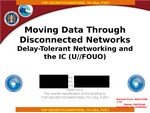
Moving Data Through Disconnected Networks - Delay-Tolerant Networking and the IC [pdf]
This June 2012 NSA Laboratory for Telecommunications Sciences presentation details Delay-Tolerant Networking (DTN) applications for surveillance operations, including covert communications in denied areas, data exfiltration from isolated networks, unwitting data mules, and integration with TAO's CHIMNEYPOOL implant framework. The document reveals R4 development of FUZZYLINT, an ultra-lightweight DTN implementation designed to enable multi-hop exfiltration from implants without requiring direct physical access.
People: Vahdat, Amin · Becker, David · Juang, Philo · Oki, Hidekazu · Wang, Yong · Martonosi, Margaret · Peh, Li-Shiuan · Rubenstein, Daniel · Grossglauser, Matthias · Tse, David N. C. · Fall, Kevin · Shah, Rahul C. · Roy, Sumit · Jain, Sushant · Brunette, Waylon · Lindgren, Anders · Doria, Avri · Schelen, Olov · Small, Tara · Haas, Zygmunt J. · Zhao, Wenrui · Ammar, Mostafa · Zegura, Ellen · Ginzboorg, Philip · Kärkkäinen, Teemu · Nagata, Akira · Lenders, Vincent · Legendre, Franck · May, Martin · Karlsson, Gunnar · Du, Bowei · Demmer, Michael · Brewer, Eric · Ott, Jörg · Pitkänen, Mikko Juhani · Han, Bo · Hui, Pan -
NSA June 2012 SSO Weekly Brief Excerpt [pdf]
This NSA Special Source Operations (SSO) briefing from June 2012 describes SPINNERET, a surveillance program that became the second-largest source of phone calling records and "tips" feeding into SHELLTRUMPET, a system that obscures the origin of collected metadata before forwarding it to NSA's Real-Time Regional Gateway (RT-RG) in Texas. The document indicates SHELLTRUMPET "obfuscates the source designators" and filters metadata to only include call events within NSA-Texas's area of responsibility.
“Mission Creep: How the NSA’s Game-Changing Targeting System Built for Iraq and Afghanistan Ended Up on the Mexico Border” - The Intercept ↗ (2019-05-29) · “Norges hemmelige krig i Afghanistan” - NRK ↗ (2019-05-29) · Moltke, Henrik · Skille, Øyvind Bye · Døvik, Olav · Hansen, Ståle Ellingsgard · Fjørtoft, Martin -
One Fish, Two Fish, My Fish, Your Fish! SIDtoday [pdf]
This SIDtoday document discusses the challenges faced by the U.S. and its partners in monitoring foreign fishing fleets, particularly Chinese vessels, in exclusive economic zones (EEZ). It highlights issues with the Automatic Identification System (AIS) used by fishing boats, where Chinese vessels were broadcasting inaccurate positional data, either due to technical errors or intentional misuse of the system, complicating monitoring efforts and posing risks to maritime safety and security.
Programs: SCQAWK -
SIGDEV Conference 2012 - Making Things Measureable: Technology Trending Challenges and Approaches [pdf]
An NSA presentation from the 2012 SIGDEV Conference describing NSA's technology trending methodology — a framework for identifying which encryption and communications technologies targets are adopting, measuring the SIGINT risk they pose, and prioritising capabilities development responses — notable for containing the risk matrix that was later cited in Der Spiegel's December 2014 encryption investigation showing NSA's difficulty levels against specific technologies including Tor, TrueCrypt, OTR and ZRTP.
Programs: XKEYSCORE · SEEKER · BIONICTURTLE · JEMA · JOLLYROGER · MARINA · TUNINGFORK · STARPROC · MICROEXPANSE · ECHOBASE · PRISM · GMHALO · UTT · TKB · LAE · FAMT · WPMO · AMOD · FORTREND · GAMBIT · DATAEXPLORER · MYNOC -
"Signal v. Noise" Column: Summit Fever SIDtoday [pdf]
A 2012 NSA opinion column in the "Signal v. Noise" series using the mountaineering concept of "summit fever" — the dangerous fixation on reaching a goal despite worsening conditions — as a metaphor for the institutional tendency within SIGINT to continue pursuing failing projects, collection sites, or targets long past the point where objective data would justify stopping.
-
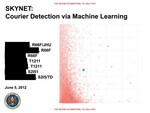
SKYNET: Courier Detection via Machine Learning [pdf]
A June 2012 NSA research presentation detailing the machine learning methodology behind SKYNET's courier detection system, which applies a Random Forest classifier to 55 million Pakistani phone records to identify individuals exhibiting courier-like behavioral patterns — with one of the highest-scoring results being Ahmed Zaidan, Al Jazeera journalist flagged as a suspected al-Qaeda courier.
People: Zaidan, Ahmad Muaffaq -
SNIPs of SIGINT [pdf]
A monthly notes entry from June 2012 by an NSA analyst on exchange at DSD Australia, describing two CNA/CNE tool development projects — PITIEDFOOL, a Windows file system destruction suite that kills the MFT and volume shadow copies and was successfully tested inside FUZZYEBOLA, and PANT SPARTY, an OpenSSH daemon backdoor granting covert root access while suppressing log entries — alongside a briefing to the US Ambassador to Australia on CNA/CNE work and TAO collaboration.
-
SSO News on MYSTIC SHELLTRUMPET for June 20, 2012 [pdf]
Internal NSA memo describing how SHELLTRUMPET, part of the MYSTIC program, works in conjunction with Real Time-Regional Gateway (RT-RG) and various Special Source Operations (SSO) programs to provide metadata access for RT-RG Texas. The system obfuscates source information and filters irrelevant metadata, enabling RT-RG Texas to efficiently process metadata from DANCINGOASIS and SPINNERET.
“Mission Creep: How the NSA’s Game-Changing Targeting System Built for Iraq and Afghanistan Ended Up on the Mexico Border” - The Intercept ↗ (2019-05-29) · “Norges hemmelige krig i Afghanistan” - NRK ↗ (2019-05-29) · Moltke, Henrik · Skille, Øyvind Bye · Døvik, Olav · Hansen, Ståle Ellingsgard · Fjørtoft, Martin -
The SIGINT Philosopher: Descartes Would Have Been a Lousy SIGINT Reporter SIDtoday [pdf]
A 2012 SIDtoday SIGINT Philosopher column using Cartesian epistemology to examine the fundamental reliability problem in SIGINT reporting — arguing that by the time raw intercepts pass through collection, translation, interpretation, and reporting, the finished intelligence product is several steps removed from ground truth and risks becoming little more than an analyst's painting of a scene described to them secondhand.
Programs: SCQAWK -
Tor Stinks [pdf]
A June 2012 joint NSA-GCHQ presentation titled "Tor Stinks" detailing the two agencies' attempts to de-anonymize Tor users through analytics, exploitation, and network disruption — candidly admitting they will never be able to identify all Tor users, but outlining a range of techniques including cookie leakage tracking, QUANTUM attacks, circuit reconstruction, timing analysis, and deliberate network degradation.
Programs: REMATION · EPICFAIL · QUANTUM · NEWTONSCRADLE · QUICKANT · GREATEXPECTATIONS · RONIN · ONIONBREATH · QUANTUMCOOKIE · SHORTSHEET · FOXACID