"Signal v. Noise" Column: Summit Fever
Open PDFDocument date: 2012-06-25
Type: SIDtoday
Pages: 2
Genre: newsletter
Classification: CONFIDENTIAL
Dissemination: REL
A 2012 NSA opinion column in the "Signal v. Noise" series using the mountaineering concept of "summit fever" — the dangerous fixation on reaching a goal despite worsening conditions — as a metaphor for the institutional tendency within SIGINT to continue pursuing failing projects, collection sites, or targets long past the point where objective data would justify stopping.
My notes

(U) "Signal v. Noise" Column: Summit Fever
FROM: (U//FOUO) [REDACTED]
Run Date: 06/25/2012
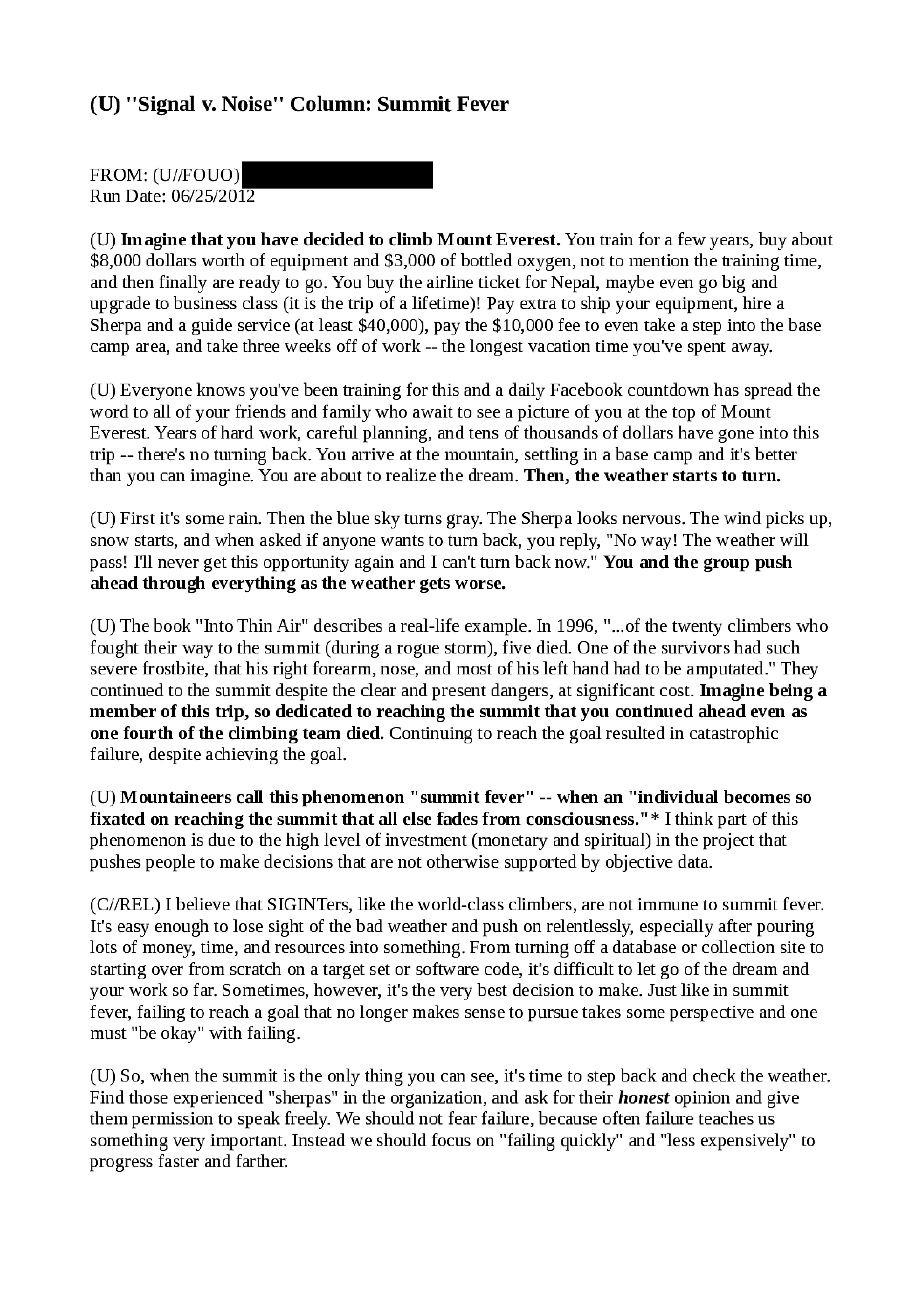
(U) Imagine that you have decided to climb Mount Everest. You train for a few years, buy about $8,000 dollars worth of equipment and $3,000 of bottled oxygen, not to mention the training time, and then finally are ready to go. You buy the airline ticket for Nepal, maybe even go big and upgrade to business class (it is the trip of a lifetime)! Pay extra to ship your equipment, hire a Sherpa and a guide service (at least $40,000), pay the $10,000 fee to even take a step into the base camp area, and take three weeks off of work -- the longest vacation time you've spent away.
(U) Everyone knows you've been training for this and a daily Facebook countdown has spread the word to all of your friends and family who await to see a picture of you at the top of Mount Everest. Years of hard work, careful planning, and tens of thousands of dollars have gone into this trip -- there's no turning back. You arrive at the mountain, settling in a base camp and it's better than you can imagine. You are about to realize the dream. Then, the weather starts to turn.
(U) First it's some rain. Then the blue sky turns gray. The Sherpa looks nervous. The wind picks up, snow starts, and when asked if anyone wants to turn back, you reply, "No way! The weather will pass! I'll never get this opportunity again and I can't turn back now." You and the group push ahead through everything as the weather gets worse.
(U) The book "Into Thin Air" describes a real-life example. In 1996, "...of the twenty climbers who fought their way to the summit (during a rogue storm), five died. One of the survivors had such severe frostbite, that his right forearm, nose, and most of his left hand had to be amputated." They continued to the summit despite the clear and present dangers, at significant cost. Imagine being a member of this trip, so dedicated to reaching the summit that you continued ahead even as one fourth of the climbing team died. Continuing to reach the goal resulted in catastrophic failure, despite achieving the goal.
(U) Mountaineers call this phenomenon "summit fever" -- when an "individual becomes so fixated on reaching the summit that all else fades from consciousness." * I think part of this phenomenon is due to the high level of investment (monetary and spiritual) in the project that pushes people to make decisions that are not otherwise supported by objective data.
(C//REL) I believe that SIGINTers, like the world-class climbers, are not immune to summit fever. It's easy enough to lose sight of the bad weather and push on relentlessly, especially after pouring lots of money, time, and resources into something. From turning off a database or collection site to starting over from scratch on a target set or software code, it's difficult to let go of the dream and your work so far. Sometimes, however, it's the very best decision to make. Just like in summit fever, failing to reach a goal that no longer makes sense to pursue takes some perspective and one must "be okay" with failing.
(U) So, when the summit is the only thing you can see, it's time to step back and check the weather. Find those experienced "sherpas" in the organization, and ask for their honest opinion and give them permission to speak freely. We should not fear failure, because often failure teaches us something very important. Instead we should focus on "failing quickly" and "less expensively" to progress faster and farther.
* (U) Perkins, D.N., Holtman, M.P., & Murphy, J.B. (2012). "Leading at The Edge: Leadership Lessons from the Extraordinary Saga of Shackleton's Antarctic Expedition." AMACOM, p. 70.
(U) Thoughts on this topic? Post them on the related Tapioca Pebble.
Published in the Same Report
(10 documents)
-
Dealing With a 'Tsunami' of Intercept SIDtoday [pdf]
As part of NSAs efforts to implement Human Language Technology, prototype processors located at collection sites will soon be able to query content at "line speed" based on the language, it is written in.
People: Kulman, Anita H.The Intercept ↗ (2019-05-29) · “Inside NSA, Officials Privately Criticize "Collect It All" Surveillance” - The Intercept ↗ (2015-05-28) · Maass, Peter -
Is There a Sustainable Ops Tempo in S2? How Can Analysts Deal with the Flood of Collection? SIDtoday [pdf]
The NSA's Deputy Director for Analysis and Production discusses the unsustainable operational tempo caused by overwhelming data collection volumes, advocating for "Analytic Modernization" that would shift from treating SIGINT as "radioactive" NSA-only material to sharing raw intelligence with other agencies for collaborative exploitation.
Programs: A-SPACE -
The SIGINT Philosopher: Cognitive Overflow? SIDtoday [pdf]
A 2011 NSA SIDtoday opinion column reflecting on whether the SIGINT Directorate's collective analytical capacity has a finite "channel capacity" — borrowing from cognitive psychology to ask whether SID's ever-expanding mission, tools, and information load risks exceeding the combined cognitive limits of its workforce.
Marking: UNCLASSIFIED -
'Data Is Not Intelligence' SIDtoday [pdf]
A 2007 NSA SIDtoday summary of a keynote address by Deputy DNI for Analysis Thomas Fingar at the Analytic Transformation Symposium, outlining the Intelligence Community's agenda for improving analytical quality, cross-agency collaboration, and integrated operations through training, shared standards, and new tools like A-Space and the Library of National Intelligence.
Programs: A-SPACE -
"Signal v Noise" Column: Do We Need a Bigger SIGINT Truck? SIDtoday [pdf]
A 2012 NSA SIDtoday opinion column arguing that SID lacks adequate internal metrics to evaluate the value and cost of its SIGINT collection capabilities, using the analogy of melon sellers buying a bigger truck to illustrate how expanding capacity without measuring effectiveness is a flawed response to resource constraints.
-
Op-ed: Leave Bright Pebbles, Not Breadcrumbs, for Those Coming After You SIDtoday [pdf]
A 2010 NSA SIDtoday op-ed by a Chinese language analyst urging analysts to actively document and share their target knowledge through available tools rather than hoarding expertise in personal files or spreadsheets, arguing that the agency's increasing reliance on short tours and rotating assignments makes institutional knowledge-sharing an operational necessity.
-
The SIGINT Philosopher: The Fallacies Behind the Scenes SIDtoday [pdf]
A 2011 NSA SIDtoday opinion column in the "SIGINT Philosopher" series examining four cognitive fallacies — the Texas Sharpshooter, Gambler's, Sunk-Cost, and Appeal to Probability fallacies — and their implications for how analysts unconsciously distort intelligence assessments and decision-making.
-
SIGINT Mission Thread 3 SIDtoday [pdf]
A 2011 NSA SIDtoday article outlining SIGINT Mission Thread 3's strategic initiative to shift the SIGINT Directorate's analytical culture away from data production toward discovery and understanding, introducing tools like the Analytic Body of Knowledge, Analytics Taxonomy, and GAMBIT portal to systematize tradecraft sharing across the Five Eyes enterprise.
Programs: GAMBITPeople: Gladwell, Malcolm -
ELINT Analysts - Overcome by Overload? Help is Here with IM&S SIDtoday [pdf]
A 2011 NSA SIDtoday article announcing the Initial Operational Capability of the ELINT Modernization Information Management and Storage system, designed to give analysts worldwide unified access to five years of ELINT reports and raw data from an expanding range of traditional and non-traditional collection platforms.
-
The SIGINT Philosopher: Too Many Choices SIDtoday [pdf]
The inaugural 2011 NSA SIDtoday "SIGINT Philosopher" column by a Russian language analyst, using the everyday paralysis of grocery shopping to introduce the concept of "analysis paralysis" and argue that the SIGINT enterprise's greatest challenge is not a lack of access or information but the cognitive difficulty of prioritizing among an overwhelming abundance of choices.
People: Simon, Herbert
Related Documents
-
"Signal v Noise" Column: Do We Need a Bigger SIGINT Truck? SIDtoday [pdf]
A 2012 NSA SIDtoday opinion column arguing that SID lacks adequate internal metrics to evaluate the value and cost of its SIGINT collection capabilities, using the analogy of melon sellers buying a bigger truck to illustrate how expanding capacity without measuring effectiveness is a flawed response to resource constraints.
-
The SIGINT Philosopher: Unlike All My Terrible Teammates, I Am a SIDtoday [pdf]
A 2012 SIDtoday SIGINT Philosopher column using the annual ACE performance review process as a springboard to examine the structural tension between individual competition and collaborative teamwork at NSA, arguing that the agency's promotion and awards system inadvertently incentivizes analysts to hoard work rather than mentor colleagues or enable others.
Programs: SCQAWK -
The SIGINT Philosopher Is Back -- with a New Face! SIDtoday [pdf]
The inaugural column of the second SIGINT Philosopher series, in which the new columnist uses a personal polygraph experience and the ethical tension of spying on diplomatic targets to argue — somewhat counterintuitively — that thorough, comprehensive surveillance is more ethical than partial or halfhearted monitoring of non-adversarial targets.
Programs: SCQAWK -
The SIGINT Philosopher: The Fallacies Behind the Scenes SIDtoday [pdf]
A 2011 NSA SIDtoday opinion column in the "SIGINT Philosopher" series examining four cognitive fallacies — the Texas Sharpshooter, Gambler's, Sunk-Cost, and Appeal to Probability fallacies — and their implications for how analysts unconsciously distort intelligence assessments and decision-making.
-
The SIGINT Philosopher: When Brevity Is Just the Soul of "Huh?" SIDtoday [pdf]
A 2012 SIDtoday SIGINT Philosopher column arguing that the NSA culture of brevity in writing — while generally valuable — can be taken too far, with excessively terse communications creating confusion, follow-up cycles, and ultimately more lost time than a slightly more complete message would have cost in the first place.
Marking: UNCLASSIFIEDPrograms: SCQAWK