Document year: 2012 102 documents
Search documents matching “2012” →When each document was written, from its own dateline. Undated documents don't appear here.
Sort: Title
Documents
-
AND THEY SAID TO THE TITANS: « WATCH OUT OLYMPIANS IN THE HOUSE! » [pdf]
This Top Secret CSEC “Olympia” document details a Canadian intelligence program that analyzed and tracked the Brazilian Ministry of Mines and Energy’s telecommunications, mapping IPs, servers, proxies, and mobile devices while automating data collection and network analysis to develop actionable intelligence. It outlines tools, workflows, and contacts used for surveillance, though the presentation does not explain the specific purpose of the operation.
Programs: OLYMPIA · QUOVA · PROMETHEUS · PEITHO · SLINGSHOT · LEVITATE · STRATOS · EVILOLIVE · GCHQ Geofusion · ATLAS · HYPERION · ATHENA · DANAUS · TIDALSURGE · BLACKPEARL · MARINA · STARSEARCH · PEPPERBOX · TRITON · PACKAGEDGOODS · ARK · TOYGRIPPE · FRIARTUCK · MASTERSHAKE · COEUS · STALKER · MAINWAY · FASCIA · SEDB · OCTSKYWARD · FASTBAT · TWINSERPENT · EONBLUE · DISHFIRE · GNDB“Read a CSEC document that was first acquired by Edward Snowden” - The Globe and Mail ↗ (2013-11-30) · “Ministério de Minas e Energia está na mira de espiões americanos e canadenses” - O Globo ↗ (2013-10-06) · “No Place to Hide” - Metropolitan Books ↗ (2014-05-13) · Freeze, Colin · Bridi, Sônia · Greenwald, Glenn -
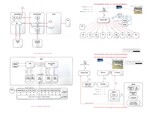
Architecture of U.S. Drone Operations [pdf]
“Germany is the Tell-Tale Heart of America's Drone War” - The Intercept ↗ (2015-04-17) · “Ramstein Air-Base: US-Drohneneinsätze aus Deutschland gesteuert” - Der Spiegel ↗ (2015-04-17) · Scahill, Jeremy · Bartsch, Matthias · Baumgärtner, Maik · Blome, Nikolaus · Darnstädt, Thomas · Gebauer, Matthias · Gude, Hubert · Rosenbach, Marcel · Schindler, Jörg · Schmid, Fidelius · Stark, Holger · Weinzierl, Alfred -
Are Obscure Languages Still... Obscure? SIDtoday [pdf]
A 2012 SIDtoday first-person account by an NSA language analyst describing their experience cross-training from Korean into Tigrinya — a strategically important but rarely studied language spoken in Ethiopia and Eritrea — and the unique professional challenges of working as a less-commonly-taught-language analyst with minimal institutional support or quality-checking infrastructure.
Programs: SCQAWK -
Attention, SIGINT Analysts: E.O. 12333 Transit Communications -- What Are They? SIDtoday [pdf]
This SIDtoday article clarifies the difference between NSA's longstanding authority to collect "transit communications" and FISA Amendment Act (FAA) Section 702 authorizations. The Office of Special Source Operations (SSO) manages these transit communications under various programs like US-990, US-983, and US-3273.
Programs: SSO -
AURORAGOLD Working Aid [pdf]
This document is a technical reference guide for analysts that categorizes the specific data fields extracted from mobile network documents (IR.21s) and commercial databases. It serves as a manual for translating telecommunications infrastructure data—such as encryption types, network layer protocols, and hardware versions—into actionable intelligence for target development and cyber exploitation.
Programs: AURORAGOLD -
AURORAGOLD Working Group [pdf]
The "AURORAGOLD Working Group" briefing is a highly classified SIGINT development presentation from June 2012 that outlines the NSA's progress in mapping the global mobile landscape (GSM/UMTS/LTE). It focuses on the project's "value proposition": providing an exhaustive database of network identifiers and technical configurations—often obtained by intercepting internal company documents—to support tactical military operations and long-term surveillance forecasting.
Programs: AURORAGOLD · UTT · XKEYSCORE · CADENCE · JUBILEECORONA · RONIN · NKB · GLOBALTIPPER · PINWALE -
AZTECTOMB32 DMW Install and ESH Package [pdf]
This document is a top-secret NSA internal project log detailing restrictions on installing new implants on machines running Kaspersky 2010+ due to the software’s cloud functionality, which prevents safe deployment of NSA malware. It records the suspension and eventual closure of a project (AZTECTOMB32/DEMENTIAWHEEL) that would have targeted such systems.
-
Black Budget: Cryptanalysis & Exploitation Services – Analysis of Target Systems [pdf]
This document is a budget justification for the NSA's Cryptanalysis & Exploitation Services project, which develops capabilities to defeat commercial encryption systems, exploit emerging communications technologies, and conduct vulnerability analysis against both foreign and domestic security products.
“The CIA Campaign to Steal Apple's Secrets” - The Intercept ↗ (2015-03-10) · Scahill, Jeremy · Begley, Josh -
“Black Budget” — FY 2013 Congressional Budget Justification/National Intelligence Program, p. 262 (February 2012) [pdf]
This excerpt from the Fiscal Year 2013 Congressional Budget Justification (the "Black Budget") details the NSA's financial and performance metrics for "Analytics Modernization," specifically focusing on the transition to high-volume, automated speech-to-text systems. It records the decommissioning of legacy voice processing systems (VoiceRT) in favor of more robust, scalable capabilities aimed at rendering millions of intercepted voice files searchable via text queries and paired dialogue transcription.
Programs: VoiceRT -
“Black Budget” — FY 2013 Congressional Budget Justification/National Intelligence Program, pp. 360-364 (February 2012) [pdf]
The "Human Language Technology (HLT) Research" section of the FY 2013 "Black Budget" details a specialized research project focused on creating "force multipliers" for the NSA workforce through automated speech-to-text, machine translation, and content extraction. With a requested budget of $29.4 million, the project aims to bridge the gap between foundational academic research (via Johns Hopkins University) and the practical exploitation of the volume and velocity of global SIGINT.
Programs: HLT -
BOUNDLESSINFORMANT - Describing Mission Capabilities from Metadata Records [pdf]
This presentation on the Boundless Informant program (BOUNDLESSINFORMANT), which uses big data tools to analyze and visualize global SIGINT metadata collection in near real time. It explains how the system replaced older manual methods, enabling the NSA to track collection volumes, coverage, and trends for specific countries or sites through cloud-based infrastructure.
People: Patel, Vimesh“NSA-files repeatedly show collection of data «against countries» - not «from»” - Dagbladet ↗ (2013-11-22) · “Boundless Informant: the NSA's secret tool to track global surveillance data” - The Guardian ↗ (2013-06-08) · “Claves y giros del espionaje masivo en España” - El Mundo ↗ (2013-11-04) · Greenwald, Glenn · MacAskill, Ewen · Aranda, Germán -
BOUNDLESSINFORMANT – Frequently Asked Questions [pdf]
This document outlines the NSA’s internal metadata analysis tool, designed to provide real-time visualizations and statistics on global SIGINT collection by country, organization, and site. It explains the tool’s purpose, data sources, technical architecture, views, data limitations, and the process for requesting feature enhancements, highlighting its role in cataloging surveillance activity without human intervention.
Programs: BOUNDLESSINFORMANT · ASDF · GAO · RAMPART-A · SPINNERET · GM-PLACE · FALLOUT · TUSKATTIRE · FASCIA · MUSCULAR · Terrestrial RF · MachineShop · TurkeyTower · CloudBase · GXT · ExtGWT · JUGGERNAUT · LOPER · FLAWMILL · SSO · MAPREDUCE“Boundless Informant: the NSA's secret tool to track global surveillance data” - The Guardian ↗ (2013-06-08) · “NSA-files repeatedly show collection of data «against countries» - not «from»” - Dagbladet ↗ (2013-11-22) · “New NSA Revelations: Inside Snowden's Germany File” - Der Spiegel ↗ (2014-06-18) · Greenwald, Glenn · MacAskill, Ewen · Becker, Sven · Gude, Hubert · Horchert, Judith · Müller-Maguhn, Andy · Poitras, Laura · Reißmann, Ole · Rosenbach, Marcel · Schindler, Jörg · Schmid, Fidelius · Sontheimer, Michael · Stark, Holger -
Classification Guide for FISA, the Protect America Act and the FISA Amendments Act [pdf]
The Foreign Intelligence Surveillance Act regulates spying for national security purposes on domestic soil. This guide lays out secrecy restrictions for various aspects of those programs. Among other things, it mentions the Large Content FISA order, a term that has not previously been disclosed.
-
CLASSIFICATION GUIDE FOR THE NSA/CSS TARGET EXPLOITATION (TAREX) PROGRAM [pdf]
A 2012 NSA/CSS classification guide for the TAREX program — the agency's clandestine human intelligence and close-access signals intelligence unit — establishing what information about TAREX's operations, locations, methodologies, and interagency relationships must be protected, revealing forward-based presences in Germany, South Korea, and Beijing, and confirming that TAREX personnel operate undercover at U.S. embassies worldwide.
Programs: TAREXPeople: Shea, Teresa H. -
Communications Capability Development Programme [pdf]
The Communications Capability Development (CCD) Programme (formerly the Intercept Modernisation Programme, IMP) was a Home Office–led effort to maintain the U.K.’s lawful interception and communications data capabilities amid changing technologies, emphasizing that law enforcement faced a “significant decline” without new measures. GCHQ supported CCD with technical expertise and interim services like MILKWHITE Enrichment, while stressing that CCD was politically contentious, technically complex, and required legislation to mandate data retention by U.K. network operators.
-
CSEC Surveillance of Travellers Through Airport Wi-Fi Tracking [pdf]
The leaked 2012 top secret CSEC presentation details a trial program that used airport Wi-Fi metadata to identify and track travellers’ devices across Canada and internationally, developing advanced “IP profiling” techniques to map movements through hotels, airports, and public hotspots. The program, conducted with NSA support, aimed to build powerful analytic tools for surveillance and real-time alerts within the Five Eyes intelligence network.
Marking: TOP SECRET -
Cyber Integration [pdf]
The leaked 2012 GCHQ JTRIG presentation detail a wide range of offensive cyber and influence operations designed to “deny, disrupt, degrade, and deceive” targets, including hackers, foreign governments, companies, and individuals. Tactics include hacking, DDOS attacks, disinformation, honey traps, credential harvesting, and psychological operations, reflecting a shift from traditional surveillance to active disruption and manipulation campaigns.
“Exclusive: Snowden Docs Show British Spies Used Sex and 'Dirty Tricks'” - NBC News ↗ (2014-02-07) · “No Place to Hide” - Metropolitan Books ↗ (2014-05-13) · Cole, Matthew · Esposito, Richard · Schone, Mark · Greenwald, Glenn -
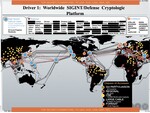
Driver 1: Worldwide SIGINT/Defense Cryptologic Platform [pdf]
A 2012 NSA management presentation slide revealing the agency's global surveillance architecture across five categories of access — covert cable taps, regional collection sites, computer network exploitation implants, foreign satellite collection, and third-party liaison relationships — including a list of cities hosting clandestine collection operations and confirmation of over 50,000 worldwide malware implants.
Programs: STELLAR · SOUNDER · SNICK · MOONPENNY · LADYLOVE · INDRA · IRONSAND · JACKKNIFE · CARBOY · TIMBERLINE“NSA infected 50,000 computer networks with malicious software” - NRC ↗ (2013-11-23) · “No Place to Hide” - Metropolitan Books ↗ (2014-05-13) · Boon, Floor · Derix, Steven · Modderkolk, Huib · Greenwald, Glenn -
Entry From SSO News [pdf]
This document discusses the initial operational capability of MONKEYROCKET, a non-Western Internet anonymization service developed as part of the OAKSTAR program, aimed at supporting counter-terrorism efforts. As of July 2012, the system was forwarding metadata to backend repositories, with a significant user base of around 16,000, primarily from countries like Iran and China. The service is expected to grow in usage, generating about 2,000 events per day.
-
Expanding PRISM Sharing With FBI and CIA [pdf]
An SSO item describing two projects that widened PRISM sharing with the FBI and CIA: PRINTAURA software that compiles the tasked-selector list every two weeks for both agencies, and weekly operational PRISM news and guidance from the mission programme manager.