Agency: GCHQ Government Communications Headquarters (UK) 174 documents
Search documents matching “GCHQ” →The agency that WROTE each document.
Graphs
By Banner
By Classification
Refine (combine with another filter, via search)
Sort: Title
Documents
-
GCHQ Visit to NSA on Voice Analytics Systems [pdf]
This document is a GCHQ report detailing a late-November (2007?) visit to NSA’s R64 division focused on collaboration in language identification (LID) and speaker identification (SID) systems, including sharing models and research insights. It also describes NSA tools like Hotzone and Voice RT for real-time voice analysis, and mentions an upcoming visit from the CLEAR consortium to address challenges in speech intelligibility and audio recovery for intercepted communications.
-
GCHQ VisWeek 2008 Conference Report [pdf]
This GCHQ document summarizes key findings from the VisWeek 2008 visualization conference in Ohio, highlighting techniques and tools relevant to SIGINT analysis including collaborative analysis capabilities, graph visualization methods, and the Palantir Government platform. The report recommends incorporating features like analyst notebooks for tracking investigations, collaborative workspaces for multiple analysts, and various graph layout algorithms into GCHQ's MONTE VISTA visualization system.
Programs: MONTE VISTA · MAMBA · CHARTBREAKER · PIGS EAR · KNIME · RAPTOR · BROAD OAK · HAUSTORIUM · SALAMANCA · IIB · INFOVIS · PALANTIR -
GCHQ – Computer Network Exploitation [pdf]
This document outlines GCHQ’s Computer Network Exploitation (CNE) capabilities, detailing how teams remotely access computers and networks without owners’ consent to gather intelligence, support operations, and conduct effects. It also covers operational tools, techniques, infrastructure, joint working with partners, deconfliction, and challenges such as avoiding detection and meeting increasing intelligence demands.
-
GCHQ – Making network sense of the encryption problem (2011) [pdf]
GCHQ’s Network Analysis Centre convened a 2011 roundtable on “making network sense” of encryption, pushing a metadata-first strategy to triage SSL/TLS, IKE, OpenVPN, and SSH flows, pivot from “seed” indicators, and zero in on targets and subnets worth decrypting. The playbook leans on enrichment, AS-level scoping (explicitly citing Belgacom AS6774 GRX VPNs), and “access optimisation” to collect data pre‑encryption—passively or actively.
Programs: SQUEAL · BEARDEDPIGGY · CLOUD · IRASCIBLEHARE · IRASCIBLERABBIT · IRASCIBLEMOOSE · IRASCIBLEEMITT“Operation Socialist: The Inside Story of How British Spies Hacked Belgium’s Largest Telco” - The Intercept ↗ (2014-12-13) · “Lees hier hoe de Britse geheime dienst GCHQ Belgacom aanviel” - NRC ↗ (2014-12-13) · “Britse geheime dienst bespioneerde jarenlang Belgacom-klanten” - De Standaard ↗ (2014-12-13) · Gallagher, Ryan · Modderkolk, Huib · Vanhecke, Nikolas · Eeckhaut, Mark -
-
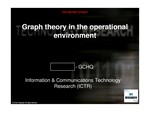
Graph theory in the operational environment – GCHQ [pdf]
This document details GCHQ’s research on identifying “closed loops” of communication, where targets use a small set of phones to communicate exclusively among themselves, often with cheap, disposable handsets like the Nokia 1100. It explains the methodology for analyzing anonymized metadata, constructing contact graphs, and extracting non-giant, non-tree components to discover operationally relevant closed loops for intelligence and counterterrorism purposes.
Programs: VOICESAILPeople: Rumsfeld, Donald -
Intrusion Analysis – GCHQ [pdf]
An internal GCHQ write-up defines the Intrusion Analysis team’s remit inside the Joint Electronic Attack Cell: all‑source analysis of emerging and active electronic attacks, stewardship of electronic attack signatures, and SIGINT‑driven targeting under EITT oversight. It details sources, reporting channels, legal authorities, and auditing controls that govern how signatures are deployed and how selectors are managed.
-
Legalities - GCHQ Databases eg Pilbeam, Salamanca, UDAQ etc [pdf]
This October 2007 GCHQ document outlines the legal authorization requirements for querying surveillance databases, revealing that GCHQ analysts can search their own databases (like PILBEAM, SALAMANCA, UDAQ) for metadata on anyone regardless of nationality without additional authorization, while NSA databases (like MARINA, MAINWAY, DISHFIRE) prohibit searches for Americans and other Five Eyes citizens but permit searches for UK persons.
-
LOVELY HORSE – GCHQ Wiki Overview [pdf]
This February 2012 GCWiki page describes LOVELY HORSE, a GCHQ initiative to collect, index, and distribute open-source intelligence from cybersecurity blogs and Twitter accounts to analysts on classified networks, utilizing JTRIG's BIRDSTRIKE architecture to scrape content from approximately 60 sources including security researchers, hacktivist groups like Anonymous and LulzSec, and cybersecurity companies, with legal approval from MP-LEG (Mission Policy-Legal).
Programs: LOVELYHORSE · HAPPYTRIGGER · BIRDSEED · JTRIG · BIRDSTRIKE · MERAPEAK · LEXHOUND · JEDI · DISCOVER -
MHS/GCHQ Projects - Turkey Energy Company Development (GCHQ) [pdf]
This GCHQ project, classified TOP SECRET STRAP1 COMINT, details a focused effort to gain intelligence access to key Turkish energy organizations, including the Ministry of Energy and Natural Resources (MENR) and major state and private corporations. The goal was to understand their communications traffic, improve collection access, and assess the balance of power within the MENR.
Programs: ROADBEDPeople: Güler, Hilmi“Turkey Is 'Partner and Target' for the NSA” - Der Spiegel ↗ (2014-08-31) · “How the NSA Helped Turkey Kill Kurdish Rebels” - The Intercept ↗ (2014-08-31) · Poitras, Laura · Rosenbach, Marcel · Sontheimer, Michael · Stark, Holger -
NAC BUDE Partnership - SATELLITE TELEPORT KNOWLEDGE (GCHQ) [pdf]
A top secret GCHQ Network Analysis Centre document from GCHQ Bude detailing comprehensive intelligence profiles of three German satellite teleport operators — Stellar, Ce-Tel, and IABG — including their network infrastructure, router configurations, IP ranges, employee identities, satellite customers, and login credentials, compiled to identify access chokepoints for SIGINT collection against German IP transit infrastructure.
People: Steffen, Christian · Sommer, Christoph · Fares, Ali · Grave, Richard · Steffen, Simona · Skaletz, Oliver -
NDIST — GCHQ’s Developing Cyber Defence Mission [pdf]
GCHQ’s NDIST sets out a developing cyber defence mission to reduce vulnerability and harm while enabling prosperity, centered on building a global-level picture of strategic threats and sharing intelligence with allies. The team anchors this work in massive telemetry, claiming roughly 100 million malware events collected per day to drive situational awareness.
-
NSA/GCHQ/CSEC Network Tradecraft Advancement Team [pdf]
The "NSA/GCHQ/CSEC Network Tradecraft Advancement Team (NTAT) 2010" document describes a collaborative mission between the US, UK, and Canada to synchronize and advance SIGINT techniques. The NTAT focused on "Network Analysis Tradecraft," specifically integrating analysis tools such as IRASCIABLE RABBIT and TOYGRIPPE into CSEC's OLYMPIA and developing standardized "use cases" for tracking mobile networks and virtual private networks (VPNs).
-
Operational Legalities – GCHQ Powerpoint Presentation [pdf]
GCHQ’s “Operational Legalities” deck is an internal compliance playbook that translates the UK’s surveillance laws into day‑to‑day SIGINT procedure—drilling staff on authorisation, necessity, and proportionality, and walking through warrants, targeting justifications, database queries, dissemination, and oversight. Half slides and half speaker notes, it shows how analysts are trained to document, audit, and defend operations under ISA, RIPA, HRA, and WTA while navigating edge cases like location, nationality, second‑party constraints, and “indirect targeting.”
-
Quantum – from GCHQ documents dates October 2012 [pdf]
Portion of a document from the NSA’s British equivalent, the GCHQ, in which Sweden is not mentioned, but it describes an example of how Quantum has been used to attack computers in an African country where the users have visited extremist websites.
-
Reverse Engineering – GCHQ Wiki [pdf]
GCHQ’s internal GCWiki page sketches the TEA Reverse Engineering unit inside the TECA Product Centre: a lab team built to dissect hardware and embedded crypto devices, defeat smartcard‑class microprocessors, and turn black boxes into SIGINT‑ready emulators. It doubles as a training hub and liaison node, with kit lists, tours, and SRE exchanges—most real work pushed behind higher‑compartment CAWiki pages.
Marking: UK SECRETPrograms: RUSSETT -
Software Reverse Engineering – GCHQ [pdf]
GCHQ’s Network Defence unit runs software reverse engineering across both malicious and commercial code to map vulnerabilities, validate security claims, and feed CESG’s advice on electronic attack. Malicious code is fair game, but commercial RE hinges on GCHQ’s ISA s5 SRE warrant (GPW/1160), with local authorisers and audits—after a documented lapse in 2008 was retro‑authorised.
Marking: TOP SECRET -
Summary of GCHQ Info Wrt OC TSS1 Excerpt [pdf]
GCHQ Summary of RTRG (or RT-TG). The RTRG program provides real-time intelligence support for global operations, particularly in the context of the Global War on Terrorism, using tailored systems that integrate multiple data sources to enhance target identification and analysis. The success of RT-RG in support of Operation Iraqi Freedom led to an expansion of the programme to support operations in Korea and Afghanistan, with new applications for keyword-based selection and alerting on voice intercept being trialled.
“Mission Creep: How the NSA’s Game-Changing Targeting System Built for Iraq and Afghanistan Ended Up on the Mexico Border” - The Intercept ↗ (2019-05-29) · “Norges hemmelige krig i Afghanistan” - NRK ↗ (2019-05-29) · Moltke, Henrik · Skille, Øyvind Bye · Døvik, Olav · Hansen, Ståle Ellingsgard · Fjørtoft, Martin -
TLS trends at GCHQ [pdf]
A GCHQ presentation describing their TLS trends analysis programme, which processed approximately 10 billion SSL/TLS Server Hello events per week from Special Source cable tapping and COMSAT collection to produce weekly trend reports, alongside two operational tools — TargeTLS for matching TLS events against BROAD OAK target profiles, and FLYING PIG, a TLS knowledge base enabling analysts to query certificate, IP and client data across the full intercept base.
-
Welcome to the Mission Driven Access Workshop - GCHQ Bude [pdf]
This document, sourced from a Mission Driven Access (MDA) Workshop at GCHQ Bude, outlines a strategic intelligence shift toward South American targets. It identifies a historical underperformance in monitoring Brazil and highlights the Foreign Office's urgent need for intelligence to counter growing regional support for Argentina regarding the Falkland Islands dispute.
Marking: CONFIDENTIAL