CNO Core Secrets Security Structure
Open PDFDocument date: -
Pages: 3
Genre: slides
Banner: TOP SECRET//COMINT//NOFORN
Classification: TOP SECRET COMINT
Dissemination: NOFORN
A 3-slide NSA presentation outlining the classification architecture of Sentry Eagle, a national cyber operations initiative, showing how its most sensitive components — covering network hacking, encryption sabotage, and covert industry relationships — are locked behind ECI and SAP designations accessible only to a tiny circle of government officials.
My notes
TOP SECRET//COMINT//NOFORN
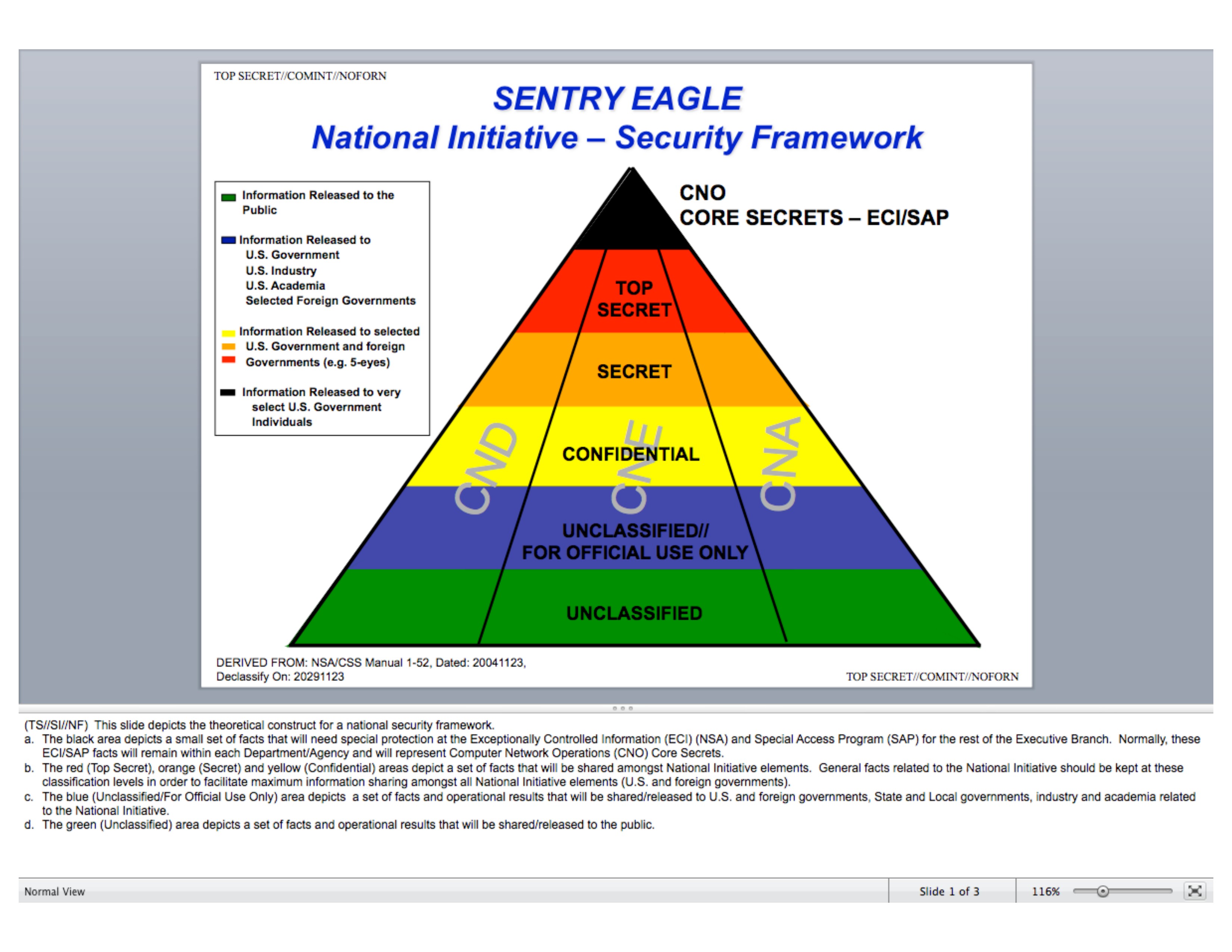
SENTRY EAGLE
National Initiative - Security Framework
- Information Released to the Public
- Information Released to U.S. Government, U.S. Industry, U.S. Academia, Selected Foreign Governments
- Information Released to selected U.S. Government and foreign Governments (e.g. 5-eyes)
- Information Released to very select U.S. Government Individuals
- CNO CORE SECRETS – ECI/SAP
- TOP SECRET
- SECRET
- CONFIDENTIAL
- UNCLASSIFIED//FOR OFFICIAL USE ONLY
- UNCLASSIFIED
CND
CNE
CNA
DERIVED FROM: NSA/CSS Manual 1-52, Dated: 20041123,
Declassify On: 20291123
TOP SECRET//COMINT//NOFORN
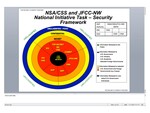
(TS//SI//NF) This slide depicts the theoretical construct for a national security framework.
a. The black area depicts a small set of facts that will need special protection at the Exceptionally Controlled Information (ECI) (NSA) and Special Access Program (SAP) for the rest of the Executive Branch. Normally, these ECI/SAP facts will remain within each Department/Agency and will represent Computer Network Operations (CNO) Core Secrets.
b. The red (Top Secret), orange (Secret) and yellow (Confidential) areas depict a set of facts that will be shared amongst National Initiative elements. General facts related to the National Initiative should be kept at these classification levels in order to facilitate maximum information sharing amongst all National Initiative elements (U.S. and foreign governments).
c. The blue (Unclassified/For Official Use Only) area depicts a set of facts and operational results that will be shared/released to U.S. and foreign governments, State and Local governments, industry and academia related to the National Initiative.
d. The green (Unclassified) area depicts a set of facts and operational results that will be shared/released to the public.
Normal View Slide 1 of 3 116%
TOP SECRET//COMINT//NOFORN
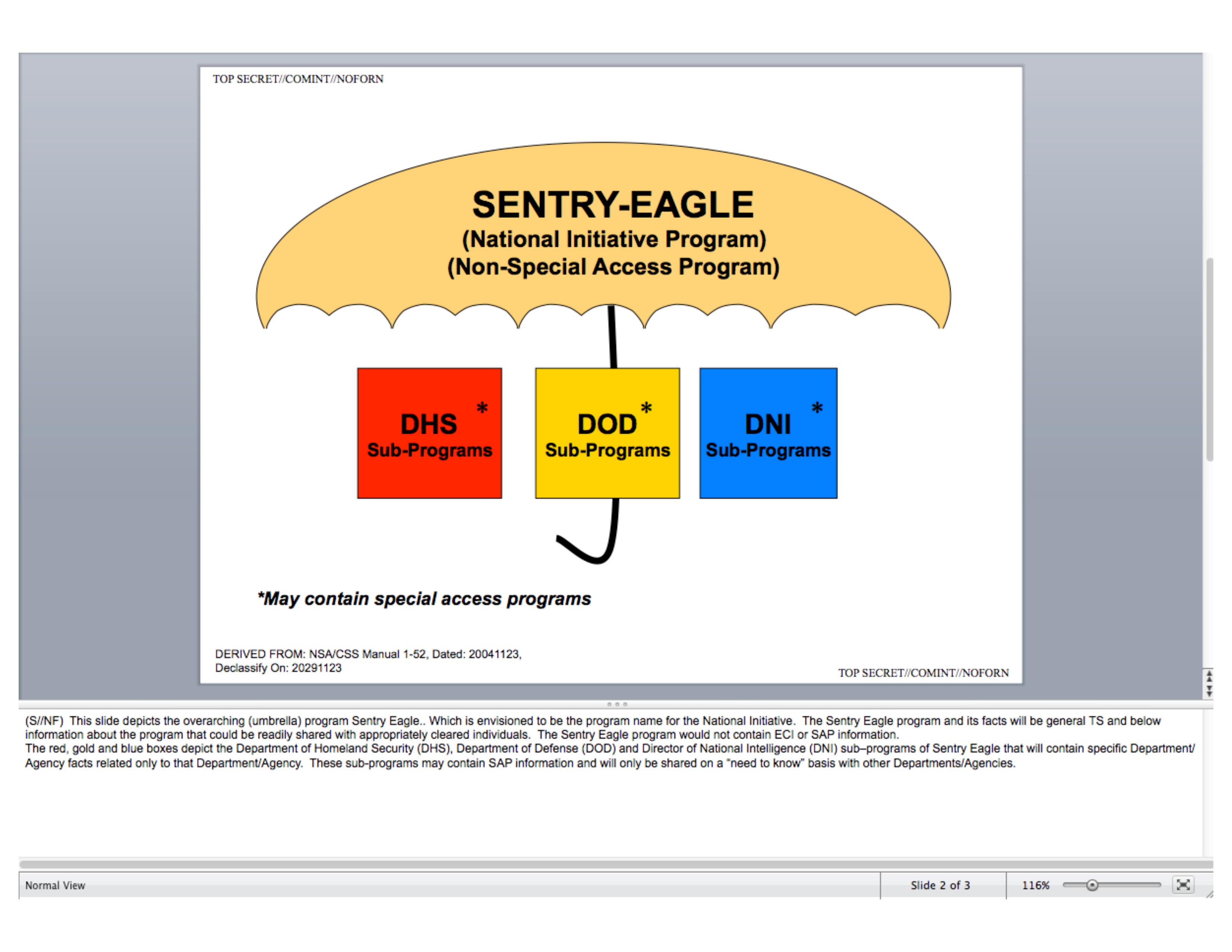
SENTRY-EAGLE
(National Initiative Program)
(Non-Special Access Program)
DHS *
Sub-Programs
DOD *
Sub-Programs
DNI *
Sub-Programs
*May contain special access programs
DERIVED FROM: NSA/CSS Manual 1-52, Dated: 20041123,
Declassify On: 20291123
TOP SECRET//COMINT//NOFORN
(S//NF) This slide depicts the overarching (umbrella) program Sentry Eagle. Which is envisioned to be the program name for the National Initiative. The Sentry Eagle program and its facts will be general TS and below information about the program that could be readily shared with appropriately cleared individuals. The Sentry Eagle program would not contain ECI or SAP information.
The red, gold and blue boxes depict the Department of Homeland Security (DHS), Department of Defense (DOD) and Director of National Intelligence (DNI) sub-programs of Sentry Eagle that will contain specific Department/Agency facts related only to that Department/Agency. These sub-programs may contain SAP information and will only be shared on a "need to know" basis with other Departments/Agencies.
Normal View Slide 2 of 3 116%
TOP SECRET//COMINT//NOFORN
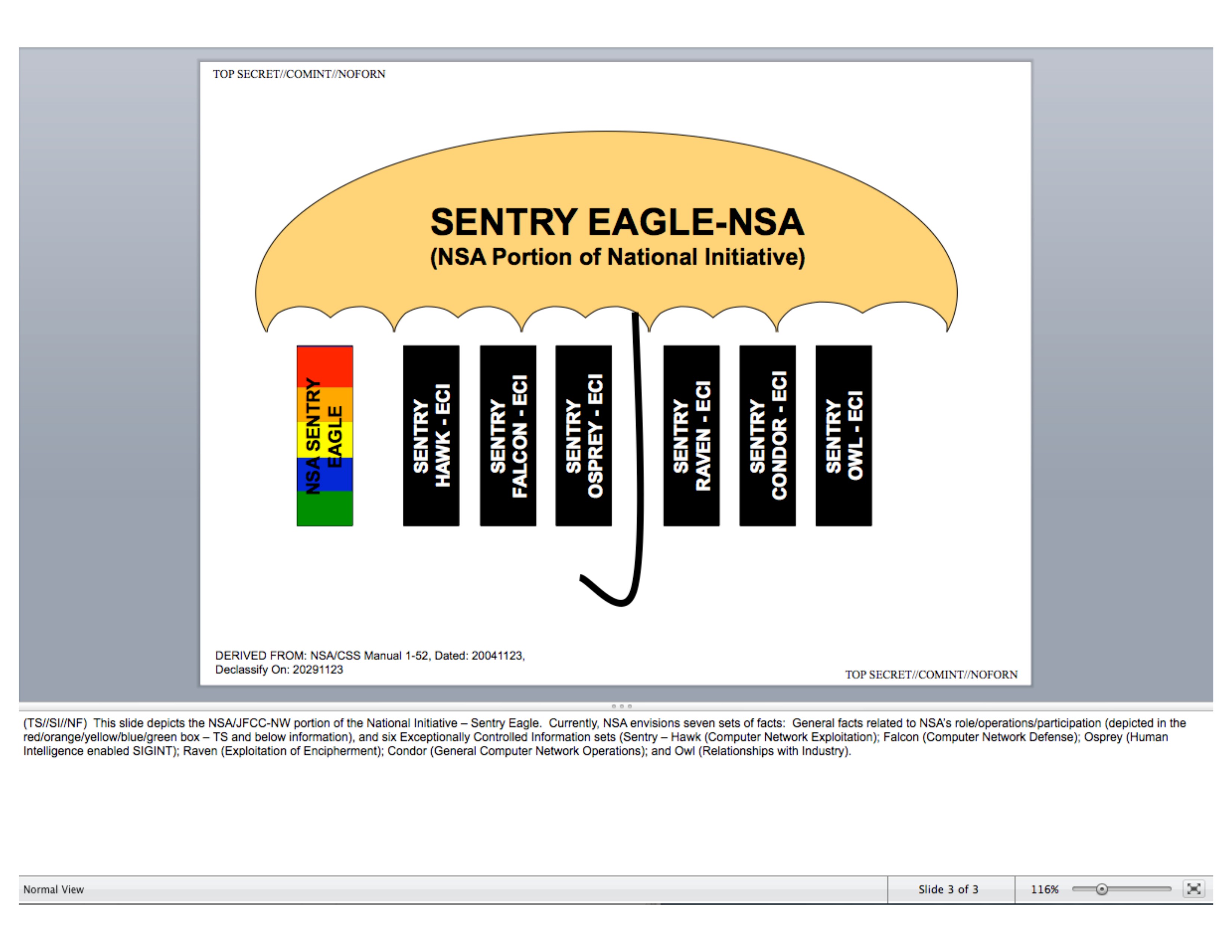
SENTRY EAGLE-NSA
(NSA Portion of National Initiative)
- NSA SENTRY EAGLE
- SENTRY HAWK - ECI
- SENTRY FALCON - ECI
- SENTRY OSPREY - ECI
- SENTRY RAVEN - ECI
- SENTRY CONDOR - ECI
- SENTRY OWL - ECI
DERIVED FROM: NSA/CSS Manual 1-52, Dated: 20041123,
Declassify On: 20291123
TOP SECRET//COMINT//NOFORN
(TS//SI//NF) This slide depicts the NSA/JFCC-NW portion of the National Initiative - Sentry Eagle. Currently, NSA envisions seven sets of facts: General facts related to NSA's role/operations/participation (depicted in the red/orange/yellow/blue/green box - TS and below information), and six Exceptionally Controlled Information sets (Sentry - Hawk (Computer Network Exploitation); Falcon (Computer Network Defense); Osprey (Human Intelligence enabled SIGINT); Raven (Exploitation of Encipherment); Condor (General Computer Network Operations); and Owl (Relationships with Industry).
Normal View Slide 3 of 3 116%
Published in the Same Report
(8 documents)
-
Exceptionally Controlled Information Compartments (January 2013) [pdf]
This document, dated January 2013, provides a list of Exceptionally Controlled Information (ECI) compartments utilized by the NSA and its Five Eyes partners. This document categorizes highly sensitive intelligence programs by their codenames, three-letter trigraphs, and the specific organizations responsible for them. The primary organizations listed include TAO, NCSC, and CES. These compartments represent the highest level of information security, designed to restrict access to sensitive technical data and specific intelligence sources even among individuals with high-level security clearances.
Programs: AMBULANT · APERIODIC · AUNTIE · BLACKANT · BLACKAXE · BLACKBALL · BLACKCLOUD · BLACKHOLE · BLACKJACK · BLACKTIE · BLACKVULTURE · BLACKWIDOW · BOXWOOD · CELESTIALGLOBE · CHIEFDOM · CLICKUMBER · CRIMSONREGENT · CRIMSTONSTEAL · CRUMPET · DECKSTOP · DEVILFISH · DIXIESPRING · DOMINATE · FASTIDIOUS · FIRESCREEN · FIRSTDOWN · FISSURESALUTE · FLYLEAF · FORBIDDEN · FORBORNE · FOXHEAT · FREELUNCH · FROTHYTWOPACK · FURTIVERELIANCE · GOLDENCALF · HELLFIRE · HISTORY · HYSSOP · INVEIGH · KESSELRUN · LIGHTNINGTHIEF · LITTLECROWN · LONGSERPENT · MAGICSTROKE · MERCURYTAO · MUSICBOX · NITEHAWK · OCELLUS · PAINTEDEAGLE · PAWLEYS · PAWNSHOP · PENDLETON · PENDRAGON · PERKYAUTUMN · PHENYLDOUR · PICARESQUE · PICAROON · PIEDMONT · PITCHFORD · PLACEBO · POMPANO · PRESSURETWIN · REDHARVEST · REEFPOINT · REFRACTOR · REVELRY · RIVERROAD · RUBIOUS · SAILWINDS · SCABBARD · SILVERCLOUD · SINKGOAL · STAIRWELL · STARCHART · SUITESWIVEL · TRICKSHOT · WAXOFF · WHIPGENIE -
CLASSIFICATION GUIDE FOR ECI PAWLEYS (PAW) [pdf]
This 2006 NSA classification guide outlines the protocols for ECI PAWLEYS (PAW). PAWLEYS is an Exceptionally Compartmented Information (ECI) category designed to protect clandestine operations—both physical (HUMINT) and digital (CNE)—specifically aimed at acquiring foreign cryptographic information and material. The document confirms that the NSA actively seeks to circumvent encryption through clandestine HUMINT and computer network access aimed at cryptographic information and material, rather than relying solely on traditional codebreaking.
Programs: PAWLEYS -
NSA/CSS EXCEPTIONALLY CONTROLLED INFORMATION (ECI) 2003 [pdf]
This document acts as the definitive "master list" of the NSA’s Exceptionally Controlled Information (ECI) compartments as of September 2003. While standard Top Secret information is shared among those with the appropriate clearance and a "need to know," ECIs are even more restricted—they are "silos" of information where access is granted only by the Director of the NSA (DIRNSA). This list provides a rare architectural view of the NSA's most sensitive secrets, ranging from illegal money laundering stings to the subversion of global encryption standards.
Programs: PAWLEYS · ABEYANT · APERIODIC · AUNTIE · AMBULANT · FIRSTDOWN · BOATMEN · BOXWOOD · BULLET · CHILLY · CLERIC · CONQUERER · KLAMATH · DECKSTOP · DICHOTOMY · DILEMMA · RAMPART-M · DOMINATE · FLEXURE · ENSIGN · STAIRWELL · ESCAPEE · STATEROOM · EVADEYIELD · FORBIDDEN · FORBORNE · GRAYSCALE · HELLFIRE · HISTORY · INVEIGH · INVENT · LYSERGIC · MISCHIEF · RAGTIME · BLARNEY · OPALESCE · TAREX · PENDLETON · PIEDMONT · PITCHFORD · REFRACTOR · RUBIOUS · STEREO · STRESSFUl · TAXONOMY · VISITOR · WASHBURN -
CNO Core Secrets Slide Slices [pdf]
This document outlines the Security Framework for a joint national initiative between the NSA/CSS and JFCC-NW, detailing the highly compartmented structure used to protect cyber and intelligence secrets. It utilizes a concentric security framework diagram to visualize the layers of sensitivity, placing the most critical technical capabilities at the absolute center of the intelligence community's protection.
Programs: SENTRY-EAGLE · SENTRYHAWK · SENTRYFALCON · SENTRYOSPREY · SENTRYRAVEN · SENTRYCONDOR · SENTRYOWL -
Sentry Eagle Brief Sheet [pdf]
A classified NSA/JFCC-NW briefing document formally inducting cleared personnel into Sentry Eagle — the agency's most sensitive umbrella program protecting core secrets about its cyber operations — and enumerating, tier by tier, what the NSA conceals about its covert industry partnerships, encryption sabotage, network hacking, computer network defense, and human intelligence relationships.
Programs: SENTRYEAGLE · SPARECHANGE · WHIPGENIE · AUNTIE · AMBULANT · OPALESCE · REVELRY · REFRACTOR · SENTRYHAWK · SENTRYFALCON · SENTRYOSPREY · SENTRYRAVEN · SENTRYCONDOR · SENTRYOWL · BLUESASH · TAREX -
CLASSIFICATION GUIDE FOR THE NSA/CSS TARGET EXPLOITATION (TAREX) PROGRAM [pdf]
A 2012 NSA/CSS classification guide for the TAREX program — the agency's clandestine human intelligence and close-access signals intelligence unit — establishing what information about TAREX's operations, locations, methodologies, and interagency relationships must be protected, revealing forward-based presences in Germany, South Korea, and Beijing, and confirming that TAREX personnel operate undercover at U.S. embassies worldwide.
Programs: TAREXPeople: Shea, Teresa H. -
ECI WHIPGENIE Classification Guide [pdf]
A 2004 NSA classification guide for ECI WHIPGENIE, covering the agency's Special Source Operations relationships with US corporate partners for cable collection and domestic wire access, including FISA-warranted collection and FBI-assisted compelled and cooperative partnerships.
Programs: WHIPGENIE · FAIRVIEW · STORMBREW · BLARNEY · POWERPLANT · TUMBRIL · WEALTHYCLUSTER · RAGTIME · PLUS · YELLOWSTONE · SSO -
Computer Network Exploitation (CNE) Classification Guide / 2-59 [pdf]
A NSA/TAO classification guide establishing the precise classification level for 41 categories of information about computer network exploitation operations — covering remote and physical subversion methods, CNE tools and techniques, supply chain operations, hardware implants, off-net field operations, zero-day vulnerabilities, and cryptographic material acquired through CNE.
“Core Secrets: NSA Saboteurs in China and Germany” - The Intercept ↗ (2014-10-10) · “The Digital Arms Race: NSA Preps America for Future Battle” - Der Spiegel ↗ (2015-01-17) · Maass, Peter · Poitras, Laura · Appelbaum, Jacob · Gibson, Aaron · Guarnieri, Claudio · Müller-Maguhn, Andy · Rosenbach, Marcel · Ryge, Leif · Schmundt, Hilmar · Sontheimer, Michael
Related Documents
-
Sentry Eagle Brief Sheet [pdf]
A classified NSA/JFCC-NW briefing document formally inducting cleared personnel into Sentry Eagle — the agency's most sensitive umbrella program protecting core secrets about its cyber operations — and enumerating, tier by tier, what the NSA conceals about its covert industry partnerships, encryption sabotage, network hacking, computer network defense, and human intelligence relationships.
Programs: SENTRYEAGLE · SPARECHANGE · WHIPGENIE · AUNTIE · AMBULANT · OPALESCE · REVELRY · REFRACTOR · SENTRYHAWK · SENTRYFALCON · SENTRYOSPREY · SENTRYRAVEN · SENTRYCONDOR · SENTRYOWL · BLUESASH · TAREX -
CNO Core Secrets Slide Slices [pdf]
This document outlines the Security Framework for a joint national initiative between the NSA/CSS and JFCC-NW, detailing the highly compartmented structure used to protect cyber and intelligence secrets. It utilizes a concentric security framework diagram to visualize the layers of sensitivity, placing the most critical technical capabilities at the absolute center of the intelligence community's protection.
Programs: SENTRY-EAGLE · SENTRYHAWK · SENTRYFALCON · SENTRYOSPREY · SENTRYRAVEN · SENTRYCONDOR · SENTRYOWL -
Computer Network Exploitation (CNE) Classification Guide / 2-59 [pdf]
A NSA/TAO classification guide establishing the precise classification level for 41 categories of information about computer network exploitation operations — covering remote and physical subversion methods, CNE tools and techniques, supply chain operations, hardware implants, off-net field operations, zero-day vulnerabilities, and cryptographic material acquired through CNE.
“Core Secrets: NSA Saboteurs in China and Germany” - The Intercept ↗ (2014-10-10) · “The Digital Arms Race: NSA Preps America for Future Battle” - Der Spiegel ↗ (2015-01-17) · Maass, Peter · Poitras, Laura · Appelbaum, Jacob · Gibson, Aaron · Guarnieri, Claudio · Müller-Maguhn, Andy · Rosenbach, Marcel · Ryge, Leif · Schmundt, Hilmar · Sontheimer, Michael -
CLASSIFICATION GUIDE FOR ECI PAWLEYS (PAW) [pdf]
This 2006 NSA classification guide outlines the protocols for ECI PAWLEYS (PAW). PAWLEYS is an Exceptionally Compartmented Information (ECI) category designed to protect clandestine operations—both physical (HUMINT) and digital (CNE)—specifically aimed at acquiring foreign cryptographic information and material. The document confirms that the NSA actively seeks to circumvent encryption through clandestine HUMINT and computer network access aimed at cryptographic information and material, rather than relying solely on traditional codebreaking.
Programs: PAWLEYS -
Tailored Access Operations 2007 [pdf]
This NSA document describes the Tailored Access Operations (TAO) division, which conducts sophisticated cyber operations to penetrate and maintain persistent access to target networks globally through both remote exploits and physical interdiction methods. The presentation outlines TAO's organizational structure, mission capabilities across telecommunications and data networks, development of hardware/software implants for devices ranging from servers to SCADA systems, collaboration with HUMINT partners for physical access operations, and specialized divisions focused on exploiting telephony systems, computer networks, and developing tools for computer network attack and exploitation.